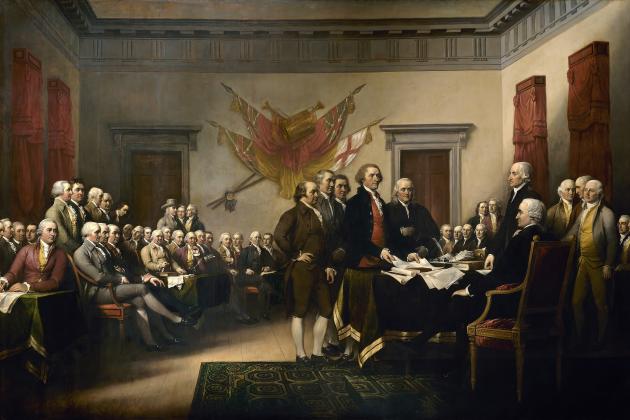
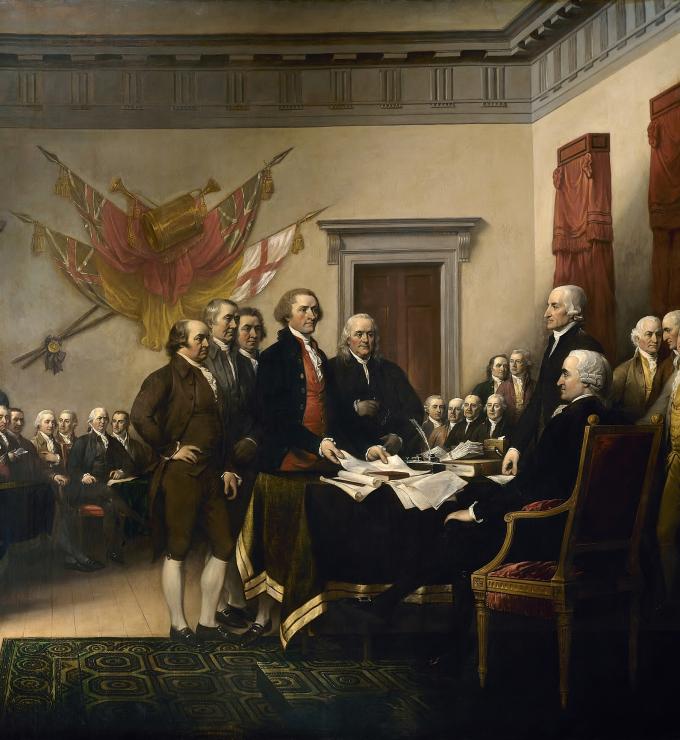
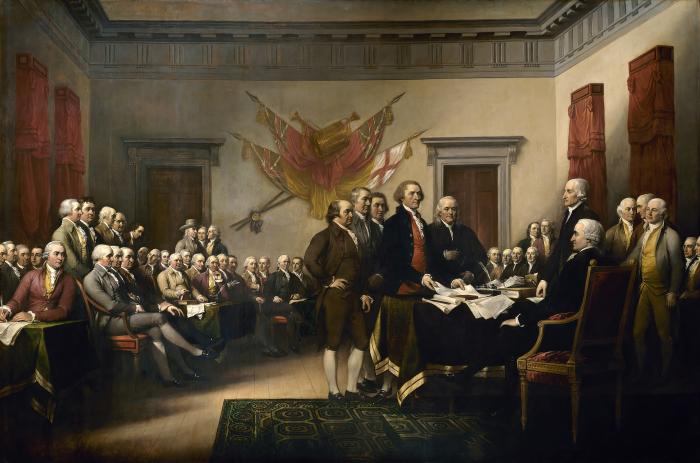

The Hoover Institution Center for Revitalizing American Institutions webinar series features speakers who are developing innovative ideas, conducting groundbreaking research, and taking important actions to improve trust and efficacy in American institutions. Speaker expertise and topics span governmental institutions, civic organizations and practice, and the role of public opinion and culture in shaping our democracy. The webinar series builds awareness about how we can individually and collectively revitalize American institutions to ensure our country’s democracy delivers on its promise.
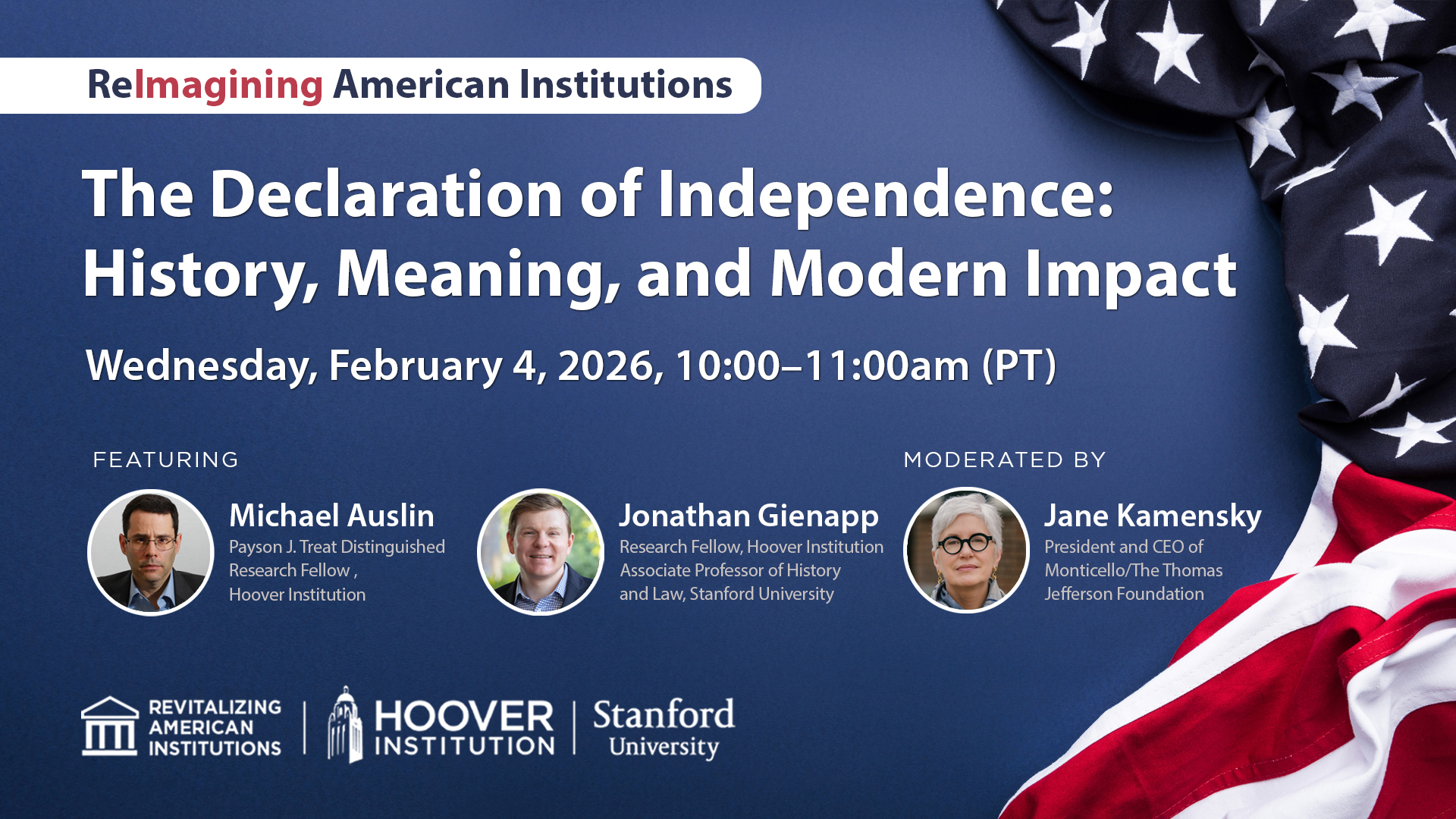
The Center for Revitalizing American Institutions (RAI) held The Declaration of Independence: History, Meaning, and Modern Impact with Michael Auslin, Jonathan Gienapp and Jane Kamensky on February 4, 2026, from 10:00-11:00 a.m. PT.
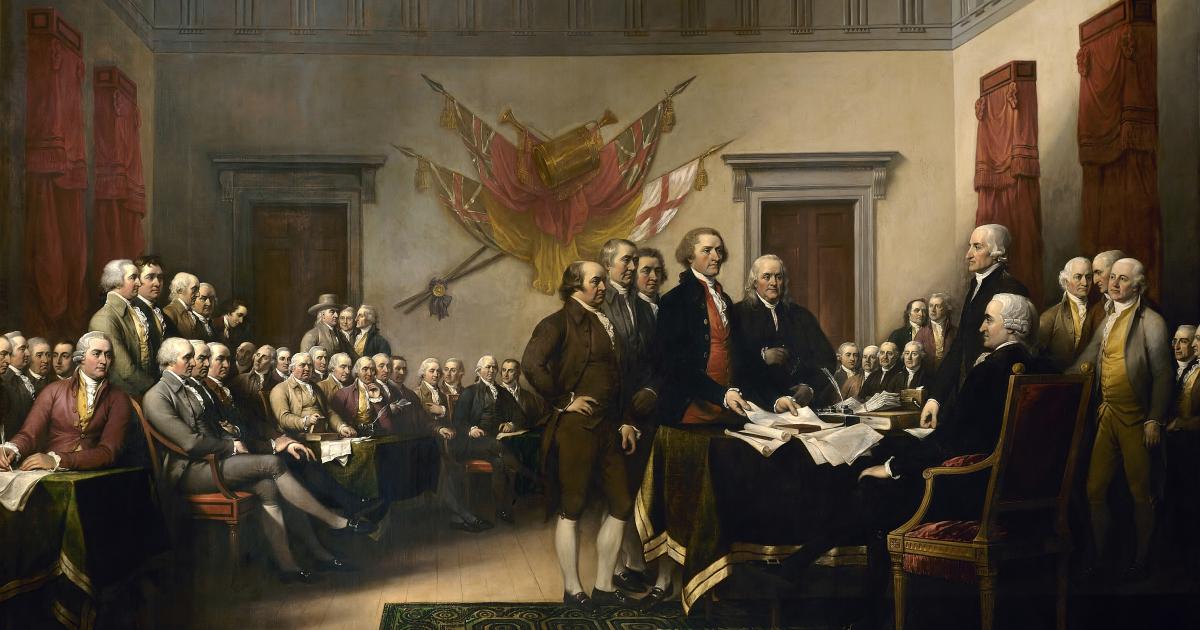
As America observes the 250th anniversary of the Declaration of Independence, the Hoover Institution’s Center for Revitalizing American Institutions (RAI) provided a renewed look at the origins and enduring influence of this defining national document. Expert speakers examined the Declaration’s cultural and physical history, its philosophical foundations and contested meanings, and its evolving role in shaping debates about rights, equality, and self-government. Participants gained insight into how the Declaration continues to inform national identity, animate civic discourse, and guide the ongoing effort to fulfill the promise of America’s democratic ideals.
- Welcome and thank you for joining us for today's webinar hosted by the Hoover Institution Center for Revitalizing American Institutions. My name is Erin Tillman, and I serve as associate Director at the Hoover Institution, and I'm serving as the webinar host for today's session. Before we, we begin, let's review a few housekeeping items. Today's session will consist of a 30 minute discussion followed by 20 minute question and answer period. To submit a question, please use the q and a feature located at the bottom of your zoom screen. While we may not have time to address all questions, we will do our best to respond to as many as possible. A recording of this webinar will be available on the RAI event page of the Hoover website@hoover.org slash a i. Within approximately three to four business days, the Center for Revitalizing American Institutions, also known as RAI was established to study the reasons behind the crisis in trust facing American institutions. Analyze how they're operating in practice and consider policy recommendations to rebuild, trust and increase their effectiveness. RA works with and supports who fellows, as well as FA faculty practitioners, and policy makers from across the country to pursue evidence-based reforms that impact trust and efficacy in a wide range of American institutions. When we say institutions, we mean governing and judicial bodies at the state, federal and local levels, as well as non-governmental civil society organizations such as media, nonprofits, and foundations. We also attempt to understand public opinion and behavior, particularly as it relates to electoral accountability and are making investments in improving civic education in both K through 12 and higher education settings. RAI operates as the Hoover Institution's first ever center and is a testament to one of our founding principles, ideas advancing freedom. Since 1919, the Hoover Institution has sought to improve the human condition by advancing ideas that promote economic opportunity and prosperity while securing and safeguarding peace for America and all mankind. Today's webinar, which is part of the Hoover Institution's year-long efforts to observe the 250th anniversary of the signing and the Declaration of Independence, offers a renewed look at the origins and enduring influence of this defining national document. It gives me great pleasure to introduce today's moderator, Dr. Jane Kaminsky. Jane is the president and CEO of Monticello, the Thomas Jefferson Foundation, and one of the leading historians of early America in the United States, trained at Yale. She spent three decades teaching and leading in higher education most recently at Harvard, where she was the Jonathan Trimble Professor of American History and directed the Schlesinger Library. She's the award-winning author of a revolution in Color and Kenia Royal and the Sexual Revolution, and a widely respected historian whose work has been supported by major national fellowships. Today's topic will examine the declaration's culture and physical history. It's philosophical foundations and a contested meanings, and its evolving role in shaping debates about rights, equality, and self-government. We are honored to have guest speakers, Michael Oslan and Jonathan Gnet. Misha is the Payson Jay Treat, distinguished research fellow at the Hoover Institution, historian by training. He is the author of the forthcoming National Treasure, how the Declaration of Independence Made America and the End of the Asian Century. He's a regular contributor to leading print and broadcast media and was a distinguished visiting fellow at the Library of Congress. John Wcl Center. Jonathan is a research fellow at the Hoover Institution and leading historian of American's constitutional origins with appointments at Stanford's history and law school. He's the author of two acclaimed books and nationally recognized public educator whose work connects the founding era to today's constitutional debates. More complete biographies of our speakers are available on the webinar webpage, and I'll now hand it off to Jane to start today's conversation.
- Thanks so much, Erin, and it's great to be with you all today. I was thinking, as Erin was speaking, I think the two 50th is an exercise in the restoration of trust through honesty and evidence-based learning and the inspiration that we can take, and maybe one of the things we can explore today is what does it mean to have trust in the Declaration of Independence? What, what can we do to spread that? We're thinking a lot at Monticello this year about what a founding means and what it means to be a founder in history and a founder in the present, and how to think about foundational things. So today is in some ways an exercise in Foundationalism because we're looking at, we can talk about whether it's the dome that covers us or the rock on which we stand, this declaration of causes and principles of which, as we like to say here, our guy wrote it, of which Jefferson was the primary author, and I thought maybe we could begin by asking Misha and John and Jonathan how the declaration intersects with your work, right? Of all the gin joints and all the world, how did you come to devote time to studying and teaching the declaration? And, and Misha, since you have the the new book out, first I'll ask you to begin and then pass the baton to Jonathan.
- Well, thank you, Jane, and, and thank you to Hoover for doing this and to obviously to everyone who's going to, who's joining now and is is going to be watching. Yeah, I guess, I guess it's a good question for me. Most people who've watched me on, on Hoover events or other events, you know, know me as an Asianist and someone who's looked at America and Asia for a long time, and I, I guess, you know, everything's personal for, for individuals in, in my case, you know, I spent something on the order of 35 years trying to understand America in the world, trying to understand America abroad, American values, American history, American American priorities, and the like. And I, I guess at a, at a certain point, or at least for me, I wanted to understand America at home, and I wanted to understand a, a my own country better, not looking at how it acts out in the world, but how it acts here at home. Unfortunately, I'm not out in balmy California, I'm in frigid Washington, and I know Jane is, is near me in, in Monticello, in Charlottesville. So I, I began trying to understand a little bit more about the history of Washington as, as, as a site where these different types of American values collided, whether it was the question of how we should act abroad or of course, of course at home. And, and in the course of that, when I was looking at, at the, the National Archives as one of these sites where Americans go and understand their history, you know, as a kid, of course I had seen the Declaration of Independence, but I hadn't done it very recently. And to be honest, you know, I thought I'd go buy a book on it, and there wasn't the type of book that I wanted, which was a general history to tell me what American's own engagement with the Declaration was. Over time, I mean, there are, there are wonderful and important books on, on the declaration's thought and the philosophy and the, the, the drafting of it and who influenced Thomas Jefferson and how Abraham Lincoln reinterpreted it, but sort of history for the rest of us in, in, in terms of what the Declaration is meant to Americans. That's what I didn't find. And that was about two years ago, and I realized the two 50th semi quincentennial was coming up. So I checked around, did a little due diligence, see what else might be out there and, and what might be coming on board, but I decided that was, that was the thing that would help me best understand this country. And, and before I knew it, I was off to the races.
- And we'll come back and talk about the architecture and, and unique contributions of the book. Jonathan, how'd you get into this racket? And I'm obsessed with your row of Bobbleheads behind you on your proper right little Jimmy Madison. There is
- Thomas Jefferson there too, so don't
- I see it? Oh, it's Stan Tall.
- Yes. Very towering over Madison, which is appropriate. So I'm a scholar of the origins of the United States and its institutions and constitutional traditions. So in a straightforward sense, the Declaration of Independence has always been very central to what I need to figure out and what I need to teach and communicate. But part of the reason I've spent so much time with it, because I'm principally a scholar of the other document, the US Constitution, is because of a belief that in the 18th century, these two charters of liberty, if you will, were far more tightly entwined in how people understood their own world and how to think about it than they in some ways have become. And I can get into some of the research I've done that helps elaborate on this, but increasingly over time, those who are interested in thinking about legal authority will focus on the Constitution and those who are interested in something more like political or moral philosophy or the underlying principles or creed of the United States. Something more in the realm of politics and culture will focus on the Declaration of Independence, and we'll see these as perhaps related in some general sense, but distinct genres and distinct ways of thinking about the world. And for a long time, as a student of the Constitution in the 18th century, making sense of it was not possible without recognizing why people did not think in those terms, did not see them as separate genres, but ins fact entwined that you couldn't understand the Constitution without understanding the declaration, and you couldn't understand the full effects of the declaration without understanding the forms of government that people who are part of this founding that you referred to and who took very seriously and consciously the idea of what it meant to found something, what it meant as the declaration announces the right of a people to be a people, what that meant that you could not disentangle these things. And therefore, if you're a scholar of the Constitution in the 18th century, you need to spend a lot of time on the Declaration of Independence and not treat it as something different.
- That's great. And I'll, I'll, I wanna come back to, to tracing how that detachment happened and, and what it means to put it back together again. But let's circle back for a moment to National Treasure. I have a, an advanced reader copy here. It's a, it's a wonderful and lively book. Misha, tell us what you mean by history for the rest of us and what you've done in the book to restore the declaration to its, would you call it a vernacular history to the hands of ordinary people? How do you go about that work?
- It, it was something that, that for me was a learning process as, as I was going through it. And, and as daunting as that is, it also is incredibly fresh and invigorating because it, it was new ground in the sense that I had not thought directly about these issues, but obviously had dealt in, in almost all of my books with American history in one, one form or another. And just to refer quickly back to something Jonathan said, it it, it's true. And when you look at, at the, the, as I like to think of it, the battleship of constitutional studies and you know, we have new enormous volumes coming out, even, even as we speak, you know, rightfully the Constitution is, is that, as I describe it, at least to myself, that battlefield on which we fight out our, our political and, and legal and of course, you know, constitutional to, to use no better term issues, right? And the declaration, you know, is it, it was not designed, it was, it was entirely not designed to be a governing document. You know, that was, that was the farthest thing from their minds. And so in many ways, over the course of our history, whether it was in the, the Civil War era or the progressive era, or, or the Cold War, or whenever it was, you know, it was the, the constitutional questions that engaged the greatest minds where the, the declaration was this revered and yet somewhat sidelined document. Now, it, it didn't always have to be. And, and certainly for people like Abraham Lincoln, it was, as he put it, you know, he never had a thought that didn't derive from the declaration. But in terms of what you might call the operative parts of American history, it's really about the Constitution and not the declaration. So in, in part, I had to, for myself, try to figure out then why did I, as an American care about it, why, to be very frank, did the declaration speak more to me than the Constitution did? Was it because I wasn't a legal scholar or I wasn't interested in, in governing mechanisms? What was it about the spirit of the declaration that struck me as a young child and stayed with me and, and in fact became even stronger in a sense in its absence when I went out into the world to live in Japan and study about Japan and study about Asia, and not really think explicitly or exclusively about the declaration. But what I found is that there was more than one declaration. And, and certainly to me, what was interesting was that there was more than one declaration. So the book talks about three declarations. The first one is the relic, what lies a few miles from me away in the National Archives, this parchment, which is a material history. And, and that's how I sort of stumbled into this, and it's fascinating. You talk to the conservators and the archivists and the wonderful staff at the National Archives in, in Washington, their job is to make sure that in the fifth hun 500th anniversary, this thing will still be around that paper or parchment will still be there. So there's a material history, which is fascinating, how it survived to this day. Why has it not crumbled into dust? And then of course, there's what we've sort of been talking about, the symbolic document, the, the, the ideas, the ethos, the creed, whatever you want to call it, that I think animates Americans self understanding our idea of the country and the people that we want to be. And then as Jonathan was pointing out, intersex, of course, throughout our history with the Declaration, but then I stumbled across, or I started maybe with the third one, and it was one that nobody had written about. And that is the declaration as an indelible part of our culture, our popular culture. We, we magnify it in, in our own minds by having prints and reproductions and paintings and knickknacks and trinkets that make it a, a permanent and in some cases, everyday part of our lives, right next to me. I, I have three different copies of the declaration hanging up on my wall, two different broad sides, and I mean, reprints, obviously of a broadside and, and the famous engrossed copy. And we've been doing that as a people for 200 years. And in some ways, I think that's the most important declaration for many Americans. We as scholars obviously can talk about the philosophical influences, but this physical declaration, not the relic, but the physical object that we buy and we put on our walls and we saw hanging in our school yard, we can buy our school rooms and we can buy little plates of or, or scarves or baseball caps as I have on my bookshelf. There's something intimate and, and enduring about that. And so about a third of the book, all three declarations take up a third, is tracing how that evolved and why it evolved and why, for example, I never saw friends in Britain hang up Magna Carta on their wall or in Japan. Prince Cho Toku seven point Constitution is not printed on t-shirts. But we do that with the declaration. And I think it, it is something critical and important and commercialized in many ways that gets to the heart of how we engage and interpret. And remember this document, not statically in 19, in 1776, but for each of us at different moments, 18, 20 18, 65, 19 20, and 2026.
- Thank you. And, and the book gives me a genealogy for our, our guy wrote it t-shirt, which is, which is selling very well. And, and Jonathan, I wanna ask, do you agree with Misha that it's not a governing document or do we have another way to think about another wonderful word that you used that's a baton pass to Jonathan is to make it operative. So your work is both tracing this rupture that de institutionalizes the declaration, but also thinking about how to make it constitutive again. Tell us about that and and play with some of what Misha has thrown down in the process.
- Absolutely. 'cause whether it's a governing document or not, you can take it in both directions from the perspective of the 18th century. And I that's precisely what I'm trying to understand. So I've embarked on writing a book about, as I, as I dub it, the forgotten history, the lost history of the preamble to the US Constitution. Essentially, why do these opening words that a lot of people know from the Constitution, but no longer have legal effect in constitutional interpretation, why were they once of such significance and how did that go away? And it's, in some ways less about the preamble than about the way of thinking about constitutional more generally, that once made it so vital and how that went away. And the foundation of all of this was thinking about the nature of constitutionalism as rooted in the Declaration of Independence. So in other words, the preamble begins, we, the people of the United States, it announces this legal author of the document and then proceeds to explain some reasons why the Constitution is being established. And in 18th century thinking, when you thought broadly in constitutional terms there were purposes, and then how you executed them. So in some ways, the governing documents like the Constitution are the execution side, but you couldn't have any sense of not just how to execute it, but what was being executed on behalf of whom with what authority and for what purposes, unless you had a sense of that underlying purposes. And for a great many people at the founding, the source of the underlying purposes of the Constitution. What the preamble is, is, is alluding to, in a broad sense, is what the Declaration of Independence did. And here the key question from a constitutional standpoint, and you could also argue a cultural, political and moral standpoint, is it creates this thing called the United States of America. And this people, Americans, what as an actual matter of fact, did it create? So someone like James Wilson, you can see his bobblehead there in the back, a somewhat forgotten framer, but who had a significant, a role in writing the US Constitution as anybody was obsessed with the Declaration of Independence in his time in the 1770s and 1780s. And he was of the belief that the declaration was essentially the United States' of America's first constitution. 'cause what it did as a legal matter was it established that the United States of America was a single nation. It was not a collection of relatively independent states that had only subsequently come together and Confederated to create this thing called the United States of America, plural. It was the United States of America, singular. And we can see very clearly the, the sort of stakes and significance of this at the Constitutional Convention in June of 1787 when they were trying to figure out what kind of a government is going to replace the articles of Confederation, how many powers it's going to have. Luther Martin from Maryland, who is more committed to the idea of what we would call state's rights and protecting the prerogatives and powers of the States says the revolution threw us into a state of nature out which we created individual political communities in our states. The, and we created Peoples of the United States, the people of Virginia, the people of Maryland, the people of Massachusetts. And only later did we create this thing called the United States. And James Wilson very dramatically pulls out his copy of the Declaration of Independence, reads from it to Luther Martin and says, you were wrong. The states did not come before the union. The union came before the States see, the Declaration of Independence says one people, it says, we did this together, we did not do this separately, we did it together. We created this single thing. And for those like Wilson who thought the national government needed more power and as a legal right had more power, the basis of that argument very much turned on this reading of the Declaration of Independence and what had had created. And James Wilson is the original author of the preamble to the US Constitution, his nationalist ally and friend, governor Morris completes the preamble later in the convention. And in their eyes, the preamble is announcing, referring back to this fact about what the Declaration of Independence did. Certainly not everybody agreed, but they had, everybody had this debate running right up to the eve of the Civil War where that Luther Martin v Abraham Lincoln fight is reformulated in 1861 with Jefferson Davis saying, the reason we have a right to secede is because the states came first and therefore reserved to themselves certain powers and prerogatives. And Abraham Lincoln's case, whole case of course, is that is wrong. The union came first, or at least was born at the same time. And like James Wilson uses the Declaration of Independence to anchor that idea. So this is a way of thinking that assumes we have a framework of government what the Constitution of the United States lays out, but you can't read that or interpret it or understand it unless you understand the prior constitution, the constitution of the United States, of America, of its people are there, is there one people that makes up the United States or is it several different peoples? And that was how they did constitutional interpretation. So as a result, you couldn't disaggregate these things. The story then of how it got became disaggregated, such that you would never make these arguments in, in, in a modern legal space is, is of, of similar fascination to me. 'cause that is not our history. Our history was seeing these things as entwined
- And that that one people is strengthened in the editing, right? It's, it's a people in Jefferson's original draft, we don't know whether it's he or Franklin who makes the edit to say one people, but underscoring that unionist perspective. And it's a powerful time to think about union. We'll, we'll close in a little while with talking about wishes for our federal union at the two 50th, but I wanna move now into the classroom or into the symbolic classrooms. We're all educators. How, how are we seeing the uses of the declaration in educational spaces ranging from think tanks and op-ed pages to classrooms at Stanford to historic sites? And Misha, how do you, how do you think about the educational work that you've, that you've done on the declaration? How, how do you, if you could dream a classroom use for it, what would it be? And then I wanna hear what Jonathan is is doing in the classroom at Stanford around it.
- Well, I have to say, I, I'm, I'm actually quite impressed though. I don't really know if I can assess it, but I'm very impressed with the, the plethora of civic education groups and organizations that are out there that I at least don't remember when I was in school. And I don't, I may not have paid attention and I don't remember when I was, when I was teaching at Yale, although again, I was teaching something different. But you know, there are, there are lots of different groups. There's the Jack Miller Center, which I think both Jonathan and I are connected with. I don't know Jane, if you have been, there's the Martin Center for Academic Renewal. There, there is a network of sort of humanist civic organizations that, that shadow the, the Ivy League and, and shadow Stanford as well that, that are set up like the Zephyr Institute and Abigail Adams Institute and, and the like. And then of course you have this, I guess probably the latest iteration are these explicit new schools. And I get departments maybe, but more of them seem to be schools that are set up, places like Hamilton at Florida, cyl at Arizona State, CITAs at at Texas and, and the like. So it, it seems there's this effusion of, of attempts to bring, to bring civics back into explicitly the, the classroom. And, and I think it goes down, you know, into the, the high school levels as well. I think, you know, the, the Jack Miller Center does things with high schools. There's Constituting America, which was founded by Janine Turner, they focus on, on school children as well. But again, as a story, then I have to look at it and say, well, why are all these things there? And they're probably there because people felt there was a need, the need being a lack of focus. I don't know. Because again, it wasn't something that I did professionally. All I can tell you is that when I was a, a youngin back in the seventies and remembering, well the, the bicentennial in Illinois, you couldn't, you couldn't go on to high school unless you passed both an Illinois and a US constitutional test. One, one in seventh and one in eighth grades, which Jonathan, by the way, is of course where we all memorize the preamble thanks to Schoolhouse Rock and which we all, now, everyone's got it in their heads, right? You'll, you won't hear the rest of what we're saying, you'll just be singing along. So, but my son did not have to do that in Maryland in the 2010s. So something changed. I happened to be going through some, some family documents a few months ago and came across my grandmother's, she was born in 1910, my grandmother's high school, not just the diploma, but her grade card, they used to have a, you'd have like a booklet with all of your grades through all of your four years and every single year there was civics that, that she had to take explicit civics classes. So something certainly seemed to change. So I don't know how, how well all of these, these different new initiatives and organizations are doing. I certainly wish them the best. But if they are sort of extracurricular, so to speak, or many of them are extracurricular, then I guess the question is what's actually happening in, in the midst of the classroom. And it's no surprise, obviously that history, like many other things, is among the most American history, among the most contested of our national questions. And we went through a, a rather large brouhaha only a few years ago with the 1619 project and responses to the 1619 project that raised, I think, significant questions about whether we are telling any type of coherent civic story. So I don't have an answer for you, Jane, other than at the two 50th. What it does feel to me is that there's an enormous amount of activity, but I I, I don't know if we even have a way to really assess, we don't have national standards testing anymore, really. I mean, it's SAT maybe, but you know, that would say, okay, how much do seventh graders and 12th graders or 11th graders know about the Constitution, but even, or the declaration and the revolution and everything else. But even to do that, you would have to have some sense of agreement on what the questions are that you're testing. And I don't, I don't know if we have that. I I can only say that I feel a lot of this, I, I feel a great, I feel like I have great skin in the game now having written this book, but I also still feel like an outsider to it. And perhaps that makes me much more sensitive to things that other others may look at and say, don't worry, or that's okay. But I, I think that we have a lot that people can take advantage of how much it's really making a difference and how much Americans feel we have a shared understanding of our past as well as quite frankly. And I do think it's important, patriotism, love of country, a feeling that this country for all of its faults and weaknesses and failures is important. And as Lincoln said, perhaps the last best hope that I don't know how we assess,
- So I'm gonna underline some of that and form it into a, a sort of proposition for, for Jonathan to, to take up or rebut. I think what Misha is describing, and, and you see some of it play out in the book is at least the half century and maybe 70 years of anti foundationalism in the academy come home to roost, right? And you could point to 68 as a kind of peak anti foundationalism moment, but it really goes back to the immediate wake of World War ii. And so these, these various centers and and civic organizations are trying to think about what it would mean to have shared foundations that are not relics, right? Like how, how can we have vital and, and living foundations? I tried very hard to do that in my elite college classroom before I left Harvard. We can talk about the ways that it went well and didn't go well. A place like Monticello has been foundational like that from the beginning because we are standing on the living ground. And I think that kind of foundational thinking is, is is sort of natural to a place like this. Let me ask Jonathan, first of all, you're far more of an intellectual historian than I am. Do, do you, do you accept that sort of broad brush sense of American history in the last 50 to 75 years? And then how, how has your classroom tackling these questions of foundationalism with the declaration for somebody who was trained in an anti foundational moment?
- Yeah, I think I'd broadly agree with that though. I would also, there are ways to connect that back to the very tradition and dynamism that the declaration on unleashes, which makes it so alive and important and is among the things I really try to emphasize when I teach it, which is this is not a, a single kind of text, nor is it an inert one that to understand its power in both the 18th century and beyond is to understand why neither of those propositions can be true. So if you're just trying to understand what it's doing in 1776, you're struck by the fact that it's at least trafficking what seems like three different genres if you actually take the time to read through the declaration of dependence. One is about the, this idea of the powers of the earth. That there are other things called nations out there, other political communities that rightfully call themselves peoples. And this is an open brief to them. You know, it's not, it's not just a, something written for Americans, it's something written to the rest of the world to take part in the world to be part of the world. It then offers as is certainly its most famous part by this point, this sort of ringing pronouncement of the nature of human rights in equality. But then of course the vast majority of it, which sometimes gets excised, but is quite central in the 18th century context. It is a detailed legal brief against the King of Great Britain for doing the precise sort of things that allow you in under extraordinary circumstances to dissolve the political bans that have held you together. So you, you know, you've already got a challenge with, with all people and certain students. Well how do these three elements fit together? Are they splitting off in slightly different directions? How do they ebb and flow over time? There's then also a, an interesting, this gets back to what I said about James Wilson in the preamble. What kind of notion of equality is at the heart of the declaration? Is it collective equality that Americans are saying we have a right, an equal right to all those other people around the world to be a people and to set up our own country and government? Or is it a statement of individual equality that each person is born free and equal and therefore certain things inherit in that? Well, there's a kind of instability here, which is the point that the minute the declaration is unleashed on the world, it belongs to nobody. So there's a kind of anti foundationalism foundationalism there that anybody and everybody can grab hold of it and, and, and claim that those words mean something. And we see this right away in the founding era. So this is part of what I always try to emphasize to my students. Elizabeth Freeman is an enslaved woman in Massachusetts who uses the parts of the Massachusetts Constitution in the preamble of the Massachusetts Constitution that are essentially copying and pasting the Declaration of Independence to say, based on this pronouncement that all men are born free and equal. My condition of enslavement is therefore in violation of the laws of America. And she wins her freedom suit is able to undermine slavery and end her condition of enslavement based on this kind of claim. It's the first of millions that the Declaration of Independence means something that no one else can say. It didn't mean who was perhaps in the leadership class who was trying to keep it more contained. It has this its own power to always let the water spill over the banks. So it becomes very challenging then. I mean if, especially if you trace the history of sort of antebellum abolitionists using the Declaration of Independence to, in the eyes of a many people at the time do very radical things that undermine the foundations of America. How do we square, how do we reconcile in our minds the use of sort of foundational principles to call into question in some respect those foundational principles? That activity in and of itself is kind of what makes up the history of the declaration. And I really try to emphasize that with the students. You know, the declaration is, is is as living a document as we have because what gives it its urgency is that each generation reinvents it and ascribes new meaning to it and has, and nobody can tell any particular group of people that they can't do that. 'cause its power is precisely in the notion that it speaks for a kind of universal claim. So you both need to reflect on are there, are there ways in which you, you, in, in trying to live up to the foundations so sap them and so, so undercut them that it makes it impossible for one people to coexist without also flying in the other direction. That misses the very energy that made the declaration possible, which is sort of a tradition of dissent and, and, and demanding that pronouncements be realized. You know, that Steven Douglass and Alexander Stevens and other anti Americans who claimed, sure it says, you know, all men are created equal, but we know what that means. It doesn't really mean that that there, the declaration has a power that other people could say no, I think it means that Frederick Douglass could say it means that, and there are different ways to understand the sort of fissures and anxieties of the last 75 years as either being at odds with those foundations or acting them out. And I don't have easy answers to know how to reconcile that, but I do think that's a huge part of the history that I try to, you know, impress upon my students.
- And it, it, you almost suggests you, you've written so powerfully about the intellectual history of originalism and against the intellectual claims of originalism. And I think part of what you're suggesting is why the declaration has resisted that kind of originalist argument and, and thinking that that vitality. So I wanna, I wanna close us out by asking for some hopes and dreams for the two of you, for the two 50th broadly, but especially with respect to the declaration. Can the declaration be a kind of moral anchor for America's future? And what would it, what would it take to make it so in practice, are there wishes that you have for the two 50th that's connected to that work? And then we have a lot of questions in the, in the chat to get to.
- Yeah, I would, I would say briefly that the, the probably for myself, for me, the biggest takeaway writing the book was a, a greater appreciation for we've been there and made it through. And that may be, you know, that may be a, an initial reaction from having just dealt with this tsunami of, of, of, of, of history and data and, and and the like that I was going through. But you know, the idea that we're at the end, everything's falling apart, it's all about to be, you know, swept away into the dust bin of history. Obviously they, they undoubtedly felt that in 18 60, 18 61, they may have felt it in 1929, but you know, you can go back. I they, you know, some of them felt it in in 1787 as they're looking at this, this potential monstrosity called the Constitution that was going to come and centralize everything and take away all the freedoms of 76. So in part, my feeling is we all, I hope should, should understand that you, yes, nothing stays the same, but nothing ever changes permanently in the sense that we've made it through these things and we will make it, we will make it through other things. You know, Aaron started off by describing RAI, our, our revitalizing American Institution Center as created in part to address the crisis of trust in American institutions. Well, you can't think of a possibly worse time to celebrate the declaration than 1976, right? Coming on the heels of Watergate, Vietnam, assassinations, riots, everything. And yet, and I have a whole
- Chapter I heard 1876 wasn't too great either,
- And 1876 was, it wasn't nearly as bad, but it wasn't too great. And, you know, and right, and, and that's, that's 10 years after the, the greatest crisis in our history. But 76 19, that is, I remember, and I was there and by the tens of millions we did celebrate. And, and you know, so I, and I have a whole chapter on that. But my my point is that we, and this is a little bit I think to what Jonathan was saying about the, the descent tradition. We're constantly have a crisis of our institutions. And that's part of what has made us, in my view, you know, the, the first most durable self-correcting, self-governing republic in history. We, we do slowly, painfully, sometimes bloodily never perfectly as, as Lincoln said, always looking beyond to that next horizon. But we do, we do fix our, our problems. And so my hopes for the two 50th is that there is a, a desire to recommit. And and that's what, by the way, president Truman called for in 1951, the hundred 75th. It's what President Ford called for in 1976, a recommitment to the principles of the declaration. And I guess if you have to keep calling for a recommitment, maybe it means people aren't committed to them. But you know, there is, at one level, I think we do face a, there is a fundamental binary one zero in out question. Do you believe in the United States it's inherent goodness, it's inherent ability to better itself and it's future? Or do you not, do you want to truly radically change the system into something different? Or do you want to make a more perfect union? And I hope it's taught in, in the way that makes the young people. And somebody told me that Gordon Wood recently said this, I didn't see it. So if you guys know where it is, please point me to it that the most important part of the, the bicentennial and I speak from my own experience, is that it inspired the younger generation with this fascination and interest and quite frankly, love for American history even after the, the terrible period that America was coming through. That's what I hope we do again, with students that are more distracted and less, less unified in many ways and with many different backgrounds than it was in 1976. Because if we don't, then that question of how a self-governing people keeps together because they want to keep together, I think will become a much more fraught question.
- Jonathan, how about you Hope Streams and the declaration?
- Sure.
- It's not self-correcting. We all have to do the work.
- So picking up on something Nisha said, 'cause I've certainly felt it and others have said it, how striking that we're living through a time of what feels like great crisis and consternation and anxiety whilst trying to celebrate the 250th. But perhaps that's the perfect time to be thinking about these things because of course that the moment itself in 1776 was one of extraordinary crisis in which choices were being made of profound significance and people were thinking through as deeply as they could what it meant for all of this to work not just to say nice things, but to build something that was better and durable. So my hope would be that this would be occasion if people are feeling anxiety and a sense of that, that that things are unwell and must get better, that they will try to take seriously what the Declaration of Independence was doing and saying perhaps not as they have in the past when it is accompanies, when it accompanied 4th of July barbecues. And so sort of drained of the, the context that animated it, but with a real sense of the context that animated it. And toward that end, to connect this back to a number of the things I've been saying and what I emphasize when I describe my book to understand what the declaration is doing and was trying to accomplish and what was understood to follow from it, my hope would be that we could get back to something of the more integrated way of understanding our constitutional and civic lives that was taken as foundational and commonsensical in the late 18th century and through much of the ninth century that we have lost. So for instance, a lot of people will ask, is our constitution broken? Is it working? Well, one way to answer that question is to go back to the things that were deemed foundational in the 18th century, which is a constitution of government cannot work unless you have, unless you're cons. The constitution of your people in society is strong and healthy. These things are not disconnected. For instance, a well-informed citizenry that is, is just a prerequisite of constitutional institutions working. So if constitutional institutions aren't working, is that because a particular feature of the Constitution wasn't well written and we can't amend it? Or is it actually something completely outside of that, that it's because there's been a basic breakdown in how we take our own civic responsibilities, what we know, what people know, how we relate to one another, what we now see of as culture over here and legal obligations over here. We're all entwined constitutions were understood in this broad sense that linked the declaration to the Constitution. If the, if the civic community was not healthy, if people were ignorant, if there were, you know, sort of wild disparities in wealth. This is something they talked about constantly that, you know, Europe could never be free because so much of the wealth was in the hands of so, so, so few people that you needed a sort of foundation upon which these things would work. That we need to think maybe more caly about how civic health works and recognize why the Declaration of Independence is in conversation with all of these other things in ways that perhaps we don't realize. And maybe we'll take that seriously.
- That is a wonderful place to conclude. I I just wanna note how active the verbs are with which you and Misha are both talking about the anniversary and the declaration, right? Jonathan, earlier you opposed this vital declaration to something inert. I think Misha, you used that too. And as we talk about the two 50th, you're talking about commitment, revitalization in RA's, aim Health, Misha Used Love, we're talking about a sort of renewal of vows moment here on, on Jefferson's mountaintop. So the chance to leverage the university, university the anniversary to, to activate our connections as one people in a way that we have maybe let lapse to our peril. So I want to, I wanna turn to some audience questions now. There was a question early on, and I'll throw this to Misha to set the scene in the graph house in Philadelphia on seventh and, and market now seventh and High Street where Jefferson is, is drafting away. Do you wanna give us a little creation story there?
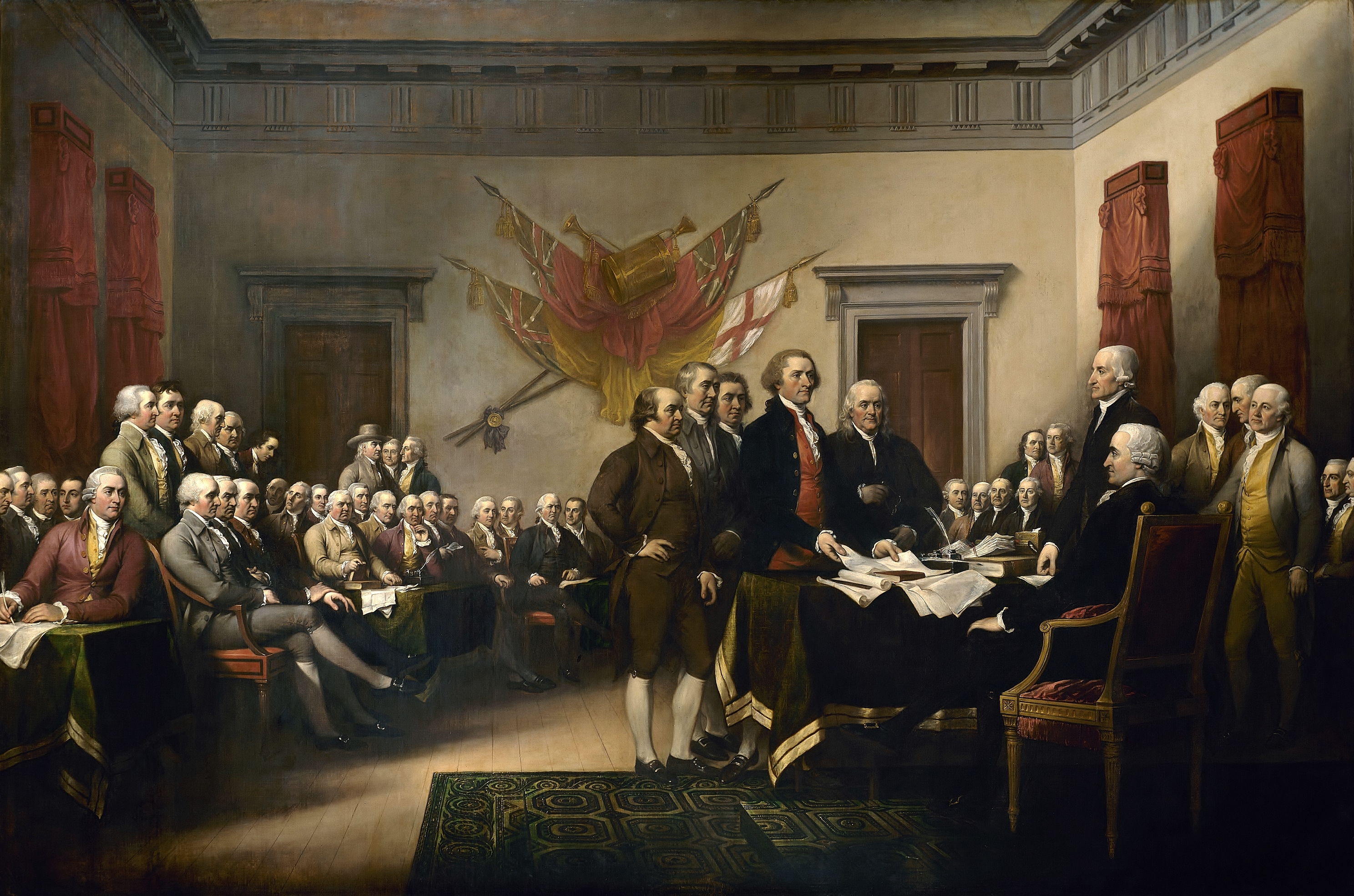
- Yeah, briefly. And, and unfortunately as, as much as I love the, the romance, 'cause I, I think that's important and I think it myth building is important and myth sharing is important. It sounds like it was a pretty quick and dirty job. You know, we have these wonderful, and IIII wasn't able to reproduce it in the book, but I did, I I only in, you know, certain number of illustrations, but I did describe it. There was a, a mid-century wonderful heroic painting of, of Thomas Jefferson standing by candlelight above a table with crumpled papers as he's, you know, solemnly looking at his draft. I think it was done by the artist Howard Pyle, if I have the name right, I have to go back and look. And you know, Jefferson was on multiple committees at the time. He wrote quickly, he got it done in just a couple of days as, as he later recalled. And so he's in the graph house. What's interesting when you go to the graph house today, of course it's, you know, it's like closed. It's, it's, well, yes, unfortunately it is closed, although I've been told that, that they are working to reopen it. I don't know to what degree. And anyway, but that's where the city ended back in the day. And he chose the graph house. It was a two story house. Ja Jacob Graff was a bricklayer because beyond it were the fields. And so it was a little quieter from a few blocks away where the State House was. And you had cobblestones and you had carts going back and forth and horse stables and the like. And so he's up on the second floor. He has, he has two rooms and, and he has his enslaved servant with him. And he is working on this draft very, very quickly to get it to the committee. It's a break, it's a three week break that Congress takes in order to secure the votes for independence, which that vote of course comes on July 2nd. But the, the question is not whether independence will pass most by that point, most people believed it would, it was whether it would be unanimous and whether that would send its own statement of the type of unity that we are talking about. So Jefferson quickly, quickly drafts this thing. There's a committee of five, it's himself and John Adams, Benjamin Franklin, Robert Livingston and Roger Sherman of Connecticut. It appears the, the last two weren't very involved, but we have many stories of course about, as you pointed out earlier, Jane, both Adams, but Franklin in particular editing a little bit of this. And then though the fascinating thing to me is this, these personal memories and Jefferson later in life says, oh, they did almost nothing. They had a few verbal verbal changes and then I rewrote it and sent it to Congress. But then we've uncovered other letters that show that there was, there was more engagement both by the committee and of course we know by Congress. So Pauline Mayer, when she writes her book American Scripture in 1997, she's talking about this as a, as a communal effort. It's a communal effort, not only of Jefferson, the committee in Congress, but of all these different groups in America that are coming up with their own declarations. And Jefferson acknowledges this. He says, this was intended to represent the mind of America, the American mind, not to say anything new that had never been said before. So Graph House is a wonderful place. Thoughtlessly torn down in 1883, only a few lentils and doorknobs remain rebuilt for the bicentennial, hopefully will be reopened for the two 50th. But it, it is a spot where this concentration of of passion, hope, idealism, realism, as Bernard Bailin called it, the pri, the pragmatic idealism of the American Revolution, all came in those rare of extraordinary focus. So that 250 years later, we are talking about the product of what was drafted on a piece of paper in those rooms.
- Thanks. And I'll, I'll add, you know, on the Reliquary side graph house reconstructed in 1976 as a, as a kind of room where it happened artifact, and then for any of you who was in Philadelphia last fall, there was an extraordinary public art projection project called Descendants of Monticello, thinking about what Robert Hemmings saw in that, in that second floor where we think Jefferson was writing. And in the Garrett space where, where Hemmings probably lived by the artist Sonya Clark. So I would encourage people to look that up as a way of making declaration house foundational but not originalist. Right. Not, not inert and, and vital. Jonathan, a question for you. The debate over states as laboratories of democracy and states' rights of course continues to this day. And the questioner would like you to contextualize the role and evolution of the articles of Confederation in its relationship both to the declaration and and to what comes after.
- Yeah, so in some ways the debate I laid out between what is the United States of America, who are we as a people has never ceased and continues to animate, you know, important and vibrant discussion and debate. So the United States did not need to have a federal system, though it was pretty much the only game in town in the 18th century by federal system be there would be a central government and state governments there would be sort of shared authority between center and periphery and, you know, between, between what was, what was in the middle and what were the localities. And this always created, you know, from the beginning sort of the central question, which powers are allotted to which, and if the national government has a certain duty or obligation to see to truly national problems, what constitutes the national problem and how does that change over time? Does it change over time through technological change? Which is one of the big arguments of the post-Civil war years of, you know, we used to have a horse and buggy economy and now we have a national economy and therefore what falls under federal supervision ought to grow significantly with that. But the, you know, the underlying, deeper problem that had animated James Wilson and his opponents, when James Wilson is making these arguments under the articles of Confederation in the 1780s, we are Americans, you know, I'm not here representing Pennsylvania, I'm here representing the United States of America. He is met by others who say, no, that is not true. Including Thomas of North Carolina, who's kind of these great antagonist at the time who says, I'm here representing North Carolina. This is essentially the European Union. He obviously doesn't say that, but that's one way to think about it. And I'm here to protect like a diplomat, the, the prerogatives of my home country and this sense of what we are as Americans and what loyalty we have to, or sense of identity we have to our states as opposed to the nation. And how we reconcile those continues to course through our life. And then leads to these sort of practical questions of, you know, the Laboratories of Liberty claim that Brandeis and others sort of mentioned in the 20th century. That the, you know, the states don't just have a kind of moral authority over our souls, but also have a, a great capacity to better understand particular kinds of communities and how to relate to them and can be the testing ground for certain ideas, but that can run up against the need of the national government in the eyes of some to see two problems that are truly national. And in many ways you can see that as very productive friction. Right? And I think one of the great advantages is the state's right tradition has shifted over time depending upon the priorities of the nation and who's in power. I mean, it is often thought as though the people who are the great defenders of states' rights leading up to the Civil War are those who are the southern states who end up supporting the Confederacy. That is to a certain extent true. On the other side, you have a lot of northern states defending in particular their state's, right, to create citizens, in this case the right to, to establish free blacks as citizens of say the state of Massachusetts that therefore must be respected by the other states. So the other states can't treat them unequally when they arrive in their state or can't prevent them from freely migrating to their state. And we've seen more in more recent times of course, and, and you know, just the last couple years a lot of blue states that might in a previous iteration have been more nationalist in their orientation, defend the prerogatives of states to resist the federal government's efforts to regulate them. So in a lot of ways this debate never goes away. And that's an important part of the legacy of the declaration. It says one people in free and independent states in the plural. And in some ways the whole history of America is trying to understand how those two things fit together and when push comes to shove what it means in practice.
- That's great. So quick hits at a last question. I know Aaron wants to take us out. So there are a couple of questions about information literacy, information technology with respect to the declaration, which I'll try to mush into one on the long ago and far away. And we have kids that can't read cursive anymore. How do we engage them with the vitality of this document on the other, we've got the internet and, and deep fakes and a new technology of misinformation pulling us away from the sense of the real, real that, that Misha has recovered in the declaration. Quick thoughts about our desire to create an educated citizenry in these rapidly shifting information technology moments.
- Well, just very briefly, and, and it's, it's really, it's actually where I end my, my historical narrative is with the digitization of the declaration in the 21st century, which I see as the, the culmination of a process that began back in the early 19th century to bring, don't forget back in the early ninth century, no Americans had actually seen the engrossed declaration unless you were part of a favored few who could go to the Secretary of State and say, show it to me. So starting in the 18, late 18 teens, we start getting all of these reproductions and so people can now read it, not just read it, you know, in a, in a, in a type set, but read it and, and sort of reengage with what it must have looked like and look at those signatures and think about the people behind the signatures. And very quickly after that we get this whole cottage industry of biographies, of signers. So I end the, which continues to this day, so I actually end the historical narrative with this moment starting in the early 21st century of digitization. And, and so the answer I think in part Jane to your question is that first, you know, reliable sites like let's say the National Archives or the Library of Congress and those should be used as resources because what they've done is they have unlocked the hidden histories of the declaration, I'm sure of the Constitution and Bill of Rights and, and Emancipation Proclamation as well. But put it all online so that you can now see the original tally sheets, you can see the original handwritten resolutions. You can get that sense of excitement of, of looking not just at a at, at something that's printed, but what was really written and given to Charles Thompson at that desk in the State House in 1776 and then go from that into these histories that have been put online that that our oral histories and our administrative histories and all the things around the declaration that allow you to understand how Americans began to revere it and decided that it's more important than just being a piece of paper. It must be protected for all of us as as our common inheritance. So that's, you know, we actually have that opportunity. There's all the noise out there and there's all the stuff, but you do have to be a discerning consumer and you can be pretty sure that if it's a NARA site or it's an LOC site or it's state historical societies, they're gonna give you the right things that teachers and parents need to kindle that enthusiasm for students to say, look, this is what they actually wrote with their own hands and touched.
- Thank you so much. And Aaron, with that, I will thank Misha and Jonathan, turn it back over to you.
- Great. Thank you, Jane. Thank you Misha. Jonathan, thank you to our audience for your participation and great questions. If you're interested in diving more deeply into the concepts discussed today, feel free to pre-order National Treasure, how the Declaration of Independence Made America, and Mark your calendars. RAI together with the Hoover History Lab will be hosting a book talk on campus on May 26th from Misha's book. More information to come. We also invite you to join monticello's Online Declaration Book Club. The next webinar on March 4th will be on judicial importance and dependence and legitimacy and polarized times featuring Michael McConnell, Tom Clark, Genevieve Laier, and moderated by Eugene Bullock. Incur. Please visit our series webpage and sign up for our next session. You can access recordings of previous webinars and subscribe to the RAI newsletter to receive updates on upcoming events. Have a wonderful rest of your day, and thank you again for joining.
ABOUT THE SPEAKERS
Michael Auslin is the Payson J. Treat Distinguished Research Fellow at the Hoover Institution. A historian by training, Auslin is the author of the forthcoming National Treasure: How the Declaration of Independence Made America and The End of the Asian Century. He is a regular contributor to leading print and broadcast media and was a Distinguished Visiting Fellow at the Library of Congress’s John W. Kluge Center.

Jonathan Gienapp is a research fellow at the Hoover Institution and a leading historian of the United States and its constitutional origins, with dual appointments in Stanford’s History Department and Law School. He is the author of two acclaimed books on American constitutional history and interpretation, and his scholarship on the Declaration and the nation’s founding informs lectures and public programs nationwide. A dedicated educator and award-winning teacher, he also works closely with institutions such as the National Constitution Center and the Brennan Center’s Historians Council to deepen public and legal understanding of constitutional issues. His public-facing writing, advisory work, and civics initiatives help connect historical insight to today’s constitutional debates.

Jane Kamensky is president and CEO of Monticello/The Thomas Jefferson Foundation and a leading historian of early America and the United States. She earned her BA and PhD in history from Yale University and spent thirty years as a professor and higher education leader, most recently as the Jonathan Trumbull Professor of American History at Harvard University and director of the Schlesinger Library at the Harvard Radcliffe Institute. Kamensky is the author or editor of numerous acclaimed works. Her award-winning A Revolution in Color: The World of John Singleton Copley earned multiple major prizes, and she coedited The Oxford Handbook of the American Revolution with the late Edward G. Gray. Her latest book, Candida Royalle and the Sexual Revolution, was a finalist for the National Book Critics Circle Award. A dedicated public historian, she has served on boards and advisory councils, including the Smithsonian National Portrait Gallery and More Perfect. Her work has been supported by NEH, Mellon, and Guggenheim fellowships, and she is an elected fellow of several distinguished historical societies. She also invites readers to explore Monticello’s vibrant online book club.