


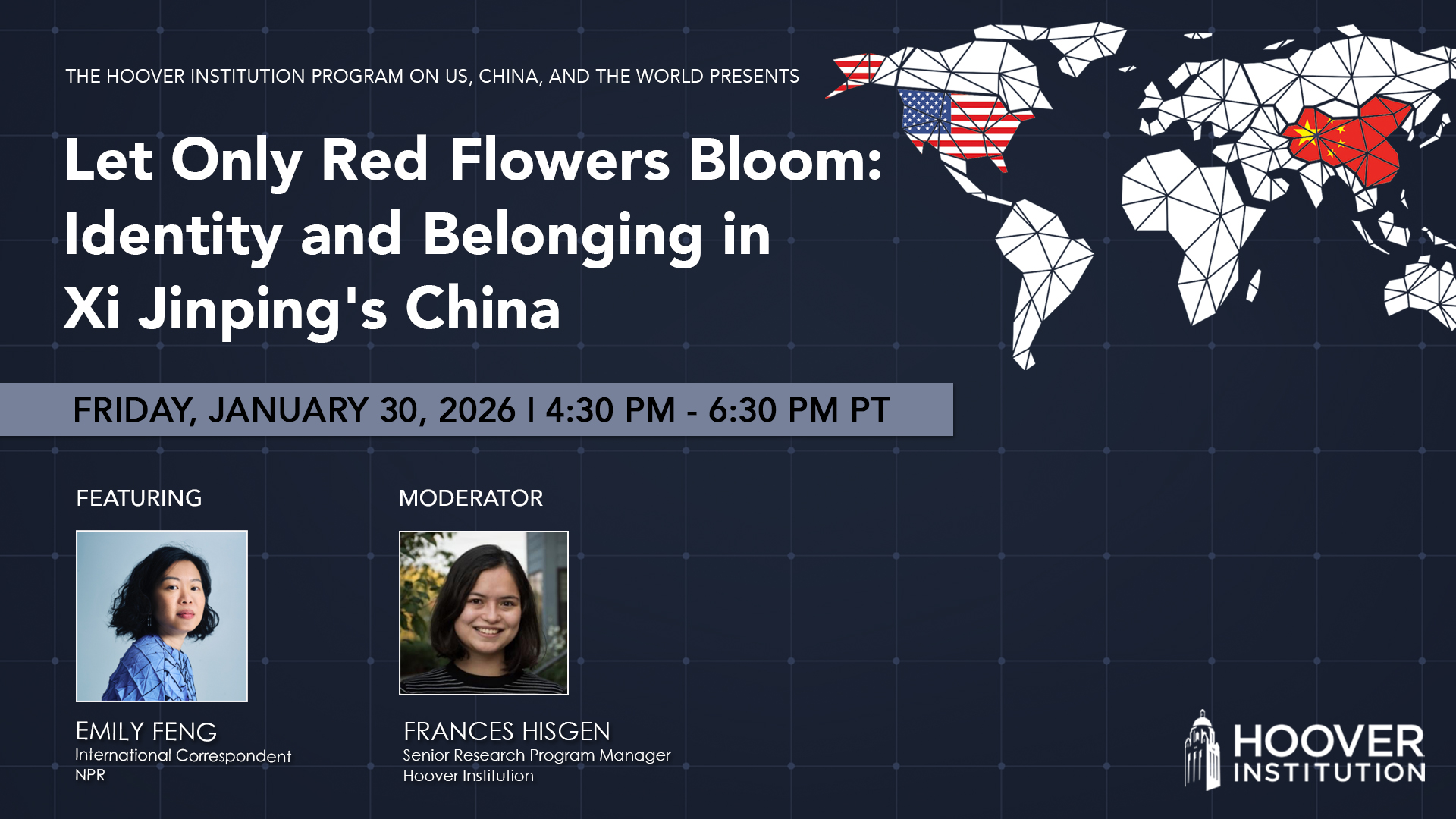
The Hoover Institution Program on the US, China, and the World invites you to a roundtable on Let Only Red Flowers Bloom: Identity and Belonging in Xi Jinping's China on Friday, January 30, 2026 from 4:30-6:30 PM PT.
As China rises as a global power, understanding its complexities requires insight into the lives of the people who navigate its challenges. In her book, Let Only Red Flowers Bloom, Emily Feng, NPR international correspondent, tells the compelling stories of individuals resisting state control over their identities and expressions. Drawing on her firsthand reporting, the book tells the stories of individuals in China who challenge prevailing norms: a Uyghur family torn apart by detention camps; human rights lawyers striving to defend civil liberties; a teacher in Inner Mongolia fighting to preserve his mother tongue; and a Hong Kong fugitive searching for a new place to call home.
Join us for a conversation with Emily Feng as she reflects on these stories and the challenges of reporting them, including the obstacles that ultimately led to her expulsion from China. The discussion will be moderated by Frances Hisgen, senior research program manager for the Hoover Institution’s program on the US, China, and the World.
- Welcome to the Hoover Institution. I'm Glenn Tiffert, co-chair of its program on the us, China, and the world where we produce scholarship, podcasts, newsletters, conferences, and speaker events like this one that aimed to deepen our understanding of China and the way it impacts our world. Today we go down to the grassroots for a deeply humane account of how people from different walks of life in China are experiencing life under Xi Jinping. I won't say more about that though, because that privilege belongs to Francis Kin, my colleague, who will host this session. It's my pleasure to introduce her. Francis j Hiin is the senior research program manager for the program on the us, China, and the world here at the Hoover Institution. Prior to joining Hoover, she worked at sine the Asia Society Center on US China relations and the American Chamber of Commerce in Hong Kong. She's a dynamo of inspiration and energy at the heart of our program, so it's my pleasure to welcome Francis to the stage and introduce our speaker. Francis, take it away.
- Thank you everybody. It's good to see so many familiar faces in the crowd as well, our frequent guests at USCW programs. You're in for a real treat today because I'm honored to welcome Emily Fung today for a talk on her recent book, let Only Red Flowers Bloom Identity and Belonging in Xi Jinping's China. Emily is an international correspondent for NPR covering China, Taiwan, and beyond from her new base in Washington dc. Before that, she covered China for the Financial Times and the New York Times, and her reporting has also let her nerd out over semiconductors and drones travel to environmental wastelands and write about girl bands and art. She's filed stories from the bottom of a coal mine, the top of a mosque in Shanghai, and inside a cave where Chairman Mao once lived. I wanna thank Emily for writing really one of my favorite books on contemporary China. It made me laugh, it made me cry, and it's a real achievement in deathly moving between multiple lenses, the immediacy and intimacy of personal stories and the important historical and political context required to understand how this tapestry all fits together. Please join me in warmly welcoming Emily to the stage.
- Okay, well, thank you very much for those kind words. My eyes opened up wide when you made those comments, Francis, because I'm so flattered and blown away. When you're writing a book, all these ideas are in your own head, and to put them down and to have your little mind world then get transferred to someone else's mind, and for them to come up to you and say, I thought this, and this about what was only existent in your brain for so long is it's still staggering even after the book has come out. Thank you all for being here today. I was told to prepare about half an hour of remarks, but I see so many new and friendly faces in the audience that I thought I'd speak a little bit more shortly about why I decided to write this book and some of the people, these characters in the book, and then just open it up to the audience because I like a discursive format more. When I thought about why I wanted to write a book, I I thought about why I, why I tell stories. What is it that drives me in journalism? There's the, the pace, of course, the external validation of getting a new story or getting a scoop. But ultimately, at the end of the day, what drives me in telling stories is building empathy and getting let into these very, very intimate worlds of people that you encounter along the way. When I first began in journalism, I thought I did reporting because it explained someone's world to someone. So it was about facts. It turns out as one journalist, it's impossible to cover everything. And so that became a less important reason that drove me in my work. Then I thought, I do journalism because it's to make an impact. And the moment that that connection weakened a bit for me was during the beginning, the early days of the COVID Pandemic in China, where I felt like me, my colleagues, my friend and colleague, John Ruit, who's in the audience here, we're covering these stories about how people were getting sick in China and trying to get these stories out to the rest of the world because we knew this virus was spreading. And you know, not that I think I could have done much to stop it, but, but it, it didn't seem to make that much of a difference. And so I slowly divorced myself from this idea that I do stories and I work hard in journalism purely to make an impact. So then what is the purpose of doing journalism? And ultimately the reason that stayed evergreen for me throughout years and years in China, Taiwan, and now the US has been to build empathy and what, what readers and what listeners choose to do with that is, is their own choice. When I sat down and thought, what are the stories that have stayed with me the most after 10 or so years of covering the Chinese speaking world, they've always come back to themes of identity and whether it was news stories or investigations, the characters that were on the periphery, and many of these reporting trips that I decided to stay in touch with and follow their stories were people who were not necessarily dissidents, they were often ordinary citizens, but they were grappling with some form of how they wanted to live their life in China. And they often had very, very differing visions for how they wanted the China that they often loved very, very much to develop. And that's why I chose to write about identity in this book. I just, I had so much fun when I was reporting in China and reporting this, this, I love this, this was right after the fir the early days of the, the first cases of COVID in, in Beijing. But when I talk about identity, I wanted to get it very, very broadly. And so the book begins the most populous east coast cities of China, and it, the first third deals with people who are thinking about different political and economic realities for China. I'm guessing many people in this room here actually have been involved in these conversations or movements in China and mainland China itself about what is best for the country, how could the country develop? And the year that I moved to China, 2015 was the year this is, I moved there the week before the country rounded up and arrested about almost 400 human rights lawyers, which was really a watershed moment July, 2015 in the civil liberties and civil rights movement that had been quite robust in China. And so as I was writing this book, I wondered what had happened to those people, what had happened to their ideas? How had they been incorporated, erased, forgotten, revived in conversations about how China could develop. So, so I ended up focusing on one of my favorite characters, a woman who had been a state prosecutor in the Chinese government, and then halfway through decided to cross the aisle, so to speak, and become a human rights lawyer herself. And her very, very tenacious journey pursuing that career, even after she's disbarred and the unlikely circumstance in which she finds herself when someone who she might have prosecuted as a state prosecutor comes knocking at her door. I also wanted to get at freedom of expression in China. One thing that really baffled me was, we hear all this news since I wrote some of this news myself about internet surveillance and censorship, and yet there's an incredibly prolific online life that exists of cultural creation that exists in Chinese cyberspace. So how do you have that diversity while at the same time living in a state that manages to take down sensitive post or even errant comments within minutes sometimes? And the the way that I, that I explored the subject was through another character who I kind of met by accident named or in China, he's known as the scooter thief because he goes viral for a jailhouse interview. He does after getting caught for like the fourth time, stealing scooters. And while he's in the clink, that video goes viral and he comes out of prison discovering that he's become this internet megastar and how he deals with that fame and the unlikely path that that fame brings him along, I thought told the story of, of the Chinese internet and of the, the slippery nature of internet censorship really, really well. This was a fun story because when I was reporting it, I thought it was kind of an easy feel good story. Here's a guy who's become an unlikely influencer and he'd opened up a couple of businesses in Guangxi in southern China. And then, you know, the story evolved from there. It wasn't, I thought it was a nonsense sort story. It ends up getting me in trouble, him in trouble, you know, off to the races we were, I, when I talk about identity in the book, I also wanted to get into gender identity. I realize that I'm sounding a little bit peripatetic, but I think the point here is that there are many, many different facets to identity in China. It's an incredibly diverse country, and that's why I loved living and reporting there and covering it to this day. And of course, I, I explore religion and ethnic identity in the book. Some of my favorite reporting trips were to China's northwest and to the Xinjiang region as well. And these are themes that have stayed with even reporting that I do to this day. And I find them resurfacing not just in China proper, but among the diaspora in Europe, in Southeast Asia and North America. And also the last couple of months of travels I've had in the Middle East and in the Middle East. It turns out there's a China story everywhere. One of the, the big stories on my patch when I was reporting in mainland China was of course the crackdown in Xinjiang against mostly Uyghurs. And so there were dozens of stories that I could have chosen from, but the story that I chose to profile in the book is the story of a family who are separated from their children and their quest to find their children who have been sent to a state boarding school. This is one of the children and unexpectedly about halfway through reporting this book, and just as I was sitting down to think about how to write this book, I was, I found myself unable to return to China. So I moved to Taiwan and I finished most of the first draft of the book in Taiwan. And I'd always planned on having the last third of my book in the diaspora outside of the boundaries of the PRC. You know, the first third of the book was on coastal China. The second third of the book were along the historic Ching Borderlands that the, the PRC largely inherited. And the third I thought would be in Hong Kong, but it was in Taiwan where of course these identities, these conversations about identity are so salient, not just Chinese versus Taiwanese, but Taiwan's many layers of colonial history. And they really added a lot to how I thought about identity and, and the threads. Many of the, the, the threads, for example, there's a couple of chapters about Hong Kong and one of the characters who really, really spoke to me, this frontline protestor who'd been born in mainland China, was an economic migrant to Hong Kong, but then basically becomes politically engaged because of real estate in equality in Hong Kong and becomes a frontline protestor in the 2019 anti extradition movement. He ends up fleeing to Taiwan. And so we, I had this beautiful moment of where I shouldn't say beautiful, it was a very hard experience for him, but where all these different threads of characters I'd followed from the mainland to Hong Kong to Taiwan were coming together. And then finally it ends, the book ends in the us. So that's a quick overview of the book and why I wrote the story. And I hope if you have a chance to read a part of the book or to engage in in China journalism, I hope that we can still create the resources and the space to tell stories that are important because they, they move markets and they make headlines, but also give the reader or the listener, the viewer some feeling of the texture and the rhythm of what it would be like just for a second to live in the shoes of someone in China or to live there yourself, even if you've never been. And I know that my colleague John still endeavors to do that kind of reporting, but because of the dwindling numbers of foreign correspondence and, and the ongoing restrictions on local press in China, and I think also the distraction of editorial interest in the second Trump administration, I haven't seen as much of those stories get space and get play these days, but I think there is still so much value in telling the stories of people, whether they're important or ordinary folk because they impart some kind of truth that might not be immediately useful, but might tell us something deeper about exactly how a place thinks and how a place works. I say that and my main message for the book actually was, was none of us really know how a place thinks and how a place works, especially one as complicated as China and that China is not a monolith often at these events. I get asked, you know, what's one thing if you could boil this book down to one thing that we should take away? And it's that there is, there is no takeaway, China is not a monolith. One policy might look very, very differently in one province versus another region and one person or one community that you meet in China and may have a very different opinion than a community on the other side of the city. And that's also why what I hope to impart in the book. With that, I would love to hear your questions and thoughts
- About anything regarding the book or outside of it. I did wanna pick up on something, Emily, that you said in the last bit of your remarks where you talked about the story of the frontline protestor that you followed in Hong Kong Kenny, and how you felt it was beautiful that the threads came together and being able to follow Kenny to Taiwan and explore identity in Taiwan and the place of Hong Kongers after the 2019 protests in Taiwan. But also that it was really tragic, of course for, for Kenny to live through. And something that really struck me as I was reading the book was this intertwining of two moods. There's this very melancholic mood in a way. There's there's many moments in the book where you follow people whose sense of possibility of paths they're open to them, of futures that they could take of China's that they could inhabit, get foreclosed, but there's also a, a remarkable amount of resilience and hope in the book. So I was wondering if you would reflect on, on managing those two moments and, and telling these stories in, in a time when I think for many of us who loved China and observed China, both within China and afar are feel a little bit bleak and pessimistic about, about its future
- Plot. Spoiler, Kenny is now in the US and so he's joined this big diaspora of Hong Kongers and mostly the United Kingdom, but also increasingly the United States who are often very active in politics and lobbying, but also I think just have kept their Hong Kong identity alive, even if they're not in Hong Kong per se. And after reporting the book and moving to Taiwan, I, I did a lot more reporting in Southeast Asia and I think there the Chinese diaspora has also been very, very prolific and has taken the initiative to create new cultural products in, in the Chinese language and to hold festivals and events and connect with other diaspora communities and media platforms across the world. So there, there, there is a lot more work and a lot more talented people who are very cosmopolitan, who are imagining different new future Chinese communities that are not necessarily geographically tied to a place. And I think that's very powerful. Thanks
- Emily. Any questions from the audience or the online q and a? I'll ask another. You talked about how you finished the first part of your manuscript in Taiwan and I was wondering if you could reflect a little bit about the experience of having to leave reporting on the mainland perhaps earlier than you might've wanted and, and what it was like and continues to be like to cover China from outside its borders. It is,
- It's not as fun, it's not as satisfying for sure. I did a lot of reading of exile literature when I was in Taiwan. Not that my experience was to the degree as painful as it was for many people who moved to Taiwan in the 1950 forties and fifties. But of course, for obvious reasons, there were themes that really resonated. And I think for that reason I became really, really interested by figures who were second generation Taiwanese. And one interview that I did with Taiwan's former president Ma Joe ended up making it into the beginning of the book where he talks about his understanding of China. He'd, he'd recently, when I interviewed him that year, I think it was 2023, he had just gone to China for the first time in his life in a very controversial trip, of course that was highly covered by Taiwanese media and he was describing the China, the China that he felt that he had seen. And it, it was a completely different country than the China I felt I had encountered. And that discrepancy led me to think, you know what, there's many, many different Chinas, it exists just as much as a material country as it is by the people who understand it in different ways. He obviously has a very different perception of what he thinks China should be and is compared to me and compared to other Taiwanese and certainly compared to other Chinese people, which reinforce my, my understanding, my my theme in this book that there's many different, many different ways to be Chinese.
- I'll keep the mar moderator's prerogative for a little bit more. And I'll say that one of the things as someone who also has Chinese heritage that most struck me about the book was the way you reflected personally on the experience of being someone of ethnic Chinese reporting on China. And at first maybe thinking, you know, that you could be part of this polity or part of this sense of chineseness, but ultimately being denounced in many ways by nationalistic voices in the media who went so far as to call you a race traitor. And I was wondering if you could both reflect on that experience for us, but also talk about why you felt it was important for those voices for the Chinese state to kind of draw that line and draw that boundary where, you know, you were not someone that could be inside their conception of Chinese and their conception of Chinese was drawn as something very state directed and state centered.
- I think this has always been the case that it's been, it's been a little bit harder for foreign reporters of Chinese descent to report in China. Just you encounter much more pushback from state institutions because there is this expectation of writing or behaving a certain way. And I would reflect later after I moved to Taiwan, whether it was the right decision. You know, we'd have like once or twice annual meetings with the foreign ministry if it was the right decision for me to always engage with them in Mandarin or if I was called into the police. There were a few think events I covered and the police weren't happy about it and, but I would go in and I always made it a point to speak Mandarin if that was a mistake. Maybe they saw me as two Chinese in their, their very narrow conception of how a Chinese person should behave when in fact I kind of floated between these, these worlds. I, you know, of course I'm interested in the theme of identity because my own identity is mixed. I'm a, an American born Chinese and my parents were born and raised in China and are very, very proud of their heritage and their culture as am I. But I hadn't gone to China expecting anything and was just blown away by how different it was. Of course. Why, why am I surprised saying this? So how it was so different from the China that I had heard from my parents' stories. They had immigrated in the early 1980s. Of course the, the country had changed so much and I had, I made it my mission over the next couple years to see as much of the country as possible. And I think it was more painful than I realized to feel that my, my work there and my time there had been in some ways rejected. I felt very, very welcomed in Taiwan, but I missed the work in China and, and it was in Taiwan. I think that I first encountered this familiarity with so many different kinds of Chinese identity. It was the first time where someone could stop me in the street and kind of do the body scan or how do you speak, what are you wearing? And they would immediately diagnose what kind of Chinese I was. Whereas in Beijing I often got questions, are you in Indonesian, are you Filipino? Are you, someone asked me once if I was Nepali, I got a lot of, are you from Hong Kong? Are you from Taiwan? Whereas in Taiwan, I think because they encounter so many different kinds of Chinese in this fluid spectrum of, of whether you're Malaysian Chinese or Singaporean or from Hong Kong or the mainland, it was just, I didn't feel like I needed to explain myself and that probably also gave me the confidence to sit down and, and write this book.
- Thanks for that reflection, Emily. Yeah, I think we have a question from the audience, the gentleman upfront and then we'll go to you Philip.
- Yeah. Thank you for your presentation. My question is, a fundamental question is to the title of the book, identity and Belonging. You're obviously born here and your approach will most likely reflect the perspectives of identity and belonging in a western definition. And I'm curious to know whether that western definition translates well into the sense of identity and belonging that the people in China actually experience and whether the fundamental influences of Confucius, Taoism, Buddhism may have an effect that defines it differently, differently. And whether your book actually attempts to define those terms only in the context of a Western definition or whether it attempts to define it as people in China understand it, both in terms of their self identity, their relationship to others, the sense of belonging to groups and subgroups within the country. And then of course, you know, in terms of modernity as as a Chinese identity in the 21st century century, whether those topics are actually relevant to, to the perspectives that you have gathered and presented in your book.
- Thanks for your questions. So as the, I think the spread of identity or themes of identity that I had in my brief photo slideshow, I don't make any attempt to classify what I mean by identity. It probably the book probably would not stand, stand up to the academic rigors of submitting a paper or coming up with a model or a, a working argument for what I mean by identity, and again, I define identity very, very broadly. So it was everything from how people saw themselves in relation to other people in their community, to people within their religious group, to people within their geographic group, to people who identified themselves solely by, by their self ascribed political values. So there isn't a consistent way that I try to describe identity. There is one chapter in here, actually the chapter where the title comes from, where one of the peripheral, I'm trying to remember, no, not one of the peripheral, but some of the, some of the content that I talk about in the book, in the, in the chapter is about how Chinese policymakers go towards conceptualizing in that particular chapter, at least ethnic identity and how it's often conflated, particularly when it comes to historically Muslim populations with religion. And my character in that chapter called The Believer is trying to divorce that connection between ethnicity and religion. That religion is something that you choose for yourself and ethnicity is something that you might be born with, but in fact ethnicity is often construction as well as it was in the, in the as it is in the PRC and his work, his writing is taking place amid a policy rejigging in China about how to classify ethnicity and understand it in the context of assimilation into a greater Chinese identity. So around 2016 17, there were a number of conferences in Beijing describing, discussing the topic of ification of various religions and it reflected a change among communist party apparatuses about how, what counted as assimilation. And interestingly, some of these state papers would use the term melting pot theory to describe what they wanted to see from ethnic minorities and religious minorities in China. This idea that there was, and of course this is used in American discourse, but in a slightly different way, their idea was that there was this common Chinese identity and everything should kind of be melted into that so that there were no distinctions, everything was kind of averaged out. But the, the biggest denominator of all that would be Han ethnic Han culture. And I talk about in the book how that contrasts with American conceptions of melting pot theory, which is that you have an American identity, but that you can simultaneously have a private or social identity alongside that. So that's kind of the closest I get to explicitly addressing the fact that there are many, many different schematics for how to identif or understand identity. But you're absolutely right that I'm extremely loose and, and how I use identity here. But in general, I was trying to get to the fact that, I mean this might be a little bit too general to, to make any conclusions, but that there are many different kinds of people who have very, very different conceptions of how they self-identify in China.
- Hi, Emily in Stanford, you report from Taiwan and also in Hong Kong. I wonder if you could give us some perspective on how these two big diaspora of Chinese community view themselves in relation to their relationship with China. They're not part of China. Well that's a political statement of course, but how do they feel themselves? Are they, do they see themselves differently or are there some commonality as well?
- The
- Chinese diaspora in,
- In Hong Kong.
- And Emily, if you want, I could ask you to layer on your Chinese dia your work on the Chinese diaspora in the United States as well.
- Sure. I didn't meet that many Chinese citizen, you know, people born in mainland China who had moved to Taiwan. And in fact that was kind of the point of the, the, the chapter in Taiwan. I didn't deal so much with this ongoing discussion and evolution of what is Taiwanese identity in the book. More so I was thinking about how does Taiwan see its role in the Chinese speaking world, given that it thinks of itself as the leading democracy in the Chinese speaking world. And one of the main issues that, that I was covering when I was living in Taiwan was they weren't getting higher numbers of political asylum seekers from China. And they were wholly unequipped to deal with these asylum seekers, both from a lack of political will, but also because of their own complicated political identities. Many of these asylum seekers were coming from mainland China or Hong Kong, which technically are within the border, the, the, the sovereign borders of the, the Republic of China, Taiwan. So they didn't count as foreigners who could then apply for, for asylum status. And it's still very, very hard for A-A-P-R-C citizen to claim asylum status in Hong Kong. There was unfor, the unfortunate case of the Chinese born publisher in Taiwan who went back to China to cancel his ku, his his household registration and, and is still arrested and imprisoned to this day because it's a requirement that the ROC Taiwan has for Chinese citizens to apply for, for Taiwan Taiwanese citizenship. So I was thinking about the diaspora and Taiwanese and identities, the issues of identity in Taiwan, much more in terms of Taiwan's position as a, as a political player in terms of citizenship questions and migration flows more than anything,
- If you could reflect a little bit on the decision to include the Chinese diaspora in the United States, particularly at a moment when you were writing your book of great political contention in the wake of the COVID pandemic anti-Asian racism, but also US government initiatives like the China initiative.
- So once again, I was baffled by the diversity of perspectives that I encountered among Chinese Americans regarding all these issues that covered while in China itself. Chinese Americans were really divided about what had happened with COVID, how to deal with the political fallout. You had people who very strongly identified with the Trump administration the first term and other people who were fundamentally against it. And you also had, of course, the US being a u the us many different ways of political and artistic expression to, to express these perspectives. And I ended up focusing on one character who is a sculptor out in California and who ended up embroiled in an FBI investigation into people who it, it appeared, it they found the Chinese government had paid to, to burn down his sculptures, which of course brought him incredible publicity, you know, it was like really shooting yourself on the foot if you're Beijing. But it was kind of through his wacky, sometimes contradictory personal story and pers and political perspectives that I felt, you know, you teased through the fact that the Chinese diaspora also loved to argue with themselves and in fact often the strongest critics of people in the Chinese diaspora or other members of the diaspora.
- We'll take a question from Perry in the front.
- So far we've been talking about the great variety of identities and complexities in China and Taiwan and the diaspora, and that's great, I've liked it, but the first part of the title of your book, let Only Red Flowers Bloom Suggest a different kind of idea. What did you mean by that part?
- That is a direct quote from a peripheral character, again, I forgot to mention Yeah. In, in the chapter called The Believer, and it was, it was uttered to me in the context of a discussion about the publishing world. So the person who who told me this said something to the effect of before the state allowed pink flowers and blue flowers and, and purple flowers to bloom, but now they only want to let red flowers bloom. And he of course was making a reference to let 100 flowers bloom the, the slogan from the, from, from the Mao era about superficially allowing diverse perspectives to exist for a while before cracking down on them again. And that phrase stuck with me at the, at the time he uttered it sometime in 2018. And when I was writing the book, that phrase came back to me again. So other, it was a quote that spoke to me and it was, I didn't think too much of it at the time, but thinking back, I thought it spoke to the, to the cyclical nature of Chinese politics and periods of opening and closing and hopefully opening again. And, and it was a character who I stayed in touch with for a very, very long time. So I felt special that, that I could include him in the, on the cover as well. In a way there wasn't a very systematic
- Thinking behind it. In a way it feels as if there's a tension, as Perry pointed out between the title of your book and the subtitle of your book. The state in a sense is trying to only let red flowers bloom. And I think so many observers from outside of China can get caught up in sort of observing the downward spiral that has happened, particularly since 2013 when Xi Jinping took over. But also a moment that you talk about in your book document number nine and the way that you brought to bear this multiplicity of voices, it felt to me that there were cracks forming in the concrete that the state wanted to pour over that reinforced single version of Chinese identity. And that there were ways in which as you demonstrated the vibrancy of the diaspora in particular, folks are pushing back against that. So I wondered if, if you could reflect on, on how you feel now both reporting on China from the outside and working in with the Chinese diaspora, the extent to which people are still able to have that kind of elbow room to express themselves.
- I think there's less and less, but, but this is also the same about reporting in horror stories of how reporting gets limited in China, but there's still incredible room to do on the ground reporting and talk to people and understand their stories and experiences that gets lost when you're not there on the ground. So just because the state is trying to con control certain forms of identity doesn't mean that there are many other forms of identity that don't continue to exist. I'm curious, Perry, what you get from the title of the book, let Only Red Flowers Bloom.
- I got exactly what Francis articulated, the title in the subtitle seemed a bit, I won't say contradictory, but countervailing. And I wondered if you wanted to expand on what you meant by the first part, but I think you did. It's fine.
- It was more of an emotional way of reasoning than it was a strong argument. But I think you put it more succinct than me, even we'll take
- From the woman in front. I
- Understand that you identify yourself as Chinese when you grow up in the us And did your perspective change when you were treated as outsider or foreigner when you were in China?
- No, I always considered myself Chinese American and maybe in a more pithy way in the US I felt more Chinese and China, I felt more American. I think this is a common experience for many Chinese Americans. And now that I'm living in the US I think I've, I've thought about more I've, I've identified even more strongly with, with the characters in this book and the way that they're trying to make Chinese identities for themselves. But was the question, if I identified as, as Chinese growing up,
- You actually treated as outsider because new Chinese, they'll not be, we're Chinese.
- I think that, yeah, I think, I think that when, this is maybe my personality, I think that when I encounter resistance, I pushed back. So I did feel more Chinese after living in China. Question in the back.
- Thank you. Sam George, senior fellow at the Asia Society. I was just touching on the first topic you spoke about, which is the diaspora. And I'm just, I'm, I'm really interested in what seems to be quite a, what's an interesting experiment is huge cultures blooming in Tokyo and Chiang Mai and flushing in New York with these emigre figures. Some of them who are politically disenfranchised, but some of 'em who are just economic migrants. And you alluded to having spent a lot of time in Southeast Asia doing some reporting in these communities and the interesting cultural products they're creating. I'd just be interested in a bit more texture on what you're finding and how you reflected on it given you'd written the book.
- Unfortunately, I didn't do any, I I never traveled to these places to do reporting on the Chinese diaspora communities there. But it was stuff about like the South China Sea, about the Philippines drug war, about ocean, like environmental stories more so. But you couldn't help but notice when you're in, I never did reporting in Cambodia. But if you're traveling through like Cambodia or Vietnam or Thailand or the Philippines or Indonesia, that that Chinese communities, whether they've been there for hundreds of years who have recently moved there, are really, really present. They play a role and, and they're very, very active. And I'm sorry to say that I don't think I have any new findings that you haven't read about already in media reports and maybe some of the emerging scholarship on these communities, but I unwittingly I didn't plan to, but I just kind of bumped into these, you know, the, the bookstores that are popping up in Tokyo or the community that's in Chiang Mai or the historic community that's been in Malaysia and Indonesia for years and years for, for centuries. It was a very happy byproduct of, of doing geopolitical stories out there.
- Speaking of doing geopolitical stories in various places of the world, Southeast Asia, I know you just got back from the Middle East, that theme of identity, state control over identity, contestations over identity and imagining sort of alternative political realities feels pretty salient in many parts of the world as you alluded to in your opening comments. So I was wondering if you wanted to reflect on that theme, not Chinese identity in other places, but the role that identity has played in this, using this lens of identity in your reporting in other contexts. Identity is one of those, like one of the stickiest
- Things out there. I mean, to varying extents, you can change someone's mind perhaps about a small issue. People can learn new languages and grow a culture to a new society, a new country. But identity is really, really hard to change. And more and more so especially, you know, one of, one of the projects I've been working on in the Middle East is the hur who are there. And one thing that has just stuck with me, for better or worse, whether you agree with these communities or not, the harder you push down on a community, you often get an equal even greater reaction back, particularly if you don't give people a chance to, on their own terms, express their identity in different ways. And to get back to the, the the beautiful synthesis, your comment earlier about envisioning these flowers, pushing their way up through cracks in the concrete identity is one of those things sometimes that the harder you try to mold it or push it to shrink it or make it disappear altogether, it can bounce back in very, very unexpected ways.
- There's so many stories on that theme of, of resilience and continued resistance and persistence in your book, there's one that comes to mind of the human rights lawyer who defended Hong Kongers who were attempting to flee Hong Kong for Taiwan and found themselves captured in the middle of the sea and brought back to Shenzhen. I was wondering if you wanna share that story with our audience, because that was something I found really wonderful and striking from the book that
- He was representing these Hong Kongers.
- If you could reflect a little bit on the conversations that you had with him and, and the role that ultimately he played in your chapter.
- Sure. That was another example I think of where people that you meet in one phase of your China reporting career then pop up in an unexpected ways. And I had originally interviewed that lawyer about a new wave of lawyer, human rights lawyer disbarments in around 2019, 2020 I think. And when he tried to represent those Hong Kongers several years later, it was initially a story about the Kafkaesque ways you had to jump through semi made up bureaucracy rules where he was never able to actually ever meet with his clients. He would stand for hours outside of the Xin detention Center trying to talk to his clients, which of course he had a right to never was able to meet them. Eventually the argument used against him representing them was that they had never agreed to bring him on as their lawyer, even though he had signed statements from their family saying that he had been assigned or like yeah, assigned as as their lawyer and the state would argue, no, no, no, they actually chose a another lawyer. So that was how, that was the story that I wanted to do about him. But as I learned more about his personal story, you know, he wanted to be an opera singer and becomes a, a, a human rights lawyer instead. And also his, his surprising political views, I mean, I'm not sure what they are now, but the time that I, I got to know him, he loved Trump was a born again Christian and but, but also very much believed that that not, but, and believed that defending these Hong Kongers was the right thing to do even though it led to his own license being taken away from him to practice law in China. So the last time I saw him, he was essentially a paralegal. It was a very, very high cost to pay for taking on a case where he never even got to have his day in court, so to speak, with these Hong Kongers.
- That was a story that for me really spoke to that theme of persistence, just standing outside the detention center, working through all of the various little bureaucratic loopholes that he might be able to find to represent his client ultimately now, perhaps having not so much a happy ending, but there's latent possibility and latent human capability and latent talent that maybe one day hopefully there could be alternative imaginaries. We have some questions from students, I think, in the front. Great. So I'll take you first.
- Thank you. I'm an undergraduate student, my name is Jack. I'm wondering, after writing your book, what do you think right now the American media misunderstands most about China? Or is there something in the current media discussion that the media doesn't seem to quite be getting? Right?
- I don't think China's trying to take over the world and there's no singular China. Just because one man says something doesn't mean that that represents what the rest of the country wants or thinks. And then I know
- We have a another student question in the front.
- Hi there. Aston also an undergrad here. Thank you for being here. You spoke a little bit about the protest and the human rights dimension at the beginning of the lecture. I'm interested to know if you think that there's a potential for human rights to reform in China, and if so, what would that reform look like?
- I think it wouldn't use the language of human rights. I think it's just so loaded and so associated with western societies that it just, it doesn't have political traction in China. What do you mean by reform though? That's not a human rights issue. It's a, it's a national security issue according to China. And I think it's really, really un what's unfortunate is the conflation of so many issues, whether it comes to protests over environmental regulation or environment like financial fraud even, or things like the uyghurs where it's all been lumped under internal security issues. And so it's, it's in a completely separate realm now from civil liberties and human rights. So to use that language has absolutely, it, it just doesn't apply to the topics anymore. So unfortunately in the immediate term, no. But yeah, it's, I don't have an easy answer to that. It's mostly, no,
- I'll go to Rowena, but before I do that, I wanna ask you, Emily, a question about the stories that you spotlighted in the Uyghur chapter. And something that stood out to me was the inclusion of two characters. One ahan Chinese, I think academic who was a friend of yours who had devoted much of her life to understanding the Uyghur region and a Uyghur individual who I think was a little bit more perhaps in favor, not so much in favor of the policy, but finding himself employed by the government to carry out the policy. And that kind of texture I felt was something that was rare, both Han allies and, and uighur workers for the state. And I was curious if you would reflect a bit on, on including those, those bits in, in the book.
- You know, one thought actually is perhaps in the language of economic development, you know, economic growth is not necessarily the highest priority anymore for Chinese officials, but, but there may be a way to speak about equal opportunity and this language of developing, allowing different communities access to economic development, which is something that the government is very much in favor of, that that might be a way, a way forward. I, yeah, I wanted to show that there's no, there, there are no heroes and there are no bad guys in this book. Everyone is for the most part, not a dissident. They're ordinary people who by way of living the way they want to live their lives, all of a sudden or very slowly find themselves on the opposite side of where the political trends are going. And it also just means that people have complicated or even sometimes contradictory roles to play in, in that system. But, but even when people, like for example, I think you're describing the propaganda officials. So I often met on my trips to Xingjiang, they had their own opinions. If you sat down with them for more than half an hour, they were, they, they were complicated people who had their own backstories and one of them got in trouble for it later. I mean, in the, i I assume so I just never saw 'em again, but the other one kept showing up. So, you know, these are not two dimensional people.
- A question in the back from Rowena.
- Hi Emily. Thank you. Look forward to reading your book Rowena her, I I just want to make sure I understand what you mentioned about the human rights in China. So, so you mentioned may, maybe the turn is more western concept and not apply to, is that what you meant just
- Now? I think it's perceived as such a western concept that it, it, it leads to a complete blockade in the conversation when you try to talk about human rights with, with Chinese officials these days.
- Oh, okay. You're talking about Chinese officials. I I somehow thought that you mean that human rights is a different western concept because we have human rights in China, we have CHRD, Chinese human rights defenders, so all these people are on the ground on daily basis working for human to improve human rights in China. So I, I think that this debate about whether human rights is western or, or, or Chinese is being debated a long time ago. And I think that like anyone else, Chinese people do need the same human rights in China. I I just want to clarify.
- Thanks. Well take a question from the gentleman up in the front.
- Hi John, local resident. I was just curious, from your travels within China, what do you think are some of the biggest misconceptions by the Chinese about America or the rest of the world?
- Misconceptions. I actually find one of the stereotypes about reporting is you always ask your taxi driver what they think about what you're reporting on. And they often are very, very, very well informed. So I found them, you know, they followed the news really, really closely. I think one can misconception was even while there was a rising sense that the US was trying to contain China, and I would understand why you would think that as an average Chinese person these days, there was still this very over on average, a very, very rosy perception of what life was like in the US that Americans are really wealthy, that the individual human life was much more highly valued in the us One of the concerns, for example, when I would travel around Fuji Young for example, which is just to cross the Taiwan Strait from Taiwan, is there were several instances where there were some, there were, there would be more like military planes flying overhead and stuff. And I would ask people whether it was related to Taiwan, what they thought about Taiwan, would they ever fight an war against Taiwan? And people were like, no, because we wouldn't be sent there to die. Like no, the, the Chinese state doesn't care about me or my son who's gonna serve in the army. But there was this weird, there was there, there was this perception that the US very much cared about that. And so you had this strange paradox, maybe not strange, but a paradox that the US was increasingly seen as the, the bad guy in China, but also that life for the average American was so much better than what it was, what it was for the average Chinese. Take a question from Glen.
- So you mentioned shortly after you arrived in China how conditions for the rights defense attorneys had dramatically changed and the sweep of arrests. But a few years before that conditions changed for local journalists, there had been a really active community of investigative journalists throughout the alts in China, and it looked as if, you know, they would be reporting on events in other provinces in order to escape the sort of gaze of their local officials. You know, the, the high speed rail crash, for example, the earthquake, A lot of really good reporting. Can you talk about your engagement with your colleagues and peers from the Chinese journalistic community and the conditions under which they were operating in during your time in China and how they were struggling to sort of be authentic journalists within conditions that were becoming more adverse to doing that kind of reporting?
- I had a lot of contact with both state and like a journalist, Chinese journalists who were working for both private and state organizations. When I was in China, particularly the first couple of years I went to a lot of T events. Their office was right across the street actually from my office for all the years that I was in China, T was really, really active and I tried to go to as many state press conferences as possible, so you'd run into Shua people and CCTV and the local Beijing newspapers, and they were all really, really thoughtful, smart people contact, I I didn't have as much social contact with them the last few years that I was in China, and part of it was COVID, just people came out less. But part of it was, I think that there, there were stronger internal regulations about socializing with members of the foreign, not even just members of the foreign press, but I think with maybe foreigners or in diplomats in general. I encountered a lot, a large number of entrepreneurs who had been, I think part of that vanguard of really active, excellent journalists and investigative journalists of the late nineties and early aughts who had left the industry. And they were still really, really great to talk to, but they weren't in media anymore. And increasingly towards the end of my time in China, and certainly when I was in Taiwan, I interact, I read much more media from WeChat channels and from places like in me. So these are explicitly diaspora publications and, and some of the younger journalists in their twenties and thirties had moved in order to continue contributing. I actually knew a few who were doing that reporting on the ground still in China anonymously for an issue. So the outlets that I paid attention to and the outlets that I thought were most active changed quite a bit from what you might think of as the traditional, you know, physical newspapers and television stations to purely online publications.
- I think speaking of online, we might have a few questions from our online audience.
- We do one question. Where do you think China can do better at telling the China story? For instance, many developing countries such as Japan, Saudi Arabia, have put a lot more emphasis on this front throughout their development journey.
- This is, I've said this before and I I don't think it's been successful as an argument, but when you, when you let in more foreign journalists, they tend to get stories about China out more and they have more time to do stories that are more nuanced and not necessarily just headline. So that would be a great start is letting people report more freely in China. The other would be letting more of your own journalists report stories and giving them more bandwidth to do stories that they would like. And to be totally honest, foreign journalists get a lot of their information from Chinese journalists. And so when you have that healthy media ecosystem, there is just a more robust variety of information and diversity of stories that people will pick up and find interesting. But I think also the China story is told inconsistently across the world, so perhaps it's not very pervasive. There's not a lot of stories about China, or at least Chinese state news outlets don't get as much play in North America, but I know they're getting huge amounts of play in the continent of Africa and in, in what we call, you know, in the in, in more of the developing world. And I haven't studied that and, and how that changes people's opinions about China and their understanding of it, but I'm sure it's making an impact. So to ask that question, I think is to also recognize that China has told its story, its version of its story better in some places than others.
- Emily, you spoke just now about how a vibrancy of a media ecosystem might lift all boats, so to speak, and that might be your advice to whoever might wanna tell the China story. Well
- That's a good way of putting it.
- I know that you came to China first in 2015, right? Was there a particular turning point for you in your years of reporting where you started to feel, hmm, we're losing that vibrancy or the, the environment is sort of closing in? Is there a moment or a few moments where that st where something stands out?
- I realized that my relatives mostly, some of my relatives mostly read Guha. Okay. And then could you explain what Guha is? It's a very aggressive, mostly nationalistic online publication. And they had written something very not nice about me and I didn't tell anyone, I didn't tell my parents of course, but they heard about it because it turns out that a lot of my relatives read that. And so that's when I was like, oh, okay, they're not reading Tyson, they're not reading south the, you know, s foreign publications or, and they're not reading private newspapers. They're mostly watching the CCTV evening news broadcast, which I do too, and gua. And that's when I felt like maybe the walls were closing in a little bit.
- Question from the gentleman in the middle.
- Hey, thanks graduate student here. I was wondering what you saw in maybe some of the people that embraced that state endorsed identity more so in mari of speech, people that were content with the state of affairs of letting only red flowers. What, what, so one of the stories that you alluded to earlier, the official Xinjiang who had a more complex side, I would be very interested in that.
- The who in
- Jang, sorry. Well, one of the two officials that later disappeared that you were,
- They were Uyghur officials who, because they, one of them had studied English literature and one had watched a lot of American movies, had really, really good English, worked for the propaganda department and were like my receivers on many trips to Xinjiang. So again, I don't think like the perfect character. You know, when I was writing this book, my book, my wonderful book agent said to me, could you actually find like the ideal Chinese citizen per the party at least, and do a profile like an entire chapter on them. And I couldn't really, because if you dove beneath the surface, every person is their own world. And so I couldn't find anything that actually like withstood scrutiny. But you're absolutely right. I think it's, it's rightful to recognize that many, many people in China are content. That they have very, very materially good lives. That they're happy with the jobs that they have and the lives that they have. And that just wasn't what my book is about. It could be interesting to profile that, but I'm always interested in stories at the margin regardless of the society that I'm in and I'm reporting on. But I, there's, there's a lot to be written about why people are content with, with their situations and I think that, that, that the government should be recognized for, for materially providing for many, many people.
- We have a question right back there.
- I'm a undergraduate student from Berkeley. Your, your story about the Hong Kong protestor who moved from Hong Kong to Taiwan, that's really, and then United States. It's really interesting and I think there's, from sort of my generation, a Gen Z Chinese, there's a sense of either indifference to what's happening in China or a sense of pessimism, especially to those who are studying in the US or you know, Europe or trying to run, you know, you've probably heard of the term running away from mainland. That's like a, you know, almost a meme at this point. So what do you want, like what do you think about that? What do you think about that? Is that indifference or pessimism or is there, there's a kind of fear of not wanting to engage with what's happening in China and what, what do you think about that?
- I think in this case, there are two sides of the same coin, or perhaps indifference is maybe in a, a more advanced stage of pessimism because you've advanced into the realm of, I mean, fringe nihilism, that nothing you do really can have a measurable difference, or at least is correlated to like direct action doesn't lead to the direct result that you'd like to see. And I also think that this is, this is not necessarily a Chinese phenomenon. One of my favorite projects that I did when I was in China was an episode for an NPR podcast called Rough Translation, which is now defunct, RIPI absolutely love this podcast. It was about looking for parallels in, in things that were happening in one country and what was happening in the us and we did this cross-cultural international story about quiet, quitting and essentially ine we hadn't gotten to yet, but just like giving up in the middle of the COVID pandemic and collecting stories mostly from what within China, but also finding how that was prevalent in, in English language discourse about what were people so tired with and what were their ways of coping or what were their ways of quiet resistance. That was actually a story in which I first met the scooter thief and then the story kept going and going even after that, that podcast episode. But I don't think it's a uniquely Chinese thing. I think it is largely a global thing, but it might be felt most, most acutely in China because the contrasts are so big. You have one generation that has grown so quickly, economically and materially and a, a current generation that I think is comparing themselves maybe a little unfairly against it. A question over there.
- I thank you Mark Wu from Harvard. One of the main elements of conversations of identity belonging in this country over the last decade has been about unconscious bias. So I'm curious if you could reflect a little bit more about what are some sources of unconscious bias amongst everyday Han Chinese that may have been apparent to you as an outsider that may not be apparent to them, and whether or not those sources of unconscious bias are similar or different between mainland China and Taiwan.
- One thing that I found very uncomfortable, and I think that pushed me down this path of being so fascinated by Northwestern China and also by the Xinjiang region, was the first time I ever went to Xinjiang. You know, I thought of myself as Chinese American, to get back to your question, but I not, I've never met, I'd never thought about being Chinese as an ethnicity and as looking a certain way. My unconscious bias was that I had approached it in a very American way. If you're born in China and you were educated in this system and you spoke Mandarin Chinese or some very, some Chinese language, then you were Chinese. And in Xinjiang for the first time I was traded and, and read as a Han Chinese person. So, you know, if I wanted to help someone, I actually helped, I had helped someone fill up their, their car with petrol with gas because they didn't have the right id, you know, they were Uyghur to get gas or you know, I didn't have to go through a certain checkpoint line because even though I had an American passport, no one ever asked for it because they just looked at my face. And I remember being driven to the airport at the end of my second ever trip to Xinjiang, and my taxi driver was Uighur. And he said to me, see how differently you're treated? It's because they just scan your face and then they think that you're one person versus me. They see me as a different person. And it was baffling to me that many Uyghurs I met, spoke and read Chinese so much better than me. They'd gone through the public education system in China, and yet they weren't treated as, as Chinese in the way that I was. And I was obviously the foreigner. And that that, that really struck me. I think that was one of the, the sparks that then led me to, to thinking about themes of
- Identity in this book. Speaking of themes, I guess from American discourse on identity and belonging, you used the phrase model minority in your book to talk about reporting that you did and the profile that you did of folks from Inner Mongolia. So I was curious for, for those in the audience who have not yet read the book, if you could unpack that a little bit.
- Sure. Again, not an academically rigorous term or an analogy to apply here, but I was fascinated by the status of ethnic Mongolians in China. And this all came about because there were these surprise protests one September right before the school year began of mostly Mongolian parents, but also some students against this very technical textbook change they were making in the, in inner Mongolian to reduce the amount of Mongolian language education and also the number of hours they would teach it in public schools. And it was surprising because on average the Mongolians in an American context would be considered a model minority. They have much higher average levels of professional and educational attainment compared to Han Chinese. They have benefited economically, though maybe not environmentally from state owned companies coming into inter Mongolia and doing things like mining. They have seen their cities boom as a result because of the infrastructure boom that's followed. And they've mostly, at least I felt welcomed that. And so I was really, really taken aback by the ferocity of these short-lived protests in September that year. And I wanted to understand more about that. And so, you know, I did my stories at the time about the protests themselves and the fallout and you know, a lot of people were arrested. But I wanted to find someone in the months afterwards who had been an unlikely participant in those protests. And that's how I found a idea who becomes the main character in this chapter about Mongolian language, who is an IT engineer and speaks Mandarin as his, Mongolian as his first language, but Mandarin as his best language. And because of his obsession with the 2019 Hong Kong protests weirdly starts thinking more about his own identity and becomes a very, eventually on the second day a very active participant in these language protests. But again, I think that it, it shows that identity, it people, people think of their identity and react to their identity in very, very unpredictable ways. Identity is not something that a state by definition can regulate as a result. An idea I thought was the perfect example of that. I
- Know we have a question over here and we'll wait for the mic. Well
- Pick, I'd like to pick up on two topics that have been mentioned. This emphasis on language and the importance of language as an expression of identity or symbol of identity is one thing. And then the very interesting point I thought a moment ago from the speaker from Harvard about unconscious bias. Now I would like to comment on an expression in language that has occurred in this forum repeatedly this evening, this afternoon. And that is the phrase Han Chinese in the English language. I don't know of any corresponding exact corresponding phrase in the Chinese language. We don't talk about Uyghur Chinese.
- Hmm.
- Or Tibetan Chinese for example. But we talk about Han, we, we and I I think th so I wonder if this is a bias that exists within the western language wi within English. Is it, does it extend internationally or is there only in America? But of course it's very common in America. And I've thought about this at length and I won't go into it all in detail to lead off. I'll let you mull it over and see what, how you react to this.
- I've never thought about that. Yeah, you're right. I don't think anybody does think, what is the etymology behind using that
- Phrase? It means something I'm sure,
- Has it always been used together as a phrase?
- I believe it goes back to the early 20th century. I I'm sure you find it in English language writings in America that explain the,
- So all of your students out there who are casting around for senior thesis topics, Han Chinese in the history of the phrase consider it.
- And my point really is why is it necessary to say Chinese the han are are one of the 56 Minzu, right?
- Hmm. I'm mentally scrolling through how I might have used that phrase and written articles of mine. I think one of the assumptions is people barely know anything about China in the English speaking world. Why should we assume they know what the ha are?
- I know we have a another question over on this side of the room.
- Thanks. You mentioned many people's interest in how China should develop. I thought that was an interesting phrase. Where do you think those people think China is now on some sort of development scale and what sort of options or opportunities for the future do they tend to talk about?
- The characters in question in this book are in prison who were thinking about these economic ideas. And I, and the characters I chose specifically were focusing on the question of what role should private industry play in the Chinese economy? So, you know, this is just one facet I think of even just the economic conversation about how China should develop. But I was really fascinated by a number of very senior private entrepreneurs in China who were all given 18 year prison sentences in like the span of three years. And so I decided to profile two of them. One of them who was more, well, who had this big agriculture business in Hube. And then another person who is not very well known. He, I only knew about him because his daughter was very active and she managed to get an appeal for his case, in his case of he was investigated for gang activity actually. But that was a pretext Yes. Was her argument. Yeah, I don't think this guy was an angel, but I don't think he ran a gang. And it was through their, their experiences that I wanted to explore how at one point the, the hopes for private industry had been much stronger in China. And how, for both of them, at one point they had been lauded as like economic pioneers in their various cities. One was actually an inner Mongolia and the other was in Hobe province and how all of a sudden the tides change against, against them and the conflation between economic power these days in China and political power as well. That's not necessarily a new thing, but it became more salient during their cases. So in short, I don't know because they're both ones, but they're, they're both in prison. One of them might be dead, actually I should check. But all this to say is that, you know, what's a good business deal one decade is not necessarily a, a smart one the next, when the political winds change. I know we
- Also had a question from the gentleman in the same row.
- You, you made reference to conversations you had with a publisher. And I'm curious to know, actually it's a question for both Francis and and yourself, who did you envision to be the target audience for this book? And, and I'd like to also hear Francis' assessment of that too.
- I was hoping that it would be for, it would ring true with people who had studied or lived in China themselves and also would be accessible and moving to people who had never thought about China and never had anying to go there. So in short, a general audience reader,
- I'll just say in reading it, it did ring true for having stayed and, and lived and studied and spent a large part of my life in China. And there were moments where I felt you captured the vibrancy of the energy of a China where maybe more possibilities were open and also, you know, the melancholy and the bleakness of a China where as you say, two of your subjects are in jail, possibly more than two of your subjects are in jail. Frankly, the chapter on Hong Kong as somebody who lived in Hong Kong during the 2019 protest was almost hard to read in that you captured both that swirl of optimism at the beginning that you know, oh my goodness, we've gotten Carrie Lamb to withdraw the extradition bill. We might have some momentum here. And then at the end where folks, especially folks who were born after July 1st, 1997, so for those of you in the audience who might not be aware that's the cutoff date where they could have gotten British citizenship, we're just thinking, we, if you burn, we burn with, you know, if we burn, you burn with us. And it was you who taught us that peaceful protests did not work. So there was just such an intimate immediacy in the book that I really was very, it was a very praise you for that
- At the end of the protest. But it's not a comprehensive book. You know, this is not like, it's is not a primer for someone who just wants a China 1 0 1, what's happened in the last 15 years book for sure.
- Speaking of publishers and copy edits and agents, were there any stories that you wanted to fit in that had to go on the cutting room floor because of length or any narratives that had initially weaved in in early drafts but didn't make it to the last
- Part? No, but after I, after I finished reporting, I started writing, I realized one of my big regrets is I don't have an explicitly, I don't have any chapter that's explicitly about rural urban divides. And I think that that is an incredibly important to this day force, however you wanna call it, factor identity that shapes policy and, and livelihoods today in China. And the reason for that was in 2020, I had a whole series of stories about rural China I wanted to do, and COVID restrictions pop, you know, started, COVID became a thing and the hardest places to go were rural areas. They were very, very protective of their citizen, of their residents and, and were very, very restrictive in letting people out. I mean, some of them would literally build earth mounds outside of their, on their road so people couldn't drive in. So yeah, I nixed that series and I, I I never ended up devoting a substantial amount of time to understanding the rural fabric of life and how, and, and what, what being a rural person in, in current day China was like,
- If you would, could you expand on why you thought that story might be so important, getting beyond sort of the glitz and glam of skyscrapers in Shanghai and road? It's
- Still a substantial minority of people in China. And whether or not you split your time between living in urban centers and more rural areas, it's still a literal, it's a, it's a explicit designator on your household registration. And also, you know, particularly my father, my, my father grew up as a farmer and it very much shapes his worldview to this day, his worldview on Chinese politics, on how he understands his fellow Chinese. He thinks of himself as a peasant from Joji first and foremost. And I think one of the reasons why he feels very alienated from current day China is it has moved so far beyond the China that he grew up with as an agricultural in an agricultural centered rhythm of life. He often felt that city people looked down on him and it was just a different perspective that I wish I had gotten more at head on. In the book. Go on.
- One of the things we used to hear a lot about, about say 10 years ago was the China dream. Of course one of the most frightening things that form about that formulation was there could never be a single China dream, but I wonder if you could channel some of the voices that you raise in your book about their private China dreams and how they understood the trajectory that they were on.
- I was very, very moved by the state prosecutor in the first chapter of the book who, who ends up sticking with law and with working in the state prosecutor's office because she envisions a more humane application of criminal law, which is what she specialized in. And when that doesn't happen, she eventually quits and becomes a human rights lawyer. I was very intrigued by this man named Yusef in the book who makes it his life mission to thread the needle on Muslim identity and a Chinese identity. He believes that they're fully compatible and in fact that Islam is a Chinese religion. Do I totally agree with him? Not necessarily, but I found his like really out of the box thinking and his semi nomadic lifestyle as he moves around writing and publishing and connecting different thought communities in different parts of the world from Beijing to southern China to hood and in Shei where he grew up. I found that really interesting because it gives an alternative view into the, the communities that exist in China and and where information flows. I was really moved by protestors like Kenny, who I felt were really driven mostly by civic engagement that they had learned from, as he says, that both WSA novels but also his public school education in Hong Kong, you know, really citing his teachers, his high school teachers as one of the reasons why he thought more critically about economic development, economic equality, and his role in political movements in Hong Kong. Just really thoughtful. Yeah. Critical people who ultimately had a more pluralistic vision for what Chinese society could be.
- There's a sentence in the preface of your book, Emily, that really stood out to me and I'll, I'll read it for the audience. We were all yearning for different China's and we were all chasing after visions of a China that no longer existed or perhaps never had. And you use that we formulation. So I was wondering if you have your own sense of a vision of a China or a yearning for a different China or your own China dream that you might think about.
- I hope that I get to live and report in China again one day. I don't think it's my right to say China should be one way or another, but I do hope it is a China in whatever form that values freedom of expression and free.
- Thank you. The
- Question right there
- Actually yeah, follow up on your comments on the freedom of speech. So it has been long belief that that China involved in the global trade develop the middle class and then people will generally demand more political civil rights. But that seems like not working. So based on your experience work living in China and observing ordinary Chinese people, why that didn't became a big demand from the mass, like for the political civil rights,
- Maybe people aren't politically organizing and it hasn't translated into mass action. But I think on the whole, on the individual level, I found most people to have, again, every person is a world I found people to, to have their own opinions and to have their own information ecosystems and be curious and opinion opinionated about the world. It just might not have translated into any collective action. But yes, I also observed the other phenomenon which is quiet, quitting and resignation. And I don't think that that's uniquely a Chinese thing
- And repression too as well. There are many corners in your book where folks did stand up like the Mongolian language protests or the protests in Hong Kong. I mean certainly
- Repression makes collective action difficult, but I still was, I I I really like living in China because I felt you could still have very interesting conversations with people who clearly were reading very, very widely maybe not expressing that publicly though. A question in the back.
- Thank you so much for the very interesting comments. So I que my question is about this. I mean I don't know if how much this is true, but I work in technology here and there's this notion that China has a social score used by the Chinese government to impose, you know, to give you access to credit to how much that social score impacts, if at all the identities of the different people. If first of all, if it exists, that social score, I don't know if it is a made up concept that we hear here in the text in Silicon Valley to justify a a similar system. So that's the first question. And second, if it exists, how does it impact?
- So other people have done much better and more comprehensive studies of this purported social credit system. There, there is no unified social credit system that is then interoperable among all realms of life. Perhaps the closest that we get to that is the financial sector in China trying to create something similar to what the US has, which is a credit score. There are localized and highly specific functions where there might be a numerical score assigned to someone that's linked to their trustworthiness, but again, they're often highly localized and for very, very specific purposes. So there isn't one comprehensive unified system.
- Emily, in the time we have left, I wonder if you could share with the audience if there are any stories or themes that you're working on now or hope to work on in the future that excite you future directions you think for your reporting?
- Great. Question two, two people who have done really good studies of the social credit. This idea of a social credit system have been China, China law translate. Someone named Jeremy, I think who does it and Hir Kremer is at the University of Leiden who have looked at this and really looked at the policy documents and how that's been implemented on the ground, but also media coverage of this and what Chinese media also has said about this that has contributed to this idea that there is some kind of unified social party system, something I'm interested in working on. I I love that there's a China story wherever you go. As I mentioned, one project that I I'm in the midst of working on and finalizing is now that Syria to some extent has opened up, is reporting on Uyghur communities there and it's complicated and contentious. And so I'm in the middle of, of finalizing or I finished the reporting, but finalizing all of that and I, I would love to do more about Myanmar, which is very much linked to China, but it's just a very, very unstable place.
- I'll put out a last call for audience questions and I would be remiss at a university and at a place where we have so many students in the audience. If I didn't ask you what your advice for a young China correspondent, maybe 2015, Emily, would it be,
- I had this conversation with another journalist about three nights ago over dinner and we both thought that it was irresponsible to give any advice about journalism to people younger than us because there is no advice that I can generalize about an industry that's become incredibly fractured and the the traditional pathways have completely broken down. In some ways the industry itself is breaking down. And so I, I don't wanna lead people on with a false hope that there is some way that if you do X, y and Z you will become a China journalist. But there are other ways, I think, to get the same traits that make a job covering China so enjoyable, a way to, to find those qualities and other professions. I think what you do is so laudable if you're looking for travel, meeting new people, having new experiences, having your curiosity professionally rewarded first get to China, learn the language, travel to China and, and figure out how you can, how you can nurture that curiosity in different ways. Journalism is not the only only way to do it.
- Thanks. And I know we have one final question from that audience member there.
- I am Lee Gu from uc, San Diego. I'm sorry I was late so I missed the first 20 minutes
- Also. And you hadn't told me. I wouldn't have known that you were late.
- Okay. But I, so this, my question is, you know, social geographies play an important role in Chinese people's sense of identity from family mean age to a native place to regional identities. I remember when I was researching migrant labor, there was a book called, it's not exactly Ugly HERIs or something, you know, so all those regional formations and how do they play into their chin contemporary Chinese people's identities?
- I think still very strongly, but less and less so. You know, one of my bigger grits personally is that I never learned the mother tongue of my parents. Me too. Which is a woo, it's a, it's a woo language, very similar to Shanghainese, but Shanghainese people weirdly can't understand it. And I just noticed that my, my cousins who are of my generations who spoke it fluently, not one of them has taught their children. And it's, it's very, very sad. I didn't address the, the, the politics of language as much in this book explicitly. But one of my favorite stories that I did in my first year in China was about how Mandarin was created and a museum that was going up in Beijing, specifically recording the sounds of Beijing hu of the Beijing dialect because it had all but disappeared. And I profiled this one man who of course in a very Chinese bureaucratic way had been determined to be the perfect specimen of the Beijing dialect. And so as a retiree, he was spending hours a day essentially recording audio books and his state prescribed perfect Beijing dialect. So I've always been fascinated by, by language and how they're constructed and used and how they evolved over time. But I didn't have one specific chapter or character who addressed that in this book. But it's something that I think about because, because my parents have this whole other language that I, that I can only understand about a fifth of.
- Well, I wanna thank all of you for attending. Thank Emily so much for coming, for sharing her book, sharing her stories from reporting on China, sharing her empathy and her windows into all of these profiles with us tonight. I also wanna thank our stellar events team at Hoover, our AV staff, our catering staff, our events staff, without whom none of this would be possible. So if you join me in giving a hand to both Emily and the Hoover team.
About the Speakers
Emily Feng is an international correspondent for NPR covering China, Taiwan and beyond from her new base in Washington D.C. Before that, she covered China for the Financial Times and the New York Times. Her reporting has also let her nerd out over semiconductors and drones, travel to environmental wastelands and write about girl bands and art. She's filed stories from the bottom of a coal mine, the top of a mosque in Qinghai and inside a cave Chairman Mao once lived in. She's also the author of Let Only Red Flowers Bloom, published last year and telling the stories of how ordinary people are redefining Chinese identity, as well as the state's preoccupation with identity.
Frances Zhu Hisgen is the senior research program manager for the Program on the US, China, and the World at the Hoover Institution. In addition, as key personnel on the NSF SECURE Program, she leads a team analyzing developments in international science, technology, and innovation, and works to ensure efforts to enhance the security and integrity of the research enterprise align with democratic values. Prior to joining Hoover, Hisgen worked at Caixin, the Asia Society’s Center on US-China Relations, and the American Chamber of Commerce, Hong Kong.