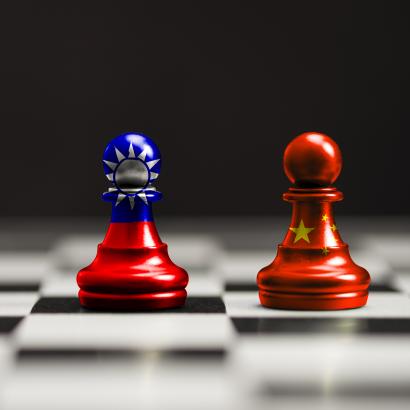
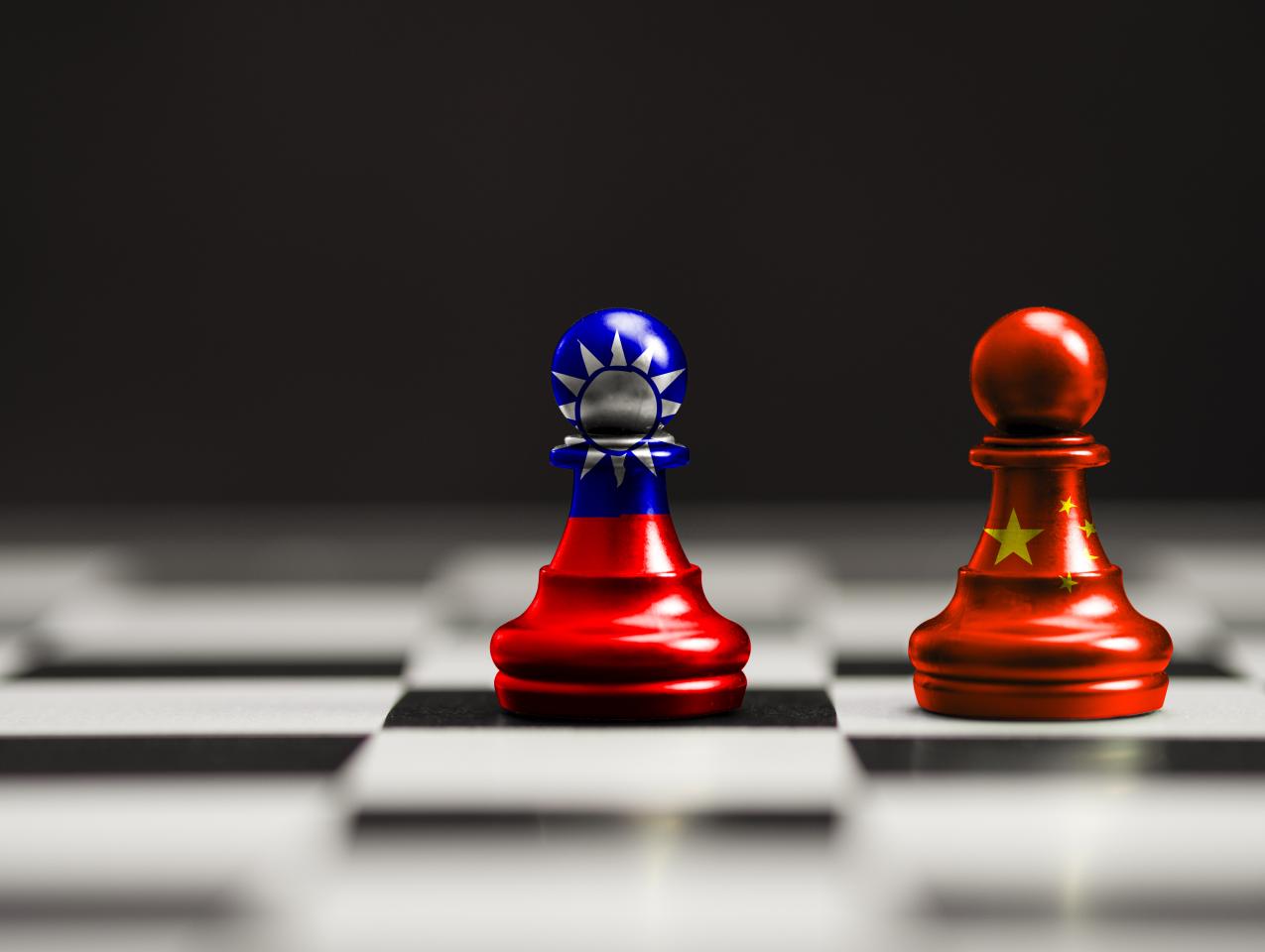

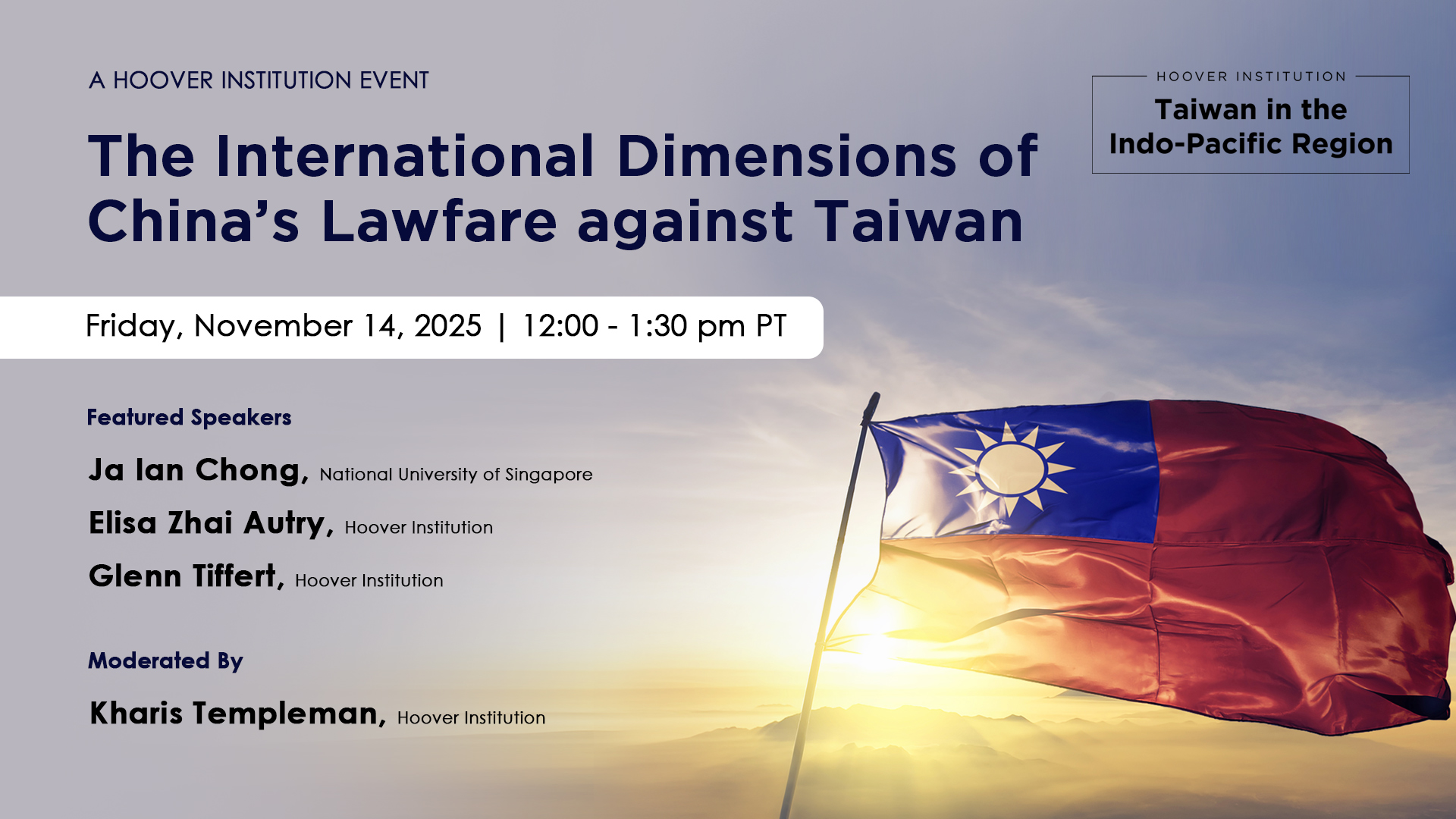
On behalf of the Project on Taiwan in the Indo-Pacific Region, the Hoover Institution held The International Dimensions of China’s Lawfare against Taiwan on Friday, November 14, 2025 from 12 p.m. - 1:30 p.m. PT in the Herbert Hoover Memorial Building, Room 160.
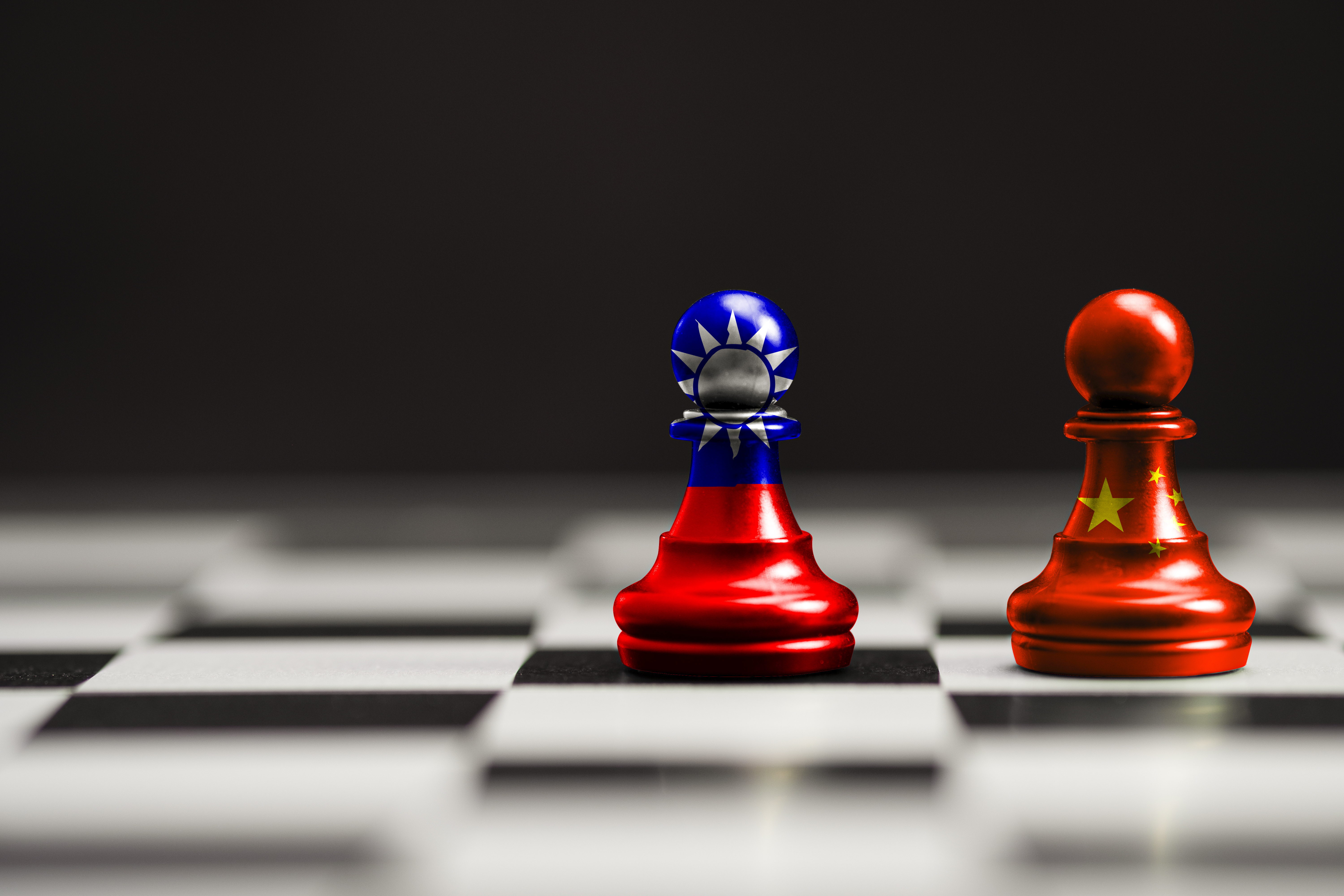
For several years, the People’s Republic of China (PRC) has ramped up its pressure on international organizations and on third countries to endorse its preferred position on the legal status of Taiwan. This campaign has born fruit for Beijing: it has made significant gains in the number of countries now signing joint statements that accept the “one China principle” – that there is only one China, that Taiwan is part of China, and that the legal representative of China is the PRC with its capital in Beijing and led by the Chinese Communist Party (CCP). These shifts in policy have been made possible in part by the PRC’s growing economic and diplomatic clout in the world, and by its increased willingness to make the one-China principle a precondition for bilateral cooperation on other issues.
To explore this issue further, this symposium brings together several experts on the topic of People’s Republic of China (PRC) coercion against Taiwan, including its efforts to deepen Taiwan’s international isolation, bolster the claim that cross-Strait relations are China’s “internal affairs,” and build international legal justifications to legitimate further coercion and potentially the use of military force against Taiwan.
- Well, it's great to see such a, a robust turnout. For today's event, I wanna welcome you all to the final event of the project on Taiwan and the Indo-Pacific Regions Fall Speaker Series. I'm Kapelman, I'm a research fellow here at the Hoover Institution and I manage the project on Taiwan in the Indo-Pacific re region. And the topic of today's session is the International Dimensions of China's Law Fair against Taiwan. I do wanna encourage those of you who are here in the room, if you haven't already, there is lunch in the back. Please make sure you get a box for yourself. And another housekeeping note for those unfamiliar with this room, there are no restrooms in this room, so if you need to use the bathroom, they are, the nearest one is to go out that door there, turn left and go down the stairs into the Schultz building another housekeeping item. This event will be recorded and posted to our website and on our Taiwan website, you can find all of our events over the last calendar year. I encourage you if you've missed previous events to check out our offerings there. I'd also like to note we are working on a pretty robust lineup for the winter and spring quarters. Stay tuned for announcements about that. We're gonna have some great content for you over the next few months as well. This event is also a hybrid event where we've got a virtual audience joining us today online. I wanna welcome you all to this event and I would like to note for online audience, if you have questions or comments, we encourage you to drop those into the q and a box on the Zoom platform and I'll monitor those throughout this session. And if we have time at the end during our discussion, I'll go ahead and kind of act as as a moderator and raise those questions of our speakers. All right, we have a great event planned for you today. This is on a personal note, a bit of a dream come true for me. I've been trying to get Ian Chong here for what feels like five years now and it's wonderful to have Ian here in person in the flesh in this room. Ian has joined us after a very long flight from Singapore and then he's proceeding on to Northeast Asia. And so I hope you're fully caffeinated and we thank you for your sacrifice in making the detour over here to North America before you proceed on to Asia. This Ian's presence here today is gonna be supplemented by two of my stellar colleagues at Hoover, Eliza Ja Autry and Glen Tifford. We've been trying to do something on this topic for quite a while now and it's a real pleasure to have all three of you here in person. The genesis of this event, I should note, was an article in the Economist that came out in February of this year entitled China's Stunning New Campaign to Turn the World Against Taiwan. The piece noted a rapid increase in the number of countries endorsing the People's Republic of China's preferred position on Taiwan. And that position is that there is only one China in the world represented by the PRC government in Beijing, that that government in Beijing enjoys indivisible sovereignty over all of China, that Taiwan is unequivocally part of China and that therefore the PS PRC is entitled to pursue all efforts to achieve what they term national unification without specifying or requiring that those efforts should be peaceful. Now, as the Economist article noted, and this really set my hair on fire, this last piece is new. It's a recent edition and as the economist put it, of the 70 odd states around the world that have adopted that position in joint statements, the vast majority have shifted in the last 18 months after a Chinese diplomatic offensive across the global south. I wanted to highlight three examples mentioned in that article. First in January of this year, the Sri Lankan president visit visited China and signed a joint statement that said, for the first time that Sri Lanka quote firmly supports all efforts by the Chinese government to achieve national reunification with no mention that it needs to be peaceful. Second example, in September, 2024, the representatives of 53 African governments all gathered in Beijing and signed a joint statement agreeing that Taiwan was Chinese territory and saying that they quote firmly support all China's unification efforts at the previous such summit in 2021. They did not explicitly mention Taiwan in a joint statement, but instead backed quote, resolving territorial and maritime disputes peacefully. In third example, Malaysia in June, 2024, a joint statement with the PRC used new language recognizing Taiwan as Chinese territory quote, in order for China to achieve national reunification, it stopped short of endorsing all unification measures, but this statement also dropped an earlier call in previous joint statements for peaceful efforts. To that end, now why does this matter? In my view, there are two reasons why these, I mean it's just rhetoric, it's just words, but to my mind there are two reasons why these statements and the trends in these statements are really of substantive importance for Taiwan and for the peace and security of the Western Pacific Pacific. First, these statements provide legal and political cover for the PRC to ramp up its coercion against Taiwan, including the possible use of force to compel unification on its own terms. If a majority of the countries in the world, if endorsed the PRCS preferred position, that bolsters Beijing's claim that Taiwan is entirely an internal affair and that international law and norms about the peaceful resolution of territorial disputes do not apply in this case. To put that differently, the PRC is laying the groundwork to justify military action against Taiwan and trying preemptively to divide and demobilize international opposition to that action. The second reason is that even if you don't care about Taiwan by itself, Taiwan is still kind of a canary in the coal mine it the Taiwan issue is a high priority for Beijing's diplomatic core and the PRCS demands on all states are the same that they endorse Beijing's one China principle. And so when we see variation in states' willingness to comply, that is at least a somewhat crude measure, but a measure nonetheless of how much influence Beijing has in these countries. And in particular the number of states that do so that comply with Beijing's preferred narrative about the Taiwan issue. That is an important indicator of of where PRC influence is growing in the world. And it should be alarming to you as it is to me at how quickly and easily Beijing has managed to achieve significant shifts in the rhetorical positions of so many states around the world. Now, for those of us who follow Taiwan, primarily in the context of US China relations, it helps place recent developments over the US one China policy in a broader context as well. For instance, president Xi and secretary President Xi and President Trump recently met at the APEC Summit in South Korea and reporting before that meeting suggested that the PR side wanted Trump to explicitly state he opposes Taiwan independence. End quote, not simply assert as many US presidents have done that the US does not support Taiwan independence. The differences here may seem subtle, but to Beijing they are extremely important. And a shift in language indicates a symbolic concession that will be used as a precedent to tie the hands of all future US leaders in this relationship. And in some cases, Beijing deliberately stretches or obscures the meaning of bilateral statements or other international positions on Taiwan's status to bolster its own claim that Taiwan is part of China and should be subject to the PRCS jurisdiction. In particular, the PRC has regularly asserted in recent years that the one China principle is quote, a basic norm in international relations and an established international consensus. And they regularly cite UN resolution 27 58 passed in October, 1971, which transferred control over the China seat on the National Security Council from the Republic of China, which was then on Taiwan and Taiwan only to the People's Republic of China. They claim that that resolution also endorsed PRC sovereignty over Taiwan, but in fact, UN resolution 27 58 says nothing about Taiwan. PRC representatives often also assert to American institutions, including academic institutions like this one, that the United States, one China policy accepts that Taiwan is part of China and does not enjoy separate sovereignty. The problem with that is that the US position actually does not accept that Taiwan is part of China. And so for the record, I thought in the final bit of my remarks here, I thought it might be, and I will, I will spare Ian the opportunity or the the, the pain of trying to explain the US one China policy. So I thought I'd just kind of lay out in practice what the US one China policy actually says. The US has a one China policy and even the indefinite article here is important. It indicates that there is something different about the US as one China policy from those of many other countries around the world, and that it is different from Beijing's one China principle. The US position on Taiwan is based on the three joint communiques between the US and the PRC in 19 72, 19 79, and 1982, the Taiwan Relations Act, which is an act of Congress that has written US policy into law and the six assurances delivered to Taipei in 1982. The key elements of this policy include that the US in 1979 and continuing until today recognizes the PRC as the sole legitimate government of China. The US ended diplomatic relations with the ROC on Taiwan and cut off official ties with the government in Taipei at the same time that it normalized relations with Beijing. The us however, in doing so, did not take a position on Taiwan's status as part of China. It acknowledged the PRC position that Taiwan is part of China, but it did not recognize or accept that position or Beijing's claim to have the right to rule over Taiwan. Instead, the US position then as now is that Taiwan's international status remains undetermined unsettled, and that the resolution of that status must be both voluntary and require the consent of representatives of both sides of the Taiwan Strait. The US has also maintained a separate parallel policy regarding the defense and security of Taiwan. The, the US in the Taiwan Relations Act notes that quote, any effort to determine the future of Taiwan by other than peaceful means, including by boycotts or embargoes, is considered a threat to the peace and security of the Western Pacific area and of grave concern to the United States. The TRA also states the US will provide Taiwan with arms of a defensive character and shall maintain the capacity of the United States to revisit, to resist any resort to force or other forms of coercion that would jeopardize the security or social or economic system of the people of Taiwan. So here today to help us understand in a bit more detail the nuances of various one China policies around the world and how the US kind of fits into this broader picture and the consequences for the peace and security of the Western Pacific, I'm really pleased that that we can have Ian join us today. Ian is going to introduce his own work on this topic. He's written quite extensively about it, and then that will be followed by comments from our other two colleagues here, Glenn and Elisa. So without, well, I should mention Ian's background here. Ian is an associate professor of political science at the Nashville University of Singapore and a non-resident scholar at Carnegie China. He received his PhD from Princeton in 2008 and previously taught at Hong Kong University of Science and Technology. And his research covers a lot of different areas, but in particular the intersection of international and domestic politics with a focus on major great power competition, nationalism, re regional order security, contentious politics and state formation. Without further ado, we'll turn the floor over to Ian.
- Thank you very much Karis for your, for the invitation here and for the very kind introduction. So I guess where I'll start is to talk about this idea of a singular China. I've got some slides. So I, I think where I I'll start is to talk about this idea of a singular China, which is in some ways fairly, I would say novel in the sense that it's very much of a late 19th century, early 20th century vintage before that China or the Chinese empire was many, many different kinds of things. And the reason I mentioned this is because if you look at a lot of PRC claims today, and in fact the ROC claims before that, there's a gesture towards, since ancient times, it's, you know, lots of states have their borders change over time. If you think about the United States, the fact that we here now in California are part of the United States that wasn't, you know, part of the original 13 colonies, the, you know, borders expand and they change. So that's, there's nothing wrong with sort of having that changing in border, but I think it's important to recognize where the PRC makes their claim. So just to give you a sense, first is the, so the Chinese video, you get a, to show you the sort of borders of what was considered the sort of different Chinese polities. It's quite quick, excuse me, grammatic music. This is from TikTok I think I took it off from, but what you can see is that different Chinese polies come up, they have very different borders there, you know, what is considered China that, you know, there, there are lots of fights over it, there's lots of fight about fight. There are many fights over who is the imperial center before things sort of, you, you see that the sort of boundaries, they, they split, they expand, they contract. And that goes on for a while until we finally still running. But we'll finally get to what the PRC looks like today. We're getting there about 700 years more and okay, so Ching, and that this is the PRC that we we have today. So just to give you a sense that this idea of one China is part of the whole modern Chinese state building process, right? It's not something that is given and the assertion of one China is in many ways an effort for people who self identify as Chinese and Chinese nationals to create this sense of, of a Chinese nation. And that creation of a Chinese nation, like the creation of many other nations and many other states has to do with a certain linguistic conformity as well. So the, what is today, the PRC actually contains, you know, multiple Sino phone languages and also nons phone languages that are mutually unintelligible. Just to give you a very quick sense, I've got this, the cook just basically saying the same thing, but you can see it, they sound very different. Okay, whoops. But just that, that isn't the whole thing. But just to give you a sense that there's a lot of linguistic diversity in, in the PRC today and the sort of standardization around Mandarin is part of this idea of creating a singular China, right? And the, and when this idea of a singular China gets challenged, you know, the, the PRC state today, but it always has been the case, but today has been very quick to sort of clamp down on it. So, you know, there've been scholars mostly based in the United States, but not just the United States who've been looking at Qing history and trying to understand the Qing empire as an empire. They, they've been sort of loosely termed the, the people who work on new Ching history. And one of the things maybe about 10 years ago, but continuing, continuing until today, that you have the Chinese Academy of Social Science. This is their sort of main social science of body research body. They came down very hard against this sort of, this approach. They call it, they called n ch history splitters, they call it an American plot, which you see in the headline here, they sort of, I mean n chch history is something that comes out of the ade. It's got nothing to do with the US government, but there's that conflation, right? So you get this sense of that the PRC feels very much challenged when this idea of a singular China co comes under pressure or is comes under question. So that, that's not to say that Taiwan has, al has the position of Taiwan has always been sort of clear. Taiwan has been on the frontiers like many other places on the frontiers. There's lots of questions over what, where it comes in, where it goes out. The Khi emperor had, you know, called Taiwan a ball of mud. You have Ong in 1936, this is a very famous interview. He gave Negar snow where he talks about supporting, you know, Taiwan independence movements as he would support Korean independence movements. So you get this idea that ti where Taiwan fits in hasn't always been very clear, even though at this time what Mao is also arguing against is this is the kts Republic of China that does have, you know, a sense of creating a a one China. But that sense of one China comes from an effort to tamp down on the various militaries regimes that were challenging the, the non-kin government at the time. So the point that I'm trying to drive home here is the sense that this one China idea has been historically fluid. It is something that is, it comes from a very clear sort of historical political context and that's how we should understand it going forward today as well. So this gets us to the point of this one China principle, one China policy. So this is what Karis had mentioned earlier in the Shanghai communique. What you have is the, actually, if you look at the text of the Shanghai communique, it's really interesting because it's got a paragraph that says, the US government says another paragraph that says the Chinese government says this other thing. They basically talk across each other. It's basically a set of statements that point to agreeing to disagree. So you have the PRC government making this claim that they're the, that the, that Taiwan, that the PRC is the sole legitimate government of China. Taiwan is a province of China, has long been returned to the motherland. Of course you can ask, okay, if the long been returned, then why is the issue of unification an issue? But that aside, that's the, that's the PRC claim, which is important. That's the baseline that we're starting with. And if you sort of look at the US claim, this is what KA had also been referring to earlier. The US acknowledges the position that all Chinese, there are lots of qualifiers here, right? That, you know, the US acknowledges all Chinese. We can ask, you know, what happens when people don't see themselves necessarily as Chinese in different ways or what does Chinese mean, which that which is pretty variable as well, and the US doesn't challenge that position, right? If it doesn't challenge that position doesn't necessarily support or do other things about that position, right? And then the, this is a bit about the US also talking about having a peaceful settlement and predicating all of this on the expectation there's a, that there's a progressive reduction in intentions across the Taiwan Street. So, you know, there are lots of qualifiers here and we can of course ask ourselves, what if these conditions start to not hold anymore, including this expectation that tensions across the Taiwan Street diminish. If it doesn't diminish, what, what does that do to the, you know, the statements prior. So you can see in the US and the PRC position, while they're talking about one China, the US one China policy is clearly distinct from the PRC one China principle. But because the terms are so close, it's very easy to conflate. And if someone chose to, they can sort of con confuse, especially for people who are perhaps less familiar with the nitty gritty of a lot of this stuff. Okay, so just to bore you some more, this, the text is very small. I don't expect you to read it. But basically the, this whole acknowledge the Chinese position is repeated in the 1979 communique that establishes formal diplomatic relations between the United States and the People's Republic of China. And in the 1982 communique that talks about a gradual drawing down of arm sales, again, predicated on a peaceful, on a peaceful progression in cross trade relations. That too has this acknowledgement. Now I raised this because one thing that you will see is the PRC claim that the US has stepped away from a promise that it ha that it saw Taiwan as part of China. That is, that is equated to the PRC. So if, if we understand the history of this, it, it clearly, it's clearly the case that the Chinese claim is pretty much overstated. Okay, moving, moving along. Again, this, I apologize for the really small text, but the way that I've sort of arranged this is like if you look down at the different one China policies that different states have, they're clearly divergent. There's some that are very close to the PRC position. There are some that are closer to the US position, but suffice to say that there's a spectrum and it's not all convergent with the PRC position. And essentially why this exists is why this divergence exists is because states they, when they negotiate for diplomatic relations with the PRC, the PRC often insists on this some sort of one China language. And depending on what interest the state has, depending on how much they want, they feel that they can trade this point of one China with some other point. They'll have language that that sort of reflects that. And whatever the two sides end up agreeing on is the sort of one China policy language. Of course this can get changed over time and I suspect this is what the PRC is trying to do is change, is to try to change the one China policies of the various different states. I'm not the only one who's sort of done this or looked at this, Benjamin Herskovitz from Australia, he's looked at it, we sort of cut things up in different ways. He has a more elegant sort of five category where eyes have more, I have a more clunky sort of 10 category that I try to get to more detail. But the point is that there is a spectrum and it's not just me that's seeing this, right? So what does all this mean? Just, I'll just give you a few examples to give so that you, you get some of this fleshed out. So I'll talk about one that I know quite well. This is the Singapore position, which, you know, I'm, I am from Singapore. If you look at the recognition or the, the establishment diplomatic relations to communicate this would be the two docu. The the the PRC document on the top and the press statement on the bottom you'll find that the commu the, the statements about establishing formal diplomatic relations say nothing about Taiwan. They say nothing about one China. But on the 10th anniversary of formal diplomatic relations, this is where the one China language gets introduced. But this, just to give you a sense of how this variation, I talked about what the US one China position is. What you see with the Singapore one China position is that it recognizes that Taiwan is part of China. This next sentence says the government of the Republic of Singapore recognizes the government of the people's Republic of China. What is missing in here? Does anyone know what's missing in here? The what's missing is the equation of the people's republic of China with China. So the Singapore position is there can be a China that is some abstract thing out there and Taiwan is part of this idea of China, right? And it recognizes the PRC whether the PRC is the same as that idea of it's ambivalent on that, right? So you can see how with one China, there's quite a lot of wiggle room to play with, right? So on this, what we find is there's the variation. What Harris had mentioned is over really the past two, three or four years, Beijing has been pushing hard to try to change the language that others have on one China and the Taiwan question in this white paper that they have on from 2022, you find that there's a claim that over 180 plus countries recognize the one China principle. But what they actually mean, if you go back and look at the table that that I put up, and if you, that comes from an article I wrote for Carnegie China. Ben Husk also has a piece that he did for Lowe. If you actually look at the, the content of it, most of the countries have some version of the one China policy. It's not the one China principle, but that's the claim that Beijing is trying to afford is the claim that it's trying to convince others of. And it's also the position that's trying to shift other governments to take sometimes taking advantage of the fact that a lot of this one China language is very convoluted, is very difficult to get into. And you know, policy makers and bureaucrats may not be that familiar with this language. So just to give you a sense of how we're going on this, this is something soon after the white paper was, so this, so this year after the white paper was released, the PRC was really pushing hard to get people to under to see their one China countries, one China policies in terms of p the PRCS one China principle. And to push this line that the US had walked back on its acceptance of the one China principle. So here in the many embassies around the world, including the P many PRC embassies around the world, including the SPRC embassy in Singapore, put out this video of President Carter doing this, reading out the recognition statement from 1979. Just take a quick look at it, it's not very long.
- The United States recognizes the government of the people Republic of China as a sole legal government of China. There is, but one China and Taiwan is part of China.
- So from there it looks like the US has taken on the PRC position. But this is actually edited from a much longer video, which you, where you can see some of the real differences. And this is when I, when I say the PRC is trying to confuse the picture, this is what we have.
- Good evening. I would like to read a joint communicate, which is being simultaneously issued in Ping at this very moment by the leaders of the people for Republic of China. A joint communicate on the establishment of diplomatic relations between the United States of America and the people Republic of China. January 1st, 1979, the United States of America and the people Republic of China have agreed to recognize each other and to establish diplomatic relations. As of January the first, 1979, the United States recognizes the government of the people Republic of China as a sole legal government of China. Within this context, the people of the United States will maintain cultural, commercial and other unofficial relations with the people of Taiwan, the United States of America and the people Republic of China reaffirmed the principles agreed on by the two sides in the Shanghai communique of 1972 and emphasized once again that both sides wish to reduce the danger of international military conflict. Neither should seek hegemony. That is a dominance of one nation over others in the Asia Pacific region or in any other region of the world. And each is opposed to efforts by any other country or group of countries to establish such hegemony. Neither is prepared to negotiate on behalf of any other third party or to enter into agreements or understandings with the other directed at other states. The government of the United States of America acknowledges the Chinese position that there is. But one China and Taiwan is part of China,
- Right? So what you see is President Carter's sort of very long careful statement has been truncated and put for public consumption in such a way that is highly misleading and confusing, right? So that's part of the push that we see Beijing trying to make. But this comes across a bunch of other fronts as well. So for instance, one of the things that Ba Karis had also mentioned that Beijing's trying to push is this idea that un resolution 27 58, which seats the PRC government at in the United Nations. That document has deter that has decided the status of Taiwan. It actually does not. You can see the text of UN of the resolution here on the right hand side. It just talks about the sea text talks about expelling, the representatives of Chen Kai-shek is, has nothing on Taiwan, but because many people, including people working in the press, don't bother to look at a lot of the actual text. There's this perpetuation of, of this misguided belief that, you know, UN 20 re resolution 27 58 says a lot more than it actually does. It's not the only area where we see this. The PRC is also pushing very hard on the Cairo declaration saying that you, Taiwan is part of China. The C declaration does talk about Taiwan, but if you note the Cairo Declaration, it's not a treaty, it's a, it's a statement, it is a press communicate, it's a announcement of intent. But the PRC is trying to make that as if is a, it's some sort of legal document. If you look at the San Francisco treaty sign, not too far from here, establishing the UN and having, it's a peace treaty with Japan where Japan relinquish, right? It's it's authority on the territories that are ly occupied. What you can see from the text is Japan relinquish control over Taiwan pescador, but it does not say to whom the PRC makes this claim that it's relinquished to the Republic of China. What you a actually is the case is that the ROC they had taken over and administered Taiwan in the same way that the US had was administering Okinawa, right? So those, whereas the actual sovereignty ownership question was left open you and you see in the Treaty of Taipei a separate treaty between Japan and, and the ROC, again the, because it governs the relations of people and property in Taiwan and in and in and in Japan. The Japanese are very careful to restrict this to actually Taiwan and Pescado 'cause and move away from the OCS claim about controlling all of China. So you can see that in the, these documents, there's a lot of vagueness of where Taiwan is buying, you know, part of it, a lot of it is intentional, right? So San Francisco Treaty, this is height of the Korean War. Now the, what the PRC is doing is to try to, you know, reinterpret and to give meaning to these texts that they don't actually contain. And that's, you know, something that they've been trying to do quite a bit. And when you see various governments who sometimes are perhaps less familiar, this is the economist, economist piece that Karis had talked about, they will sometimes quite readily take on the PRC position because there's some promise of some benefit or sometimes they're just less clear about their own positions. I take the Malaysian and the Malaysian position here. Yeah, and the, I also talk about the Indonesian one too because these are quite recent. So Malaysia, there was that change in language that Kaas had mentioned. But what was, what's also interesting here with the, with the Malaysian piece is that the understanding that came across in the communique between Prime Minister Anwar and, and Xi Jing and State Chairman Xi Jinping, that, you know, apparently they had did not, that was done through the Prime Minister's office. It was done without sort of more consultation with the Ministry of Foreign Affairs because apparently they were, the Malaysia side was trying to, you know, reach some sort of quick agreement with, with the PRC and didn't sort of consult the past record. So this is something that you can get with decision makers who are unfamiliar and think that, you know, the things that they can, may be more willing to trade off than they perhaps should be. Similarly with the Indonesian statement there, you see that repetition of the UN resolution 27 58 piece, which of course as we saw earlier is not true. And again, the Indonesian statement between PBO and Xi Jinping, sorry, the Malaysia one was with, with Anwar and, and Li Chang, the, the premier, the, the Indonesian one was between Xi Jinping and, and President Pao. Now in this case the acceptance of year resolution 2058. And also they, there was another part about, you know, shelving a dispute between the PRC and Indonesia to, to, to be short Indonesia doesn't recognize, historically doesn't recognize that they have a dispute with the PRC because they say that PRCS claims have no legal basis. But at any rate, what President Pau did was again to, you know, agree to this language without consulting the Ministry of Foreign Affairs Chem Lu in, in Jakarta. So both Chem Lu and lots of Indonesian policy people were very surprised by this position. Again, it's an example of the PRC pushing on a position to people who might be less familiar with their own countries positions on, on on one China and so on. So that's not the only thing that that we see, you know, it's, it's not confined to Taiwan there and there are other issues of sovereignty and other disputes where the PRC seems to be trying to change the meaning of text and so on and so forth. The Indonesian sort of acceptance of a shelving of dispute that that should not have existed in the Indonesian province. That's in the Indonesian sort framework is one thing. Another is this arbitrary tribunal under convene under Article seven of Unclos where the Philippines basically took the PRC to court to try not, not to determine who owned what because Unclos doesn't do that, but to determine what features are in the South China Sea. Now why this is important because if, if features are an island, you get to claim things like a territorial sea and a 200 nautical mile exclusive economic zone. And if they don't, then even if you own them, what you claim is far less. Now the PRCS nine 10 dash lines, that's, you know, the closest approximation is if you assume that the south, the Raley islands are the Raleys are all islands and they, and China occupies them and CCCU and has, and they can all generate exclusive economic zones. So that's why the PRC was very unwilling to accept the arbitrary tribunal. They didn't even take part, they, they said it was illegitimate. They said it was, it had no jurisdiction and that it was le illegal even though that, even though, you know, all the sort of processes that it went through was under unclos, which the PRC had signed and ratified, right? So you see this sort of effort to challenge meanings, not just related to Taiwan, but a whole bunch of other things as well. So, so this is the so unclos and you can see that the PRC had signed, assigned, you know, when it came out, but ratified in 1996, well before the tribunal, it was about 20 years before the tribunal. So, and that just gives you a sense, you know, if if the tribunal's, if the tribunal's arguments award is correct, then the sort of 10 dash line claim it, even if China, you know, you know, legally held all the set front island, they can't make this claim, right? So when the PRC is faced with these sorts of challenges to their position, you find that they, one of the things that they've resorted to is this blurring of lines why a lot of this is important. Whoops, not too far. Sorry, that's the tho those are ceilings and stuff. We can talk about that if you want. But the point is that the broader implication of, of a lot of this is if we see meanings of text documents, treaties, or even just agreements that are not trees being reinterpreted meanings getting inserted that are not written, then we are in a world where basically there's a lot less room for the rule of law. We're in a, we're in a world where, you know what the more sort of ability you have to muscle your way around, that's what goes rather than to have, you know, clearer institutions and, and the rule of law, of course for medium, medium and smaller size powers, that becomes a very significant challenge to their ability to hold onto the interest. So that whole one China issue, you know, given how vague it is moving to where we are today, has the potential to hollow out a whole bunch of, you know, parts of international law. Of course the PRC is not the only actor to do this, but the more major powers do this, the more the whole system comes under pressure. Okay, let me end there. Thank you.
- Okay, great. Thank you Ian. We've now got Elisa Jai Autry, who is a research fellow at Stanford's Hoover Institution, where she contributes to the human security project advancing security, liberty and prosperity in authoritarian countries. She has joined us fairly recently. We're glad to have you here. She was previously the principal policy advisor on global China and East Asian Pacific Affairs in the Bureau of Educational and Cultural Affairs at the US Department of State as the Bureau's China expert and chief liaison for diplomatic affairs involving China, Hong Kong and Taiwan. She played a key role in shaping public diplomacy strategies and advancing US foreign policy objectives worldwide. And so in other words, she was on the front lines of this in terms of US government's response to PRC pressure on these issues. So really looking forward to your thoughts on this topic.
- Thank you. Well, thank you for really, really wonderful discussion. Very informative. Think I'll, I'll come a little bit from, from this is, you know, what we talk about as a scholar and then I say almost everyone from here, we're already a little bit confused, right? We have no idea about all these versions. Imagine you are the most informative people probably in America, probably in the world. Imagine the general audience. Imagine someone from Vietnam, someone from Zimbabwe, someone from someone from Palau. Hear all of this. What's their response? I have no idea. What are you talking about? Where is Taiwan? So, so, so, so I wanna talk about how did the government of China, China de deliver all of this to the actual buying of a country? How did in the world that now you have only 12 countries only have diplomatic connections ties with Taiwan and seven of them are in Latin America. So let, let's zoom in a little bit on Latin America. So in, in, in short, I won't go into too much detail. This is all open source information. China's spared no expense to influence the country to buy in of this, to, to be willing to take sides, switch sides from Beijing to from Taibei to Beijing. So what does that look like? That there, there is a national strategy from the PRC side to, to influence at all levels possible to deliver a strategy and a law like this to the day-to-day other people in, in Palau in Guatemala. So let's see, for example, you, you can think about in this as a carrot and sticks perspective, right? You have all kinds of economic coercion. Of course if you agree, I'll, I'll, I'll buy you, I'll I'll give you three ports, don't gray, I'm gonna kick you out of a, a trade agreement. But there's so much more in influencing the people. You know, for example, what, a couple years ago I was in Greece, a land of philosophers we talk about on Taiwan and you have a little bit, a very small group of indigenous, Greek China experts and much of them are actually know very little about Taiwan situations. And what they know, as you can guess, are from their engagement from Confucius Institute. So in other words, within the limited knowledge on Taiwan, much of a much of it is already shaped by PRC narrative. So that's actually one of the tactic is for China to, to influence the China expertise in this country to shape the experts who would talk about this. And now let's move on to the general public you have even on these countries that you don't have official ties. The influence to, to bring the officials to China from all kinds of, or expense paid for trips, visits to shape your correct understanding of China is tremendous presidency just launched a new initiative May 25, as part of that engagement with Latin America. That in, in that part of that initiative, they talk about China will bring 900 officials from all these countries to China for official visits. How does that visit make a difference? Tremendously. They will will shape how you view and they will help you to see the correct China and they would help you probably have a lot of financial benefits coming out this spaces. And also youth you, you've probably heard of, again, Chi, one of the ways that Taiwan maintaining this diplomatic ties with this country is to say, is to say, we, we give you a really good support in, in healthcare, in, in digitization, in emerging technology. Well, China would say, I have that too. I have even better ones. For example, Huawei. So everybody heard about Huawei, right? So when you think about Huawei, what what comes to your mind there? Tech, there's a tech company, right? But in many countries, Huawei was the pillar for soft power influence. They're the one to move over. Confu Institute, it was Huawei in almost every single country hosting and sponsoring ai, emerging tech training programs for many of those global south youth. And just even look at those countries that Latin American countries that still have ties with Taiwan, they're very aggressive in bringing youth to China. So, you know, no official ties, no problem. We have other regional ties, we have other regional influence mechanism, sub-national influences, a comprehensive, comprehensive whole society influence to change everything you discuss here into the hearts and minds of the people. Also in, they would also in these countries who either previously had ties with Taiwan or currently removed Taiwan on textbooks. If you buy say a net, you can try actually net geo atlas, you will see, sadly Taiwan does not be part of that section on Asia. So eradicating discussions or even mentioning of Taiwan in all these countries is a long line to say, hey, I will gain not only a legal recognition, but also a recognition of the hearts and minds of the people. I'll stop here from now.
- Okay, great. And finally, bating clean up here we've got my colleague Glenn Tifford, who is a distinguished research fellow at Hoover and a historian of modern China. He co co-chairs Hoover's program on US, China and the world. And he also leads Stanford's participation in the National Science Foundation secure program, which is an effort authorized by the Chips and Science Act of 2022 to enhance the security integrity of the US research enterprise. Glenn,
- Thank you. Ka I don't like sports metaphors because sometimes I drop the ball, but you know, I think it's a great service really that, that Ian has done here to organize the evidence and present it in such a crisp way. Because very often it's our atomization that works against us, our, our unawareness of what other actors are doing in this space. It's, and it plays into a divide and conquer strategy. I think that the PRC in particular has been relatively adept at adopting. I wanna back up a little bit and just talk more broadly as I think others have really about, you know, how the PRC regards word games as a cognitive strategy and it's largely to build coalitions that other mi well otherwise might be more resistant to seize discourse power. More than a decade ago, the PRC identified seizing discourse power as a major initiative. The, the notion that the west and in particular the United States define the terms of international law, universalization of human rights and various other measures, including international standards on technology for that matter, was deeply appalling to China because it realized it was always on the back foot. So these word games are also an attempt to kind of shift the ground of language underneath us and redefine it in a way that's more conducive to PRC interests. So they do that by reinterpreting terms like human rights, democracy, autonomy, sovereignty. And by doing that they essentially redefine the status quo and they inject uncertainty into the environment about what these things really mean, which creates a permissive environment for the PRC to move the envelope. It really seizes on the decentralized nature of our information and political spaces because we have diverse democratic pluralistic spaces in which there is not a sort of monotonic state perspective articulated. We know how the PRC is in that respect and really sometimes it trades on efforts as I think as Ian made clear for us to paper over differences as the United States, you know, and China that might be a little too clever by half, you know, language that serves an immediate diplomatic purpose that creates ambiguities for people to agree to disagree, but then may come back to bite us by allowing China to push the envelope. The bottom line really is that this, as a general matter matters much more to Beijing, at least when it comes to Taiwan, than it does to almost any other government around the world. And the, and Beijing really benefits from that asymmetry because they're willing to invest much more in, in, in these kinds of word games. I mean, a great example of this happened early in the first Trump administration when Beijing decided to go to US airlines and hotel chains and require them as a condition of essentially doing business to redefine the way, the way they represented Taiwan on their websites. So if you're buying a plane ticket and you wanna fly to Taipei, you don't find it under Taiwan. Now you find it under China and the White House pushed back very hard on this and yet lost because our firms continue to wanna do business with China and they're free to make their own choices, right? And so what it does is it, it it changes facts on the ground underneath our own feet in a way that often gets ahead of where our political positions are. Another way in which this happens is in the release of readouts after summits very, we very often western governments are too slow in defining the frame of what happened in a summit. And the PRC moves quickly articulates what happened, who talked about what, what didn't get raised. And they kind of seize the discourse power in, in that moment. And our western governments are, are not attentive enough actually to challenging the PRC assumptions when there are differences about what happened in the room and what was discussed about, you know, sometimes there are attempts, for example, to create things that never happened. You'll recall the Apex summit here in San Francisco at which Xi Jinping met with President Biden and very quickly China in the readouts and in in reporting afterwards spoke of a San Francisco consensus and it tried to define what that consensus was to box in the United States and create paths in which the united, it was challenging the United States to in fact resist the idea that there was any consensus that came outta that meeting on things that, that mattered to China. Similarly, the effort to talk about a new model of great power relations, this was about a dozen years ago in which at that time the United States actually did push back and said no, the United States is not essentially in favor of a G two, though funnily enough in the media today we are in fact talking about a G two and now it's China that's pushing back on that notion. As a reflection, I think of how power relations have changed just in the last 10 days. We've seen a a little diplomatic, minor diplomatic conflagration breakout between Japan and China. And very interestingly in the pushback from the foreign ministry, what we often see is the Chinese texts of remarks differing in important respects from the English language translations that the Chinese foreign ministry provides. So in the Chinese language texts of their protestation to comments made by Prime Minister Takai in Japan, they spoke about the Japanese prime minister's comments representing an active invasion on Taiwan, right? But the English language translation was active aggression. And so they're messaging different things to foreign language audiences in English versus what they're messaging at home in Chinese. This is really important also in English language spaces in the media with respect to Taiwan, because to an amazing degree, US media have picked up PRC talking points when they speak about reunification of Taiwan as opposed to the stat, you know, Taiwan was never unified with the PRC just as a pure empirical historical matter. And yet that's a subtle indicator of the way in which the PRC has changed the way our media talks to our publics about Taiwan. You also see this at the subnational space in the United States in which PRC consulates and the embassy are very quick to go to elected officials at the, at the state government and local level to explain to them what US policy on Taiwan is. And as you might imagine, it's not exactly an accurate explanation. I mean it's a convoluted policy to be sure, but it's explained to them in a way I think that very much favors the PRC positions. And the purpose of this is to disincentivize local US political leaders to meet with representatives from Taiwan to shrink the space within the United States that's available to Taiwanese representatives to pull the ground out from under Sister city agreements that exist between local governments and states and, and and entities in Taiwan. And so, again, changing facts on the ground and unfortunately our local actors very seldom have the resources level of sophistication or knowledge to understand that the PRC is not accurately reflecting these interpretations and that there's a hidden agenda underneath. Let pivot for a moment to lawfare because language and go together very closely. You know, law fair is a, is shall we say, a more assertive strategy to silence critics and change policies. We see that here in the, at the Hoover Institution actually in contestation over an important component of our own archival collection in which the PRC is essentially using US law and US courts to bury or disappear inconvenient sources in the historical record. We've seen an increasing use of lawfare against think tanks and journalists who are writing reports in the media, but also scholarly reports that document things that have consequences that are adverse to the PRC. For example, a think tank in Washington published an excellent report looking at BGI at a time where the US Congress was considering the BIOS secure act. And this report was politically impactful in a way that, that that favored one side of the argument in, in the Bio Secure Act. And so BGI hired a, a US law firm to write threatening letters to the think tank and the authors of that report asking them to disavow the report, otherwise there would be legal action that potentially bankrupt the authors and going up against BGI, which is a billion dollar company, which has even deeper pockets because it's backed by the state. The PRC state is challenging even for an institution as rich as Stanford or as others. And so again, it's meant to kind of silence people and change the discursive space in which we operate. There are ways too, in which the injection of ambiguity over the status of Taiwan is meant to create space in our civil society to mobilize groups, to advance positions that are sympathetic to the PRC. And it can be really hard to understand whether these are surrogates for the PRC non-state proxies or whether these are authentic positions, which of course under the First Amendment people should be able to be, you know, free to express. But where this really, where the rubber really meets the road on this is it complicates our ability to prosecute cases of foreign interference in foreign agents because it allows the defense strategies and defense counsels of people who are accused of being foreign agents operating unregistered in the United States to argue what's the big deal? This is actually US policy anyway, and you confuse the jury about what it is. And so it's a good discursive strategy actually for getting your defendant off. So then let me pivot quickly to social media because I think this is key in that we don't give it enough attention. Maybe it's generational. I just see in my own household the anchoring effects of new media on public consciousness. You know, there's a, a real concerted effort backed by the state just across the board in every media space, but especially new media, social media to cultivate a new who internalized PRC positions. It is just natural to them because they see it in very visually appealing seductive ways, short form videos. It connects with their own sense of injustice on what's happening in their own societies. And this has been brilliant because it is allowed the PRC in particular to connect with a generation that it's more traditional methods of propaganda were missing. For example, in Southeast Asia, the PRC very often acted through sympathetic Chinese language newspapers, but very often younger generations were no longer as proficient in Chinese and they weren't turning to the Chinese language newspapers that their parents or grandparents read. So the PRC messages were not reaching those younger people, but in social media very often they are now because they're arriving in local languages. And so this is huge also because the goal here is to really affect the level of local public support within nations that are among Taiwan's friends for the expenses of blood and treasure that might be required to defend the autonomy of Taiwan and to defend the autonomy of Taiwan to determine its own future. And so again, changing facts on the ground. So I just wanted to leave those thoughts on the table.
- Okay, great. I wanna do one round with the three of you and just pose a couple questions to you and have you respond quickly to those. And then we'll open it up and I'll keep a list here of questions. We'll go until one 30 here. The, the first question is, I, I think we've done a good job of, of pretty much destroying this argument, but I just wanna put it on the table anyway, which is, I, I sometimes hear people say the, the kind of gray zone or the, the sharp power or the narrative elements of this challenge, at least for the United States, are beside the point. Who cares about all of rhetoric? Because it's just rhetoric, it's just words and it's the hard power military balance that should be our singular focus on in the Taiwan Strait. And so why should we care about all of this kind of battle over narratives and rhetoric and discourse power? And then second, if it does matter, what should we do? You know, what is the, we've got someone here who was in the US government, what kind of options are available to do more than we are doing now at institutions like our own here at Stanford in local governments? And you can think of some of the other civil society organizations in the United States. Is there a relevant, legitimate role for these organizations to play in kind of reshaping or pushing back against this concerted effort by an authoritarian regime to shape how we think about the Taiwan issue. So Ian, I'll I'll give you the flow first.
- Thanks. So I think it's, there are a couple of things I think are important. One is this sort of idea of knowledge about the topics, and the other is to actually see the broader patterns that are out there. I'll start with the second first. So I mean, we've talked a lot about Taiwan towards the end I tried to mention things about the South China Sea, but it is, I think with the PRC, it is a pattern of, you know, when they try to shift some of the, the language, and it's not, it's not new, it's just that they've been a lot more assertive and active in, in pushing this kind of, to, to give you a few examples, not again, not to not that far from here. In 2015, there was the Sunland summit between she and, and President Obama. There was a commitment, apparently, well, she said it in a sort of joint statement, I just checked it, that he did not intend to militarize the South China Sea Islands that the PRC had occupied and reclaimed. Well, they did. There was apparently US broker negotiations between the Philippines and the PRC over Scarborough Shoul. In 2012, both sides withdrew, then the PRC came back. So you can see that there's that, you know, that sort of turn, you know, supposedly promising things and then sort of walking back, that's not new. You can make claims about what lots of countries, of course, are violating what the WTO is doing. But the PRC is party to, you know, one of the reasons why it stuck, if you look back as early as 1972, the PRC had removed Hong Kong and Macau from the list of colonies. So they cannot seek self-determination. So that gives you a sense of, you know, how far back this goes. Just that it's a lot more active now. So you can see that across a slew of issues. This playing with language, this walking back of promises made is something that's common. Of course, many big powers do that, but if we think that the rule of law is important, is important, I guess it's probably imperative to sort of note that and push, be able to push back against it when necessary. Now, the other thing about knowledge is a lot of how this sort of playing on vagaries and confusion functions is because policy makers and media people are not familiar with, with the, with the topics. So this is where institutions like this one, you know, there is a, I think, imperative to educate, right? To make sure people understand what the context is so that things don't sort of are, it's, it's harder for things to get misrepresented. And also, I guess finally for policy makers to know your own country's position if you are posted to another country to make sure you know that country's position. So if so, you know the rules of the game under which you're playing. Yeah, that's it. Okay. Thank you. Even,
- Well,
- I think we are, well this is a welfare from the China side. Both MA and C said, you know, when they talk about the success of the Chinese Communist Party, we often talk about the three pillars of success. What are the three? You have the party ideology, you have the ideology driven military, and you have propaganda or united front work. So all of this discord discourse power to solve power, influence to all this other information warfare are all part of active warfare. Hmm. If we don't recognize this part of the welfare, we're already losing. So in terms of what we do, I think recognizing we are in a welfare, the soft power front is first step. And then also I would humbly suggest Taiwan would need a national strategy, or at least at a national strategic level to address non-military influence as much as addressing monetary influence.
- Okay. Good. Glen? Yeah, I mean, very briefly. I, i, I would underscore what others have said, which is role of institutions like this and scholars who understand this material, especially, well, we should not, you know, call out people who inadvertently reproduce the ambiguities that are intentionally injected into the discourse by the PRC. But simply try to literally write out to the journalists who say, this is exactly what the position should be, please try to do better as you continue to talk about this in the future. And maybe even explain it a few times to your readership so that the public understands in a more sophisticated way. But I think really a, a problem in this, and I, I know that this is about the international dimensions of law fair against Taiwan, but the challenge really is that Taiwan internally is not unified around many of these issues as well. And so I think some of our strategy must be just contingent on Taiwan, figuring out for want of a better phrase, what it wants, and then I think it's easier for us to identify how to support that.
- Okay, great. All right. I'll go ahead and take a queue. I've got a couple names in the queue so far, but first I should note Admiral Ellis is one of the co-PIs of this project. And so I want to give you prerogative here if you want to interject before I turn to that queue.
- No, no. I just, I think we've been dancing around this issue for as long as I've been involved in, in Taiwan discussions and, and I think recognition of the centrality of this is the, is the value that, that Ian and, and, and others for whom we'll hear shortly have, have brought to this. And I, and I think it's deserving of a more fulsome conversation. I mean, I routinely give talks on Taiwan and the history and the strategy and the experiences and, and I, and I brush through the, hey, the, the policy and the principle are not the same thing, and then glibly move on. And I think it's time to, to really bite the bullet and have the hard conversation and, and help people understand why this is important and why it's not just a matter of, of terminology. It's not just a matter of semantics. It really does matter. And it's, it's fundamental to the, to the, to the conversation. If you don't do that, I think we end up at different, we end up at, at at end points that, that don't bring a, a clarity that's, that's necessary for the situation. So I really think this is a, a, a great thing to focus on. It seems a bit, you know, more focused and a bit too academic and a bit too parsing, too finely and the like. But I think now more than ever, it's absolutely essential. Arguably we should have done it two decades ago, while the numbers weren't as skewed as, as Ian has helped us understand we haven't. But now this conversation matters and, and I think that understanding is gonna be important going, people are gonna make their decisions on their self-interest and the like. And, and so I don't wanna overstate the fact that this is gonna change the world's opinion on, on the circumstances around Taiwan. I don't think that's the case. But we ought not to be allowing ourselves to be co-opted and to be a part of a solution that we don't believe in, to be espousing an outcome that that does not conform with historic American policy, particularly in a day when you could argue that that tweets and exes and things that like that, that are of, of limited number of characters tend to, to, to characterize the, the depth of the conversations. It's, it's very, very important that we, we bring more clarity to the conversation. So I applaud the effort. Thank you.
- Thank you, Jim. I've got Philip first in the queue,
- So thank you for the presentations. Like Jim, this is a, a familiar situation for a long time and I, I, I appreciate the further information about it. I'd like to offer three comments. First is just a brief historical comment. I, I've worked in my career on other problems of this kind. The one there are familiar ones from Middle East and so forth, but one point I want to call out, cause explicitly has to do with the issue of unification is in the early part of my career, I spent quite a lot of time on Germany and, and was involved actually in the negotiations to unify Germany in 1990. And you'll notice that I used the verb unify. I did not use the verb reunify. In fact, the book I coauthored with Condi Rice is called Germany Unified and Europe Transform. But it is common, in fact, maybe more common than not to hear people refer to German reunification and even sometimes Mistitled, the book that I wrote, he wrote the book about Germany reunified. No, but the, this is actually a case in which the semantics mattered quite a lot because the last time there had been a unified Germany was in 1937, the Germany of 1937 was not being recreated in 1990. In fact, the germ one third of the Germany of 1937 is no longer part Germany. It, it is not a semantic difference. The heart of the old state of Germany was a state called Prussia. The state called Prussia no longer exists in Germany. And most of the territory of what had been Prussia is not part of Germany anymore. So it's, it's a material thing. It, and as as just a historical note, I just a little bit of background that I thought might be worth mentioning to people who focused on East Asia. My second point is really a point to follow up on Glen Tiff's observation. I think Taiwan currently labors under a crippling liability on this issue. You can't beat something with nothing. They have a story, basically your story is that their story has semantic problems or their story is incomplete. And or, or to simply say, I didn't agree to your story even though you say I did. Okay, well what's your story? I can't tell you. All I can tell you is I don't agree to your story. Well that is just, that's just a losing position. You can't beat something with nothing. So if you don't like their story, you have to have a story. So I just think that's a simply a fundamental point. And then you're, you have this structural liability is that even if you come up with a story, you can't say it because if you came up with a story and then said it, it would be explosive. So now, but let me be constructive about that. I'm now, I'm just, I've just been hand wringing about the problem. So what you could imagine is a situation in which thoughtful and influential people come up with a story, but the government does not yet decide to say it. But you know, but influential people develop a story that gets growing convergence and consensus in non-government circles as a, as a story of Taiwan. Alright, let, and let's just suppose for a moment that folks decided to pursue that line, understanding that the, that the government in Taipei could not yet formally endorse such a story without setting off a powder cake. Then the next question that might arise is, as, as Harris I think said is that people in Taiwan don't agree on what the story should be. The alternative story should be. So actually when I work through this problem a little bit, I can come up with kind of three stories, three alternative stories and that, and I think it's, it's actually worth kind of articulating what are the alternative stories influential people who are not in the Taiwan government could articulate and could promulgate and then go ahead and have that debate. One of course is that Taiwan is a second Chinese state and or it's one of several Chinese states. As Ian was observing, there were once, there were several states that might be de described as Chinese depending on what that term really even means. If as you roll the clock for far back enough, it's, which is problematic and, and then you get into Singapore and and so forth. So that's, that's alternative one. I, it's not a, to me it's not a very convincing alternative. But that's alternative one. Alternative two is that Taiwan was never part of China. So basically you have a situation in which there is this Taiwan with its indigenous population and its Dutch and Portuguese colonizers and merchants that's then occupied by refugees from the Ming who are and which who are then conquered by the Ching. I'm afraid I'm now indulging in that pernicious new Ching history, which actually seems kind of influential to me. I remember Bill Kirby at Harvard once explained all this to me and educated me on this. So then you've got Ming refugees Ching going straight to Japan. Japan was forced to grant independence to the people who'd been part of these empires. So now this becomes a very familiar problem of people who've been part of multiple empires who are now given their freedom and have to define some kind of nationhood. This is a problem commonplace actually all through Asia, Indonesia being a really spectacular case and everything around Indonesia actually. So what then? And then the argument could be that that that Taiwanese, that Taiwan's independence was characterized in these different ways. And at first it was characterized one way and now it's, and it may eventually be characterized in another way, but it was, it was really never part of the China nation state. It had basically been occupied by a dictatorship made up of guang refugees kind of hinting at the analogy to the Ming refugees. But right, so then that's a second theory. A third theory could be that Taiwan was occupied by guang refugees who installed a dictatorship and that Taiwan acquired full freedom when it liberated itself from the dictatorship of these refugees. And so that when Taiwan became a democracy, it was able to attain full freedom and choose its nationhood, which it has been in the process of choosing and defining in a democratic way as democracies would. And that that process is continuing and evolving to some endpoint through a lot of democratic discussion. But, but that's a different theory that that might accept that it had become, for a time ruled as part of a, a a, an offshoot Chinese state because it was conquered by these expatriates who installed the dictatorship. But when their dictatorship was overthrown you could have a liberated democratic process that could ch finally choose nationhood in a free way. I'm not taking a side as to which of these theories influential Taiwanese ought to adopt, but I think it is worth beginning to articulate these theories. And if Taiwan ever wants to tell its own story, it's going to have to come to some sort of convergence around which of these theories enjoys a growing consensus in its democracy.
- Great, thank you Philip. Let me just respond quickly. 'cause as you were speaking I was kind of writing down a bunch of recent books that have been written about the history of Taiwan and they do fall into those three camps. So I think there's a lot of people trying to articulate this theory. The problem that Taiwan faces is one, there's not domestic agreements on which of those should be the vision for future Taiwan. And second, and the, the, the bigger problem here is that the PRC has a strong view on all three of those and that they're all three wrong. And so I think there the vast majority of Taiwanese would be able to converge on some, some form of one of those three if you didn't have the PRC threat. So anyway, we can talk more off on that, on that. Rowena wanna give you an opportunity. Yep.
- I'm so happy that Ian used that cast article. 'cause I remember when it came out at the Fairbank center we were all teasing about is about 80 something exclamation marks in that article. So we were saying that the late, that people are taking over the taboo of the free teas, Ian, Taiwan and Tibet, and, but it didn't last for long. But anyway, so for me, like I of course Ian, we can, we can do that. I, I think that the Taiwan to never just about a land or, or because if you remember in 1999, John signed the, the, the agreement with Russia and and agreeing that about all the land conflicts. So they were given away much more large number of lands to the Soviet Union or Russia at that time than Taiwan and Hong Kong adding together. So I think the Taiwan issue to me as a historian, I thought that in the, the whole narratives that started to reshape was immediately after the, the British crackdown in 1989 in the Patriot education textbook when the history was originally revised in 1992 when they started to reshape all these narratives about Taiwan and all of this. And this is also first of all of course is legitimacy concern of the time. And, and and second they were building this new Chinese national identity playing the car of nationalism. And in this idea of rising China and, and the rising China and now they call it the China model is, I think it's the same thing. And one of the key point is despite all the problems of the CCP authoritarian government, they are the only region that can keep Taiwan, Tibetan Xinjiang and and Hong Kong, all of this within the ccp. So, so that China proper has expanded broadly and they've been playing domestically with the, the mandate of heaven once they lost the mandate of heaven, they need to regain it. And that that's domestically and as plan eloquently explained later, how they play with international classrooms, media, right? I've been teaching in a classroom with all the Chinese students attacking me and saying that their story is the real story and my was lie western conspiracy. So we can define China and, and that kind of, so they very skillfully use democracy to undermine democracy. That's them because of all the, all the situations and, and the, our beliefs in terms of democracy. And I think because of that, as a result of that in the past 25 years, we actually also have been fall into their narratives and rhetorics about what this competition is. We totally forgot the strengths of democracy and why we are stronger and better than them other than we are competing with the numbers. And because the tiny things and say, okay, let's fall into this it competition times the domestic. Of course Taiwan want the parade was the best example. The CB hijack the whole success of, of the, the, the, the, the success of the world Wari narrative. And, and the KMT dropped it and then the, they don't want to, you know, have anything. So basically they became the one who said that, okay, we are the one who Japanese one or we, we should not let the CCP to the best example. I'm Jim is here, right? You will remember Belgrade, the, the, that was around, I think that was the first time they tried to play the national was part of the nationalism. Mostly they connected to their, I don't think we should just let them say, okay, this is, this is the story. I, I think. Okay. Okay. You cannot hear me over there at all.
- Okay. I've done a terrible job managing time. We're, we're one minute away from closing. So I want to actually offer our three, our three panelists, you know, 30 seconds final words, final thoughts on what you've heard in, in scene today, Ian?
- So I think just to take off from Rina's point about democracy, I personally I do think democracy is important, but I think that if you look at how democracies, just like how markets work, information is important to have good information to make, you know, to make the, you know, consider choices when it, whether it's the ballot box or whether it's investment. That's key. One of the things that's happening now is of course that information is being contaminated by various kinds of narratives, so to speak. So getting that information out there I think is important. But apart from the sort of public spaces, what I was alluding to as well as, you know, to have the sort of expert in policymaking spaces understand what's going on is important too. And some too often I find that people who have may have worked a lot of their careers on the PRC and understand how the PRC thinks sometimes are put in positions where they are then looking at Taiwan or looking at Southeast Asia and they bring that PRC lens without understanding that there's quite a significant difference. So that, that's something maybe we should think about too in terms of information democracy. The point, there's also the point about military, which I forgot to mention with cars, I mean sure military might count, hand count for a lot, but it depends on whether, I suppose states want to go it alone or they think that they need friends. And if they do need friends, then getting their friends on board, maybe something is important. Clearly the PRC understands that that's where they're going. And I think on the final point about the stories, what I observed now is basically with the promulgation of the anti secessionist law and the guidelines from last year, anything that the PRC does not like gets labeled as splits. So there's a lot of arbitrariness there. And maybe one of the things to understand is, you know, maybe you have to bite the bullet on it. You have to accept a certain labeling 'cause anything gets called splits.
- I think one of the biggest challenges we have right now is to make a case why Taiwan matters to sure ordinary people. I think it's hard to convince ordinary American citizens from Ohio, from Alabama why Taiwan matters. And I think that struggle is same to ordinary people from Mexico, from Palau, from other countries. So I think we should, we could work together to think creatively in a time like this, how to make the case, why Taiwan matters.
- I think there are wonderful ways for us to lean into the fact that small states feel vulnerable and to build coalitions of small states globally we're stronger together and in fact we're weaker when the PRC picks us off one by one as it likes to do either individually in society or at the level of states. And so to build those coalitions and also to understand that when the PRC has gone after individuals, very often we, I think over-interpret the pain that has been inflicted. Particular states have had sectors of their economies attacked. But when you look across the range of their GDP, the effects are quite limited. And in fact they can be addressed if we just stick together to preserve our autonomy to act as we choose rather than as the PRC chooses for us.
- Okay, great. So we're past time. I just want to reiterate, you've been participating in our last seminar event for the Taiwan project Taiwan in the Indo-Pacific Region Project at the Hoover Institution. I'm Kara Templeman. Until next time, take care and we hope to see you again at an event here in the near future. Thanks.
ABOUT THE SPEAKERS
Ja Ian Chong is an associate professor of political science at the National University of Singapore and a nonresident scholar at Carnegie China, Carnegie’s East Asia-based research center on contemporary China, where he examines U.S.-China dynamics in Southeast Asia and the broader Asia-Pacific. He received his PhD from Princeton University in 2008 and previously taught at the Hong Kong University of Science and Technology. His research covers the intersection of international and domestic politics, with a focus on the externalities of major power competition, nationalism, regional order, security, contentious politics, and state formation. He also works on U.S.-China relations, security and order in Northeast and Southeast Asia, cross-strait relations, and Taiwan’s politics.
Elisa Zhai Autry is a research fellow at Stanford University’s Hoover Institution, where she contributes to the Human Security Project, advancing security, liberty, and prosperity in authoritarian countries. Previously, Dr. Autry served as principal policy advisor on Global China and East Asia and Pacific Affairs in the Bureau of Educational and Cultural Affairs at the US Department of State. As the bureau’s China expert and chief liaison for diplomatic affairs involving China, Hong Kong, and Taiwan, she played a key role in shaping public diplomacy strategies and advancing US foreign policy objectives worldwide.
Glenn Tiffert is a distinguished research fellow at the Hoover Institution and a historian of modern China. He co-chairs Hoover’s program on the US, China, and the World, and also leads Stanford’s participation in the National Science Foundation’s SECURE program, a $67 million effort authorized by the CHIPS and Science Act of 2022 to enhance the security and integrity of the US research enterprise.
Moderated by
Kharis Templeman is a research fellow at the Hoover Institution and part of the Project on Taiwan in the Indo-Pacific. Templeman is a political scientist (Ph.D. 2012, Michigan) with research interests in Taiwan politics, democratization, elections and election management, party system development, dominant party systems, and politics and security issues in Pacific Asia, among other topics.