





- Education
- Economics
- Answering Challenges to Advanced Economies
- Reforming Education
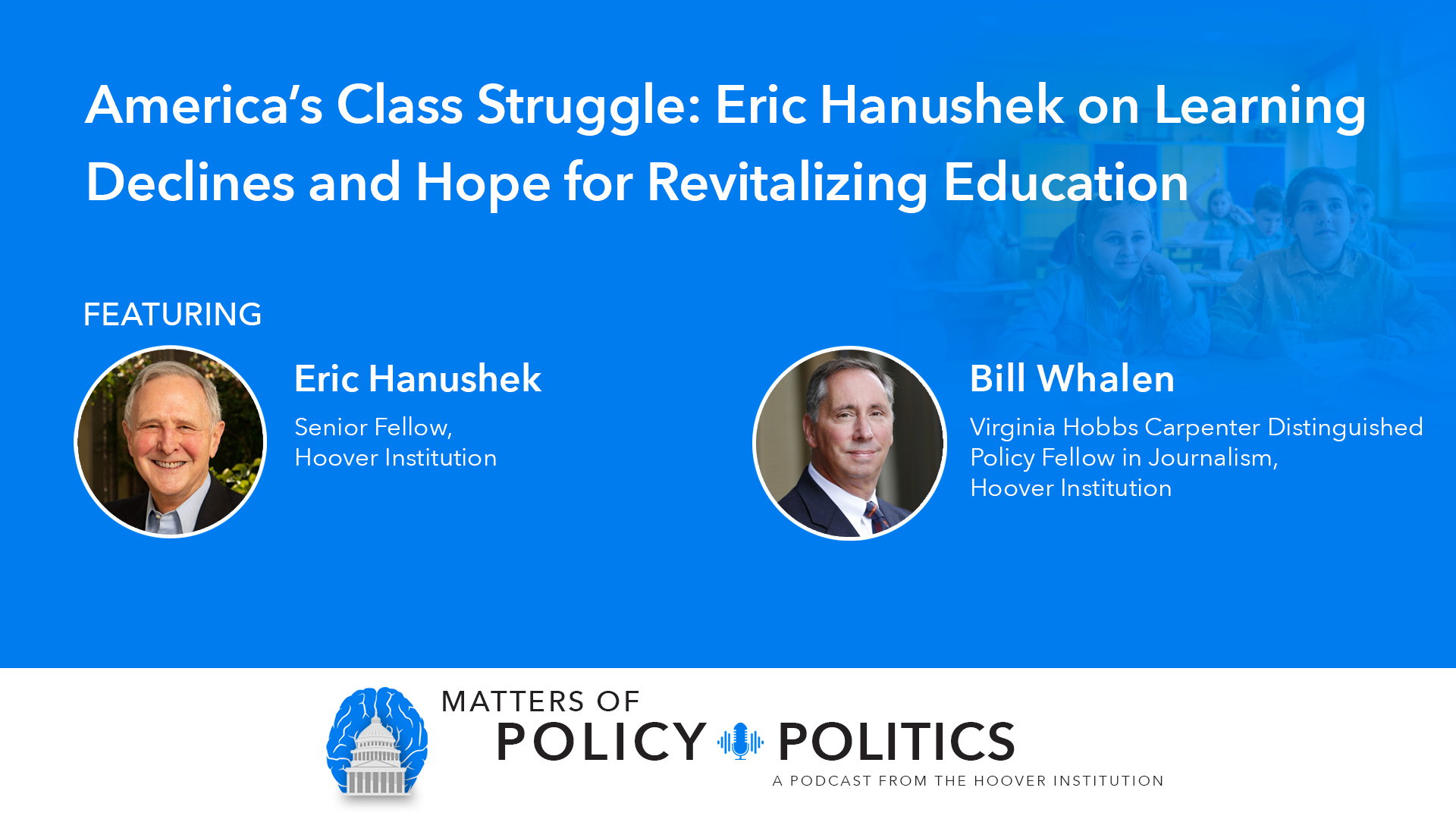
If you think America’s schools fell into decline solely as a consequence of 2020’s pandemic and a year of alternate instruction models, guess again. Eric Hanushek, the Hoover Institution’s Paul and Jean Hanna Senior Fellow and a leading scholar on the economics of education, discusses misperceptions in the Covid-education debate (learning and achievement were in decline years before the pandemic struck), why education reform remains elusive despite decades of talk and treasure, a few sleeper concerns (long-term absenteeism), lessons to be learned from learning and teaching innovations in Dallas and Mississippi, plus the future impact of learning loss on earning power and America’s GDP.
- It is Friday, November 14th, 2025. And welcome back to Matters of Policy and Politics, a Hoover Institution podcast. I'm Bill Whalen. I'm the Virginia Hobbs Carpenter distinguished policy fellow in journalism here at the Hoover Institution. And while I can lay claim to that rather wordy job title I am one of, but many Hoover fellows who are in the podcasting game these days, rather than go down the list of podcast. Why don't you do me a favor and go to our website, which is hoover.org/podcast and see what all we have. We cover economics, history, foreign policy, healthcare, and we also have the audio version of the Goodfellows broadcast that I do with the incomparable Neil Ferguson, John Cochran, and HR McMaster. So again, that's hoover.org/podcast. The Hoover Institution has developed a reputation over the years and decades for its prowess when it comes to economics, foreign policy. More recently, we have emphasized history. We have a remarkable project called the Centers for Revitalizing American Institutions, but one constant in the institution's life has been its interest in education. We think about this, this makes sense, Hoover's mantra's, ideas defining a free society and any free society begins at the premise, the assurance that quality education is forwarded to all children who get the same shot at Opportunity Education Reform is indeed the topic of today's podcast. Joining me, I think making his debut on this podcast is Eric Ick. Eric Ick is the Hoover Institution's Paul and Gene Hanna, senior fellow, and one of the world's leading scholars in the economics of education, meaning he is a go-to source when studying teacher effectiveness, school accountability, and the economic returns to educational quality. He's the author editor of some 26 books. His accolades include in 2021, the Yon Prize for Education Research, the Field's Most Prestigious International Award. Eric Anek joins us today to talk about an essay he recently pinned. Its titled The Pandemic and Perspective US Learning Losses in the 21st Century. Rick, thanks for joining us today.
- It's wonderful to be with you.
- So we're gonna get into this weighty topic that is education reform, but first let's find out a little bit about Rick Hick. So I'm always curious about how fellows came to do what they do in the present life here at Hoover. And you, typical of many, a fellow has a bit of a roundabout story. You went to the Air Force Academy, Rick, you got a PhD in economics at MIT, I believe George Schultz got a PhD in industrial economics at MIT, I believe in about 1949. So you're in good stead there, but tell us how you go from the Air Force Academy and maybe the presumption of flying airplanes to now trying to make sense of education before.
- Well, I had the choice when I left the Air Force Academy of either flying planes or going to graduate school. And I guess I make made the right choice because I've been happy since choosing to go to graduate school. But in graduate school, you, one of the ideas is to figure out what you're gonna write a thesis on and your first major activity. When I was doing that in my second year at MIT, I noticed that the US government had put out a major report called Equality of Educational Opportunity. It's sometimes called the Coleman Report after its prime author Jim Coleman. Nobody understood that report. It was a very dense 736 pages of tables and statistical analyses and so forth in a time when people didn't do statistical analyses and particular in education. And in order to understand it, pat Moynihan then a professor at Harvard before becoming a US Senator and Fred Mosell, or a STA statistics professor at Harvard, put together a seminar for faculty at Harvard to try to understand what this report said. My mentor from the Air Force Academy who moved to Harvard, a man named John Kane, snuck me into the back of this seminar. I started to try to figure out what the report said. It led to a thesis, it led to then some follow on work and at some point I just either had too many questions or didn't know anything else and decided to continue on studying education policy.
- And Rick, was this really the beginning of looking at the economics of education or had there always been studies on economics before that? So I assume education reform has always spun around what quality of teachers curriculum outcomes, but the economic component,
- It had none of that when I was a student. There was no such thing as the economics of education when I was a student. And in some sense I think I'm pretty responsible for starting that as a field which has grown into a much larger enterprise. But nobody was studying education, but MIT was quite open to having people do different things. And so they let me go off and and try to study education.
- And what brought you to the Hoover Institution? What, what was attractive about Hoover to you?
- Well, I went to teach at Yale, then I went to the University of Rochester for a long time and while at the University of Rochester, John Ian, one of our prior directors, started something called the correct task force, which was a group of people around the country that were trying to provide more rigorous scientific and policy oriented evaluations of education policy than existed at the time. I was a member of that task force until one day John asked me if I wanted to come here full time.
- Now, when we talk about Hick and Hoover, oftentimes the name Margaret Raymond comes up. Can you tell us who Margaret Raymond is?
- Margaret Mackey Raymond is my wife. We were together in Rochester. She was actually a student of mine when I was teaching at Rochester, but that we weren't together at that time. But subsequently she was teaching at the University of Rochester where I was. And we got together and decided that we should jointly move to Stanford when after John Ian had sort of enticed me to do it.
- And Mackey also works on education reform, and we're gonna talk about some of Mackey's work here in a few moments, but did the two of you team up?
- We've worked together. It takes a little bit of effort for us to actually write things together because we have different styles. But past getting past the styles, we have some pretty interesting dinner conversations about education policy and we certainly keep each other informed on interesting things that we see.
- Is there anything you disagree on?
- Oh, I don't think there's any major disagreements in details. There are are disagreements, but they don't rise to the surface of leaving, leading to, you know, classic cases of a Republican and a democratic political analyst getting married and fighting over that level of policies.
- Exactly. Alright Rick, let's get into your paper. The title again is The Pandemic and Perspective, US Learning Losses in the 21st Century. And the word that stands out in the title Rick is perspective. We talk about COVID, we talk about learning loss, and we tend to focus on the years 2020 and 2021. And you're taking us back and you're taking us back to 2013, correct?
- I'm taking you back actually to the beginning of the century and then beyond the pandemic. So what I trying to do is to place what happened during the pandemic in the context of what was going on outside of the pandemic before and after.
- Okay, so here's what you found. Although 72% of the decline in math performance since 2013 occurred over the pandemic period, only a quarter of reading decline is found over the same period.
- The key thing of looking at performance of students, which we measure regularly through the national assessment of educational progress, is that at performance in math and reading for fourth and eighth graders and also for 12th graders, as far as we can tell, peaked in 2013 it had been rising some and then it just started to fall down and the declines were a little bit slower than we saw during the pandemic and people didn't pay as much attention to the declines because there'd always been some jumping around up and down a little bit. But it turns out that they were very consistent and the pandemic brought the declines in achievement to our minds because how could kids learn when we shut the schools or how much could they learn? But recently, when it's put into perspective, I see that the pandemic is just one event in a field of change.
- You're right, you also talk about the economic cost of the decline. Here's what you write students affected by these learning declines, we'll see lifetime earnings reduced by an estimated 8%. If student achievement does not return to 2013 levels, the economic impact could equal three times the current GDP. How do you come up with this equation?
- Well, there are two different ways of estimating that the National Assessment of Educational progress, or nape, as I said, regularly measures achievement, right? And so I know how the achievement in 2024 compares to that in 2013 by this test, which is keeps track of a common measure of achievement. If you take the difference in scores between the peak and today or the peak at the beginning of the pandemic, whatever you wanna do, you can apply that to what labor economist and and econom economists of education have found about the relationship between what people know and what they earn. You know, it doesn't surprise anybody to say that people who know more earn more, but we have that quantified from previous research. So you take the history and you apply what we've seen in the change in achievement, and you get on average 8% declines in earnings of people. I mean, that's a big number, right? If I told you I was gonna put an 8% surcharge on income taxes, there would be a riot. This would be sort of the Turkish square of people out protesting day and night if I told you that. But that's what we've done effectively to our current students.
- Another point, your paper, Rick, traditional reform approaches have failed consistently. Now let's talk about this for a minute. I want to get into the idea of why education reform is so elusive this January. Rick will mark 62 years since Liz Johnson went before Congress and declared a quote, unconditional War on poverty. If you look at the poverty rate in America, Rick, it's a state line pretty much for the past six decades with a few bends up and down. And by some estimates, this country has spent about $25 trillion that suggested for inflation trying to deal with about 11% of the population, or 37 million people who are qualify as living in poverty. So 60 years of frustration, if you will. We talk about education, we're talking about things like school choice, merit pay. I worked for California Governor Rick 30 years ago. We were having the same conversation, education spending in America, Rick, about $857 billion annually, about 17,300 kids per pupil. And yet, progress remains elusive. And let me point you to, one thing was in the news, and I believe I sent this to you, and this is just staggering. A news report the other day, the University of California San Diego, this is not a trade school, this is not a fly by night school, it's not a fallback school or anything like that. It's a very serious university. It's a uc. What we discovered at UCSD math skills are falling below a middle school level. It's increased over 30 fold over the past five years. Meaning kids are going to college rec and they don't have eighth grade math skills. I, I don't understand how you can get outta high school with this. And I certainly think it's a tragedy to go to college. You have to make up like this. And UCSD, by the way, Rick, it ranks as it's the sixth best public university overall, according to US News World report. So the sixth best university in America has a bunch of kids who can't do eighth grade math.
- If you read deeper in that report, it says that the average GPA of these people without eighth grade math is like 3.6 or something like that so that the schools are passing kids on without these scores. Let me go back quickly to what you said at the beginning of this historical path through achievement. One of the important things that Lyndon Johnson said in declaring the war on poverty is we don't want to just go after the symptoms. We want to understand the causes and eliminate the causes. And this led him to focus on human capital or the skills of people in schools and try to in fact provide the skills to individuals so that they wouldn't be in poverty. It's rather consistent, of course, with the Hoover perspective on the world, that instead of just giving money to people, we try to improve their ability to participate in society. And we've been doing it, as you say, but not very successfully.
- Let's try this. Let's try this into something which you were involved in two years ago, and that was a report the Hoover Institution called Nation at Risk plus 40. And this was in 2023, looking back on the 40th anniversary of the original nation at Risk, which was released by the US Natural Commission on Excellence in Education. Basically in 1983, what we're looking at is why the United States was failing to produce a competitive workforce. So this gets back to my little screed about, about about poverty, the war on poverty 40 years, Rick.
- Right? Well that report actually is rather important in my thinking about how to view the change in achievement that we've had. That report, which was edited by Mackey Raymond and by Steve Bowen, it commissioned a dozen people to look at major changes in schools and the way we've treated education since a nation at risk. And those dozen chapters basically said, well, sometimes things worked, but if they worked, they didn't propagate to other school systems very well. They were either forgotten or pushed aside by new reforms or never got picked up elsewhere. And so what you see is a whole series of attempts to change poverty, to to change the overall level of schools, to make them more competitive internationally. And nothing has made much of a dent. And of course we spent a lot of money doing all of this, and that's in the background. All of these things cost money. So that today we're spending 2.7 times what we spent in 1970 on a per pupil basis corrected for inflation. So that we're really trying very hard and we haven't got the results. And that has significantly affected the way I think about education policy. You know, finding the next reform that's gonna be magic strikes me as a fool's errand that we now have a lot of experience with very disparate programs that have one common result, they haven't worked. And so it leads me to think that just adding on something to our existing schools is unlikely to be very successful.
- So a passing grade in terms of consistency of approach, but a failing grade in terms of outcomes, I guess is what you're suggesting here. Getting back to Nation at Risk plus 41 chapter that stood out to me, Rick was titled Fixing Schools Through Finance, who wrote that.
- I've spent a lot of my on education finance, being an economist. I'm always pushed toward, what do you say about the spending on schools and the way we finance our schools. And in fact, I've been involved in many, many states in talking about what they're, the way they fund schools and the results they're getting. And the answer there is just what I told you. We've, since 1970, we're spending over two and a half times what we did in spending per pupil. And according to the national assessment of educational progress for reading, our reading scores in 2024 are identical to those in 1975.
- That's right. Alright, now let's get back to the report. 21st century perspective, fundamental institutional change is needed. Explain to me what exactly fundamental institutional change
- Means. Well, this picks up actually on something else done at Hoover, the Education Futures Console, which our director, Condoleezza Rice, yes, put together a group of people to sort of think about what's going on in education
- Created, created two years ago. Condi is the co-chair and it's an interesting cast of characters. Mitch Daniels, the former Indiana governor is on it. So is Andrew Luck, the ST story Stanford football quarterback, so not the usual suspects when it comes to educational reform. When you're talking Andrew Luck,
- The attempt, well the, actually he's a very thoughtful guy who has a master's degree in education. After he left football, he came back and got a master's degree. He's been interested in education, but he certainly also knows a lot about how big institutions work and get their results. He can say a lot about the Indianapolis cults and what it took to get results. And so what what this group was, was a not by non-partisan group with a lot of different perspectives on the role of government, philosophical, et cetera, et cetera. But what they suggested was that there were some basic things that we weren't doing that we should be doing. And the two that really struck me as an economist are, one, if we're interested in the, in the way students perform, we should focus on student performance. In other words, we should make achievement of students the centerpiece of all of our policies and evaluate them in terms of that. Secondly, a big element was we should focus on providing incentives for the performance. We wanna see, rather than trying to mandate what people should do, rather than sort of monitoring tightly the behavior of the, of the schools and the personnel and so forth, we should just provide incentives. If people do better, they get more rewards. If they do worse, they did get less re rewards. So a a rather standard economist view, but completely alien to this sector we call schools.
- Why isn't performance more highly regarded, more highly looked at?
- Well, I think that people like to have better achievement. I think people in schools are really trying to provide better achievement, but they have multiple things that they're interested in and worried about, one of which might be their employment and their pay and so forth, as opposed to what students were learning.
- When you're talking achievement, Rick, you're not talking just strictly grades because the cynical pushback would be okay, if you define this as better grades, we'll have grade inflation, every kid will get an A or a B problem solved. But in terms of achievement, you're talking about the ability to actually read the ability
- To, yeah, - Write to the actual, to to critically think.
- We know how to measure learning pretty well. We've been doing it for a long time. So we have things like the national assessment, we have No Child Left Behind. That was the federal accountability statute introduced by George W. Bush in 2001. And in these in No Child Left Behind states were required to develop measures of student performance to define what they wanted to achieve and then develop measures of them. And these were the standards used for accountability. And that's seems pretty straightforward except for the fact that lots of people don't like to be held accountable. They wanna do well, but, but if we don't do well, I don't want to have anybody saying that I'm doing a bad job. So, correct.
- Let's, Rick, let's talk about two parts of the country where we see education reform afoot and what lessons they offer for the country. Wr large, the first tell us, Rick, what's going on with the Dallas Independent School district?
- Dallas was a standard large city school system in Texas that wasn't doing particularly well. They hired a person named Mike Miles to come in and be the superintendent. And Mike Miles had views that were very consistent with some of the things in the Education Futures Council report. He had a view that we should evaluate the effectiveness of principals and teachers and personnel in schools on the basis of what students were learning. So he spent several years convincing the school board that they should dramatically change the way they pay teachers. Today, almost all school systems in the country pay teachers based upon their years of experience and how much graduate education they have, neither of which are very closely related to how effective teachers are in the classroom. So he basically said, we should junk that system and replace it with more reliable evaluations of the effectiveness of teachers and their principals. And we should pay people according to that and we should make decisions on where they're placed in, in the system, the incentives we provide and so forth based upon their effectiveness.
- Now I remember Rick, it was in, I think, a special election in California 2005 where Governor Schwarzenegger, then Governor Schwartzenegger put merit pay on the ballot and the California Teachers Association, but ballistic.
- Oh, and they, they were very effective. They convinced the entire state that this was a bad idea. And I think that Governor Schwarzenegger was really hurt by this then didn't really feel that he could subsequently battle with the teachers unions, that they were just too strong.
- He was shocked by it. Remember they, the teachers union plays hardball in California break. They took out a mortgage on, there were headquarters in Oakland to make sure they had enough money to fight this campaign. But my question is, if you can't do this in California, how do you get away with it in Texas? What, what is different about the two states? Is it, is it unions or something else?
- Well, every state has unions, but Texas does not allow for collective bargaining so that they have unions in the background that are in fact influential on what school boards do and the decisions that are made, even though they're not bargaining in a traditional way. And so that's part of it. And part of it was that Mike Miles was very persuasive and spent a lot of time convincing the school board that this was in the interest of their children. It's interesting that he has subsequently left Dallas. Dallas has continued to use his system and do very well by it, but he has been appointed as superintendent in Houston, Texas by the commissioner, who, the commissioner under law took over the operation of the Houston school system because their, they had so many failing schools and the commissioner appointed him to take over the Houston district and he's doing a lot of similar changes in Houston right now.
- Yeah, that was my next question. Is this portable? Can you just pick this up and do the same formula in district to district across America? Like you would set up say McDonald's franchise with the same menu, the same offerings.
- So I don't believe you can do that. I don't believe that people can come in from outside and tell somebody how to run their schools. That doesn't seem to work
- Right.
- But what Texas has done about three years ago when they were considering school finance developed a grant program in which school districts could apply for funding. If they put in a system that looked like it was evaluating the effectiveness of teachers. And if, if that system was also used to ensure that the most needy children got good teachers, the state would pick up some of the extra funding for these teachers. Interestingly, at the beginning of this school year, some 800 plus districts have applied for this out of the 1200 in Texas. Now they tend to be more rural districts and smaller districts, and the big districts haven't applied. But it looks like you can provide incentives to school districts to behave the way you think they should be behaving.
- The other reformer is the, the Mississippi Miracle. And this deals with K through three literacy in that state. Mississippi went from 49th and fourth grade reading results according to the forme nap or National Assessment of Education progress decade ago. It's now ninth in the country. This is in 2024. So Mississippi goes from 49th in the country to ninth. How did this happen, Rick? And again, is this portable to other states?
- I think that what we saw in Mississippi was leadership from the State Department that insisted that schools pay attention to achievement, that they use scientific reading methods, et cetera. It's a, it's a model that we've seen elsewhere where Florida made tremendous gains when Jeb Bush was governor and it was his leadership that kept saying, we're interested in having Florida kids learn.
- Right?
- Washington DC Trama tremendously changed their evaluation and pay system on the what Michelle re managed to institute in Washington. And so I think that part of the story is having strong leadership. Part of the story is trying to put in a system that makes sense and has the right incentives in it and hope that it's not eroded and taken away.
- So we have talked about K through three challenges. Literacy, we have mentioned eighth grade algebra one, we look at education, we reform. Rick shall be looking at K three, she'll be looking at the eighth grade. What, or should we just be looking at all the K through 12? In other words, is this sort of a movable problem up and down the scale?
- I think we should look at all, all the areas. I think where we've fallen down pretty obviously is in this sort of K four, K eight area in the end of primary middle school area where we develop lots of basic skills that are used in subsequent coursework and in subsequent learning. And I think that we've shown that we have huge problems there and that those multiply to later grades, they multiply to the uc, San Diego University system, when in fact they get poorer prepared students. They don't know quite what to do with them. And we know that the results with poor prepared students at UCSD are not the same as those with better prepared students.
- So two ch words, Rick, that we've looked out of this conversation so far would be choice and charters about charters, charter schools. I have a bias here. I have a beloved niece who teaches kindergarten at a charter school in, in Charleston, South Carolina. She's a saint, by the way, going to school every day with a bunch of kindergartners. Holy smokes. But her school is remarkable in that regard. So as we look at charters, we look at choice. I know there's a tendency on the right to look at these as panaceas kiros, if you will, but talk about how those two entities fit into the overall question of education reform and let's be begin with charters.
- Well, I mean, charters are a form of choice that are public schools that are given a lot of latitude and, and don't have to obey all of the multiple regulations that the traditional schools do. But they're responsible for results. And what we've seen is over time their performance has improved so that on average charter schools are doing better than their traditional public schools where the kids would've gone elsewhere. That fits in to what I was talking about of institutional changes before in the sense that charter schools are basically a new system of schooling that we could put in place and show that it could develop and work. It's a system that tries to learn over time and do better. And you can see that in the results. Charter schools are six or 7% of the student population today. They're somewhat held back because lots of states restrict how many you can have,
- Right? California is a cap.
- But the answer I think is that with open choice of schools, you're still going to have a very dominant traditional public sector. The traditional schools are gonna stay around. You're going to give lots of parents an opportunity to do something better. And the competition may have some influence on the traditional schools, but we're still talking about two thirds to three quarters of the kids. I think that'll be in something that looks like our traditional public schools. Therefore, I think that we have to think about choice. I, I'm a big fan of choice and, and expanded choice, but at the same time we have to worry about what the tra traditional schools look like.
- Where do you think the choice stand movement stands these days? Rick, if we were having this conversation 30 years ago, back when I was working for a governor, they were governors around the country, Tommy Thompson and Wisconsin, for example. Choice was very vibrant in Milwaukee, for example, choice was seen as the next big thing. But here we are 30 years later and school choice seems problematic in this country. Some states embrace it, other states do not.
- Well, I think there's been a lot of movement toward choice. There have been education savings accounts and other devices that's, that states have used to expand choice. And we've gone to, Texas basically has a voucher system. It's not funded very lavishly right now, so you, it can't handle the entire state. But everybody is eligible. And you've got Arizona and Indiana, Florida that have quite broad choice programs. And I think that that in the last two to three, four years has really had a lot of momentum behind it of providing more choice. So it's, it's a varied pattern across the states. California is not a big choice state and you don't see much going on in California. But there are lots of other states that in fact have in fact pushed toward opening up choice more broadly.
- Yeah, California's not choice state. You might remember Rick Beck and I think it was 2000, the venture capitalist Tim Draper put a measure on the ballot for school choice. And again, the teachers union came after him very hard. But the problem in California, it's not just the unions, I only sound like a union measure here. It's also the political establishment. And California, the attorney general is charged with writing titles, his summaries for ballot measures. And so there's a guy named Bill luckier, a long time democratic lawmaker, obviously very close to unions. So he gave the measure Rick, the title was something like Taxpayer Money for Religious Schools. That's really, that's really his best way to defecate on the whole concept. But let's quickly go through some of the players in terms of education of this idea of how frustrating reform is. Let's talk about some of the players involved in their relative culpability to the challenge. And let's begin with politicians. The obvious political answer is to throw more money at schools. But you mentioned, you mentioned Pat Moynihan, the late Daniel Patrick Moynihan. Fascinating man, just intellectual at all times. Moynihan was looking at welfare reform 2030 years ahead of welfare reform. He's looking at schools. Is there any politician in America right now, Rick, who brings the same intellectual firepower to education reform as Pat Moynihan did?
- It's hard to stand up against Pat Moynihan intellectually. He was, he really was, as you point out, a very smart, thoughtful person. And it's hard to pick out current politicians that are of that ilk.
- But is anybody just thinking sort of to evoke Mr. Spock and Star Trek, is anybody playing three dimensional chess with education reform or is everybody just caught up in the same idea of money?
- Well, no, I mean it, as I say, there are a number of of state governors who have pushed expanded choice. And that's been one answer. Part of the problem of education and talking about needing change is that governors that want to say they're the education governor generally have to have a plan. And so they wanna introduce something new that is theirs that will in fact inspire voters for them. They, they're probably gonna be out of office before any plan that they propose ever takes effect. But there's a lot of just starting and stopping because people have to pro produce new plans. That happens at the local level too. School systems look for new superintendents. You have three finalists. Whom are you going to choose? Well, each of them is going to come up with a set of plans of what they're going to do and saying, well, I just wanna do what the guy before me did is not an inspiring talk in general. So that you get, schools are sort of ping ponged around with new plans that replace the last reform measure. And they're generally more of the mandate character as opposed to the incentive character because that's in part what superintendents can, can control more easily.
- Right. Alright, Rick, player number two would be unions who I think took a very bad beating during COVID. I remember the one Chicago Union official who was doing a zoom call from Puerto Rico, not a good look during the middle of a pandemic, but unions are a very convenient scapegoat. No,
- Depends on how you wanna define scapegoat. They have not been very productive, positive forces for better achievement.
- Well, well scapegoat on a couple levels, Rick scapegoat, first of all, in terms of, you know, I'm being adamant against reforms at a state like California, Jesse, you wanna put merit pay on the ballot and they try to kill it adamant about teacher reforms, tenure reforms, for example, firing teachers striking in the middle of school years, which at one point was a no-no for a teacher. But now in California and other states they strike in the middle of the school year and then the pandemic being resistant to opening up.
- Well, so I don't think they're a scapegoat. I think that they are part of the problem,
- But I'm just saying that it's easy to beat up on the union. It's just saying
- Bad
- You bad you do.
- No, no, I I, and I think you made the statement before that I agree with unions are not the only problem,
- Right?
- There are lots of other forces of inertia, but the unions have in fact quite consistently done the things you said. My favorite example is the Oakland Teachers Union that at, in 2022, if I have this dating right after kids had been outta school for the pandemic and were hurt in April or May had a eight day teacher strike that was about having better plantings around the schools, housing the homeless, making sure there was a water cooler in all the schools, right? They'd already decided on pay and benefits, but they had to also decide on all of the social ills of the, of the world before this could be done, before they would go back and teach. I thought that was despicable is the only word that comes to my mind. That you have kids that have been damaged a lot by unfortunate circumstances of the pandemic and they just pile on so
- They, you're teaching in theory because you love kids and yet your action punishes kids. So it's just,
- Yeah, but you know, they, I keep thinking, and I've tried to convince some of my union friends that teachers could be much better off if they just stop the idea that you have to defend the worst of the worst teachers. They spend enormous amounts of time and energy defending teachers that they know are not good, good for the kids. And if they stop doing that, I think that a vast majority of the country would give a lot more support to teachers and they could get paid more.
- Alright, we've covered politicians, we've covered unions. Let's go to our third player in this, Rick, and that is parents. It is a different American in 2026, the American in which you and I grew up in part because two parents work. So it's a greater challenge for parents to pay attention to what the kids are doing in school, maybe being aware of what's happening in the school.
- One word I have that is probably too strong, but it's complacency that we see a lot of complacency among parents that are not, are not very pushing and active. We know that parents are extraordinarily important in education and in fact the high achieving kids are often ones where their parents spent the time during the pandemic making sure that they were high achieving and spent a lot of time at it. But I don't think that we, that parents have in fact entered in as positively as you think they should.
- Yeah, it is. So getting back to my, my family, my, my niece who teaches in Charleston, so her kids, her two boys go to the same charter school where she teaches. So she knows what they're doing at school all day long. She knows their teachers on a first name basis. So she's keep, she's all over what they're doing and she and her husband have just really drilled reading into these kids. I was visiting them last summer and her younger son who is in first grade right now, Rick, he must, he must read about two levels ahead of, of his grade right now. That's just because they're telling them to read at all times. They're encouraging them to read and they're finding ways to make it fun for them to read.
- Well, that's absolutely the case that that, that some parents really do a lot. But we have another phenomenon going on in the background today, and that is we have long-term absenteeism from schools. So if you look at some of the largest school systems in the country today, over half the kids in the school have missed more than 20 days of school.
- So you're talking truancy, not kids leaving the system altogether, which
- Is, I'm talking about truancy tru, that they are enrolled in the system and that they are absent more than 10% of the time of schools. Wow. And this has just exploded, particularly after the pandemic. If I could find something to do for 20 days in the school year, it's doubtful that my parents would've ignored it and, and allowed it. And in fact, one of the most effective ways of dealing with this tru truancy and absenteeism is to send notes either postcards or emails to the parents and say, do you know how many days of school your kid has missed? And it turns out that that gets quite a response, a significant response. It doesn't eliminate all the problems, but it gets a significant response as if there's a large number of parents that have no idea what their kids are doing. So it might be that two parents are working and they're not home. It might be other things, but the parents aren't participating very strongly in at least portion of this education business.
- And that takes us, Rick, to our fourth player in this. And that's kids themselves. Kids are different than they were generations ago. There's this thing called my cell phone. They're on their screens, they are watching a lot of tv. They're easily distracted it seems. But the challenge seems to be getting to what your work is, is saying that, look, you may not enjoy going to school every day. I'm sure you'd like to stay home and, you know, watch YouTube all day long. But you know, there's reward to doing this and the reward is getting an education and you know, having a good life down the road. So how do you get, I know it's a heavy topic for a young kid, but as a kid is going through the pipeline, how do you tell 'em that, you know, the harder you work it's gonna pay off.
- So I'm not sure how you, you motivate, I mean, it there, the idea of cell phones being the root cause of all problems has picked up a lot of momentum.
- Well, here in California, there's been a movement to ban 'em and, and just make you gotta turning your cell phone at beginning of the day and
- Sure, sure. There's, there's things like that. I think cell phones are probably part of the problem, but they're certainly not the entire problem. You know, the whole world has cell phones and the whole world didn't start falling off in achievement in 2013.
- Right.
- So I, I think that it's overblown to say that cell phones are doing this. On the other hand, cell phones and what's on them are competition for the schools. So the schools have to be better to get the attention of the kids because the people who make cell phone apps know that it takes a lot of work to get somebody's attention and get them doing what you want them to do. Schools I think have to adjust to the fact that some of the things they do are historically important and very boring.
- And actually, you know, Rick, there's one group I've lived out here and obviously that's teachers.
- Yeah. My work over a long period of time has suggested that the effectiveness of the teacher is the biggest thing that goes on in a school. Determining whether the school is good or bad. Having effective teachers has an enormous impact. A dozen years ago, I tried to actually estimate the impact of good and bad teachers or effective and ineffective teachers. An effective teacher a dozen years ago could increase the lifetime incomes of her students aggregated each year by a million dollars more than the average teacher that if you add up the future incomes of her students compared to an average teacher, the worst teacher is just the opposite. The, the lowest portion of teachers subtract a million dollars from the lifetime earnings of their students each year. Each year. So if you're talking about that kind of impact, I keep thinking that we ought to pay more attention to it. And that's part of the futures council work. Part of my own views on this is that we should be evaluating, supporting, helping teachers, paying teachers that are effective, keeping teachers that are effective and not keeping those that are ineffective.
- I'm curious about economic incentives for Rick, you and I for teachers. Rick, you and I are in Santa Clara County right now, where I think the medium income is about $95,000 a year. But housing is exorbitant. Good luck buying a house. I don't think 50 year mortgages the answer, but is there any proof, do we have any evidence that if you offer economic incentives to teacher Rick, such as tax breaks, such as ability to buy homes, does that improve teaching at all? Does it bring a better breed of teacher into the mix?
- Well, we don't have things like plans to provide housing and so on.
- Right. - We do know that teachers respond to incentives. We talked about Dallas in the past,
- Right?
- One of the things that Dallas did once it had good measures of the effectiveness of teachers was to offer an incentive program for teachers to go into the worst schools in Dallas where the incentive was related directly to the teacher's effectiveness. So the most effective teachers got $10,000 a year more. The next most effective teachers got 8,000, the next most 6,000 to go into these poor schools before this incentive program. There were none of the top two categories of teachers in the worst schools because the standard way that we man our schools is give teachers choice of where they wanna be. The better, the more experienced the older teachers, and to some extent the better teachers choose places where it's easier to teach, where the schools are better after they put in that incentive. There was a dramatic shift so that a large portion of the teachers that would go to the worst schools were in the top two categories of teachers. And in two years, the worst schools in Dallas came up to the city average. So that first teachers move according to incentives, they respond to incentives. Secondly, effective teachers are effective teachers, you take an effective teacher move or to some other place and she does a good job and the kids benefit. So I think that that's sort of a no-brainer. What we historically did with the most disadvantaged schools, or the most violent schools or so forth, was to offer anybody who wanted to go there can get $8,000 to go there.
- Right?
- And it turns out that good teachers and bad teachers both liked more money and you didn't change what the composition of the teaching force looked like, like in these schools. And you didn't get any results because they were exactly the same teachers or same type of teachers that went when you had the incentive is when you didn't.
- Let's, we only have a few minutes left. Let's circle back to the idea of the pandemic and perspective in this regard. If you got COVID during the pandemic, maybe you got your health back. If you lost money in the market during COVID, maybe you got your money back. If you lost business, maybe you got your business back. But education, the kid who had a bad year of education by, by virtual learning, not being in the classroom, how does he or she get a year of learning back
- If he or she graduates from high school? He or she is basically on, on their own and they're on their own to to do it. And if you're motivated and can put together your own learning program, you can get it back. If you're not very motivated, you don't get it back. And then you end up with this 8% loss or whatever, more for disadvantaged kids, of course, because they lost more. And so I think it's the pandemic, but also the pre pandemic period has in fact harmed a group of students that are going to be harmed for life.
- So, so if we're talking about kids, Rick, who were, who got this second rate education from 20 to 21, they would've been in about what, seventh grade at the time if they,
- Well they, they there kids all throughout school.
- Right. But I'm just figuring the class of kids who graduated this past summer. Yeah, the class.
- Yeah.
- It would've been seventh graders I think in that school. Yeah.
- Yeah.
- Right. So So you're just saying they, you just have to kind of write them off in terms of getting a year back.
- If the schools didn't gear up programs for these kids. Yes. And on average they didn't. That's what the D data show is, that on average the schools, whatever plans they put in place didn't have the effect of moving the average kid forward.
- Okay. So what about the kids saying K through three at the time, the pandemic Rick, who's still got a few years to go in high school?
- Well, they, the schools can do it. I gave you the, the Alice example. If you have effective teachers for these kids, you will in fact be able to make up for their LA lost time. If you just say, oh, kids are resilient, they're gonna do okay, then you're in trouble.
- So to know me, Rick, is know that I have sometimes a dark sense of humor. And I was joking the other day that I missed the pandemic in terms of air travel and as being completely joking here, I don't wish illness upon anybody, but if you travel during COVID, it was glorious time to go on airlines because the planes were empty and they were clean and it was almost like year old plane. But the question is though, with COVID and schools, what's gonna be different the next time around if we get started with another pandemic and we have to shut down schools? What, what's gonna happen differently?
- Well, I don't think we learned that. Well, I mean, we know that during the pandemic in class instruction was on average better than hybrid instruction that had part in class, part electronic of one sort or another. And it was better than remote instruction. And we haven't put together systems that don't involve teachers that are as good as those that involve teachers. So the question is, if we had another pandemic or similar thing, can we still provide the kind of instruction we've been doing? I don't know if we can or not.
- I guess this is the both the blessing and the curse of being a republic that in a situation like this, if education is going to be in the Jeffersonian fashion, run the state level, 50 states are gonna decide what they're gonna do.
- Yep. Yep. That's exactly the case.
- Okay. Rick, we've talked a lot about education. Is there anything we've missed that you'd like to touch on?
- I don't think so. I think that this is the future of the US and improving our schools, and I've found it difficult to get people very excited about it. People nod their head a lot and say, yes, we should do something about schools. But they don't get ready to go out on the front lines and push for change. And that's, I believe, is going to be important to where we end up as a nation.
- The title of the report, again is The Pandemic and Perspective, us Learning Losses in the 21st century. Rick, it's been fun to have you on the podcast. Thank you for all that you and Mackey do for the Hoover Institution. Your work is just extraordinary. Thanks for having me, bill. You've been listening to Matters of Policy and Politics at Hoover Institution Podcast. If you've enjoyed this conversation, please don't forget to break, review, and subscribe to our show. And please leave comments. We always wanna know we can do things better. What topics you want to hear. The Hoover Institution is Facebook, Instagram, and X speeds. Our X handle is at Hoover, its, that's spelled H-O-O-V-E-R-I-N-S-T. I mentioned our website, beginning of the show. That's hoover.org. While you're there, sign up for the Hoover Hoover dealer report, which delivers the latest from Merk sch and Mackey Raymond and the Hoover colleagues to your inbox, weekdays for the Hoover Institution. This is Bill Waylon. We'll be back soon with the new installment of matters of Policy and Politics. Till next time, take care. Thanks for listening.
- This podcast is a production of the Hoover Institution, where we generate and promote ideas advancing freedom. For more information about our work, to hear more of our podcasts or view our video content, please visit hoover.org.
RELATED SOURCES


