
















- Economics
- Regulation & Property Rights
- Answering Challenges to Advanced Economies
- Understanding the Effects of Technology on Economics and Governance
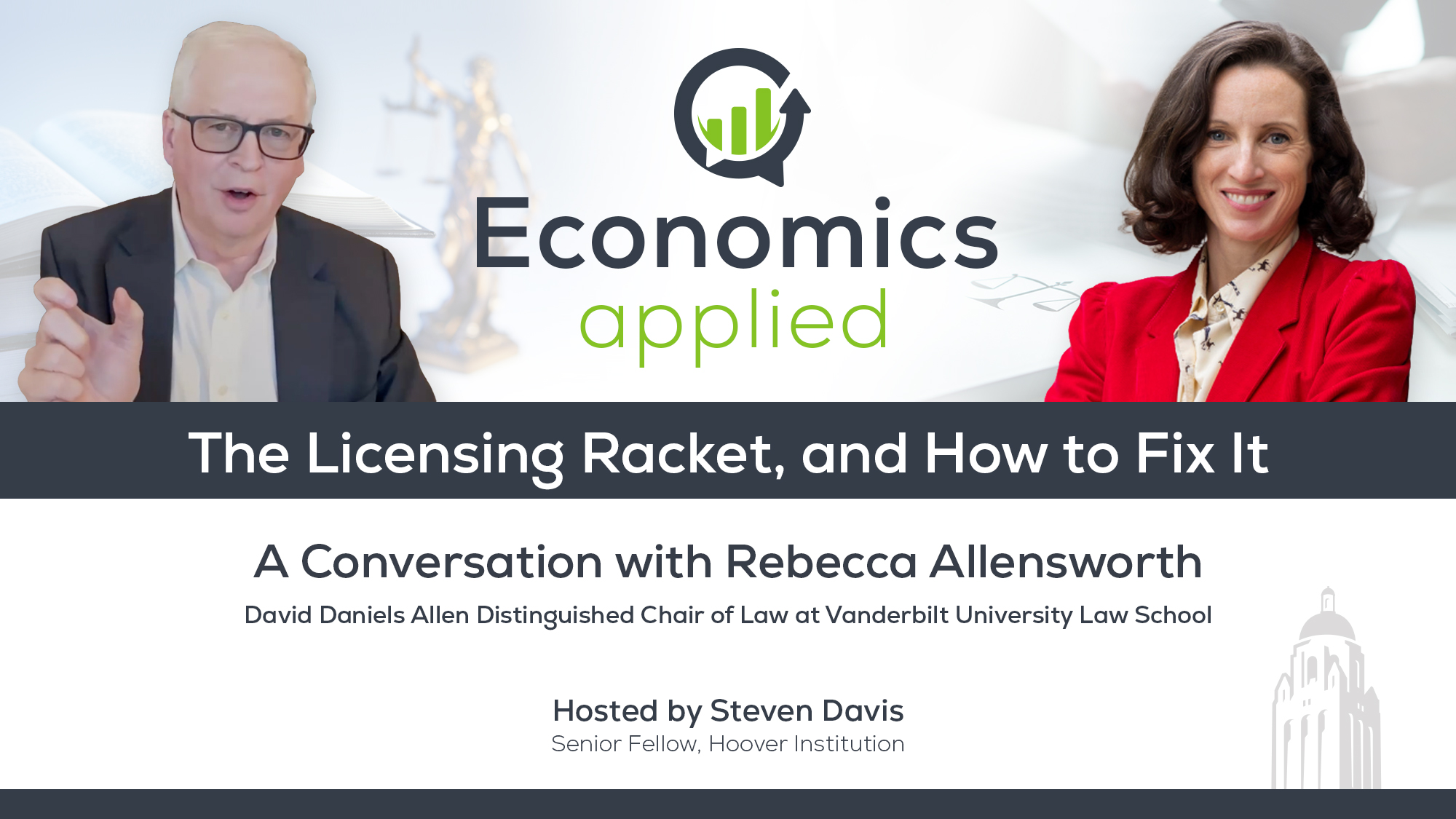
Rebecca Allensworth joins Steven Davis to talk about her new book on occupational licensing, which covers one-fifth of all American jobs. Licensing reduces supply, limits competition, raises prices, and harms consumers, benefiting incumbent practitioners at the public's expense. The US approach to licensing is especially prone to conflicts of interest and poor performance. Professor Allensworth offers several proposals to fix the licensing system, and Davis offers his thoughts as well.
- Milton Friedman published Capitalism and Freedom in 1962. Many policy ideas he espoused then struck critics as outlandish, unworkable, or unwise, or maybe all three, but some of his ideas were later adopted. For example, the idea of an all volunteer American military force has now held for half a century. Friedman devoted a full chapter of capitalism and freedom to occupational licensing. He and many other economists argue that licensing reduces supply limits competition raises prices and harms consumers benefiting incumbent practitioners at the public's ex expense. Yet in this area, Friedman's ideas failed to gain traction. In fact, licensing has expanded a great deal in the past 60 years, and licensing requirements have become more onerous in many occupations. That raises some questions. How does occupational licensing work in practice? Why is it spread and resisted reform or rollback? Do we really need occupational licensing? And if so, how can we fix it? Welcome to the first episode of Economics Applied in 2026. I'm Steven Davis, senior fellow and Director of Research at the Hoover Institution. Our guest today is Rebecca Allensworth. She is the David Daniels Allen Distinguished chair of law at Vanderbilt University Law School, where she studies antitrust and professional licensing. She earned a JD at Harvard Law School serving as articles editor for the Harvard Law Review. She clerked for Judge Richard Posner of the US Court of Appeals for the SE seventh Circuit, and went on and continues to have a distinguished academic career. Her work has been cited by the US Supreme Court. She's testified before Congress and has advised three US presidential administrations. Welcome so much, Rebecca. It's great to have you.
- Thank you for having me. I'm thrilled to be here.
- We are thrilled to have you. So you, you are the author of a recent book titled The Licensing Racket, how we Decide Who Is Allowed to Work and Why it goes wrong, and a lot does go wrong, as you will, you'll tell us about, but let's, let's start with the basics. Give us a, give us your definition of occupational licensing.
- Yeah. So the definition that I use is a little bit different from ones that economists have used. So I, I actually call it professional licensing to highlight the difference. So professional licensing by my definition is the regime where you have to have state permission to work. And that is obtained only after significant investment in human capital. So we're talking about education that's measured in months, usually years, usually in exam and other kind of fitness and character requirements. So this is a little bit distinct from what other economists use, which is any sort of state required permission to do a job that might just be a CPR course over a weekend or, you know.
- Okay.
- More limited,
- But just, I wanna make it clear. So if to become a florist in a certain state, I've gotta do many hours of study, pass a course work as somebody's apprentice for a while. That would count under your definition.
- Right? That would count under my definition. Okay. Exactly. So the use of the word occupational, I think is used to show that this form of licensure has really expanded beyond what we think of as the, you know, learned professions. And that's true and that's true even of the, the kind of regulation that the book is about, because I saw, you know, so auctioneers are a good example. Alarm system installers, they require significant in investment in human capital to really get a license. You know, so it's a, it's the same category of, of regulation.
- Yeah. And I, I, that that's a key point. And I, I wrote down a little example of mys, there's examples like that the Institute for Justice, which you talk about, and which is pushed back against licensing in many occupations, makes the point in one of its studies that in, in many states, it, it's more onerous to get your cosmetology cosmetology license than it is to become an emergency medical technician. So That's right. Suggesting there's something other than just actual human capital development required to meet these Yeah. Meet these qualifications.
- Yeah, I mean, hair is the big one. Hair is the really big one. It's actually one of the oldest professions. And so it has kind of grown over the years the way that the professions do when they're licensed. As I show in the book, and I'll give you another statistic that I like to share, even, even better, I think, than the EMT one, it takes more hours to become a barber or a cosmetologist classroom hours than the hours in law school. Okay. It's really, it's really a huge investment. And, you know, for a profession that's not gonna be a very high earning and for a profession that doesn't seem as sort of complicated or safety sensitive.
- Yeah, exactly. And that, that, just like I had one little quibble about your definition, which is it's a lot of what a lot of the hoops that people are required to jump through with some of these occupations are not really augmenting their human capital.
- Yeah. So I see what you're saying, right. So maybe I should say ostensible
- Investment. Yeah, exactly. Exactly.
- Yeah. Okay. I see. I take your point. Friendly, amen.
- Exactly. But okay. So, and, and what do the numbers look like now and how have they changed over time?
- Yeah, so even with my more sort of restrictive definition of professional licensing, you're still looking at nearly 20% of the American workforce, one in five workers. That translates to about 30 million American workers. That makes it a more important regulation than unions, than certainly than the minimum wage. I argue that it is the most important regulatory institution we have for labor today.
- Yeah, okay. And I, I, I think you can make a pretty good case for that. And this, this, by the way, this is hundreds of occupations and, and each occupation, you know, this differs across states. I'm not saying every state has hundreds of different occupational licensing requirement standards, but they differ across states. The, the what's defined as a occupation requiring licensure, the, the requirements themselves and so on. And the reason I'm emphasizing this point is it's not like you can get some generic qualification that says you are a competent good worker. No. You've got, if you wanna do this little narrow thing in some states, you gotta get a license. And by the way, if you move to another state, you gotta get a, you gotta go through the hoops again in many cases.
- That's right. And so I think I added them all up. And according to my definition, there's 300 licensed occupations that are licensed in at least one state. And you can figure a sort of a back of the envelope calculation. Any given state's gonna have about 30 to 50 licensed occupations. And many of them are overlapping, you know, nurses, lawyers, doctors. But then every state's got its own little, you know, handful of professions that it licenses that are maybe not licensed in other states. And this means that, you know, if you work in one of those professions in one state that's unlicensed, you cannot transfer to, to the other state without, you know, getting a whole new license. And even if you have a license in one state and you wanna go to another licensed state, there's nothing saying they'll have the same requirements or that you can easily transfer your license. So there's a real mobility problem here too.
- There is, and I, I think that's underappreciated. You do have a chapter in the book about how these mobility barriers were a problem during the COVID-19 pandemic for medical personnel, you know, getting the medical personnel to practice in the states that were most affected by the pandemic at any one point in time. But more generally, it, it inhibits the ability of people and the economy to respond to shocks that might lead to people moving. And it could be an economic shock, like one part of the country has become depressed, job opportunities are more plentiful than another. Or it could become an individ just an individual level thing. Like, my, my spouse got a fabulous job in another state, but if I move to that other state, I've gotta go through all my occupational licensing requirements again. So it inhibits the ability of people to pursue their own livelihoods as individuals and as part of a household.
- Yeah. And I think, you know, part of that chapter was to point out the difficulty of mobility, but then to also point out that mobility is just one small part of a larger problem, which is that state by state licensing makes the professions less reactive to new demand. You know, it's very hard to turn a workforce on a dime when demand increases. Demand changes. And this goes not just for increase in demand for a particular kind of service, but also innovation in how you perform or how you might deliver it. So the whole thing's very ossified as a result of this.
- Yeah. So the, the innovation point's a good one. Give us an example of that to bring that home. 'cause I don't think that's, that's a point that I don't usually see emphasized in this context, but I think you're right.
- So I think the familiar examples would be stuff like telemedicine, other ways that, you know, we're, we understand, we, we hear about, and we think about ways that we could be consuming services better, faster, cheaper across state lines. But it is happened in little ways too, that I actually observed when I went to these licensing board meetings. So I saw the, the, it was the veterinary board shut down a new business idea by some technicians. So the veterinary technician is a lower level license you can get from the veterinary board. And importantly, you must be supervised onsite by a veterinarian. Well, the veterinarians on the board shut down this idea that these techs had for pet sitting services. They were saying, well, come to your home. We'll do the complicated meds. We'll do the i the subcutaneous fluids that the owners were doing for their kid, their, their pets. This was not like, you know, something that was beyond the scope of what a, a regular person could do.
- Right. They
- Just wanted to give them peace of mind. And this seemed like a great innovation, you could call it. I certainly would've used this when I had a sick dog and I was, you know, traveling. But the, the licensed members of the veterinary profession shut it down at the board level because it was, you know, relaxed in those requirements.
- So, go ahead. So a classic example of turf protection.
- Yeah. You know, and, and, and they have no incentive to do otherwise, right? Yeah. They, they don't have to.
- We'll come back, we'll come back to that point.
- Yeah. - 'cause your book's very good on explaining why it is with the system we have, we get the bad outcomes that we do. But I, I just wanted to, to put one more kind of piece of background, factual background on the table. Give us a sense of how licensing has expanded over time in the United States in term in terms of both its scope, but also the intensity of the requirements.
- Yeah. So the, the first licensed profession, sort of classic licensed profession was medicine and law followed not long behind. And then really hair that was kind of the next one. Dentists and hair barbers and dentists were sort of a similar license. And then things were relatively steady for a while in terms of the scope of, of, of licensing. And then in the seventies, as economists, Morris Kleiner has really documented in the seventies, it really started to expand as a, as an intervention. And most of the time it was the professions themselves asking for the licensure status. And so that's when it really grew. And there's, there's a graphic that everybody points to who, who worries about these issues about that shows over time from 1950 to the present, the, the movement of people who are in trade unions goes down in this sort of like, dramatic downhill slope and then going uphill in the opposite direction into the same degree is licensing. So it really has just since the seventies really taken off.
- Yeah. So, so the statistics I've seen using a, a somewhat more expansive definition of licensing than yours says that in the early decades after World War ii, maybe 5% of the American workforce was covered by licensing requirements. And now it's 20% by your definition. And it's, you know, closer to 30% I think, by some other definitions. So there's been this huge expansion in the scope of licensing. And what about the, what about the onerous nature of these requirements? And can, can you give us a sense of, or at least an example of how that's changed over time?
- Yeah. There's been great empirical work in this recent empirical work on this question. And, and the answer is, if you give licensure to a profession, it will over time expand its oneness. So the biggest one is years of education and kind of education, but also exams and continuing education are good examples of, of how this is done. So to give you an example, I saw a board that had gone from the nineties requiring about 1500 hours of supervised therapy. This is for a drug and alcohol abuse counselors,
- Hmm.
- 1500 hours. Then they went back and changed that to 3000. And by the time I was watching them, it was 6,000, which is by the way, a three year medical residency for, right. So there's just kind of, this is the chapter about this is called the ratchet because over time these requirements tend to really grow and grow and grow. And that's why I brought up hair, because hair has been around for a long time. They've been working the ratchet for a very long time.
- Yeah. And so this is this example you gave, and it's true across more broadly, you know, as part of how the supply restriction that Friedman had in mind that I mentioned at the, in my opening remarks. It's not just that there's limits to competition after somebody becomes licensed in one of these occupations, but part the, a big part of how these licensure requirements function is to, is to pro is to inhibit entry. And so you limit the supply. And so that by itself, even in a comp, even in a competitive marketplace, if you were to limit supply, you're gonna get higher prices. Okay. Aside from any other impediments to competition or innovation, going back to your earlier examples.
- Yeah. So I think you're right to split it to two different effects. One is the limitation on supply tends to raise prices and, and, and limit, you know, innovation. And then the rules on what you can do once you're licensed. For example, you can't go to somebody's house and give their pets, you know, medicine or you can't do a, a lot of 'em are actually in home issues. You can't do hair in somebody's home. Those also will tend to raise price or at least decrease, you know, quality services or kinds of
- Services. Right. Okay. So we should, let's get to the question. Well, do we need occupational licensing? And if so, when and why?
- Yeah.
- Make the case for it for a minute and then we can talk about that.
- Right. So we've been talking so far about how, you know, kind of terrible, a lot of this can be, but I'm actually one of the few people who both thinks that professional licensing as we do it in the US is terrible and totally broken and, and willing to defend it in the abstract, just not the way that we do it. So I do think that there are good reasons to use something like professional licensing, where you have real potential for public harm. And an economist would say, you know, that's gonna be present wherever you have externalities, you have information asymmetries. So people don't know what they're getting. It's good to have a baseline. You've passed the test, we know you're not gonna be awful at this. That satisfies the information. Asymmetry issues and externalities. You know, you don't want to have doctors out there, you know, performing dangerous type medical practice because that's actually gonna sort of reverberate beyond the patient and, and the, the doctor relationship.
- Let's take those two arguments separately. 'cause I think they, they have different strengths and weaknesses. So I think the stronger argument in my view, you can tell me if you disagree, is about externalities in some occupations. So the example that I would give, if you have a doctor who fails to diagnose a highly contagious disease and give somebody aspirin says, go sleep it off. Come, you know, call me next week if you're not better. And that person goes off and infects many others, well that's, that's, that's an externality beyond the that patient doctor relationship. And we would like to ensure that that kind of thing doesn't happen or doesn't happen very often given the state of medical knowledge. So that, that seems like a reasonable case to require a certain level of proficiency in occupations that give rise to that kind of externality. The information asymmetry argument, I think is weaker because you can argue that certification, especially government sanction certification, can play at least as productive a role in a, addressing the information asymmetry as licensing. And by certification, I mean, you don't, you don't need a license to practice in a certain occupation, but you have to make it clear to your customers, to your patients, to your clients, whether or not you've met certain certification standards. And those certification standards can be blessed by the government or it can be private certification. There's pros and cons to both of those. So I i, in many, you don't talk a lot about this in the book unless I missed that part. But in many, in many occupations, it seems like certification could, could work as well or better than, well certainly than licensing as its practice now in the United States, but even perhaps better than the kind of licensing regime that you would prefer to see. I wanted to get your reaction to that.
- All right, so let me agree and disagree at the same time. And let me give you an example. So court reporters, these are people who write down what said, not just in court 'cause that's what it sounds like, but also depositions. This is a great example of a licensed profession in my state that suffers from potentially an information asymmetry problem that I think would be well solved by what you're identifying, right. Some sort of certification. And that's because the people who hire court reporters, courts A and b lawyers are sophisticated consumers and they may want the cheapo person who's gonna have some typos and they're gonna pay less and that's their choice. Or they could go ahead and get the state certified, certified, not licensed or privately certified court reporter. And they have a little bit more of an assurance that they've gone to school and they're gonna be a little bit better. I am totally on board for that. But the reason why I wanna defend though and disagree what you're saying with what you're saying on some level is because I believe, and maybe maybe the economists listening to this podcast disagree, but I believe in paternalistic regulation. Right. So I I'm just gonna come out and say that. So seatbelt laws right are fine with me. I do think it is appropriate to protect people from themselves sometimes. And that's why when I, when we're talking about doctors, even if the misdiagnosis isn't contagious, there's no externality. It's just the guy makes a bad choice by going to a bad doctor and he has a bad outcome.
- So two, two things here. One, that's still a problem. The not regulating it, that's still a problem, still a problem. All the doctors out there are licensed. But, you know, I worry every time I pick one about picking the bad apple. But let, let me give a different example that I think makes your argument most, I like the court reporter example. I think it's excellent for an excellent example of where certification, it's not just that these are informed users of the court reporter service, but they're, they're in a repeat relationship. It's a repeat game. Yeah. Yeah. So here, here's where I'd like to see licensing the guy, the emergency medical technician in the ambulance who comes to my house if I have a heart attack. And I, you know, I'm not in any position at that point to say, well, let me check out your certifications and see if I like them, or no, I'm gonna call a different ambulance. 'cause I don't really trust that certification service. I want a different one. Okay. That, in that case, you know, I kind of, I'm, I'm on board with, i I want licensing rather than certification. So maybe these two examples kind of cover the extremes and, and you and I might draw the line in a slightly different place on where, between certification and licensing. But at least it sounds like in principle we're not really all that far apart.
- That's right. I think you're highlighting the idea of choice. And I think we can sort of define choice as you know, is it, is it thrust upon you like the EMT or do you have the information to make an informed choice? But you're right, the question is really choice. And one thing I wanna highlight is that it's easy for us to think, you know, we are sophisticated consumers. I I'm imagining you are a sophisticated consumer of services.
- Sometimes, sometimes not. I mean,
- We just by virtue of of of, you know, our position in life, we go to like the hospitals that are certified. I don't think you probably go to a, you know, a local rural cash clinic for your services. I don't think that you're, for example, incarcerated and have to take the defender who comes through the door. You know, so there's a lot of people who just by virtue of their place in society, have a lot fewer choices about the professional services they consume. And I worry about them too. But I will say not as much as defenders of licensing as the status quo. Do they use that they wave that flag as a reason to have extreme licensure?
- Yeah, they, they wave the flag. That's right. I'm not sure they're really so worried about it at all. They wave the flag. And you make this very clear in your book, there's a big difference between the rhetoric that surrounds licensing, especially when these licensing boards are first created and the way they operate in practice. So tell us how they operate in practice. I mean, this is a big part of your book and your larger body of work, as I understand it, is you and you do much more so than any economist that I've seen get into the details of how it actually works on the ground. So tell us about that. We don't, can't cover all of this, but give us some of the highlights.
- Well, I wanna talk a bit about methodology. 'cause that's what I think is so different about this book is I, instead of looking up databases and looking up data, which I did for my, my writings previously about licensing, I just went to licensing board meetings. I went to dozens of meetings here in Nashville. It's a, it's a, the state capital. So we had all the licensing board meetings happening and I just sat there and took notes. I attended the medical board meeting the most, but I also went to a lot of hair meetings and, you know, dozens of professions, dozens of meetings to learn how, like what happens when we give regulation over to industry itself. Because my previous research had revealed that that's the case. That these licensing boards are primarily staffed by volunteers part-time. They're fully work, fully professionalized working in their profession. And then they sit on the board a few days a quarter and do this work. Like what happens when we hand over regulation to self-regulation in that way. And the answer was like, actually scarier and worse than I thought it would be, especially in the medical profession. But essentially the interests, the professional interests as a, as a, as a sort of affect almost not, not, they're not thinking there with, with dollars sitting there thinking with, you know, dollars and cents in their eyes and thinking about how this is gonna make me richer. But they are thinking about things from the professional perspective. And that's both to do with the kind of barriers and the competition that we've been talking about, but also in the way that they handle wayward providers.
- So I like this part of your research a lot, but nothing in that would surprise, nothing that you found in that regard would surprise Milton Friedman or George Stigler in his theory of regulation or so on. So you are what, what you, you can tell me if you disagree, what you do is you get into the nuts and bolts of how the licensing works on the ground and why in some respects it's maybe even worse than Friedman might have articulated. But the idea that if you give people authority to regulate an area where their self-interest is very much affected by the decisions they make, they will make decisions in their interest. That's no surprise. That will come as no surprise to a Freedman or Stigler or to many other economists that there, there are sadly a lot of my fellow economists, colleagues clinging to this myth of the benevolent regulator. But the Chicago school and I spent most of my career at Chicago would wouldn't fall victim to that, that kind of rhetoric or viewpoint.
- No, no. And nor would I, you know, day job as an antitrust professor.
- Yes, I, I noticed that
- I am very, you know, very attuned to the idea that a, that a cartel, which in fact is what I called these boards in previous writing Yes. Would regulate in their own interests. And I imagined this as, you know, the things we've been talking about. So restricting supply, keeping prices high, keeping working conditions high, you know, resisting things like home visits because they would, you know, reduce maybe the, the, the happiness of the workers. And I found a lot of that. I think that I was able to better observe the psychology behind what the freedmans and the Steelers were writing about, which was not about money, it was about prestige and esteem. So, so many of the reasons why they wanted to keep the barriers high was because they wanted be perceived as, I'm not saying that the, the economics and the money doesn't explain it. I mean, this is the age old, the age old argument about economics, right. So like, people have to be thinking in terms of dollars and cents in order to engage in dollars and cents related behavior. No, right. What they were thinking about and what they were talking about was status and esteem. And so I thought that was very valuable and very interesting. The Yeah,
- I, I I think you're right. The, the psychology of it is not drawn to the fore in traditional economic analysis. But the way I like to think about it in this domain and many others is it's easy for a person to think along certain lines that will enhance their financial wellbeing. And it's hard for, harder for them to think along lines that presents risks or threats to their financial wellbeing. And that, that view is very evident that that characterization of what happens is very evident in some of the examples you give in your book.
- Absolutely. And I will also say that there is, there are entities here with a more systematic, more finance, specifically financial interest at stake. And those are the associations. So the American Medical Association, the A BA, every one of every profession has an association. And they're a little bit more, I think clearly thinking about the economics of the thing, but still the way that they message it to the individual board members. And then the way that the board members message it to the public, it tends to be more about the ideas of esteem and prestige and, and of course public protection. I mean, they talk a lot about public protection. I just didn't really see it in the way that they made their decisions.
- Yeah. You have some great statistics on two kinds of actions that boards undertake disciplinary actions and often arising from complaints from clients, customers, patients, and so on. And I forgot your term for it, but, but basically turf protection actions,
- Unlicensed, unlicensed,
- Unlicensed, unauthorized activity.
- Yeah.
- So just tell us a little bit about that. This is about how what boards actually do on the ground and what they are responsive to and what they're not responsive to.
- Yeah. So, you know, for some of these professions that I was like, why is this licensed? I would ask members of the board and members of the profession, why is this licensed? And so for example, for alarm system installers, they would say, well, you know, you can have a lot of like people coming by and selling an old couple another system. They already have a system, you know, just kind of fraud type stuff, you know, scare tactics and whatever auctioneers, it was shell bidding and other fraud, like mis describing the items. Then they went to these meetings and I went to the her disciplinary proceedings. And for every customer complaint that alleged one of these things, they would say, well, we're gonna dismiss this. This is really more like a business problem. Or, you know, he said, she said, but anytime somebody said that there were auctioneering without a license or installing alarm systems without a license, they would throw the book. And so I got interested in this and actually read a year's worth of disciplinary decisions by a set of boards. Not just those two, but including those two. And I learned that like in some cases they were 10 times more likely to act on the unlicensed practice. And usually by the way, the complainants, there were fellow licensed professionals, not consumers, Like 10 times more likely to act on those complaints. Then on the very reason that the, the, you know, the raison detra for the license, which is the consumer fraud or the, you know, the other sort of illegal acts. So that should be that like yeah, the public protection obviously is not their priority if they're willing to poo po it so, so thoroughly at the disciplinary stage really. Maybe this is about keeping the unwanted competitors out.
- Right? Exactly. Exactly. So you, you have quite a few ideas in the book about I would, they, they, they come in many buckets. Some are you, you say we should just roll back licensing in some areas and others, you, you say, well, there's things we could substitute for licensing. I think we, we ought to talk about an example like that. And then you also have some ideas for, well, in your view there are certain occupations that should be licensed, but we need to reform the way boards work and even what constitutes a board.
- Yeah. So - May maybe you can take each of those in turn. What would you, what would you just roll back?
- Yeah. - What would you try to substitute some other form of regulation premise, you talk about premises inspections and so on. And then, you know, where, where, where would you actually just stick with licensing, but to do it very differently?
- Yeah. And before we get to that, I do wanna highlight one thing that I found that did surprise me and I think maybe would've surprised stickler and, and Milton Friedman. And that was what the higher esteemed professional profession boards did with discipline. And I think this is another example, just like the unlicensed practice enforcement, where you really saw that this is not about public protection. So I saw especially the medical board, but the nursing board too. And, and the law boards keep in practice some of the worst of the worst. I mean, stories that are in the book, I don't need to summarize them now, but stories that would really, really surprise and surprise me surprise an average person, you know, looking at what these boards are doing. And I think that is a little inconsistent with what Friedman might've said, you know, because if you could kick somebody out of the professional that's one less competitor, if you keep them in your profession, it makes the profession look bad. And this was in fact something that people told me, but that all seemed swamped by a different impulse also coming from self-regulation, which was to kind of circle the wagons. And that was, I think where identity and, you know, played that, that played a very strong psychological role in what, in what the boards did. So anyway, I just wanna keep, I just wanna at least flag. Yeah. Can
- I, can I just elaborate on that? Yeah, because 'cause I think you're right and you, you could, you could interpret Friedman's arguments to encompass this, but it would be a strain. I, the way I interpret what happens is these people sitting on the boards making disciplinary decisions, they are in the same occupation. It's easy for them to identify with something like, oh, I'm a doctor, what if I happen to make a mistake? And I was booted out of the profession. So there's, you know, they may not have done, they may not have been likely to do something as egregious as the person who's before them for the disciplinary proceeding. But the whole way the thing runs, they're kind of inclined to identify with the incumbent practitioner who's misbehaved or worse as you give some examples of very bad behavior that are then, you know, things like exchanging sexual favors with clients or patients and giving them lots of drugs which they can then resell on the open market or the, the black market I should say. And yet, you know, giving these people a chance to, a second chance. Yeah. So that's a pretty egregious offense.
- And, and third and fourth chances, and here's another example where I think the associations were, had a big role to play in messaging to the board members about going, you know, using their leniency, using forgiveness, using second, third, and fourth chances. It's obvious how to the profession in general, you'd want the disciplinary system to be pretty casual. So that was definitely what the associations wanted. But there was also an economic argument behind it, which I think is interesting, which was, you know, hey, we, this, this doctor has $1.5 million worth of training and to remove him from the profession does away with that investment. And it also deprives this whole area of their, of their, of their care. And so for access to care reasons, which is ultimately an economics question, we need to keep him in the practice. Now, this made very little sense to me, especially given how hostile they were to access to care arguments when it came to restrictions to enter the
- Profession or immigrant doctors Yeah. Or nurse practitioners expanding the scope of what they are allowed to do. Yeah.
- Yeah. So anyway, getting to your question, what to do about this? So I, yeah, I do have some buckets I wanna put professions in. And one bucket is this doesn't need to be licensed. This is what I think about court reporters. I think it's probably true about hair, although I think that there may be some regulation, not professional licensure, not, you know, a year's worth of education that, you know, these are areas where the market more or less is gonna protect consumers. The worst thing that could happen, a bad haircut, you know, wouldn't seem to be the end of the world. And where access to these professions is really important for people who wanna be entrepreneurs, you know, wanna just, you know, get a job for things like hair, you could do something more straightforward and targeted at the actual risks. So to the extent that you think that hair cutting potentially spreads disease, and I want to emphasize that I do not know this to be true. This is just something that people tell me, advocate for licensure. They say, if you don't clean your instruments, you could spread disease. So let's take that at face value, which we shouldn't, by the way, we should demand evidence of all these things. But if we were to find that that's true, you could have a premises regulation, you could say you have to clean your instruments, you have to clean them in this way, and we'll come by and inspect once a month to make sure you're using
- So like what we do for restaurants,
- Like what we do for restaurants, which is an important con comparison because actually I would probably rather this, I'm not gonna say this, I I I would rather get what you might get in a hair salon than get the kind of thing you could get in a restaurant. Yes. You know what I mean?
- Exactly. Okay.
- Like
- Anyone who's had food poisoning after eating in a restaurant, that that's a serious risk even it's terrible. Even in the regulated regime we live in.
- Yeah. So, and, and we have, we have ways of dealing with that. We have rules about handling food, we have rules about keeping things clean. And so we don't require licensure for people who work in a restaurant. So I kind of make this, I make this move to say, professional licensing is appropriate only for professions for which you can't write a code. You can't say step by step, here's what you do. Tattoos would be a great example of, of something that is dangerous and clearly can spread disease, but that you can describe the specific steps you need to take to clean your instruments. And to be a safe tattoo artist, it doesn't mean we shouldn't regulate it, but we don't need the elaborate education and, and, and deep knowledge building that's required for what I call professional judgment, which is the application of a vast and complex set of knowledge to an individual case by case situation. So there's no code for how to defend a murder case. There's no set of steps for diagnosing cancer, you know, specific steps that work every time. You have to have that elaborate education. So that's the line that I try to draw for professional licensing.
- Okay. Can't things that can't be reduced to kind of a formula that applies broadly and that don't involve, like in the restaurant example, kind of a, a natural inspection verification regime. So that's what we do with restaurants, right? That's what we do with many things.
- Yeah. Okay. And by the way, you have to have the information assymetry and or the externalities problem too. So university professors, for example, would be an example of something that does require professional judgment, but it just doesn't fail. The other, you know, we, people know what they're getting when they hire a university professor, they do their due diligence, you know, CEOs would be the same, the same thing. You can have highly complex, difficult jobs that aren't appropriate for licensing.
- Right, right. Okay. So let's take, let's take the ones then that do meet your standard for some form of licensing is required. How would you fix the current system?
- Well, I think the biggest problem is the boards. I think that the way that the statutes in the states delegate regulatory authority, which involves both rulemaking about how you enter and how you can practice and discipline about when somebody has, has, you know, acted inappropriately. That's all given to this licensing board that's both biased in the ways that we've talked about, but also really inexperienced and unknowledgeable in ways we haven't talked about. Because keep in mind these guys are, you know, they're great nurses, they're great doctors, but they don't understand regulation. They don't understand the big picture problems in their profession. They don't understand rural medicine, they don't understand access to care, the kinds of things that economists actually study and know very well in some ways. You know, there's other kinds of experts, mostly regulatory expertise that bears on what we should be doing with licensing. So I think that we've gotta get rid of the dominance of these boards. We can make the boards represent broader interests, broader degrees of expertise, and essentially house that decision making authority not with the private board, which I'd argue is basically a private cartel, but with government itself.
- Okay. I think you give some examples the contrast that sticks in my mind that you drew between cemeterians And funeral directors. So yeah, if I recall correctly, funeral directors are typically licensed, at least in many states, perhaps all, I'm not sure Cemeterians are not, they are regulated by, at least in, maybe I don't remember whether this was a universal example or a Tennessee example, regulated by a commission, a public commission. So there's still oversight of how people in that profession practice. But the oversight is by a, at least ostensibly disinterested public servant who can draw upon the kinds of regulatory expertise and sources of information you were alluding to earlier, rather than just a bunch of people in the same business deciding what they wanna allow within the scope of their occupation and handling disciplinary matters.
- That's
- Right. Do you wanna draw that out a bit?
- Yeah. So they're actually, I would say they're both licensed in the sense that you cannot be a ceter. And by the way that me, I learned this word in my research. This is somebody who operates a cemetery, so buries people and also typically does cremation, although I think those are different licenses. And then, you know, takes money from you now for funeral services in the future and also commits to long-term upkeep of the grounds so that that's what a cemetery does. And then a funeral director is, you know, typically more involved in the preparation of the body. But the point is that they both involve some very similar consumer risks. They both involve handling of bodies and they both involve long-term commitments by, you know, pay now and we'll perform later. That creates some, you know, consumer protection problems. The cemeterians are done through, as you said, a program where basically a bureaucrat in some ways this book is in defensive bureaucrats decides on the specifics of the rules, you know, transparently and through the governmental process, and then initiates disciplinary proceedings against cremator and, and, and cemeteries. And then the other one is done by a board, which is dominated by funeral directors who've done the education, have done the whole thing. And actually, this is an example where I think that the, the funeral directors have really resisted innovation and change in the way we do death rituals and have really insisted on the elaborateness, the overhead, the viewing, the, the embalming of the bodies as like the real kind of funeral experience. And I think part of that is driven by licensure and demand for licensure. Meanwhile, I think people have said, that's too expensive. I don't wanna deal with a licensed professional. I don't wanna deal with all this. I wanted to go to the simple cremation and burial. So in some ways licensing is actually driven, I think clients and, and consumers to the simpler one. But yes, the point is that I attribute at least in part the simpler, more straightforward, more economically reasonable regulation for cemeteries to the fact that they're regulated differently and not through a licensing board.
- Right. So the, this, this example is an interesting one because it illustrates the potential for retaining licensure, but moving towards a very different regulatory approach, namely getting away from the boards that are totally dominated by people who are in the same business.
- Yes, exactly. And it suggests that if you have more governmental accountability, you're gonna have better and more reasonable regulation.
- Okay. And, and you also have some discussion about the comparison between the US and the uk where the bureaucratic approach, let's call it the, is actually the prevailing, the prevailing approach in complete contrast to the US where the, the board approach the, the own profession dominated board approach is much more common. So I mentioned these because the reforms you're pushing for where you wanna retain licensing or they're not pie in the sky ideas. You can find examples of them in some occupations in some states in the United States, but they're also, they're also the, these alternative ideas are also the prevailing approach and our common law ancestor, I guess the uk. So it's, it's not, it's not like these are somehow foreign to the, the US way or the American way of doing things.
- That's right. I mean, there are best practices, you know, I think I say that no state is doing it all perfectly, but some of them do it better than others. And what I like about the UK system is that everything from the way regulation is made for doctors and also the way discipline is administered, there's a real balance between physicians having a seat at the table and other actors having a seat at the table. And those other actors are not what they are in the us. So in on all these boards, there's typically one, two, or three public members, but they have no qualifications. They too have not read the statutes. They too have not read the regs. And they are probably even more clueless about both the profession and regulation. I'm speaking in broad terms, this is not true about every last one. Sure. This is the tendency in the uk, half or more of the decision makers about professional regulation for doctors are not doctors, but they are paid for their work. They're trained in the statutes, they're trained in the aims of regulation, and they're like, it's, for lack of a better word, sort of a professionalized role for them. And I think that they get better results because they have more serious regulators making the decisions.
- Okay. So one way to summarize part of your argument, maybe somewhat facetiously is that yes, bureaucracies have lots of problems and they can get captured and so on, but the usual type of state and local bureaucratic apparatus is an improvement upon the way licensing boards operate.
- Yeah, I
- Think for, for good reasons.
- I think the way I put it in one of my articles is that this, these boards are born captured, you don't have to
- Yes, exactly. Exactly.
- Because they are just by, by their very fact are
- No, I like, I like that way of putting it because, you know, there's a whole branch of economics associated with Stigler, but more broadly public choice theory and economics that says, look, even when regulation ostensibly pursues good goals, there's a risk of capture. And we want to try to design regulatory institutions to at least minimize the likelihood or the negative consequences of capture. And here, as you say, we have an instant, well just gonna, they're, they're captured from the outset by design. So it's, it's in that sense really a crazy, a crazy way to regulate a profession.
- Yeah. It really is. I mean, this was evidenced also by the fact that I would see the board doing something, you know, make, trying to make a decision. And they would, and then somebody in the audience would pop up and say, hi, I'm a member of the association, you know, we're happy to do this for you as a special task force. Would you like us to take over the, the rulemaking revision here? You know? Yes. And we would say, oh yeah, oh, that would save us a lot of time and work. And hey, I'm busy. I get, get to get back to my practice. You know? And, and that was just not something I think you would see happen quite so nakedly in, in with a different board composition.
- Yeah. I, I wanna make one other point. I don't, this isn't so much a feature of your arguments in the book, at least that I, I picked up. But I think it's an important consideration here, and it it takes us to a broader set of concerns. So yeah, it has become harder in the United States to pursue a path towards upward mobility without getting a lot of credentials associated with licensure, but more often for many people, a collegiate degree. So, you know, there's, it's, it used to be the case that if you were an able bodied high school educated man, it was more often men than women coming out, you know, grad, you're 18, 19 years old, you finish high school, you're able-bodied. You're, you're, you have, you know, you show up at work on time, you're willing to work hard. You could get a good job in manufacturing or construction or so on, or you could start your own business. You know, maybe you're, you're, you're mowing lawns, trimming trees. You could turn into a landscaping business over time. There are many Americans who in the early decades after World War II, built a path towards prosperity for themselves and their families without going to college. That path has become narrower and harder for many reasons. Some which have to do with just shifts to the nature of available jobs, labor saving, technological innovations, and agriculture and manufacturing. But another reason I think is we have foreclosed these paths where you kind of pull yourself up by your own bootstraps. Again, I gave the example, you start by mowing, mowing lawns. When you're 16, you graduate from high school, you build this into a business over time, by the time you're 30, you're a landscaper and you've got, you know, five or 10 people working for you. All of that becomes much harder because so many of these occupations in so many states are licensed. So we, we've just made it much harder to pursue a path towards upper mobility for people who don't kind of go the academic, the route you and I went, okay, you and I, you know, happened to have a, an ap an aptitude set that suited higher education as a means of professional advancement, but not everybody's like that or wants to be like that. And we've made it a lot harder for those people, not just because of these structural changes in the economy, but also because of the policy decision that we've made around things like occupational licensing. I just wanna get your reaction to that.
- Yeah. So this is one of the most interesting, I think, complicated parts of my book because so, so much of this story is true, and then there's also a counter story. So sticking with what you're saying, first think about what it takes to become a cosmetologist. So you've, you're in the end, you're gonna be cutting hair for a living. I don't know how much you're gonna make, but it's gonna be at best maybe $40,000 a year, probably less. What you have to do is you have to take an entire year out of the labor market, so you're earning zero, you are paying between 10 and $20,000 to as tuition to the beauty school. And you're probably doing this because you have a family who you can live with. So you're living at home, maybe no low living, living expenses, and you're either gonna pay with their money 'cause they're gonna pay for you, or you're paying what, putting on your credit card, which unfortunately I learned was a common way to pay for beauty schools, 10 to 20 thou, now you're graduating with 10 to $20,000 of credit card debt into a profession that's gonna earn you $40,000 a year. So, and this is all, if you have a clean criminal record, that's another thing we haven't talked about. Right. Which is the way criminal records and licensure interact to keep people out of the labor force as you're talking about. So that makes it really u uphill and impossible for many people, especially people who don't have wealthy ish, or at least, you know, relatively flush families they can live with for a year. So that is a huge problem, and I totally agree with you, but it's also true that the professional license has become the picket fence. It has become the American dream. It has become the way that you are a member of the middle class, and especially the lower income professions like hair let go of that very unwillingly. They don't wanna give up the profession professional status of licensure because that is making it, that is, you know, achieving that toehold into the middle class. What I think gets lost in that set of arguments is that it, it's that because of the people, it keeps out, you know, it's, it's, it's really like a, it Yes. The people who have access to that kind of education can get ahead and can get that credential and then can use it to be a, a professional with a good income. But it really does that because it leaves behind so many people.
- Right, right. All righty, thanks so much, Rebecca. This has been a great conversation. I hope I, here's, here's my copy of your book. Yay. Go and buy it. Go and buy it. I hope, I hope, I hope you get a big boost in your sales on Amazon and other platforms after this, this conversation.
- I really enjoyed it. Thanks for having me.
- Alright, take, take care, Rebecca. All right, bye.
ABOUT THE SPEAKERS
Rebecca Haw Allensworth is the David Daniels Allen Distinguished Chair of Law at Vanderbilt University Law School, where she studies antitrust and professional licensing. She earned a JD at Harvard Law School, serving as articles editor for the Harvard Law Review. She clerked for Judge Richard Posner of the US Court of Appeals for the Seventh Circuit and went on to a distinguished academic career. Her work has been cited by the US Supreme Court. She’s testified before Congress and has advised three US presidential administrations.
She is the author of The Licensing Racket: How We Decide Who Is Allowed to Work, and Why It Goes Wrong.
- Faculty Profile: Rebecca Haw Allensworth and Video
- Follow Rebecca Allensworth on X: @HawAllensworth
Steven Davis is the Thomas W. and Susan B. Ford Senior Fellow and Director of Research at the Hoover Institution, and Senior Fellow at the Stanford Institute for Economic Policy Research (SIEPR). He is a research associate of the NBER, IZA research fellow, elected fellow of the Society of Labor Economists, and consultant to the Federal Reserve Bank of Atlanta. He co-founded the Economic Policy Uncertainty project, the U.S. Survey of Working Arrangements and Attitudes, the Global Survey of Working Arrangements, the Survey of Business Uncertainty, and the Stock Market Jumps project. He also co-organizes the Asian Monetary Policy Forum, held annually in Singapore. Before joining Hoover, Davis was on the faculty at the University of Chicago Booth School of Business, serving as both distinguished service professor and deputy dean of the faculty.
RELATED SOURCES
- The Licensing Racket: How We Decide Who Is Allowed to Work, and Why It Goes Wrong by Rebecca Haw Allensworth, 2025.
- Capitalism and Freedom by Milton Friedman, 1962.
- The Theory of Economic Regulation by Geroge J. Stigler, 1971.
- License to Work: A National Study of the Burdens from Occupational Licensing, third edition, by Lisa Knepper and others, 2022.
ABOUT THE SERIES
Each episode of Economics, Applied, a video podcast series, features senior fellow Steven Davis in conversation with leaders and researchers about economic developments and their ramifications. The goal is to bring evidence and economic reasoning to the table, drawing lessons for individuals, organizations, and society. The podcast also aims to showcase the value of individual initiative, markets, the rule of law, and sound policy in fostering prosperity and security.
For more information, visit hoover.org/podcasts/economics-applied.

