
















- State & Local
- California
- Politics, Institutions, and Public Opinion
- Campaigns & Elections
- Empowering State and Local Governance
- Revitalizing American Institutions
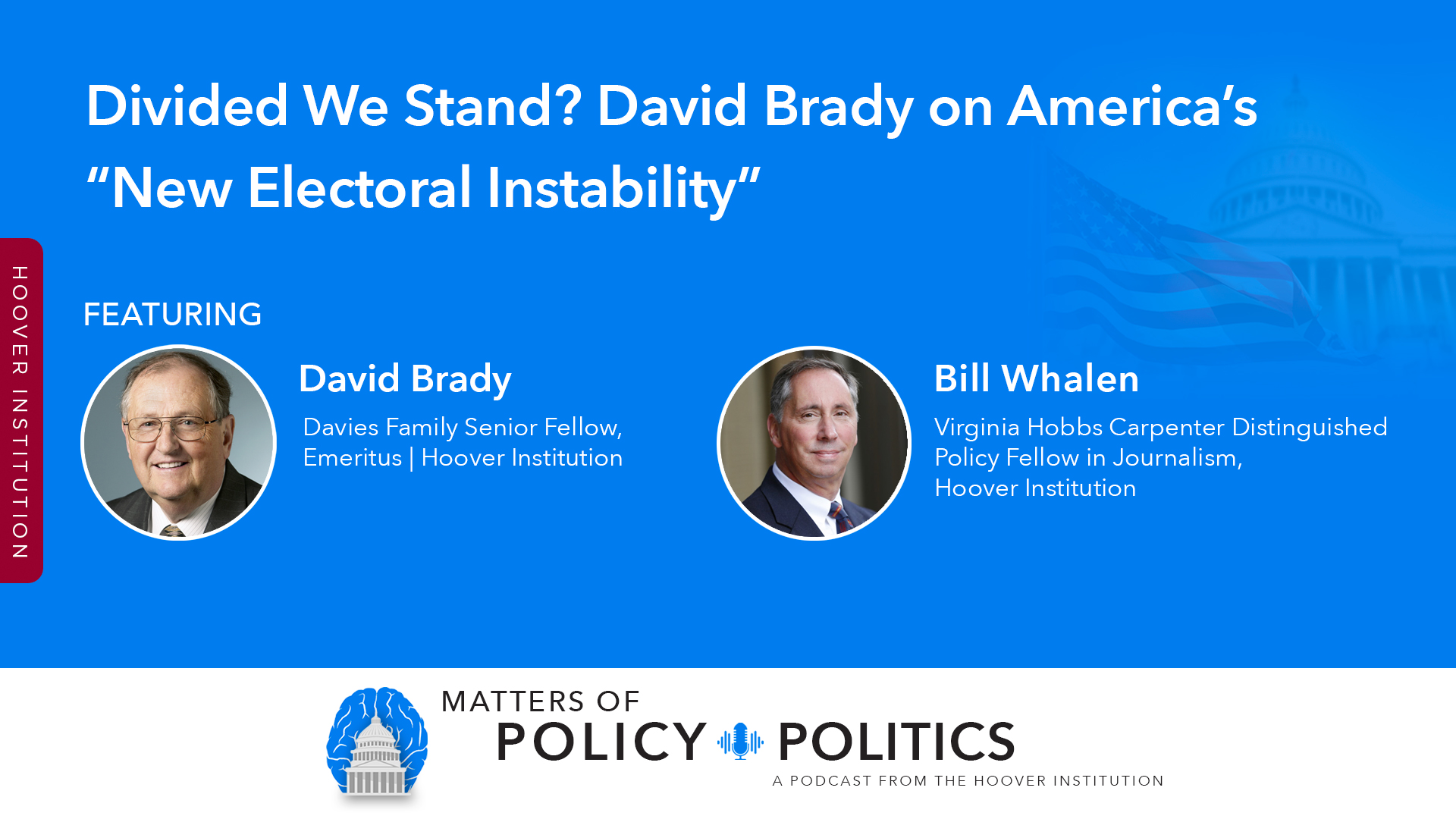
How did America go from relative political stability in the postwar era—one party controlling Congress for the better part of four decades leading up to 1994—to the past three decades of revolving-door majorities on Capitol Hill and increasing partisan bitterness in our political discourse?
David W. Brady, a renowned political scientist and the Hoover Institution’s Davies Family Senior Fellow, Emeritus, explains why in his latest book, From Dominance to Parity: America’s Political Parties and the New Era of Electoral Instability. Among the topics discussed: how the Roosevelt and Reagan landslides scrambled America’s voting blocs; why the 2008 Obama landslide wasn’t as transformational; the many dimensions of partisan shift (gender, age, income and education); the possibility of old-school moderate Democrats and Republicans repopulating the political landscape, or hyper-partisanship continuing to dominate future elections.
Recorded on January 12, 2026.
- It is Friday, January 9th, 2026, and you're listening to Matters of Policy and Politics, a podcast devoted to the discussion of policy research here at the Hoover Institution, as well as issues of local, national and geopolitical concern. I'm Bill Whalen. I'm the Hoover Institutions, Virginia FBB Carpenter distinguished policy fellow in journalism. But I'm not the only fellow who is podcasting these days. I recommend you go to our website and check it out. That link is hoover.org/podcast. You're gonna find all sorts of podcast economics, history, current events, foreign policy, and so forth. We cover the waterfront residue, the audio version of the Goodfellow show that the honor of hosting with John Cochrane, H.R. McMaster, and Sir Niall Ferguson. So definitely check out what we have in the podcast. It stable. Now, this of course, is an election year in America, as it is in more than 40 other nations around the world. Something like 1.6 billion men and women going to the polls. That's about one fifth of the population of this planet. By the way, here in the United States, we call it a midterm election, as in the middle of the President's four year term. The second time Donald Trump has experienced this. 2018 things didn't go particularly well for Mr. Trump, while his Republican party did add two seats to the United States Senate, making it a 53 to 47 advantage for the GOP Democrats gained a net total of 41 seats, that's 40 on election day plus one from the special election earlier in the year to secure a 2 35, 1 99 majority. As such, it constituted the largest gain in house seats for the Democratic Party since 1974 and the aftermath of the Watergate scandal. But now to be fair, Donald Trump is the only president in modern times to have suffered this political indignity. In 1994, bill Clinton lost both chambers of Congress in 26. In 2006, George Bush's GOP went from majority to minority in both the House and the Senate. Barack Obama and his fellow Democrats lost the house in 2010 and the Senate in 2014. You see a pattern here now. This back and forth is revolving door of power raises questions, one of which being why is it that America's electorate keeps changing its mind? On which party should run Congress? Second, why such volatility over the past three decades as compared to a 40 year stretch preceding the first Clinton midterm, during which the house always had a democratic majority justice? The Senate was a democratic province, with the exception of the first years of the Reagan presidency joining us to discuss this trend plus what to look for in this year's midterm election. It's my pleasure to welcome back to the podcast my colleague David Brady. Dave Brady is the Hoover Institution's Davies Family, senior Fellow Emeritus, and the Bowen h and Janice Arthur McCoy, professor of Political Science at Stanford University's graduate School of Business. He's the author of numerous essays and books on political landscape, the most recent of which we're going to discuss today, co-author with Brett Parker. The book's title is From Dominance to Parity, America's Political Parties in the New Era of Electoral Instability, it's available at Stanford University Press. David Blady, belated, happy New year and welcome back to the podcast.
- Thank you very much.
- Our listeners who've been follow this podcast for years are now asking, where is Doug Rivers?
- Yeah, Doug, Doug is around, but he wasn't a co-author on the book. So, so,
- And for those who, those who are not familiar with Dave and Doug is a political tandem, Doug is a political scientist at Stanford, like Dave, he's also the lead scientist at U gov, the international polling firm. So Dave, what are you and Doug doing in terms of polling right now? Since the election is what, almost 10 months away?
- We have been doing several things. We did a regular poll on the elections in New Jersey and Virginia and the Special House race and so on. So we've been doing that. But more importantly, for the 2000, as you know, for the 2024 election, we did a Stanford, Arizona State Yale project where we interviewed a panel of a hundred thousand people seven times over the course of the election. And we have decided to go ahead with that. But it's just gonna be a Stanford, Stanford Hoover project funded by Condi. And so we're going ahead with that. We're in the process of trying to put that questionnaire together. And as you know that you and I and Bob Grady and Ben Ginsburg will soon be meeting with Doug to talk about looking at what the future of the Republican Party is. Sounds Trump. So that's where we're doing all of those things. And, and the point about, we may part of this big Stanford poll where we're polling six to six to 10,000 people in a panel. I think we're gonna probably do some of the future of the Republican Party in that poll.
- And briefly, Dave, what is the advantage of doing the long-term tracking poll versus the traditional 2 3 4 day snapshot poll?
- Well, that, the point of this is that we interview the same people so we can track the people. One example of that is, the advantage of that is, as you may recall, after the first Obama Romney debate in two thou 2012 election, Obama did very badly. And the polls, all the polls showed that Romney was then the leader By three four points. But we had a panel of I think, 20,000 people that we interviewed before, during, and after the debate. And we got a switch, but only half a percent. And what happened is when you have, when they do the phone call polls, as you might expect, the Democrat Democrats weren't too willing to pick it up because they, anybody who watched the debate knew that Obama hadn't done very well. Right. And so who was more willing to pick it up and talk about, so it oversampled Republicans. So the advantage of doing it this way is we're interviewing the same people. We can track change over time.
- And how did that compare to 2024 when you had a presidential debate? We would agree was a seminal moment in that election.
- Yeah, it, it changed. It changed dramatically. The number that went up the most dramatically, as I recall, was the number of Democrats who thought Biden was now too old to be president. That number shot way up. And then it did take a couple weeks for the polls to show that they wouldn't vote for him. So the first reaction was not only did he do badly in the debate, he may be too old. And that was the first time that that number had gone among Democrats. That number had gone over 50%.
- So here we are talking about polling a political science. Dave, is this the life that you envisioned for yourself when you were a young man growing up?
- No, I grew up in Kke, Illinois in forties and fifties. At that time it was pretty prosperous blue collar town. You could, your father worked in a factory, you was, you know, you could get by. No, I wanted to play major league baseball. And needless to say, that didn't, I knew I was 13. That wasn't gonna happen. So no,
- And I told you also wanted to be a poet.
- Yeah, when I was, when I was, I was at the University of Iowa, the very famous writers workshop program, but it turns out I was better in political science than I was in poetry.
- So how, how do you, we will get to your book in a second, I promise. But how, how do you measure if you're a good poet or not?
- You read other poets and you can see how much better they are than you. And, and the instructors tell you,
- And how does one manage to be a poet?
- They kind, but they say, you could be a third level poet. That's, that's not a good sign.
- And how do you manage to be a poet, Dave, without that one adjective before it, which is starving poet.
- Yes. You don't, you don't, you teach, you teach at some of my friends from those days are they've gotten by, but they Yes, yes, it is quite right. Poets salaries are not, not that great.
- No, they're not. Alright, let's talk about the book, Dave, and congratulations, it's really wonderful read. At the premise of this book, there are six primary claims. So let's, let's address each claim. Have you explain each one. The first claim, Dave, that you and Brett make is the post-war period could be divided into three eras, a period of sustained democratic advantage lasting through 1980. Second, a period of transition lasting around 19 9, 19 80 to 1994. And now the current era of political parody. Question, Dave, is this unique in American history, or is there a parallel where you're talking about a 70 year stretch, which
- Well, there is the parallel. Well, the, the unique part of it is that you got parody now, and the parody seems to stay hang in there. The, the question of what happens o over time is that change that, but you normally had, so you had the pre-Civil War period and discontent with all sorts of issues north and south. And so you finally get the breakup of the Wi North. There was a northern wig and, and a southern wig and a Northern Democrat and Southern finally get the breakup that the Republican party and then the Civil War and a period of, of Republican dominance That actually, with the exception of Wilson, lasts really until Roosevelt. Then there's this period of dominance. But this is the first time, so this is the longest time period where there's been relative parity. So if you, so once the Republicans win in 1860, they control the government till 1874, they lose the house. And then there's a famous Kentucky 1876 election, which the Democrat Tilden probably won, but the Republican became president. And the and reconstruction ends that period from 1874 to 1896. That also as a period of great flip-flopping in the government, it corresponds in my view to the present period what the driving factor in both of them is the rise of capitalism. So in the first period, about a third, one third of the world became capitalists that made great changes in agriculture, people moving to cities, factories, great, great period of discontent strife. And that ends in 1896 with a Republican victory, which maintains itself until 32. But this period is the longest period where one, where, where there's parody and there's a lot of flip-flopping between the parties. Nobody controls the presidency and the house and the Congress for long enough to really make policy changes that provide stability.
- Right. So there are are three subsets of this, three eras here, Dave. What would the fourth era look like, Dave, would the fourth era go back to the first era and be a stretch of one party controlling Congress? Or would it be something entirely different?
- Well, the, the first period is, if you think about Roosevelt and the Democrats from 30, from 32 on, they basically, they controlled the presidency house and the Senate for 16 consecutive year. They controlled till 1946. And during that time period, they passed a lot of legislation. Then, then, then, then that, that begins to, and by the way, during that period, it forces the Republicans in order for them to be competitive. The Republicans were the period of no welfare, not much government intervention in the economy. And in order to become competitive, the Republicans have to become the party of less welfare, less less regulation. But they, they're no longer the party of none. And it, it's not, no, it's not a clear, so then that begins to break up. So there's a period of clear dominance. Then in a second period you get, so 1874 to 1876, that's a period again of no dominance. No party is dominant. And then the issues resolve themselves. And you get a period of dominance though in, in this particular period, what we do in the book is we combine party identification key variable, right? In American politics with self, self, self-proclaimed ideology. So we, we match those. And in the first period, the Democrats are dominant. The Democratics are, the liberal view is dominant. By the 18, 19, I'm sorry, the 1960s, the civil rights movement, you get the first bump towards the Republicans and states are less democratic than they used to be. And then 8, 19 80 to 94, with Reagan, you get the switch. Then you go from a period where down, if, if you look at Carter going into the election in 1976, Carter if he just 53% of the country said they were Democrats. So all Carter had to do was hold Democrats to win. But what what you noticed during that period is a lot of times what Nick, Republican presidents had to get 25% of democratic votes to win. IR got 25% of Democrats in Nixon in 72 against McGovern. He gets 33% of his total vote came from Democrat. And where were they coming from? They're coming from conservative Democrats. So just, this is an interesting, in 1980, 40% of all people who said they were conservative, you said, normally you yourself about 40% of all people who said they were said they were Democrats. By the end of the Reagan period, 1980 to 1994, there's been a big realignment in the fact that conservatives move away from the Democratic 'cause There's, and moderates move away from the Democratic party and into the party. And Republican liberals, they move toward the Democratic party. But the big, the switch, and by the way, that switch we shown in the book, that switch was not what sometimes the media commonly look at as, oh, that's just a southern phenomenon. Every region of the country moved more Republican during that time period. Every age group gender, there's no race. Every group moved more towards the Republicans during that period. And it was driven by the fact that it was conservatives who were moving from the Democratic party to the Republican party.
- Dave, you mentioned party id and in the book you note that the American National Election studies survey asked would be voters if they Republicans, Democrats are independents. Dave, that sounds a little, if not outdated, it sounds like maybe it needs to be updated in this regard. You can be a Republican, but you can also be maga and if you're maga you have kind of a weird relationship with the Republican party, you could easily ditch the Republican party after Donald Trump, just as you may vote Democratic day. But if you're a democratic socialist, you could easily walk away from the democratic socialist if someone like a OC mounted a third party. So should we be thinking maybe in terms of looking at the electorate in terms of breaking it down into even wider groups in the traditional rds and I,
- Well that's why we, that's why we used the ideolog, the ideology variable. You could break that down a number of ways. So in, so you're quite right about the effect of maga and, and the effect of democratic socialists versus moderate Democrats, which you could see in the Democratic party. And you can begin to see that in what's happening with Margaret Taylor Green and so on in the, in the Republican party. And Venezuela, the first sort of results of Venezuela shows that that is causing Trump some problem for MAGA voters. But it was where we're digging into that more in the next, in the next two polls. So, so the answer is yes, you, you do need to break that up and you do it by ideology. And if you use ideology, you say very conservative, conservative, moderate, and you break it down into five levels, then you get this breakdown in the party a little bit better. That that's one thing. The second thing is Doug actually created, we think, a much better measure, which is you ask people, how often do you vote for the Democratic party? And that would be all the time, most of the time about half, almost never, never. And that turns out to be just as you're suggesting a better measure, but given the scholarly tradition of party identification, nobody has run that over time. Nobody's run that, that, that new five point scale, nobody's run that over any long period of time. So if you're gonna deal with time, we thought the best way to deal with your question was to put, put together ideology, self-proclaimed. So this is not Dave Brady or Brett Parker or you or anybody saying, oh, this is, you're a liberal. This is asking people, do you consider yourself to be a liberal coor? So we're not, we're not, we're not categorizing people. They're categorizing themselves.
- Right? Second claim in the book, Dave, is the period of transition produced a political realignment with little historical president. You've talked a bit about that, but it's my question, Dave, let's go back to 2008, which was, you know, a, a late mark election, not just in terms of who Barack Obama was in terms of his identity, but if you look at that map, Dave, you see a splotch of blue in North Carolina that hadn't been there in some time. And Dave, you see blue in all places, Indiana, which never votes Democratic presidential elections. And between Obama being a unique force in politics and now winning in a place like Indiana, people like me thought, wow, the map may be changing, but then it was over before we knew it. What happened, Dave?
- Well, people over interpreted the election there. My favorite title during the period was, why A book by a, a prominent and actually a very good pollster, but the book was Why the Democrats will Dominate Politics for the next two generations.
- Well, I've got a better, I've got a better one. Carville wrote a book called 40 Years of Democratic Majority.
- Well, that's, that's sort of what I was trying to disguise it, but that's the book. Okay, that's the book. And because I do think in general he's pretty good, but, but the point is that that's exactly right. So generations are shorter. So what, what they, so here's, here's my view of what happened and this, we did this in another piece, fi and I, the, so what happened was Obama comes in and he thinks he has this big liberal, he has a, he has a 60 seat. He, he's, he, he's clear on the cloture. He, he's got enough votes to beat cloture. The, the filibuster is out because they're 60 40,
- Right?
- And they, they put together the healthcare plan,
- Right?
- And what, what we showed in a, in a separate paper, not in this one, is Democrats in marginal districts. So, you know, the, the number of districts where the, a marginal district is one where the president, whoever wins, it's between 45 and 55% Democrat or Republican. And in districts like that, where the Democrat voted for the Affordable Care Act, about 70% of 'em lost. They lost 64 seats in that election. And most of it, about 70% of that variance can be attributed to the fact that they went, they moved too far to the left on that, on a couple other pieces of legislation. And the, and the representatives who got beat were that way. So kind of in the same way, you know, when Trump comes in in 2016, he pushes that. Same with Biden comes in, in 2020, moves too far to the left and gets, gets the, and the people doing this, this rejection, by the way, are, are essentially independent moderate voters. The, the one thing we show over time in this book is that people, if you're partisan, if you say I'm a Democrat or I'm a Republican, over 90% of the time you'll vote for your candidate for president house Senate. So that's kind our, that, so that means that it's the independents who are mainly moderate, about 55% say they're moderate, is there are the people who are deciding elections.
- Alright. Third claim in the book, David, the eighties realignment permeated almost every major demographic cleavage, in other words, gender, age, race, religion, education, regional and so forth. Is this similar to what happened with FDR in the thirties? And secondly, Dave, when we look at now in the eighties, okay, three Republican landslides, 80, 84 and 88, they controlled the Senate 80 to 86. But the point I always make to people, this is a very California point. When you talk about the Republican problems in California, it's fine to embrace Ronald Reagan. But there's a problem with using Reagan as your example. Ronald Reagan was last on the ballot in 1984. So do the math. If you're 18 years old in 1984, congratulations, you're, you know, approaching retirement. In other words, younger generation don't, don't really understand Reagan. My point, Dave, is the realignment under Reagan, does it still last to today or has it been modified? And give us examples, a couple groups that have moved,
- But still, so what, so what happened with Reagan was conservatives. So the conservatives moved in and, and the, to the extent of which people didn't get that the change was real, that conservatives had moved over and the Democrats and Republicans were about equal Parity, roughly was the fact that people thought Bush would lose Herbert, what George Herbert Walker. But, and when he won, they were amazed. But the problem was the House of Representatives and the Senate continued to stay Democrat. And, and part of the reason for that was you, you think of what happened was that Southerners and people in the border states could vote conservative, could still vote conservative and liberalize up a little bit toward the election, but they were selling, it took until 1994 when the Republicans took the house and the Senate to end that democratic dominance in the House and Senate and the con and the fact that presidential elections are going one way and Senate elections are going the other fee, professor fee Arena Hoover has a, a very good book on, has a good Bill Hoover book on that.
- We seem to find a voting block each election though, and talk about them being a change. For example, 2004, we talked about security moms. Yeah.
- Oh, so, so the main, so the main change is conservatives moved over. And so by 1994, the parties are essentially equal, the parties remain equal, but there have, there have been change. The biggest change that I point out here is one, you, you've, you and I have talked about before is education. Education. It was the case that republicans, if you, if you had a high school or less degree, that you are generally Democrat and college educated voters were Republican. And so sort of the gap, what's the gap between those, right? With Trump, Trump has, there were the Reagan Democrats and Reagan did, but he didn't do as well with those people as Trump has done. So today it's flip flop and college educated people are more likely to vote Democrat and people with high school or less are likely to vote Republican. And that gap has increased through trump's all three of Trump's elections. And for the Democrats, that's not so great because you know about 30, at most, about 30% can be said to have graduated from college. So that means two thirds of the voters are in that group that favors that, that that that's favoring Trump.
- And can that snap back pretty fast? In other words, could blue collar voters return to Democrats? And I'm talking about something of a permanency, not just jumping back in one election, say 2028, but becoming a consistent vote just as, can Republicans get back the college vote, Dave? Or should we think about these things more in terms of decade and era stretches?
- No, that's, that's a $64 question. I wish I could, I wish I could tell you that I had the answer, but I, I will tell you that what ha is that, that what happens is as the number, as Democrats continue to vote Democrat more right religiously than they did before. And same for Republic. Part of the reason for that is there are some moderate Democrats and there are some moderate Republicans, and they are more likely to switch. But at the presidential level, it's not likely to be so because it's not li so think Biden was the moderate candidate among people who ran.
- Right? - The, the point is that, that you're not likely, if you're a Democrat or a Republican, you're not likely. So that means if you're a Democrat, you tend to be liberal, you're a Republican, you're conservative. That means that it's unlikely the other party's gonna nominate a candidate to appeal to a moderate in the Democratic party. So I don't, but at the house le at house levels and lower levels, you do get that. So we do see large numbers of people who say they voted for a member of the other party, generally just not at the top.
- And also I think it's important, Dave, to point out the importance of external events. People think that Donald Trump came down the escalator in 2015 and jumped into politics and was phenomenon. But what I try to point out to people is Trump kind of jumped into a very convenient tailwind in this regard in that you had had the financial crisis in 2008 and people upset that nobody went to jail for this. While people lost mortgages and so forth. You had Obamacare and spending a government money, the Tea party movement, disappointment with Obama as a president, you know, disappointment with John McCain and Mitt Romney as a candidate, Hillary Clinton in the bullpen warming up to be the democratic nominee. You can't find a better environment which Donald Trump can run.
- Well that, that's, that's absolutely correct. The each election has that, it's twofold, right? In a sense, each election has, as you pointed out, some issue like the mo moms that move. And that's true and and particularly true in in the modern era elections post Reagan, all presidential and congressional elections are exceedingly close. So Obama's big win in 2012 wouldn't on the period of the 19th century, all the way from the 19th century up until past Roosevelt up until 1960, that win would not even have been in the top half of Democratic wins.
- Right? - So once elections are so close, then these election moms, the things you were talking about in some off your elections, the abortion vote, tho those things can matter a tremendous amount. And they matter more because fewer and fewer voters in fewer and fewer states are deciding who controls Congress deciding who wins the presidency.
- Alright? Claim number four, Dave, the movement toward the Republican priority was nearly universal because 1980s was a period of ideological sorting for the non PhDs out there. Would you mind explaining what ideological sorting means?
- Yeah, so there's, everybody talks about polarization. Democrats are all liberal and Republicans are conservative. But you know, how did that, how did that happen? And, and so what we show is, so, so the parties, the parties there in the Republican party, there were a lot of liberals, Scranton, Rockefeller Brook, Senator Brook, box senator from Massachusetts. So there were liberals in the Republican party. And you remember the Goldwater battle was, that was what the battle was about,
- Right?
- And when he finally won California, they, they had taken over the party, then they lost and were set back, but they, they didn't go away. So, so, so the question, so then the question is that, that that's the, it's it's the case that those mo movements are, are sort of always present and they, it changes election to election, any specific election or period you want. So, so I guess the, the point is the sorting means conservatives over time drifted into the Republican party, liberals more to the Democratic party. So just some issues. First it started in the sixties, there were some southern states that had always voted Democrat. And if you recall then about in the sixty four, sixty eight those election, the South did very well, 68, 72, Wallace did well in 60 68. Nixon won big in 72, it was two Southerners, Carter and, and Clinton who did pretty well in those south, in, in those southern states. After that, it it, it hasn't happened. So the sorting means the first part of the sorting was kind of the racial sorting from the sixties. The second part was under Reagan where Democrats lost their, the view most American voters fallback position was if there's a crisis, the Democrats can solve it. And if you don't believe that, go back and look at any of the reports on what happened in 1958. Eisenhower very popular president when the 58 recession hits all the media, everybody says that, and there was a big turnback in 58 16 to the Democratic party. But Reagan causes that to end so that at the end of the Reagan era there, the Democrats no longer have their advantage of, if times are tough, the Democrats are the party to go to. So they lose that. And that's, that's a big, and then finally you get the social, you get the social conservatives, you get the issue of abortion, social conservatism, ruralness, that, that all sorts out in that period too.
- Alright, your fifth claim of the book, Dave, we're seeing ideologically consistent parties coinciding with hyper-partisan politics. Now, I'm very interested in the concept of what exactly hyper-partisan politics is because if you look at the rich history of politics in this country, it's always had an edge to it.
- Yep. What I mean, what we mean by that is if, if you look at some of the charts, you can see, let's, let's take split voting there. If you're running at a presidential camera, there's only three places you can get votes from. Nonpartisans, other members of the other party who defect and vote for you. And then independence. And when you look at what happens to the Democrat, people who say I'm a Democrat or a Republican, over time their, so Democrats would often vote for Democrats, 25, 30% of Democrats voted for Eisenhower, many Democrats voted for Nixon against Kennedy, so on so forth. But that line is gone now in elections since 19, since the end of the Reagan period. 90% of Democrats vote Democrat in those elections and 90% of Republicans vote Republican. So that's, that's kind of what you mean by that's kind of what we mean by hyperpartisan. And then, and again, that puts pressure on independence to resolve these things.
- Is it a coincidence, Dave, that at the years since 1994, you have at least two things playing now in politics. One is cable news, which is really not so much news as opinion. And then secondly, social media. In other words, you have a drum beat out there, Dave, every day pushing your partisan line.
- Yeah. That we don't, we don't deal with that much in the book. And the, those are important variables. They, they come up over time, but we were dealing with a much longer slice. And it's not, it is not clear to me that you need that to predict, to predict the election. So I'll give an example of that, I think. So when Trump wins in 94, again, go back to the example of you can get your own partisans because, so Trump, Trump takes 95, 90 6% of Republicans to vote for Trump. The Republicans who sort of defected were more likely to consider abortion or social issues, the big thing. But the reason, so I'll give you an example. The, for most Americans, the big three issues were the economy,
- Right?
- Jobs, jobs in the economy, inflation and immigration. And so over 90% of the Democrats vote for Harris. But if you're a down 12% of the Democrats thought that inflation was the most important issue,
- Right?
- Of those people. She, instead of getting 95%, she got 86, 80 8%, sorry. So she loses 7% among but among independents whose thought inflation was the most important, and that's about 30% of independents said inflation, she gets 10% of their vote. And if you, if you thought in immigration was the second most important issue for independence, she got about 20% of that vote. So, so the so issues do, do, the issues do make a difference, but generally it's the economic issues that dominate. You may have as in 2022, the thing that got the Democrats crosswired for 2024 was because of the abortion issue and the Supreme Court decision, Democrats did better in house elections than you would've expected because of the abortion issue. But once the presidential issues on the ballot, then, then you got the full monopoly. And basically it's, you gotta count on the economic variables will dominate in my view.
- Okay,
- Let's what happened in 2026 too?
- Okay, let's say a year from now, the house is under democratic control. Two roads, they can take, they can take the policy road, they can talk about what their vision is for America, or they could take the partisan road and they can impeach the guy. It seems to me impeachment fits into your hyperpartisan narrative.
- Yeah, this gets back, this get Well that's a great question that it gets back to, so the Democratic party, about 65 to 70% of the Democrats say they're very liberal or liberal, but the percentage of liberal, very liberal liberals and very liberals have differences on all kinds of issues. But still it's about 30%, 25, 30% of Democrats are moderate.
- Right? - I think the battle in the Congress is gonna be over the issue of how well do you want to position your party for the next presidential election, right? I think my personal view is trying to impeach, impeach the president, et cetera, is not gonna do the job. And, and I'll give an example of what in, in 20, in 2006 when the Democrats took over the house, there were the fire, a lot of firebrand Democrats wanted to do, wanted to impeach George W. Bush,
- Right?
- And Pelosi kept him from doing that by and large on the ground. We've interviewed her here several times and by and large she did it on the grounds that she thought the party would put the party in a bad position, we'd be in a position of being hyperpartisan and, and that's not gonna bring around the moderates that you need to win the election. So it'd be interesting to see, I do think the Democrats will take the house and, and the result then will be see where they go and Right,
- But the second time around Dave, she didn't hesitate to impeach him. She impeached him twice actually, which takes us to point number six in the book. You talk about Trump, tell us how you explain Trump, who we can agree it's a book within a book.
- Well he is unique,
- But you're arguing he's not necessarily an agent of change.
- No, he is a very unique candidate. First of all, he is a huge vote turnout. The highest vote turnouts since 1910 have been under the Trump president. He, he, he gets out votes on both sides. Two in the elections that he won, the economic issues favored him. And he has changed, he's brought a bunch of voters along with him that hadn't been that high. This is high school or less. But there you want to say it, it's, it's not clear well happened to the Republican party who can, whether, whether other people can hold them in the same way, in the same way that he holds them. I, I think the most important thing about understanding Trump though is that MAGA base that you referred to earlier, that maga base is about 30, 35, 40% of the Republican party who say sometimes a little hire it very some, but it's a big hug of the Republican party that is Maga and no other, no other presidential candidate when we poll 'em, had that kind of unbinding loyalty. And that has meant that in congressional elections, the president can threaten to primary somebody,
- Right?
- And that constitutes a real threat because those voters will in fact cause trouble for an incumbent candidate. So he's been able to bring support in the Republican party along for some of his policies, which I think they probably wouldn't have supported otherwise. But that's beginning to, that's beginning to fade as you can see the Republicans and Democrats just passed a bill that is higher much, it's quite a bit higher, provides more funds than the president had proposed. And he'll he decide. So you're seeing some of that, some of the breakaway but not, I don't think among his base voters. I think it's starting to see in Congress and you'll see when after the 26th election where we are. But I think he'll be weaker in the party than he is now.
- Yeah, I think me gonna, Megan's gonna have to sort of revisit itself in 2028 and figure where it's, I mean look at it right now Dave. So here's Stephen Miller Trump's White House aid and he is out saying that nobody would object to invading Greenland militarily, which is, I don't think what most MAGA people stand up for in 2016. Conversely, Steven Miller's wife is doing a podcast she had on her guest the other day, Jenny McCarthy, who's Jenny McCarthy, she's an actress, she does a show on tv and she is a big anti-vaccine person. She believes that vaccines cause autism. She believes they caused autism in her son. So here you have Miller on the one hand doing something in foreign policy, some rattling that MAGA maybe doesn't like in terms of nation building and so forth. But then the wife is getting back into Maga and Maha and doing kind of the, you know, don't trust the government, don't trust science side. So, you know, interesting, interesting schisms developing there.
- No, no, that's true. And the, and the schism in the Democratic party is the, you wanna put it, it's the span Berger a OC.
- Yep.
- And that that's gonna play out, it's gonna play out in very interest, very interesting ways, especially as you pointed out when and if they take the house. And I think they will, the evidence we have from our recent polling shows that, but if they, if they do take the house, then what they do is gonna make a big difference for what happens in 2028.
- Alright, let's talk a bit about 2026 now, Dave, first of all, we're not gonna do predictions. So you and I have been doing podcasts together for over a decade. And I remember you and I, you and I, Doug Rivers doing one in 2016 and getting all the things wrong about election prediction wise. So let's, let's not go down that rabbit hole. Here's how
- I make a prediction on 2026.
- Yeah, but here's what I'm looking at right now. And that is the health of the Trump presidency, David, how it's going to spill over into the congressional vote. You go to the gym and work out, you probably have noticed there's a certain kind of person at the gym and from the waist up, he is a god. He is just more muscular and can believe. And from the waist down, he's got chicken legs because he never does a leg day. And that to me, Dave is kind of the Trump presidency right now. It is very muscular on foreign policy and a lot of things he can talk about, be it Venezuela, Iran, Israel and so forth. But on the domestic side, the economic side, they're struggling right now with the message.
- No, I, I agree. Absolutely. So you gov dead polls and Virginia and New Jersey, and by the way, they were the only, we were the only pollster, Doug, not me, but the only pollster that had democratic gubernatorial candidates winning by double digit figures. They're off by only percent. But nobody else had both that high. And when we looked at the numbers, what, what, so what happened? So I looked at 'em in dumber, boy, but just think back to the question of what are the economic issues? And in, in those states, the issues are the economy. And if voters thought the economy wasn't doing well, they were worse off, et cetera. They were the ones that abandoned Republicans who felt that, not many of 'em, but they abandoned. There were a couple percent of Republicans who's who abandoned the Republican candidate. But most importantly, where I lost was in 2020 and 27, we looked at the vote. And if you were worried about inflation or worried about jobs, guess what? You voted for Trump. And this time voters who were worried about that, and particularly among independents, they voted Democrat. So then if you take that economic information, then we looked at a series of the latest u gov economists polls where we have that data and we have a, a question, if the 2026 congressional election were held today, would you vote? And it's generic vote Democrat or Republicans, we don't have candidates. So, and on that, exactly what was happening in Virginia and happened in New Jersey and in the Miami race is exactly what happened here. Independents who are concerned about the economy and inflation, they're, they were the ones that there are 20 points now more down. There're the independents now favor by 12 points, but among people who care about the economy and that it's over 20 points. So the Democrats now have a 12 point lead among independents and a six point lead on that generic question. And going into 2026, you only need to swing five seats. And you've got the, and and you have the, you have the house and you have the house, you have control of the house. 'cause the margin is very small now.
- Yeah, A shout out to our friends at real clear politics who do great jobs of, of compiling data. And if you go on the website, you can find actually they will compare and contrast the various polls out there, which do a generic congressional ballot. And as Dave mentioned, YouGov has it at plus six Democrat. That's a little bullish if some other polls are around 3, 4, 5 points. So we're all kind of in that sweet spot right there. But they show lean Democrat. Dave, here's a question for you though. In 2026, you, the Democratic party looking to regain Congress, you mentioned it's not that hard to do, only handful of seats, but let's talk about how they do it. And 1994 had his new Gingrich do it, he recruits candidates obviously, but then he comes up with a contract with America and it's a very detailed policy paper about what they will do if elected in terms of policy. There's some value stuff in there in terms of how they'll run the house, but they have a plan about what they're gonna do if they come to power. Now in 2026, Dave, in 2025, actually I'd say we saw something very interesting here in California. Gavin Newsom presumably gonna run for president in 2028. He shoots to the front of the pack. And how does he do it? He spends a lot of time on social media just being Donald Trump and insulting Trump and posting social media thoughts and Trump's style being bombastic, never offering policy alternatives, never really offering a vision for America, just tearing Donald Trump a new one at all times. Question Dave, is this in this age of social media? Is this the ticket now to flip Congress? Forget about policy ideas, let's just talk about how much we hate the guy in the White House and just kind of appeal to people's darker nature.
- Yeah. The more people you have do that, then the more certain, in my view, you'll be on the wrong path.
- I I mean it's, I it's an important question because here we are to think tank and you know, why do think tanks exist? Because ideas matter, right?
- Well, you know, it's twofold. First question you got through, in most democratic districts, the, the, the Democrat wins with a huge margin. They're winning by 65, 35 or 60 30 points. And in those districts, it doesn't matter, you could have somebody who just campaigns on, I hate Trump, but in the districts where it's gonna be swung, I I think that's not, that's not gonna be enough. You can, they can not like Trump, but on the other end, they have to have some set of issues. I don't think they have to have issues about which way the country's going. I think they have to talk about affordability, inflation, that set of things just like Berger and Cheryl did in New Jersey and Virginia. If they talk like that, I think that'll be enough for them to swing 20 or so, 20, 25 seats and give the Democrats a 15 seat majority. And then we'll see what they do. But, but I, I do not think the strategy of just, and Trump works in all kinds of districts that they need to win.
- Will it be a national election? I mean, I know it's a national election in terms of all states vote, but in terms of the theme of the election, will it be a national theme, Dave? Or will it be more local?
- I, I think the way we'll interpret it is it'll be a national election,
- Right?
- But the one thing that could take the Democrats down is you can imagine in all these key districts, there's a big battle and a OC and Bernie Sanders wanna put one of their candidates in and you get a divisive, very divisive primary. The Texas Senate primary I think is a good example, right? It's a case where it looks like, given that Paxton, the former Attorney General had been indicted, looks like he's going to defeat the incumbent, and that looks like the Democrat polling shows. But then the Democrats are engaged in a three-way deadly shoot 'em up and knock 'em down the primary where they're insulting and taking on each other, which doesn't so good right in the primary. So you'll, we can't know about that until we know more. The more my view, the more successful a OC Bernie people are in these congressional districts, that that means you have to modify the, you have to modify the chances that the, that the Democrat will win.
- And finally, Dave, a couple thoughts on congressional retirement. So last I checked 10 senators and 46 house members are going to step away from Congress, I think actually it's 47 now. Juliette Brown this morning a congress member from there, Joe and 50 house members bailed in 2018 as well. How do you read retirements, Dave? Is it as simple as age? For example, Nancy Pelosi, who is 85, is stepping down. Steny Hoyer, who is also, I think about 85, he's stepping down. So you just say generational turnover. But then you look at someone like Jody Ernst from your Iowa, she's stepping down after only two terms. And you and I know how the senate game is played. You run for the Senate, you promise you'll serve only two terms. And how do you spend your second term figuring how to weasel outta your promise when you first ran? So she's leaving after only 12, which is kind of early by Senate standards. Yeah,
- I, I think it's complicated. So part of it, part of it is age. Yeah. But a part of it's, I don't, I don't think the jobs are as meaningful as they used to be. People, some people in the house, people a bunch of those house, some of those house retirements are people who wanna run for the Senate, governor wanna run for a higher office and they do so.
- Right?
- But I think in general, with interviews we've had with members of Congress, it's not a place that gets a lot done as it did in the old days. It's harder if you want to go and legislate. So I, I think people are not so happy. And then the third component is right, in 2018 there were more Republican retirements than Democratic retirement. So part of it is strategic people who've been around a while and they're looking out there and they're going, you know, this is my 12th campaign. Do I really want to go out? And the odds are that I might, it's the odds are higher that I might get beat. So it's a com it's a combination of all three. But I, and I think there are more at this point, you better than you looked at it more recently. But I think the Republican retirements are a little higher than democratic retirements.
- Final question, Dave. Here we are approaching the 2026 election. How can we get back to a better style of government in Washington? In other words, how can we get back to more traditional times when you had a very active Congress, when you had the president and members sitting down and solving problems, instead of presidents saying they've got a pen and a phone and basically this Supreme court stepping in and have to refereeing all public policy. How do we get back to something more in line with what the founders had in mind?
- I don't know. You know, I, that that change has been, that that change to what you're talking about in my view has been more recent.
- Yeah. 10 years.
- So this, our book sets the background for it. But, but my view is, if you looked at the first term of George W. Bush and how he did with several, he had several proposals that were the one education proposal and others, and he was able to bring along democratic votes. They go back even further. Reagan, he had the Senate, but he didn't have the house, sorry. And he was at, managed to bring them along in 82, 84 and 86 on all of his acts. That that seems to be gone. One reason that people give for that is the parties have gotten even more polarized. There, there are fewer moderates. I don't see 2026 or 2020, I don't see anything other than some huge exogenous event, world event or depression or something that would get us a better politics. So, so I, I I, I don't, I don't see that. But I will say what's happening is the American public is really upset about the way things are going and, and in a populous anti-establishment sense. And, and so we did a reason poll, we find irrespective a party democrat, Republican, they believe that people, because you have a degree from a, a big time Ivy Place doesn't make you any better at making decisions. They believe that the institutions in the United States have been captured by an elite. They also believe that most of those decisions are made behind closed doors without accountability. That's true of Democrat, Republican, but little less true of Republicans. But that's because Trump is president of a Democrat was president, said. But it's, it's over. It's, it's over 70, it's about 80%. And, and what's happening I think is because we're not solving these problems of housing, et cetera, et cetera, we're not solving those problems. People be begun, be become more and more, I mean, look at, look at Mond of people, families making 300 young families making 300,000 in New York. He want a huge proportion of their vote. And, and, and he's gone. I mean, what's he done Is it will, will rent control work? No, of course. No. But the fact is he's at least talking about, I'm trying to do something about it. And in the same way that Democrats say, well Trump is talking about billing a border wall and it doesn't happen it yet, it's the same, it seems to me it's the same phenomenon. People want, they want change, they want these policy things solved and candidates who push that view and pushing it from a populist view of the left and right seems to at the present point to be the dominant position.
- Yeah, maybe Dave, both parties need to be taken to the woodshed in terms of votes. If you go back to the eighties, it wasn't just, the Democrats lost three elections in a row. They got pounded in three elections. You know, they got swept out twice by Reagan. Then the real shocker was 88, which you mentioned earlier in the podcast. They lost 40 states and 424 electoral votes to George Herber Walker Bush. A good man will agree, but not a political dynamo necessarily. But they lost to him. They ran a bad candidate into caucus, but it was very clear the party was out of touch with the nation. So, but you know, the curing thing is Bill Clinton comes along and, you know, corrects the course for the party. But it doesn't last
- No, with Bush w Bush, that was a period, that was the longest period here where we had 2000, 2002, two and four. So three elections. The Republicans had the trifecta, they had the houses and you know that Christian conservatism had he brought along, he did bring along Democratic votes on some, some of the issues. Yeah. But then the banking crisis hit that and drove, and drove, drove that away. So it didn't, it didn't last that, that lasted that long. But then it was over. Okay. So I don't, I'm sorry, I don't have an answer to that.
- Alright, so you got the tracking poll you're working on. We're gonna do the Republican project. What else do you have in mind for 2026, Dave?
- Nothing that'll be, that'll be hard enough trying to figure those two out. Condi has a big project on, on global affairs and where we are and why we're in trouble and I think we'll be doing some polling on Europe and the US on some set of issues there.
- I, I think that's something which we should know more of. Just put more polls into our research just to, just to back up our premises.
- Yep.
- Alright, Dave, enjoyed the podcast. Thanks for joining me today and congratulations on the book. I look forward to the next book.
- Yeah, same here. Thank you. Thanks for the interview. Thanks for the good questions. As usual,
- You've been listening to matters of Policy and Politics, the podcast devoted to the discussion of policy research from the Hoover Institution, as well as issues of local, national, and geopolitical concern. If you've enjoyed this podcast, please don't forget to rate, review, and subscribe to our show. And if you wouldn't mind, please spread the word, tell your friends about us. The Hoover Institution has Facebook, Instagram, and X feeds. Our X handle is at Hoover, Insta, spelled h double O-B-E-R-I-N-S-T. You should also sign up for the Hoover daily report, which keeps you updated on what Dave Brady and his Hoover colleagues are up to. And that's still read to your inbox weekdays Dave Brady's book From Dominance to Parity, America's Political Parties in the New Era of Electoral Instability available at Stanford University Press. The website is www dot SU dot g for the Hoover Institution. This is Bill Whalen. We'll be back soon with a new episode of Matters of Policy and Politics. Till next time, take care. Thanks for listening.
- This podcast is a production of the Hoover Institution, where we generate and promote ideas advancing freedom. For more information about our work, to hear more of our podcasts or view our video content, please visit hoover.org.
RELATED SOURCES
- From Dominance to Political Parity: America’s Political Parties and the New Era of Electoral Instability (Stanford University Press, 2025)

