Today, Timothy Garton Ash argues that a new internationalism should rise from the ashes of the global order now imperiled by the Trump administration’s overtures to seize or purchase Greenland. Ross Levine pens a letter in the voice of Adam Smith, celebrating the value of hard work serving "the desire to be worthy rather than merely admired." And the Tennenbaum Program for Fact-Based Policy explores America’s exceptional system of governance.
Determining America’s Role in the World
In response to escalating rhetoric (and now troop deployments and tariffs) imposed over the future of Greenland, Senior Fellow Timothy Garton Ash argues in The Guardian that now more than ever is the time for Europe, Canada, and like-minded democracies around the world to band together and assert themselves. “What we need is a new internationalism: faster, more flexible, harder-edged,” Garton Ash writes. “Reject the use of force but embrace the use of power. Don’t fixate on existing structures and alliances but seek a wider range of partners, pragmatically, from issue to issue.” He says the leaders of the EU should visit Nuuk, Greenland’s capital, as soon as possible. In addition, Garton Ash argues, retaliatory measures against US tariffs should be considered. Read more here.
The Economy
Hoover Senior Fellow Ross Levine channels Adam Smith, paramount philosopher of freedom, in the first of a series of imagined letters from the Scottish thinker. Smith, who explored profound issues of self-worth and esteem in his 1759 work The Theory of Moral Sentiments, exhorts the Americans of today to channel their hard work and ambition into lasting values—not into the fleeting rewards of public applause, worldly goods, and pride. Smith sees that a person’s conscience—his “quiet observer within you”—is the only true judge that can bring life satisfaction. “Your happiness depends not on being admired,” Levine writes in Smith’s voice, “but on becoming admirable.” Read more here.
Confronting and Competing with China
In The New York Times, Research Fellow Dan Wang contrasts recent moves by the Trump administration to seize control of Venezuela’s oil reserves with the Chinese effort to decarbonize and boost electricity production. China now generates two and a half times the electricity each year as the US, and more than half of all vehicles sold in China are electric-only or plug-in hybrids. Because of this, Wang says, oil demand in China may peak as early as 2027. Wang argues that to compete, the US must reinvigorate its industrial base so more components for the ecosystem of electric transportation and renewables can be produced here. Read more here. [Subscription required.]
Healthcare
In a new Plot Points analysis in Freedom Frequency, Policy Fellows Daniel Heil and Tom Church point out that as Medicaid enrollment swells nationwide, so does the burden on state budgets. In California, for instance, growth in Medi-Cal outlays ($81.7 billion next fiscal year, or 23.4 percent of the entire state budget) is a key driver of state spending. That growth is largely due to a booming enrollment (8.1 million) among low-income able-bodied adults, whose eligibility expanded under the Affordable Care Act. Now, the One Big Beautiful Bill Act looks to reduce projected Medicaid spending by $910 billion over the next decade, a reduction that has provoked a “wealth tax” campaign in California. Still, Medicaid costs might not torpedo California’s budget after all: New work requirements for adults and a six-month redetermination period could restrain the spending. Read more here.
Space
A Hoover scholar who studies ways to manage satellite and space debris congestion in Earth’s orbit is joining a federal effort to shape international space and satellite policy. Science Fellow Simone D’Amico will join a US State Department discussion group to help inform the US position at the United Nations on how to improve space traffic coordination and address the challenges arising from the proliferation of objects in space. “Our policy framework was built in the 1960s for a world that averaged fewer than one hundred satellites per year, not today’s reality of thousands launched annually and massive constellations with satellites maneuvering every day,” D’Amico said. Read more here.
America at 250
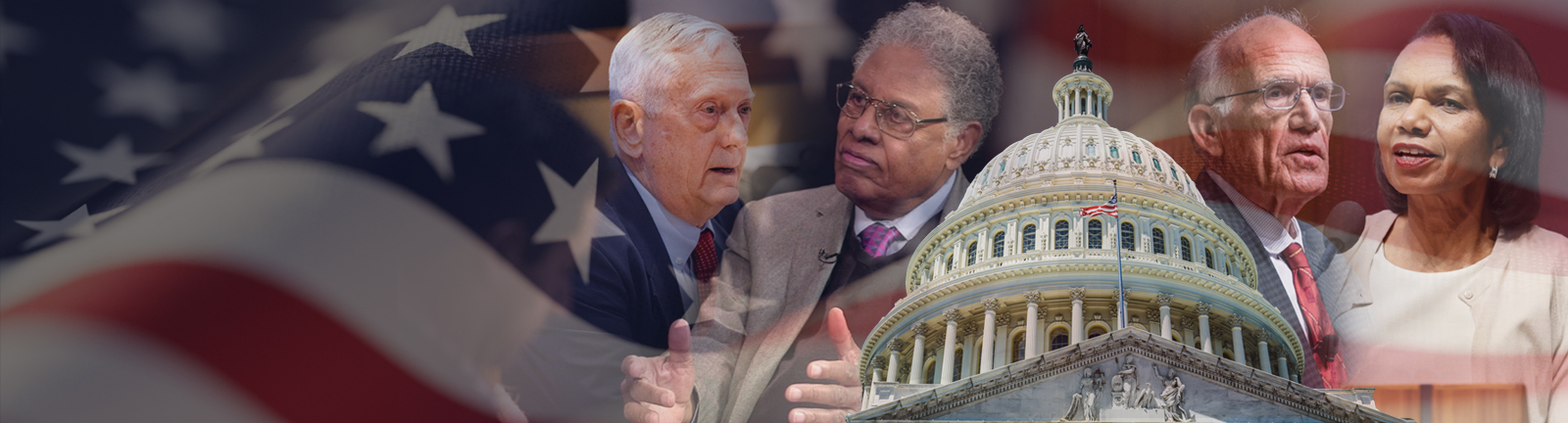
In a new fact sheet for the Tennenbaum Program for Fact-Based Policy, Hoover illustrates facets of the US democratic system, one of the oldest continually active national-level systems of government operating in the world today. Highlighting the role of the Declaration of Independence, the Constitution, the Electoral College, the presidency, federalism, the separation of powers, the peaceful transfer of power, and civilian control of the military, the page highlights the ability of these institutions to endure through periods of instability and hardship. It also chronicles how these parts of the American system evolved through history. Read more here.








Related Commentary