

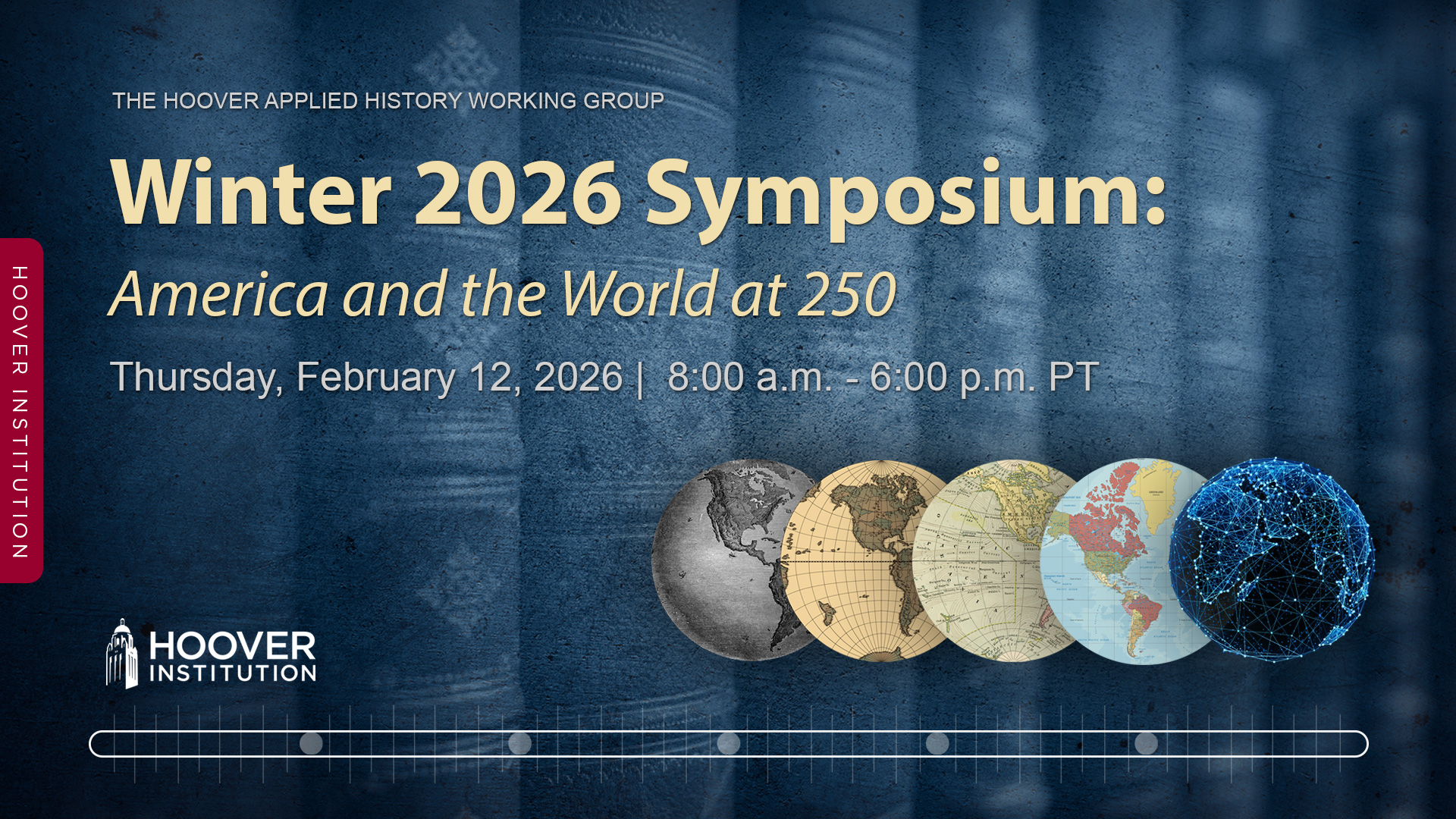
The Hoover Applied History Working Group hosted its virtual Winter 2026 Symposium on Thursday, February 12, 2026, 8:00 a.m. - 6:00 p.m. Pacific Time.
The Symposium theme is “America and the World at 250.” As the United States begins to celebrate the nation’s 250th anniversary, our intention is to review recent historiographical developments, revisit enduring debates, spark new ones, and relate them to contemporary world order and the crises facing America at home and abroad.
- Hello everyone. I am Joseph Letford. I'm a Hoover fellow and the vice chair of the applied History working group here at the Hoover Institution, where this year we're celebrating America's 250th birthday. And as part of that, we're having a series events of events throughout the year that looks at the past, present, and future of the United States. And I can't think of anyone better than our guest today to help us make sense of it all since he's been in the middle of it very recently. Michael Anton is the Jack Ross Senior fellow at the Claremont Institute and Electra of Politics at Hillsdale College. He's the author of three books, including a forthcoming tome on Machiavelli, who will be in bookstores soon. He's been widely published in mainstream and academic presses. Many of you likely recognize him as the author of the Flight 93 election, the widely recognized 2016 essay that galvanized support for then president or presidential candidate Donald Trump and his New York magazine said, came to define the Trump era. In addition to his scholarly work, Michael has extensive experience in government service. He served in the administrations of California Governor Pete Wilson, New York City Mayor Rudy Giuliani, and Presidents George W. Bush, and President Donald J. Trump. During the Bush administration, Anton served four years on the National Security Council staff and President Trump's first administration. He served as deputy assistant to the president and Deputy National Security Advisor for strategic communication on the NSC. Most recently in President Trump's second term, Anton served as the 33rd director of policy planning at the State Department, a position from which he was the lead author on the 2025 National Security Strategy. Today Michael will be in conversation with Neil Ferguson. Neil is the Millbank family senior fellow here at the Hoover Institution, and the founder and chair of the Hoover Applied History working Group. Neil is the author of countless books and articles and columns, and he's currently at work on finishing the much anticipated second volume of his monumental biography of Henry Kissinger. Ladies and gentlemen, please join me in welcoming Michael Anton to the Hoover Institution.
- Michael, thank you very much indeed for joining us. I learned about you in the last 24 hours, actually, slightly more hours than that, that you are a very keen swimmer.
- Yes. And - Indeed, a condition for your coming here was that I make sure that you had access to one of Stanford's
- Famous and you and you pool. You came through for me and as promised, I said that I would wear my cow cap as a troll. And I did. We, we, not today, but yesterday,
- We are gonna return to the rivalry between Cal and Stanford later. But swimming brings to mind the metaphor of swimming against the current. And you were, it felt at the time, swimming against the current when you published the Flight 93 election, when that essay was published. I didn't realize that you'd served in the George W. Bush administration. Indeed, unless my researchers wrong as press secretary to our director, Condoleezza Rice,
- I was one of the her communications people not in charge. And then I became her speech writer. So for two years or so, I was her speech writer while she was National Security Advisor. And for about six months while she was Secretary of State and then out of exhaustion, and I was out of the blue, offered a very cushy job, I decided to just take the cushy job and and move, which I did. And we had a baby coming. Like it was just a great time to leave.
- But this, to me, knowing that, and when I reread the essay, I read it in a new way as, as really quite a departure from,
- Remember it had a fake name when it originally came out because I was working as I like,
- Yes, it's worth saying what that was Publius Seu me,
- Right? Who's a character, not a character, a real historical figure from Livy. You can read about him in Livy book nine. It's a long story. Originally I had this blog with a bunch of guys and we were, we each had a Roman name and mine was Deus. And then, so I wrote this thing for another magazine and I submitted it under Deus and they said, well, that's too short. Like, and you get a better, so I just, I go back to Libby and his full name is Pub Mu. I just resubmitted. I go, okay, here's another name. You, you good with this? And they took it, but I would've preferred if it was just dc.
- So this is an applied history conference, and we therefore take seriously the pseudonyms that people use. This was a fourth century Roman console
- Yes.
- Of the Republican era.
- Yes.
- Who was
- Notable for his self-sacrifice. He's really notable for only one thing. So this story is told in Livy Book eight, and he has a son who apparently did the same thing according to Livy, which is told in book nine. Anyway, the Romans have a battle. And the night before they take the Aeries, which is of course of an extremely sophisticated way of figuring out if you're going to win or lose, you throw a bunch of seeds on the ground, and then if the chickens eat them, you're gonna win. And if the chickens refuse to eat, you're going to lose. So this is what they did. And the, the Aer further opined that, well, it's, this one's really complicated. One side is going to lose a general, and the other side is going to lose the battle. And so, and the, this is the Republican Rome, so they always had two consoles, right? This is the way you overcome tyranny. According to the Romans, there's no one person is ever in charge in any one time. So there's always two. And in the these early Republican days, the two of them would literally go as heads of the army and fight the same battle together, violating the principle of unity of command. But we can talk about that later if you want. And anyway, so it's madly as Torti very famous for other reasons, it's one of the consoles and Publius moves is one of them. And they have each controlling a wing and they're fighting. And Publius, DUS is wing, starts to fold a little bit, and he dismounts and he says, a devotion to the gods and rallies the troops and, and charges forward on foot. And then in the course of it is killed. But then he wins the battle. The Romans win the battle.
- So I want to explore the significance of that because for somebody who'd been a res, an established Republican official to write that essay was quite a remarkable thing. And I want, for those who maybe read it 10 years ago or never read it, let me just quote from it. This is a very Peter Robinson thing to do in an interview, but I, I'm gonna do it anyway. 2016 is the flight 93 election charge the cockpit, or you die, you may die anyway. You or the leader of your party may make it into the cockpit and not know how to fly or land the plane. There are no guarantees except one. If you don't try, death is certain, to compound the metaphor, a Hillary Clinton presidency is Russian roulette with a semi-auto, with Trump, at least you can spin the cylinder and take your chances. And you argued, we are headed off a cliff. The United States, well, that is based a tidal wave of dysfunction, immorality, and corruption. There was a real possibility the republic is dying.
- The the headed off a cliff, I will say though, was phrased as a conditional. And the whole tenor of the article was meant, it was targeted at conservatives and in particular conservative intellectuals who I think I thought then and still believe now, have spent many decades very cynically saying, we have all of these problems. Give my institution a bunch of money and we will fund scholarships and white papers and conferences and we'll help solve these problems. But when it really come, came time for, you know, something to fundamentally change, they would revert to a, or economists called revealed preference. Everything is fine. We don't actually have to do anything different. I'm gonna go out there and keep writing these pieces saying we're headed off a cliff, but when it comes time to actually change course, I don't wanna do that. And if you try to change course, I'm gonna say that you're a dangerous radical. So I was sort of tired of that pose. I thought it was disingenuous and dishonest. So I said, if they really believe X, Y, Z be A, B, C, blah, blah, blah, blah, blah, then they must also believe that we're headed off a cliff. And in fact, they don't believe any such thing was the argument I made because they revealed preference shows that they're pretty happy with the status quo. This of course could never have been said of the Hoover Institution. No, I I think tanks you top I meant it elsewhere very broadly. And if I had any particular institution in mind, might have been one or two others.
- So the
- The
- Critique that that you made, which was a critique both of the Republican and Democratic party was, that's quite interesting to revisit it, you make three points in the essay. One I'll quote again, the opinion making elements. The universities and the media above all are wholly corrupt and wholly opposed to everything we want, everything conservatives want. And increasingly even to our existence. Two, the importation of third world foreigners with no tradition of tastes for or experience in liberty means that the electorate grows more left, more democratic, less Republican, and less traditionally American with a recycle. And then third, a foreign policy point, the Gulf War of 1991 was a strategic victory for American interest. No conflict since then has been. So the argument for Trump, well, remember that's 2016. I can point to
- One or two,
- But, and at that point, but 10, 10 years ago, that was your reason for taking a gamble on, on Trump when as you said, most conservatives recoiled and weren't willing to go there. Can you give us a kind of 10 years on how has it turned out? Assessment?
- It's still an open question. I'm a naturally, I don't know if naturally or it's ingrained, but certainly it's been with me a long time. So it feels natural at this point. Pessimistic person. So I always think everything is going really badly. And you know, I look around the world and I just see the same sort of trajectory going on that, you know, I can point to some successes, but then I, then you'd have to ask the sort of the larger question, which is, are these successes enough to overcome the huge deficit or gaps or the whole that, you know, I think we've collectively dug for ourselves. I think that question is very much open. I'm inclined to say no, but that could be my natural pessimism and not, you know, an accurate assessment of where we are. I do think President Trump's rearrange you, you know, you're kind of succeeding in certain, let's just take foreign policy for a second. You know, you're kind of succeeding when your opponents keep doing what you were doing and decline to admit it. So there's a lot of ways in which the Biden administration, I think got foreign policy wrong. And there's a lot of ways that they quietly just sort of kept doing what Trump had been doing without admitting it. Because they don't wanna say, you know, and this is true of both parties, it's true of administrations all the time, right? That I do think our foreign policy is in a better direction, not the perfect direction, not necessarily the direction I would take it if I were in charge of e of everything. It's a better direction. And I do think both parties out of necessity have kind of realigned in that direction. On the other stuff, I, I don't know, like I said, I, I'm, I'm, I'm, I'm humming and hawing and blah, blah, blah, because I just don't like to tell the truth in public about how pessimistic I really am because it makes me seem sort of crazy. And I actually have an okay time navigating day-to-day life. And you know, I, I feel like I should just show that the the rational side, the side that kind of remembers to get up in the morning and like go do what he has to do during the day rather than the side that like sits up thinking about where are we gonna be at a hundred years. Oh my God.
- But I just makes me seem like alone. But I think you, you are amongst friends here. I'm, I'm even more pessimistic than you, but you know, coming from Scotland, you'd expect that, I want to kind of get at the counterfactual because I think you presumably stick to the view that it was better that Trump won in 2016 than that Hillary Clinton had won. So in a counterfactual scenario, we'd be in a worse place than if she had won.
- There's one little exception, not little, it's a huge exception that I might admit to, which is it really does depend on how it all turns out, right? If in hindsight we look back on four years and then a four year gap and then another four years of Trump and then the Republican party, you know, doesn't win again for a long, long time and gets wiped out at the electoral level, at the congressional level, at state level. And progressivism kind of re cements itself even more strongly than would have happened had there been a Hillary victory in 2016. It's possible that from a distance of 20 years from now, we could look back and go, you know, it would've been better if we had just done this in, in a more gentle way in 2016 than in the really hard mean way that it ended up happening in 2020. I don't know, jury's out on that. I do fear it, but I, I I, I, no matter what, I will say that it was worth trying, right? I mean, you can either kind of give up or you, you, you try against great odds. And from my perspective, what Trump wanted to do, I still think what he wants to do basically is, is pretty sensible. The United States needs a secure border. It needs to have political control over who it admits as immigrants in what numbers and so on. And we lost control of that. And he's trying to reassert that. I, I'm not an economist, an economist can tear me apart with facts and figures on trade. But I also have to say that like we had practiced a kind of, I think ridiculously open trading system to the vet, to the detriment of so many industries, so many communities, so many states, so many counties for 30 or 40 years that the answer cannot be, this is the only possible way. We just need to keep doing what we're doing forever. And so trying to do what Trump is doing was worth trying. And in 2016, you know, from the hindsight of the nation building, failed nation building in Afghanistan, failed nation building in Iraq, you know, wars that cost many thousands of us, I was gonna say seven and I hope I don't get that wrong, but it was something like 7,000 US combat deaths in Iraq and Afghanistan over the, over, over more than a decade and trillions of dollars spent that did not accomp. And, and the opportunity cost of all that focus, all that money on these places when the rest of the world is maturing, changing, growing stronger in some cases, adversaries are growing strong, stronger, a allies are growing weaker. Just seems to have been an kind of an obvious disaster that absolutely had to be corrected. And if you're gonna be involved now, the question is do why be involved in politics? Right? I ask myself that a lot and lately the answer is more and more. I don't wanna be, but if you're going be, then you gotta try. So let's take
- The first Trump, look back on those four years, what was achieved? What were the successes
- Do you think? Certainly he got a border crossings down, he secured the border. Did he build every inch into the wall that he said he was gonna build? No, but he got a, a, a problem that had been, I think a serious problem since at least the mid 1980s, if not before that, much more under control than it had been in the first place. The trade was much more mixed in part because I think the president himself was a little hesitant. He sort of had a belief in his bones that we ought to do this. And he, you know, one of the myths about Trump is that he's just some kind of stubborn or impulsive guy who doesn't listen to anyone. The first term one could argue that, you know, the opposite was maybe more of his problem is that he listened to everyone. And so he could easily, you know, be talked out of or not talked of, just persuaded like he's open to persuasion. He could be persuaded out of something that he wanted to do and made the implementation of some parts of his agenda a little more hesitant than it could otherwise have been. You know, the foreign policy, all of this. I was asked a long time ago after he was out, so this had to be somewhere between 2021 and 2024. It's probably early 21 or 22. What grade do you give him? And I said, look, as a college professor who asked for grade papers, I give him an I, right? I can't give him a letter grade yet. He got an incomplete, he did a bunch of good stuff. He didn't finish all the things he wanted to do. Had he had perfect implementation over four years, I'm not sure he could have implemented all he wanted to do. But you know, maybe over eight years, but we'll see. But the, what I saw of the agenda being implemented, most of it was what I wanted to see. My biggest complaints or criticisms or regret, you know, I don't know, I'm using dumb words. Complaint criticism, regret was, I wish I had seen more of acts or more of y or whatever. I wish we could have gone farther here or there.
- But in a way there was a, a chance to go from incomplete to something more complete. And in your terms, looking back on that essay, having a, an intervening Biden Harris term, kind of put certain things in your argument to the test because on those three policy areas, the Biden Harris administration took very different right directions. Well, I mean certainly on the border, which
- Essentially I would say, look, the, I I think I'd say my thesis was completely vindicated on the border where they were more radical than any pre and right. We hadn't really had serious border enforcement. I don't even know when, but Reagan didn't take it very seriously. As much as I love Ronald Reagan hw I don't know that he ever talked about it. Clinton was a great example of he understood what was going on and he certainly understood how it made middle America uneasy and rural communities and, you know, the, the, let's just say the, the bottom half of the socioeconomic ladder uneasy. And he, he commissioned Barbara Jordan to run that commission and she said, we need to have, and we need this and this and this. And he endorsed the findings, but he wouldn't spend any capital to do any of that. So he kind of tried to play it both ways. Whereas w was an open border zealot, certainly in rhetoric, if not in every case in policy. And the, even then the Biden administration I think took it further than any. So that, you know, seems to be a v vindication of what I wrote. We will get more of this if, if if if X happens we will get more of y and X happened and we got way more of y So in that
- Sense, the Biden administration did vindicate your argument. But another way it did too, in that it continued the trade policy. If, if the trade policy had been so dreadful as many of its critics made out, it was odd that they kept the tariffs right and didn't fundamentally change that part of what they inherited. But they kept a sort of
- A, what they kept was a, a kind of partial version of what Trump had promised to do in 2016, as is evidenced by what he's actually doing now. And you can argue that it's not gonna work. Like I said, I'm not an economist, a real economist will tear me apart on this and show that I don't know what I'm talking about, trade and so on and so forth. I accept all of that. But like, I, I have two sort of counter arguments to that. Number one is if it's, if this kind of trade policy is always so bad, why do countries all over the world historically and presently erect trade barriers, put quotas on foreign imported goods and do all the things that economists say you're never supposed to do and get rich and strengthen their domestic economy and see per capita incomes rise and all of this stuff like I it, they must all be failing. Like why is Vietnam so so successful in 2025 compared to what it was in 1995 or 1975? 'cause they're doing everything wrong according to trade economists. And the second point is just like, if the answer is we gotta keep doing this forever, I just don't accept that there's gotta be, there's gotta be something we could try that. I mean, think about the massive acceleration of de-industrialization that happened after WTO session, a bipartisan initiative, right? I always tell my students when, when I go through this briefly this, the two big things that happened in the trade world, mostly before they were born were NAFTA and the WTO session. And they were both bipartisan, just you have to reverse the parties NAFTA's fundamentally a republican adminis initiative that George HW couldn't get across the finish line because he didn't get a second term because of a bad economy that Clinton took office having not cared that much or thought about was just sort of preternaturally against because he was a labor democrat and got in there and was surprised when all of the PAHs of the Democratic party, both in the Senate and in his own cabinet and staff and you know, major donors and Influentials sat him down and said, Mr. President, you gotta make sure that this thing passes, passes with over with presidential support. But overwhelmingly with Republican votes, WTO is the flip side. Clinton decides he's gonna make sure he wants China. And he, he, his entire second term, or sorry, his entire administration, but especially his second term, was devoted to this notion, again, shared by many Republicans. I'm not as, I am partisan, but I'm not trying to be partisan in making this point that the way you're gonna tame the dragon is you're gonna let China in become a responsible stakeholder in the international system. And this was the phrase everyone used, right? And Clinton just the clock just ran out. He didn't quite get it over. And Bush 43 had run hammering Al Gore on the Clinton administration being soft on China, calling it a strategic partner when it's really a strategic competitor and so on. And then they got in there and they're the ones, they flip it around and they go, okay, we're gonna make sure we drag WTOA session over the line. And these two things very bipartisan ended up I think doing incredible damage. And I, I don't know the way, I don't know that anybody necessarily knows, I don't know the way to get, or even if it's possible to get back to where we were on industrial policy. But look, there's a lot of things people look at that and show like overall wages rose during the first Trump administration, the GI coefficient shrank. To me, those are good things. There was a certain amount of reindustrialization that happened during the first Trump administration. There was a certain amount of reshoring. Now, some of the reshoring admittedly is because it's no longer that good of a deal for us companies to move production to certain economies anymore because you don't get that big of a discount anymore because these places got rich. And so the labor costs, and they're not on par with American costs anymore, but they're sort of high enough that they look at it and they go, all right, well am I gonna make this widget in Shenzhen or am I better off trying to make it in Alabama? Even where wages are 20%, it's when they're 90% higher. There's no question when they're 20% higher and there's all these other friction costs, maybe it's better to reshore it. Some of that is just in the inevitability of developing economies reaching closer and closer to parity. But some of it I think is a result of policy as is seen by the, you know, the graphs that you can just read the bottom, like who's in power and what's going on here. And I, I count those as successes. Let's
- Talk about the foreign policy. Yeah, because that became the key role that you played in the second Trump administration in your professorial capacity, give the Biden administration a grade for its foreign policy and then explain why
- It seemed to haphazard to me. I mean obviously the biggest F would be the Afghanistan withdrawal, not the, not the substance of it. The doing of it I think needed to happen. I don't know why it needed to happen the way it happened. I have a cynical theory, which is that the, basically everyone but the president didn't want it to happen. And so the permanent bureaucracy and the chiefs and others, this is a theory, nah, it's not even a theory, let's call it a hypothesis. They just, they had a kind of, you know, it's like when you tell a kid to clean his room and doesn't wanna clean the room and they pick up two things they put on the shelf and they go there, I clean my room, it's like, mission accomplished, what else do you want from me? They're like, oh, you wanna get out? Okay, we'll get out. We'll just do it in the dumbest, most haphazard way possible to show you the error of your ways. So I think a little more strict control over the planning of that would've been good. But the getting out I think was necessary. I do like the fact that they, they did not pivot back to the, let's call it 1979 to 2015 or 2016 bipartisan China position, which is they're going to be, you know, the responsible stakeholder, welcome them into the international system and blah blah blah, blah, blah. They trump permanently, I think changed the conversation on that and the Biden administration, either out of genuine conviction or out of just a kind of political sense that we can't go back stayed with that. I think they were needlessly and foolishly hectoring in the Middle East, right? That is to say, I mean, oh, like inevitable thing someone would bring up here is Khashoggi. But you know, when, when the president says of Saudi Arabia now, and that was a disgusting and horrible thing and Saudi's absolutely deserved and did pay a reputational price for it as they should have. But the president of the United States at one point literally said, I we're, the policy of this administration is to make them an international pariah. It's a country that we, which which we've had a formal alliance since February of 1945. And which whether you like it or not, controls just an enormous amount of global oil. And even though they don't have the largest reserves anymore for the, as long as any of us are gonna be alive, they're still gonna have the largest number of reserves that are easy to drill, cheap to drill and cheap to refine because the quality is already so high and that are right on a shipping route as you can send it anywhere in the world. That's just going to be a fact for a long time. So then when the president later gets in some energy price trouble, they quietly call the Saudis and say, Hey, will you guys want input production? And Saudis don't pick up the phone, right? Well, when you say you're gonna make somebody an international pariah, and I know that they, that's an outstanding example, but I traveled around the region a little bit in 2022 and there were hurt feelings kind of all over the place no matter where you went. I just think they weren't handling, and Trump is actually remarkably good at this, at, you know, the, the Gulf States with where there's a lot of oil wealth and, and emerging tech wealth, he's very friendly with them. The bigger Arab states that don't have the oil wealth, he, or even the smaller ones like Jordan, but certainly the Egyptians, he can get along with them, he can get along with the Israelis, he can balance all of this at once in a way that I haven't seen a president been able to do in, in a long time. And it could be
- Argued that actually in the first Trump term, middle East policy was quite successful and made some major breakthroughs. Yeah. For example, the Abraham Accord. Yes. And in the Biden Harris term, you got the disaster of October 7th, 2023. I mean,
- Right.
- It seems like there, there's a fairly strong case to be made that Trump had a better yes approach to the, now
- My hypothesis, this is maybe verging on a theory a little stronger than a hypothesis, is that the Abraham accords, if not a happy accident, it wasn't what they went, they, they went in trying sincerely trying to think we can solve the Arab Israeli conflict forever, which means we can solve the Israeli Palestinian issue. And they spent, I, I mean I dealt directly with the people doing this for the administration. So I can tell you they were extremely conscientious and they spent a lot of time on it and that they didn't get what they set out to do. But the by the happy byproduct of that was they spent so much time building links to the Arab states, especially the Gulf monarchies, that when it came time to realize that we're not getting a, an Israeli Palestinian deal, no shame in that. I mean, nobody has been able to do it since the late forties or since 67, whatever you wanna start the clock. But they had so much good political goodwill in the bank around the Gulf that they were able to pivot and turn that into something positive. Who you give the credit. I give it, I mean, to Trump obviously to Jared Kushner and the, the name that you may not know is Jason Greenblatt should get a lot, even though by the time the Abraham Accords happened, Jason had left the administration and gone back home to New Jersey. He, it's his three years of labor that I think really made it all possible more than anything.
- Let's talk a bit before we get to the thing I wanna turn to in a minute. The national security strategy about Russia. It felt to me in, in 2021 that the Biden administration failed altogether to deter Putin from escalating to a much higher level of aggression against Ukraine. President Trump has said on more than one occasion, it wouldn't have happened if I'd still been president. Do you agree? I, I always,
- I hesitate to disagree with President Trump, but then again, I always hesitate to endorse a counterfactual 'cause who knows? But it is true that, and I was there for that. I remember this decision and the president felt uneasy about it, but he did sign off on the provision of jave and anti-tank missiles in the summer of 2017, a step the Obama administration had not been willing to take. He did keep the pressure on now, and boy, talk about sanctions. I mean, we sanctioned the, the bleeping heck out of the Russians throughout. And again, the president wasn't always enthusiastic about this. To some extent there was pressure from the Senate, but he did keep pressure on and tried to maintain good relations as good as possible given the circumstances given. And I'll say something extremely unpopular, but whatever, like I'm, I'm, I'm an easygoing guy. When I come to a place like Stanford, I realize like, you're the bad guy, so go in and play your role like you're supposed to and don't let down your host. So if you wanna imagine me twirling my mustache, like it was almost impossible for us to have any kind of meaningful contact with the Russians on any substantive issue with the Russia hoax. And I do think it was a hoax. There was never any collusion, there was never any intent to collude. It was all fake, but e everybody believed it. So like he goes and sees Putin in Helsinki and I re the media freak out over that was unreal. Oh, lemme give you a little anecdote, okay. That, that is telling. So the first Trump met Putin was in Hamburg at the G 20 Russia, could still attend the G 20 prior, prior to February, 2022. And they, they go in and they have a meeting and it's, you know, consecutive, not simultaneous translation. So it takes a long time. So they're in there for a long, long time, like a co three hours or something. And the media immediately, and I was there, I was the guy, guy doing comms for the NSC. So it was my job to kind of facilitate all of this and manage the communications around it. And they were freaking out like, this must be, this is an incredibly long meeting. They're in there carving up the world. I'm like, no, they've just talked, they've never met before. They're talking and one has to give a statement and then the other one has to be translated and so on. And, and now I'm, I'm quoting Marco Rubio here, but, but he's right. He's like, and the reason why these conversations take so long is 'cause both those guys talk a lot, right? So then they break up, we try to, we calm everything down, they go to dinner. So I wasn't in the dinner, right? It's just leaders only and they're seated wherever they're seated, it's all very prearranged. You don't just like grab a chair, you go right where you're supposed to go. And when they clear the dinner plates, they served the dessert. Apparently Putin got up and he walked over to Trump and he, like, Trump stayed seated and Putin talked to him for a couple minutes and he walked off and this leaked out. And the media is this secret Putin Trump meeting, second secret meeting that the White House tried to hide what was said in the second secret meeting. And I, I, I don't know, maybe he was commenting on the strawberries, like, this is crazy. This is the environment that we were dealing with and it made it just impossible to, to and doing it. And I, I give him credit, he kept the pressure on, and yet he was able to have a couple of reasonably productive and cordial meetings with Putin and prevent things from getting significantly worse.
- Let's turn to the, the national security strategy that was published late last year, which I understand you were the
- Principal
- Author.
- I mean, there is no, in a way, there's no principal author like these, these documents I've, I've worked on three of them. They, they come out, there is no author, there's no signature on it. There is typically, if not always, I, I've never, I've read many of them. I think I've read all of them. Going back to Coldwater Nichols, a one or two page letter from the president that will have, whoever the president is, will have his signature. And then everything behind that is just the position of the US government, of the administration. But somebody has to like get it going. And in this case, I was the one who got it going. And then after that, a committee comes in and a lot of people look at it and a lot of people have ideas and changes and this and that, and it's a, it has many, many authors. And that was, that was true of the one I worked on in 2002. Who's, by the way, the first draft was written by Phil zko. I don't know if he's here now, but he was there last night. Okay, well he wrote the first draft in
- That, in the room,
- Right? And the second probably preparing a very difficult question as we speak. The second one I worked on was 2017, and the principal drafter who got it going was Nadia Chatow, who's a colleague who's brought in by HR McMaster, one of your fellows who I used to work for and I wish he could be here, but he is not. And then I was just the guy who got it kicked off for the, but every, inevitably, you can't have a cons. The whole thing is supposed to represent a consensus position of an administration. So inevitably for it to work, it has to have, you know, 20 or 30 authors.
- Let's talk about the, the finished product. The, the media coverage when it came out struck me as wided the mark because it all focused on the allegedly disrespectful things said about Europe. I think the phrase civilizational, erasure made it in my reading was different. It seemed to me that was the least interesting part of the document and the most interesting had to do with Latin America and the Caribbean. Whose phrase, who came up with the Trump corollary? Was it you?
- I don't remember. Honestly. I do remember that it got in there somehow and once it was there, several people who we were working on it said like, make sure this stays in there. I said, okay, sure. I mean the basic idea w was something that had, we had kicked around in sp and a kind of thing. Plus, let, let me also be clear that Marco Rubio, who you know, was a three term, well in his third term as a senator and is from not only Florida, but South Florida and as Cuban heritage and speaks fluent Spanish and knows more about Latin America than probably anybody in the United States had ideas coming in about what he thought the right policy toward Latin America should be. And our, his very first trip, which I was on as secretary, was to Latin America. And you know, we had pretty clear direction from him what he thought the right way to go about approaching it was. But that's the other thing about these documents is you're trying to channel and put down on paper what you think your bosses want, right? And that's, you know, that shouldn't be that difficult. They talk as Marco put it, you know, they talk a lot. So you just kind of go back and read, read the speeches. I'd been paying attention to Trump for 10 years, so I know I knew what he had said on a lot of these questions over the years. I helped out on the campaign doing some foreign policy stuff. So I had a, you know, I had a pretty good idea of what the gist was. You're not trying to necessarily really break ground. You're trying to say, okay, if there's gonna be one 20, whatever it is, whether it's 20, 30, 50 pages, right? This can't be some intellectuals idea of what ought to be it need. I mean, they're, they're happy to take input and take suggestions, but at the end of the day, it has to be an encapsulation that everybody who, you know, the president above all, but everybody around the president who's trying to further what he's trying to do, will look at it and immediately recognize it and go, yeah, that is it. And not, oh wait, you didn't get that? That's not what we're doing.
- The unusual thing was that so soon after its publication, the Trump corollary was put into action in Venezuela. I did not anticipate that, didn't know that was gonna happen. How do you interpret this? It's not regime change if you just take out the top guy and hand over to number two, how, how should think
- About what I mean, number one, the president has been more than frustrated by drug trafficking in the Western hemisphere. I mean, I can remember this is how out of touch I am as a coastal blue American when he won the New Hampshire primary in 2016. And he gets up to, you know, thank everybody and give his acceptance speech and he starts talking at length about fentanyl in opioids. And I thought, I just didn't know that this was this giant national crisis going everywhere because I'm outta touch. But he's been angry and frustrated and, and really desirous of doing something about it for more than a decade. And the Venezuelans we know are a big, big part of this. I mean, there's drug traffic. I, I can't talk in great detail about the following, but my deputy and I went down to Southcom early in the administration. This is the, you know, the military headquarters that runs the all, all, all operations basically south of the Mexican, the southern Mexican border, all the way to Tara del Fuego. And, and they showed us these in just incredible, incredible detail where the smuggling routes are, who's doing what, what the volume is and all of that. And it, boy is it depressing and sobering to see. And I think the two threads that tie the Venezuela operation together are one trump's you know, genuine anger at this going on and, and just a lack of consequences for it. And two, there's a lot of foreign interference that's behind this, right? There's, you know, we have kind of, despite the fact that this is our backyard and our front yard and our security hinges more on the western hemisphere arguably than it does on any other part of the world. We have let hostile foreign actors become extremely active and influential there. And he wants to start reversing that. So you would expect more action in the West. I wouldn't be surprised by more. I, I never, I try never to expect or not expect anything because you know, Trump does like to surprise you and especially in the second term, I think he's, he's, he keeps council a little tighter than he used to. And so, you know, you, you never really know. I, at least I at least never really know what he's going to do day to day to day. And plus, you know, I don't have that job anymore. So I'm in the pool all day and I can't watch Fox.
- Well, let me ask a couple more questions then I'm gonna open it up to the audience. Let's have a, a brief word more about the Middle East. He struck Iran last June would, and I don't wanna ask whether you'd be surprised 'cause he surprises you, but are you expecting more military action against Iran or do you think there'll be some diplomatic off ramp,
- Which, which is you are more likely? I think he wants a diplomatic off ramp. Everyone that I talk to who knows something about the Middle East and including some people who, you know, have contacts through this person and that person, that person who says they know what's going on in Iran says now, that's why I was surprised that they actually went and talked to Woff again just because the word after June of 2025 was that the Iranians were incredibly angry and felt betrayed. Now, I'm not saying that they were justified or that this was legit, but people feel how they feel. And the reports that I was getting was that they felt like they had been played deliberately misled to lull them into a kind of quietude and then the United States hits them when they were negotiating in good faith. Now I was there for several of those talks and I don't have any doubt that Achi and the people he brought with him were negotiating in good faith. The basic problem, I don't know how this would have been or could have been resolved, is that he doesn't make any real decisions, right? So whatever he can offer, whatever he can quote unquote promise or he has to go back to Tehran and talk to a bunch of hardliners who are much more skeptical of the prospect of any kind of deal. And that was the wall we kept hitting and whether we would've eventually broken through, I don't know it, they just restarted. They had one round, I saw this, it was in Oman like what, a week ago, 10 days ago. It was the same format we had had before. Meaning I literally, I, I assume they took him to the same place. It's this like beach club for Omani military officers. It's very nice by the way on the, it's not the Gulf 'cause it's outside the strait, but it's sort of looking at the, the Arabian Sea I guess and beautiful, you know, and then these two humongous wings and they put you in, they put us in one wing and then the Iranians were over here. But then there are these floor to ceiling glass windows. So you could look kind of far off across the courtyard. You could see the Iranians sort of milling around. And then there'd be this room in the middle and you know, we'd go and we'd talk to the Omani foreign minister and we'd go back and we'd wait. It could be hours sometimes. And then we'd come back and, and then at the very end we'd be together. And you know, I think, I think we did, I participated in it three times. I think Wco at least five, maybe six. But yeah, that was that, it was that, you know, this is not a brick wall, but you get, you see the point, it was that okay, achi if, if, if, if he's a decision maker, we're gonna get a deal, no problem. But he's not, the supreme leader is the decision maker. And the people surrounding the supreme leader are in his ear saying, stay, hang up, hang up, hang up. You can't trust these guys.
- Last question. Deterring a conflict over Taiwan, ideally by preserving military overmatch is a priority. That's a direct quote from the national security strategy. I'm guessing you didn't write that bit.
- Well, like I said, it's a consensus document and you know, I have my own views, which I expressed once at a conference like this. And someone was in the audience and said, wow, that's important. Will you write that for us? And so I wrote it for them. It was published, I think this was long, this was like December of 21, I don't remember. It was a while ago. And that got around, I remember when I was, when we were during the transition, when the question was are we gonna hire this Anton character or not? Somebody brought that up, said it was discussed. I was like, I mean if, if it's fine, like if you don't want me because of that article, like whatever I, is
- That the article where you said the commitment to Taiwan was a
- Cold War relic? I did I say Cold War Relic? I don't remember that. I, I did find that, I did find that quote, but I traced the history of why we made it. And it's in fact, but, but I also dispute, it's not really a commitment, right? 'cause the Taiwan Relations Act of 1979 is not a treaty commitment like the NATO charter or like status as a non non NATO major, non NATO ally or like other specific treaties. It says if X happens, we will do Y right? So I was pushing back on the argument that, well if the united, if if you know, something happens and Taiwan were to fall or Taiwan were to be conquered by China or whatever, the United States alliance structure will collapse because it will be a sign that we don't keep our commitments. To which I asked the question, well, if we haven't made the commitment, like how can we, like if a NATO member got attacked and we didn't do anything, that would be not keeping your commitment because there's a commitment. But if we didn't make the commitment and then we don't do anything, like if the argument is there, well, in your alliance structure collapses, I was saying then anything anywhere could cause the alliance structure to collapse. 'cause there's all, there's, there's an infinite number of commitments that we haven't made that somebody could go and do something that may be against our interest. It may be immoral, like for instance, invading Ukraine immoral. But we didn't make a commitment to Ukraine.
- I'm gonna turn it over to the audience now for questions. If you have a question put up a hand. There are roving microphones, there's a question down there and there's a question back there. Make sure you catch my eye. Yes, please.
- Hi Mike. Nice to see you. So I'm just wondering if you think that Trump's new foreign policies like the next stage of maga because he, it's like a naked imperialism. Like he says exactly what he's going to do. He has all these oil CEOs around the table. He's like, we're gonna give you this and this and this. And it's just, it seems like it's something that we haven't seen in a while, mean Yeah, and it's like, and and totally new phenomenon where he's just going in like he's saying like, he's not even hiding the fact that he's here to like help American business.
- I mean I, I tend to like to define words super strictly so, you know, is the United States an empire? I mean the Spanish American war was an imperial war. We acquired territory from some other power and then we administered it directly for a while. And in some of those places we still do administer directly. Like if the president were to somehow grab Greenland, that would be imperialism if I, I don't know what the terms of what's ever's going on, but at Davos, so what is today the 12th? I don't know. This was like 20 days ago. He went to the podium after the rhetoric had gotten kind of a little bit hot. People were freaking out and he said, don't worry about it where you have a deal in the works, it's going to resolve everything. I don't know what that looks like, but if it's some, you know, something short of just go in and taking it, I wouldn't call that imperialism. Yeah, I, I, I personally don't mind the candor about just wanting to use American influence and levers to specifically further American interests. I do think, and I know the NSS says that the United States is fundamentally not an imperial power and that there should be in every, as a principle, in everything we do a predisposition to non interference, which is not inviable because there are always gonna be some circumstances in which you're forced to intervene. There's no, I don't know that there is any one principle in foreign policy that is literally applicable a hundred in a hundred percent of every imaginable circumstance. And so the, I think the predisposition is good, but as long as we recognize that the country has interests and there are sometimes gonna be certain things that we're just forced to do a question at the back.
- Yes, hi, I am Iranian born American who voted for Trump this time only because that I was hoping that he would help Iranian people to overthrow the regime after 40 years of their effort to do that. And nobody helped. And when he said that help is on the way, I said finally someone is going to help and now I want some clarification from anyone because I don't understand. He said that help is on the way and people become much bolder and felt that he's going to help. And they came out with their family, with their kids, everything. And then regime massed, like slaughtered them. And then Trump is going to just go for the negotiation about the nuclear weapon that he told in June that is already was destroyed. And no Iranian people, none of them ask about negotiation. And I don't understand, I would like to be clear how nobody tell him that this is the biggest betrayal to the people and history would judge him based on that. Because Iranian regime would just wait out three more years and just continue negotiation. It just, just three more years negotiate and so on about something that nobody ask him, please explain. Nobody ask about negotiations.
- No, I don't explain necessarily what he meant by help is on the way. I, I think I understand his general approach, though he definitely hates the Iranian regime, hates the Islamic Republic. He knows it treats its people very badly. He would love for it to be gone and replaced by something better. But I think he's also a little hesitant to react because he saw how unintended consequences of good intentions against genuinely bad regimes in the past have led us foreign policy astray. And in terms of just, and I know this is not a satisfying answer for you personally, but in terms of just hardheaded calculations of US interests or Iran not having a bomb is a much more urgent priority than regime change for human rights purposes. And it sounds like, it sounds like just an incredibly cynical thing to say, but you know, you're writing a biography of Henry Kissinger, like there are sort of irreducible hard interests that the coin of phrase trump other considerations when you're dealing at this level. I also think that, we've seen this before, the Iranian people have been dissatisfied for a very long time. They sometimes go out in huge numbers and you know, every, I want, maybe not every time it happens, but it happens. People think, well this is finally gonna be the end. And it so often, you know, every time so far it has not been the end. I don't think anybody really knows when it will finally be the end when critical mass will have been reached, when the tipping point will have been reached and so on. And then finally I would say, I'm just not really sure what actual effective levers the United States has to do anything inside Iran that would be effective against, you know, a regime like that in control of all the apparatus of state in a country with a lot of wealth, a lot of oil wealth, a lot of sophistication and 75 million people, or it's actually little harder than that now. It's like 90 now I think. Right.
- But as you said, it's kind of quite hard to predict what President Trump will do. And while there may be a diplomatic option, he may just be doing what he did last year and lulling the Iranians into a false sense of, of security. You may have seen the Wall Street Journal piece where they analyzed how many of his threats he carries out on the threats he makes on social media. And it's roughly half, it strikes me as quite a good strategy if you, I trying to dominate the internet.
- But I think the, I think the difference is the Israelis in the late spring, early summer of 2025 felt a real sense of urgency that I I I, I'm not saying they don't feel it now, but I know they felt it then and I'm not seeing signs that they feel it now. And without that pressure or without, you know, then is there the same sense of urgency to do another military strike? I, I would argue no, but you know, you never know what you don't know, especially when you're outta government, you're not reading intel every day and you're not talking to people every day. For all I know the Israeli government could be showing people intelligence left and right saying, oh my God, look, but look at what they've reconstituted we're, you know, this is just as bad. Or maybe it was worse before then, but if I would think that if that were happening, some whisper of it would get out somewhere, you know, it would be in the paper somehow, some way. And we would know, we would at least have an indication. And I haven't seen it. Luke has a question.
- I, my question has to do with the impact of Trump's time out of office. And of course we haven't had a president with non-consecutive terms since Grover Cleveland. And we now we see we have a dearth of Cleveland scholars to tell us what this means. But my question is, in your view, how is Trump's approach to governing different in Trump 47 versus Trump 45?
- Number one is I think, much more tight control over the personnel apparatus. Number two is, I think he spent those four years in a way that he didn't and couldn't before 20 15, 16, really trying to remake the Republican party in a more, you know, populist trade restrictionist and so on. Or let's just say Trumpy direction. So there's a lot more foot soldiers out there. There's a much bigger pool to draw from. And you know, there's not that, that, you know, that massive opposition that he faced within his own party in 1516. There's some out there, but it's, it's a fraction of what it was. Number three, the, just the way the government operates, it's a lot tighter. There is no, there's no real dissension. Any, you know what, look to be blunt. I mean, if, if HR were here, he would admit this too. Like he just had a lot of flat out insubordination in the first Trump administration. Just, people would just say, I'm gonna do, I know you told me to do X, but I'm gonna do Y 'cause I think y is the right thing. And I don't think you know what you're doing. There's none of that in, in second administration. Now you may say that's for ill because we don't have people of the same stature and so on. On the other hand, the election is supposed to result in a unified administration with a unified body of personnel trying to row the boat in the same direction. And that's definitely happening this time to a degree that it isn't. If I had a, a reservation, it would be that information is now so tightly controlled that even then they've done way better at staffing. They've done way better at filling the sub cabinet positions, although in a sense, some, some extent too, slowly, but that's partly the Senate's fault. It's that the information flow is so constricted that, that all throughout the government, I know there are people who believe that they are there for the same reasons that he got elected and they really want to help. And they don't, they just don't know what they're supposed to do necessarily. And so it's, it's, it, it's hard to find the balance, but the purpose seems to me the meaning of an administration is not just president plus some cabinet secretaries, it's president plus cabinet secretaries, plus deputies, plus unders, plus assistant secretaries, and all these people down this giant tree where directives flow downward from the top and they're supposed to implement stuff. And I think there's just a lot of that information and just, just, just plain, just orders for lack of a better term, doesn't get down far enough. And so I, there's a lot of things that I believe could be happening that aren't happening or are happening too slowly because of that consequence.
- We got time for one or, or question, did I?
- Yes. Hello. Thank you so much for your presentation. I was wondering about your answer to the first question and about how you were presenting imperialism as kind of, I think tightly definitionally, direct territorial conquest. It seems like historically imperialism, or at least colonialism, often functioned through negotiation or diplomatic pressure as well as territorial concessions made in exchange for payment as well as direct a territorial conquest. And likewise, today it seems like kind of alongside what I would call sort of fearmongering about territorial conquest of Greenland. There also is a sense that it would similarly be wrong for the United States to purchase Greenland outright. How should we think about that in a historical frame? Is it always wrong to construe imperialism is also containing this domain of purchase, and how should we think about that in the
- Modern, I mean, purchase per personally wouldn't bother me, but only if it really did reflect the will of the people of Greenland. They didn't mind it and it didn't, you know, mess up relations with the Danes. I don't, I don't really think we want to do that, or at least I don't think it would be beneficial to us to do that. But like if they, and they, they have said, we'll, we'll see if they change their mind, but like they've said, like, we don't, we don't wanna sell it. So, you know, if it's, if it's a coerced purchase, it's like, oh, you know, you're selling, but, and we actually give the money, but it wasn't really willing. I, I personally would call that unwise and un unhelpful. You know, look, the United States has certain interest in Greenland. I get it. I, I, I would like to see this thing. I was encouraged by what the president said in Davos when he turned the temperature down the day after it was really, really high. Like, oh, well don't worry about it. We're gonna get a deal. And you notice that it's kind of, I haven't been hearing a lot about it lately, right? So that could mean that he's just, you know, it could mean a lot of things, but it could also mean that they're actually getting close to some kind of deal that makes everybody, if not, you know, ecstatic, at least satisfied. And that, you know, doesn't create any further turbulence.
- Well, Michael, you, we, we lud you out of, of a kind of retreat after government in which you were writing a book. And I'm very grateful that you accepted the invitation. I've got one last Yeah. Question for you. In some of your writing, a phrase appears American Caesar. I'm not sure though, I don't think you apply it directly to, I can tell
- You exactly where it came from. So I wrote a book post published in September of 2020 by Ary, so you Osten, not os ostensibly is the wrong word, like an overtly conservative publisher. And it was, you know, a bit of red meat for my own side, I'll admit that. But it also has a lot of, you know, my own sort of political philosophy, usings. And it has eight chapters, and the most discussed one was chapter seven. Chapter six is called If Present Continue. And I sort of sketch like if everything just keeps going the way it's going, this is what I think the world's probably gonna look like. And then chapter eight seven is entitled dot, dot, dot. And if they don't, and if they don't, it's just my attempt to speculate about possible futures and kind of handicap them that is not, not in terms of necessarily desirability or anything, but what's more likely than the other. And I work it out like, you know, there, could there be another civil war? Could there be a secession? Could there be some kind of collapse? Could there be anyway, depending on how you count headings and subheadings, there's like at least nine of these scenarios. And one of them, I sketch like Caesar, the two terms that I coined were Blue Caesar and Red Caesar. Like it's possible this has happened before that in the breakdown of constitutionalism and in the breakdown of small R Republican rule, somebody will just take over the country, right? I mean, Napoleon is a great, you know, Napoleon's famous line. How did you become Emper? He says, I found the crown of France lying in the gutter and I picked it up with my sword. The, or the original meaning of Caesar is of course from Caesar himself, who establishes one man rule in a situation where Republicanism is no longer possible because it's broken down. So I said, okay, maybe that could happen here, but then who would be Caesar? I said, it could be a blue one or that could be a red one. And I actually painted the blue out one as well, more likely to take place than the red. I don't, you know, I could be wrong, but that was my honest assessment as a handicap. And I would say Scur, if people who don't wish me well have taken that chapter to say like, Anton is an advocate of Red Caesars and wants Trump to replace the American constitution. Like, gimme a break. I mean, I have been, I'm not asking anyone to read everything I've written that mean that would be torture for you. I'm sure, and there's a lot of it, but I have written hundreds of thousands of words in defense of the American founding, the Declaration of Independence. I just spoke at Yale on the 250th anniversary of the Declaration of Independence to an a crowd of largely like, you know, right wing college students who are skeptical of the whole business. It's like, I'm not sure that all men are created equal, even works. And then in alienable rights and proposition, you know, blah, blah. And I had to explain to them why this is still the best possible way for the American Republic and for any government in the modern world to function. Like I'm on the record overwhelmingly as saying that that's what I want and that's what I favor. I am paid by the Claremont Institute for the Study of Statesmanship and political philosophy, which was founded in 1979 precisely to advance this argument and what's what we do every day. So, you know, I guess maybe I should not have written that speculative chapter about the future, but it seemed interesting to me at the time, and a lot of it could still come true. You never know. But no, I'm not an advocate of that. There may come a time, I mean, I'm gonna sound like a real geek here, but you asked, right, well, what's Plutarch's ultimate judgment of Cicero? Right? PLU tar has a biography of Cicero and he basically is condemnatory and he says the guy was diluted. He kept trying to restoration of a thing that at that point could not anymore be restored. Right now, I hope and pray that the United States is not near the point where the thing cannot be restored. But it seems to me the height of folly, especially for those of us who supposedly study and teach political philosophy, not to admit that it's possible as if history ended on July 4th, 1776 and nothing that ever happened before that could ever recur again. I don't personally
- Believe that. That seems a very appropriate note to conclude this conversation on a historical note and one that alludes to the 250th birthday of the Declaration of Independence. Michael Anton, thank you so much for joining us. The round of applause.