









Stanford Center on China’s Economy and Institutions and China’s Global Sharp Power Project at the Hoover Institution are pleased to present a special lecture featuring Professor Minxin Pei who will be speaking on How Does China Spy on Its People? and his newly released book, The Sentinel State: Surveillance and the Survival of Dictatorship in China. This is an in-person event.
Contrary to the widespread perception that advanced technology enables the Chinese state to maintain full-spectrum surveillance of its people, evidence collected from local yearbooks shows that the backbone of China's surveillance state consists of close bureaucratic coordination among security agencies, an extensive network of informants and labor-intensive surveillance tactics. This system is made possible and run effectively by the party's Leninist organizational structure. The hi-tech surveillance apparatus, which China began to construct in the late 1990s and did not become fully operational until probably around 2010, has given the ruling Communist Party a complementary, but not substitutive, tool. The Chinese regime’s surveillance capabilities, unrivaled by other autocracies in history, may be one explanation why rapid economic development has not led to democratization. Growth since the early 1990s has produced abundant resources for the regime to expand its labor-intensive network of surveillance, refine surveillance tactics, and adopt new technologies. Its powerful surveillance state prevents the emergence of opposition despite the rapid growth of the middle class and other elements that can potentially threaten the party's hold on power. Economic development alone is unlikely to promote democracy because an autocratic regime can take advantage of the growing resources to strengthen its capacity for preventive repression. Economic failure, not success, is far more likely to trigger regime transition.
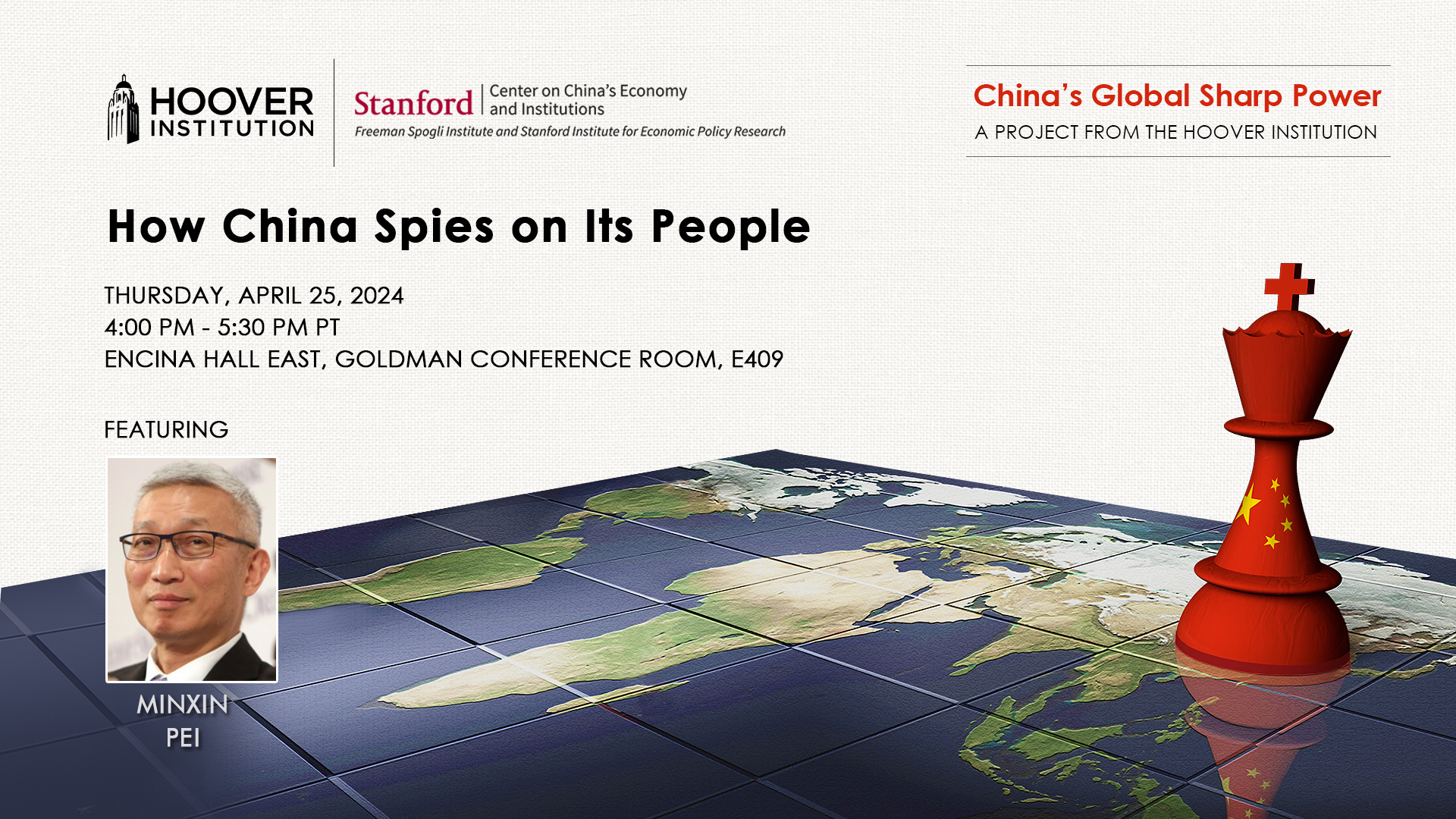
About the Speaker

Minxin Pei is Tom and Margot Pritzker ’72 Professor of Government and George R. Roberts Fellow at Claremont McKenna College. His areas of expertise include China, comparative politics, the Pacific Rim, U.S./Asia relations, and U.S./China relations. Pei has been a Robert McNamara Fellow at the World Bank (1994-1995), Edward Teller National Fellow at the Hoover Institution of Stanford University (1994-1995), and Olin Faculty Fellow at The Olin Foundation (1997-1998). Pei has written three books including “China’s Crony Capitalism: The Dynamics of Regime Decay” (Harvard University Press, 2016), “China’s Trapped Transition: The Limits of Developmental Autocracy'' (Harvard University Press, 2006), and “From Reform to Revolution: The Demise of Communism in China and the Soviet Union” (Harvard University Press, 1994). Pei earned a B.A. from Shanghai International Studies University and an M.A. and Ph.D. from Harvard University.