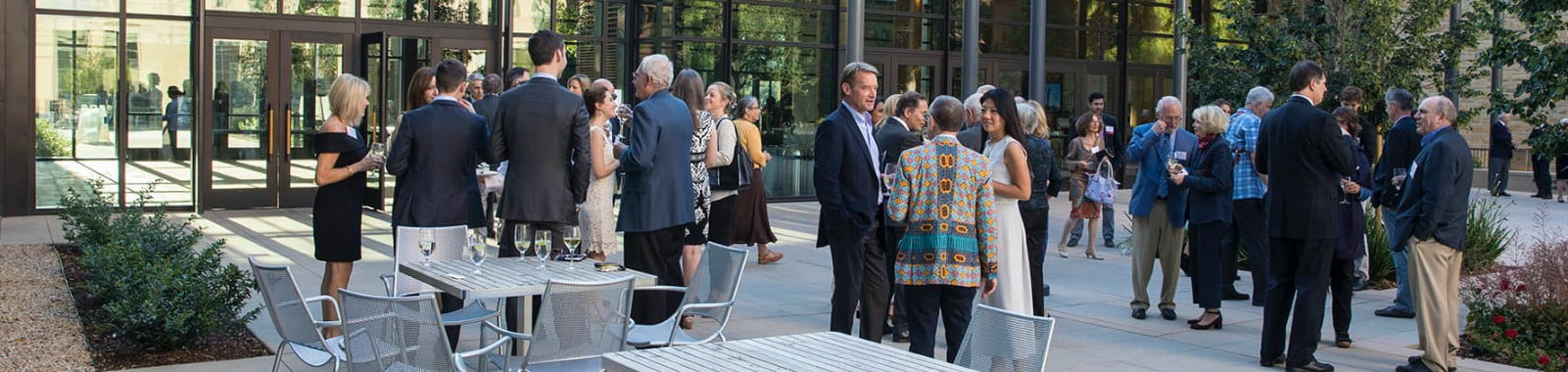


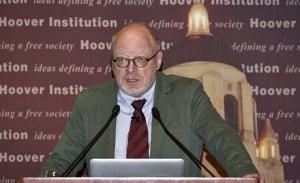
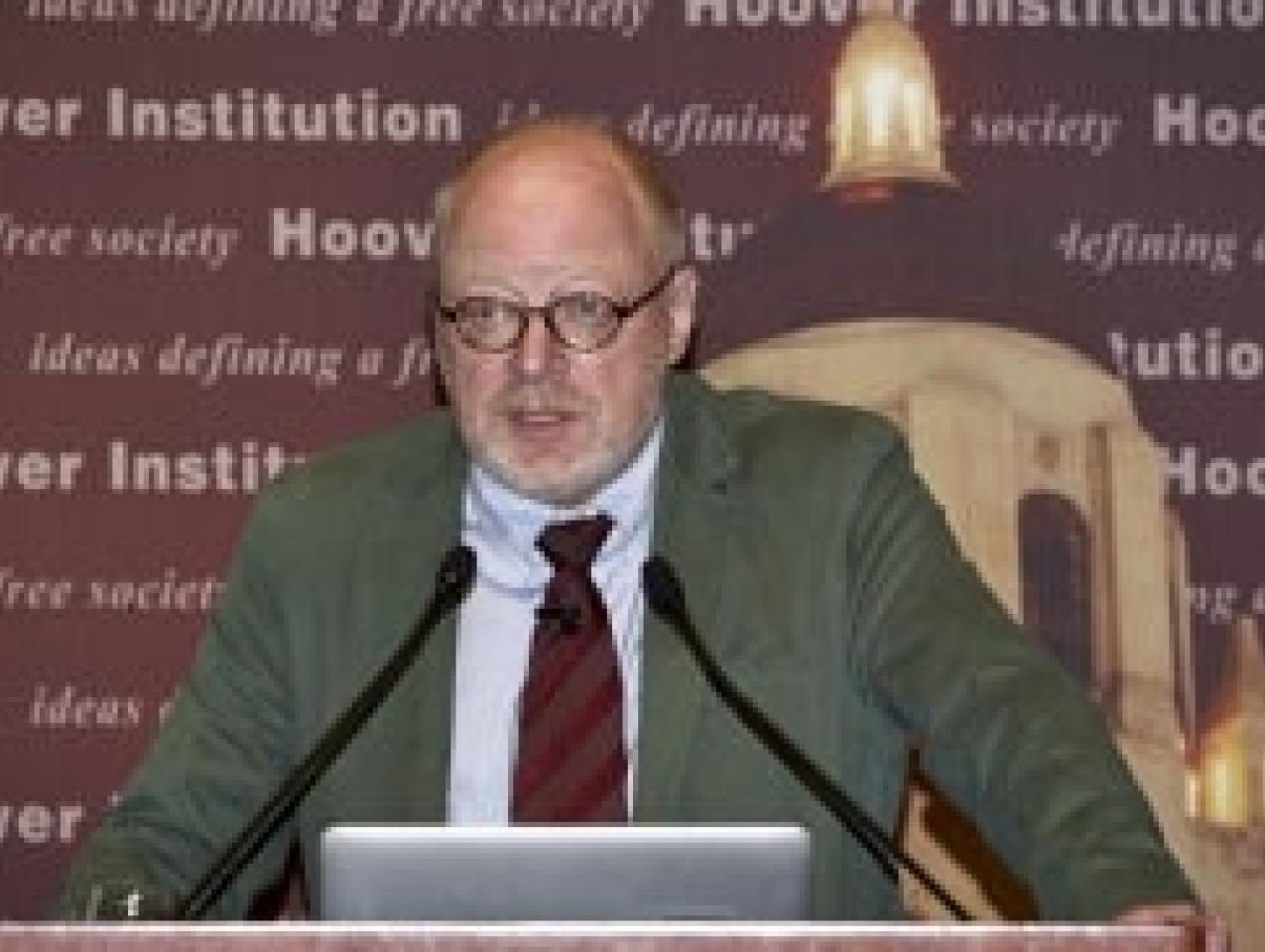
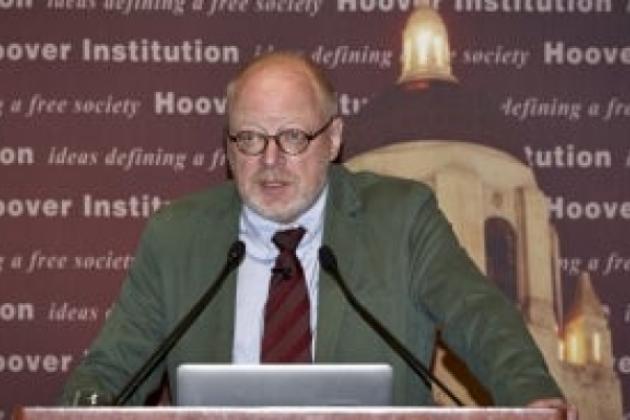
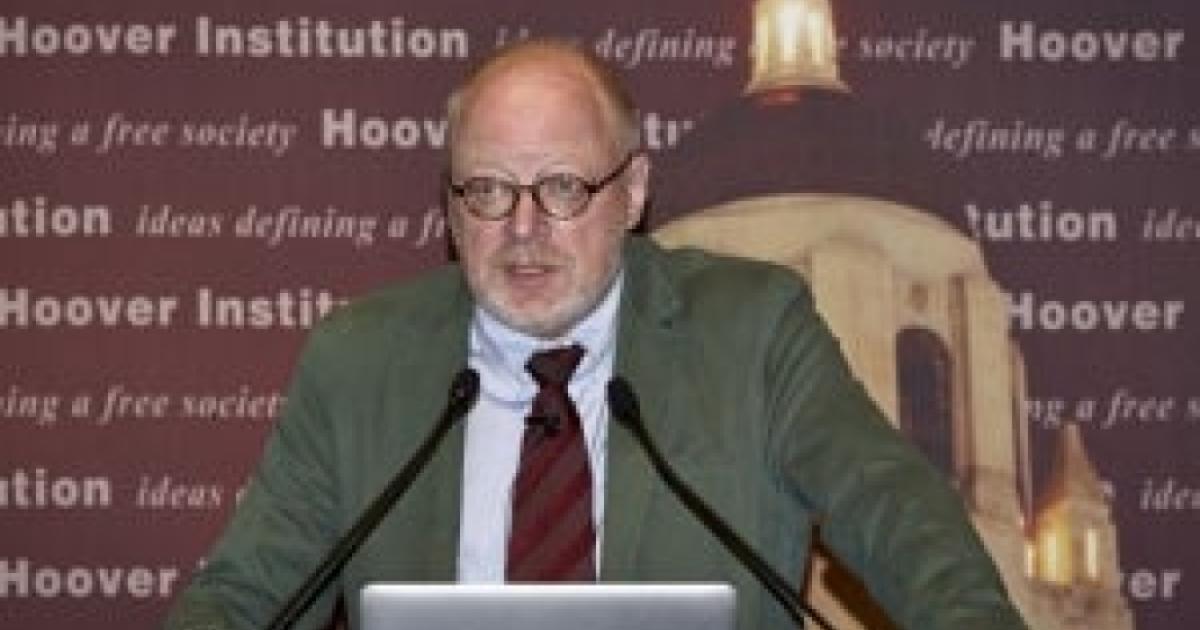
Swedish author and historian Bengt Jangfeldt spoke Tuesday to a packed Stauffer auditorium on the heroic actions and tragic fate of the young Swedish diplomat Raoul Wallenberg, who saved the lives of tens of thousands of Jews in Hungary during World War II, including a member of the audience (as well as the late Tom Lantos, a former member of Congress from California).
Professor Jangfeldt covered key aspects of Wallenberg’s life before his posting in 1944 to Budapest, where he rescued Jews from deportation and almost certain death by issuing them Swedish passports and by sheltering and feeding them in more than thirty safe houses under Swedish diplomatic protection. His talk, “Raoul Wallenberg’s Fate, 1945–47: A Diplomatic Failure,” however, centered on the events following Wallenberg’s disappearance in Budapest on January 17, 1945, at the hands of the Soviet occupying forces, and the subsequent failed attempts—or lack thereof—by the Swedish government and the Wallenberg family itself to attain his release.
The English translation of Jangfeldt’s 2012 biography of Wallenberg is coming out in February 2014 under the title, The Hero of Budapest: The Triumph and Tragedy of Raoul Wallenberg. In 2003, his biography of another fellow Swede, Axel Munthe: The Road to San Michele, won the Swedish Academy’s prize for biography.
Affiliated with the Center for History of Science at the Royal Swedish Academy of Sciences, Professor Jangfeldt is a preeminent specialist on Russian literature in the twentieth century and considered the foremost scholar of the Russian poet Vladimir Mayakovsky. (His 2007 biography of Mayakovsky was awarded the August Prize for best nonfiction book of the year.) He is also a renowned translator, who translated the Nobel Prize acceptance speech of his friend, the poet Joseph Brodsky, another giant of Russian literature.
Professor Jangfeldt was introduced by Barbro Osher, Swedish consul general for California, chair of the Bernard Osher Foundation, and president of the Barbro Osher pro Suecia Foundation. She had been introduced by Eric Wakin, director of the Hoover Library and Archives, who made welcoming remarks and presided over the event.
During an earlier visit to Hoover, Professor Jangfeldt examined documents, letters, diaries, photographs, posters, and artifacts (including material relating to Mayakovsky and Brodsky and his own writings on Mayakovsky) from the Russian and Soviet holdings of the Hoover Archives, including the papers of Aleksandr Ginzburg, the Pasternak family, Andrei Siniavskii, and Gleb Struve; the Irwin Holtzman collection; the diaries of Kseniia Aleksandrovna, grand duchess of Russia; and the photo album of N. A. Lakoba, party leader and Stalin’s personal friend.
The sound recording of his talk is now available: “Raoul Wallenberg’s Fate, 1945–47: A Diplomatic Failure.”