

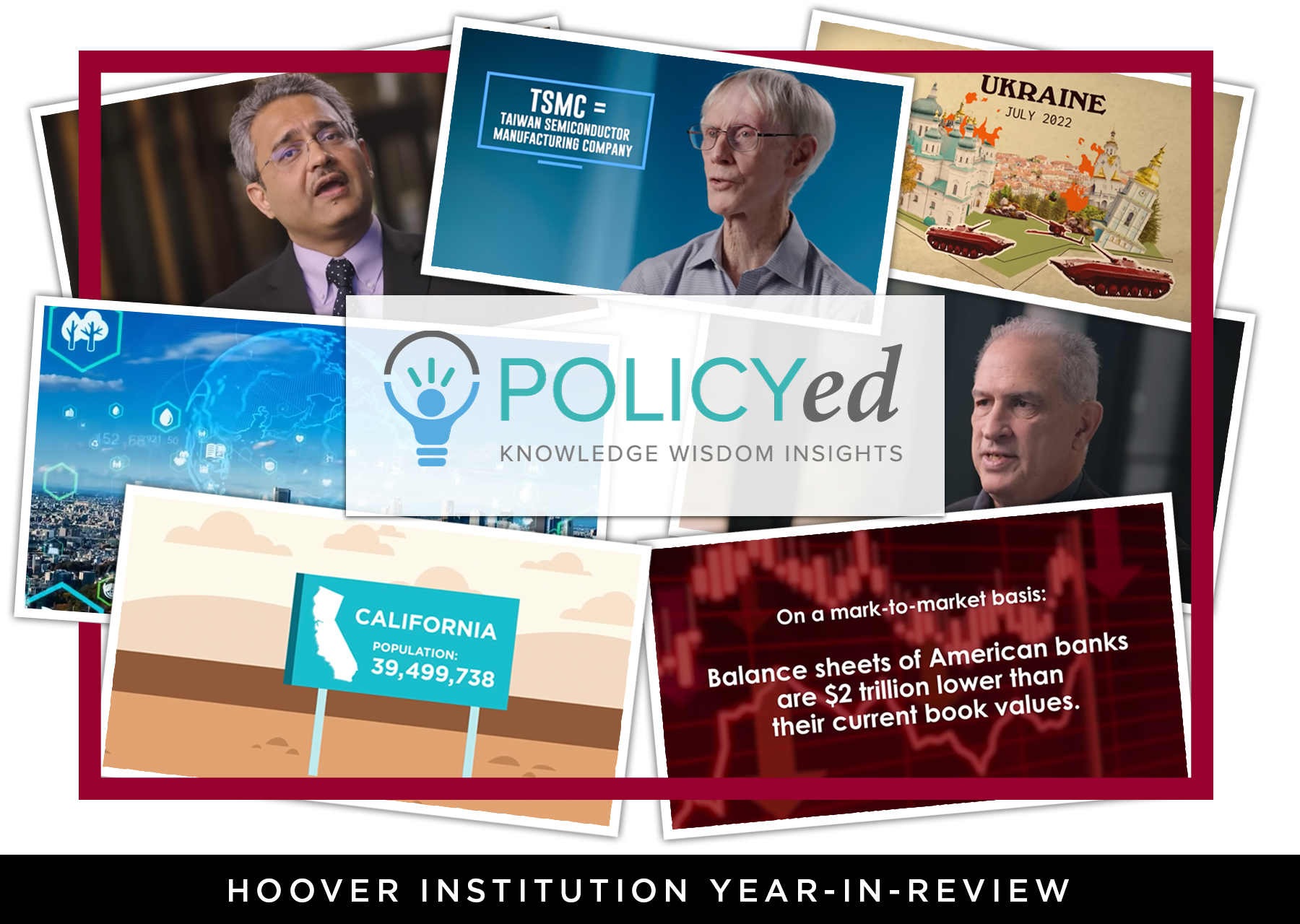
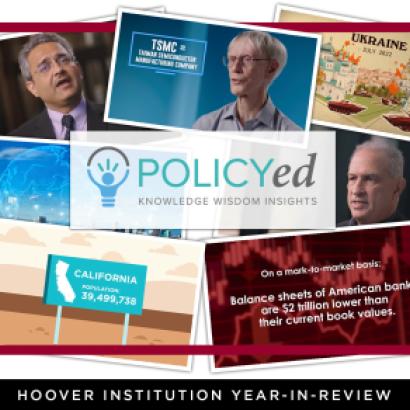
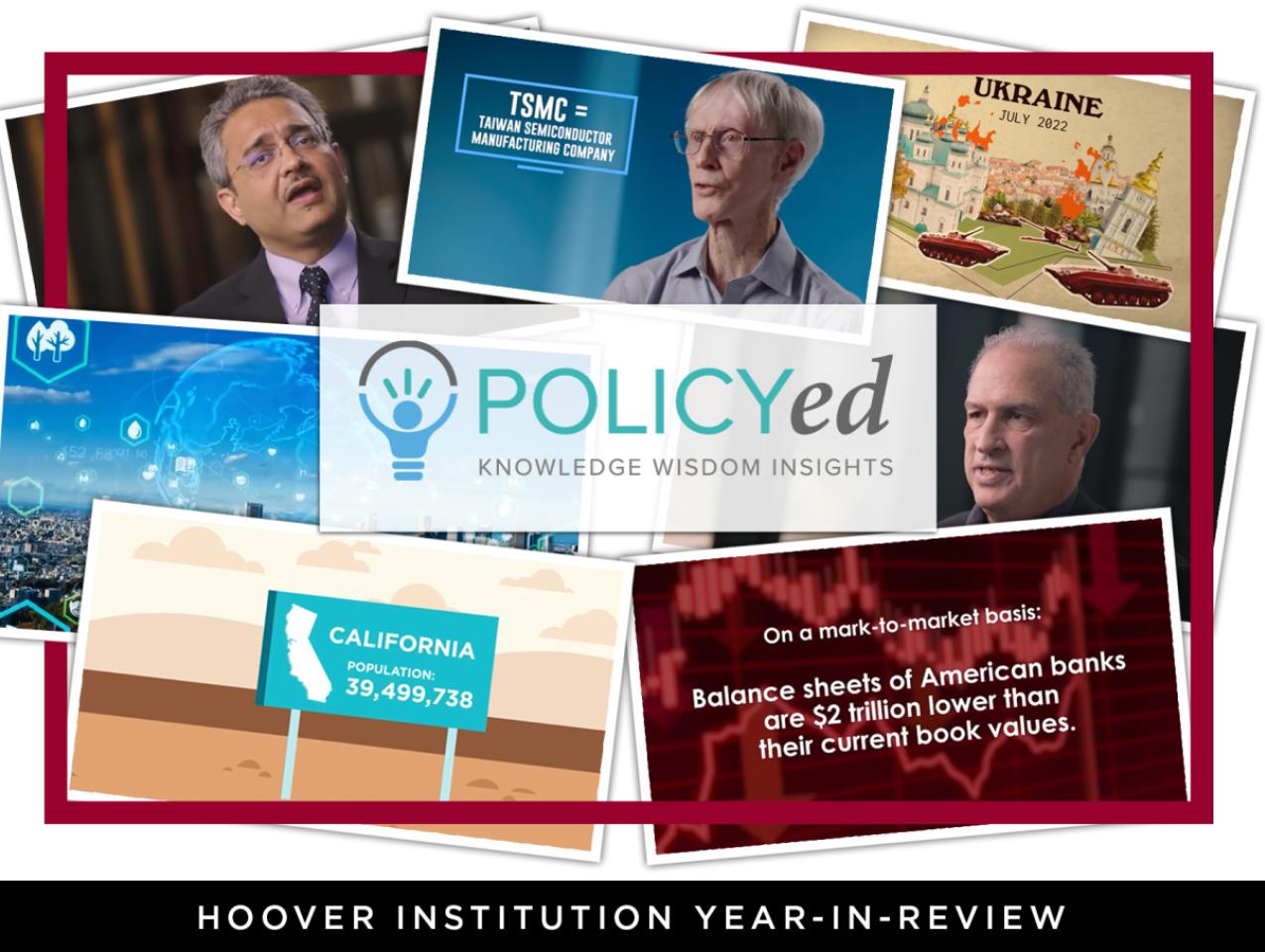
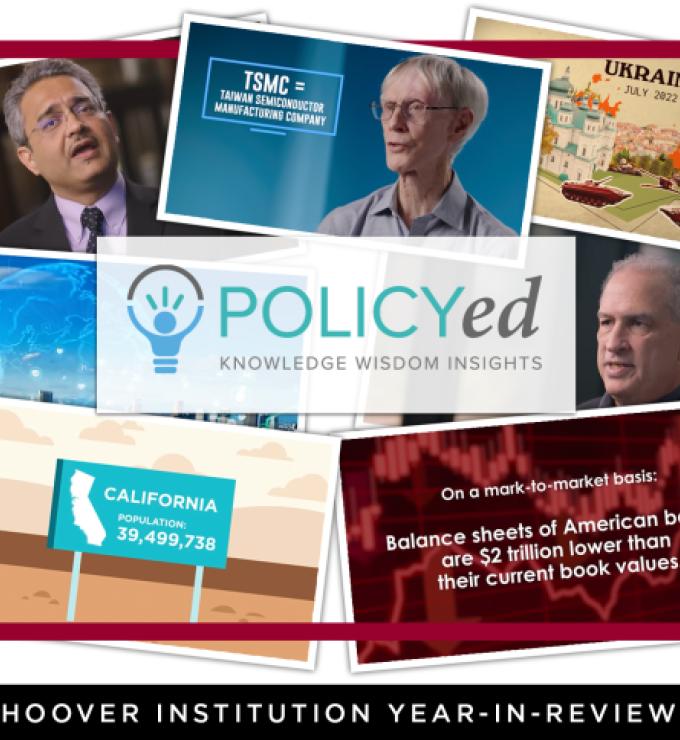
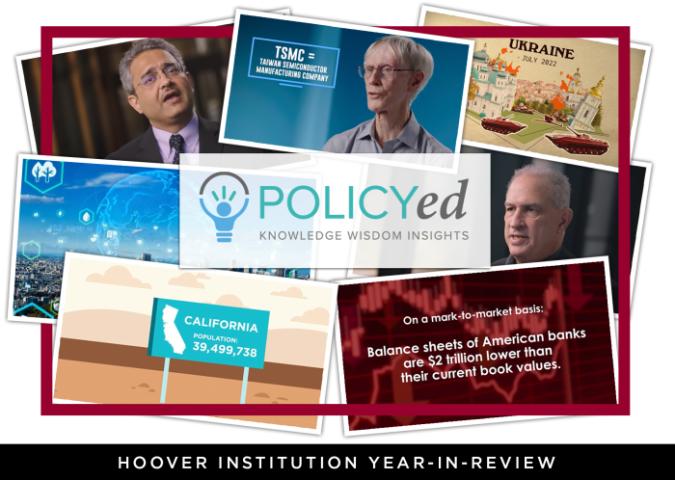

The Hoover Institution continues to assemble a vast library of video content to illustrate and explain the research of our fellowship to students and younger Americans. Our content includes short animations, video series, and several feature-length documentary films spanning a variety of topics, including economics, national security, health care, the environment, and civics.
This year we collaborated with 43 Hoover fellows to release 85 videos across 7 different series. We launched one new series to promote the launch of the Silicon Triangle report, focusing on the United States, Taiwan, China, and global semiconductor security. Since launching in late 2016, PolicyEd videos have been watched more than 220 million times.
Here are some highlights from 2023:
Economics
A Market Test to Avoid Another Government Bank Bailout with Amit Seru
Silicon Valley Bank's failure led to several of the largest bank failures in American history, prompting government intervention to prevent widespread contagion. A mark-to-market analysis of American banks’ balance sheets reveals that many are illiquid but not yet insolvent. The government could require banks to raise capital through equity in order to prevent another widespread bank bailout.
States that require the rich to pay more in taxes than other states run the risk of having high earners leave in search of lower-tax environments. When high earners leave, states lose out on tax revenue and either need to raise taxes on everyone else or cut social spending programs.
National Security
The United States, Taiwan, and China are bound within a “Silicon Triangle” that links our geopolitics, ongoing economic prosperity, and technological competitiveness. The more than two dozen participants in this working group have worked together for eighteen months to better understand this strategic triangle.
Throughout centuries of warfare, Russia has displayed consistent wartime strategies that have endured through the Tsars, the Soviets, and even into the present day. Historically, Russia is able to absorb early, often devastating losses, through a seemingly endless supply of soldiers. As war prolongs, Russia adapts, persists, and nearly always overwhelms their enemy.
Civics and Education
The Threat to Academic Freedom of Expression at American Universities with Stephen Haber
The relationship between faculty and students in the pursuit of truth is vital to American society, but restrictions on language, anonymous bias reporting, and required diversity statements undermine higher learning. Eager to protect students from discomfort, university bureaucracies have prioritized ideological conformity and self-censorship over critical thinking and the pursuit of truth. Academic inquiry and the pursuit of truth may be uncomfortable, but it is necessary to preserve what makes our higher learning institutions great.
How to Challenge Teachers Unions Control Over Local Elections with Michael Hartney
Teachers' unions in the United States hold significant influence over school board elections, winning 70 percent of races when they make endorsements. Despite the Supreme Court’s Janus decision in 2018, union-backed candidates have continued to prevail. However, a strategy out of Florida provides a possible avenue for education reformers to challenge teachers’ unions at the ballot box.
Environment
The Challenges and Realities of Climate Modeling with Steven Koonin
Computer models of climate change are complicated and struggle to show real-world processes correctly, making their future predictions uncertain. Looking at past data, climate models often don't accurately simulate temperature changes, making their future predictions less trustworthy. Because of these problems, the models should be viewed skeptically to project climate change risks and impacts.