







The Hoover Institution Center for Revitalizing American Institutions webinar series features speakers who are developing innovative ideas, conducting groundbreaking research, and taking important actions to improve trust and efficacy in American institutions. Speaker expertise and topics span governmental institutions, civic organizations and practice, and the role of public opinion and culture in shaping our democracy. The webinar series builds awareness about how we can individually and collectively revitalize American institutions to ensure our country’s democracy delivers on its promise.
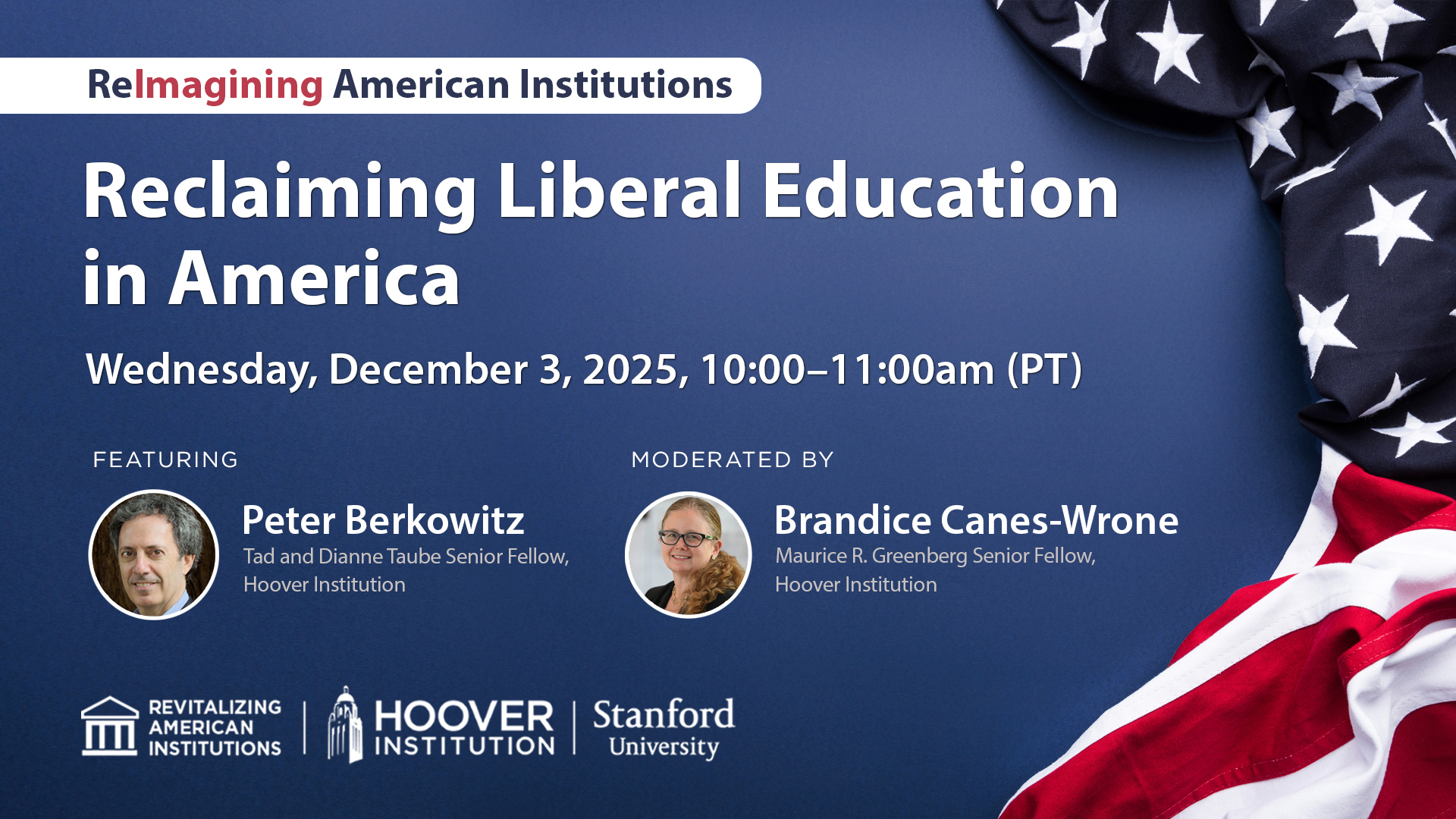
The Center for Revitalizing American Institutions (RAI) hosted Reclaiming Liberal Education in America with Peter Berkowitz and Brandice Canes-Wrone on December 3, 2025, from 10:00-11:00 a.m. PT
Join Peter Berkowitz and Brandice Canes-Wrone as they explore the intellectual and civic foundations of liberal education, why they matter for a free society, and how they can be reclaimed in today’s polarized climate. Participants will gain insights into the enduring value of liberal learning and practical steps for strengthening it in universities and beyond.
- Welcome and thank you for joining us for today's webinar hosted by the Hoover Institution Center for Revitalizing American Institutions. My name is Erin Tillman and I serve as Associate Director of the Hoover Institution, and I'll be your webinar host for today's session. Before we be, we begin, let's review a few housekeeping items. Today's session will consist of a 30 minute discussion followed by a 20 minute question and answer period. To submit a question, please use the q and a feature located at the bottom of your zoom screen. While we may not have time for all questions, we will do our best to respond to as many as possible. And a recording of this webinar will be available on the RAI event page of the Hoover website at hoover.org/within the next three to four business days, the Center for Revitalizing American Institutions, also known as RAI was established to study the reasons behind the crisis and trust facing American institutions. Analyze how they're operating in practice and consider policy recommendations to rebuild, trust and increase their effectiveness. RI works with and supports super fellows from across the country to pursue evidence-based reforms that impact trust and efficacy in a wide range of American institutions. When we say institutions, we mean governing and judicial bodies at the state, federal and local levels, as well as non-governmental civil society organizations such as media, nonprofits, and foundations. We also attempt to understand public opinion and behavior, particularly as it relates to the electoral accountability. And we are making investments to improve civic education in both K through 12 and higher education settings. RIA operates as the Hoover Institution's first ever center and is a testament to one of our founding principles, ideas advancing freedom. Since 1919, the Hoover Institution has sought to improve the human condition by advancing ideas that promote economic opportunity and prosperity while securing and safeguarding peace for America and all mankind. Today's webinar is the third installment in our 20 25, 20 26 series re-imagining American institutions, a program in which we spotlight speakers who are developing innovative ideas, conducting groundbreaking research and taking meaningful action to strengthen and the trust and effectiveness in American institutions. It gives me great pleasure to introduce today's moderator, Brandis Kanes. Rohn. Brandis is the Maurice r Greenberg Senior Fellow and the director of the Center for Revitalizing American Institutions at the Hoover Institution. She's also professor of political science and professor by courtesy of political economics at the Graduate School of Business, and she served on faculty at MIT Northwestern and Princeton before returning to the farm in 2022. Today's session on reclaiming liberal education in America will explore the intellectual and civic foundations of liberal education, why they matter for free people and how they can be reclaimed in today's polarized climate. We are honored to service. We are honored to have as our guest speaker Peter Berkowitz, the ta Diane Toby, senior fellow at the Hoover Institution From 2019 to 2021, Peter served as director of the state department's policy planning staff and senior advisor to the Secretary of State, a recipient of the 2017 Bradley Prize. He's a columnist for real clear politics and director of studies at the Public Interest Fellowship. Peter has authored several books on political philosophy and constitutionalism and taught at Harvard and George Mason University. Thank you, Peter, for joining us today. I'll now hand you off to Brandis to start today's conversation.
- Thanks so much, Erin, and thanks Peter for joining us today. It's always great to see both of you. So Peter, as you know, higher educations in the news these days quite a bit actually, and the idea of a classical liberal education is part of that discussion. You've actually been writing for a long time about the importance of a classical liberal education. So just for starters, can you say a bit about what that means?
- Happy to do so and great to be in conversation with you, Brandis. Thanks. So classical liberal education really goes all the way back to classical Greece in Rome. It starts with Socrates conversations in the public square, Plato's Academy, Aristotle's Lyceum. It combines formal studies with, let's call it excuse the fancy word, dialectical questions and answers. Even the most simple observations about moral and political affairs. Give rise to questions, efforts to answer those questions, shed shed some light and give rise to additional questions. So the combination of formal studies, typically in in the, in the sciences and the human and the humanities too. Plus the Socratic question and answer. That's the heart of classical liberal education. In the Middle ages, liberal education was the liberal arts were formalized in the, the so-called quadrivium and trivium. The quadrivium included arithmetic, geometry, music, and astronomy. The trivium included rhetoric, grammar, and logic. What were thought to be the, the hard subjects, think of the quadrivium as stem and grammar rhetoric and logic as the humanities. And then we see a third important moment in the history of liberal education, and that's really our era, the era we still live in. Let's call this the era of rights, protecting democracies in the era of rights, protecting democracies. Liberal education is understood to serve the interests of maintaining political societies based on individual freedom, human equality, limited government, and so on. I think the best account we have of liberal education in the modern era is, is provided in a these days little red speech that John Stewart Mill gave in 1867. He was named honorary rector of sa, university of St. Andrews. He gave an account of liberal education for a free society. And in his count we can see that liberal education has a certain aim, has a certain structure and content, it has an underlying spirit. What's the aim? Argued mill. And I think it's a good aim for us. The aim is to of liberal education, not the whole of what a university does, but liberal education is to produce capable and cultivated human beings. Capable for what? Cultivated toward what end well to prosper and free societies and to maintain the political institutions of free society. What's the structure and content? Well, liberal education, like many inquiries, begins from the simple moves to the more complex and moral and political affairs. It begins from the close to home and branches out in the United States. Such an education would combine, study the sciences, humanities with a focus on American political ideas and institutions, political economy, jurisprudence, international relations. It wouldn't stop there. It starts there as the base from which it broadens out to study the great moral and political ideas in our civilization. And it keeps broadening to study other peoples and nations. But like almost every human activity, sports, music, law, medicine, liberal education also has, has a beginning point, a base, and finally it's got a spirit. What's the spirit? It's the spirit of curiosity. It's the spirit of civility and conversation. It's the spirit as John Stewart Mill emphasized in on liberty of understanding that he who knows only his side of the argument knows little of that.
- Okay. Peter, thanks for that great description and I'm sort of pleased and intrigued that music is in the stem, but that's not today's focus, so we'll, we'll, we'll, we'll talk about that another time over lunch. But I wanna, I wanna quote something you wrote back in 2013, this, this happened to be about Boin College, but you know, we're not, the focus here is not boin, it's the, the bigger, the bigger point. And you wrote quote, the problem today is that this legacy has morphed into a pronounced tendency. The Boden's government department is a noteworthy exception to identify the contemporary progressive understanding of government and the various since hundred policies associated with the left wing of the Democratic party as equivalent to morality and reason. Boin proclaims its devotion to liberal education and the virtues of open-mindedness, critical thinking and freedom on which it depends, but the college reinterprets these virtues to serve partisan ends. So without kind of hyper-focusing on Boin or for that matter, any specific university or college, do you think this issue has gotten better or worse since 2018 in the higher American higher education landscape? How do you think it's, it's sort of operating today?
- Sadly, I do think things have deteriorated over the last decade, although the, in the past two years, we are seeing the beginning of a renaissance. Why, why, why do I think it's worsened? Well, I'll give you a few actual examples. We are old enough to remember many of our listeners will old enough to remember the, the controversy at Yale University in 2015 over Halloween costumes. A, a dean and associate dean at one of the college houses dormitories wrote a letter to all the students and the house saying that, I understand some of you would like the university, Yale University to regulate your Halloween parties, but I believe in the woman writing, this was her Exel herself, an expert in child psychology. She said, I believe students should be in charge of their own Halloween parties, and if they see a Halloween costume that they think is offensive or inappropriate, they should let the other student let the student who's wearing it know this provoked outrage among the students, the husband of this associate dean, who is the dean of the whole college, Nicholas Christis, his wife, had written this letter can be seen on a video. It's available on YouTube being surrounded by 20 or th 30 students, yelling at him, screaming at him, telling him that she should be fired because he refused to apologize for his wife's letter without hearing all the arguments on the side. In response to this Yale University president Peter Salve announced two weeks later that he was earmarking $50 million, $50 million for more positions and to study race and diversity at Yale, and also to authorize seminars and training sessions for top administrators, including himself as if Yale hadn't devoted extraordinary resources over the previous 20 years, five years later, summer of 2020, COVID summer, but also the summer following the killing of George Floyd by police officers who were in the process of subduing and arresting him, Dean of the Faculty of Arts and Sciences at Harvard University. Claudine Gay says that this moment was a teaching moment. She speaks as if she spoke as if in a message to the faculty. There was only one possible interpretation of those events of the riots, many of which were not peaceful in cities around the country. Those riots actually caused a country upwards of $1 billion. Many police officers were injured, many buildings were burned down, including government buildings. And Dean Gay also said she's going to earmark tens of millions of dollars to take advantage of this moment, putting the Harvard University squarely on the side on one side of a very difficult political controversy, controversy in the country. And then after the October 7th massacres committed by Iran backed Hamas in Southern Israel on the very day that Hamas was slaughtering Israeli civilians, 1200, taking 250 prisoners, 34 student organizations at Harvard University published an open letter in which they declared that they hold Israel entirely responsible. That's a quote for the atrocities that were being perpetrated against Israel. I think they used the word violence. One has to ask oneself, where did these students acquire the intellectual habits that would lead them as the fighting was still taking place to, to condemn the victims of a, of a massacre? Where did they learn the, those intellectual habits or where did they fail to learn those intellectual habits? So I think the situation actually has gotten worse at our universities, but as you know, and I'd be happy to talk about it, we see some promising signs of, of reform.
- Okay. So I wanted to just press you a little bit on, it sounds like you think the, the this issue has gotten worse, this kind of reinterpreting classical liberal education to serve partisan ends, or it was getting worse for a while. Maybe it's getting a little better in in recent times, which we'll get to. But what do you think are the underlying causes of that? You know, why, why is that happen? Why did that happen?
- Yes. - Right, because I understand there were these big world events, right? That, that we've just, you've mentioned a few of them, but, but in some ways it wasn't October 7th itself, right? Or or the George Floyd killing that co you know, or, or maybe you think it was, but I, I've sort of, you know, it sound seems as if there's something that was going on on the ground and then these yeah, these brought to light some, some things that were already happening on campus.
- It's a very important question. And just in case I haven't yet said something provocative or controversial,
- Just in case Okay. No, we, we don't fear that, but go ahead.
- Okay, let, let me give it a shot. So you're entirely right. It is a mistake these days to think that the problems that we encounter on the university arose out of nowhere. I've now traced things back for about decade, but we should keep in mind that in 1951, a young recent graduate of Yale College, Yale University, William F. Buckley, published a book called God and Man at Yale. And the central argument of Buckley's book is that the Yale faculty had conscripted the curriculum for ideological ends. The humanities he argued and the divinity school were actually teaching atheism and the social sciences, especially political science and economics were teaching, he called it collectivism or statism. We might today call it a, a progressive interpretation of economics. So already we have testimony, and I should say about this book, it's probably the only boring, boringly boring book that Buckley ever wrote, because even, well, f Buckley could not make the summary of college syllabi fascinating. And, but a lot of this book is devoted to here's a syllabi, here's a syllabus, here's what it teaches. In any case, there are additional historical moments or, but, but already before the 1960s, there's a deviation from liberal education, which ought to be presenting in addition to the progressive side. The, let's say in this case, the limited government side of, of economics and politics, in addition to teaching secularism or atheism liberal education, ought to have been teaching the history of religion. Because after all, there's only maybe one big phenomenon that has been more, that has been as influential as religion in our moral and political life. And that's war. And we also have a problem in teaching military history. In any case, the second big moment it seems to me was when the students of the 1960s arrived in graduate school in the 1970s, they brought with them a new orientation toward higher education. For them, education was to be politics by other means. In other words, their scholarship was going to be oriented toward improving society. The classroom was going to be oriented toward getting the message out to students of what the proper values and principles are to, to govern this reorganization of society. And the third big moment in this history is when the graduate students who brought that new sensibility, our education, should be practically oriented toward changing society. And it went without saying in a progressive direction when those, when those graduate students eventually obtained tenure in the late ear, late eighties and, and, and early nineties. And that coincidentally, I think you see a spade of books already in the 1990s. And by the way, some were by conservatives. But in the 1990s, I'll give you two example books by one, by a man who's not a conservative. David Bromwich, a very distinguished scholar of comparative literature at Yale University in the early nineties, published a book called Politics by Other Means in which he at DA David writes for, wrote for, for dissent in which he deplored the ways in which scholarship and the classroom were being used not to study great works of, of literature and political thought, but to advance a political agenda. This also the nineties also saw the publication of a book called The Shadow University by Alan Charles Kors, who is to the right of center. And Harvey Silverglate, a man of the a Man of the left, they published a book called The Shadow University. The Shadow University came out in 1998. It's a 300 page book, the documents cases in which universities are betraying the imperatives of free speech and the imperatives of due process. For, for those who are curious, I strongly recommend this book. Those two, those two gentlemen went on to create the foundation for individual rights in education. They assume that their, that this organization, which was created to defend individual rights on campuses would go outta business within 10 years. Little did they know that they were entering a growth industry. Every year that their organization's been in existence, it's been compelled to take on more, more cases, more abuses of power on fighting, abuses of power on campus.
- Thanks, Peter. So I wanna move to kind of the current time and as well, what might be some solutions. So you've identified, you know, a number of issues. So what now what, what should be done by universities themselves in order to be more devoted in practice to a liberal focusing first? I, I'm sure there are other issues too, but on this, you know, since it's the topic of the webinar to be more devoted to a liberal education,
- F first, I think what we need to reeducate ourselves about liberal education, it's very interesting. Universities these days study an enormous range of questions and subjects and, and topics. But if you look at the course catalogs of many of our leading universities, Stanford's, I'm happy to say different on the, in this regard, but if you look at the course catalogs of many of them, one subject that is seldom studied is actually the university itself. Yes. What is it, what is its mission? How does it govern itself? What are the ethics of university education? But the university is big, liberal education is part of a university because our universities also include professional schools. Liberal education is separate from the professional schools. So one step we can take is by reeducating ourselves about the history of leg liberal education. What are its purposes? How does it fit into a TA 21st century university? Second, I, I would like to see our universities incorporate into their orientation materials, s seminars, documents, readings on free speech, on due process, on, on the curriculum, on the basics of what it is, what one would need to learn to be a minimally educated person. And I suppose in a way, more controversially, although happy to talk about it, I would like, I would like to see universities adopt, and I recognize that a multiplicity of constraints, but I would still like to see universities adopt even a minimal core curriculum. I think it sends a terrible message to students when universities abandon the idea that there's no set of books or ideas or events or principles or institutions that all educated people should be familiar with. Now, I understand majors can be demanding. I understand this could involve retooling for, for faculty members, but I don't think it would be too much to incorporate, let's say a handful of courses you could complete in three semesters, two, two courses per semester. Say, start with ancient and medieval history and an introduction to political philosophy in the first semester. And by the way, all students would take these in the second semester, American political ideas and institutions and the principles of economics. And in the third semester, two more classes, a class on modern history and a class in on literature. And by the way, this has at least two advantages. One, it introduces all students to, to some basics that will actually help them both as, as citizens in a free society and I think as, as flourishing human beings. But second, and we've run this experiment, students tend to like these courses when they're studying a, a, a common curriculum, their fellow students are studying it, and out of class in the cafeteria, over a beer on a walk. They can continue the conversation. They learn how to disagree product productively in a way they can't, if every single student is taking a, a set of whatever, 32 courses tailored, especially for himself or herself by himself or herself, but by each, not with the view to what constitutes an educated person. I'll met, I'll mention one other recommendation I have, which is that because it's so poorly understood today, and because it's so essential to the enterprise, I would like to see universities create an annual free speech lecture. And by the way, invite a range of people to do it. Political scientists, philosophers, scholars of literature, sociologists, activists, lawyers, all kinds of people, and bring these people to campus, not for a day, not for a single lecture, but for a week. So to give this keystone lecture, but also to sit with faculty. So to sit with students to give seminars to, to converse over dinner. This would be a way for the university to signal the importance it attaches to freedom of speech and how do you signal that importance by increasing educational opportunities around this great principle.
- Excellent. Yeah. Okay. So some great suggestions. I one thing you didn't, you sort of was there in indirectly, but you didn't head on, talk about, is this a topic that's been getting a lot of attention in the press about viewpoint diversity? And you did recently write about it. Can you, can you say a bit, and I, I realize how we get there is in some ways a different, maybe a different question, but can you say a bit about why you believe viewpoint diversity is important for the pursuit of truth? And if the primary university mission is truth seeking? You know, critics have argued, you know, then why does it matter if faculty, students and staff happen to all share the same viewpoints, right? Like, why do we need viewpoint diversity? Because we're truth seeking, so we're gonna get the truth. I, I understand some of these people didn't seem to be for truth seeking 10 minutes ago, so some were celebrating that they've come up, you know, but, but, but you know, this is a, a serious question, right? Like, why, why do we need Viewpoint diversity
- Ex Exactly. And in fact, as you know, just a few months ago, a, a professor of humanities and literature at, at Johns Hopkins University, Linda Sian, I think wrote a, published a piece seven thesis against Viewpoint Diversity. I, I think many of her arguments contained a core, a core insight, but I think that they all, the thesis were ultimately mistaken. She and many straw men, she, she does, for example, reasonably observe that we pretty much understand DNA structure. Do we need people on both sides of the question? We know that two plus two equals four, we know that earth is round. Do we need flat earthers represented on our faculties? The answers of course are no, no and no, but this misses the essential, it it blurs the essential point. Questions in math and it's questions, especially in the natural sciences, differ from questions and certainly in the humanities and in many cases in the social sciences, in the sciences like DNA structure or math two plus two, there's generally nothing to be said on the other side of the question, although I'm, I'm very aware that we should be very careful of saying the sciences settled. But in moral and political affairs especially, there's almost always something to be said on the other side of the question. And it is our limitation, our human limitation that few of us have minds capacious enough to keep in the front of our consciousness, both the opinions to which we are drawn and the opinions that, that we disagree with. And one, if I may just remind, remind us of what Mill says on this. He says, look, there, there are only three situations in regard to the truth. In all situations, we need freedom of speech. In other words, a variety of views. If our views are wrong, perish the thought it's good to have viewpoint diversity because someone will correct us if our views are correct. Let's say we have the correct view about executive power. Well, we don't want our views about executive power or the extent of judicial review or the structure of the family. We don't want our reasoned views of these difficult matters to collapse into dead dogma. The only way for our views to remain alive, for us to understand the presuppositions, the implications, the ambiguities, if we are challenged by dissenting views. But mill says, and this is the crucial part, these first two cases are not the common case. The common case, and I think this is true of academic theorizing too in our business, political science, that in most cases the opinions we hold are mix of true and accurate statements and false and misleading or ambiguous statements, and the same about the opposing views. So bringing together the clash of views allows us to sort things out, to figure out what is defective in our own views, and to figure out what is, even if another view is overall wrong, it may contain a portion of the truth. So it seems to me our educational mission, our very educational mission depends on this. Although I make one final point, I do sometimes think we make a mistake when we treat viewpoint diversity as the be all and the end all. It's not intellectual excellence is what we're seeking. And in our curriculum we're not. When we think about our faculties, it seems to me our number one priority should not be balancing on the basis of political ideology. That's bad. It should be balanced, it should be ensuring that important topics are covered. Now, last point here, most universities, especially elite universities, do a bad job of covering topics these days, like constitutional history, diplomatic history, military history, religious history. Did I say economic history?
- Not yet, no.
- Okay, let's add economic history now. And if we fill those gaps in the curriculum, it turns out we're going to increase viewpoint diversity because these days it's conservatives who tend to those subjects. But what I'd really like to do is fill in the gaps in those, in those areas. And if a man or woman of the left can teach Adam Smith and Edmund Burke and Friedrich Kayak, terrific. What I want is subjects like that in religious history and military history also taught.
- Great. Thanks for that. Great answer. We've, we've gone for almost, so we're gonna be having our final two questions, so please get your questions in so we can move to them. Peter, we've talked for almost a half hour now and not, not actually mention Trump yet, in which, you know, in today's world is sometimes unusual. So you've written about the Trump administration's proposed compact for higher education. And to take just one quote from that excellent article, you note that it quote, predictably provoked substantial concerns about government exceeding its legitimate powers and presuming an expertise that it lacks unquote. And then you go on to highlight how you know, even well-intentioned administration officials from either the Trump administration, but from the progressive left as well, you know, could, could suddenly find themselves either lacking the expertise and then maybe less enlightened ones trying to coerce universities to take on certain orthodoxies. So I wonder, are there any government reforms or programs you would endorse as constructive rather than overreach or, or potentially destructive, or would is your kind of final word, like just please stay out.
- My my final word is not please stay out. How, however, I Yes, I'm, I I have been concerned about bureaucratic overreach in higher education, in part because I'm concerned in general about bureaucratic overreach and, and Trump administration officials generally are not somehow more expert in educational affairs than they are in other affairs in which bureaucracies have a tendency to, to overreach, I should say, about the compact. That if universities were to have adopted roughly nine of 10 of the, of, of, of the principles on their own, I would say terrific. But I'm very worried about, about the federal government having a say in whom universities hire. And there was one provision in particular, which singled out conservative ideas and said, universities must, must not punish belittle, must not support any part of the university that punishes or belittles conservative ideas. They shouldn't be the, the universities should not punish or belittle any ideas. They should, they should meet bad ideas with effective criticism. So here are two undertakings, though I think it's entirely proper for, for the government to be, to be engaged in and in, in one case it's the federal government, the other case it's state governments. I am happy to see the Trump administration seek to enforce Title six. Title six says that U universal institutions of higher education that receive federal funds, that by the way includes scholarship and grant money and loans to students as well as research for faculty. Universities that receive federal funds may not discriminate based on race, color, or na, national origin. Universities have been doing that. And I'm glad to see the Trump administration indicating that that won't be tolerated. Even though I've, I've also written that the Trump administration, nevertheless has to, has to follow federal statutes, which govern how money once pledged to universities might be withdrawn if those universities are found to be in violation. Second, a matter dear to our hearts, I should have mentioned earlier, I am delighted to see state governments support new programs in they're called programs in civic thought. We have examples that there are numerous. Now, Arizona State University was a founding program. There's such a program at the University of Texas, the Hamilton School at the University of Florida, on whose board I sit, university of Tennessee, North Carolina, and others here. Governors and state legislatures have been concerned about breakdowns in liberal education and, and they have decided to create units within the greater university, often with direct reports to the president of the university whose principle purpose is to give students an education in the, in the basic knowledge they need to be citizens in a free society. Typically that means a concentration we've already discussed on American political ideas and institutions. And the aim is to equip these graduates of these programs to be more effective in exercising their rights, honoring the rights of other people and participating in, in public life. It seems to me entirely proper for governors and legislators who are stewards of taxpayer dollars to want to use taxpayer dollars at our universities to teach a better understanding of, of American citizenship.
- Peter, that's a, a great lead in to some of our questions that have come. Yeah, so I'm gonna give, I wanna give, we have a lot of questions here and I wanna try to get to as many as possible. So one of our questions is actually from Paul Car Carice, who as you know, is the head of a civic center at Arizona State University. So I wanna take that lead in from your comments about them to ask Paul's question. Thanks Paul for joining us, and thanks to all of you for joining us and all these great questions that are coming in. So, Paul's question is, how might the America two 50 moment, which could mean commemorations up to the 1791 ratification of the Bill of Rights, so that could take us up to 2041, in theory be useful in this effort to renew the nexus of liberal arts education and American civic education and universities and colleges with benefits for America's deteriorating civic culture and our institution. So do you think this moment could be helpful?
- The, the answer is I think we should take best advantage of it. My my own view is that every year is an excellent year to introduce students to the Declaration of Independence, to the Constitution, which instantiates the promise of inalienable rights for all. Every year is a good year to study the, the struggles within the United States to make us a more perfect union to overcome the legal sanction of slavery, the, the, the, the, the legal, the legal support to slavery that was given by the Declaration of Independence in effect, even though it contradicts the principle and by the constitution. So we should always be doing this, but yes, of course the 250th birthday we should, we should celebrate, we should have lecture series built around the declaration. For, for what it's worth, when I served in the State department in 2019 and 2020, Mike Pompeo then Secretary of State, was so convinced that we had lost an appreciation of the role of human rights, which is a 21st century way of speaking of inalienable rights that is rights that in here, in all human beings that Pompeo commissioned a commission to. He established a commission to recover the, the original understanding of human rights at the founding and to give an account of their place in responsible American foreign policy. So yes, of course. Now of course Paul, the founder of the a SU program on civic thought, has effectively already built an, an organization, an academic unit that revolves around those principles. We should take every opportunity. And, and Brandis, as you know, the Hoover Institution is doing just that.
- Yes.
- To multiply podcasts, lecture series articles, long form essays, books that bring the focus back to our founding principles, the form of government we have created to secure the rights that in here in all people, and this is very important, the struggle over those principles, the struggle over those rights, it's an amazing American story. And Paul's question, which is really an entirely proper suggestion, is that we should take put to maximum advantage the 250th anniversary of the Declaration of Independence.
- Okay, so I have a question that hits home for those of us say at, so as the questioner notes so-called elite school. So the question is that institutional change rarely occurs from the center and generally occurs on the fringe. Is real change possible in the so-called elite schools?
- An excellent question. I'm not sure what the answer is, but I do believe that the situation is so serious that liberal education, the future of liberal education is so closely bound up with our future as a nation that we must operate on all fronts. Meaning we do what we can within, within the university. We, we rally the troops, we find comrades at the university who still have a living memory of what liberal education is we create within the universities. Programs like the one that Paul CRAs has done, other universities on civic thought, the, the Stanford Civic Initiative aspires to be a program like this. But I'm also, I'm also in favor of other approaches to the, to what I regard as the crisis of liberal education. I welcome the creation of new private universities devoted to liberal education, a lesser known such experiment as Roston College in Savannah, Georgia. A better known experiment is, is the University of Austin, Texas. I welcome an array of summer programs, many in Washington, which are devoted either to liberal education broadly understood, or that part of liberal education that focuses on morals and politics. There are a number of such programs, the Hoover Institution has a bootcamp every summer for, for, for students who want to study policy. So, so there are a variety of approaches within the university, new universities, programs, outside universities. All seems to, all, all of these efforts, it seems to me have been inspired by a sense that we are, we are depriving students of the education they deserve in a free society. So I sum up and say yes, I would not rest all my hopes on the reform of our elite universities, but I think they are an extremely important arena in which we also need to be fighting for the future of liberal education.
- Great. I have a question about your several questions actually, about your kind of proposed core courses and or great books courses. So one question is whether there should also be a core course on the history and foundations of maths and I that is, as you know, Peter, the British Yeah. You know, that, that it's only in, I don't know if it's only in the US but many countries use the word math since there are many types of, of math Yeah. Science and the scientific method. So to understand, for instance, how science deals with uncertainty.
- 100%. I'm sorry, I left, left out in my brief summary that, that of course from the beginning, liberal education has involved what we today divide into humanities and, and the sciences. You are not an educated person unless you have some familiarity with the history of science, with the scientific method, with the great achievements of modern science. But this is also important, an appreciation of the limits of the scientific method. So I apologize for having left that out. Please draw no inferences from that. This too is an essential part of liberal education. 100%.
- And another question about civics is whether some of these issues should be also addressed more thoroughly at the high school level. And I'm going to build on that myself, which is, do you think that, so first there's the answer, what should be done in high school, if you have thoughts on that in terms of a liberal education, since you know, the majority of the public, you know, right now at least, you know, doesn't have a four year college degree, although many have a, some have a a two year. But what should be being done at community colleges? What should be being done at high school? Yeah,
- Back in 1867, in, in, in response to the question, should we teach Greek and Latin at the universities? John Stewart Mills said, no. He said, if you haven't learned Greek and Latin by the time you get to universities, it's too late for you. You should already be reading Plato and Aristotle in the Greek university. Education is not remedial education today, university education is in part remedial education because yes, k through we, we also have a failure of, in my view, K through 12 education. So y yes, for sure, I, I would like to see this introduction to American political i ideas and institutions much more effectively launched in, in high school. Now, I, I should also make something clear. I don't mean I haven't meant to suggest it could sound like it, that I think that the, what is really should be the capstone of liberal education. What we receive in college is for everybody. I don't think it's for everybody. I think there are plenty of men and women in this country who at the age of 18 or so can finish high school, go on to a community college, acquire professional training, skilled artisan training in a variety of undertakings and go on to live full and happy lives and, and be excellent citizens. So the, so we should think of liberal education as actually beginning very early for, you know, with literacy and numeracy and then progressing upward college is, is, is is the capstone there? But yes, we need more reform in high schools.
- And this is a related question. Someone asked whether, you know, would this apply for instance to EU countries, would some of your lessons apply where students do these very specialized degrees? But you might actually take that since we, you know, I'll, I'll work in that music issue slightly, you know, like a Julliard, right? I mean, so you're going right, some, some undergraduate degrees in the United States aren't say a bachelor's of arts or a bachelor's of science and people are actually getting very specialized degree. Should, you know, are these core curricular and other suggestions applicable in those cases? And you know, particularly the EU as the questioner asks, since you're doing, almost everyone's doing these specialized degrees in many of those countries.
- Y yes, and we should emphasize in, in the eu, especially in, in Britain, these are professional degrees are first degrees after high school you go on to law school or medical school or, or business school or, or whatever. So in my view, students who are, who are disposed and capable of flourishing as lawyers and doctors and business exec business executives will be missing out on a, on an important part of education if they don't acquire a liberal education. So I look on that a bit with sorrow. If they, for those who, who, who miss it, is it absolutely mandatory? I suppose it wouldn't be, if our, to go back to the previous question you put Brandis, if our high schools were doing a better job of providing a basic introduction to, in that case, let's say British political ideas and institutions political economy in Britain jurisprudence common law, international relations, broadening out to other societies, it seems to me high school could, could, could supply that. And of course in the spirit of freedom, we have to recognize that, yeah, some people will go on to totally focus you, you mentioned the case of music, but even for a musician, I would think that we should recognize there will be a loss involved if you don't have an education that also involves some acquaintance with the great ideas and the defining events at college level in, in, in Western civilization. But, but here's the thing, colleges and universities that do promise a liberal education as the elite universities, yeah, they should offer it. They should offer it.
- Yes. Yes. Okay. Some, some, a few, a few questions, some of which are, are fairly, you know, kind of try kind of taking the other side and one of which comes at, well I'll do the one that kind of comes at us as faculty first, which is, is part of the problem that we don't, we don't have to do anything outside of academia. Should we require faculty? That's the questioner's question to have spent time outside of academia. And I'm gonna add, this is my own edition, which is what should faculty be doing, you know, is is you know, on an individual level, right? Because some of these, and I realize some of that is pushing for the reforms that you suggest, but when you go into, you know, you, you are in fact working with DNA, you know, that's what you're doing. So you're not the possibly, you know, the person who's gonna be leading the charge for a core humanities sequence, right? Since you're not gonna probably be teaching that sequence, what should you be doing and, and, and then addressing the questioners, the, the audience members' question about would it be spending some time aca outside of academia?
- Well, it depends what they mean. You know, mo professors do go home after work. They have weekends, they, they, they have families they can and should be engaged in, in the life of their communities in civil society, houses of worship do, do I think that it would be improve liberal education at elite universities if every seven years universities were sent to work on an oil rig or in a soup kitchen or volunteering in a hospital? No, I don't think that if, if, if anything, the problem is today that, that faculty members are consumed with, partly because this is what university departments and universities reward their scholarship. If anything, I would like to see universities give professors more opportunity to return to the basics, to build courses, to refresh their, their acquaintance with basic, basic ideas and events in, in our tradition so that they can in intellectually, intellectually retool.
- Now I'm gonna combine a couple questions in the interest of time that hit upon I think what, what some critics might, might highlight or, or at least criticisms, please. I'm not gonna say that they're individually critics. So, and this is that, you know, some of the historical figures that are responsible for democratic decline, whether it be Pul Pott, Joseph Goebbels, their products of a classical liberal education. So, you know, and then kind of, you know, somewhat different, but you could call it in the same class of questions is arguably when liberal education was more prominent, we had a series of issues on race, gender, you know, were large segments of the society were not really being given, you know, you mentioned already with the celebration of the two 50th the issues with America's founding. And so to some extent is some of the pushback at universities about saying, well we want to make this a better space for those people. And, and, and what would you say is someone promoting a classical, a classical liberal education and response?
- There is no way to make universities a better space for all human beings, including human beings who have been, who belong to groups that have been historically discriminated against, including women who are not a minority, but a majority. There is no way to make universities more welcoming space for those people and all people than to base them on the principles of liberal education. What are those principles? First of all, a liberal education today is an education that pre presupposes the, the freedom and equality of all human beings. Whether you belong to a historically discriminated against minority or not, a liberal education offers you a space when you can not only hear your own opinion, when you cannot only express your own opinions, but you can hear a variety of opinions expressed. You should understand it as a privilege and an opportunity to hear opinions expressed with which you disagree. A liberal education properly understood, gives everybody access to the treasures of the western, western civilization, by the way, also the horrors also the mistakes. But, but I would've a question for people who raised this sort of question, which is on the basis of what principles do they think it, it it was that slavery was overcome, that arguments were developed to ensure the equality for all. Well, I can tell you this. When Elizabeth Ka Stanton in 1848 delivers her declaration of sentiments demanding individual the protection of women's individual rights, she cites the Declaration of Independence. She bases her speech on the declaration five or six years later when Frederick Douglass gives his great 4th of July speech, the free slave basis, his demand for equal treatment under the law in the United States on the Declaration of Independence and, and the Constitution. Same with Lincoln in the Gettysburg Address, and same for Martin Luther King in 1963 on the steps of the Lincoln Memorial, he argues, what, what is owed to us? You, he meant what's owed to African Americans in this country is not a revolution that overturns this country that has yes given sanctioned to slavery. No, what is owed to us is the promise enshrined in the Declaration of Independence that all men, that means all human beings are by nature free, equal enough, certain unalienable rights. So it's a liberal education partly that helps us understand what the principles are that will, that protect and provide support for all human beings and that some rotten apples have acquired a liberal education. No, no more discredits medical school or business school or law school or any other activity under the sun. I, I'm sure there must be some musicians who are bad actors and wicked people, but we don't therefore blame their training in cello or piano or whatever.
- Thanks. Okay, we have time for one final question. So, and we're gonna, so Peter, and, and this has been noticed elsewhere as well as by some of our audience, and it relates to the earlier question about high school, but it actually I think is even broader than that because it's not just what's happening in America high school, it's happening, it's what's happening in American society, right? That we've become a more polarized society. A lot of activity is happening online rather than face-to-face. Arguably less constructive dialogue is happening. So part of the liberal education, you talk about presumes a sort of taking in good faith, but the other side said, in your experience with students, and I realize this is at Stanford, at one of the elite institutions. I mean, do you think students are ready for this? Do you think that this is something that, and when you work in summer programs here at Hoover and elsewhere, or do you think that this is also something that universities have to take on or, or a combination of both sort of bringing people in to the idea of what it means to disagree Agreeably,
- I believe that a sizable proportion of the students are hungry for this kind of education. Practical example from my own course, as you know, for four years now, I've taught a seminar called Varieties of Conservatism in America. This course begins with John Locke. Why? Because John Locke gives an account of freedom that was very influential. America's founding, and I believe students should understand theoretical foundations of that which American conservatives seek to conserve. And we read lock slowly and carefully, and I try to ensure that students understand the arguments and appreciate problems with the arguments the next week. And it really throws the students off. We read Karl Marx. Why? Because it seems to me also students should be familiar with the most powerful and influential critic of that which American conservatives seek to conserve. And that's Marx and Marxism. Now here's the thing, and this is what sometimes throws the students off. We read Marx exactly as we read Locke, meaning I give a little historical background. I do mention because it's part of the history that around a hundred million people were killed in the names of Marx in the 20th century when it comes to reading these classic Marxist texts, the communist manifesto, the economic and philosophical manuscripts, 1843 and 84 and so on. We read them just as we read Locke's second treatise slowly, carefully trying to identify the argument, its assumptions and its implications, and then and only then criticize them. And this, I think students find liberating, whether it's lock or marks, whether it's a thinker that they can presume the instructor is more favorably disposed toward, or a thinker that they can presume the instructor is less favorably disposed to. They see that they've got one job to figure out what the arguments are and assess them and they, and they do it in the same way by making their points and then responding to questions from me and from other students. And so the conversation unfolds. In my experience, not absolutely every student, but the majority of students actually like this and they wish they had more opportunities for it.
- Thanks Peter, on that optimistic note, we are over time, so I'm gonna turn it back. Thanks again for all these fantastic insights. I'm gonna turn it back to Erin.
- Thank you Brandis. Thank you Peter. Thank you for the op to the audience for your participation and great questions and our events team, for all your assistance, I wanna remind you that the recording will be available on the Hoover Event webpage in the next few days. And please join us for our next webinar on February 4th, 2026, and we'll focus on the Declaration of Independence, history meeting, and Modern Impact. We encourage everyone to visit the series webpage and sign up for our next session. You connect access recordings and previous webinars and subscribe to the RAI newsletter to receive the updates for upcoming events. Have a wonderful rest of your day and thank you again for joining.
ABOUT THE SPEAKERS
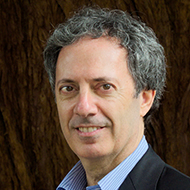
Peter Berkowitz is the Tad and Dianne Taube Senior Fellow at the Hoover Institution, Stanford University. From 2019 to 2021, he served as director of the State Department’s Policy Planning Staff and senior adviser to the secretary of state. A recipient of the 2017 Bradley Prize, he is a columnist for RealClearPolitics and director of studies at the Public Interest Fellowship. He has authored several books on political philosophy and constitutionalism and taught at Harvard and George Mason University. Dr. Berkowitz holds a JD and PhD from Yale and degrees from the Hebrew University of Jerusalem and Swarthmore College.
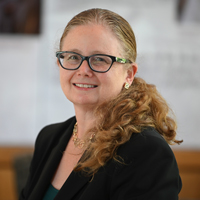
Brandice Canes-Wrone is the Maurice R. Greenberg Senior Fellow at the Hoover Institution, professor of political science at Stanford University, and the founding director of the Hoover Institution Center for Revitalizing American Institutions. She is also a member of the American Academy of Arts and Sciences and the American Academy of Sciences and Letters.