















- History
- Military
- US
- Determining America's Role in the World
- Revitalizing American Institutions
- Revitalizing History
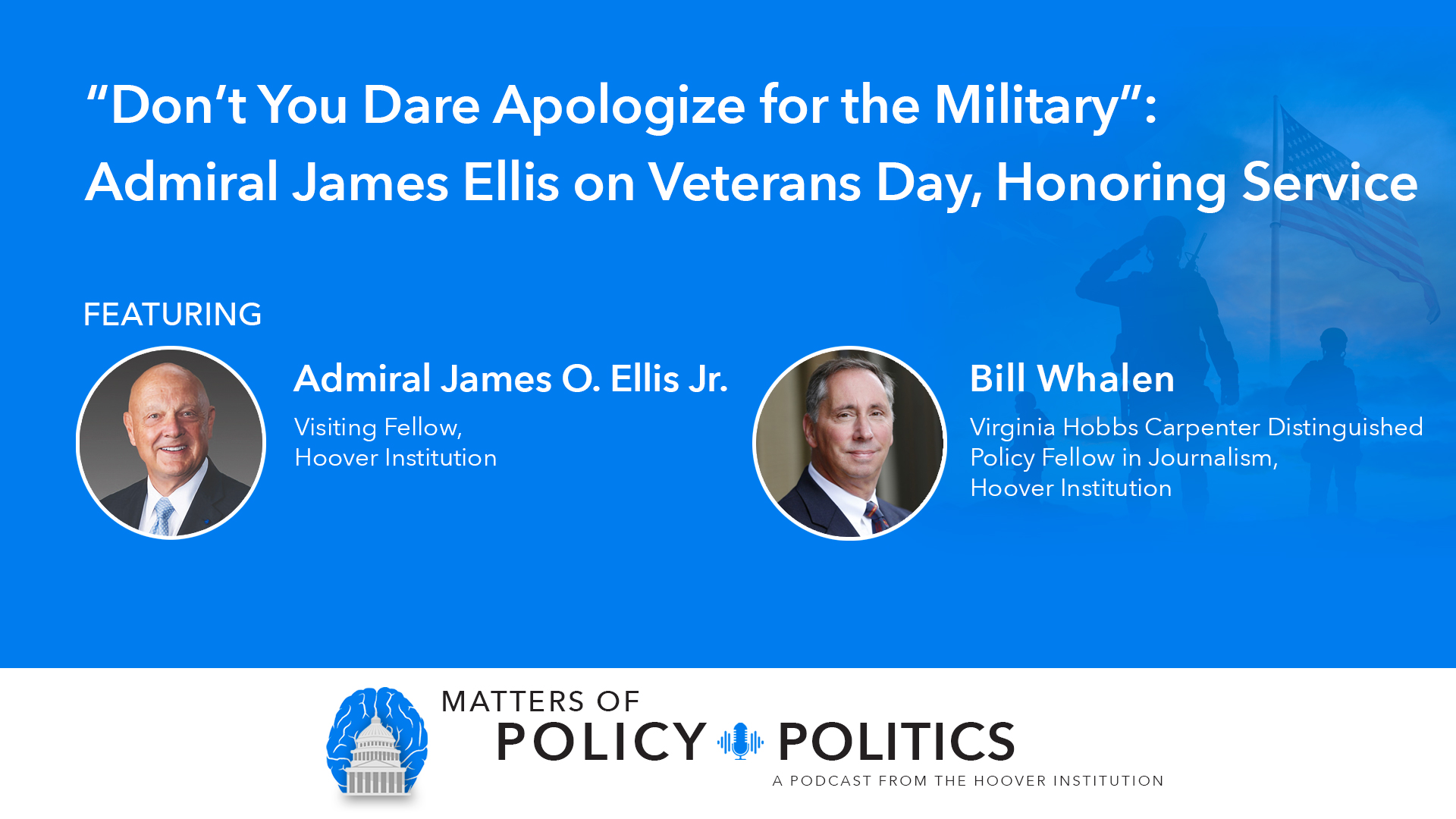
If you’re confused about the differences between Veterans Day, Memorial Day, and Armed Forces Day here in America, you’re not alone. Decades of government meddling and mixed messages have blurred the lines between honoring those who once served their country, those still on active or reserve duty, and those who made the ultimate sacrifice for freedom’s cause. Admiral James Ellis, the Hoover Institution’s Annenberg Distinguished Visiting Fellow, reflects on his nearly forty years of service on land and at sea (naval aviator, aircraft carrier "skipper" and head of the United State Strategic Command), the challenges facing veterans as they re-enter civilian life, plus ways to properly honor and improve the lives of America’s sizable veterans community.
- It is Friday, November 7th, 2025. And welcome back to Matters of Policy and Politics at Hoover Institution Podcast. I'm Bill Whalen. I'm the Virginia Hobbs Carpenter distinguished policy fellow in journalism here at the Hoover Institution. But I'm just one of several Hoover fellows who are in the podcasting game these days. I recommend you go to our website, which is hoover.org/podcast and check out what all we have to offer. We do, gosh, we do economics, we do foreign policy, we do domestic policy. We also have an audio version of the Goodfellows program that I am proud to say that I get to moderate. So definitely go check out our podcast menu for you. So today with the upcoming Veterans Day in Mind, we're going to talk about service in the armed forces and the challenges facing those individuals who transition out of military life. Joining me to discuss this is a Hoover Fellow who not only served as country with great distinction, but each year helps decide which men and women serve for one year as a Hoover veteran Fellow Admiral James Ellis is the Hoover Institutions Annenberg Distinguished Visiting fellow where he oversees the Hoover Institution's Global Policy and Strategy Initiative and the George P. Schultz Energy Policy working group, a graduate of the United States Naval Academy. Jim Ellis achieved the rank of Full Admiral in all nearly four decades of service. It took him from Naval Aviator to aircraft carrier Skipper and Commander of Carrier Strike Groups. And finally, commander of the United States Strategic Command. Admiral Ellis, thank you for your service and thank you very much for coming on the podcast today, and I hope you're enjoying your, your time at the Hoover Institution now, your land-based endeavors.
- I'm enjoying it very much, bill, and thanks for the welcome. And I've been now here for 13 years, believe it or not, and I learn much every day from interacting with folks like you and the other fellows and hopefully contribute in some small way. But it's a great place to be and I'm proud to be a part of it.
- You definitely do. So I know you're a very modest man, so I'm gonna test your modesty here and ask you to talk a bit about yourself. So the first thing about Jim Elli that I discovered I was delighted to see, is that you hail from Spartanburg, South Carolina. I have a particular fondness for that city Admiral Ls, because A, I have family that lived nearby in Greenville, but BI drive A-B-M-W-X five. And you wanna know where that car was made,
- Spartanburg?
- Exactly. It's a fascinating to go there and see the assembly line, by the way. Yeah,
- That is, it is. I've done that once.
- Alright, so the Naval Academy, you're a Navy class of 1969.
- That is true. Long ago in a galaxy far away.
- How did you end up in Annapolis? Where do you come from? A Navy family or?
- I did Bill, my father was a World War II vintage naval aviator. He, after demobilization, he went home to Spartanburg where I was born, and then he looked around at Spartanburg, which was then a very small town, no, BMW plants or hurst fibers or any of the other things that empower it today. And he decided it was a little bit confining. And so he went back in the Navy and did 25 more years as a, as a reservist or actually training reservist at air stations up and down the East Coast. And so I grew up in the Navy,
- So we have something in common. My, my father was ROTC through UVA, and he did only four years of active duty, but then he did reserves for, gosh, about 30 years, I think.
- Yeah, well, as, as I often note, and as a son of the South, you'd appreciate it though. I think the accent has long since left. Both of us, you know, they don't talk about being in the military or being in the Navy. They talk about being in the service and, and I like that term, and that's often a theme that I touch on in Veterans Day celebrations such as we'll have next week because it really is about service and in a lot of different ways. And so it was a, it was a real treat to, to be born there. Years later, I was asked to be the Grand Marshal of the Veterans Day parade in South Carolina. And I was quick to point out that I left South Carolina at the age of one and a half, and you'll excuse my affectation of the accent. They said, Admiral, it doesn't matter. It's where you were Bowen, that counts.
- So they said, so actually no, I grew up in Washington, DC Arlington, Virginia. So that's when I was growing up, that was kind of the tip of the South, if you would, if you would drive into Manassas, you would suddenly the accidents would get very thick. But now, you know, the, the south, I'd say like my receding hairline, the south, I think the South might start around the North Carolina, South Carolina bordering it. It's gone.
- Oh, I think you're right. I think you're right.
- One other thing about growing up in DC Admiral was that my father and I would take very delightful father-son trips and DC is kind of a midway point between Philadelphia and Norfolk. So we would take trips up to Philly to enjoy American history, see some baseball, and see what was then a very impressive reserve fleet sitting in mothballs there for my father, this is very sentimental because he was on the Iowa on a mid shipment crew. Wow. So we actually went on the Iowa, and then we go down to Norfolk and go on the base. And I remember as a little boy being I oppressed by the fact that my father is a reserve officer would be saluted. That just really blew you away. But you talk about an innocent pre nine 11 age admiral, you could actually drive up to the destroyer submarine peers parked nearby, walk out, and the fellow on watch, if you said, can we come on board and look around? Yeah, they'd let you on board and let you look around. So
- Yeah, those are great old ships. And I remember I was in the Navy when we brought them back, as you recall, as part of the Reagan buildup approaching a 600 ship Navy. And it was astounding to, to go through those spaces and you had actually open drawers of, of the main space in the engine room and find letters that those that actually sealed the space up before it went into moth balls left convinced that the ship would come back someday. And these are the things you need to remember, which valves leak, which gauges don't exactly work, those kinds of things. So it was quite a, a quite a treat to be a part of those that reactivation.
- When I was young, what attracted me to the Navy was, first of all the technology, but then secondly, the uniformity, the just how the men were dressed, but also the ships decked out, but also the names back in a, in a more innocent age. Again, Navy ships had a kind of logic to them. Ships were states, cruiser, city, and I just wrote a piece where whoever's defining ideas on this recently, and I'm very bothered by how they're naming the Ford class carriers right now. It started out with the president, then we've shipped over to Dory Miller and now we put in a ship of the line at the Enterprise right before Joe Biden left office, the Navy Secretary named one after George W. Bush, and now one after Bill Clinton. There's not a lot of rhyme or reason here, it seems.
- Well, I'm a traditionalist by nature, not, not a lot. I I understand the need for progress and the like, but I'm like you, I think there was a, an apolitical way to, to commemorate some of our great naval history embodied in those, in that naming architecture. Everybody understood it. I mean, submarines were fish and, you know, all those kinds of things. And we've kind of lost a lot of that. And again, maybe that's the way things are going, but there are days when I look back and say, you know, it was a lot simpler then. And sometimes simplicity is good.
- I did a little digging into the Naval Academy class of 1969. Do you know how many members of your class achieved flag rank?
- I don't know how many were Flag rank. I think I'm the only four star though.
- That is correct. You're the only four star. So eight actually became Navy admirals and three became Marine Generals.
- Yep, yep.
- Is that about normal for a class out of Annapolis?
- That's a little light. You know, that was a transitional time as you recall, where the Vietnam War was tailing down. I caught the tail end of that in early days of my, my fighter business flying off of aircraft carriers and, and so a lot of folks left. And so, you know, it's a, it's can be a numbers game after a while, and the force was shrinking. Those were not easy times. The Navy was kind of in the process of rebuilding and, and the like from some, some challenges that the Navy and the nation faced in that timeline. And so those of us that stayed, perhaps the, the opportunity was bigger for those that that remained.
- Okay. So one little factor we tucked away into your biography is that you did time at Top Gun?
- I did. And I'd never met Kelly McGillis. She was not there at the record show. Yeah, I was one of the early classes, I think I was class number eight. Top Gun was formed as, you know, in the darker days of the Air War over Vietnam and where the loss rate was not all it could or should be, and, and basically was instituted to reverse that, which it succeeded in doing. So I was pleased to be selected. It's a little different than the model that you see in the movies. You don't go to Token and then go off to some top secret mission to, to bomb this or that. It really is a train the trainer approach where a very few one per squadron, if you're, if you're lucky, gets selected to go to Top Gun and they come back and be the squadron, become the squadron's training officer essentially, and hopefully bring that knowledge back to everyone else in the squadron. So it's a, it's a great opportunity. I was very fortunate to have it, and it's always a line that gets a little recognition in the resume, I have to say.
- And do you like the movies?
- I do. You know, the first one was a little bit over the top, a little more humanizing of the, the, the protagonist in the second. So, so I liked that and he was flying the airplane that I last flew on active duty, the Hornet, so I could kind of relate to that as well.
- Yeah, I think the key is that it's entertainment at the end of the day. You have to just kind of tell yourself that the Navy probably is not chock full of 60-year-old test pilots and most people are involved in a plane crash or a plane is going to Mach 10. They they don't come out in one piece.
- No, they do not. They do not. Even though the, the scene in the diner was wonderful.
- Okay, we'll get to Veterans Day here in a moment, bit Admiral, but tell me a little bit about what you're doing here at Hoover. Explain what the global policy and strategy initiative is.
- Well, we put together, when the Late Secretary Schultz was, was, was still with us a an architecture. One of the things that Jim Mattis and a few of us that were working in the national security space early in, you know, over about a decade ago, actually before Jim left to become Secretary of Defense, offered that we might be able to support the, the National security conversation if we had an architecture on which to hang participants, not to try and capture everybody's project or program, but if folks needed help or they needed a Chapo, if you will, to cover them, that might be nice to have an architect. So we call it the, you know, national Security working group. And, and then, you know, we decided to evolve that late in the secretary's time, and I looked for a title that I thought was appropriate. Global policy and strategy were kind of what we're talking about. And it's no coincidence that GPS or George Schultz's initials, so Condi said, are you sure you don't have a marketing degree? When I presented the name change proposal to her, and I assured her I did not. But that's what it's become. And it's a, it's a broad area under which we put a lot of things, you know, maritime security in the Indo-Pacific, some of the Indo-Pacific security dialogues that we have in support of the active forces and the project on Taiwan and the Indo-Pacific. And so it's kind of a, a broad, as I say, framework for, for that. It doesn't include everybody. I mean, HR has his very active and very effective programs. And so I'm not implying that I, I am the national security guru, but because I live here, because I work here, my wife is a professor at Stanford and, and the, like, I'm around. And so I'm kind of the caretaker of that and proud to be. So the other thing I do is the, I chair the energy policy, the Schultz Energy Policy working group, again sponsored and funded generously by Tom Stevenson to represent the late secretaries and his interests in, in all things energy. And we just finished a, a two day conference, very successful in Dallas, for example, with very senior representation talking about the energy issues such as powering I AI and, and some of the natural gas challenges in Europe that, that confront us. So again, that's kind of the broad scope, you know, I find myself every day coming to work to, to look at issues that are important. They're timely, they're focused, and in some small way hopefully enable or contribute to the conversations and, and the learnings that can come from that.
- I think energy is a great and underappreciated topic in this regard. It played a roundabout issue in the recent New Jersey Governor's race because electricity is becoming very expensive in New Jersey, in the Virginia Governor's race. It's kind of a sleeper topic because Virginia is becoming very aggressive in trying to get ai, well, AI requires just a ton of electricity, is that question. But then you go into Europe, Admiral, I was watching a really fascinating documentary the other day on the rise of the a FD in Germany. This is the, you know, right,
- Right
- Germany. And it's very disturbing. There are a lot of Nazi parallels in terms of their messaging. And the question is, what is turning people onto the a FD? And it's a combination of feeling just kind of isolated and lonely. You don't really trust your political class, but energy also plays a role in hearing that there's a pushback against green energy.
- Yeah, well we've seen the a a, you know, very visible shift, not just on the political side, but on the, on the reality side. I mean, George Schultz used to talk to us about a three-legged stool when you talked about energy. You know, the, the environmental piece was always there, the economics piece, not just, you know, the affordability element of it, but how do you make this work? How do you make it a, a viable enterprise over the long term? And then finally, the national security piece or the sec energy security piece and the emphasis on the environmental has not gone away and shouldn't go away. But it's very clear that affordability and reliability are two of the big issues that are confronting us in this nation and, and our international security partners abroad. And not only that, some of our adversaries as well, I mean China this year will consume one third of the, the Globe's energy. And so those things affect all of the, the, the residents of this planet. And how we get that policy right in a, in a time of change is, is something we think is very important. As I say, far too often people are beginning to, to blanch a little bit, but, you know, energy security is national security in a very real sense.
- Well put. Alright, let's talk a little bit about Veterans Day. If you go back and look at the history of this holiday, it is a good example of good intentions clashing with government meddling in this regard. I trace this back to November of 1919, A wood world Wilson wants to have a day honoring World War I, right? November 11th, 1918, the armistice. So here's what Wilson says, quote to us in America, the reflections of Armistice Day, which is what he calls it, will be filled with solemn pride and the heroism of those who died in the country's service and with gratitude for the victory because of the thing from which it has freed us and because of the opportunity he has given America to show her sympathy with peace and justice. In other words, what Wilson is talking about in 1990s, 1919 is common an American version of Remembrance Day in the uk, absent the absent wearing of the puppies. The problem with this is when you honor the dead in November, you're kind of stepping on what is called now called Memorial Day in May. Exactly, which dates back to about 1868 when people started putting flags and flowers on Civil War. Graves
- Then called Decorations Day, as I recall.
- Exactly. So then we move forward to 1938 when Pharmacist Capital A, capital D becomes an actual holiday. But then we move forward to 1954 Admiral. And now America has been involved in two conflicts overseas. World War ii, your father was involved in and Korea as well. So now Pharmacist Day, well, it doesn't really reflect Korea and World War ii. So what do you do? You look for something different. And so Congress decides to call it Memorial Day, which is all fine until 1968 Admiral, when Congress gets involved and Congress is looking at, ab is looking at holidays on Monday. So what it comes up with is it calls the Uniform Holiday bill, which makes Veteran's Day a federal holiday, a Monday, great, but it assigns it to the fourth Monday in October, which doesn't sit well obviously with people who want to tie this in November, world War One, right? So we now move forward about another decade to 1978, where it's now returned to November the 11th. So what we have now is we have a Veteran's Day in November. We have a Memorial Day in May with those, don't forget that we have Armed Forces Day, which is on the third Saturday in May as well to honor those currently serving. So we have three holidays to honor military service, past, present, and, and future, if you will. But it's kind of confusing. And by the way, adding to this, the Now Department of War, I have a hard time not calling it DODI don't know if you struggle with this as well, but it's technically now the Department of War, and here's how they describe Veterans Day, quote, veterans Day Honors, all of those who have served in the country of war and war and peace, dead or alive, although it's largely intended to thank living veterans for their sacrifices.
- Yeah, yeah, no, it, it's, it is a bit confusing and, and, and people conflate the the two, and you know, I get lots of, you know, congratulations, thank you for your service on Memorial Day. And I, hey, it's not about me, is my, my response, because I do believe that has a fundamentally different focus. And that's on those we lost. And I've, you know, as we all have, I've known a lot of people and had a lot of friends that, that are no longer with us as a result of that. And so I I kind of approach it a little bit differently. I mean, that's a sadder time. I mean, not, not morosely sad, but just one of of quiet reflection for me, even though it kind of flies in the face of the picnics in the holidays and the kicking off of the summer and all the things that, that always get ascribed to, to Memorial Day Veterans Day is, you know, a little bit different for me. And, and, and I recognize everybody can make their own choices and should, but for me, this is a time to think back about the folks with whom I serve, to see all those faces as I can now see and faded photographs, you know, in my study of, you know, once familiar faces, I, as I say, crouched behind a line of, of fighter pilot helmets in front of a freshly painted jet on a carrier desk deck somewhere. And, and remember what that was all about and how much that taught me and how much I learned. And you know, how far we've all journeyed since then, those of us that are still around and, and, and how that in many ways shaped me as an individual and, and as a man and as a citizen. And so I, it's not, it's, it's pensive, but it's not sad is, I guess, the way I would put it. And, and so I, I differentiate between the two and others may, may make their own choices.
- A storied athlete might recall his career and think, okay, I hit a home run in the World Series, or I want a most I will play award. You reflect on 39 years of service. What, is there one memory that stands out for you?
- Well, you know, there, there's so many and you, you, you know, it's all about the people with whom you serve. And that too is a theme that I touch on, on in my Veteran's Day remarks often, because that's what it's really all about at the end of the day. And, and so, you know, I've been a part of conflicts large and small. I've been a, you know, I caught the tail end of Vietnam. I did the Gulf Wars, Iraq, you know, one and two Afghanistan. I actually ran a war in Kosovo NATO's first conflict in, in 1999 and those kind of things. And, and, and you know, there are always vignettes, there, always memorable experiences, interactions, and, and they're not the ones that people think about often. You know, sometimes they're, they're related, they're tangential, if you know what I mean. I mean, I can remember at the end of the war in, in Kosovo, people forget, but we had almost a million refugees that flowed out of, you know, Kosovo into neighboring Albania. And we had set up refugee camps and, and the like, and I was touring the refugee camps as they were being shut down and talking to this woman who, you know, was a member of an NGO that for 25 years of her life had been doing nothing but this, you know, refugee camps and tragic places around the world. I thought there might have been a bit of a tension between the military involved in supporting her and, and the like. And I began to apologize. I said, you know, I hope we didn't create too much friction for you. And, and she looked at me in tone of voice that I hadn't heard since the third grade, said, Admiral, don't you dare apologize for the military. I said, she, we could not have done any of this without you. And then she pointed at this young special forces major about 50 yards away, who was out of earshot. And, and she said, that man is the finest man I have ever known, and not the finest military man, but the finest man I have ever known. And so, you know, those kinds of things remind you of what the military represents. And we tend to see it in the, in the kinetic side, the war fighting side, the courage and the bravery kind of thing. And that's hugely important. Don't, don't misunderstand me, but it's the other things that, that you can contribute in the military if you're fortunate enough to have that opportunity to, to the betterment of mankind. And so I, you know, those are the kinds of things that actually stick in my mind. Believe me, I remember every night catapult shot and night carrier landing and all those kinds of things. But, but the ones that, that come back to you and that you can sit on a, on a veteran's day with some sense of you're not, you know, overbearing pride, but you know, quiet satisfaction that hey, you were part of something that added value and made a difference.
- And so on Tuesday, November 11th, tell me what I should do, Admiral, in this regard, I did not serve. I am about 13 years behind you. My generation, the fall off of military service is remarkable when you start looking at, at what happens to people who graduate from college in the 1980s moving forward. So I don't have the same memories you do. I don't have the same personal connection other than my father. Tell me how I should honor veterans on Veteran's Day.
- Well, I think, you know, veterans are not, are not seeking out, you know, self-aggrandizement or, or, or flattery. They, they appreciate, you know, the words and the, and that, but I think, you know, the ceremonies that we put together, the ones that bring together people in time of, of celebration, and they include folks who perhaps didn't serve in the military, but served in other ways. And, and I talk about that when I speak, you know, you can serve in ways large and small and in or out of uniform. And it was Martin Luther King who once said, you know, service is the rent we pay for the space we occupy. And I think in a, in a real sense, people to a large degree serve in their own, in their own way. I recognize the difference and, and some of the sacrifices that come with the, the military. But, you know, Albert Schweitzer then went on to say, you know, I don't know what life will bring you, but that you'll only I can, I do know that the only people that'll truly be happy are those that have found a way in which to serve. And I think that's the, the way I would approach it. The veterans were fortunate. They got some, some opportunities. Many of them paid a a price sometimes, you know, gave it all as the, as the old saying goes, but, so I don't think you need to seek out veterans. But I think being a part of a, of a, of a celebration that acknowledges all of those who served being, you know, understanding the difference between the, the, the challenges that the veterans face today versus what they faced decades ago, you know, recognition as we now have that there are lingering issues that, that the veterans, many of them still continue to face. But not assuming that everybody who served comes back bent or broken. And that most go on as, as my father did. As your father did to, to successful careers and, and, and great and productive lives, perhaps hiding and carrying quietly scars that, that we never knew or saw. And I think just an appreciation of that bill. It doesn't have to be verbalized. You don't have to go outta your way to, to pat somebody in the back or shake their hand. But just the acknowledgement that that's real, that it helped make this country what it is and continues to, to inspire veterans to serve going forward, I think is important.
- There are about 17.9 million veterans in the United States, give or take a few, that's a population somewhere between Pennsylvania and New York State. It's a sizable population,
- Less than 6% by my count. Yeah.
- Right. But if you break it down by demographics in the age group of 75 plus, 42% of all males have military service.
- Right?
- If you look at the age group, 65 to 74, you're now getting into my territory, Admiral, 24%. If you go down to ages 35 to 57.89%, it's interesting, I was looking at Congress and right now in the new Congress, when the new Congress came in, about a hundred members had military service. And this is the highest number. And I think in about eight years, that includes JD Vance. It's now down, I think of the high nineties 'cause a couples stepped away. But back in your day when you're in Annapolis, about 70% of Congress had military service.
- Yeah. - This seems a challenge, not just, we can get to the issue of, you know, Congress appreciated the military doing the right things on strategy and defense, but it seems to be one problem here is you have individuals who do not have a common experience. It's the old cliche that 20 years ago you could take a group of men to sit 'em down together and they would've had military service to talk about. They would've had at least a starting point, something in common. But we don't have that in society anymore. And that strikes me as a real problem.
- No, I, I would agree. And we've begun to address that, you know, obliquely and directly and, you know, revitalizing American institutions. One of the programs that, that Hoover has underway, it's a very difficult issue to come to grips with. And how do you change that? Should you change that? Is that natural? I mean, now, you know, from a number standpoint, about 1% of the American population serves, to your point. And, and so as we get that bow wave, the, the pig in the python of those that served in the Gulf War days in the, in the sandbox is my son, who's still in the army would would call it either in Iraq or Afghanistan. We're now seeing that reflected in, in congressional service and, and, and government service. And, and I think on balance, that's a good thing. But I do think that there's not a common perspective on that service, as you pointed out. And that can bring different perspectives. You know, it's, you know, I was, as a young officer, a part of the Navy legislative process on Capitol Hill, the Navy legislative affairs office, and, you know, got to know, not personally, don't, don't imply that folks who had served, I mean the, the John Towers and the others who was a, a master chief petty officer, believe it or not, in the Navy reserves as the, as a senator from Texas, a senior senator from Texas and those kinds of things. And you know, that, you know, they were wounded veterans, you know, and you know, that, that we knew well and some of whom ran for, for president. And they're like, that's gone. And, and so I think that makes it a little bit more difficult for people to appreciate the challenges. I think it, it shapes our involvement as the statistics clearly show, you know, my family is not unique. You know, my father served, I served, my son continues to serve. And, and so that, that narrows the field from which we draw people and you know, people say, well, we need to go back to the draft. Got it. That's got its own set of challenges in a high tech military and a, with a short conscription cycle. And so I I, we need to, we need to think about that, but I think there are other ways that we can do that. I do believe, for example, in, in national service, I do, I do think that's an option that, that we could and should pursue, whether it's teaching for America or, or whatever it is. It doesn't have to be in uniform. And I think that shapes people, people's thinking and their, the breadth of their friendships and their acquaintances. The, the understanding of the different societal levels and demographics of this great nation, this melting pot. And I, and I think on, on balance, that's a, that's a clear plus. And how you mandate that though is a, is a different issue and, and who gets exceptions or waivers or whatever and, and, and it, and it gets, it gets politicized at the end, so, or can get politicized at the end. So I, I do think your concerns are, are valid, bill, I mean, I've been told by folks on the, on the Stanford campus that, you know, folks like me are, are a part of the problem. We've, we've, we've brought the, now we've got a, a, a family that is, is part of the, the military leadership and we've made it the family business kind of thing. I don't think any of us that served ever thought of it as a business, quite frankly, if we did, it's got a tremendously different bottom line.
- Two things we do here at Hoover Admiral. One, we have National Security fellows who I love to meet each year because these are people who are going to be something special One day, I remember when I first started at Hoover, my next door neighbor was HR McMaster. I think he was a major at the time. So, but he clearly was going places. And that's why these men and women end up at the Hoover Institution because the branches see them as having promise. I did a podcast much like this several years ago. It was actually during the filming of Top Gun, two of all things. And my guess was a national security fellow who's gonna be Jim Ellis one day. I dunno if he'll get four stars, but he headed it somewhere. Why is he gonna be Jim Ellis? He was a commander, I believe at the time, Admiral. And he was here at Hoover for his one year as a security fellow. Then he was headed, and this is gonna sound very familiar, he was headed to South Carolina and he was going to nuclear training school. He was going to, you know, hang out just outside of Charleston and go on board those old submarines and learn how to propulsion plant and why, because he's gonna skipper a carrier one day, right?
- Yeah, no, it's, that's, that's the wonderful thing about these, these nfs and it's a very competitive program. We get very select and now a broader range of folks. We, as you know, it extends into some of the, the three letter agencies as well. We now include Space Force members in it. And so it's, it's reflective of the, the new DODI still call it that I'm an old guy, maybe I can get away with that. But it's, it's a tremendous opportunity. And we've had, as you know, many of them have gone on to, to senior things, you talked about hr, but JP McGee, there, there are others that, that are out there that that, that, you know, took that service, that exposure and, and it, and it, I hope, and I think informed them in ways that that contributed to their future success, though obviously they were tremendously talented to be selected for the program to begin with. So it's a, it's a great program. Like you, I get to interact to varying degrees with them each year. And it's a, it's a wonderful opportunity. Amy Zieger does a great job of, of running that program. And, and now they turn around and mentor on campus and become that person, as you pointed out earlier, that to, to classes of, of Stanford students who may never have met anybody serving in the military. And, and it, and it, it can change their perspective and on who these people are, their intelligence, their charisma, their, their skills and, and the like, and you think differently perhaps about your own national service going forward.
- And then we also have the veteran Fellows program that you're a part of. You're on the selection committee as MI, and this must be a flashback, it must be like going back to your Navy days and doing fitness reports because you, you have to, you have to go through about what, 50 60 biographies and kind of deciding,
- I think it was 80 this time, but anyway, but whatever it was, it was worth it. And, and you're exactly right, it is like reading fitness reports and, but you know, the challenge to this one bill is as you, as you have found, and I have found is that there's more to it than that. And, and some of the folks that, that we selected and I'm proud of that have been a little out of the ordinary, out of the mainstream, if you will, with, with topics that cause you to quizzically think a bit. And it, and it acknowledges that, you know, the cookie cutter approach, the, the, the, the way it always works doesn't always yield the outcome that you're looking for. And so we look for things that, that are unusual, that are impactful. They have the ability to, to have a short term effect that, that approach challenges from a perhaps a different perspective and the like. And as you say, all of these folks have left the service at some point, both officer and enlisted and, and an hour at their, their mid-career. What, however, broadly one defines that. And they're looking for ways to, to contribute and to make a difference. And I think there's been a tremendous value to, to Hoover in the, what now, five or six years we've been doing this. It's, it's really, it's now almost self-generating. I mean the, many of the folks that that come to us as you know, have been in conversations with previous fellows who speak highly of the program and the opportunities that are there. As with all things human, you get a, a level of, of productivity or effect out of this. But we've seen tremendous success on balance and, and I think it's been a, a uniquely a focused and successful product for, for Hoover. And I think it continues to serve us well and, and I look forward to being a part of it for years to come.
- Yeah, I tell people this is very much Director Rice's vision in this regard. She is very interested in local communities across America. The Hoover institution traditionally thinks great thoughts, national thoughts, international thoughts, but she wants us to drill down more into states and communities, if you will. And the beauty of this program is you meet fellows from around the country who want to change their communities locally. And so this is a fantastic concept.
- Yeah, no, exactly right. And and they scale it appropriately. You know, sometimes, as you know, in reviewing the proposals, we, we look and say, well, you know, that's a bit broad. Can you focus it a bit more narrowly or more regionally or more state oriented? And we're now seeing more of that as, you know, I mean, some folks come in with things that are focused on their town and their, their local governance and, and making a difference. Some have it at the state level, others at, you know, at the department levels within the, within the government. So I think there is a, a level of awareness that, you know, one person can make a difference in all of that. And in many cases we're finding these are those people. And, and I think it's, it's inspiring to watch them watch them work and sacrifice part of their own time to, to make a, a difference with the, the incredible support they get from the Hoover Fellows and, and the Hoover Veterans Affairs Fellows program,
- Admiral, there's a group called combat wounded.org and they have some interesting statistics on veterans in America. They found that 58% of veterans are married. This strikes me as a very good thing because you have somebody in your house, you have a partner, you have support if you need support, but it's found that four in 10 veterans feel like a quote guest in their own home. They have not quite, you know, filtered back into society, if you will. If you saw the movie American Sniper, it gets into this where
- Right,
- He comes home and he just cannot put a rack out of his mind and he has a hard time adjusting and there's a very uncomfortable scene in a backyard barbecue with his, one of his children and a dog not to give away the movie if will, but there's that transition problem. It's found that 90, this group found that 94% of veterans are proud of their service and that's good. But 84% admiral believe the public has quote little awareness of the challenges veterans face. So this is the question, how do you better educate the public on challenges veterans face? And there's kind of a nuance here, because you referenced this earlier, you don't want to turn this into a tale of woe. It suggests that every veteran who comes outta the system is broken.
- Right, right. No, that's exactly the challenge, bill. And, and there are, you know, everyone's an individual at the, at the end of the day, you point out that the military can mold you and does to to, to a collective effort and a collective standard, hopefully a high standard, an appropriate standard. I I think that's true. But there's also the acknowledgement that people respond differently and, and people hide things because they're, they want to continue to serve, for example, and, and perhaps, and so there's a lot of effort and has been in recent years to kind of, you know, take the stigma away from, from asking for assistance and, and help. It's met with mixed success, but I think it's, it's, things are a little bit better than they were in making those kinds of conversations available to, to veterans when they feel those stresses. And it's kind of the, the oxymoron, you know, we talk a lot about, you know, the Band of Brothers Effect, which is what I call it after the great book. And, you know, actually stolen from the corp speech that Shakespeare tributes to Henry V as we, as we know. And, and there is that, that bonding and that, and, and so you, when you leave that, when you, you come home or you leave the service something you, that's a, that's a, a gap, that's a, a void that, you know, something has to fill. And in some ways, maybe that's what, you know, our, our Veterans Fellows program is, is doing where they, they go out and find a, a cause or an issue that, that fills, fills some of that. But I do think we need to be careful that we, we bound this appropriately. The statistics you talk about, you know, make sure those surveys are, are accurately, are accurate, they're well done, you know, get the VA's involved that there are ways in which we can, we can, we can improve on that. But you know, it's, it gets back to the history and, and you and I talked about that. We began the conversation, we're talking about our fathers and, and the like, and you know, you wonder how much of that's always been with us as part of, of, of conflict and, and the like and, and has just not been represented now. And that no way diminishes the significance or the seriousness of it. But you, you wonder the baggage that that many of them carried for all those years that never one acknowledged for which they never got, got rebo, now we have better options. We need to continue to work to, to not stigmatize the people going out and asking to, to exercise those options. And I think that's, that's part of the message that I know all of the services are trying to convey, particularly as they come back from, from very difficult scenarios, you know, such as the exit from Afghanistan and, and some of the, the darker days of, of the Iraq conflict and, and, and Afghanistan as well. I mean, you know, my son is still in the army, but as a young officer, he went to Afghanistan 19 times and you know, that's fairly significant time away from home deployments and the like, that, that obviously have an impact on you. And each individual has a different ability to compartmentalize, as I call it, which is what you try and do in, in, in demanding situations where you can put that away and put it in a box and, and you go home and you, you come back to being a dad and a, and a husband and a, or a or a wife depending on your gender. And, and so, but people have varying levels of ability to do that. And we've just gotta acknowledge that as, as being part of human, of, of humanity, not as a, as a failing or a shortfall.
- You have flown and you have, you have committed a carrier, you have overseen aviators. Is this a problem with aviators admiral? Is this more of a challenge for people in land combat?
- Well, I, it's interesting, you know, there've been some statistics in, in, in recent years that show us even a problem for drone operators who aren't even in the battle space really that well, that you know it, well, there's a logic to when you think about it, and this is probably much more detailed than you need on your podcast, but, but they found that particularly if you're tracking high value targets or suspects or you know, potential terrorists that, you know, you'll follow 'em for days with the drone and the drone operators kind of get to see, you know, them in their, in their homes with their families playing in the er, those kinds of things. And, and then all of a sudden, you know, you, you get to the kinetic outcome and so you can understand how even remotely it could affect you and how you think about, you know, the actions that you just, you just consummated even though they were legal and certainly appropriate and the law of armed conflict and the, and the like. And so yeah, it's, it's, so I'm not, I'm not saying it's just as tough to, you know, be in a, in a fighter and, you know, as my, some of my army friends always remind me, at least you come back to, you know, a hot meal and some, and some clean sheets on the, on the, on the aircraft carrier, you know, as opposed to where they might find themselves in, in, in the field with the army. But you know, I, I do think that it's probably a, a, a more up close and personal effect for those that are on the ground and, and the like, and you know, I'm not a Luddite, but I think that's gonna be a part of conflict always. And it's what, you know, Nick Carter and I talk about the, you know, the character of warfare changes, it's changing all the time. The character of war does not, and that's the, the broader issue where it comes down to, you know, that conflict with between amongst human beings and, and that if you're, if you're the right kind of human being that is going to affect you to some degree. And we just have to ensure that people have the right tools they need and the understanding, the appreciation, the leadership and the, and the understanding of the, the legality and propriety and proportionality of the cause that they're, that they're supporting as they go into that. And, and then, you know, deal with whatever effects may come after in an appropriate manner.
- Alright, this podcast is coming out on Tuesday the 11th, veteran's Day itself. So how are you spending your day?
- Well, I've got two opportunities to speak. One at an ROTC unit, believe it or not, in, in Santa Clara University. They've asked me to talk and, and I'm gonna go down there and talk to the young, the young cadets and
- Where, where do, where do they drill outta curiosity because Stanford, they drill
- There actually, and they have, they have some folks from, from Stanford as I understand it. They're a part of that unit. So this is the army side. Yeah,
- Because Stanford had a problem for years with its Navy or they, they had to go over to Berkeley to drill, I
- Believe, right? The Navy goes to Berkeley, this is Army. And so this one's down at Santa Clara. And so I'm gonna do that in the morning. And then in the, the evening we've got our annual veterans event here at Hoover. And once again, they must be getting tired of me. They've asked me to speak at that. I understand Condi is gonna speak as well. So it should be a, a great and well attended event. It's the the one where we classically welcome the, well, we acknowledge the presence of the, the, the Veterans Fellowship program as as well. So again, it's always a welcome event. As you know, there are a lot of folks at Hoover that were veterans are veterans and, and so we get a tremendous turnout and, and also representation from folks as you've already pointed out, that didn't serve themselves in uniform, but that wanna be part of an acknowledgement or recognition of those who did.
- And also point out we have not one but two, four store admirals in our ranks here, you and you, you and that tin can guy Gary Ed.
- Yeah, no, no. Gary's a great, great colleague and and friend of, of longstanding in many, many years, as you know. And we also, as you know, have, Dave Goldfine is a visiting fellow, former chief staff of the Air Force and of course our very well known colleague, Jim Mattis, who's, who served, and now we broadened that to include general Sir Nick Carter, who was chief of defense staff for the United Kingdom. And so we've, we've branched out internationally as well. And so I think, you know, you, you gotta be careful, you don't want to over liven that, but you also have to appreciate the perspective as you've highlighted that, that those years of service can bring. They, we've, we've seen a lot. I mean, you know, that's the, that's the price of getting old. You know, you, you get to, to see as I, as I joke, you know, I've been a part of, it's not a joke, but I've been a part of Six Wars, if you count the cold one. And, and so that, that colors and shapes how you look at things from a different perspective, particularly when you look at things now that, you know, artificial intelligence, as we've already talked energy that are beginning to affect national security in very real and powerful ways. It's can be helpful to have folks who have a, have a background in that. You also need all the economists you need. Certainly the, the historians, I, I love Stephen Kins quote, those that don't study history think everything is unprecedented. And, and so we, we learn from each other here at Hoover and it's a, a great pleasure to be a part of it.
- We have very quietly built a bench of historians between Steve Kotkin and Neil Ferguson, HR McMaster, technically it's historian. He has a PhD in history. It is better than most universities history departments, my estimation.
- Yeah. And Phil Zel was a part of that as well. And, and, and I, and I think they really do bring an important perspective and we see that, interestingly enough when folks from outside, folks that are currently serving at very senior positions come to talk, you know, they can get something from folks like me. And I know they get a lot from talking to Jim Mattis, but they get a tremendous amount from the historians,
- Right?
- And those that bring a perspective on things that, that allow them to look at a problem differently and encourage them to do so. And, and they come to some very different conclusions as a result of that. And very much value that interaction with the, the hu the Hoover historians and, and policy folks.
- Alright, two final items that I'll let you go Abel, 'cause I'm chewing up a lot of your time today. One is George Schultz. Let's circle back to George Schultz for a second. You knew him better than I did through your endeavors here at Hoover. If when Secretary Schultz was alive, we would have a function here at Hoover that we'd call a round table, for lack of a better word. We'd invite some notable to come in and it would be an off the record conversation. So there would be candor. And the way the meeting would begin was we'd sit around a table and on the Annenberg room here in Annenberg Fellow and we'd all go around, introduce ourselves and of course the Great Man Secretary Schultz would go last, you know how he'd introduce himself, aro Ellis. He would always say George Schultz, United States Marine Corps.
- Yeah.
- And that stuck with me because I thought, my God, here is somebody who has been a Secretary of State, a Secretary of Treasury, a Secretary of Labor, head of the OMB, an incredibly storied career. But he points out the service as his definition, the Marine Corps. You knew George Schultz. What was it about the Marine Corps that just did that to him? 'cause I, I know a lot of gentlemen who served in the Marine Corps, Jim Mattis you mentioned, and others were very much the same way. Just the core gets near blood and it never gets out.
- Yeah, that's one of the great things about the, the Marine's ethos and their birthdays coming up. And so they're 250th by the way. And so it's be a blowout. They are unique, well, many ways, I would say uniquely capable of, of defining that ethos and instilling that ethos in, in, in Marines. I mean, once a Marine, always a Marine is not, you know, a bumper sticker on the back of a pickup truck in South Texas. I mean it's, you know, and you never want to call a Marine, an ex-Marine. They're a former Marine, but they are, they are still a Marine. And, and so they do a marvelous job at that. And you know, you hear stories all the time about, you know, recruiters who, who from the other services, who don't quite get it, who show up with PowerPoint slides and all of that. And, and then the Marine comes in and Apocryphally stands on the stage, looks at the audience, says, you know, I don't think there's anybody in here that really is good enough to be a Marine, but if some of you think you might be able up to the challenge, I'll be in the back of the auditorium when we're done. And that's all he says. And he is mobbed at the end of the day by people who want to be a part of an organization that sets high standards, that are unequivocal about it and unapologetic about it. And, and that if you want to join us, you can. And, and that's the thing, the people, people resonate with that kind of a challenge and the the right people, the people they want, and they're a, they're a young force by design. People don't stay long. They, they rotate people through, but it creates this whole ecosystem and it, and it served them very well on Capitol Hill as we all know, because there are, there are lots of former Marines up there all the way up to senators whom we know, some of whom we know well, who just left the Marines after serving in reserve capacity as, as, as colonels and the like. And so it, it creates that, that culture, if you will, of a, of a service that, that I think we can all, you know, appreciate and to some degree work towards emulating. They're smaller, much smaller than the, than the other services with the exception of the Space Force, which is much smaller still, but, but they're very uniquely capable of, of crafting that and living up to it to a, to a large degree.
- I would recommend to our listeners who want to better understand, appreciate the Marine Corps on the day of the Corps's birthday, they should watch the movie Taking Chance. Have you seen that movie Admiral? Yes, I
- Have many times. Yeah.
- Right.
- Yeah. It's, it's, it's, it's marvelous. And, and I think that's what, that's what it's all about. And that's why, you know, when we get back to go full circle Bill, it's, it, it's easy to conflate Veterans Day and Memorial Day because many of the folks that you know, particularly when you get to be my vintage, that you look around at, that you served with, even though, you know, they, some of them were lost in in combat. Many of them were lost in operational access. Oth others have now just moved on due to, due to old age. And, and so there's that, there's that sadness in it. But, but that movie particularly brings home to me what I've always said. I said, the real measure of organizations is not how they say hello to people, it's how they say goodbye. And, and this is an example of, of that marine culture, that admirable culture of which I spoke where you are a Marine from the day of your, you're, you're pinning on the e the Eagle Globe and Anchor. You're not, you're not a Marine yet on accession day, they're very clear about that at bootcamp. But once you, you wear that, you are always a marine. And, and, and that, that movie very movingly and very compellingly, I think shows the, the essence of, of that approach. And it's, it's remarkable and it's wonderful.
- For those who haven't seen it, they plot Kevin Bacon the, after Kevin Bacon plays a marine lieutenant colonel who is a military escort, bringing home a fallen soldier.
- Right, right. Yeah.
- But well done. Alright, final question, Admiral, I'm concerned about happiness inside the House of Ellis in this regard. You have a son in the Army. I'm curious as to how that came about since you are navy descendant yourself, but what happens in the house of Ellis come that Saturday in December when Army Navy take out their hostilities on the grid iron?
- Well, I get that question often, bill, as you might imagine. And, and I'm, I'm fond of saying, you know, for those of you that aren't aware, my son went to West Point and in those days it was before laser surgery for eyes. And he inherited his mother's vision, unfortunately, and, and couldn't fly. And so even though he had offers from both the Naval Academy or from Navy and from West Point, he elected to go to West Point. He'd always been a, he was an Eagle Scout, used to take 50 mile hikes for fun. When I lived in Idaho. He dug snow caves in the mountains with his compatriots and Boy scouts and camped out and those kinds of things. And so, and he also had the benefit of, of doing something different. You know, he, he could, he could claim anonymity as he did for many years, you know, no, I'm not related to him. No, he, I don't think he actually did the three times in the, in the garden denying me. But, but he could go his own way. And, and he's, he's obviously done well. He's still serving. He's a major general now. And, but you're right, we agree to disagree one football Saturday a year. But as I tell people, but that's as far as his youthful rebellion took him, his late mother and I did. Okay,
- Very good. Is there a wager involved?
- No, we don't, we don't do that. Anyway, one point we did with, you know, the tradition, believe it or not, for some strange purpose between Naval Academy and West Point, is you, you, you bet a bathrobe, they each have institutional bathrobes, and the armies are much better than the Navy's, by the way. But you would always bet that, or you, or at the end of the game, you'd find a, a, a compatriot of the other stripe across the field, and you would, you would swap cuff links, one cuff link. 'cause each had Naval Academy in West Point cuff links. There's a, there's a little bit of a tradition and an exchange. But, but now we, we have had the occasion to watch the game together in person on, on occasion. Not, not often, and not lately, but, and a lot of times, as I mentioned earlier, he, he was deployed for the game, but we'll, we'll compare notes when it's all over. And, you know, Army's struggling a bit this season, and Navy's actually doing very well. We're seven and one, believe it or not, undefeated until last weekend. Now Notre Dame is this weekend for Navy. That's gonna be a challenge. But, but nonetheless, when that game comes up, you know, all bets are off to, to your point Bill, and you never know how that's gonna turn out. But at the end of the day, the important thing is what happens at the end of the game, as you'll see in no other football game in the nation, each team goes with the other to their respective sides of the field. And the, and they sing the alma mater of the opposing team together facing the stands and the, and the, the winner goes last. And so the motto every year at Navy is sing second. And that's what they do.
- I think the coldest night in my life, Admiral, was when my father took me to the Army Navy game in 1977. And this is back in the old JFK State Philadelphia. And you're nodding your head because you probably spent several afternoons and evenings there yourself. My God, it was cold
- Ankle deep in snow. I remember it. And know, I, my late wife and I, you know, we were, I was with the brigade and she was in the stands small girl from small town Georgia, you know, she was from Marietta, Georgia. And, and she had never been that far north and certainly never stood in the snow. And I guess the fact that she stayed and, and we were actually, wed some, a few years later indicates that maybe, maybe she saw something in me that I didn't see in myself. But nonetheless, you're right. It was absolutely freezing in that stadium.
- Well, a, we see a lot of you here at the Hoover Institution in terms of your value to the institution. We are honored to have you here. You have been a great addition and we just greatly appreciate all you do for the institution.
- Well, bill, you're very kind. As I said, it's an honor and a pleasure to, and a privilege to be a part of this great organization. The I learn every day from folks like you and, and some of the, the fellows that we've already been discussing. And, and it gives you pause as George Schultz once reminded us, when you can sit down there for occasionally, for a couple of hours during the course of the week and think about things in a, in a different way, informed by the conversations that you've had around this, this storied campus. And so, again, delighted to be here and really appreciate the opportunity to share some thoughts with you as we approach this Veteran's Day.
- Thank you. This is fun ail, and hey, safe travels next time you're in the air. Our listeners should know the admiral just flew in yesterday and it was not a very pleasant experience because he, like a lot of Americans had been caught up in the mess that his airline travel courtesy of the government shut down.
- It's all right. We're all here and we're all safe. That's all that matters. Take care, bill.
- Okay, you too, sir.
- Thanks.
- You've been listening to Matters of Policy and Politics at Hoover Institution Podcast. If you've been enjoying this podcast, please don't forget to rate, review, and subscribe to our show. And if you wouldn't mind, please spread the word, tell your friends about us. The Hoover Institution is Facebook, Instagram, and X feeds. Our X handle is at Hoover, incest, spelled H-O-V-E-R-I-N-S-T. Val Ellis, are you on XI
- Am not on X, but I am on Instagram.
- Okay.
- Now my kids are on Instagram, so you've gotta be in this day and age, and so I, I kind of got off Facebook at, I was being inundated too much, but, but I still am on Instagram.
- Okay. I missed our website beginning of the show. That is hoover.org. While you're there, why don't you sign up for the Hoover Daily report, which delivers the latest from Admiral James Ellis and his Hoover colleagues. Dear Inbox, weekdays for the Hoover Institution, this is Bill Whalen. We'll be back soon with the new install on a Matters of policy and politics. Until next time, take care. And to all listen who've worn or still wear their country's uniform. Thank you for your service.
- This podcast is a production of the Hoover Institution, where we generate and promote ideas advancing freedom. For more information about our work, to hear more of our podcasts or view our video content, please visit hoover.org.

