Today, John Cochrane explains why tariffs are troublesome in the eyes of most economists; Federal Reserve Chair Jerome Powell joins Condoleezza Rice, Michael Boskin, and Peter Robinson to honor the legacy of the late George P. Shultz; and a new episode of Free Speech Unmuted explores how defamation law is being updated to meet the novel challenges of the digital age.
Freedom Frequency
Why do tariffs remain politically popular when many economists across the spectrum warn they make us poorer? In this week’s Grumpy Economist rant, Senior Fellow John H. Cochrane unpacks how trade actually works beneath the surface. He explains why the first stop in a trade transaction is never the last, why money sent abroad doesn’t simply disappear, and how open markets quietly generate benefits most people never see. Cochrane walks through the real flow of goods, services, and investment in the global economy, showing how attempts to “fix” trade with tariffs often end up limiting our own prosperity. And while there’s a narrow, legitimate space for national security concerns, he warns that the label is too often stretched to justify broad protectionism. Watch or read more here.
Remembering George P. Shultz
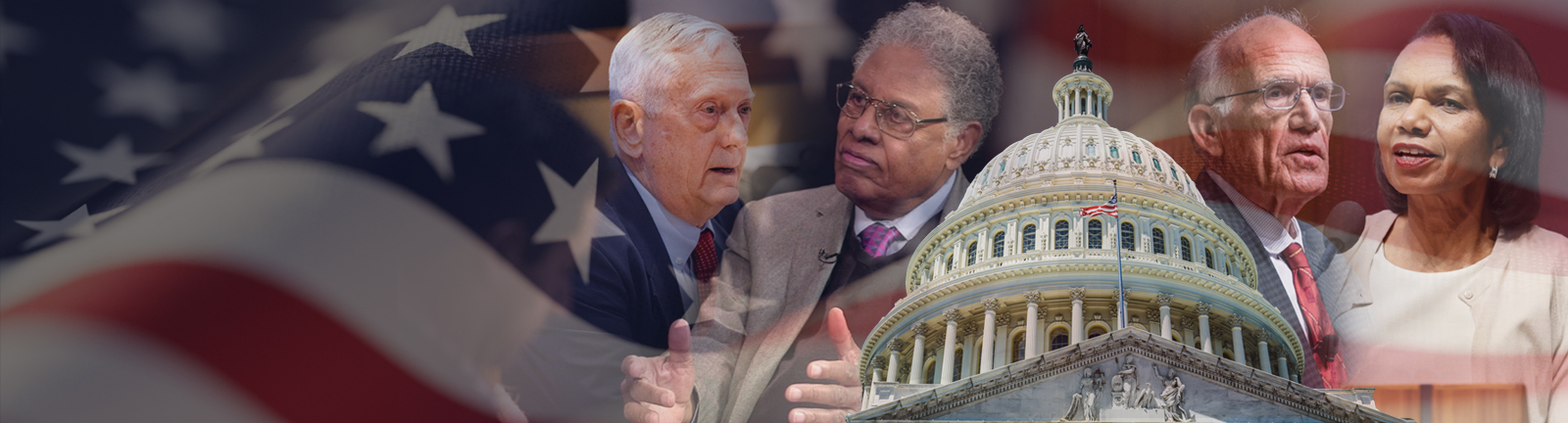
Yesterday, the Hoover Institution hosted an event with Federal Reserve Chair Jerome Powell, Director Condoleezza Rice, Senior Fellow Michael J. Boskin, and Distinguished Policy Fellow Peter M. Robinson on the legacy of former Secretary of State and Senior Fellow George P. Shultz, who served in the Nixon and Reagan administrations. Topics included the history of US monetary and fiscal policy, Shultz's work across different eras of American politics, and the value of public service. “He stuck to his principles while treating people with honesty and respect,” reflected Powell. “He was extraordinarily good at steering people toward agreement. . . . All those who aspired to serve can learn from his example.” The event was broadcast by C-SPAN. Watch here.
Law & Policy
What happens when 1970s-era defamation law collides with the internet, social media, and AI? In a new episode of Free Speech Unmuted, Senior Fellow Eugene Volokh and cohost Jane Bambauer are joined by University of Florida Law School legal scholar Lyrissa Lidsky to explore how the law of libel and slander is being rewritten for the digital age. The law professors discuss why the old line between libel and slander no longer makes sense; how Section 230 upended defamation doctrine; the future of New York Times v. Sullivan and related First Amendment doctrines; the idea of large libel models (or, when large language models meet libel law); and other speech law topics. Watch or listen here.
US Foreign Policy
In an essay published at his Blade of Perseus site, Senior Fellow Victor Davis Hanson responds to a number of trending questions concerning the war in Ukraine. “Putin is now in a 1967 Vietnam, no-good-choices dilemma,” says Hanson to the question of why the Russian autocrat continues his war despite a yearslong inability to take all, or even most, of Ukraine’s territory. Hanson also considers Russia’s nuclear saber-rattling, the question of Ukrainian corruption, and the broader geopolitics of Russia’s alignment with China. Ultimately, the classical historian writes, Ukraine is “a rare, militarily competent ally that can do a great deal of damage to America’s rivals and enemies. . . . No one has done more harm to our adversaries than have Ukraine and Israel.” Read more here.
Strengthening US-India Relations
Last month, the Hoover Institution’s Strengthening US-India Relations research program hosted the India Economic Policy Conference, bringing together leading experts, policymakers, and scholars to explore India’s evolving economic landscape. This full-day event provided a platform for invited participants to share their latest research and engage in focused, solution-oriented discussions. The session topics spanned a wide spectrum, including the effectiveness of major government programs; healthcare and education; environmental and energy policy; digital transformation; workforce development; political economy; and geopolitics. The conference aimed to identify and address the critical forces shaping India’s economic future within a rapidly changing global environment. Videos of two conference sessions are available at the links above and below. See the agenda and watch here.






Related Commentary