






- History
- International Affairs
- US
- US Foreign Policy
- Military
- The Presidency
- Revitalizing History
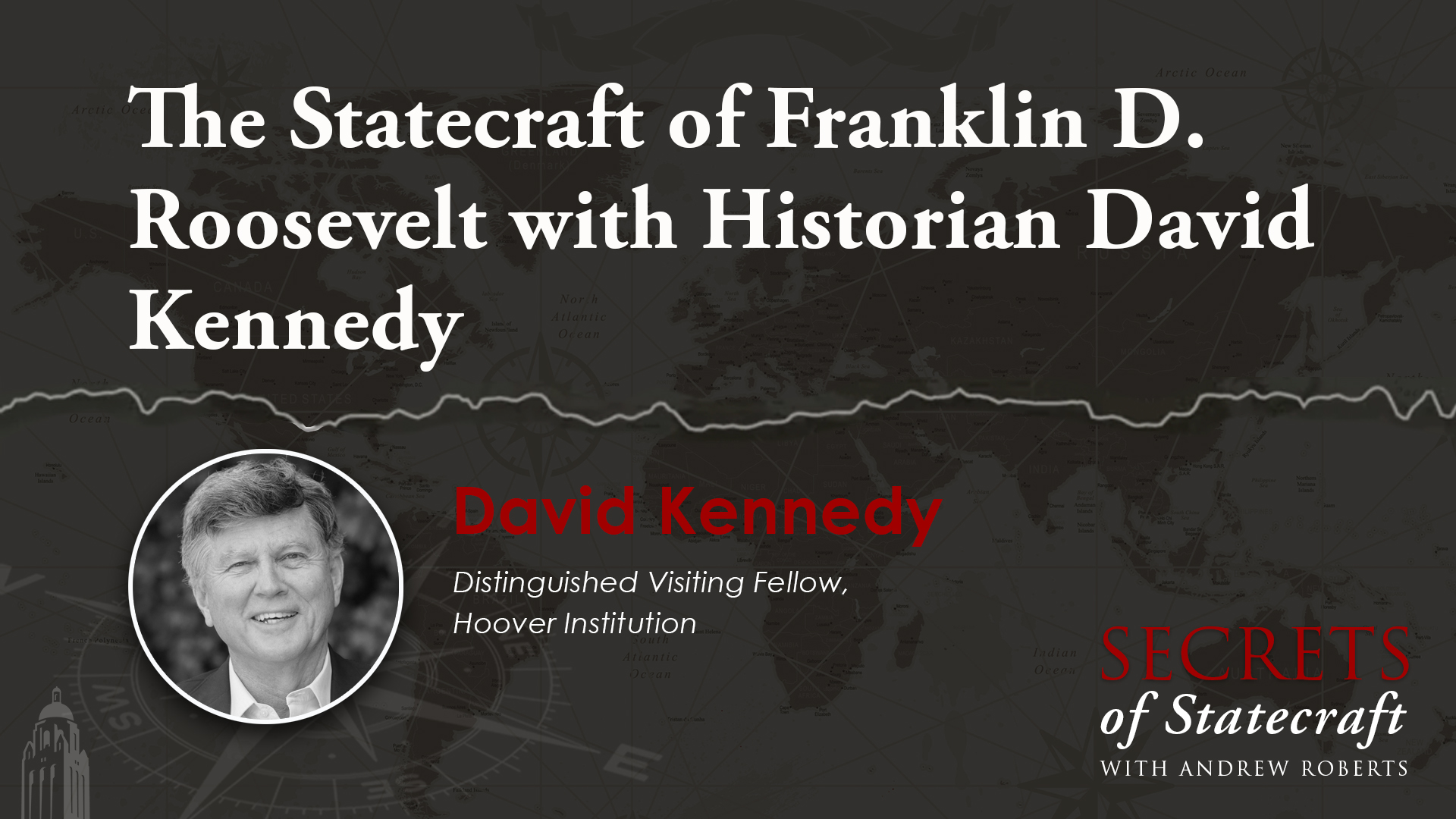
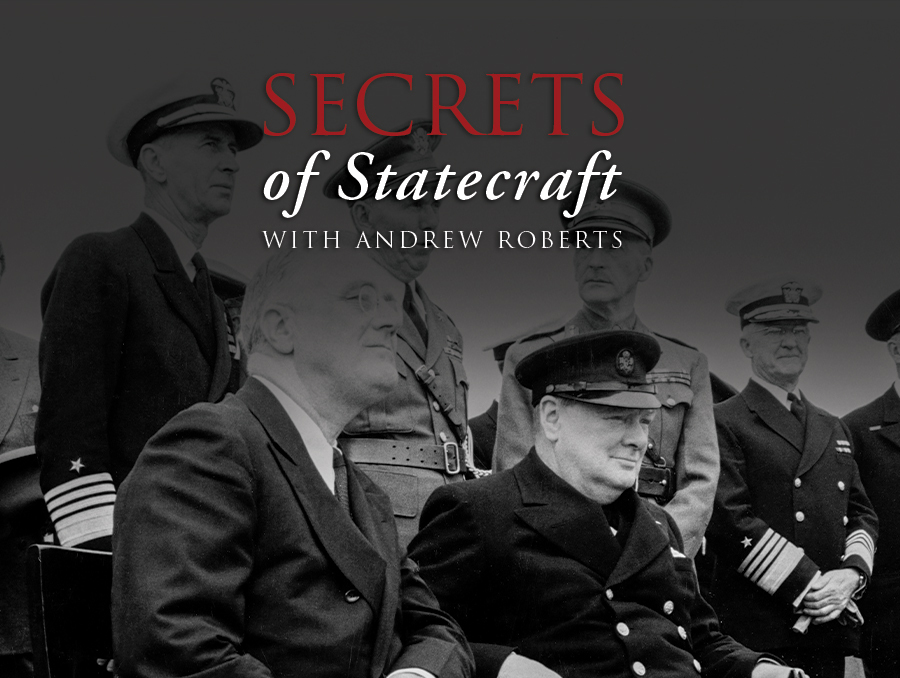
Historian David Kennedy looks at Franklin D. Roosevelt’s leadership by exploring how he guided the United States through the twin upheavals of the Great Depression and World War II. Kennedy explains how FDR reshaped federal power, responded to mass economic hardship, and slowly steered a largely isolationist nation toward global responsibility. The discussion highlights the weaknesses of the pre–New Deal government, Roosevelt’s innovative (and sometimes improvised) approach to rebuilding institutions, and the ongoing historical debates over what he was trying to achieve and how successful he really was. Overall, the exchange paints FDR as both a bold domestic reformer and a key architect of the postwar international system that defined American leadership for decades.
- David Kennedy is a professor of History emeritus at Stanford University and one of the world experts on President Franklin Delano Roosevelt. David, you got your BA here at Stanford in history and then your PhD in American Studies at Yale, and in the year 2000, you won a Pulitzer Prize for history for your excellent book, freedom From Fear, the American People in Depression and War. So you are pretty much the best person in the world to talk about Franklin d Roosevelt. And my first question is, where do you think he stands in the pantheon of American presidents? If we look at Lincoln and Washington and and the others, where, whereabouts is FDR, would you say?
- Well, my, my opinion or my answer to that question about Roosevelt's standing in the pantheon of American president is not idiosyncratic with me. He repeatedly shows up as the number one or two or three rank ranked one or two or three as the most consequential American presidents. And I think, you know, I often tell students that there are three moments in American history when if you understand their character and their depth, you understand a lot about the whole trajectory of this society through time. And one is the revolutionary and constitutional moment. The second is the Civil War and Reconstruction moment, and the third is the Great Depression of World War II moment. And all three of those episodes turns out, not coincidentally, each embraced a armed conflict as well as great upheaval at home. The basic character, you might even say, trajectory of the society's development was deeply inflicted. And it's not surprising, given the consequence of those three moments that the presidents who presided over each of them respectively show up repeatedly in these polls of historians and others as the most consequential presidents. So as George Washington, Abraham Lincoln, and Franklin Roosevelt. And we could probably quarrel at some length, debate at some length how to rank those three. But those three always show up consistently as among the most important. And they were also, you know, and this, I hesitate to put the discussion onto this plane, but they were also not only consequential, but they were, they were people of character. They were people of admirable human qualities. And they, I think they, they by and large led the country in a positive way. They, they did not, they did not trade on the politics of hatred and resentment the way some other national leaders have done here in elsewhere. But they were, again, not to put too fine a point on it visionaries about the the country's future. And I often argue with people, this argument has now got a little stale, frankly, but the, there was a view of Franklin Roosevelt that prevailed in some quarters for a long time, that he was an experimentalist and a pragmatist that he tried this and that and the other thing, whatever stuck to the wall became his policies. I think that's a view of him and his fundamentally mistaken. I think he had a vision, I use that word advisedly, of the, where he wanted to take American society. And you can find that vision articulated fairly well in his correspondence with his political associates and intimates and others in the 1920s before he became president. And he wanted a society in which there was more security. It's no accident. The word security appears in the single most durable, consequential piece of legislation from that period, the Social Security Act. And indeed, he, he presided over a lot of measures of the passage of a lot of measures that reduced risk in American life and risk of the unemploy, risk of unemployment risks associated with old age risks associated with investing, risks associated with home ownership, and so on and so on. And he succeeded largely in taking the society in that direction and creating a society in which, which was more inclusive and less risky for a lot of people. He said something at one point, I can't quote it exactly, but I could paraphrase it pretty well, something about he wanted to build a society in which no one was left out. And that that's a pretty fundamental idea for any leader to embrace. And I think he largely succeeded. And then if we turn to the international scene, again, the record is more muddled here because he was less articulate about this, but the war over which he presided as the American president created a world that was less risky. There's been no grand GE for three generations after World War ii, a whole set of new institutions that tried to bring a measure of order to the international system. These two are legacies of his leadership. And I think it's, it's quite legitimate and justified that he has this ranking as one of the three most consequential American presidents.
- And, and another way to rebut this idea that it was unplanned and, and he was experimental. W were the first a hundred days in office, weren't they? Where he brought in an extraordinary blizzard of, of new organizations and institutions.
- Well, I might argue with you on that point, Adam, be, if there's any moment in his presidency when the, the accusation of experimentalism and pragmatism might have some, some traction. It is that a hundred days. But the there, but there's a particular context there because the urgent question at that moment in early nine, the spring of 1933 was the counter punch to the depression, which it was at its absolute nature at that point, 13 million people, 25% of the workforce, unemployed banks closed, so on forth. Now, the idea was common that the, the entire economic system was fatally wounded and it might never recover. So there was a, and no one understood the causes of the Great Depression. As a matter of fact, people to this day debate what exactly drove that great economic calamity. And John Maynard Keynes did not yet publish this great work, tried to analyze that matter. That was several years later. So there was a lot of, of haphazard and eclectic experimenting, let's say in that first a hundred days. But the real consequential moment comes a year or two later, 1935 in particular, which in some ways is the Anes Monopolous of the New Deal at a Roosevelt's domestic legacy when you, we see the Social Security Act passed the, the, the full employment bill, so on and so forth. So it's, it takes a while for Roosevelt to really get past the urgent task of combating the depression. And down to what I think in his mind was the more serious task of leaving a legacy of institutional change that really altered the landscape of the American, of American society and the American economy.
- Did he save America from communism? If it gone ever gone wrong, if the Great Depression had got worse, worse, if his, his actions hadn't helped create the uplift, how bad could it have got?
- Well, again, I I tweak your question a little. Not only save the country from the possibility of communism, but the, the equal danger of fascism. And in fact, if you remember the famous open letter that John Maynard Keynes wrote to Roosevelt at the onset of his administration in 1933, and again, I'm paraphrasing, not quoting exactly, but Keynes said something to the effect that if, if Roosevelt did not prove to be a successful champion of rational and deliberate liberal reform, the the path would be open to extreme measures of another sort entirely. And he had in mind quite clearly either BOLs communism or fascism or Nazism. So tho those were quite different. But also twin dangers, you might say, if the, if the whole liberal democratic order proved unable to recover from the Depression and really set the society on a more stable path.
- And you had populists who were waiting in the, in the wings, didn't you, Huey Long might have been one that you could probably name some others.
- Yes, Huey Long Father Coghlan, I suppose would be yet another. And there were German buns and brown shirts in the United States. My own view, frankly, is that the, the idea that any of those people were imminently capable of pushing the country into a, a fascist or a communist pathway have been greatly exaggerated. In fact, one of the remarkable things that I discovered when I first started researching from fear was something that Roosevelt remarked on the campaign trail in 1932. And I found plenty of contemporary evidence to support this. Again, I'm paraphrasing, but he said something to the effect that this country is now facing the greatest challenge to its institutions and its stability since the Civil War. And yet the American people remain passive. They're not flooding into the piazzas of the country and demanding some kind of radical change. They're, they're grimly accepting this without really organizing any deliberate, deliberately focused alternative. And that, that struck me, and again, I found plenty of evidence to support that observation at the time. So I I, it, it was in 1933, the depths of the Depression, the best evidence we have is the American people were not psychologically on the precipice of being wooed by some kind of man on the white horse leader, whether he took them the direction to the left or the right. So I, when Sinclair Lewis wrote that famous book, it Can't Happen Here and later, Philip Roth wrote a book many years later, kind of the same effect. I read them both as hugely exaggerated, kind of almost operatic exaggerations of the real possibility of the United States going fascist in the 1930s that there were voices to have that tenor and that flavor. Yes, no, no question about it. But the best granular study, particularly of the long and clin movements by now, deceased Alan Brinkley, the book published some years ago, he proved to me conclusively that both of them commanded the most support when they were perceived as being aligned with Franklin Roosevelt. And to the extent that they were perceived as deviating from the direction that Roosevelt was trying to take the country, they lost support. So IIII just resist the idea that we were almost there and Roosevelt snatched us back from the brink.
- He was an American aristocrat, wasn't he, by background, had a strong sense of noble ob obliged. What, what drove him?
- Well, you know, again, it's a simple answer I think of what drove Roosevelt. This may sound kind of corny, but I think it captures something essential. He loved his country. People often ask me, particularly young people today in their cynical mood to say, why would anybody wanna go into public life or be a political leader or whatever kind? And I say, I think there's a simple answer to that. If you love your country, you wanna serve that way. And I think he had a lot of that deeply internalized in his family. You called it No bless ob oblig. I called a little bit different term, but same idea, an a an attitude Al Solicitude for his country. He, he, it's just, I think it was deep in his DNA, I don't think there was some or Paul on the road to Damascus moment. It's just the way he'd been raised and his family tradition of public service and his cousin Theodore Roosevelt had I think a lot of the same cultural orientation or political attitude. And we know that Franklin admired theor, even though they're from different parties and different political parties and different branches of the Roosevelt family. So again, in our cynical age, it's maybe hard to get our imaginations around the fact that someone would really devote himself lifelong to the improving the conditions of the society around you through political leadership. But I think it's as simple as that. In the last analysis,
- He came to power at much the same time as Adolf Hitler and, and died in the same month as Adolf Hitler. So it's, it's worthwhile asking about his, his fight against American isolationism and, and the America First movement and Lindeberg and and so on. To what extent was that something that developed over time or was it something that he saw as being a, a sort of central unwavering part of his, of his political being?
- Well, again, I think Roosevelt's record as an internationalist and as a proponent of a, a different role for the United States in the international system, and indeed a different architecture for the system as a whole, it's, it's, it's mixed in its evolutionary development. He starts out as an assistant secretary of the Navy in the Wilson administration. And Wilson of course, is in some ways the defining iconic American leader who first seriously proposed a pathway for the United States to play a more active international role. A lot of controversy about exactly what the character of that proposition was, but there he, there he is. But in his first inaugural address in 1933, Roosevelt essentially said, for the moment, international relations do not concern us because we have such serious problems here at home. And that's often been seized on by people who think that he at that moment had repudiated any kind of internationalist position. But I, again, I think it was a matter of priorities that as, as exactly as he said is, is for the moment we must concentrate on matters at home. But he wasn't abandoning the Wilsonian vision of a more active international role for this country. And indeed it, as the situation globally gets worse through the 1930s with the Japanese incursions in China and ment of Nazi Germany and born Ethiopia, Italian invasion, Ethiopia, and so on, he begins a process, you can date it roughly from 1935, again, I think it's a master class that he offers in presidential leadership trying to convince a largely isolationist public, public whose isolationism had in some ways been reinforced by disillusionment with the results of American intervention in World War I. He begins a years long effort to educate the public at large about the, the necessity and the, the legitimacy of the United States playing a more active international role. And it gets some roadblocks along the way there. It doesn't succeed right away at all. And it takes this a succession of events in the international system itself, not least of all more Japanese and Russian and Asia, the fall of France in particular in 1940, but also this consistent years long effort on Roosevelt's part to educate the public about the need for this country to put its weight in the scales to bring some measure or order of legitimacy to the international system.
- And when in December, 1941, the Germans declare war on America days after the Japanese have attacked America, one might have thought that the United States, the natural thing would be to deal with the people who actually had attacked the United States at Pearl Harbor, but instead the Roosevelt administration adopts the Germany first policy and, and puts the, by far, the greater amount of troops into the West rather than the east, which I've always thought of as the greatest act of statesmanship of the 20th century to adopt this Klaus Vian concept of of, of taking out the more powerful of the two enemies.
- Yeah.
- Would you go along with that?
- Absolutely, yes. Roosevelt himself, again, in his usual homely way, quite succinctly, put this great strategic principle as follows. He said, the defeat of Germany will mean the defeat of Japan, but the defeat of Japan will not mean the defeat of Germany. The Japanese aggression in Asia was, in many ways parasitic on the disruption of the European system, especially the colonial powers in Asia were hugely distracted and diminished in their capacity to control events in Asia. And it was Roosevelt agreed from the outset with the idea, or he himself put forward the idea that Germany was the number one strategic adversary and had to be dealt with first. There's an interesting byplay to this that comes up in some of these discussions in Roosevelt, pardon me, in Churchill's memoir, I forget exactly where, but he describes, Churchill describes for the reader, he was state of mind when he heard the news of the Pearl Harbor attack in December, 1941. And, and Churchill writes something like, so the United States was in after all into the neck and into the death, Churchill and rhetoric. And so I went to bed and, and England would survive, Britain would survive, and I went to bed and slept the sleep of the thi saved and the thankful. Well, strategically, that, that's an accurate description of Churchill's great objective is to bring the United States into the conflict at the side of Britain. No question. But as a description of what Churchill actually did in December, 1941, it's inaccurate because the first thing he did essentially was get himself to Washington DC as fast as he could, lived in the White House for a period of two weeks, I think in December of 1941, to make sure that the Americans were going to honor the Germany first principle. And he, he sensed, as you've just suggested, Andrew, that the, it was possible imaginable that the, the insult of the blow at Pearl Harbor and the thirst for revenge against Japan might be so overwhelming that the Roosevelt administration would hound off into the Pacific in a war of vengeance against the Japanese and abandon the Germany first principle. But Roosevelt again, and I I give him credit here for what you've just described as one of the great strategic decisions of the century, he was steadfast in his vision and a great strategic premise that Germany was the principle adversary, and we were not going to commit resources to the Pacific War that would distract from the European theater. Now, that changes a little bit, maybe more than a little bit after the battle of Midway, a few months after the Pearl Harbor attack, when the American forces sank a majority of the Japanese aircraft carrier fleet in a single day. And that opened the possibility of a more, what should I say, forward expeditionary, aggressive war in the Pacific on the United States part. So there was a slight revision of the original plan, and the original idea was to devote something on the order of 90% of American resources to the European Theater, and 10% on a, a purely defensive war in the Pacific after midway, that changes to 70% Europe, 30% Pacific. But the United States turned out to have such depth of resources that even that recalculation left a lot of material in both human and otherwise for the Principal Theater of War, which was the European Theater.
- Tell us about the personal relationship between Churchill and Roosevelt, as you say, he, after his sleeping the night, the sleeping, the, that, that night, the sleep of the saved and the thankful, he did go out to, to DC and started a, well, they'd already met of course, twice before, but this was the real time when they got to know one another properly. What, what was the relationship like?
- Well, I think it was cordial, but also somewhat cautious, especially on Roosevelt's side. And again, I think there's a lot of mythologizing about just how, how Boone companion, both the two of them were. They certainly got along in ways that are maybe a little bit remarkable, the annals of great state relations, but both were also quite calculating. And one interesting question that I tried to pursue a bit when I wrote about this never fully resolved is that what point does it become clear that Churchill, pardon me, Roosevelt, not Churchill is the senior partner, and I think Churchill is probably the senior partner up through the moment of the Cossab conference, when the unconditional surrender formula is declared and the invasion of Italy is agreed. And after that, Roosevelt becomes the superior partner.
- Well, Churchill doesn't even know about the unconditional surrender until, until FDR brings it out in, in the Casablanca conference. I mean, that's a, that's quite a key moment of, of sort of power play between the two, isn't
- It? I agree, and in some ways you can regard the unconditional surrender statement as a kind of a, what should I say, a constellation prize for Stalin now that the invasion of Italy has been agreed thanks to Churchill's dominance in the relationship. And the great worry was that the Soviets might either collapse under the Verma pressure in the Soviet Union or be so badly bloody that they would seek a negotiated settlement and leave the war. And that would make the whole situation of the Anglo-American Alliance much more dire. So the, there's another interesting moment. Go back to Pearl Harbor when Churchill is preparing to come to Washington DC and he tells somebody, it might have been Alexander Kagan, the foreign office person, I can't remember up to whom he was talking, but he said something to the effect, I'm going to go to Washington and make sure that those bloody Americans stick to their Germany first premise. And who, whoever his interlocutor was, said something like, well, isn't that a little harsh to speak to them that way? And you've been speaking to them so kindly and solicitously up till now. And he says, again, I'm paraphrasing, but I've got, I can quote this pretty exactly. He said, well, that's the way we talk to them when we were wooing them. Now that they're in the harem, we don't need to do that anymore. So he had his own calculating attitude about how to deal with the Americans and the, the, again, on Roosevelt's side, Roosevelt all was, I think, somewhat wary when, when they get to the first big three meeting at Tehran in 1943, Roosevelt's very first initiative is to have a private meeting with Stalin and exclude Churchill. And he, he deliberately kept Churchill outta that conversation. Churchill was quite upset about that. But again, as part of Roosevelt's determination not to be, especially at that moment in 1943, to be the, the creature of Churchill's strategic desires and to his own,
- And before by 1943, it's very clear that the United States is the arsenal of democracy, that the amount of sheer war material that is being poured out is hugely superior to that, the, the British Empire. And, and this obviously gives FDR the final say in things like the final decision over when to launch the cross channel attack.
- Yes. Again, as you well know, Churchill for understandable reasons, was very nervous about the possibility of success of the cross channel attack. There had been, he of course, remembered the fate of the British army. When it confronted Kaiser's German army at Pash Dale and so on, he remembered Gallipoli and the dup raid Churchill was understandably very, very worried that an amphibious invasion across the channel would not succeed in result of the kind of bloodshed that he witnessed in World War I. And again, this re this reflects or, or illustrates a longstanding strategic debate between the British and the American military, Rosa, pardon me, Eisenhower, in his diary, when the decision was made to invade North Africa, Eisenhower says, in 1942, Eisenhower wrote something like, this is the blackest day in American, the history of the American military, because we're gonna divert forces to a peripheral theater Africa, which has no real bearing on the event of the, the, the, the, the standing power of the Germans in their strategic heartland and the continent of Europe itself. Italy had a lot of the same character. And in fact, the, the Americans would refer to this, these initiatives in North Africa and Italy as periphery, pecking. And this, they thought this was the, the, the heart of Churchill's strategic concept of how to wage the war where the Americans were impatient to wage war the way they'd all learned at West Point for the previous several generations to build enough strength to take on the enemy's main strength and have one big decisive battle.
- And yet, FDR went along with Churchill and Alan Brook rather than with Eisenhower and General Marshall.
- Yes, because he, he really had nothing, no counterweight. The American force was so quite small American and military production was still just in it Mississippi stage. So he really didn't, did not have the, what should I say, the, the resources to effectively counter Churchill's strategic priorities. But by 1943, certainly by 1944, he surely did,
- Yes, absolutely by 1944. But in 1943, you hadn't won the Battle of the Atlantic and to launch a cross channel attack without being able to resupply would've been possibly suicidal in France. Yeah, yeah. Yelta, by the time of the Yalta conference, obviously FDR was was ill and failing physically. How was he mentally?
- Well, there's plenty of evidence that he was failing cognitively as well as physically well before the Alta Conference. A lot of anecdotal evidence. Now, well substantiated that at social gatherings, one kind dinner parties, let's say he would tell the same story 2, 3, 4 times in a row. I mean, the kind of signs of mental deterioration with which for now, many of us, all too familiar in our own contemporaries. So yes, he, he, he was diminished at Yalta and Yalta formalized certain arrangements that became politically highly controversial and mobilizable, especially by the Republican party in this country after the war. And again, my own personal view is that Yalta was not all that consequential. The, the really important dispositive decisions were ratified, not at Yalta, but at Tehran well over a year earlier. And that those decisions in turn were a consequence of the way this, the United States mobilized for the war. And let, let me dilate on that just for a moment. Again, I'll try not to overburden you or your listeners with too much detail here. But the, a decision was made in 1943 to scale back both the timetable and the, the, the depth of American mobilization. And it was agreed that the original target of mobilizing 215 divisions would be scaled back to the 90 divisions. This was called the 90 Division Gamble. Actually, this decision was made on October of 42, sorry, not 43. And to postpone the target date for D-Day from its original target of July 1st, 1943, to what becomes, as we all know, June 6th, 1944. So the, the United States made a very deliberate decision to betting on the fact that the, the Soviets would stay in the war. That's the premise of all this, that they could fight on a slower th table and with a lesser degree of mobilization than originally anticipated. So what did that mean? It meant necessarily, it was an absolutely inevitable, logical consequence of the decision to fight the war on this basis, that the Soviets were gonna carry a lot of the burden of the military conflict, and that the Red Army, so-called would be well into central and Eastern Europe at the war's conclusion. So go back to Tehran, that, that meeting, I mentioned this a moment ago, when the very first thing that Roosevelt does is have a meeting with Josephs, just the two of them. And there are two translators, and we have very good records of this meeting, almost verbatim records. The first thing that Roosevelt says to Churchill is, depart b to Stalin is, I know, again, I'm paraphrasing, I know that when this war ends, you, since you're bearing so much of the burden of fighting, you'll be well into Eastern and central Europe, and you'll be in control there. And that's just the logical consequence of the way we've decided to delay D-Day and mobilize a smaller force and so on and so forth. And th that, that's going to be your tar. Again, I'm paraphrasing that's gonna be your territory, but I hope you'll at least do me the favor of going, making some gestures at establishing democratic governments. And he, he, he explicitly said, he said, I have a lot of Polish voters in Chicago, and they'll need to know that their other country's interests are being protected. It was a cynical proposition, but, but it was the logical and necessary consequence of the timetable and the scope and scale and depth of American mobilization. So that, that's, it's, it's just, it's clear by the time of Tehran in 1943 that this is gonna be the case. So Yalta does nothing more essentially than officially recognize what were these consequences. So again, I've always thought that the focus on Yalta is mistaken, that the focus really ought to be, if you wanna focus on a meeting, it should be on Tehran. And what happens at Tehran, again, is the logical consequence of the decision made in late 1942 to take the 90 division gamble and keep a lot of the manpower that was originally targeted for conscription and mobilization deployment to keep them at home. So another consequence of this, and again, you, we could argue about the morality of it or the cynicism of it, but another consequence of this is that keeping 115 divisions of manpower at home that was originally destined to be in the battlefield, meant that the American economy could not only build the great war machine that supplied itself and the allies, but the American civilian sector of the economy grew during the war by we think 15%. That's not true of any other belligerent that fought the war for any length of time. The United States and the United States alone both created this gigantic military machine and also grew its civilian economy. And guess what? That the, the strength and health of that economy is what put the United States in the position in 1945 of originating and proposing institutions that would work to change the whole structure of the international economy and statecraft.
- So what you are saying essentially is that the revisionists who criticize FDR and also Churchill for essentially giving away the independence and integrity of places like Poland at Yelta, in fact, really this had already been agreed by the November of 1943 in the case of
- Ab, absolutely Teran is the place where it's official recognized.
- And of course in October, 1944, with the percentages agreement that Churchill drew up with, with Stalin at the Kremlin in, in the October of 1944, the criticism, and that makes perfect sense to me. And it also seems that the agreements with regard to where troops would, would stop in the, at the end of the war were agreed much, much earlier on as early as 1943 in some cases. But the, so, so basically the critique of modern day critique of FDR coming from, and Churchill indeed coming from the, from the right, especially the revisionist, right? People like Tucker Carlson and, and Darryl Cooper at the moment, who essentially try to put their own isolationist views, project them back into history as it as it were arguing that, that Churchill and Roosevelt made the war worse than it needed to have been. And also the criticisms that are made and have been made for, for decades now, about how many communists there were in the State Department, and Alger Hiss going to Yalta and Harry Dexter White and all of that kind of stuff. Basically your response to that is it's, it's ahistorical with regard to the isolationism and it's irrelevant with regard to Yar.
- That's, that's a terrifically good way to encapsulate my general arguments irrelevant with respect to all of that inconsequential with respect to the conduct of the war in general.
- What about the, what about the less sort of, in my view, irresponsible critiques that have been made of FDR at this period, the, the number of Jews who are allowed to come into the United States before the Second World War? We, we too in Britain, were, were keeping Jews outta Palestine, of course, in under the white paper of 1939. What do you, what's your response to the critique of FDR over that?
- Well, again, another terribly complicated matter, both in terms of historical policy and the record, and of course our moral judgment about the people involved, that there were well placed people in the, in American policy apparatus who were anti-Semitic, no question about it. My own view is that the, the, the story would not look a lot different if, if you could somehow revisit that equation and remove the antisemitic factor altogether. And I say that for a couple of reasons. Number one, the, the controlling legislation that Roosevelt had to work with in the 1924 National Origins Act, so-called, had no provision in it for refugees. It just, the language is not there. Nobody had envisioned a refugee crisis on the scale that the Holocaust eventually starts to create. So there, there was no legal channel for him to really substantially change the law or, or use the law, let's say that's number one. Number two, when the proposal was made to allow more refugees, especially from Germany and then Austria after the Oslos into the United States, unemployment was in this country, was still running at the 17 and 18% rate. And again, any, any country with that degree of unemployment that is asked to allow more dependent refugees in would naturally hesitate. I mean, that's number, that's number two. Number three, and this is a difficult point I think for a lot of people to grasp. It's difficult for me to articulate even. But at this date in the 1930s, even in the late 1930s, no one knew what the full godawful wholesale industrial strength Holocaust was going to be. And indeed, a lot of German Jews couldn't understand, couldn't foresee what awaited them in their, their fellow Jews in the future and, and refuse to leave Germany. And the Holocaust has really visited mostly on people to the east of Germany. And that, again, in my view, it's impossible to separate the full industrial strength holocaust after 1942 from the circumstances of the war. It's a product of the war, and there we are. Now, all that said, I, I go back and I've tried to convey this in the classroom many times. It's a difficult point to make and go back to the difficulty everybody had at that moment and just understanding the scale and depth and monstrosity of the moral crime that the Holocaust is and was. And there's a terrific moment. It's an, it's an anecdote, but it tells us volumes. I think when this guy young Karski, who's a Polish Gentile and a righteous person honored today, Yaba tells the, comes to the home of the Polish ambassador or government in exile Washington DC and tells Felix Frankfurter arguably the most prominent Jew in the United States at that time, Supreme Court justice, intimate friend of Franklin Roosevelt. He tells him what he's seen at, actually, it was at the departure station for the Holocaust death camp in Beza. And there's a, a recent play and movie with David Stra there called, remember this, which dramatizes this moment, powerful moment. So Kaki who has come across the Atlantic and escaped from Nazi doc occupied Germany, he'd been a Polish diplomat. He was multilingual, but he was afraid his Polish accent might give him away when he spoke German as he was making his way through Nazi occupied Europe. So he pulled a couple of his molars out so his face would swell to mask his accent. And that's how he got to the United States. And he tells the story, and there's this tremendously dramatic moment when Frankfurt, after he is heard Skee tell about what's happening, and he death, cancer. And he says, I cannot believe you. And the Polish ambassador says, Mr. Justice Frankfurt, this young man has come here, great personal sacrifice and risk nearly lost his life. He's mutilated himself to, to actually get here. And you ca cannot call him a liar. And Frankfurter says, I did not call this young man a liar. I said, I cannot believe it. There is a difference. Well, that reminds us of something. Why, why do we have Holocaust memorials and museums and plays and movies and so on about it today, we still can't fully understand the depravity that made that Bos press crime happen. And contemporaries, again, this make a distinction here between knowledge and understanding. They might have known some facts about it, but I think fully understanding just what they were looking at was difficult. Frankfurter, that that response he gave Karski to me makes the point. So that's all in the background, I think, to this whole question of Roosevelt and the Holocaust and the fate of U European jewelry. And again, I think we need to make two important distinctions here. One is the phase of Amer, the pre-war phase, the 1930s down to 1939 when the question is about refugees. And turns out, in fact, the United States took in more refugees than any other country, about 150,000 all told. And then there's a second phase, a very distinct phase that's wartime when the question is then not about refugees, but about rescue. And let's remember that the death camps are deep into, in central Europe, in Poland of Ukraine and so on. And we didn't land a troop on the, on the main body of the European continent, Italy accepted until 1944 and the war's over 11 months later. So neither this country nor any other western country really had the means to conduct a large scale rescue operation until the war's conclusion. So again, it's a complicated story, and I don't wanna be understood as making excuses for the Roosevelt administration. I think once they created the, the war refugee board in 19 early 1944, the, the administration took some positive actions, particularly with respect to Hungarian Jews. They sponsored Raul Wallenberg to go and hand out fake birth certificates and passports and so on. Cardinal Spelman broadcast into Hungary saying that any, any Catholic Hungarian who participated in the export of Jews to Auschwitz was committing mortal sin. So there were significant efforts too late, you might say, to really have been consequential. But as circumstances permitted, it seems to me there, there were some positive efforts.
- Another, another critique of, of his administration is, of course, the internment of the Japanese after Pearl Harbor. We, in Britain, in turns a great deal of large number of Germans and, and Austrians in the, even though Churchill considered it in the highest degree, odious, but considered it to be an absolute necessity on grounds of national security. What, what do you think is the, is the sort of present day view of the Japanese internment?
- Well, I, I think the present day view actually is consistent with the contemporary view of a lot of people. This was a shameful and odious and unconstitutional thing to do. And again, this make a distinction between people who are designated as enemy aliens, that they're citizens of a country with which this or any other country is at war and American citizens. And from the moment that that executive order came down, people as consequential as Secretary of War, Henry Stimson said, this is going to blow a great hole in our constitution. And there was great discomfort and unease about it right from the beginning. When Milton Eisenhower is appointed the first director of the Japanese relocation program, he very quickly, within weeks or months, he said he couldn't sleep at night given the job that he had. And he gave it up and he handed it to his successor man named Dylan. And he said, I hope you are able to deal with this. I can't take it any longer. So they, they right from the beginning, a lot of people were disillusioned with this. That's a complicated story again, but the, the, I must say the there people in the American military, especially the general in charge of the West coast, western military district, guy name dewitt, they, they deliberately falsified records to justify what they had done and the evacuation order so-called. So it remains a shameful episode, but to explain it simply on the grounds of some kind of reflexive anti-Japanese prejudice, I think is just far too simple. It's a much more complicated story than that.
- He was a good chooser of, of people, wasn't he FTO of a good delegator? He, he had a good eye for talented people. We've already mentioned Frank Ter and Marshall and Eisenhower, but one might add Harold Dickies and Brandeis and others, you know, he was somebody who who could spot a, a talented person to delegate to. Is that a fair, fair appreciation of him?
- Yeah, I think that's absolutely correct. And again, another index of that, or a way to kind of confirm your instinct about it is to think of the people that stayed in his cabinet for long periods of time. Again, unlike a lot of recent administrations of both parties, there was not a big shuffle of people. Harold Dickies was there the entire time at interior. Henry Morgenthau, the treasury was there through the whole thing. Secretary of Labor was there through the whole administration. So yes, I think he, he chose wisely as associates and subordinates supported them. And they reciprocated by giving loyal service over a decade and more, which is quite unusual in the analysts of American public service at that level.
- How important was Eleanor in his, in his, in his administration as opposed to his life? Or both actually, why not?
- Well, the, his administration and his life were partly separate matters, but
- Yeah, - Yeah, in fact, he once has once been, it was said of him, of Roosevelt, of his conception of the presidency when he thought about it in some conceptual or abstract way, was an image of himself in it. So, so, so there's no question that Eleanor was, in some ways had a more sensitive social conscience than he did, and was more outspoken about a lot of things having to do, especially with race relations than he felt comfortable doing publicly remains a bit of a mystery, whether in private he shared her views entirely or not, but she's on the public record as a, a more sensitive, moral conscious than he was about a lot of matters. That said, and go back to the distinction you made between his life and his administration. There's, there's less really compelling evidence about how often or how effectively she really shaped the course of policy. Is not, is not a zero debt, that calculation is not zero. But I, I'm not sure exactly what value to put on it, but yeah, she, she was an extraordinary person in her own right. They just can't argue with that. She's not just a first lady, she's just a in in her own person, her own right, a consequential historical figure.
- And his polio, his disability. How, how important was that?
- Well, again, he, he's stricken with polio when he is in his thirties, early 1920s. I go back to a a, an or a Ober dictum or whatever, an observation of William James, the great philosopher and, and the father of the discipline of psychology in this country. And he said something to the effect that every man's, he said, man could, she could have said person, every person's character is cast in plaster by the age of 30. Now modern day psychologists and geneticists and so on probably push that day way further back. The Jesuits used to say that if they could educate a boy beginning at age seven, they could control his development to manhood. Freud and people like Stephen Pinker today think it's all happens in utero, and we're hardwired in certain ways before we ever even take our first breath. So though a lot of people had tried to make something out of the Roosevelt's episode with polio as changing his essential character, I don't think that's the case. I think his, his essential character was established well before that. It was a trial he overcame. I don't think it somehow made a different person out of him. It just demonstrated the, the depth and resolve of the character he already had.
- Yes, his, his sort of inner resilience was something that was, was already there. Yeah, that makes sense. What, what history book or or biography are you reading at the moment? David?
- David? Well, Andrew, it probably comes as no surprise to you. 'cause I have a hunch that you have the same bad habit, but then I'm reading several things simultaneously.
- Yeah, yeah,
- I know what you mean. It it is, I lack the discipline to finish one before I start the other.
- Alright, well, you're not allowed to have too many give give us two. What are you, what are you reading? Think?
- Well, I did just finish Hal Brand's book, what what uses Grand Strategy, which is a, it's consists of four case studies of administrations beginning with Truman and through Reagan and Bush even, and what grand strategic architecture they use to drive policy or control policy. A a very granular study of those four episodes and one's very thought provoking about what do we mean by grand strategy? Is it really dispositive or dis notional? So then I found that a very interesting read. I'm reading a book by a, a Brit Jonathan Sump, a jurist and political philosopher of sorts about the, the character of mass democracy. I find that very provocative. He has some very almost heretical things to say. He raises the prospect, which I've raised more cautiously in other contexts. Very, very unorthodox question. Is there such a thing as too much democracy? That democracy, it's the, the excesses of democracy can be highly consequential for the problems of democracy. So I'm reading those two now. I'm about to start Robert Mary's biography of and President James Polk. And so that, that's what's on my list right now. I'll tell you, let I, I wanna take the opportunity to insert something here. Probably the most interesting thought provoking and well-crafted work of history that I've read in recent years. I read this a couple of years ago now, but it just came up again in another context. There's a book by a historian at NYU Nicole tis, the book is called Covered with Knight, and it's about a murder on the Pennsylvania frontier in the seven early 18th century. And the book is about how native peoples and the British colonial authorities brought to the situation two completely different concepts of justice as they tried to deal with the perpetrators. There's no question of who the perpetrators were and that they committed the murder. The British wanted to assert their sovereign authority by trying and executing these people. And the native people said, that's not our conception of justice. We want to get them those murderers reintegrated into the community in a productive way, wholly different concepts of what he meant by justice. It's a beautifully written book, and it's one of the most impactful thought provoking things I've read in recent years
- Covered
- By knight. Covered, covered with Night, I think is with Knight, one of the other, with Knight. That phrase comes from the Indian expression for what happened to the community when a murder was committed, that the community was covered with darkness.
- Tell me about your, what if your, your counterfactual?
- Well, you know, probably my favorite what if goes back to something we were discussing a little bit earlier, and it, it is the American decision. And it was a decision in very late 1941, November, as late as November, 1941, just days before Pearl Harper not to seek a so-called modus of ndi or some kind of stand down with the Japanese. This was an active proposal. Some very consequential, well-situated people like Joseph Gru, the US Ambassador in Tokyo proposed it, and Roosevelt seriously entertained it as late as the last week of November, 1941, that we would resume certain critical shipments to Japan in return for a promise by the Japanese to undertake no further aggression outside of China. But they wanted a free hand in China. And that was the thing we finally couldn't accept, but had thinking through the consequences, had the United States and Japan reached some kind of a crucial settlement in late 1941. No Pearl Harbor, no Pacific War, a hundred percent of American resources devoted to the European theater. A hundred percent.
- Yeah, but does, but does hit Hitler doesn't declare war in America on the 11th of December, 1941 absent Pearl Harbor.
- Well, again, why, why Hitler did that, as you well know, remains something of a mystery. Several people have addressed that question without, to me coming up with a satisfactory answer. But whether he did that or not, the United States could then devote all of its resources to the European Theater. If there's no Japanese or Pacific War, and think of the consequences of that, then, then it's conceivable it, the original timetable for D-Day might have held July of 1943, by which time the Red Army is not yet into Poland, or barely into Poland. So then the, the, the history of post-war Europe looks, looks very, very different. And then Germany defeated is Germany defeated then the United States and Britain, let's say, and maybe even the Soviet Union turn their attention to the Japanese theater and, and impose their will on the Japanese at that point when they have overwhelming strength. So you get a wholly different end of war scenario, and then you get a wholly different initial period of the so-called Cold War and the Tehran and the also agreements look like the would never have happened.
- Yeah. So it, the, it all comes down to that oil embargo that, that FDR slapped on, on, on Japan. Good. Well, I, I, I'm, I I hope that you are right, that he could have that FDR could have defeated isolationism sometime at that point from November
- 19. Well, I think he already had, when he got passage of the Lendlease Act in the spring of 19 41, 7. It's a huge
- Difference giving us arms and sending millions of Americans abroad though
- Shortly. But it was a 7 billion appropriation that's larger than every single one of the new deal budgets. With one, one single exception Hitler said, this is tantamount to a declaration of war. And he was right.
- And, and Churchill called it the most unsorted act, which, which it most certainly was. Thank you very much indeed, David Kennedy for appearing on Secrets of Statecraft. Thank you, Andrew l it was a pleasure talking with you. Thank you, David. My next guest on Secrets of Statecraft is Richard Horowitz, the publisher of the Octavian Report and author of In the Garden of the Righteous, the Heroes Who Risk Their Lives During the Holocaust.
- This podcast is a production of the Hoover Institution, where we generate and promote ideas advancing freedom. For more information about our work, to hear more of our podcasts or view our video content, please visit hoover.org.

