












- Education
- International Affairs
- Security & Defense
- US Defense
- US Foreign Policy
- Determining America's Role in the World
- Reforming Education
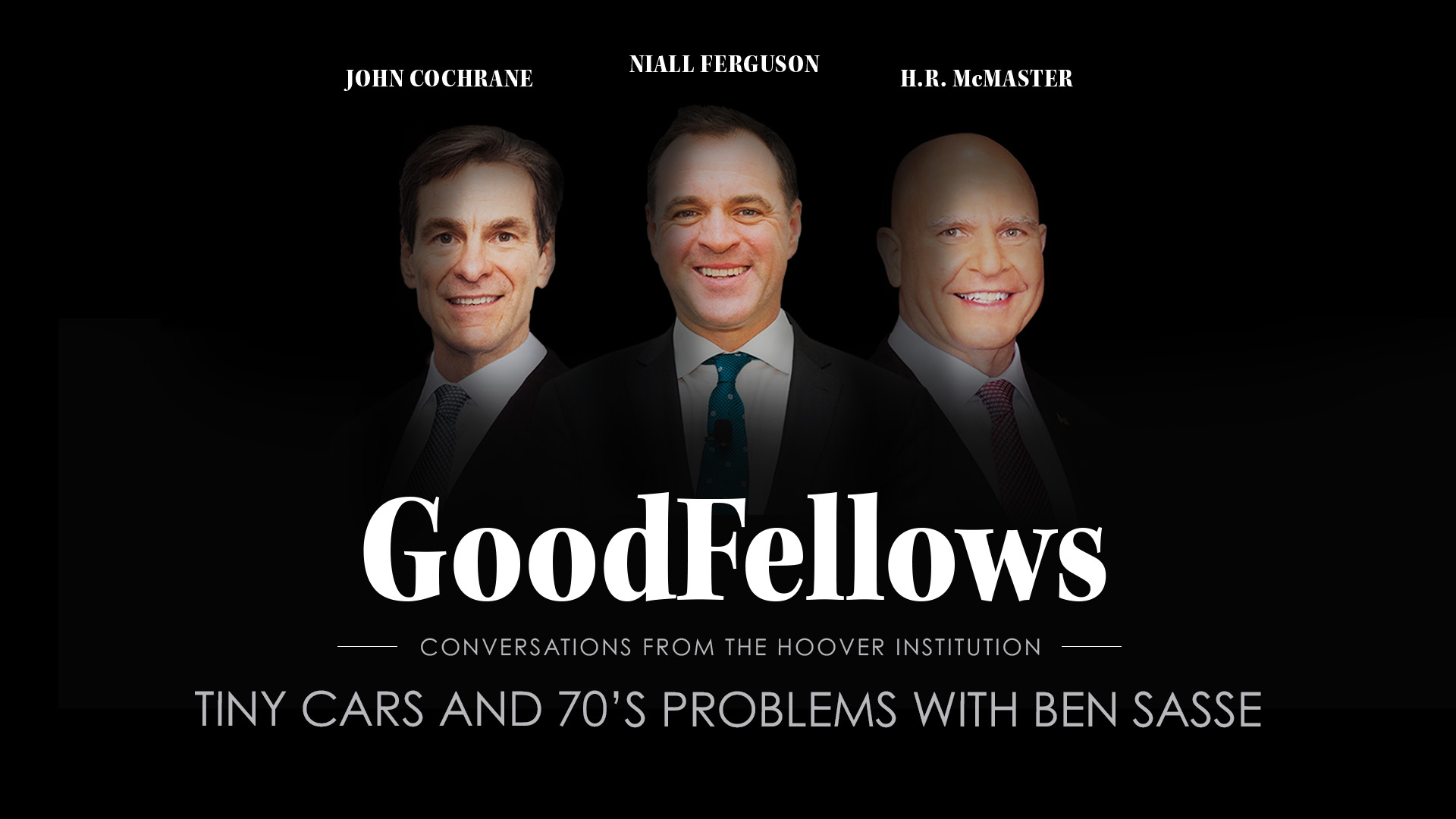
Two institutional sectors are in both steady and rapid decline in terms of public trust: Congress and academia. Ben Sasse, former US senator from Nebraska and president of two universities, joins GoodFellows regulars Niall Ferguson, John Cochrane, and H.R. McMaster to discuss what ails Congress and how to fix it (based on his eight years in the Senate), plus how America’s educational system has set a low bar for readying students for higher learning and life after college.
Next the three fellows weigh the merits of the Trump administration’s new National Security Strategy and what strategy there is (or isn’t) regarding Venezuela and drug trafficking; the shortcomings of fuel-efficiency standards; whether they’d buy an American-made “tiny car” (no way, says our resident former tank driver); and, with the World Cup coming to America in 2026, how to clear up the confusion between US-brand “football” and the international “beautiful game” that goes by the same name (Sir Niall’s solution: Change US football to “armored rugby”).
Recorded on December 8, 2025.
- It is Monday, December 8th, 2025. And welcome back to GoodFellows, a Hoover Institution broadcast, examining history, economics, and geopolitics. I'm Bill Whalen, I'm a distinguished policy fellow here at the Hoover Institution, and I'll be the moderator today of a conversation featuring the three of my colleagues we refer to as the GoodFellows. I'm talking, of course, about the historian, Sir Niall Ferguson, the economist, John Cochrane, and Former Presidential National Security Advisor, Lieutenant General H.R. McMaster. Niall, John, and H.R. are Hoover Senior Fellows. So gentlemen, good to see you. And before we get off the show, I have a sartorial question to ask the three of you. Last time we were on this show, the three of you were in coats and ties. I was not, I felt ashamed. I made a point to wear a coat and tie. Brother Cochrane's wearing a coat and tie. We shamed H.R. into wearing a coat and tie. But here's Sir Niall's sans coat and tie. So can we get a GoodFellows' dress policy here once and for all?
- My policy is variety is the spice of life.
- And you know, hey, how, what the colonials, the colonials are, you know, are dressing up more than, you know. And Sir Niall, I mean, come on.
- It's a context. The last show I was in London and I'd been doing very Londony things. So I was in town, and in town I wear a suit and tie and black polished shoes. The day you find me in my study at home in the country, that would be very unusual to put a tie on in that setting. So I think one just has to adopt horses for courses as they say over here.
- John, what do you think?
- Well, I'm in Silicon Valley, so I'll go get my black turtleneck.
- Well we're joined today by someone who is also not wearing a tie, but we're honored to have him nonetheless, he's here to talk about the sad state of Congress and the dubious question of higher education in America. He's uniquely in a position about this because he has experience with both institutions. Joining us today, making his Goodfellow's debut is former Senator Ben Sasse. In addition to representing the great state of Nebraska for eight years, the United States Senate, Senator Sasse also has served as the president of University of Florida and Midland University, which is a private college in Fremont, Nebraska. He's the author of two books, "The Vanishing American Adult." What he sees is a crisis of prolonged adolescence in the United States. If you go on YouTube, you'll find a Uncommon Knowledge episode with Peter Robinson where Senator Sasse talks about this. His other book is titled "Them, Why We Hate Each Other and How to Heal." His contention is that the problem in today's society isn't so much divisive politics as it is loneliness and the need to rediscover roots and build human to human relationships. Ben Sasse joins us today to talk about what ails Congress and how to revitalize that branch of government. And based on his experience running universities, we want to hear his thoughts on how to improve higher education. Senator Sasse, this is a long overdue. Welcome to GoodFellows.
- Bill, thanks for having me and GoodFellows, good to be with all of you. I am very sorry that I did not get the tie memo. I wouldn't have followed Niall's lead on this had I known I could have chosen the other guys.
- I think one of the beauties of leading the Senate is you can leave the tie behind you when you do that, Senator. So let's get right to it. So one month from today, January 8th is the three year anniversary of you going to the well of the Senate and delivering farewell remarks. And in those remarks you said, and I quote.
- Senators, colleagues and friends, each of us knows that this institution doesn't work very well right now.
- So here we are nearly three years later. Senator, when you look at today's Congress, what about the institution? Is it about the same, is it better or is it worse?
- Well, let me just start by saying thanks for having me. I'm a long time listener and fan, so I'm glad to get to be with you, Bill, you were inaccurate though you said when I was coming here because I wanted to talk about Congress, you invited me on, then later you guys slid the Congress topic in. I would've declined, I try to not talk all that much about that topic, but I guess from the vantage point of history, I'm the poor man's historian on the podcast. But from the vantage point of history, I think our founders would be super confused about how the Congress functions today because they thought that the three branches would check and balance one another because there would be so much ambition inside the branches. And I obviously am very critical of Article 2 overreach, but I think the more fundamental issue of our time is Article 1, underreach, the Congress isn't very ambitious. The Congress doesn't want to do very much. And so the executive branch fills a lot of that vacuum. Obviously that's partly uniquely the individual who serves as chief executive right now. But I think there's a more fundamental problem, which is that the Congress is a job a lot of people would like to get and stay in and therefore they don't wanna make anybody mad. I think America's a lot healthier if following Washington's, you know, farewell address. People really want to be from the places they're from and they go and serve for a time in Washington DC but they don't regard that as the center of the world. But while they're there, they'd like to actually exercise some power. And right now the Congress doesn't really want any power.
- Well, I can ask. So we're gonna make you talk about this 'cause you know about it and we don't. As an economist, I often point to the rules of the game when something's not going well. And I'm curious if you see rules of the game that are obvious. I mean, on the agenda is the whole question of the filibuster, which isn't in the constitution, but has seemed in the past like a useful protection of minority rights. So we don't, you know, our founders did not envision 51% shove it down their throats, that's the end of that. Also, the decline of political parties seems to be important. Everybody is now a YouTube star, at least so it goes. Parties, you know, originally we didn't have open primaries, so, you know, maybe going back to parties pick their candidates with a view to the general election rather than being granted that, I dunno, what are the other, what are the top five ways to fix the, just the rules of the game that you have in mind that might make this a more functional institution?
- Yes, I think you, John, you name a bunch of 'em. Let's pull on a thread a little bit more about your YouTube star aside. A lot of people seem like they want to use the Congress as a way to get on to the more important work of punditry. And it's a strange thing to have cameras everywhere because deal making really doesn't happen. The committees that I was most active on in the Senate were intel, finance and judiciary. Judiciary is just a craptacular show for TikTok or YouTube every day. The intel committee works really, really well. Some of why it works is the subject matter and the people who are willing to put in the time and the homework required to serve well in the intel community and doing oversight of the IC. But I think one of the fundamental reasons why intel works so much better than almost all other committees is 'cause we don't have cameras. So we meet in a skiff and there's really no reason to grandstand for a soundbite. Nobody gives a five minute speech masquerading as a question and then as time runs out asks some question, you say, Director Burns, who was the last CIA chief when I was there, you just said X, but I kind of thought Y, and how does that make any sense in our long term geopolitical fight against the CCP? Like you get a lot of questions that are 12 seconds long that are a real question. I don't understand that, explain it to me. Nobody does that in a public hearing because you don't want the soundbite to make you look stupid. But on a lot of things when you're conducting an oversight hearing you as the member know the least, you're representative of the people. But having cameras there is super distorting. Social media, it's easy to blame everything on social media, but a huge part of why the Congress doesn't work right now is 'cause we haven't gotten to a information ecosystem yet that makes sense in a world where people are living for constant sound bites.
- Hey Ben, we were just together at the Reagan Defense Forum, you know, and remember how they showed up, showed that chart about confidence in institutions what the trend has been. And you know, Congress is at the bottom. So this kind of performative over formative approach that Congress is taking, it's not working. So it's, you know, in terms of overall confidence in the institution, what do you think it is a path to regain confidence of the American people in government? 'Cause it's pretty damn important I think because of that lack of confidence in our institutions, I think great space for our adversaries and diminishes our ability to compete effectively internationally as well.
- Yeah, great point, before we get to the specifics on the decline of trust and why Congress is kind of at the bottom of a larger declining trust metric across all institutions. Let's just focus for a minute on being together at the Reagan Defense Forum. I thought it was really amazing that you were willing to go shirtless, do that whole event and both bench press and deadlift and I just wanna say H.R. general, you still got game and it was really impressive what you pulled off in Simi Valley. Back to trust, there are 10 sectors of the economy that Pew and Gallup have been studying on a decade by decade basis since somewhere between the 1930s and the 1950s. In nine of the 10 sectors, we have four consecutive decades of declining trust in the public's view of those sectors. So academia, the judiciary, Congress, federal bureaucracy, Hollywood, corporate America, the only of the 10 sectors that doesn't have four consecutive decades of declining trust is the military, roughly flat. But nine of the other 10 sectors are declining. So I think we need to make sense of that in general before we talk particularly or think particularly about why Congress is the worst. Actually Congress is only second worst right now. Higher ed has the most rapidly declining public trust over the last 12 to 15 years. But Congress and higher ed are declining really rapidly. I think social media is a big part of it, but what social media really does is it allows a lot more information to bounce around from the periphery back to the center or up to governing institutions. And it turns out a lot of people that fake expertise don't really have a lot of expertise. And we've seen this in the declining trust in public health institutions since COVID. There's obviously a lot that happens that's people grandstanding on social media and wanting to undermine trust, but it's also the case that public health institutions didn't conduct themselves very well. And so it turns out when you get a, have a microscopic look at a lot of institutions, it turns out more humility was required from those institutions. And so when you think about congress from 19, I'm making these numbers up, I'm sort of racking my brain to get 'em, from 1952 until 2006, I think change of control and the house happened one time, the Gingrich Revolution of 1994. And basically over the last 20 years, from 2006 to the present, almost every midterm election, the non-executive branch party tends to gain a lot of seats in Congress and the majorities in the Congress go away. And so we have this yo-yo swing constantly now where the Congress is turning over every four or six or eight years where it used to happen only once per half century. I think a lot of that is about the information economy we live in or ecosystem we live in. But a lot of it's about the fact that Congress hasn't done its work well, I'll just say one factual item here. The Budget Control Act was passed I think in 1974. So after Watergate and after the sort of, I forget what the term was, I'm forgetting the technical term. When Nixon didn't want to spend funds that had been appropriated.
- Impoundment crisis.
- Impoundment process, thank you, so we ended up with a new Budget Control Act in 1974. It worked for three or four years. Since 1978 Congress, which I was born in 1972, so I can do the math, for over a 47 year period, I think Congress has spent more than a third of the budget through regular order only four times in 47 years. One of the most fundamental purposes of the Congress is to say, what do we spend the people's money on this year? And probably we should have learned something from last year. Instead what we do is we get to September 30th or September 27th every year, the end of the fiscal year, and people say, oh crap, the government's about to shut down. What should we do, should we fund it at 0% of last year's level or 102% of last year's level? No organization, no bait shop in Nebraska, no large corporation ever operates like the way to spend money is exactly what we did last year, plus a little bit in every category undifferentiated, or let's shut it down and spend zero. Healthy people would say, some things worked really well, the ROI on that was high, let's spend 2x of what we spent last year and some things didn't work that well, let's cut it by 30%. And we don't have an appropriations process that works. And so it turns out the public doesn't have a lot of confidence in the people who don't have a process that works.
- I'm so glad you brought up the 1970s then, because it strikes me that the structural problem in the American system of government can be traced back to that decade. Chris DeMuth wrote a terrific article some years ago, you may know it on the rise of the administrative state. And his argument was that it's really in the 70s that Congress starts to allow power to be handed to agencies beginning with the EPA. And it goes from there until there are so many agencies you can't count them. And I think it takes the public a while to realize that instead of the 70s being a time when Congress asserted its power, which it appeared to over Watergate. In reality, the 70s were a decade when Congress stopped functioning as the founders had intended. And you've hit the nail on the head, a representative assembly that can't do the budget is fundamentally broken. It is not doing the core function of such a representative assembly. Now the problem is how do you fix that? John came up with a bunch of suggestions at the beginning, but I don't think any one of them or even all of them together would put Congress back into the position that it should be in. Here's a classic example. It's incredible that the Trump administration has been imposing tariffs willy-nilly in an entirely arbitrary way when the Constitution says absolutely clearly, unambiguously, that's the job of Congress. And we haven't heard a squeak from certainly Republican legislators about this pretty clear violation of constitutional order. Is that fundamental problem fixable or is the impossibility to fix it, the reason that you quit?
- Man, there's a lot there, we need whiskey. It's still before noon on a Monday. And so I don't want us to get to a place. I think you just pounded some sort of straight shot caffeine, that feels unfair. I don't want to get to a place where we're just hand wringing and we say, oh, we've identified six or eight great problems and we can't solve any of them, but let's keep going deeper into the problem or ask for a minute. So first I'll agree with you about the 70s and the Congress's appearance of reasserting Article 1, counterbalancing on Article 2, where really they tried to create an Article 4 branch, which was unaccountable to either Article 1, Article 2. We happen to be convening today at a time when the Supreme Court is hearing some questions about executive power and about a unitary executive branch. I do think it's right and proper in a constitutional system to have three, not four branches of government. I also think it'd be really healthy if the Article 2 branch was humble about the fact that they shouldn't be making every decision on a short-term political basis so you can tweet about it. So in general, I wanna see Article 4, the administrative state, not really Article 4, branch four cabined back, but I'd like it to be done by an executive branch that's humble about how you do a small number of things really well and try to get the American people to trust you about them. I also think in addition to that 70s problem. In the 70s we realized that the 1960s calculations about the expansion of the entitlement state didn't work and Congress started abdicating more and more responsibility. So obviously the welfare state as we know it stems from the Social Security Act and from certain sort of unemployment programs from the 1930s. But the thing that will bankrupt us is Medicare. And so it's in 1965 that LBJ in a, you know, torrent of legislation passed over a 24 month period after JFK's assassination passes Medicare as the most massive expansion of the entitlement state. And I think we should probably go full budget nerd, though it's dangerous to do it in front of Professor Cochrane 'cause he can correct all of the things that I'm gonna get wrong here. But I tried to tell my constituents in Nebraska that the way I approach the budget is in three giant buckets. There are entitlements, there is non-entitlement defense spending and there's non-defense, non-entitlement spending, which is what's really discretionary spending. And once upon a time we understood that the United States government, or the budget of the US government is a giant army or a necessary army that also has a few social safety net programs. Over time, the budget has become a giant insurance company that just happens to own a Navy on the side, right? We're at about 71% autopilot in the budget. If you take Medicare, Medicaid, Obamacare, social security and interest on the debt, those entitlement programs where there aren't specific decisions made by the Congress every year are more than 70% of all spending. Less than 30% is discretionary. And the lesser half of that less than 30% is national security, which is the fundamental thing that created a constitutional system for us. The reason we had to have the Constitution after the Articles of Confederation is because of problems around the currency and paying debts from the Revolutionary War and the ability to have a consolidated foreign policy of the 13 colonies. So the reason we went, the Constitution is a very, very, very limited document about enumerated powers, but it's a more powerful central government than you had in the Articles of Confederation because we needed a national security team, we needed a national security consolidated vision, plan, policy and budget. And right now, that's a rounding error on the budget. It's entitlements that are gonna bankrupt us. And so the question is, do we get out of our entitlement problem, which is gonna be Medicare over everything else? Do we get out of that problem by leadership or by crisis? And right now it sure looks like the most likely thing is a failed treasury auction some Tuesday morning where we can't refinance all the 30 year T-bills and we end up in a state of crisis. And then you figure out how the government responds. Boy, it'd be so much better to be doing this by leadership in advance. But to the tail end of your question, and I'll pull up here, Niall, is serving in Congress right now a meaningful place? No, almost everybody who's there is dissatisfied with the job because there's a massive collective action problem around the fact that the public doesn't really understand the magnitude of our entitlement crisis and it will eventually catch us.
- Senator Sasse, speaking of dissatisfaction, 51 members of Congress right now will not seek reelection next year. That's 10 senators, 41 members of the House. Only 12 of those members are running for the Senate. So they wanna stay at Washington. The rest either want to go home and they wanna become a governor. There was a time when being a senator, there was a joke in Washington, all senators when they first run, they promised to serve two terms. They didn't spend their second term trying to figure a way how to weasel out of that promise and stay in Washington forever. But now if you look next door, say to Iowa, next door to Nebraska, you have two extremes. There's Chuck Grassley who first came to the Senate when you were eight years old, I think in 1981. Then you have Joni Ernst who is leaving after two terms. Which leads to this question of which is better for Congress. Is it a massing seniority or is it constantly replenishing it with new blood?
- Yeah, great question, I don't wanna call it a false choice, but I think, you know, if you could wave a magic wand and say let's do six or eight or 10 constitutional amendments, I'd probably do a single, term limited 12 year term in the Senate. So I think of those choices and nobody's ever gonna wanna fight Chuck Grassley because when you're pushing a hundred years old and you're still the best guy at mowing, anybody any of us know, Senator Grassley is a special, special man. He often jokes that he's been there since the end of Washington's second term, Grassley's a special guy. But I prefer people to go to Washington for a limited period of time and then go back home. But you need to run, not trying to win a clickbait primary right now, but trying to persuade your constituents that there's a small number of things you're gonna try to force the Congress to focus on. But right now, I think the current data is over any two year period, the word Congress obviously just means meeting. The Senate is a perpetual body because only one third of it turns over every two years. The House of Representatives turns over in its entirety every two years. So a Congress is a two year meeting of the House. I think on average the joint House and Senate pass about 380 pieces of legislation per two year Congress about 11,000 are introduced. So you have about a three and a half percent passage rate, and about half of those are post office naming bills or other ceremonial things. So Congress is doing less than 2% of what it introduces every year. It ought to be focused on the most important 2%, which involve things like passing a budget that makes sense, reasserting congressional priorities over sources of revenue. So to Niall's point about tariffs, it is not an executive branch opportunity to just freelance and make up new sources of revenue and new tax policy. You ought to have fundamental questions about what the long-term national security threats are in a way that tries to bring the public along. So I think 12 years is much healthier than 47, but you ought to run for those 12 years with a defined agenda about the things we're trying to get done.
- Term limits all have notorious problems. You're instantly a lame duck, this minute you know how this job works, you have to leave and it says that we don't trust democracy, we don't trust people to throw out people who aren't competent. What seems to be missing is the founders thought there would be, Congress would want to preserve its power and its prerogatives. And the administration's very good at preserving power and prerogatives and the administration, if agencies are, boy, are they great at raise the drawbridge and preserve the power and prerogatives. But Congress doesn't seem to have that. Where would that come from?
- You know, I'll go back to what we said about intel versus judiciary. If the committees, Niall was giving us the lesson on, you know, the Budget Control act in the early 70s, the committee structure comes from the end of World War II. I think 1946, 48 ish is where we got the committee structure. Right now, the committees don't work. So the Senate is probably as weak as it's been since the 1930s, but the leader's offices are far more powerful than they've ever been before. So the legislation that does happen, that gets thrown into the few omnibus pieces of legislation that pass every year. They're not written in the committees, they're written in the leader's offices. And John Thune is a wonderful man, good friend of mine, special human being. So this is not an attack on him, but I think it's much healthier for the committees to do real work. But the committees would need to demonstrate a trustworthiness about focusing on big issues, and right now that doesn't happen.
- Because we don't need more laws, we need better laws. The European Union Parliament is really good at passing hundreds and hundreds of laws very efficiently and oh my God.
- We are aligned.
- And let's shift and talk about education. You recently wrote a.
- Oh, to a happier topic.
- Yeah, something that's working better.
- Your column of the Wall Street Journal, Senator, UC San Diego and the crisis of education. You're talking about a public ivy, the UC San Diego is, makes everybody's top 10 list of best public universities in America. And yet in that very nice campus, one in 12 freshmen cannot do middle school math. What is the problem here? Is it the problem with admissions that we're not properly checking kids' credentials? Is the problem in education further down the road, we're just not teaching kids math. What's going on here?
- Yeah, so before we, Bill, before we unpack UCSD, let's say something positive, which is that the big disruption that's coming in higher ed is gonna have a lot of great things as a part of it, right? We live in an unbelievably dynamic time. I tend to think that the way we talk about technology is too bifurcated between, you know, the accelerationist super optimist school and the safety let's regulate it all school. I think the question isn't whether or not living through the digital disruption is gonna bring us heaven or hell. It's gonna bring us both. You know, when the marginal cost of compute falls to close to zero or so close to zero, that we don't bother to meter it anymore. Almost everything humans do, we're gonna be able to do more of and faster, cheaper, which in the case of good things is great. And in the case of bad things is horrific. And so the disruption that we're living through right now, I think is gonna bring a lot of terrible things and a lot of wonderful things. But the fact that our institutions of coming of age, the kinds of institutions that shaped 15 to 25 year olds, historically shaped only elite 15 to 25 year olds, but lately have shaped the majority of 15 to 25 year olds. These institutions have calcified. Really, really great things can happen in higher ed. But we need lots of new entrants. We need new institutions, we need new forms. We shouldn't have everybody going to an eight semester long school that has four classes per semester, three contact hours per class. We need a lot more diversity in higher ed. And so the fact that higher ed is demonstrating itself to be fundamentally broken has a lot of beneficial side properties, which is, I think we will get new entrants. To your specific point about UCSD, and the data really is shocking. And so credit to the faculty senate, not a phrase I use a lot, and to the administrative committees that decided to be honest about how broken it is, they've had a 30 fold increase in students at UCSD over a five year period that basically can't do middle school math. In 2018, 2019, 2020, there was almost nobody. And now something like one in 12 UCSD undergrads can't do sixth grade math. How do we get here? I think there are three distinct problems. One, there's an admissions problem at UCSD that would allow you to admit people without any quality control about the fact that they were not ready for high school, let alone for college. Number two, there is the problem of why were these students so under-prepared, what is happening in the schools? And number three, there's the question of the fraud about how in the world these K-12 institutions continued to socially promote seventh graders, eighth graders, ninth graders, 10th graders that couldn't do, you know, not only algebra, couldn't do fourth grade fractions. And so I think all three of these are distinct problems. A lot of it is uniquely California, but we don't know how much. A lot of it is COVID learning loss, but we don't know how much. But I think the NEP has showed us that, National Educational Progress Report card, shows us that we've burned a lot of mass math knowledge, which had been growing decade over decade from the 70s until about 2010. We've attributed most of that back away over the course of the last decade. And so we need a lot more testing. It's obvious that the parents of, the elite parents of a lot of highest end performing kids know high stakes testing anxiety. And they've sort of projected this onto the general population. We probably have way too much testing out there. It's obvious that we have way too little testing out there. There's something like 31 million 18 to 22 year olds in the country. And so if you work that backwards, if there are 30 million kids at every four year cohort, if you take fourth to eighth graders right now, those 30 million kids, we know very, very, very little about what their educational progress looks like from fourth to fifth to sixth to seventh grade. And that isn't in the interest of the kids. That isn't in the interest of the nation.
- Can I just correct you on one point, when you said Ben, there will be new entrants, there already are new entrants, or perhaps there's one at least, and that's the University of Austin. I just wanted to point out that this problem has been festering for years and it's now four years since Joe Lonsdale, Barry Weiss and I said, time to create a new university. I honestly think it's impossible to fix the incumbent institutions, though all kinds of efforts are being made across the nation. There are very, very powerful institutional reasons why this will be hard. And I'll throw out a few and see if you agree.
- Please.
- If you have an institution that hires senior employees and gives them permanent jobs for life, regardless of performance, that's called tenure, is extremely hard to run the institution. There's a chronic problem of governance in most universities. We just had a conversation about the US Constitution, but you won't find a judicial branch in any university except ours to correct the errors of the executive and legislative branches. And then finally, I think the idea of DEI as a basis for decision making is fundamentally antithetical to a university which should make all its decisions on the basis of intellectual promise and achievement. And if they're making decisions about anything else, I think it's amazingly rapid the process of degeneration. Even if you introduced a little bit of diversity, equity and inclusion into decision making about just a few things. My observation is that it spreads throughout the institution extremely fast and destroys admissions all the way through to promotions of faculty, do you agree?
- Yeah, I think I agree with all that. Let me first give you and Barry and Joe kudos for the work at the University of Austin. I'm glad it's there, we need 50 more new institutions. To your point about whether the incumbents are reformable, I mostly agree though I don't want it to be true. I think we need, you can have subparts of institutions that can function separately or different than the larger institution. At the University of Florida, we've built the Hamilton School, which is essentially a new liberal arts college inside the institution. But we need parents and we need employers in particular to care a lot about when students come out, did their life change between 18 and 20 and 22 years old? There are very few moments in life that you'd ever want to go live again, more than being 18 to 22. It's a pretty great time. The opportunity cost of these institutions underperforming isn't chiefly student indebtedness. It's the waste of four of the most important years of people's lives. And right now, pardon my throat, we have a lot of employers who are willing to just defer to the admissions process of higher ed as having created a filter where you find supposedly some of the most talented 18 year olds. And then you say, well there are a bunch of network effects they got during those four years. I think there are very few employers that actually think enough life change happens for 18 to 20 to 22 year olds. And that's just, that's a Tocquevillean tragedy in America. We need lots of really great things to be happening. And if you could, if I could, my kids are 24, 22 and 14, if I could rethink the 48 months of my older two or think ahead for my 14-year-old for 48 months, what would you want if you had no barriers to how they spent those four years. If money wasn't an a constraint, if entrance to different rooms, interesting places to listen and study and learn and wrestle weren't a a barrier, what would you do with those 48 months? Well, one thing I'm pretty sure of is that I wouldn't want them to spend all 48 months in the same zip code. The world is really big and interesting. And if you could do a grand tour of work experiences and a small cohort of really interesting smart people that wanted to read two or three or four dozen important books together, I'd take 'em on the road for most of those 48 months. We need to break up the sense that 48 months all in one geography is the right way to think about it. To your point about tenure, and then I'll pull up and let the other guys in. But Larry Bacow told me a couple years ago when, when he was President at Harvard, he thought the decision to tenure a faculty member at Harvard had an MPV of about $9 million. That was the expense of the long-term employment contract you were signing into. Many folks in higher ed when you're 28 or 30 or 32 and getting a PhD have a lot of opportunities in front of them. And having a one year employment agreement isn't attractive enough to create the right kind of human capital in the sector. And yet the alternative, which is a $9 million lifelong decision, is also incredibly stupid. So somebody needs to be pioneering something that looks a little bit more like 36 month evergreen contracts in higher ed. So we could get to a place where we really evaluated people's productivity as both a teacher and a research scholar over the course of their life. But not the thing that you get the holy grail at 35 when you move from assistant to associate professor and you can now just choose on your own whether or not you do stuff that's meaningful for your neighbor in the future 'cause you just got a $9 million long-term contract.
- Hey Ben, you know, I know that you share a concern that we've voiced here many times about the atrophy of US, you know, political, diplomatic, military history. And so could you maybe just talk a little bit about what you did at the Hamilton School to reinvigorate it, how you diagnosed the problem, and then what you came up with as a cure? Because I think I've seen your model now influencing what's happening in a number of universities. We saw our friend Will Inboden, you know, who's also at the Reagan Defense Forum, who's I think, you know, taken that model to a certain extent to the University of Texas. So could you maybe just let our viewers know what you've been up to on that front and how you assess the efforts to sort of correct maybe, I dunno, the curriculum of self-loathing, you know, that has been so dominant in many humanities departments and reinvigorate the study of history.
- General, really, really well said. So let me do, thanks for the fastball, the big fat fastball. I'll give commercials for both Will Inboden, my other favorite bald guy and for the Hamilton School at the University of Florida. So first of all, I recruited Will from the University of Texas to come over to Gainesville and run the Hamilton School. And now he's been recruited back to Texas and he is both provost and executive vice president of all of UT Austin. And just doing amazing things there. So a lot of what we did at Hamilton, the credit goes to Will, but talking precisely about that. University of Florida's a strange institution because it's both flagship and land grant. It's the fifth largest university in the country. It's Texas, and Texas A&M or it's UVA and VTech in the same institution. And so because we're the AG Extension School, we have campuses or outreach posts in all 67 counties in Florida, but we're also the school that grants the PhDs in history, philosophy, English, et cetera. And so it's a giant hybrid institution, but of the 17 colleges and schools we have, five are very, very large. Four of those are kind of prevocational, business, engineering, health professions and agriculture. The fifth one that's really large is the College of Liberal Arts. And I don't want to air, you know, any dirty laundry or controversies here, but I think it's fair to say that some of the most broken parts of higher ed tend to be the colleges of liberal arts and sciences. And it shouldn't be that way. I'm a humanist by training. Most of my work history is in, you know, corporate strategy and disrupted spaces and now increasingly some national security stuff. But I'm a historian by training, so I love the humanities. But right now what really happens at most schools is the College of Liberal Arts maintains demand by controlling the faculty senates and controlling the curriculum committees that essentially say we own the general education or core curriculum requirements, but without having demonstrated a real sense of what it looks like to be a fully formed liberal citizen where you're broadly educated for life and for citizenship, not just for your next job. And so we have a lot of ridiculously nichified disciplines where you read scholars' work that were written to be read by dozens of ideological activist faculty. Not a claim that says to the general public, this is really important history, this is important. So to your point about national diplomatic history or military history, or this is really important philosophy. These are the kinds of questions and literature that have sustained people for generations. And the fact that we're all headed for our deathbed in the veil of tears. And instead you end up with a lot of really narrow, ideological activist nonsense. And so a huge part of what Hamilton is, is an attempt to course correct and say, what does it look like to study the humanities in a big serious way that wrestles with important questions. And Hamilton, I think has become a model for a lot of other places in the country where there's an attempt to rebuild a liberal arts college in a serious way that tries to take seriously the full humanity of 18 to 22 year olds that are not just heading to be workers, but they're heading to be moms and dads and neighbors and citizens.
- Other news last week in higher ed, 38% of Stanford students are disabled, one way or another wanting extra time on tests. Harvard gives out apparently all A's, and nobody seems to know what to do about this. Chicago knew what to do about this. The computer won't take your grades at the end of the quarter if it's not a B average. Somehow that escapes Harvard. You mentioned zip codes. I was recently in Europe. There's lots of American students wandering around seeing how the zip codes, party in Europe of junior year. I'm not sure that's getting much. So where am I going with this? It's not clear that they're learning that much at the high, you know, fanciest universities yet the rewards for the brand name, the necessity of getting at the Harvard, Yale, Princeton, and so forth have really shot up during our year. It was much easier to get, I don't think any of us could have gotten into where we got into these days.
- We all have something in common that would count against us. Can you viewers guess what it is?
- An audio only podcast, brother.
- I didn't count, you know, all the extracurriculars. I didn't start a nonprofit. I didn't go to Guatemala to build houses for poor people. All the things you need to do to get in these days. Well, employers start figuring out that they were selected to get in, but they didn't really learn that much. And that you can get somebody from the University of Florida who's just as well as Harvard, that seems to be, that brand name seems to be fading slowly. And in part as an economist, I always think of before we start fixing things, let's get outta the way. We haven't mentioned the huge role of the federal government in this mess who chose to vastly subsidize higher education, but in a not very thoughtful way. So we give student loans to every major. Private lenders only gave student loans to majors that might actually wanna have jobs, but we couldn't be, you know, discriminatory. Whatever silly major you want, we'll give you a student loan. What a disaster the student loan program, you know, we remember we took it over, the government took it over to save money, four hundred billion dollars later and lesson number one of economics, fixed supply, subsidized demand. Hmm, what happens to the price? But along with it comes this massive bureaucratic bloat, which is not all just bureaucratic bloat that's, you know, filling out federal forms and obeying federal rules in the federal kangaroo courts and so forth. So some of getting out of the way I certainly think might be useful to contemplate here.
- I'm a student of yours, Professor Cochrane. So I agree with everything you said. Let me also say two positive things from here. The first is I do think that the tech disruption is gonna create lots of new opportunities for hybrid institutions. And I think in the tech employer space, we see some of this. Palantir's experimenting right now, Marc Andreessen has been talking a lot about an a16z kind of academy. I think those kinds of competitors will be important. We tend to, we know that the new jobs are increasingly in the STEM space, but when AI makes free a lot of the stuff that we've thought required technical skills, the EQ edge of EQ IQ stuff is gonna matter even more as well. And so it's a false choice to say, should we be educated for a job or should we be educated for life? Should we be educated in STEM disciplines or in the humanities? The right answer is more of both. And that requires more rigor on both. And so when you see Palantir and maybe Andreessen Horowitz thinking about programs like this that add humanities training to their first couple years and trying to hire 15 to 19-year-old geniuses and just skip higher ed, it would have a positive effect breaking the network effects that might be an impetus towards some reform inside these institutions. The other thing to say is higher ed reform inside at least the privates shouldn't be this difficult. Right, there are levers that can be pulled, which is boards have abdicated their responsibilities all over the country and it's under the guise of ducking to the accreditor's language of shared governance. Well, let's parse for a second. I know we're at time, but let's parse for a second what shared governance means. What it's supposed to mean is presidents and boards are responsible for admissions, physical plan, fundraising, athletics, et cetera. And you want to have a shared curriculum between the faculty and the executive leadership of an institution. What it has come to mean in practice is that shared governance is the faculty plus executive leadership over admissions and maybe fundraising and maybe athletics and maybe physical plan. And the curriculum has been given over almost entirely to the faculty. The faculty, and I say this as somebody who's been a faculty member at four, three, or four different institutions. The faculty need to be involved in the discussion. They're the experts in their fields. But when you ultimately net out what is the balance of requirements for graduation, generally educated people on the board ought to be able to stand up in front of alums and in front of prospective's parents and say, this is why these things are required to have parchment from our institution. And we need a recovery of will on behalf of boards to say, we're actually gonna ask questions about who we tenure and why. We're gonna ask questions about why there are core requirements and we're gonna ask questions about whether or not when we're at the graduation ceremony, it's great to be in the football suite, it's great to be on the sidelines of a team going to the College World Series in Omaha. It's great to be wearing a robe at graduation. But the real question a board should be asking is, when we look at the collection of kids who walk across the stage at graduation, do we think we changed their lives? And how do we know if we did, what is the quantification of whether or not there was enough meaningful life change that happened over the course of their 45 months that they and their parents entrusted their time with us? And not enough boards are asking those questions. And that's not that hard a lift.
- Well it's also 'cause universities are, universities are so protected. If it's a private company, you simply buy up the stock, take it over, fire the people and restructure it. And they're very protected against that sort of thing.
- Well, Senator Sasse, our time is up. We sure appreciate your candor when it comes to talking about Congress and higher ed. I wanna wish your beloved Huskers all the luck in the Las Vegas Bowl, but as for.
- Down with the Utes.
- But as for a shirtless GoodFellow senator, that might be a bridge too far.
- Fair enough, we'll leave it to H.R., thanks guys.
- Hey Ben.
- Glad this podcast exists, thanks for the invite.
- John, onto the B block. Three topics I'd like to discuss with you. First, let's get into the use of US military and the Caribbean, and the question of national security strategy, H.R. I turn to you what is going on in the Caribbean right now? It seems a combination of fog of war. We don't know exactly what is going on with the strikes. Secondly is a question of chain of command, who's issuing orders? And thirdly, a question of control. Congress now saying that it wants to seize the reigns for the administration. So help us unpack what is going on here.
- Yeah, I think the way to think about this is that, hey. In our democracy, we should have a say in a lot of things. And of course when there are matters of life and death, war and peace, the American people should have a say. It relates to the discussion we've been having about Congress's lack of ability to assert itself and ask the right questions. I mean, the questions that I have and just as a citizen now are, you know, what is the overall purpose of these missions? And I think we need more about that. Is it all about the narcotics trafficking or is this about drying up the cash flow to Maduro and that illegitimate criminal regime in Venezuela? So there are issues of, you know, just cause, you know, in jus ad bellum theory, you know, what is the cause that brings us into this fight. And from Congress's perspective, there's kind of the right authority question of jus ad bellum theory, you know, in terms of, you know, does the President have this authority under Article 2 of the Constitution? And then what everybody's been talking about lately with the strike, this one particular strike in particular is the jus in bello aspect of discrimination between combatants and non-combatants. So I think what we need is like more transparency across all of these and a better explanation on the part of the administration about what it's trying to achieve. And by the way, you know, if this is what you're doing militarily, how are you applying other elements of national power to accomplish an objective that's in the interest of the American people.
- H.R., educate me here, why Venezuela and not Cuba? Didn't we try this in the 1960s? And we kind of gave up on that project. It seems like there's a larger problem here.
- Well, you know, I think the analogy might be Panama, you know, but now of course, you know, this is a problem that's orders of magnitude larger than Panama. And the Panama invasion I think took something like, you know, 40,000 troops and this is, you know, a problem set that's, you know, at least five times larger. But you know, Maduro has, you know, he has really destroyed the country. You know, he completely stole, you know, the last election, he's driven 8 million people outside of the country. I mean a quarter of his population.
- So have the Castros.
- Yeah, but you know, but the way President Trump thinks about this is also the migration problem associated with that, but he also sees the narcotics problem. Now, of course, most of the drug related deaths in the US are due to fentanyl. And that is coming from China in terms of the precursors, which are then put together to make fentanyl in Mexico and then come across the border there. So, this isn't directly related to fentanyl, but when President Trump sees how many Americans are dying from narcotics, he thinks, okay, well, you know, shouldn't I employ the military to protect the American people? That's kind the way he thinks about it. But I think there's an opportunity now to explain to the American people what the hell's going on. You know, again, like what is the objective? What are we trying to achieve? And what is the strategy that the administration is using to achieve an outcome that's in the interest of the American people at an acceptable cost and an acceptable risk, risk, you know, to, you know, our military and so forth, but really risk to our reputation as well.
- Well, Niall, speaking of strategy, the Trump administration has come out with a 33 page national security strategy. You wrote a very brilliant column in the free press on this. I don't know why John Cochrane got up this morning and read the 33 page report when he could have read your column. But tell us, Niall, what you found when you read it.
- I was shamed into reading primary sources.
- Well, the difference between the primary source and the media commentary is rarely as large as on this occasion. If all you went on was the commentary in elite newspapers, magazines, New York Times, Wall Street Journal, the Economist, you would've got a completely false impression of what this document was about because the headlines were Trump administration writes off Europe. That was the essential message. 33 pages ranked Europe second in the list of strategic priorities. Interestingly, the Western hemisphere, IE Latin America comes first. That's the single biggest difference between this document and the one that H.R. masterminded back when he was National Security Advisor in 2017. Other elements of it, it closely resemble H.R.'s document, particularly the sections that deal with the threat posed by China and its implications for national security. So I was startled when I read it by the enormous difference between what I saw and what was being written about in the press. It's a document I don't wholly like, but as I pointed out in my column, these documents are written not just by committee, but by committees, plural, in a bureaucratic bun fight, I use the Scottish term stramash, which you need to really have been a national security advisor fully to understand, right, H.R., I mean, it's not like somebody sits down and says, how shall I reconceive national security strategy? It's like a dozen plus people wrestle over multiple drafts and the end result is at some level a kind of dog's breakfast crossed with a smorgasbord. But it's a document worth reading if only because it shows what the priorities of the different elements within the administration currently are. I'd love to get H.R.'s thoughts on it. In fact, I'm itching to hear them.
- Well, just to address kind of how it's done. I mean, we did it in a, I think in a different way, Niall. Nadia Schadlow who's one of our colleagues here at Hoover and is at the Hudson Institute. She did a fantastic job of pulling together the perspectives of various departments and agencies, but really from the very beginning driving that process with clear guidance from the president, I went to President Trump about really the outline from the beginning and what he wanted to achieve with the strategy and had conversations with him multiple times about the content. So it was really his document. And what we didn't allow to happen in this process is it to be written by committee. So, I mean, it's historians if they're ever interested in how we did it, you know, we'll find pages and pages of legal pad with my cursive handwriting on it, you know, going back and forth with Dr. Schadlow about this, you know. And so it really was a document that hung together around, I think really important themes related to big correctives in the fundamental approach we were taking to foreign policy and national security strategy. And I think what's important to, in the document, is really how, you know, how it communicates. A no kidding real national security strategy to your own government, right? Because really, you're turning a ship in a certain direction, but also to the American people. You're making the argument to the American people of how you're gonna advance their interests through the application of all elements of national power. How you're gonna allocate some of their taxpayer dollars to securing them, to advancing their prosperity, to extending American influence in the world. But really a big, big audience, Niall is a foreign audience because, you know, Americans will pay attention to it for a minute, you know, and then, but I'll tell you abroad, they'll read every, and parse every single word of it. And this is where I think the document missed some opportunities, you know, especially to describe the degree to which this axis of aggressors have coalesced and how the challenges are security that are posed by the CCP, for example, the Chinese Communist Party are interconnected with really significant challenges that Putin has presented in fighting the first major land war in Europe since World War II, that might've been worth a mention, you know, as well as the degree to which it's a cause for concern that the only hereditary communist dictatorship of the world, which didn't get a mention, North Korea, has soldiers fighting alongside the Russians on European soil and so forth. So I would've liked, I think I look at it more as missed opportunity to communicate clearly what are the most significant threats and the nature of the threats to the American people, but more importantly, you know, what the administration is gonna do about it. I think I got a sense here that there still is this kind of deep sense of aggrievement among some people in the administration about Europe free riding on the largest of American taxpayers, which it did. But hey, they're winning that. I would've liked to see the administrator take more credit, you know, for the responsibility sharing in defense and to really kind of assure Europe that Russia, China are not going to be able to do what they would like to do, which is run the transatlantic relationship and break apart NATO. And this is really, I think what Putin is trying to achieve in these, you know, in these sort of not pseudo negotiations or whatever going on over Ukraine.
- John.
- Well, I wanna add, yeah, as H.R. points out, it's kind of an interesting document. It's not really about security, it's not about military, it's not even about strategy. It's sort of a broad foreign policy and economic policy document. I found the backend pretty good. It talked about Europe's civilizational decline, something to be faced. It talked about Africa saying aid trade, not aid. That's an interesting approach. Talked about the Middle East, including dropping America's misguided experiment with hectoring them into abandoning their traditions in historic forms of government. Oh, that's a interesting step backwards. But then the front part was really kind of funny. It's, Niall called it a dog's breakfast. I have to put in my weekly haggis reference. It's the dog's not sausage, it's the dog's haggis. It starts saying we want a concrete realistic plan, not a laundry list of wishes and vague platitudes. And then it goes on to, but American policy is to be pro worker and prioritize our worker and the era of mass migration is over and prioritize reducing trade deficits, trade deficits, trade deficits. That apparently is the biggest problem for us. We'll reindustrialize the economy, reshore industrial production. All of this is the minimum necessary for national security. I loved also it started with American policy elites convinced themselves that permanent domination of the world was in the best interest of our country. And then it goes on to we're going to restore energy dominance, expand exports, preserve financial sector dominance, the rest of the world. I don't know why that's all absolutely necessary to national security. But as Niall pointed out, what ends up happening is sort of a self-congratulatory policy blah, even after you start with the introduction saying we're not gonna do a self congratulatory policy blah.
- All right, let's move on to automobile items come to our attention this week. First, the Trump administration loosening fuel economy rules, and then the president himself posting on social media that he's approved building of tiny cars in the United States. John, do you have a lot of thoughts on cafe standards? We'll give that to a minute, but Sir Niall Ferguson, I ask you, what can I do to put you in a tiny car today?
- Well, I own a tiny car, as my colleagues will confirm, I drive an old Volkswagen Beatle around California and it's a car for which I'm sometimes teased as it is clearly the smallest car in the car park. I could fit two of them into the average car parking space on the Stanford campus. So I need no persuasion, I like a small car. I live up a pretty windy road. If you try and do my road in SUV, you can have some very close encounters. You know, small cars are great in the right place. I just wouldn't like to be driving my little Beatle around say Montana, least of all in winter. And this is the thing that Europeans forget when they're complaining about the size of American vehicles. There's a lot of America for which you need big vehicles. And that's my horses for courses message again. Yeah, get your Beatle out if you're Northern Californian, but in Montana that'll be a suburban, sir.
- H.R., can you transition from a tank to a tiny car?
- No, no, there's no way I could be in a tiny car. And you know, I mean and of course I wanna carry around grandkids, but also, I mean, it may be too blue of a comment for our viewers, but I'm reminded of the line that Mark Wahlberg uses in "The Other Guys" when he is a passenger in Will Ferrell's Prius.
- The hell is this?
- It's my car, it's a Prius.
- I feel like we're literally driving around in a vagina.
- Oh, I can't, no, I can't say it.
- The issue isn't what kind of car is better or worse? I enjoy tiny cars in some cases and I really enjoyed renting a Ford F-250 to pull a glider trailer from here to Texas. Amazing, and right car for the job. The issue is how much finger we put on the scales of distorting people's choices. And it was interesting just to find out how rotten the fuel economy standards have become, You would think that this is put in to raise fuel economy. But the way the rules work is that you get to have credit for being heavier so they're adjusted for the weight of the car. So the one incentive you don't feel when you're facing fuel economy standards is the one to buy to use a smaller car, if that works for you. So we've distorted it towards these big heavy cars. And you might wonder how is it after, you know, 40, 50 years of fuel economy standards, Americans drive these huge behemoths where the, you know, number one thing if you want fuel economy is where possible move to smaller cars. It's part of our catastrophe of energy policy. Something goes in and you never can fix it. Corn ethanol, we're still making corn ethanol when once we found out it doesn't save the climate. Why, well farmers vote, you know. The federal charging stations, which undermined people putting in other charging stations. Just once you put something in like that, it seems impossible to fix. Well finally, Trump is fixing these fuel economy standards, but it's just crazy that, you know, it's a miracle that they can make a Ford F-150 that gets 22, not 20 miles a gallon, but if you wanna save gas, you know, if that matters, buying the smaller car where it works would be nice. And the federal government wants us to buy Ford and GM cars.
- Oh, we move on to our third and final item. The FIFA World Cup has now announced its draw for the US Games and the president of the United States is quite concerned. What has him bothered, gentlemen, is the confusion over the word football.
- Football in the United States is, again, soccer in the United States. We seem to never call it that 'cause we have a little bit of a conflict with another thing that's called football. But when you think about it, shouldn't it really be called, I mean this is football. There's no question about, we have to come up with another name for the NFL.
- Yes, yes.
- It really doesn't make sense when you think about it.
- H.R, the president suggested that perhaps Americans give up the name football for something else. Niall, maybe you have some ideas for a replacement word. Keeping in mind this is a family show, but first, H.R., are you willing to give up football?
- I don't think it's gonna sell well. Hey, how about if we all just focus more on rugby? You know, let's get President Trump interested in rugby 'cause we've got Rugby World Cup is coming to the United States in 2031. All right, so it'll be in Australia in 2027 and then here in the United States in 2031.
- We can agree on that, H.R., but I do think the president's right, that a name change's long overdue and so we should just refer to the American game that is played with an oval ball as armored rugby because that's all it really is. And then everybody can call football football and the confusion will finally be done away with. I thought the president got this right. I'm also inclined to agree with you that it's a vote loser. So I don't know what he was thinking, but hey, if somebody was giving me a peace prize, albeit not the peace prize, but a peace prize, maybe I would've been up for it.
- Right now.
- [Bill] What is the FIFA peace prize, gentlemen?
- Oh, come, come, it's obvious what that is. It's a lot cheaper than a billion dollar's worth of somebody's crypto coins. I think we need to get Trump interested in gliding to bring the World Glider Championships to the US and we'll be happy to give him the Soaring Society of America Peace Prize 'cause we don't have the money to buy some crypto.
- So Niall, do you have a replacement word for football?
- Armored rugby, that's what it is. Although of course, I mean the term soccer is a legitimate term for describing the game of association. Football soccer is an abbreviation of association in the same way that rugby is sometimes called rugger by the people who play. This is an opportunity to reflect on the fact that these games were invented in the British Isles. The game of rugby invented at a school in Rugby. And football, a medieval sport that was codified in the 19th century and then exported from Britain to the rest of the world. These are all parts of the great British imperial achievement. And one of my favorite quotes on this subject came from the Deputy Governor of the Colony of Arden, now I'm afraid Yemen, who said that when the British Empire had vanished entirely from the scene, only two things remain to remind us of its existence, the game of association football and the expression f off.
- Niall, I gotta correct your history. I mean, people bring in balls to one side or another of a playing field has been going on long before the British Isles, I gather the. Aztecs had a particularly interesting version of this. The one I wanna bring back is the historic one.
- That codification, I'm sorry, I have to override you. The codification of games with round balls and oval balls happened in Britain and then the rest of the world, you can trace the chronology, began to create football teams. In the United States, a game of rugby was being enjoyed, but at Harvard they decided that forward passes should be allowed. And that was the moment that American football deviated from rugby football, which is the correct name for the game of rugby. And so it all begins in Britain and then it's adopted elsewhere. But for some reason there's a kind of process of corruption that happens in North America. So you end up with this mutant game, rugby with forward passes and armor. Armored rugby, that's what it is.
- H.R., we're overlooking a huge geopolitical question and that is the AUKUS angle here. If we're going to keep soccer as football and change the American game to something else, what happens to Aussie rules football?
- I don't understand that. I don't understand Aussie rules football. And you know, there are these, I agree, there are pure forms of sports and in my case, I would say, I mean I would argue for rugby union, you know. Rugby union over rugby league over Australia rules football. It is pure sport, it's continuous. I think rather than we can maybe call American football armored rugby or you could call it discontinuous rugby because it just stops too damn much. In terms of, you know, stoppages for plays and huddles and the worst of all commercial breaks. I mean, the best thing about rugby union, two 40 minute halves, continuous, a five minute halftime and everybody's gotta run for the whole match. You know, there's no, you know, sprinting for a little while and going, you know, sitting on the bench to get some oxygen. You know, I mean, so I think if Americans understood and saw more rugby union, they'd be very enthusiastic about it.
- I have to recommend my father-in-law's way of watching football, which is tape it and then fast forward through all the stuff and just get the action.
- Yeah, actually, if you break down a football game to live action, it's about four minutes out of a 60 minute game. So, but speaking of stoppage and play, we're gonna stop the show there, gentlemen. Lively conversation as always, very much appreciated. We're doing one more GoodFellows in 2025. It's gonna be next week actually. Our guest is gonna be Andrew Ross Sorkin coming on the show to talk about his hit book "1929" and other economic Matters. Chris was coming early for John Cochrane I might add. So you don't wanna miss that show. And the surest way not to miss GoodFellows is to subscribe to us, subscribing to things. Sign up for Niall Ferguson on Substack and we'll get his free press columns as well. H.R. McMaster's on Substack, John Cochrane, the always excellent Grumpy Economist blog. You can also sign up for the Hoover Daily report, which delivers the best of John and Niall to you in your inbox weekdays. On behalf of the GoodFellows, Sir Niall Ferguson, John Cochrane, H.R. McMaster, we hope you enjoyed today's show. As always, thanks for tuning in, we'll see you soon.
- [Announcer] If you enjoyed this show and are interested in watching more content featuring H.R. McMaster, watch Battlegrounds also available at hoover.org.
CONVERSATION GUIDE
This conversation guide breaks down some of the key moments in the episode and highlights several of the GoodFellows’ main points and policy (as well as reading!) recommendations.
QUOTE OF THE DAY
Senator Sasse on why Congress is not working well today:
"From the vantage point of history, I think our Founders would be super confused about how the Congress functions today, because they thought that the three branches would check and balance one another, because there would be so much ambition inside the branches."
"I obviously am very critical of Article II [executive branch] overreach, but I think the more fundamental issue of our time is Article I underreach. The Congress isn’t very ambitious, the Congress doesn’t want to do very much, and so the executive branch fills a lot of that vacuum."
THE CENTRAL ISSUE: ENTITLEMENTS ARE THE SPENDING PROBLEM
Sen. Sasse stresses that entitlement programs–”Medicare, Medicaid, Obamacare, Social Security”–are the central spending issue in the federal budget. As he explains in the quote below, failure to address runaway entitlement spending soon, through the exercise of “leadership,” all but guarantees that Congress will have to face the issue when it reaches a point of crisis.
“It's entitlements that are going to bankrupt us and so the question is: do we get out of our entitlement problem–which is going to be Medicare over everything else–do we get out of that problem by leadership or by crisis?"
"Right now it sure looks like the most likely thing is a failed Treasury auction some Tuesday morning, where we can't refinance all the 30-year T-bills and we end up in a state of crisis and then you figure out how the government responds."
"Boy, it'd be so much better to be doing this by leadership in advance. . . Is serving in Congress right now a meaningful place? No, almost everybody who's there is dissatisfied with the job because there's a massive collective action problem around the fact that the public doesn't really understand the magnitude of our entitlement crisis, and it will eventually catch us.”
KEY TAKEAWAYS
1) Drivers of Congressional Dysfunction
During his time serving on Senate committees, Sen. Sasse observed that some committees were more functional and productive than others. One key driver of these differences? The presence or absence of cameras, which can incentivize partisan performances for social media audiences. “One of the fundamental reasons why Intel works so much better than almost all other committees is because we don't have cameras. We meet in a SCIF [Sensitive Compartmented Information Facility], and there’s really no reason to grandstand for a soundbite.”
2) Questioning the Trump Administration’s Strategy in Venezuela and the Caribbean
In the episode, H.R. McMaster explains why the American people should have a say in fundamental questions of war and peace, and briefly lays out a couple of major questions he has as a citizen regarding the Trump administration’s aims in and around Venezuela.
3) Congress’s Divided Focus
Sen. Sasse notes that Congress does not pay enough attention to “the most important 2%” of legislation that it passes each year, like budgets and defense authorizations.
4) How to Improve Legislation
Sen. Sasse also notes that major legislation often is authored by Congressional leadership offices, rather than the relevant committees. He explains why legislation would be improved if it were authored by competent committees focused on the issues under their jurisdiction.
5) Revitalizing Higher Education
Sen. Sasse on the upside of current challenges in higher education: “We need new institutions, we need new forms. We shouldn't have everybody going to an eight semester long school that has four classes per semester, three contact hours per class. We need a lot more diversity in higher ed. And so the fact that higher ed is demonstrating itself to be fundamentally broken has a lot of beneficial side properties, [one of] which is, I think we will get new entrants.”
John Cochrane adds, “as an economist, I always think before we start fixing things, let's get outta the way. We haven't mentioned the huge role of the federal government in this mess, [which] chose to vastly subsidize higher education, but in a not very thoughtful way. So we give student loans to every major. Private lenders only gave student loans to majors that might actually wanna have jobs, but we couldn't be, you know, discriminatory. Whatever silly major you want, we'll give you a student loan. What a disaster, the student loan program. . . So some getting out of the way I certainly think might be useful to contemplate here.”
RECOMMENDED READINGS
- The Vanishing American Adult: Our Coming-of-Age Crisis—and How to Rebuild a Culture of Self-Reliance by Ben Sasse
- Them: Why We Hate Each Other—and How to Heal by Ben Sasse
- The Truth About Trump’s National Security Strategy by Niall Ferguson (The Free Press subscription required)
PARTING WISDOM
1) Reading Primary Sources
Reflecting on the largely critical media reception of the Trump administration’s National Security Strategy, published December 4th, Niall Ferguson offers a lesson in comparing reporting and commentary to the relevant primary sources:
“The difference between the primary source and the media commentary is rarely as large as on this occasion. If all you went on was the commentary in elite newspapers and magazines like The New York Times, Wall Street Journal, [or] The Economist, you would have got a completely false impression of what this document was about. Because the headlines were, “Trump administration writes off Europe,” that was the central message. . .
Interestingly, the Western Hemisphere, i.e. Latin America, comes first—that's the single biggest difference between this document and the one that H.R. masterminded back when he was National Security Advisor in 2017. Other elements of it closely resemble H.R.'s document, particularly the sections that deal with the threat posed by China and its implications for national security.
So I was startled when I read it, by the enormous difference between what I saw and what was being written about it in the press.”
2) Driving Tiny Cars
And in an end-of-show segment on new federal fuel economy standards, McMaster answers the question, “Can you transition from a tank to a tiny car?”
“No, no, there's no way I could be in a tiny car,” says the former tank commander.
While Ferguson concludes, “You know, small cars are great in the right place. I just wouldn't like to be driving my little Beatle around, say, Montana, least of all in winter. And this is the thing that Europeans forget when they're complaining about the size of American vehicles. There's a lot of America for which you need big vehicles. And that's my horses for courses message again. Yeah, get your Beatle out if you're Northern Californian, but in Montana that'll be a suburban, sir.”
QUESTIONS FOR DISCUSSION
Senator Sasse says that the higher education landscape would benefit from “new institutions” and new models of teaching and learning. How do you think college curricula should change to equip students for the challenges and opportunities of a future featuring much more technology?
How can citizens incentivize lawmakers to take their roles in Congress more seriously?
Do you agree with H.R. McMaster that the Trump administration should provide more information to the American public regarding its strategy–military and in terms of other aspects of “national power”– in Venezuela and the seas off the shores of Latin America? Why or why not?
John Cochrane argues that only certain majors should receive federal student loan funding, based on the employment prospects for graduates with that degree. Do you agree with this proposal?
In this episode, Niall Ferguson explains why he believes the media coverage of the recently released US National Security Strategy has missed the mark. How would you respond to this argument? What most stood out to you in the recently released strategy document?
Do you most prefer watching American football, soccer, or rugby? Why?