





- Law & Policy
- Politics, Institutions, and Public Opinion
- Judiciary
- Revitalizing American Institutions
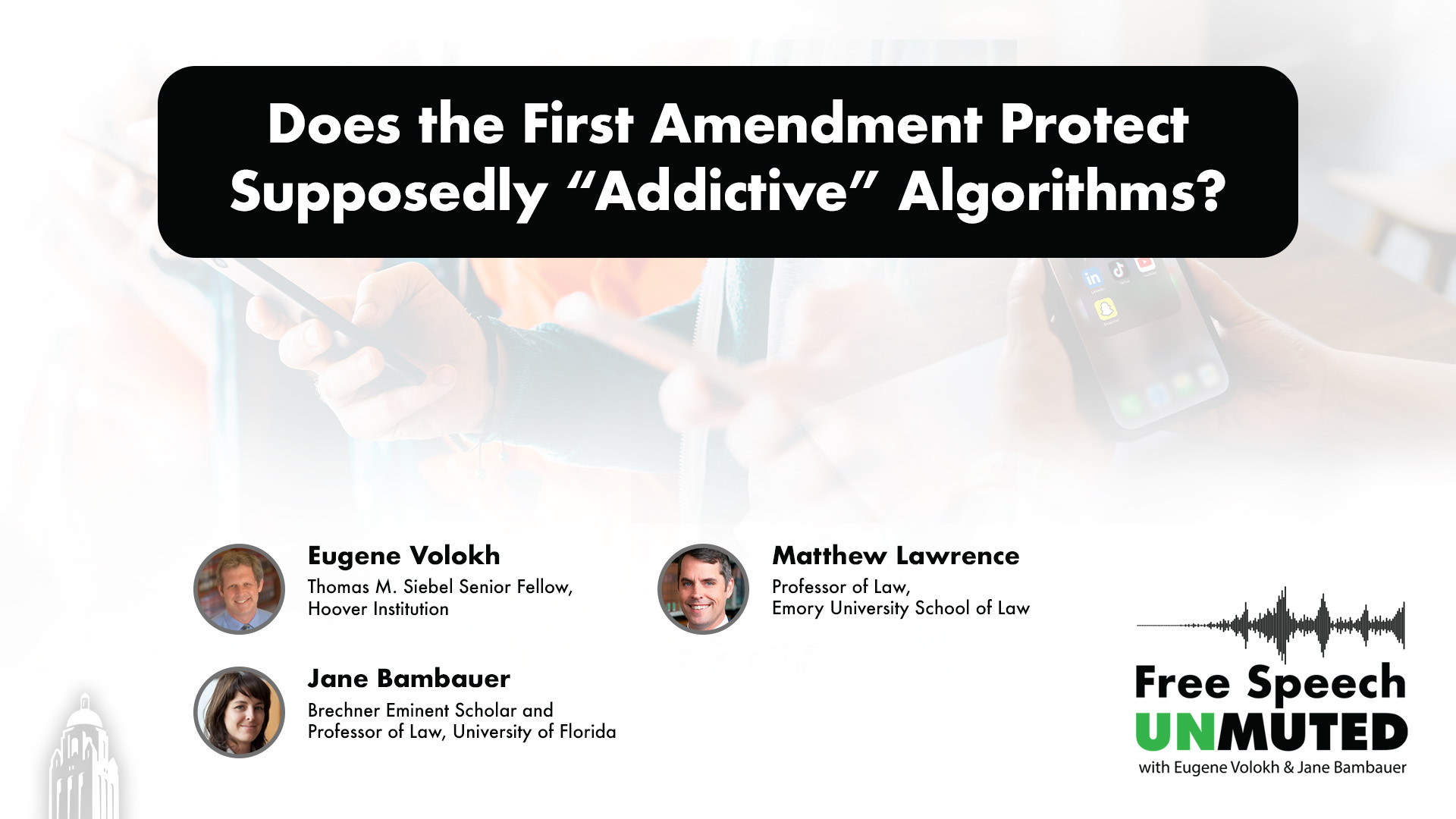
Can the government regulate social media features because they are “addictive”? Eugene Volokh and Jane Bambauer talk with Emory Law professor Matthew Lawrence about whether features like infinite scroll, personalized feeds, “near-miss” reward patterns, and dopamine-driven engagement tactics are comparable to gambling or even drug addiction — and whether that means the government can step in. The conversation digs into current lawsuits, whether there’s a constitutionally significant difference between content and design, how addiction is defined in law and neuroscience, and what First Amendment limits exist when regulating digital platforms. A smart, fast-moving discussion for anyone curious about the future of free speech, tech regulation, and the psychology behind our screens.
- Hello and welcome to Free Speech Unmuted. My co-host is Jane Bambauer from the University of Florida Law School. And I am Eugene Volokh. I'm a senior fellow at the Hoover Institution at Stanford University and an emeritus professor at UCLA Law School. We're delighted to have with us Matt Lawrence, who's a professor at Emory Law School in Atlanta. And he has written extensively about, about addiction claims related to things like social media, and we wanted to talk to him about those claims, which are currently the basis of various lawsuits, social media addiction claims and video game addiction claims are the basis of various lawsuits as well as the various calls for regulation. So we wanted to ask him what his thinking about such claims is, and in particular about the, about how the First Amendment interacts with such claims, whether the First Amendment should, should protect social media companies or video game companies. And if so, to what extent against those claims, or alternatively, perhaps this First Amendment should be seen as encouraging those sorts of claims. So that's what we're gonna be discussing. We're very glad to have Matt with us. He has written extensively on the subject. Jane and I I think are, are writing about it. I have an article in press, and I think Jane might as well let, is say in press in the production process, but Matt is, Matt is the one who has already written quite extensively in it. So Matt, tell us about your thinking on the subject.
- Sure. And Eugene and Jane, thank you so much for having me on the podcast. And this is really exciting and a little intimidating. I did not come to this area as a First Amendment person. I've studied, you know, I've, I love the First Amendment and I've litigated First Amendment claims, but really my research interest has been addiction. And I was focused for many years on drug addiction, opioid crisis, and drug addiction more generally. I worked at DEA, I have article on the Controlled Substances Act. That's where I kind of came to this. And I was actually working on a project focused on drug addiction and, and state regulation and questions of constitutional limits on state power to prevent a person from getting a drug treatment. So I have a paper on that. You, you're addicted to a drug opioids method. There's methadone, it treats the drug addiction, but the state says you can't have that drug. You can't free yourself from addiction for various reasons. I had a paper looking at constitutional issues under the 14th Amendment and that that led me to state lottery gambling. So in Georgia, for example, you can't gamble legally except that you can go to a convenience store and play a slot machine that the state of Georgia put there. Or you can download a lottery gambling app that the state will allow you to use. And I, I became interested in that and is, does that raise, do process claims if the state is the one kind of getting you hooked on some slot machine without telling you even that it might be addictive. And once I started working in that space, questions about social media come up because when you try to draw lines between sports betting, slot machines, social media, Instagram, and then we could kind of keep going drawing lines, novels, Sherlock Holmes released as a serial and the like, you start to wonder like what is, what is really going on here and what are the different regulatory paradigms? So I wound up focusing on slot machines first and then social media second, because of claims that social media apps have been designed kind of intentionally to use tricks that slot machines use to foster compulsion. So let me first talk about like the idea of a trick. My kids watch a show called Bluey, which I love, and there's a bluey episode. Where do you know the Claw when kids go to like a, like a pizza parlor, there's this claw game and the mother tries to do a claw game at home and the kid gets to steer her arm and she just goes and grabs the stuffed animal right away and the kids immediately lose their interest. But then the father comes along with, that's not how you do it. Instead the claw, you, the kid goes and it grabs the stuffed animal and raises up. It looks like you caught it, it looks like you caught it, it looks like you caught it, and then it drops it at the last minute. And now the kids are very, very engaged. And that's something going into gambling studies that's a near miss. It's just kind of known through a lot of research that if a person has the perception that they almost got the thing that's more likely to get them grabbed in and want to not only play in the moment but come back and play later. And there's allegations in the litigation against social media companies that they've designed similar sorts of tricks into kind of way that feeds are prioritized the way they're built. And so, you know, just to give you a few quotes that really interested me when I started going in on this former president of Google, sorry, former CEO of Google said that the, the companies designed the machines to maximize outrage and they play into the addiction capabilities of every human. That's Google, CEO, Facebook President Sean Parker said the like button is intended to provide a little dopamine hit and is a social validation feedback loop that exploits human psychology. And then video game programmer Jamie Madigan says that some of these tools are incredibly effective at making people keep playing because of how the dopamine based reward circuitry works. And engineer, the engineer who designed Pull and Refresh says they worry it's addictive. And anyway, this got me thinking, hey, these are the same sorts of things I read about in how opioid addiction works and also how gambling addiction works. And when you talk to the neuroscientists, they're seeing parallels in the way some of these things work. So that got me interested in this space generally. Now that has not answered your question about when can the state regulate, you know, there's a lot of concern right now about social media addiction and we could talk more about what I mean by addiction. There's a lot of concern about social media addiction and sports betting as well, you know, and the sports betting apps that are proliferating. But when the state regulates opioids, there is no question about whether are expressive, it's just a non-issue. So we don't really have to think about freedom of speech in that context. But when the state regulates social media o obviously we have to think about whether or not it's expressive. And so we've seen, as you would kind of predict, we've seen, as I understand they want to do, you know, industry in the cases that get brought, you know, so there's multi-district litigation, there's cases probably with attorney generals that are suing social media companies saying, you have designed these products to be addictive and you should, you know, have liability and things like that. That's one set of claims. And in those claims that social media companies say, Hey, first Amendment protects this, first Amendment protects this, and the courts are being forced to sort it out. And here is my understanding, my understanding of the lay of the land, the doctrinal landscape for when a state that is concerned about social media addiction is kind of checked by the First Amendment and how they regulate. So first you have the question of coverage, it's just does the social media, you know, does the First Amendment protect at all? And on that question, you have the big picture question of whether or not a particular social media design feature, and I mean when, 'cause that's the moody case from the Supreme Court, we're gonna look at a particular design feature one at a time. We're not gonna ask, is social media expressive for coverage? We're gonna ask, is this design feature expressive? And we have to ask, is it expressive? And then if it's expressive, then it may qualify for the rest of the First Amendment protection, as long as it's not gambling, because gambling is not protected by the social media, I mean by the First Amendment. So the sports betting app does not get to go argue that the way it's built prop bets is expressive. That, that there's just an exemption for gambling. Now I think that with smart thinkers like you two, we might get to a place where we can have a unified approach where gambling gets folded in to the rest of the analysis. And we don't treat it as sue generous, but at least right now you have that first question, is it expressive and is it not gambling? If it's expressive and it's not gambling, then you get to the question of is it content based or content neutral? If the regulation is content based, then we might be in big trouble. It might be very hard to do that regulation. And we saw, like the ninth circuit just had a, about the California addictive feeds law where it said the regulation of the like button and, and engagement counts, that's it. Content based, that doesn't fly. So content based is gonna be very, very hard to fly. On the other hand, if the regulation of the social media function is content neutral, and of course we can talk about what that means, but if it's content neutral, then then it could potentially pass muster. But there has to be a sufficient state interest. It has to be narrowly tailored. And there's also questions about overbred and over inclusiveness and the like. So, so that's your kind of standard kind of test at that stage. Let me say two, let me say, well, lemme back up top coverage. I said it has to be within the coverage of the First Amendment for us even to think about this. So there are regulations out there, like if there's concern about social media pushing pro anorexia content to somebody who it's algorithm knows is anorexic or has struggled with anorexia, which is a thing that happens and is alleged in the suits and, and is out there at least alleged in the suits, right? If a state comes in and says, you may not display pro anorexia content, then you're within the coverage of the first amendment, you're, you're talking about the kind of expressive choices of, of the app. And so we'd have to go through the rest of the analysis on that front. If on the other hand the state comes in and says, oh, there's these issues of like near misses, like if there's kind of this, if if we're playing with the timing of a notification or if we're, if we're not telling somebody about consumer protections that are available to them or we're using like inter intermittent reinforcement and variable of reward in how we space out content, then, then you're not allowed to do that. At least not with, without telling people there's arguments that that is content neutral. And then if it's content neutral then and it's not gambling then, oh, sorry, I got mixed up. There's argument that the regulation of something like intermittent reinforcement is not expressive at all because the, the kind of timing of things is not displayed to the user. They don't know what's happening. It's not expressed at all. And so then it just does not get first amendment protection. But if it does, then it goes under the content neutral category. And then the last thing I will say of all of this to the two of you is that when we talk about the state interests involved, I have found here that that you have a menu for a state, a very broad state interests to very to more narrow ones. Sometimes states are asserting that they can regulate this because of interest in protecting psychological wellbeing of children or interest in just the public health, which is the Jacobson case. These are potentially very broad interests. On the other hand, you could also have a more narrow interest. So if we say that the concern here is actually the addictiveness, then the state interest could be just in protecting the freedom of thought of the user. It could be in protecting that can freedom from addiction. And then what the state can do to support that interest is more narrow, narrowly constrained. So you, you have to have map out that question too. So that's a broad lay of the land. If you had my piece of paper in front of you, it'd be easier to track. And I'm thinking of listeners who don't know First Amendment law kind of very generally, but, but the bottom line is just coverage, not gambling and then this content base versus content neutral distinction before turning to the nature of the state interest.
- Other than that, thanks so much. Very helpful layout. So you explain why it is you think that there is some justification for regulation here, and then talk about where First Amendment prohibits certain kinds of even justifiable, or excuse me, certain kinds of regulations for which there is a plausible justification, but it only applies to things that are that, that are expressive in some sense. We can talk about that and it also provides more latitude for the government to restrict speech and content neutral ways rather than content based ways. So on, on those big pictures, I think, I think we all agree. I I'd say also, I don't know about Jane. I'd say also I agree with you with regard to the gambling. It's true that gambling transactions, like any kinds of commercial transactions or transactions involving exchange of value tend to involve communication. But just because a bingo game involves people saying a lot of things, or for that matter, a poker game involves people saying things and displaying visuals. The cards doesn't mean that the, that the first amendment precludes gambling regulation. So, so on that, I, I would agree.
- And then I was gonna, I was gonna say the same thing. I actually think it's such an easy case because it's really a transaction. There's a transactional hook and so much like how the regulation of drugs like you, you could say like, you know, a peddler of LSD is trying to give someone that's very communicative in some sense experience, but right. But the fact that it is a substance just trends, you know, you know, crosses that speech conduct line well enough that I think it's very obvious. Whereas if there were a law though that targeted gambling based on no money, so it was just the fun of playing with fake, fake currency that, you know, has no, has no actual financial or other real world interest on the users, I would then I think that there would be no transaction that would be non-communicative. So that was my impression too. Yeah.
- Yeah, I think that there's, you know, if we accept that gambling is simply not covered by the first Amendment, then questions come out about how we define gambling. You've each articulated kind of features of what you see as gambling. We could then ask how those features connect to our constitutional methodology for defining a concept like gambling. I would suggest that we should also think about the kind of underlying concerns that behavioral addiction to gambling presents and that we, in thinking about the definition of gambling, would want to also include practices that are part of gambling and a part of other things that raise those same concerns. Others would disagree with that, but I think we just get to interesting questions there about boundary drawn.
- So, so, so far we've talked about things that we we're largely agree on. Here are some things that I think we might disagree on. So Matt, I wanted to ask you this. My stance as a general matter is that when it comes to first amendment related activity, and of course it's an interesting question, how far that should go, we basically think that people should be free to decide in it, free of the government intruding. And, and that includes situations where we think people are making bad choices about what, what to hear and what to do based on what they hear generally. It, it also extends to situations where we think they're being psychologically manipulated in certain ways. To be sure in certain situations may not be, like for example, with fraud, if it's outright fraudulent obtaining of money, sort of related to gambling or gambling that it involves exchange of things of value. There are, there are permissible restrictions on that. But as a general matter, when people say, you know, I've been manipulated by this speech, we generally think, you know, that's kind of on you. That's not for the government to protect you against. And here's an analogy I want to draw and I want to acknowledge that like all analogies, it's not an identity, but it, it involves the first amendment, but at different clause of the person. That's the three exercise. Cause that there are a lot of people who invest a great deal of time and effort and psych and psychological and have a great deal of psychological investment in their religions. In fact, they often spend a lot of money on their religions in the form of tithing, maybe providing 10% of, of their income to the church, or sometimes even donating much larger sums of money. In fact, some people turn over all of their property either to the church or surrender it to someone else, take a vow of poverty. They sometimes deliberately cut off connections with their families because of their religion, whether it's because they think that their family are sinful and not following the right religion, or they may love their family, but they may conclude that they need to join a monastery or even become a hermit and separate themselves from their family in this way. So, so also, I take it that a lot of people, and I don't necessarily wanna endorse this view generally about religion, but I think it's probably true at least to some religious beliefs. A lot of people think that some religions act in manipulative ways, that they prey on people's emotional vulnerability. They may indeed, without sort of thinking of it in terms of dopamine hits, may indeed engage in this kind of variable, variable, I guess a reward reinforcement. They, they kind of are deliberately great habit forming or deliberately engaged in habit forming behavior, deliberately create habits, habits of prayer, habits of visiting the church, habits of giving money to the church. And one could imagine, I think the same kinds of arguments about manipulation, about praying on the vulnerable, including sometimes pre on minors, that that one would apply to religious to, to the actions of religions including to, to the religious preaching in favor of particular things or the way the religion builds its community. Yet I take it that if somebody were to say, you know, all of the stuff about how, how you are being taught to pray every day, that's kind of a religious manipulation. That's something that kind of pushes you to do these things repetitively. They get you into habits. We know that once people join a religion, they sometimes find it very difficult to leave. They sometimes do things that are bad for themselves and for their family lives and for, for their their financial outlook. We think it's all very suspicious. So we are going to either restrict some of these behaviors or require warnings. Like before you're asked to tithe, you have to provide a warning. Warning. This behavior may be habit forming, warning via the surgeon general has concluded that some such behavior may be manipulative. I take it, if we were to try to do that, the response would be probably the free exercise clause precludes that, that the, that free exercise clause includes the right to try to get people to adopt a certain religious belief system and engage in certain religious practices sitting aside one, like it's religiously motivated murder. That might be a different matter, but engage in certain religious practices without secular authorities, whether prosecutors or courts or juries either in civil or criminal cases or executive or administrative officials. Second guessing the church's behavior and saying, well, this is too manipulative, this relies too much on, on what we know now about the, the neuroscience of dopamine relief. This has been carefully honed to be sure not through a couple of years of AB testing, but through thousands of years of the, of the evolution of this church, of this religious belief system. It's been carefully honed to, to take advantage of people's liabilities, advantage of people's vulnerabilities and, and irrational approaches to things they will, that would be pretty clearly a free exercise clause violation. So if I'm right on that, maybe I'm wrong, but if I'm right on that, why wouldn't similar attempts to try to restrict communication be also a free speech clause viol?
- Well, and can I, can I, can I do a version of that question that brings, that's very similar but brings it into the free speech clause? Or do you wanna first respond to Oh, so, so I'm one, you could say the same thing. I was thinking the same thing about the news or political speech, right? So if the news has long known that if it bleeds, it leads that there's fear mongering that re causes certain psychological responses that keep people coming back more often. Demagogues certainly have, do their own experimentation, you know, pretty cl something pretty close to ab testing with the, with the help of staff to figure out what types of messages keep people at almost religious, like, you know, fey to their campaigns. And so that, that would be very similar, I think to what Eugene's asking. But, but in the free speech clause, all right, your floor is yours.
- Let me give a really short answer and then try to do a, a, a longer answer. I love these questions, so thank you each, I've just, and I wish we had more than an hour. So my very short answer is that if the state were to say that to single out a, a practice used by a religious institution and say, you know, this particular practice we think is concerning as a public health matter because it contributes to addiction. And so we're actually banning that practice society-wide, D wide, including when used by religions, right? If a state were to do that, then that would be Oregon v Smith, which is when the state banned peyote use. And the Supreme Court said that the state could apply that ban to a religious institution and it did not violate free exercise. So if the state is across the board identifying a particular practice or particular mechanism as such a threat to people's freedom of thought that it leads to addiction and it's putting that ban across the board, then it can apply as well to churches and as well to individual religious institutions. And we know that that's not a violation of free exercise clause under organ. Now RFR would be different rfr, we'd have to do a whole analysis, but it would be different. And then to go to kind of, you know, the, to unpack that answer a little bit, you know what I love about this question is that usually when I talk about addictive design by social media companies or in slot machines or anywhere, usually when I talk about it, people kind of say, what are you talking about? There's, sorry, my, we're gonna have to edit for a sec. My phone rang. Or you can not edit and readers can hear that that happened or listeners. Anyway, when, when I talk about this, people say, what are you talking about? There's free will. And if we follow your logic, then all of these things that happen in society might actually be influencing our brains and changing the way we think. And maybe there's not free will. It's all determination. Like what do we do with that? Where do we go there? And your question does the opposite. You say, Hey, here's this beloved institution of religion that is actively manipulating us. I'm grateful for the way I was manipulated as a kid by religion and the values it inculcated, right? And so this is coming from a completely different angle that's like the, like the Bethel tinker kind of thing about, well, we know that we're inculcating and sometimes we want the state to inculcate civic virtues. And then of course religion is there, inculcating, it's shaping people's minds and the like. And so I just, you know, I appreciate that. What I would say is even in a world where we know that the conversation we're having right now is gonna shape the way we all think in the future and that we don't really have freedom of thought, our thought is constantly being influenced by the people we're exposed to. Even that in that world, addiction is a different thing. It's a different thing because historically and traditionally we've thought about it as a different thing. It's a different thing because when the neuroscientists study it, they can show pictures of it in your brain and show how it changes brain structures in different ways. It's a different thing because even if it's a more extreme version of habit, it's different and kind to the point that we treat it differently medically, we think about it differently in society. And that last answer to why addiction's a different thing I'm getting at, it might be that addiction is a different thing in degree rather than in kind from other things that we're exposed to in life. I think that's actually a current debate in some of the, at least in the anthropology community, if not the medical community. But addiction is a phenomenon that is distinct. Maybe so is religious belief, I'm not sure, but I, but I, I do think addiction is a different phenomenon that is distinct. And so then I would say, you know, to distinguish your religious examples from addiction is, well your religious examples are about inculcating religion, for example, in most of those, or if not all of them, either the parent wants that inculcation or the person who engages in the practice wants to engage in the practice. Addiction on the other hand, is something that a person sees as harmful or maybe that medicine sees as harmful and addiction's got intrusive urges to engage in a particular behavior that's unwanted. So if the state labels a particular practice as causing addiction, that's a thing that's an outcome. That could be a religious practice. To go back to where I started, in that case, if the state targeted religions and said, only religions cannot engage in this, then that would be a blatant violation of free exercise clause. But if on the other hand the state says no one can do this, or it's always regulated in this way because we think it leads to reli, to addiction, that again would be Oregon v Smith. That's a case that we already know the outcome to. And then lemme just say a third thing that I'm very concerned about, which is the state using these tools, right? So the flip side of free exercise is establishment clause. We have a long history of concern about the state using some of these tools to inculcate certain things. I'm concerned today that the state will gain control over social media companies and use these tools to determine what people think and, and influence them state action near or may not protect that. But if you say that addictive design on social media is no different than like, you know, reading a book or something like that, then the kind of government propaganda, government speech cases would say that a government can also manipulate somebody to be, you know, hooked on the government version of Facebook and pay taxes through the government version of slot machines and, and all of that. So I am concerned about the kind of flip side of, of some of these, some of these equivalences if we draw them. So, but anyway, that's my best answer to to, to a question to had a lot of subtleties to it.
- Well, so, so let, before we go to the equivalent of the establishment clause, let's, let's go back to the line drawing, I guess between addiction versus other things that influence people. And I get, I get what you're saying is that if there's some sort of medically trustworthy gauge for addiction, and we can, we can safely draw some kind of line and, and say anytime someone is in is is anytime a company or an A person is engaged in addicting others that can be regulated. I guess I still don't understand how the social media lawsuits could work on those terms because I, you know, I i I really feel quite confident that the news can, the news would fit this model of, you know, if, if social media fits this model, I think the news does too. So how can a, how can a state ag go after only social media and not every, every speaker that engages in these practices.
- So the question is, hey, is couldn't, don't people get addicted to following the news in that sense? And, and might that be something medicine or whoever we are are judging this by says, yeah, that happens. And then, and then what does that mean for regulation, right? First I would say it's hard for me to imagine a regulation that targeted news outlets that wouldn't be targeting expression and that wouldn't be content based.
- Well, no, no. I mean, what if, what if it's that we know that the news organizations, they've looked at their audience figures and they've realized, oh yeah, this, these, I mean exactly what the social media companies have figured out, right? That rage bait and fear baiting those work way better than the other stories. They're gonna keep delivering those. So I, I think, I mean I, I really, I really, i I think that the media that the in, you know, the influence of the internet on the media and the sort of 24 hour news cycle has made both social media and traditional media have to run these models in order to sort of survive. If I'm right about that may, maybe we disagree on that, but, but for a minute, let's, let's assume that there's something similar going on. Yeah,
- I do agree. And actually that, that just connects to a side point, which is one of the challenges of addictive design is that it's not that people wind up consuming more speech, it's that they wind up consuming the addictive speech to the competition, to the kind of cost of the normal speech. The, the relationships, the human interaction, the novel reading. And so this isn't just a question of how much speech people consume, it's whether in our marketplace of speech, the winners are the ones who outcompete by being addictive, right? Or the winners are the ones who outcompete with being stimulating or controversial or the other things that might gar people's attention. And that's a real challenge we have in the social media landscape right now is if you had an idea for a great marketplace of ideas, kind of social media app, but you declined to do things that were gonna develop compulsions in users, then you wouldn't be able to get the number of readers, the number of users to get to that network effect. And this has antitrust implications and everything, but, so it's not just a question of how much speed speech people consume, it's like what kind they consume. And I take your point that like maybe someone singing the song I'm singing would say, so we should come in and stop news outlets from leaning into rage or leaning into fear or some of these things that I, you know, we could cite Cicero or somebody on these things, grabbing the, you know, grabbing people. My my answer to that is that it's hard to imagine that regulation not at least coming under First Amendment coverage as a regulation of expression. It's pretty hard for me to imagine it not being content-based. Like if you said you can't have outrageous speech, that's, that's content-based. And so now we're fatal, in fact strict scrutiny. If on the other hand you told me, Hey, what is I regulated a news company? And I said, you can't use personalized data in your targeting decisions, which is the sort of regulation we'll see of social media companies. In that case I'd say, well, is using personalized data is that expression? And I think there's a good argument that that's, it's not expressive to use personalized data. And then even if it were expressive, is that a content-based restriction? No, it's not. It's not based on the content they're putting out. It's on, it's on their inputs.
- W why isn't near misses? Why, why wouldn't near misses then count as expressive or the near miss? Yeah, I thought, I thought, I thought you were arguing that the design features that are like exploiting things like near misses would not even be counted as expressive. Is that
- Yeah,
- Right.
- Yeah. So yeah, for like, for one example, if, if the user like a near miss works because the user doesn't know that it's, that it's happening like, like they, they think it's real, is what I'm getting at. Another allegation that's out there just, just for, for the help of this conversation, one of the allegations in the complaints is that I forget which social media company actually I, I think I know, but I'm not gonna say 'cause I always try to be cautious about these things. The one of the social media companies, they, they come up with a ranking of how much you'll like given content And then they don't give you first best second, best third, best fourth, best, fifth best just in order like that they give you first best boring, boring, second best, boring, boring, boring, third best, boring, boring, boring, boring, boring. They'd make it like a slot machine that you're constantly pulling to refresh where the jackpot is stimulating content. And that is playing into the exact it we might say it's not value that you're getting, but it is, it's it's utility, right? And so it's, it winds up running to the same kind of psychological mechanisms. So some of the regulations would say, Hey, you can't do that. Or a person has to be able to, you know, the law would say a person has to be able to opt in to a, a social media site that's gonna do that. So they have to be told, we're not giving you your most interesting content. We are intentionally spacing content. In fact, our algorithm predicts when you're gonna leave the app and we then give you the very juiciest content we've been saving for that exact moment to keep you going, to keep you going. We're gonna do that. Do you wanna opt into that? 'cause it's exciting and it'll get you hooked and you won't be bored. And then the person could opt in that law, you know, is the one that I would say, Hey, well that's not a regulation of content, da da da da da. But that certainly the social media companies would say, wait a second, that's a regulation of speech. And you know, there's a state interest and you shouldn't even be able to empower consumers to know whether being exposed to that kind of a slot machine trick, that that law should be off the books. And that's the sort of thing where that could tell, I'm trying to describe the way the law is, but I do have a sense that, that we need a more subtle analysis for something like that, that might allow informed law where the evidence supports it.
- Matt, I wanna return you a little bit though to the, to the religion example. And I think it's, it's notably that you are saying that religious practices could be regulated as well, so long as there's this general, general rule. Well, so imagine there is a general rule that says you have to disclose to, to people whom you are seeking to join your, your listener group, whether it's religious or not. Like how is it that you select what you are going to say to them? And also a rule that says you cannot select things that are targeted based on what you know about them. So if a religion wants to approach someone with sort of generic pitch, could fire and brimstone could be love and acceptance could be any mix of that, that's fine. But if a, if a minister or just a member of the group acting in the direction of the group takes advantage of something they know about you, I see you, you, your a rich man are, have you wondered about whether your riches interfere with your spiritual progress? I see you're a poor man, you wondered if God loves you any less and that that, that that's why you're poor. Or I see you, are you elderly? I see you're sick, I see your man, I see you're a woman, that kind of stuff. No, no, no, no. That's not legitimate way of, of pitching your ideas whether they are entertainment, whether they're political ideas or religious ideas. Sounds like you were saying that that would be a constitutional restriction. Now I think as a duck triangle matter, I don't think employment division versus Smith goes that far among other things, rightly or wrong, the employment division versus Smith did expressly distinguish situations where there's a mix of religious practice in some other right, whether parental rights or speech. So I would think that a regulation of religious speech, even if it is framed as religion neutral and even if the trend is content neutral because it's just based on whether you're targeting is based on a person's attributes, I think would be subject to strict scrutiny even following employment division versus Smith and certainly po. It does look right now that the Supreme Court, at least six right now of the currently sitting justices, at least five justices have said they'd be willing to reverse employment division versus Smith. By the way, I'm a fan of employment division versus Smith generally, but that's not where I think the court today is. But even underemployment division versus Smith, I would think that that kind of regulation would be unconstitutional. But what's more, I just think it just would be a striking interference by the government with the liberty of organizations to try to convey their message, including in ways that some might conclude is are psychologically manipulative but others might conclude is actually quite valuable. Many people would much rather hear messages that are pegged to their circumstances that are just generic and applicable to everyone else. So, so can you elaborate a little more, maybe I'm wrong, maybe I'm misunderstanding, maybe you think that this kind of religious behavior would be protected, but if your argument leads the religious behavior like that to be unprotected, to be regulatable at least so long as that's the same way we treat social media platforms and even news organizations as to their kind of individualized targeting, then it just seems then that your proposal is quite inconsistent with the way we've generally done things when it comes to First Amendment protected activities.
- If Pope Leo has the Catholic church devising a Catholic social media app and they go to think about how they're gonna prioritize content and how they're gonna make, you know, recommendations to keep Catholics engaged, they have to ask what sorts of data can we consider as we do this and take addictive design out of it. I'm guessing that they say, well we're not gonna be allowed to use data that is HIPAA protected medical data and we're also, well you're, you're squinting gig Eugene, so we'll come back to you. But
- Yeah,
- I'm well take as a first cut that there's existing limits on the sort of data that someone designing an app like that is allowed to consider and use. I'm
- Sorry, I'm not sure we should take it given that that, for example, hipaa, you know, it would apply if for example, there is a, a Catholic hospital, if it's sort of the church says, oh Catholic hospitals, please pass along all the information on your patients so we can tailor things maybe that would be, that would be applicable. But that stems from the, but you're seniority of the doctor relationship. If, if the, if the law said you as a priest you may know that you are a patient is suffering from cancer, but you can't approach the patient and say, you know, I understand that, that that that that you are ill and you must wonder like what, where's God in all that? And let me tell you, here's the, here's how you should reconcile the reality of your illness with God's love. If that were something that the, that the law tried to restrict, yeah, I would think that would be a pretty clear constitutional violation. No,
- And I I think you're right that HIPAA does not govern the content of third parties. So, so HIPAA is a bad example there. I'm just trying to think of, and and maybe you can help me out,
- Generally applicable law is what you're saying, like the, if
- I, yeah, could the Catholic church go to a data broker in some foreign country and say, hey, there's all this stuff that was breached about Catholics, we wanna buy it from you because we wanna do better tiller algorithms that presumably there's some law, maybe I'm wrong, you know, Rico complicated or you know, something like that that might well limit it.
- It's complicated. Bar Viper makes it complicated. But, but I'm sorry but I'm interrupting. Go on.
- Oh, but and then I would also add on non-discrimination laws that generally applicable non-discrimination laws that say maybe don't discriminate on the basis of sex or something like that. If the Catholic church, well the Catholic
- Church does discriminate on the basis of sex, including in hiring and it as well as other religious institutions are exempt as a First amendment matter from non-discrimination laws. Well in higher, even though, even though generally saying we'll only hire a men as priests and that le would be generally unconstitutional, they, they do have a, a reli right under the first amendment to do that
- Principles. Yeah, this is where I'm going. 'cause as I, as I recall the case, it's, it's, you have a generally applicable statute that's not necessarily, doesn't necessarily exempt the Catholic church from say like, you know, employment discrimination rules or something like that. And then the court says, wait a second, this generally applicable law may be fine for plumbers and social media companies, right? And everyone else, but were we to apply it to religion, it would run into special free exercise and, and establishment cause issues. Therefore we're gonna serious constitutional question, we're gonna avoid that reading. And the upshot of that kind of a case is that we're pretty comfortable in our law with generally applicable rules that apply to all sorts of people and institutions that if it applied to a church it might make us nervous. Is is what I'm getting at.
- Oh, but I'm sorry, I thought earlier in your praise of employment division versus Smith, you were suggesting that actually these kinds of anti addiction rules could constitutionally apply to churches. They don't get any pre-exercise clause break anymore than social media platforms should get a free speech clause break.
- Yes. No, you're right. But it's
- Okay if you, if you, you change your view, I mean either because no misunderstood, well maybe it's, it's if you explain to me I misunderstood you, but if you change it, that's fine too. I mean it's great t that to have
- That. No, Eugene, I'll be honest, you know, I have on my notes, which, which aren't great, but I wrote religion question mark and then I have just two really distinct ways that I think the origin religion analogy kind of is only so helpful. The first is that it runs into the free exercise organ VB Smith issues that we've already thought about. The second is that this kind of analogy to religion, social media companies to religion sort of assumes that if we can't do something to a religious entity entity, we can't do it to social media companies and vice versa. And in fact, our law is just very, very, very comfortable with treating religious institutions differently than other institutions. And, and that case, that example of reading a generally applicable law narrowly only to create an exemption to religious institutions is just an example how comfortable our law is with religious institutions being different.
- So I appreciate that. But in addition to religious institutions being different, speech institutions are different too. The Boy Scouts prevailed in their challenge to a non-discrimination law, even though they have a religious component to it. But that, but they prevailed under free speech laws challenge. And likewise, there are cases that actually say that, that speaking organizations may in fact discriminate based on race and such in choosing people whom who are going to be on screen. There was a case involving I think the Bachelor, which was accused of discriminating based on race and selecting the contestants. And the district court said, well, they're entitled to choose based on race whom they, whom they depict on screen. So what I'm saying is we in, we recognize that religious institutions are protected by the free exercise clause, but we also recognize that speaking institutions like social media companies are protected by the free speech clause. So my suggestion is that if we recognize that the same behavior that we might label addictive when done through religious institutions and in a way that, you know, involve itself probably a lot more money in many ways than than the the typical social media platform, at least in terms of how much people give that that is something that is, that can't be restricted given the pre-exercise clause. Maybe we should say the same thing with regard to the free speech clause as opposed to gambling, as opposed to drugs, things that aren't protected by the free
- Speech. Well I I just add, look Eugene, if it would be helpful, I could put the third thing I have in my notes, which is please, you know that I agree with you that social media companies are protected by the free speech clause. The question is what does free speech protect? And so first we have to ask if a given regulation is within the coverage of the First Amendment or not decide whether it's regulating expression or not. But even if it's regulating expression, we then check if it's content based or content neutral and then finally, you know, and just go to the religious entity. So let's say it's a regulation that applies to religious entity and we say it is expressive and we say, let's say it's content neutral, then we have to talk about state interest. Any state interest that's focused on protecting people from religion, you know, or protecting people from being manipulated by religion, I would think it's gonna be a non-starter to a court that they're not gonna be interested in that, that state interest because of the establishment clause and the, the free exercise clause. On the other hand, if you get to that stage and the state says that it has a general interest in say the psychological wellbeing of children or something like that, then I think we're back at an Oregon v Smith kind of analysis when it comes to religious institutions of asking whether or not that violates free exercise clause, but only the religious institution can make that argument. Facebook, unless and until it claims to be a religious institution, can't make a free exercise clause argument. It has to try to fight a state interest in protecting the psychological wellbeing of children on the merits. And just another example of that is Jacobson Jacobson is forced vaccination. So here we're not limiting somebody's speech, we're actually putting a syringe in their body in order to vaccinate them. And the Supreme Court says, yes, you have a state interest, I'm sorry you have a liberty interest, but the state's interest in public health justifies that. So we wind up winning after scrutiny and nonetheless state, after state after state exempts religious institutions from that mandate because they recognize that if somebody has a sincerely held religious belief against vaccination, that that's kind of a different kettle of fish. And so that just goes to, you know, kind of my point here that we're pretty comfortable that sometimes we have to give a wider birth to religion because of its unique place in our history, tradition and culture. That doesn't mean we also have to give the benefit of that unique place to social media companies. And in fact, I just, I come back to the power religion has because of how it tries to inculcate and steer people, like illustrates the power that social media companies can wield as they design their apps and kind of is what motivates I think people to think that there might be a justification for some kind of state regulation, assuming that there's an evidentiary basis and it satisfies the requirement of the framework.
- Can, can I actually, well or I'm gonna take us back to like sort of thinking about addiction as what's so special about addiction in terms of its relationship to free speech. It seems to me that what makes this hard? You, you, you are categorizing these arguments as as the sort that actually help people's freedom of thought. And I will agree with, let let me go to some examples where I think I would agree with you and then show like sort of the limits of it. So if there were a virtual reality device that was so effective that even though it was only using photons and and sound waves, it just created the physiological responses or somehow kind of hijacked, you know, it was, it was so, so effective that it would hijack decision making. I would say, okay, it no longer matters that these are media, media, it uses media of communication. I'd say it's like a drug at that point, right? So, so there's some point at which purely communicative technologies I think could have the, you know, effect and results that somehow bypasses free thought and then I would be in the same land that you are. I'd say, okay, reg, you know, it's regulatable for the same reason that drugs are social media to me just seems so far from that. And so I'm wondering if you could help me, I mean, you know, I I think it would be useful if I could, you know, test whether where you are on that spectrum by asking you to say a little bit about pornography where a lot of these same arguments were made about, you know, three decades ago or so, four decades I'm and video games. Yeah. I I think starting with those two, so like if, if, you know, given that the first amendment that that that the, you know, that the, that the arguments that tried to tried to be made saying that pornography sort of bypasses the sort of higher order, you know, thought and, and is really more conduct than speech. Tho those didn't, those were not persuasive. So why should social media's similar arguments be persuasive?
- Yep. And yep. So first for pornography to me just it's content based right from the start, we're talking about a particular type of content and then the defenders of regulation in that space are saying, are saying, well, but there's a different history in everything like that, you know, and that because it's content based, it just seems very different to me than some of these questions about the design. I guess it would be similar to someone saying pro suicide content or pro anorexia content is just inherently captivating and then the person can't get away from it. I think it would be analogous to that, but that's not what I'm talking about. I'm talking about the kind of way the app is designed and the way it presents material, like how it ties out the material it presents and the infinite scroll and the pull to refresh mechanism and things like this. And so that, okay, that's di go
- Ahead. This is, that's a distinction you were making before, but I still don't quite see it, so, so would a cliffhanger, like when a new television show leaves a cliffhanger to get you through the advertisement, is that a design feature or is it content? You know,
- You know, I kind of love cliffhangers as an analogy because they, they keep us reading, you know, we all know what they are. Yeah. It has a name. Yeah, I think in 50 years a lot of things that we and our kids experience in social media, we'll have names like cliffhangers and we'll all know about them and then we'll be able to say that there's kind of consent just because we, we already know about it coming in. Like we al we know that that kind of device has that kind of a thing that we don't have today. That's another version of me saying which is which that we, we like kinda understand how cliffhangers work. So, so even if my argument got to a space that said there ought to be a thing on the front for parrots that say warning eight before you give this to your 6-year-old, it contains cliffhangers, right? I actually think when it says like, can't put this down, that kind of thing, people know that, right? And they, they, they want that, they wanna encourage more reading and that kind of thing. So I think that, I think that cliffhanger falls in the category like the timing of the reward, spacing out the exciting content where I think we could have a very interesting fight about whether that's expressive or not. And then there's things that just don't fall in that category at all. Like pull to refresh like and and things like that. No, and no. Yeah. And then pornography. Pornography is clearly content based. Okay. Pornography's clearly content based.
- Okay. - So that's, that's how I would think about those. If I could just add a thing of what you started with Jane, which is that like this device that was like just totally addictive or mind, you know, and that, that you would be with me, I would just make a pitch that especially for people who love the freedom of speech that, you know, when you have this conversation with somebody who's in their twenties, they know that, they know that device exists and they felt addicted to it and it's like TikTok and so they're, they're, they have personally wrestled with this and if you go, just go in the app store and search social media addiction or go searching Google quit social media, right? To talk to a 20-year-old about how often they've deleted their social media app and then reinstalled it two weeks later and, and then not wanted to or, or other steps they've taken. I think we have a generation coming up, this is just my perspective that is already there with a lot of these social media apps. 'cause they had experienced it, they've experienced compulsive use that interfered with their studies, that interfered with their lives. Many of them see themselves as in recovery from this. And here I would say those people are gonna be very supportive of regulation in this space. And it can go two ways. It can go for that though. Such people, public health regulation, this very broad thing. Or it can go, we're regulating addictive design. We can regulate intermittent reinforcement in that world, which we might be in in 20 years. The addictive design route is much more speech protective as a justification for regulation in this than the other route that will be very tempting, which is just public health or like Justice Thomas might say, it's parental control over speech and that, you know, so just, you can do whatever you, you know, something like that. So I don't think this is all like pro-free speech, anti-free speech here. I actually think there's an extent to which or, or lane through which focusing on the addictiveness winds up being more speech protective overall, even if it does require some, some give from free speech advocates.
- Alright, well we are coming on the one hour mark and unfortunately our, our listeners are not addicted. If they were, we could three hours and they wouldn't be able to put it down. And engaging and interesting as this has been, there is a limit limit to their patients, regrettably. So Matt, thank you so much for, for joining us and for listening to our top questions and giving, giving great answers to them. Jane, thanks as always, always a great pleasure to be on with you as well. And listeners, we hope you're hooked enough, at least that you're going to come back for the next episode, which will be coming in a few weeks.
- This podcast is a production of the Hoover Institution, where we generate and promote ideas advancing freedom. For more information about our work, to hear more of our podcasts or view our video content, please visit hoover.org.

