


- US Foreign Policy
- International Affairs
- Security & Defense
- US Defense
- Key Countries / Regions
- US
- Military
- Determining America's Role in the World
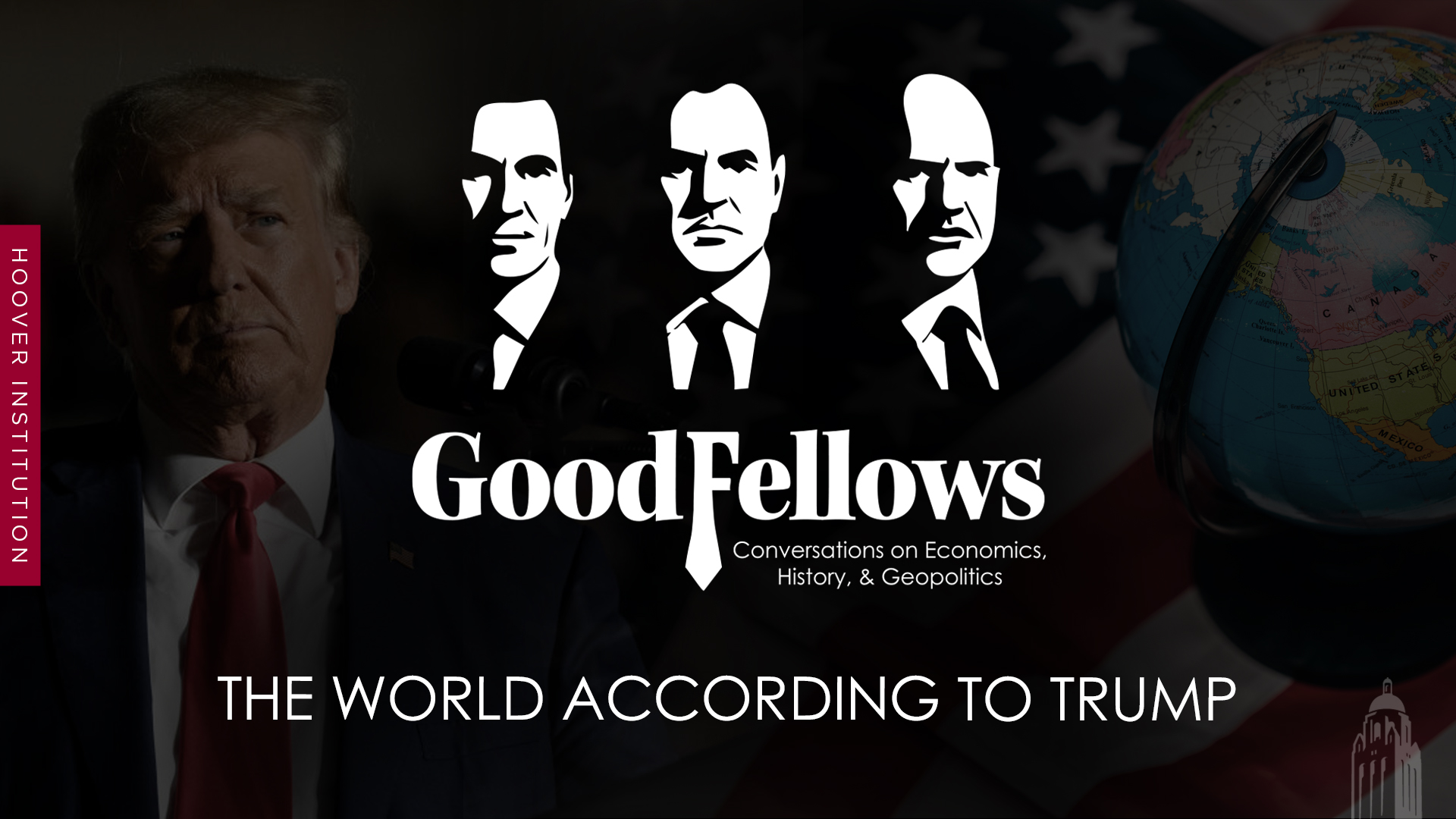
As Iran’s theocracy teeters on the brink, the question turns to what the Trump administration’s abiding interest in other bad regimes (Venezuela, Cuba, Colombia) and its appetite for land acquisitions (greenbacks for Greenland?) say about the American president’s worldview.
GoodFellows regulars Niall Ferguson, John Cochrane, and H.R. McMaster discuss policy options for Iran now that protests have turned tragic; the relative silence from the same campus leftists who fervently protested the war in Gaza; Nixonian echoes in Trump’s foreign policy; plus Secretary of State Marco Rubio’s emergence as a geopolitical jack-of-all-trades. In the second segment, John weighs in on the significance of the Justice Department’s criminal investigation into Federal Reserve chair Jerome Powell; H.R. contends America’s designs on Greenland are no laughing matter; and Sir Niall previews what to expect from Trump’s appearance at the upcoming World Economic Forum in Davos. Finally, GoodFellows’ resident “Deadhead” bids a fond farewell to the late Bob Weir, guitarist and cofounder of the Grateful Dead.
Recorded on January 13, 2026.
- There's no question that the Shah leaving Iran is a tragedy, a personal tragedy for him, a tragedy for the people of Iran who now are suffering repression much greater than they had before, who have 4 million at least unemployed and runaway inflation under a government that is not really a government. It's really a mob. All these things have happened. But also it was in addition to being a personal tragedy for the Shah, a tragedy for the people of Iran, it was certainly a tragedy for what we call the West, because what was leadership and stability in that part of the world is now replaced by instability.
- It's Tuesday, January 13, 2026. And welcome back to "GoodFellows," a Hoover Institution broadcast examining history, economics and geopolitics. I'm Bill Whalen. I'm a distinguished policy fellow here at the Hoover Institution. I'll be moderating a conversation today featuring three of my colleague like to call the GoodFellows. I'm referring of course to the historian Sir Niall Ferguson, the economist John Cochrane, and former presidential national security advisor, Lieutenant General H.R. McMaster. Niall, John and H.R. are all Hoover senior fellows. So, gentlemen, long time no see. I'm joking because we did a show just last week which is sort of a short stint for GoodFellows. We're back again and let's pick up where we left off. And I want to begin with your thoughts on what is going to happen in Iran. As I mentioned, we're recording this on Tuesday the 13th. What is going on right now, the regime seems to be on a precipice. Iran has crossed the line that Donald Trump set, saying that the US will strike if the protests turn violent. The president this morning saying, and I quote, "Help is on the way." Niall, I'll leave it to you. Donald Trump says, "Help is on the way." What is help?
- It's a good question, because it's actually harder than it looks to achieve a counter-revolution, which is what this is. I think a lot of bad analogies are being thrown around as if this is a revolution. That's different when you actually try to overturn a revolutionary regime after 46, 47 years, which is what we're seeing. And it's especially hard for foreign powers to influence a counter-revolution in an effective way. Often it backfires. In the French Revolution, intervention by Prussia and Austria backfired and radicalized the revolution in the 1790s. In the Russian Revolution, we intervened, failed to help the Whites, the White opponents of the Bolsheviks. And I could go on. So it's hard to do whatever it is that President Trump has in mind. Air raids when people are out in the streets, aren't, I think H.R. will confirm this, aren't an obvious way to be effective. However, let me just add one important caveat. What we saw in Venezuela is that the United States has formidable capabilities that didn't previously have when it comes to covert operations and what were loosely called cyber or just electronic warfare. What the administration could do is in that area where the command and control system that the Iranian regime has is still very much intact, they've been able to shut down the Internet, cut off the country from telephonic communication for days, and on that basis commit mass murder. I think the United States and Israel have capabilities to disrupt that regime command and control system, and that would be impactful, and I hope it is going to happen or indeed has already happened.
- H.R.
- Yeah, I think the way to think about this is exactly as Niall has suggested, is what can you do to weaken the regime, but also what can you do to help the opposition cohere and communicate. So in addition to disrupting the communications of the Islamic Revolutionary Guard Corps, about 150,000 strong there, and these sort of Brown Shirt brigades of the Basij with electromagnetic warfare and cyber warfare, as Niall suggested, you should also turn on the Internet for Iranians to help them communicate with one another, because really I think what you want to achieve is about four or five different kind of objectives. You know, I think what you want to do is weaken the regime further. You can do that through electronic and cyber means as well as maybe some direct strikes. You know what, why is the IRGC headquarters still standing? You know, for example. And you could go after some of these senior commanders which Israeli and US Intelligence has tracked with a very high degree of fidelity. And then, and also you could, you could weaken them further by cutting off their cash flow even more tightly. You know, this, some of the interdictions of shadow fleet vessels and that sort of thing, as well as actions you can take in cyberspace to cut off the cash flow to the resource. So weaken the regime objective number one through a broad variety of means and options you could bring to the President. And then you want to divide the elites, you don't want the elite to cohere here, you want to splinter them. And so you're going to have to have a form of transitional justice if this regime collapses because of how many of its own people it's murdered and tortured and imprisoned. But some of those elites should know that maybe they can survive the counter-revolution, as Niall said, and there should be efforts to reach out to them, much like we did to the Chavista leadership in Venezuela. Is the opposition coherent? What can you do to help the opposition cohere? And you've seen Mr. Pahlavi reach out as maybe a figure that can, that can bring these groups together because these groups have different ethnicities. You have really white collar people who are fed up, who are in the streets now. You have blue collar people in the streets. You have people who want more social freedom. How do you help them cohere? And then finally, international pressure is kind of important here. And this is why I think President Trump's statements are helpful, and so there's quite a bit that can be done as well that you know, from an intelligence perspective, a clandestine perspective, and I'm sure some of that is going on already.
- So, well, let me just add, there is things we could do. I think you guys pointed to them. Oil tankers, we know how to stop oil tankers. And you know, Iran sends oil out and uses the cash to buy stuff, and we could, what we've shown with Venezuela is we could stop that oil. Sanctions actually are working in this case. It's important, there are two armies in Iran. One is the IRGC and the other is the regular army. And it's the IRGC that is under the regime's control. And they're very ideologically committed. That's the one you need to fight. And the regular army might be the one that turns. But it's important to remember. Now, Israel was ready to go after the IRGC, and we stopped them. They had a list of about 1,000 targets according to "The Wall Street Journal" today. And yeah, why do they still have airplanes, bases, tanks, and so forth, is a good question. So there are things, and you guys have, if the goal is topple the regime, now this brings us to inevitably the larger question because we got everything going on with Iran, Venezuela, maybe Cuba coming next, and the US Seems to, do we want to implode these regimes or do we want to support them and get them to do our way of doing things, which is where we seem to be going in Venezuela. We seem to be very good at getting the ball down to the opponent's five-yard line and then call it a timeout, because the touchdown looks, touchdown party looks like it's a bit chaotic. Put it as kind of a question for my historian colleagues here. Niall alluded to some examples. When a regime implodes, when does it work out well, and when does it not work out well? Is it a good idea to, it's kind of strange that these things we've wished for for 60, 70 years, like the implosion of Cuba, and then it's coming, and the chatter you hear out of the administration, "Oh, I better send them some oil, because it would be chaotic if they imploded." Really? You finally get what you wish for and you want to say no, but. But it is important that it work out well and not well. And it's not clear that American direct intervention is a good idea. So how do you nudge things so it comes out our way?
- A lot of it has to do with organization, John, organization of the opposition. And what happens is these authoritarian regimes, they're very good at demobilizing groups, right? So what you have that remains are only clandestine organizations. Many of those have to be localized and small or else they would be big targets for the IRGC and the intelligence agencies and the MOIS. And so you have groups that are Kurdish separatist groups, separatist groups, and those are not even very coherent themselves. You have, You have Azeri groups, you have Baha'i groups, you have different groups. But what I think is different about these protests is it's cutting across the whole country and is cutting across really kind of all demographics, all income levels, and so the question you have, I think, is a good one. Remember the collapse of Mubarak, right? The only organization that was organized was a clandestine organization of the Muslim Brotherhood. So the Muslim Brotherhood takes over. They want to rewrite the constitution. They're not very democratic, so only statistically, and I'm not a political scientist, so I don't really quote these numbers very much, but only about one in five ends of authoritarian regimes transition to democracy, at least right away. So we know what it would take to do that. Can we help the Iranians to establish a security sector reform program that keeps some leaders in place but also prosecute some? Do you have a transitional justice program? Can you put into place a basic law or go back to a constitution, such you had under the Shah, maybe without the Shah, that is democratic and representative? Can you bridge into some sort of form of representative government that way? But you need security space to do that. And it's very hard to take this collapse, if it is a collapsed security force, and build something out of it.
- Well, I don't think it is a collapse. The problem is actually that the regime is not collapsing. Its economy is in a part of state inflation is at 50%, 70% in the case of food. There are all kinds of problems. But the regime's repressive apparatus, which H.R. has already talked about, not only the IRGC, but other agencies which are very numerous, show no signs of having cracks. And the news that we've received in the last 24 hours is an extremely dispiriting litany of video footage of body bags.
- I think the estimates now, which we won't know for a long time now, what I'm hearing is 4,000 killed, 10,000 arrested, you know?
- So just let's remember that there is a pattern here. There have been large scale protests against the regime in 2009, 2017, 2019, 2021, 2022, the Mahsa protests after that young woman was killed for not wearing a headscarf. And there were strikes and protests in 2023. The regime has form when it comes to crushing even very large protests like the ones that we saw over the weekend. And so I don't think it's right to talk about regime collapse at this point, unfortunately, it is showing that if you have a repressive apparatus in place, unarmed protesters, no matter how courageous and numerous they are, will lose. What we've seen in other cases which are being mentioned at the moment, say 1989 in Eastern Europe, is quite different, because in 1989, Gorbachev had signaled for several years that the repressive apparatus of the Soviet system and its satellite regimes in Eastern Europe was not going to be deployed. Even in East Germany, where the hardliners were still in power, it wasn't done. And that's the difference. So I think there's a little bit of premature excitement, because this is getting mistaken for some kind of Iranian 1989. It'll only be that if there are signs that the regime itself is divided and that some significant part of it is ready to contemplate overthrowing the Islamic Republic and getting rid of the Supreme Leader Khamenei. Remember, he is supreme leader. He is the one who called for all-out repression and who essentially ordered the massacre that has happened on Sunday. He ordered it. It's being carried out. That is not a regime collapsing, I'm afraid.
- A couple of quick points on this. As John mentioned, I think it's worth just watching the army. I think that's a really good point. In 1979, the army stayed home. That made the difference in the revolution that ousted the Shah. Also, I think it's really important to recognize that the patronage network, which was a mechanism of control, has collapsed, because of the 80% devaluation of the currency, the utter economic failure, and the cash flow is not coming through these criminalized patronage networks and the bonyads essentially. And then finally, I would just say that what they are chanting now, Niall, is kind of different than before. You know, you've already had elements of this, but what you hear is, "Death to the dictator," and this is happening in a context in which the regime has been weakened by the IDF and US strikes, because now the regime seen as they're not strong, they can't even defend against that. And the proxy network, the Iranian terrorist network in the region, is decimated and decapitated. So Iran is in a really weak position. I do think some of these measures I mentioned earlier, if we take them, it could lead to a tipping point.
- John, speaking of chanting, you don't hear it on American campuses right now. You don't see Harvard and Columbia and Stanford holding anti-Iranian protests. Los Angeles has the largest Iranian population outside of Iran. You don't see anything at UCLA or USC. So to let me channel Bob Dole, he ran for president. John, where's the outrage?
- Well, of course there's not that many Iranian students at UCLA, but of course the current progressive left is in an uncomfortable position that their heroes are Hamas, Maduro, and the Iranians. I wonder how long they could sleep at night with that.
- I think it's really worth underlining this. It is the most outrageous hypocrisy that the radical left around the world, on both sides of the Atlantic, took to the campuses and took to the streets and endlessly, weekend after weekend, held disruptive protests accusing Israel of genocide as it sought to dismantle Hamas and those who had perpetrated the crimes of October 7th, 2023. Right now, the Iranian government is in the process of massacring hundreds, thousands of its citizens who took to the streets protesting against a tyrannical regime. And those people who were so actively protesting and disrupting life on university campuses are conspicuous by their absence. Yascha Mounk has a good column pointing out that in the left wing magazines, which he still has the courage or strong stomach to read, there is no commentary, there's no condemnation of the Iranian regime. If this doesn't expose the utter bankruptcy of the left in the West today. I don't know what more could. It's astonishing.
- It is astonishing. And hey, Niall, the same thing about the Syrian civil war, right? Not a peep out of the far left during the Syrian civil war.
- And not just the far left, the mainstream media, you do not see. They were happy to pass on all sorts of fabulous stories about genocide in Gaza with no ground information. Now they say, "Oh well, we don't have any ground information, so we can't report on what's going on." And not just the repression of right now. This regime is regularly executing thousands of people a year in barbarous fashion. I think the one image that will, I will remember it by is that amazingly courageous young man preparing to be hanged in barbarous, slow manner, and trying to give comfort to his brother who was also about to be hanged. That's this Iranian regime, and at least we will remember it that way.
- Let's shift and talk about Donald Trump's worldview. What this says about Trump's evolution, if you will. I went back and looked at Franklin Roosevelt's first inaugural, March 1933. This is 33 days after Adolf Hitler becomes Chancellor of Germany. And what does Roosevelt say? The only thing we have to fear? He doesn't say, "The only thing we have to fear is fascism on the rise." If you look at George W. Bush's first inaugural in 2001, this is 33, not 33 days, but 33 weeks before the 9/11 attacks. You don't find Al Qaeda or radical Islam mentioned in his inaugurals and all. My question for the panel. You're a MAGA isolationist. You have voted three times for Trump for president. Is this the Donald Trump you voted for? The guy who wants to go in and use force in countries and by using force de facto getting involved in other nations' livelihoods?
- Well, I think this is the wrong question because I don't think that Donald Trump was ever an isolationist, and I don't think that he ever claimed to be an isolationist. Not 10 years ago when he first burst onto the political scene with a presidential campaign, and not again when he ran for re-election in 2024. President Trump was a critic of neoconservatives. He was a critic of the interventions in Afghanistan and Iraq. And I think that's on the record. But what I think is also clear is that Trump was always a fan of using American military force, if only in a demonstrative way, to assert American power. And he's been a fan most obviously in last year's election campaign, sorry, the 2024 election campaign. I'm going to have to get used to that not being last year anymore, using Reaganite slogans like peace through strength, calling for increased defense expenditure. He's just called for a huge increase in the defense budget. So I think anybody who thought Trump was an isolationist just wasn't paying attention in either the first or the second term. And I don't think anything that he's done since being reelected is likely to embroil the United States in the kind of very protracted, quote, unquote, nation building efforts that occurred enough Afghanistan and Iraq, which disillusioned voters for the obvious reason that they lasted a long time, cost a lot of money, and appeared ultimately not to succeed. H.R., I don't know if you agree with that, but it seems to me the isolationist tag was never a good one to apply to.
- Well, the question is, would Trump, would Trump have done these things in 2017?
- Well, it was a different world in 2017, I would say, Bill, and I think that what he did do in Trump one was strike against Abu Mahdi al-Muhandis and Qasem Soleimani, you know, for example. He did put maximum pressure on the Iranian regime. You know, President Trump, though I agree with Niall. But the other thing we should recognize about him, he doesn't use force capriciously. I think some people are concerned now because of the success of the airstrikes against the deep-buried Iranian nuclear facilities and then the success of the Maduro raid, that he thinks this is now like the easy button. That's really not the way he is. He really, what he prefers to do is to get a deal, and if you look at the use of force in each of these cases, he tried really hard to get a deal first. And it was the intransigence of the other party that led him to take more decisive action or to employ the military force. I think you can say the same, not using military force, but the same about what's going to happen with Russia. You know, I mean, he's trying, I think much longer and harder than he should, to try to get some kind of a deal or an entente with Vladimir Putin. But Putin's going to disappoint him. Same thing with China. This trade deal is going to be illusory. He's not going to get it. And so you're going to see a kind of a return to a more competitive approach from an economic perspective with China. But also our colleague Matt Pottinger several months ago wrote an excellent essay for our Hoover blog saying exactly what Niall said. Hey, President Trump is a heck of a lot less isolationist than a lot of the people in the administration. And I think what he recognizes and understands fundamentally is that challenges to our security that develop abroad can only be dealt with at an exorbitant cost once they reach our shores. You see that with narcotics trafficking, for example. So go to the source of that. You see that for the various forms of malign influence in the hemisphere, especially those associated with Russia and China's forms of subversion, the way Venezuela was sustaining the Cuban army, getting Ortega back into power, fomenting all sorts of anti-American sentiment and supporting far-left progressive political movements. So he understands that. When we would talk about Iran, he would say, "General, general, every time I see a problem in the Middle East, there's Iran." I was like, "Yeah, that's right." And so he really gets it and got it on Iran in Trump one, put unprecedented economic pressure on the regime. And of course now Iran is trying, I think maybe, I think it'll be futile this time, to try to get negotiations going again. And what they're going to try to get is like some form of sanctions relief. So, and hope that Donald Trump will get them up off the mat like Barack Obama got them up off the mat in 2015. Because remember, they were in a very dire economic situation 2015 too, when we started the Iran nuclear deal negotiations, alleviated sanctions, flew plane loads of cash into Tehran to give to them. I mean, so I don't think Donald Trump's going to fall for it.
- Let me, I think an average Trump supporter might be surprised that Trump paid so much attention to the rest of the world, but given that he does, I don't think it's that much surprise. Remember what we are not doing. Trump said, "No forever wars." We're not doing wars. And the sort of level of war actually doing. Presidents have sent various missile strikes and things. You know, even Barack Obama did it. We didn't, in Venezuela, we didn't even do a coup. I mean, over centuries American presidents have had coups or supported them or fomented in Latin America. We just took out one leader and left who was in charge there. So this is not a forever war. And that's certainly what his base wanted. It's limited, very effective strikes as part of a negotiation. It does raise the second thing that they shouldn't, you think of the average voter voted for Trump. He is not Kamala Harris. And when we do our next counterfactual show, we should think about what the world would look like today if Kamala Harris were president. Certainly things would be very different. And I'm not sure that the MAGA bases, if they think about that, are unhappy, or the average Trump voter. It does, the other counterfactual that I'll just tee up and we'll probably talk about it some other day, we are still living Iraq syndrome. You know, that's why we're not doing even more forceful things military, that's why we're not encouraging even collapses of regimes, let alone us changing regimes. And is that really, are we taking the right lesson there and never again, or like Vietnam syndrome, are we sort of over learning a lesson? So the counterfactual debate someday is, what if we had done to Saddam Hussein what we just did to Nicolas Maduro, or essentially what nature did to Hugo Chavez? You know, take out the leader, leave the Ba'ath party in place, start negotiating, what would the world look like? I would think that Iraq would sort of look like what Syria turned into or what Venezuela turned into. Also still aligning itself with all the people we hate around the world. And maybe sort of in honor of our boss Condi Rice, who was deeply involved in this. Maybe the world wouldn't have been all roses if we had just done that.
- Niall, you tweeted the following back in August. You wrote, quote, "Forget Andrew Jackson and William McKinley. As I keep explaining, Trump is influenced more by Richard Nixon," the guy behind me, "than any previous president." Question, Niall, if Donald Milhous Nixon wants to pull a Nixon goes to China, what does he do? Or is his action in Venezuela, possible action in Iran, possible action in Cuba, is that his form of Nixon goes to China?
- But if you look back on Richard Nixon's foreign policy, it combined a number of elements that we see again today. Tariffs were part of the Nixon economic shock of 1971. They were announced at around the same time, the same summer, in fact, when he announced he was going to go to Beijing and meet Mao Zedong and Zhou Enlai. And so what Nixon was rather good at was juggling many balls. He would simultaneously be engaged with the European leaders, trying to get them to pay more money for Europe's defense. He'd be negotiating with the Soviets, as we then called the Russians, over particularly strategic arms limitation. There was a sense in Nixon's mind that the United States couldn't do everything. It couldn't be everywhere in the way that Jack Kennedy had pledged in his inaugural address, his arch rival who had beaten him in the 1960 election. And so Nixon's view was, and this was borne out by Vietnam, we can't do everything, and we have to reduce our engagements in places such as Vietnam, and we need to exploit the Sino-Soviet split. That was probably the most bold strategic move that Nixon made. We also, of course, have to make sure that we're the dominant player in the Middle East. This was something that Henry Kissinger helped him achieve. In that strategy, the Shah of Iran played a pretty important role as one of those powerful oil-producing countries in the region that could be regarded as an American ally. So I'm constantly struck by the echoes in President Trump's foreign policy of Nixonian strategy. I noticed Stephen Miller using the word "realism" in a pretty abrasive interview that he gave recently. Nobody in the Nixon administration talked like Stephen Miller, or for that matter, like Vice President Vance. But if you strip away the rhetoric and look at what they're actually doing, I think it is quite Nixonian in a number of really striking ways. And hey, regime change, they're always given a hard time about this by liberal historians. But getting rid of Allende and supporting the Pinochet regime turned out, in the great scheme of things, not badly for Chile, because that dictatorship did ultimately turn into a democracy. It was a lot more successful than failing to get rid of Castro, which of course had been Jack Kennedy's most embarrassing foreign policy fail. That regime, that awful Communist regime in Cuba's still there, whereas Chile is the richest country in South America. So I think Nixon foreign policy is not a bad template for President Trump to be influenced by, and I think he is influenced by it. Did you notice, by the way, that when he was talking about the Venezuelan decapitation of the Maduro regime last weekend, he explicitly mentioned Jimmy Carter as the kind of president he was not like. And again, it's that 1970s echo that I get every, well, every time Iran is a dominant story, you go back to the 70s, and you see how crucial it was and how fatal for Carter it was to lose Iran as an ally and see the Iranian revolution triumph.
- You mentioned Henry Kissinger. Marco Rubio, like Kissinger, he holds H.R.'s old job. He holds Condoleezza Rice's old job. He's the man who's launched a thousand memes on the Internet. He's going to be the president of Venezuela, the next shah of Iran. John, he may be the next chair of the Federal Reserve. We'll get to that in the next segment. Does Marco Rubio have Henry Kissinger's chops? And are we at all worried that Marco Rubio is overextended?
- In his memoir, Kissinger says it was a mistake to hold both jobs, though he did it for some time, he's the only person until Marco Rubio to do so. So I think it's interesting that Marco Rubio has disregarded Kissinger's assessment of this move. And I think, H.R., I'd love to hear from you how you think it's going, because my impression is that's going quite well, and that Marco Rubio is in fact, doing a pretty good job or two pretty good jobs.
- Yeah, I think the problem is just the span of control, as Bill already alluded to, and as Henry Kissinger told both of us, Niall, it didn't work that both jobs, because you're running a department, you're the principal diplomat for the President. And it's, I think, important to understand the role of the national security advisor. The role of the national security advisor is the only person in the national security and foreign policy establishment who has the President as his or her only client. I think you have to be able to do five tasks for the President on a continuous basis, and proximity matters. You've got to be with the President in the West Wing not travel that frequently to do those. The first is to staff the President, to ensure the President's ready for any engagements on foreign policy. The second is to, you know, run a process, run a process that gives the President best information and analysis and provides the President with multiple options for these tough decisions that the President has to make. And also that process should assist with the integrated implementation of the President's policies and strategies that he approves. And the third thing you have to do is communicate, communicate across all the departments and agencies what are the President's decisions and what is his guidance. And also communicate to international audiences at times, as well as domestic audiences. If you go on the Sunday shows or something, which I tried not to do, but sometimes the heads of the departments were scarce on Sundays. The fourth thing you do is you assist with unity of effort internationally to ensure that the President, where our interests are aligned, are aligned with other world leaders, and they're working together to advance our common interests, and the fifth thing you do is you lead an organization, an organization on the NSC staff that provides all this for the President and is part of that process. I don't think you can do that remotely, Niall, and so whereas the President is demonstrating what I saw him do, which is he has the ability to make tough decisions, what's really critical then is the follow-up and the integration of all elements of national power and efforts of like-minded partners to continue to progress, to maintain the initiative and progress toward clearly defined goals and objectives. I think that's probably what's missing at this stage is a staff and a national security advisor who can provide that for President Trump.
- So let me opine on both of these issues. Back the Nixon analogy. Nixon's foreign policy wasn't a huge success. I mean, basically he declared a fake end to the Vietnam War and then it took two years for that to completely fall apart and we lost the Vietnam War. His overture to China was part of cleaving Russia from China and putting China on our side. Sort of a brilliant chess move in that we got two big communist dictatorships, and we'll cleave, I can't think of what the analogy for that move would be right now. Who do we want on our side to fight against the other one? Do we want to team up with Putin against China? Do we want to team up against China against Putin? Neither of those seems like a useful analogy. But maybe you had something else in mind. As far as that, the Rubio question, he does seem to be architect of what's going on and remarkably successful at getting these things to go so far successfully. For example, the decision not to topple the regime, just to grab Maduro, seems to have been his, and for reasons we can debate, but pretty clear reasons. Now, H.R., I read your book, and I'm going to sound like Patton here, "I read your book!" And you didn't convince me on how important it was to have a separate NSC and State Department, because you and Mattis and Tillerson were at each other's throats the whole time, in part for not really clear whose job was what and who was in charge and who was subservient. And this is the problem of our government's tendency when something isn't working, we just add other parallel agencies. We don't really make it clear who's in charge of what, and let them sort of compete at it. So certainly that interagency process needs to be streamlined. I mean, they were complaining that you were out there talking to foreign leaders and you were supposed to be talking to the President. You had every reason to be talking to foreign leaders, and you were complaining about all the terrible things they were doing to you. So we don't seem to have a well-oiled machinery of.
- Well, I get, so the question, I guess John, is like, would it have been better without that function of the National Security Advisor? I think it would have been disastrous because what you would have had is really some department heads of departments and agencies who had thought the President was a danger to be contained, and so his policies, which I think were the right ones in 2017 to 2018, would not have been implemented.
- I'm sorry, that's his fault for appointments and for not hold, in a world where he appoints people who are more loyal to him and also there isn't a competing agency, then the Secretary of State has to stay closer to the President, right?
- Yeah, but and Niall, maybe you can comment on this. One of the things Dr. Kissinger said to me is that you can never allow the State Department to control US foreign policy. And I think that he's right about that. But, but hey, I will comment quickly. Rubio is very, very, Senator, Secretary Rubio, very capable. I had a chance to work with him, and we worked with his staff in 2017 to implement President Trump's 2017 Venezuela policy, put into place 180 degree shift in Cuba policy. And his knowledge of the hemisphere is comprehensive, and his contacts across the hemisphere. He knows everybody, and he's articulate, he's extremely bright and intelligent, and he knows how government works. And so I think we're very fortunate to have him there at this moment. I don't mean to damage him by giving him such an enthusiastic endorsement. But Niall, any comments on the NSC and National Security Council staff?
- I think it's a feature, not a bug, that there's interagency conflict. It's a feature of every administration I've studied, and I think each administration tries to find a way of resolving those conflicts and that nearly always ends up being the NSC or some variant, if you go back further than Johnson. My sense is that that's not a surprising feature of the current administration, and we shouldn't expect a well-oiled machine. That's not how the US government is set up. It's set up to have conflict, not only through the separation of powers, but also in the way that power is distributed between the different parts of the executive branch. I think it's insufficiently understood by the public and by the media that this is how it gets done. The sausage gets made in a way that you describe brilliantly in your book, H.R., through some pretty brutal battles, some of which happen with the President in the room, some of which, of course, most of which happen with the President not in the room. So I think this is how the system works. And it generates sometimes good outcomes and sometimes bad ones. The worst one in modern times was the escalation in Vietnam, which began really with Kennedy, and then was taken to its disastrous extreme by Lyndon Johnson. And, John, before you dish out the standard criticisms of Nixon, remember he was handed the biggest mess in US foreign policy history. And he and Kissinger had to figure out a way of extracting the United States at an acceptable, a tolerable cost from that mess. And to do it at a time when the Soviet Union was catching up in terms of its nuclear arsenal and the exploitation of the Sino-Soviet split was a pretty effective way of achieving at least some of those goals. You then look at other administrations both before and after to try and arrive at some kind of meaningful comparison. And you'd have to give very high marks to Reagan and Bush Sr. for foreign policy success. But I think that had a lot to do with the fact that the Soviet Union in the 1980s was falling apart and under Gorbachev essentially began to dismantle it itself. In Trump's case, and this is where I want to bring it back to Trump and the options that he has at his fingertips, there are clearly some very weak elements of the axis of authoritarians. Venezuela is one, Iran is another. We've talked about it often on this show. They're the weak links. Russia's not as strong as the Soviets back in the days of Nixon and Reagan, but the biggest elephant or giant panda in the room is China. And the ultimate decision that historians will make about was Trump a great foreign policy president or not, is going to hinge on China. It's going to hinge on what happens in the next three years between the US and China. And it's anybody's guess what Xi Jinping is going to do in the face of this very active, very kinetic American foreign policy. But he still has cards that he can play. And the most obvious and important cards are economic. As we saw last year, his ability to control the export of rare earth elements is a very powerful, very powerful weapon. And he's already shown just how powerful it is. So that's, I think, what we have to watch. It's too early to say, "This is going to be 1989." This is going to be like Bush Senior, because I think it all depends on China.
- I want to do a quick acknowledgment. You're right, which is something we have to say about Nixon. And I was much too harsh.
- Hey, John, one more point on this too, though. We have to remember that the collapse of South Vietnam was really precipitated by Congress ending all support for the South Vietnamese armed forces. And it was a massive conventional offensive that toppled the government and led to the horrors that we saw after the North Vietnamese prevailed.
- I wanted to say you're both right, which we have to have a lot of time for here, in the sense that I didn't have an alternative plan that would have worked better. Cleaving Russia from China was obviously a brilliant masterstroke. And you're also right. If we're going to turn our attention to South America, it's awfully nice to have a secretary of state who knows the place, speak Spanish, American standard school curriculum doesn't even mention where South America is, and nothing about its history. So having someone around there who knows where the place is if we're going to focus on this hemisphere is wonderful.
- So, hey, that was my concentration when I was a cadet at West Point was Latin American studies, and I was an exchange cadet at the Peruvian Military Academy, because what was going on at that time? El Salvador, Nicaragua. So I thought I was going to spend my career mainly in Latin America. Well, didn't turn out to be the case.
- Gentlemen, I must intervene. It's time to move on to the next segment, and it's a return to something we like to do on the show. We call it "Big Deal, Little Deal, or No Deal at all." John Cochrane, I'm going to start with you. The Federal Reserve reports over the weekend the Justice Department has launched a criminal investigation into Federal Reserve Chair Jerome Powell, supposedly over building renovation projects. There are a lot of moving parts here. Powell's term ends in May. Can his successor get confirmed without Trump backing off of this? Will Powell stay on as Federal Reserve governor? What does it say about the future independence of the Fed? John, big deal, little deal, or no deal at all?
- Medium deal.
- Medium deal.
- All my fellow economists are up in a tizzy about Fed independence. You know, our Fed reads the election returns, as the saying goes, and slowly goes where politics wants it to go. I mean, that's why it got involved in climate change. I think it's a bigger deal is sort of how these negotiations go. And it asks some big, it reveals some big questions about how Trump administration is going. Is his negotiating tactic just sort of random bullying or is he a game theorist? A game theorist thinks about how does the opposition react. The sort of random bully, and then you kind of give in tactic sometimes works and sometimes doesn't. I say that because Powell has an option. Does he stay on as Federal Reserve board member after he is no longer chairman? Now, the natural thing to do is once you're not chairman, you go give speeches for hundreds of thousands of dollars and enjoy your life. But by resigning, he would give Trump another appointment. So this may very well backfire on Trump. There's no way he's going to put Powell in jail over a billion dollar cost overrun. A billion dollars is chump change. Cost overruns, the jails would be full if that's what we do. But he could well create Powell staying on the Fed and a powerful voice to resist him. The Fed's hackles are up. They are, if anything, going to keep interest rates high just to show Trump how independent they are. So as far as game theory, this doesn't seem like a smart one. It also raises the question of, how do you understand the administration's movement? Is it internal people do things to try to please the boss and surprise the boss, or is the boss telling them what to do? And we've seen both of these things play out. For example, the raid on the Hyundai plant in Georgia was clearly the underlings doing something to please the boss, and the boss did not like it at all. It's not clear that this one was ordered by Trump as opposed to the Justice Department trying to do something to get itself out of Trump's woodshed. And now there's kind of a problem there. So the two big questions, those questions are big deal questions.
- All right, H.R., I turn your attention now to Greenland. There's a lot of buzz. The Cochrane solution seems to be in play, which is greenbacks and green cards for the happy islanders. German Chancellor Friedrich Merz has weighed in, saying he shares Trump's concerns about Greenland security. Hopes a, quote, "Mutually acceptable solution can be reached." H.R., is Greenland can become a big deal, a little deal, or no deal at all?
- It's a big deal, because it's related to Arctic security. And now it's a big issue in connection with the transatlantic alliance and the NATO alliance. So the way it's resolved is going to be really important. I think it's important to point out it's like the fifth time, right, that we've tried to acquire Greenland in some way since the 1870s. So, hey, I think it's going to work out. But again, like John said, a lot of times, you know, what the President wants to do, okay, hey, sign me up for that, you know? Stronger defense in Greenland, stronger approach to Arctic security. But the way to do that is not to say that you have like a military option available in a territory that's controlled by Denmark, so I just think it's unfortunate the way it's developed, but I think it'll be resolved in a positive manner.
- I want to ask H.R. on this one, because it, as to the bully versus game theorist question, there's such a deal to be made in Greenland. It's so much more valuable run by the US as Denmark. I'm an economist. When I see trillions of dollars on the table, I say, "Come on, let's scoop this up off the table." But clearly the bullying approach is just getting the Europeans' hackles up in principles. And this is our thing.
- But this is why you need a national security advisor. I can't tell you how many times, right? The President would say, "Hey, why don't we do this?" I said, "Well, yeah, we could do that. But if your objective is this, is this your objective?" "Yes." "Well, let me bring you some options," you know? And then, and then think through, right, the long-term consequences and the actions of others. So anyway, I think that's why you know what the President wants to do, right? Hey, secure the border, deregulate and incentivize manufacturing, make supply chains more resilient, burden sharing in defense, energy security, or what he calls energy dominance. He signed all of us up for all that, right? I mean, but oftentimes it's the way he goes about it, I think, diminishes really his chances of accomplishing what he wants to accomplish.
- I saw a very amusing Internet meme the other day. It shows a map of Greenland, and it has Legos surrounding it, saying, "Come and get us."
- All right, Sir Niall, I turn to you for our third item, Davos. By the time we record our next show, you will have attended the World Economic Forum in Davos, Switzerland. Donald J. Trump plans to attend as well and give a speech. Is that speech going to be a big deal, a little deal, or no deal at all? Keeping in mind the Davos theme this year is a, quote, "Spirit of dialogue."
- Well, Donald Trump is one of the pantomime villains, a regular pantomime villain, at the World Economic Forum. He's the globalist's worst nightmare. They love to hate him. And I remember last year, after he'd just been re-elected, seeing a magazine cover, one of the German magazines, which had "Der Imperator" and Trump as the sort of emperor. So his appearances are always, they're always striking for the kind of sharp intakes of breath that greet his more provocative utterances. Trump derangement syndrome almost has its capital at Davos. Whatever Trump says, there'll be kind of tut-tuts. But what those tut-tuts will conceal is how deeply confusing the Europeans find the world right now. Notice there hasn't been a unanimous European condemnation of President Trump's assertion of his claim on Greenland. Nobody, in fact, echoed the Danish Prime Minister's argument that this posed an existential threat to NATO. Why? Because the Europeans still need the United States for their own security and to assist in the defense of Ukraine against Russia. The Europeans really don't feel comfortable about the extraction of Nicolas Maduro because they can't help feeling that it's somehow against international law, which, by the way, I don't think is right, but that's their sort of instinct. And so the European leaders couldn't really find words. They didn't want to appear to condemn what President Trump did, because they'd already condemned what Maduro was doing. So they were tied in a knot on that issue. And we've already talked a little bit about how the left in Europe feels uneasy about President Trump's full-throated support for the demonstrators in Iran. So the tut-tutting and the kind of hissing of Trump conceals the deep confusion of the European elites that I expect to be confronted by when I go for my sins to Davos next week.
- All right, gentlemen, I'm going to have to leave it there for this week, but we're going to end the show on a melancholy note, and that is the passing of Bob Weir, guitarist, vocalist, storyteller, and founding member of the Grateful Dead. Our GoodFellows audience knows, in addition to being our resident optimist, General McMaster is also our resident Deadhead. So, H.R., your thoughts on your friend Bobby?
- Well, hey, Bobby Weir began his career right here in Palo Alto. And he brought joy and a celebration of common humanity to countless people around the world. So fared thee well, Bob Weir.
- Okay. And that's it for this episode of "GoodFellows." We'll be back at least late January. Our guest is going to be the economist and public thinker Tyler Cowen. You don't want to miss that. Hopefully Niall will be back from Switzerland with a report on what he saw at Davos. Always a good way to follow us is to subscribe to our show. That way you don't miss us. Also, sign up for the Hoover Daily Report, every time Niall, John, and H.R. on the news, you will get it in your inbox. For the GoodFellows for the Hoover Institution, on behalf of our good fellows, Sir Niall Ferguson, John Cochrane, H.R. McMaster, thanks for watching. We'll see you time next time. Till then, take care. ♪ Fare thee well now ♪ ♪ Let your life proceed by its own design ♪ ♪ Nothing to tell now ♪ ♪ Let the words be yours ♪ ♪ I'm done with mine ♪ ♪ Fare thee well now ♪ ♪ Let your life proceed by its own design ♪ ♪ Nothing to tell now ♪ ♪ Let the words be yours, I'm done with mine ♪
CONVERSATION GUIDE
This conversation guide will provide key insights into the latest news from Iran, as the Trump administration weighs a possible military intervention. John Cochrane also weighs in on the criminal investigation into Federal Reserve Chair Jerome Powell, allegedly over building renovation projects.
QUOTE OF THE DAY
Niall Ferguson on how the recent Maduro extraction operation in Venezuela sheds light on possible US actions in Iran:
What we saw in Venezuela is that the United States has formidable capabilities that it didn't previously have when it comes to covert operations and what we'll loosely call "cyber" or just electronic warfare. . . They've been able to shut down the internet, cut off the country from telephonic communication for days, and on that basis, commit mass murder. I think the United States and Israel have capabilities to disrupt that regime command and control system, and that would be impactful. And I hope it is going to happen, or indeed has already happened.
THE CENTRAL ISSUE: WHAT CAN AMERICA DO IN IRAN?
Former US National Security Advisor H.R. McMaster says:
In addition to disrupting the communications of the Islamic Revolutionary Guard Corps [or IRGC]. . . with electromagnetic warfare and cyber warfare, as Neil suggested, you should also turn on the internet for Iranians to help them communicate with one another. . . I think what you want to do is weaken the regime further. You can do that through electronic and cyber means as well as maybe some direct strikes. Why is the IRGC headquarters still standing, for example?
And also you could weaken them further by cutting off their cashflow even more tightly. Some of the interdictions of shadow fleet vessels and that sort of thing, as well as actions you can take in cyberspace to cut off the cashflow to the rear. So weaken the regime, objective number one, through a broad variety of means and options you could bring to the president. And then you want to divide the elites.
And then finally, international pressure is kind of important here. And this is why I think President Trump's statements are helpful. And so there's quite a bit that can be done, as well, from an intelligence perspective, a clandestine perspective, and I'm sure some of that is going on already.
KEY TAKEAWAYS
1) What is the Desired End-state in Iran, Venezuela, and Cuba?
John Cochrane: Looking at "everything going on with Iran, Venezuela, maybe Cuba coming next," Cochrane asks, "Do we want to implode these regimes or do we want to support them and get them to do our way of doing things, which is where we seem to be going in Venezuela. And we seem to be very good at getting the ball down to the opponent's five yard line, and then calling a timeout because the touchdown party looks like it's a bit chaotic. . . It's kind of strange that these things we've wished for for 60, 70 years, like the implosion of Cuba—[now] it's coming [and] the chatter you hear out of the administration [is], "Oh, I better send them some oil because it would be chaotic if they imploded." Really? You finally get what you wish for, and you want to say no. . ."
2) Does President Trump Prefer Military Action or Diplomatic Deals?
H.R. McMaster: Drawing on his time serving as President Trump's national security advisor during the first Trump administration, McMaster notes that the president "doesn't use force capriciously. I think some people are concerned now, because of the success of the airstrikes against the deep buried Iranian nuclear facilities, and then the success of the Maduro raid, that he thinks [military strikes are] like the easy button. That's really not the way he is. What he prefers to do is to get a deal. And if you look at the use of force in each of these cases, [Trump] tried really hard to get a deal first. And it was the intransigence of the other party that led him to take more decisive action, or to employ military force."
4) Why Aren't More Activists Protesting Iran?
Niall Ferguson: "It is the most outrageous hypocrisy that the radical left around the world on both sides of the Atlantic took to the campuses and took to the streets and endlessly, weekend after weekend, held disruptive protests accusing Israel of genocide as it sought to dismantle Hamas and those who had perpetrated the crimes of October 7th, 2023. Right now, the Iranian government is in the process of massacring hundreds, thousands of its citizens who took to the streets protesting against a tyrannical regime. And those people who were so actively protesting and disrupting life in university campuses are conspicuous by their absence."
3) How Will Trump Engage with the World Economic Forum?
Looking ahead to the World Economic Forum in Davos that he will be attending, Ferguson analyzes the state of play in current US-European relations:
"Donald Trump is one of the pantomime villains. . . at the World Economic Forum. He's the globalist's worst nightmare. They love to hate him. And I remember last year, after he'd just been reelected, seeing a magazine cover [on] one of the German magazines, which had Dar Emperor and Trump as the sort of emperor. So his appearances, they're always striking for the kind of sharp intakes of breath that greet his more provocative utterances. Trump derangement syndrome almost has its capital at Davos. Whatever Trump says, there'll be kind of tut, tuts. But what those tut-tuts will conceal is how deeply confusing the Europeans find the world right now. Notice, there hasn't been a unanimous European condemnation of President Trump's assertion of his claim on Greenland. Nobody, in fact, echoed the Danish prime minister's argument that this posed an existential threat to NATO. Why? Because the Europeans still need the United States for their own security and to assist in the defense of Ukraine against Russia. . . So the tut-tutting and the kind of hissing of Trump conceals the deep confusion of the European elites that I expect to be confronted by when I go for my sins to Davos next week."
4) What's Going On At the Federal Reserve?
John Cochrane, responding to the recently disclosed criminal probe into Federal Reserve Chair Jerome Powell over alleged construction cost overruns, notes, "Powell has an option. Does he stay on as a Federal Reserve board member after he is no longer chairman? Now, the natural thing to do once you're not chairman is, you go give speeches for hundreds of thousands of dollars and enjoy your life. But by resigning, he would give Trump another appointment. So this may very well backfire on Trump. There's no way he's going to put Powell in jail over a billion dollar cost overrun. A billion dollars is chump change [in] cost overruns. The jails would be full if that's what we did. But [Trump] could well create Powell staying on at the Fed [as] a powerful voice to resist him."
RECOMMENDED READINGS
- At War With Ourselves by H.R. McMaster, 2024
- "The Left’s Deafening Silence on Iran" by Yascha Mounk, January 10, 2026
PARTING WISDOM
At the end of the show, H.R. McMaster honors the memory of his recently departed friend Bob Weir, guitarist, vocalist, storyteller, and founding member of the Grateful Dead. McMaster reflects:
Well, hey, Bobby Weir began his career right here in Palo Alto, and he brought joy and a celebration of common humanity to countless people around the world. So fare thee well, Bob Weir.
Recommended Listening: Cassidy, written by Bob Weir and John Barlow, performed by the Grateful Dead.