


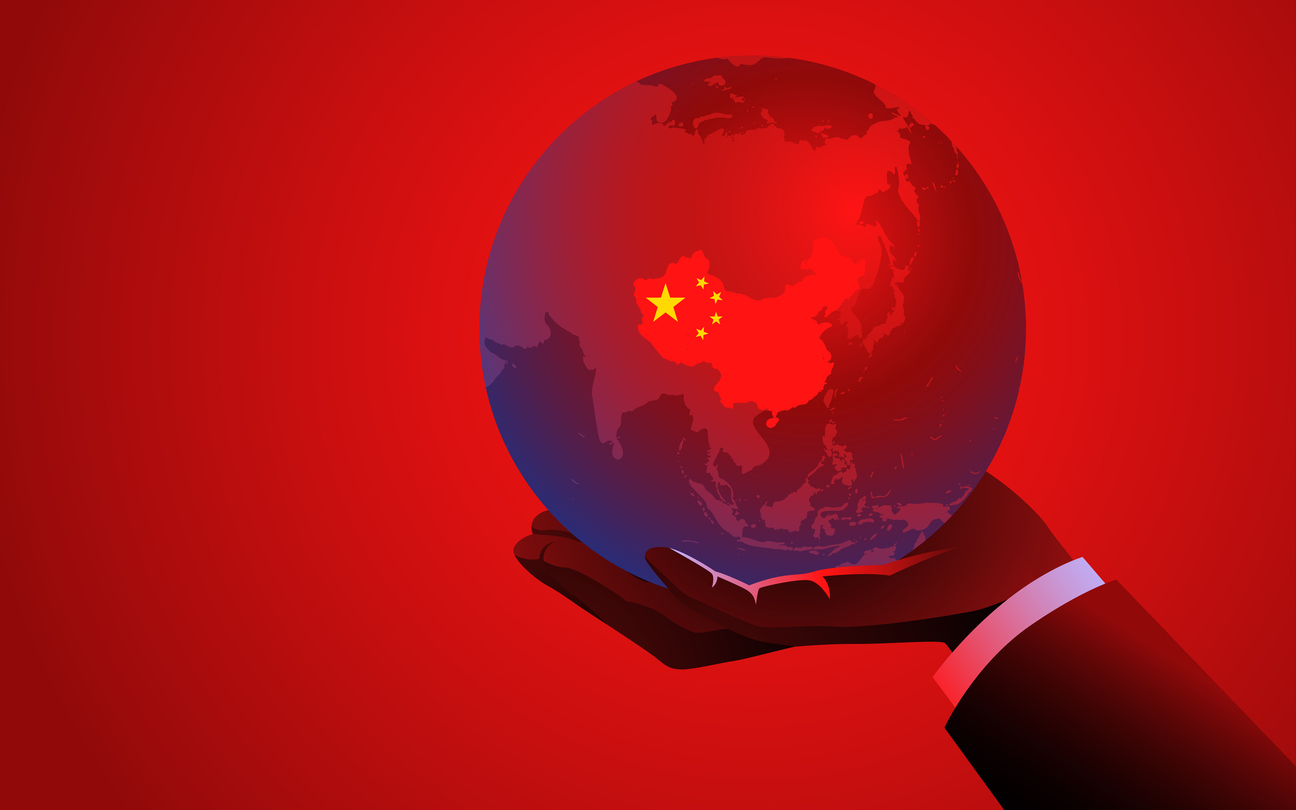
The Hoover Institution Program on the US, China, held a discussion on The Broken China Dream: How to Reform Revived Totalitarianism, on Thursday, February 5th, 2026 from 4:00pm-5:30pm in the Shultz Auditorium, George P. Shultz Building.
When China embarked on its transformative journey of modernization in 1979, many believed the country’s turn toward capitalism would put its totalitarian past to rest and mark the birth of a democratic, open society. Instead, China reverted to a neo-totalitarian state, one backed by one of the fastest-growing, most formidable economies on earth. The book, “The Broken China Dream”, authored by Minxin Pei, pulls back the curtain on the regime of strongman Xi Jinping, revealing why the reforms of the post-Mao era have been reversed on nearly every front—and why the world failed to see it coming.
Minxin Pei delves into the dynamics of China's political landscape, discussing how the dreams of reform has been overshadowed by the resurgence of totalitarianism under Xi Jinping, and why understanding these developments is crucial for comprehending China today.
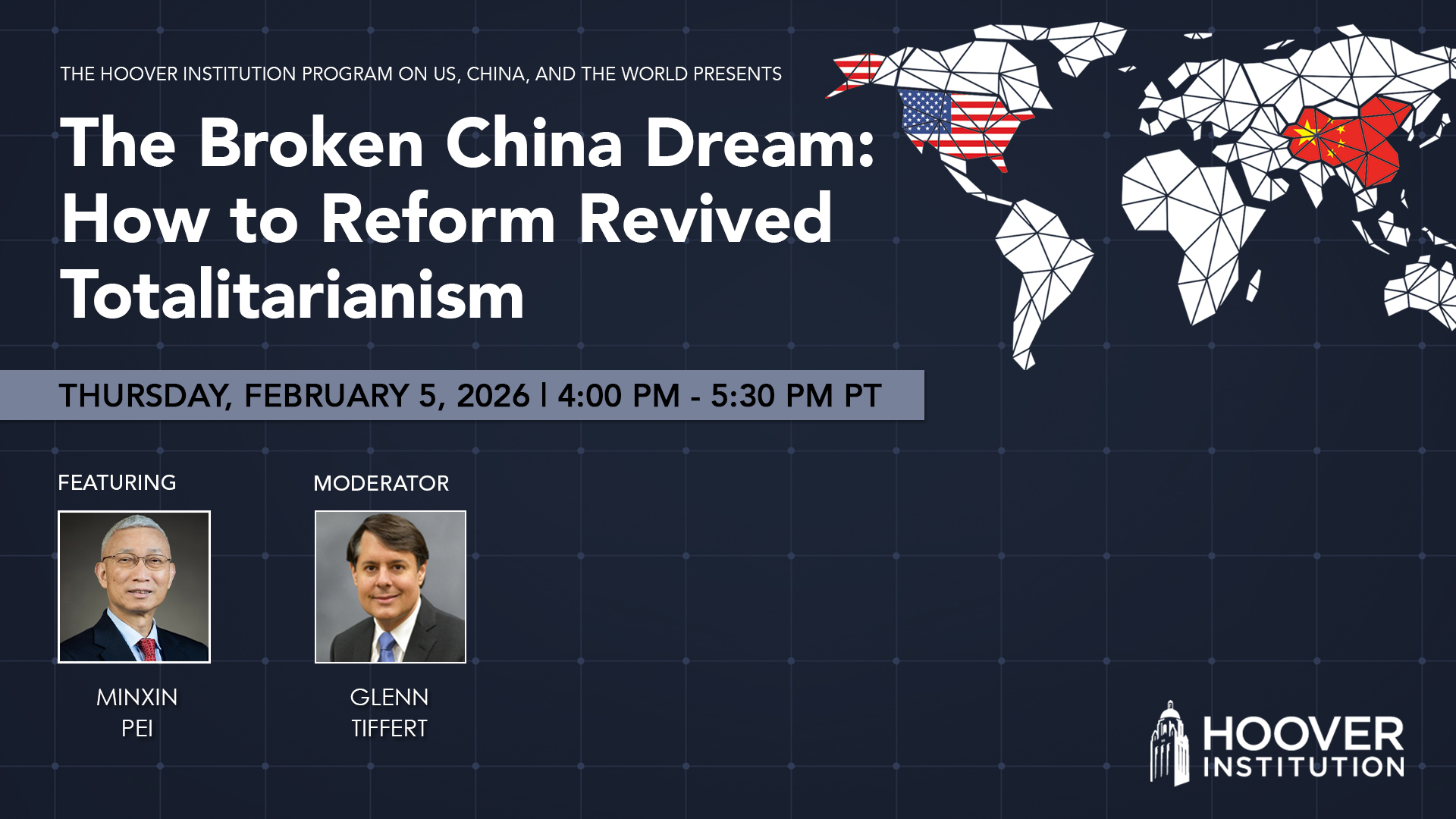
- It's a great pleasure to welcome you here today again for another installment of the Hoover program on the US, China, and the World Speaker Series. It's particularly a joy to welcome Min Chin Pei back to Hoover. Many years ago, MinMin was a national fellow here at the Hoover Institution, and he's a recidivist. He joins us every time he has a book, and, and today is no exception to that really. He's, he's here to share his latest excellent work, which I'll say a little bit more about in a moment. Minchin pays a renowned expert in Chinese politics, governance in the US-China relations. He's currently serving as the Tom and Margot Pritzker 72 Professor of Government at Claremont McKenna College. He served as the inaugural Library of Congress chair on US-China relations in 2019. Before joining Claremont McKenna in 2009, he was for many years a senior associate and director of the China program at the Carnegie Endowment for International Peace. Professor PE is the author of many influential articles and books, including China's Crony Capitalism in 2016, the Sentinel State in 2024, and the subject of today's lecture, the Broken China Dream, how Reform Revived Totalitarianism. It's a great pleasure, professor Pay to welcome you here, and the floor is yours. Thank you.
- Thank you very much, client, it's a real pleasure for me to be here. First, I want to thank the Hoover Institution for organizing today's event. In particular, I want to thank my good friend, mentor colleague, Larry Diamond, for his decades of support. The book is dedicated to Larry. Just to, just so you know, First I want to spend a few minutes on the title, the Broken China Dream. We all know what Xi Jinping's China Dream is, because I, when I pick the title, say what would be a good title? Let's, so I said, well, let's just play. I have on the, the phrase of Xi Jinping, what the China Dream title, because I think his China dream is a very different kind of dream than most Chinese would be dreaming. If I understand him correctly, his dream was a China ruled by one party regime forever, and the one party regime would elevate China to the front ranks of global power. But that's not the kind of dream that I think people like me would like to have. The dream that most Chinese would like to have is a prosperous, free and normal country, but that country, that kind of dream on the Xi Jinping rule is unlikely to be realized. So this is the one, and postal China has three very distinct phases. The most turbulent in the most interesting phase was the 1980s. This is a decade in which China opened up in which all kinds of possibilities existed. The leaders were divided as to where, what kind of policies to have, and also for about decade, you had liberals in the party, you had relatively pragmatic leaders like the party, but you also have Highline conservatives in the party, and the party fought viciously inside the leadership. And the decade ended with the Chairman Square, sorry, sorry, sorry, with the Chairman Square massacre. But it's also a decade that started China's journey toward globalization, global integration. And it was for people who I think a lot of people in the audience actually lived, worked, interacted with China in the 1980s. It is a decade. That was the freest in post 1949, China, just, you just cannot find another decade. Then the second day, the second period, I call this the post-term period, is the dec is the period of China's economic miracle. This is the period in which the party rallied around one very clear ideological strategy, ideological direction, and survival strategy that is economic performance based legitimacy, integration with the global economy, and a great deal of market opening and reform. It all started with Ng Xiaoping's Southern Tour 1992, and it ended with Xi Jin at the rise of Xxi Jinping. So it was during this period that we saw unprecedented economic growth in China, and also this is a period in which lead elite politics was remarkably stable, and foreign policy was relatively pragmatic. So this is this sort, the second decade, distinct decade. Then we have the new Stalinist, new totalitarian period. This is a, the label doesn't matter, but starting with Xi Jinping's rise in, at, in late 2012, we had a return, a revival of a form of dictatorship that most thought would be impossible or unthinkable. So this is, this, is this the crackdown in Hong Kong? This is personality code, and you have a complete shift in foreign policy. So on the surface, these three decades, these three periods appear to be ruptures because each of them is very different from the other. But what I argue in the book is that when you think about it, they all have connections, namely what happened in the 1980s, narrowed the possibilities for future developments, making some, ruling out certain possibilities, but also increasing others. In other words, when we think about the Xi Jinping era, we have to go back to what happened in the 1980s. So let's now look at, I take one step back just to emphasize just how, whether today we are having with what we are seeing in China, in the form of totalitarianism or not, it's actually a pretty big deal to slap this label of totalitarianism on China. I think it's controversial. I, I struggle with this, but at the end of the day, I would say China is now closer to totalitarianism than to authoritarianism. Okay? So, so this is the moist era. Incidentally, this gentleman with this big plaque on his neck is Xi Jinping's father. So this a di cultural revolution and red guards burning books. You have just thousands of people holding a b portrait during cultural revolution. So this is cultural revolution style perge. This is a Xi Jinping style perge. These two were his political rivals. This the, and then instead of mass terror, she relies on state terror. You have the concentration cab in Xin, you have high tech surveillance, and this looks, looks remarkably like this. And this is a corner of the Chinese bookstore. I think Xi Jinping is the world's best selling also. And it's, it makes people like us really upset because we work so hard to get a book published and nobody buys, buys it, right? And he has a team of people, ghost writers tuning out books, filling Chinese bookstore, and all state entities in China have the book buy his books. So, but this is just part of the personality cult. So if you look at these two pictures, I think at a very basic level, you can make a reasonable argument that China has indeed gone back to the future. So now, how did that happen? Because the survivors of MAs rule that one of the top priorities after they regained the power in the 1980s was that never, again, they did not want to see a repeat of totalitarian. This one thing about dictatorships that we often don't appreciate, dictatorships don't like dictators. That is the irony because dictatorships that have dictators make elite in dictatorships, insecure, unsafe. So what oping, and that's his ideological rival ing there is conservative. He was exiled. He did not suffer directly on the Mao. He was locked up in China's infamous jail for senior country. And once he came out, this is what he said, I was locked up by the KT before 49. Believe me, the cha, the Communist party's jail is much worse than K t's jail. So these were the victims of MA's rule, and they were determined not to have another amount to terrorize the party again. So they implemented a set of reforms in the 1980s. The primary goal was really to restore collective leadership, to introduce and establish increment, a set of rules to make the party, to make elite politics a lot more predictable, a lot more rule-based, a lot less vicious. So in other words, you say normalized dictatorship. But at the same time, they faced enormous DIC difficulties in making these reforms work is that first of all, these reforms cannot touch the underlying loneliness system because this is how the parties power is going to be based and exercised. And the other problem with them that they also want to maintain their own discretion. That's a feature of all autocracies. They just want, they don't want them to be bound by rules. And another problem, they re they even though they did not like ma for what he did to them and to the party, they still had to defend MA's legacy. So they operated within very serious constraints. And so I want to show just one example. For a long time, there was this perception about the Chinese system that China had, retirement had age limits and term limits. That is true only for ministers, provincial governors. It's not true for Bual members. So there were never explicit limits of age and terms for poly bill members for a reason, because in the early 1980s, all these aging leaders were above 80. So they just could not set those explicit limits. So this is, so, in other words, the Institutionalizations in the 1980s introduced Ping and his colleagues were incomplete. Were in the, in the long run, ineffective. So now let just so make the connection between the institutionalization reforms in the 1980s and what happened on the Xi Jinping's rule. First, the chi, the chi, the Chinese case on the Jin Xi Jinping, historically speaking, is actually the first case in history where a totalitarian system moved away from totalitarian system and then returned. We, we, we just, the Soviet Union did not have to see this, the Eastern Europe, maybe we just don't have too many, too few totalitarian systems around. But this is really the first case. A second as point I want to underscore is that it was unanticipated. Ben did not see this coming. She's the people who, least of all the people who put she in place did not see this coming. And I can back, had they known what was gonna happen on the she, she would not have been picked. And this is because these people were all, a lot of them suffered on the she. So that's one, in retrospect, that is Don and his colleagues build very weak guardrails against the return of somebody like Xi Jinping. I've already talked about the age and term limits. They had very explicit prohibitions against personality code and against a violation of collective leadership. But when you read these provisions, there were no enforcement mechanisms. It, those documents did not say what would happen, how the party would punish people, who would violate these rules and norms. And another thing that Dun and his other colleagues in the 1980s violated these rules all the time, because this is how they purged the two leading reformers in the 1980s. They will fight without following the rules, the party set up. And also, we need to be aware that in a dictatorship, it's impossible to enforce rules in the democracy. We now know it's actually pretty hard. But in a dictatorship, in democracy, we, we really rely, of course, on the goodness of the people in power, right? That's, but that's a very same sort of, kind of sort of defense. But we really rely on third party forces, courts, the media, civil society, public opinion. None of these would exist in a dictatorship. And Don himself brought a lot of responsibility because he was very staunchly against any democracy in society. He saw democracy would undermine his modernization project. And when Dun was in power, he did not push any so-called inner party democracy that is making political competition within the party, somehow more active and binding. So that is sort of why the guardrails were like house of cards. When she pushed against them, against them after he came to power, there was no racist, no resistance. Now come to sort of a this, she himself could not do this. You know, just one man, right? He had to rely on the system. So that gets us to another question. How come totalitarian practices could be restored so quickly? Really overnight, you will see between 20 13, 20 14, many of the things that we thought impossible happened. I remember talking to a very successful entrepreneur who was very big on social media. They had between the couple, they had tens of millions of followers in China, they called Big V, right? Verified. They said, okay, they couldn't touch us. We have some, so much public following. Then fast forward, within a few months, they all disappeared. So this is, so how could that happen? That is because Deng Xiaoping actually kept the, the, the Communist Party under Deng Xin in the 1980s kept intact all the underlying totalitarian institutions. This is the four cardinal principles laid down 1979. This is shortly after he gained power. It's I think March, 1979. And if you read carefully, basically what he's saying, that the communist party system regime, the, the most important institutions, which is coercion and the party's monopoly power could not be touched. So in other words, ra period that is up, toxis rise to power. Totalitarian institutions were preserved, even though what I say, totalitarian practices, that is mass terror personality called internal approach. These are practices, these are not institutions. They were suspended for a lot time. I personally struggle with the term post totalitarian said, what is this? I think now I have a pretty good de it's a definition, it is the preservation of the system without the result or its practices. So in other words, this whole system is like this piece of machinery, which basically has retained its functionalities. The only except thing that happened is that the power was shut off. So here you have the off, off, what, when Xi Jing came to power hissing, play, pushed on switch, and voila, you have the whole system springing back to life. So this is a reflection on how the, the sub totalitarianism returned. To add a little bit, because we have to understand that ING's as a survival strategy for the communist party is something called new authoritarianism. It's a very unique form of autocracy that is, its kind of autocracy that is completely focused on economic development, because that would keep the regime in power. Then did not see one of the sort of f key flaws that he thought. He, when I read Ben's speeches on democracy, on development, he was firmly convinced that democracy was bad for economic development. He would constantly raise objections because there will, there will be different voices and so forth. So he's, so he said, only one party can make decisions, can make economic monetization happen. What he did not realize, maybe he did realize, but he did not say it is under that kind of system, you will have systematic endemic corruption because the, when the wealths grows and the wealths is controlled by a party that is not subject to public scrutiny, media and so forth, you could have corruption. That's, that's what happened. Besides the direct impact of corruption. What corruption did was to make a very large group of top elite exposed, either because they're connected or because they can be seen as connected with scandals. So when Xi Jinping came to power, and this, this is one of China's most corrupt officials, and that's the loop. He, he hit, he, he had no difficulty because all he need to do was to investigate them, to show their family connect sort of corrupt. They, they themselves corrupt, so he could get rid of them very quickly. So that's how Deng Xiaoping's reform actually paved the way for the return of total terrorism. Without realizing, and even before Xi jinping's rise, there were warning signs that the system could return. The first warning sign was under Zain 1999 Ong. You said, what about Ong? Ong was a, was a group that had tens of millions of followers. The party decided to, to crush foreign, go, no authoritarian regime would have the same kind of capability, but the Chinese Communist Party crushed foreign ong within a year, I think within few months they just got rid of. So the, the practice is used to crush its vast network of semi-religious followers were extremely brutal, really reminiscent of totalitarianism. So that's one. The other is, you would think that sort of ideologically would not have the same kind of totalitarian practices coming back. This is, this is the guy who now sits in jail. When he became the Ong party chief, he did what Xi Jinping later would do throughout the country. He arrested private entrepreneurs accused of some of getting involved in organized crime, and he began to sing Maoist the sounds. The surprising about him is he was not stopped, actually only one bu standing committee member Hu Jinta did not go to Xing two, because if you go to somebody's place, issues endorsement, Xi Jinping went, everybody went. And for a long time, he was seen as a plausible future. So that also meant that toter, the soil of totalitarianism remained quite fertile in China. So now the question is how come, 'cause the post-human era is a very strange period because it's so unusual for dictatorship. So if it's argued that the institutions of totalitarianism were intact, the guard also were weak. How come collective leadership was preserved for two decades? For two decades, the system appeared to be working, and a lot of seasoned scholars say, okay, China has achieved impossible, resilient authoritarianism, authoritarian institutionalization. My my explanation is it's not institutionalization. Because when you look at the lineup of elites, it was a very strange period in which all the competing factions were more or less equally matched. So my analogy is that this is a period equivalent to multipolar geopolitics. That is, it has some kind of self enforcing mechanism at work. None of factions would like to see another faction become dominant. But toward the end of this era, the, this balance on power began to dissipate. I think it was very weak. John Min was getting old, Al was a very weak leader. So this was not main maintained. Okay, so now let me now quickly, so the deal with this issue, because another question we ask about China is how come economic modernization has not led to democracy? Did, did the West miscalculate and so forth Here, I want to, because La Larry is one of the words leading scholars on d democracy. And Larry can correct me, even though I think this is a former of Stanford professor read a towering figure in political sociology and political science. Even though we have a very solid relationship between the existence of democracy and the level of wealth, we actually do not know how the pro how economic development will bring about democracy. These are two very different questions. We can identify a few plausible explanations, but when you use whatever methodology approach, you just don't have a very clear answer. That is to develop a very clear theory backed by evidence that will shows that a lev a given level of increase in your economic development would actually increase the probability of a country becoming democratic. We just don't have that kind of research to show this. On the other hand, I think much more recent scholarship shows that this relationship does not exist. That says there is no such thing as a linear relationship between the level of economic development and the country's probability of becoming democracy. So this is the, the person who made this really important finding. At the same time, we actually look at how countries democratize through the process of reform, not revolution. And the conclusion is very clear. It's the in, it's the elites within the ruling regime. You have to, in other words, it had to come from within the regime. Now, so in other words, we have to look at the role of the Chinese Communist Party. And now why that did not happen in the 1980s, there was extra very narrow window because for a country to have to transition from dictatorship to democracy, the precondition is not give a certain level of economic development. The precondition is reformers inside the regime. So in the 1980s, we had two extraordinary individuals serving as the secretary, general general secretaries of the Chinese Communist Party who, and ban was purging 19 7 87. He was succeeded by Z Zian. Not much is known outside China, about one project undertaken by z Zian to reform the political system. This is a 1980s. It was elite led attempt to change the system. It was really modest. He would say it's a plan to reform a authoritarian system into much more authoritarian system. And he trusted his, he entrusted the task to his advisor, to the, the plan was drafted ing actually sort of said, endorsed it, but the party did not accept and ine actually toward the end, didn't like the plan at all because it, it, it would weaken the party. And then T Square happened. So there was this sort of, what should I say, anecdote that should, that China could have been different. When you think about his happened, just think who would be the leaders we actually know. He would be, he would succeed and then he would give his success will be another reformer. So it will be a very, very different kind of situation. Of course, you can fantasize about another China here. I also want to say something positive about modernization. Economic development. Economic development may not have changed the Chinese Communist Party, but it did change Chinese society. A lot of positive developments occurred in China. In in the post-term period. You had protest. You had much more aggressive semi official media, citizen journalism. You have lawyers. This is really hero, my hero, this, his name is, he's now serving in 15 years. Jail sentence just to illustrate the difference between the post period and QME period. He got his national thing by suing the government for enforcing an unconstitutional regulation on vagrancy. And the government abolished this as a result. And after he became nationally famous, he ran for local people's Congress in Beijing, got elected twice, and he was not prevented from serving. He found an NGO. Now, fast forward to the Xi Jinping era. The year after Xi Jinping came to power, he was arrested, accused of charged with some ridiculous crime, put in jail for three years or four years. Then just then he was let out, he wrote a letter to Xi Jin, a public denouncing Xi Jinping's handling of COVID. He was arrested and now he's serving 15 years. Just see the night and day. So Chinese society has been transformed, but unfortunately all these positive changes happened at the periphery of the political system as long as the political system itself has not changed. So now why, why didn't the Chinese political system change? Let's now revert to the collapse of the Soviet Union. The collapse of the Soviet Union was one of the things the communist party of China studied the most. My joke is that to find a real expert of the collapse of the Soviet Union, you actually go to Beijing because they have, they published lots of books. They have a documentary. What they've learned is that in order to prevent another Soviet, another collapse of the Soviet collapse in China, similar to Soviet Union, you've got to prevent reformers from emerging from within. This is what Ng Xiaoping said. If China would have a problem, the problem would emerge from within the Communist party. He knew. So in the post-term era, it no reformers could rise to the top. And, and at the same time, they've learned a lot from Kamen and from Soviet Union. That is, you've got to increase your coercive capacity. So one thing you may not be aware of, the, when Kamen protests happened, China had no specially trained anti right police. They did not, I don't think they even had gas canisters. In other words, they were totally unprepared. But of course, the 19 days was a, a decade of liberal opening and so forth. You could explain that. But after the 1980s, the party began to invest systematically in its coercive capacity. So that's the cultivated nationalism. And so they found a new survival strategy that worked until it stopped working when, okay, I think I've spoken long enough. So we'll cover this and if you want to talk about sort of how China's engagement law ended in the confrontation between China and the West, we can deal with that in the q and a. Thank you very much.
- Thanks for a great presentation, Nin, since we're here at a university, let's put our yes professorial hats on for a minute. You, you said a very important word, linear Yes. In your discussion about the relationship between democratization and wealth. Yes. And one of the terms that arises in your book is path determinism. Yes. Which is a sort of a linear kind of argument. Basically the idea that once you start down a road yes, it gets progressively harder to change the path that you're on from the vantage of 1989. Yes. It certainly looks like a universe of more pluralistic options began to close for
- China. Yes.
- And that's a linear explanation. Explanation. You show the narrowing Yeah. Of options, right? Yes. And it's sort of a supreme irony that under Xi Jinping, who has been the greatest critic of economic evolution, yes. He's pursuing a path of political evolution. Yes. In a way, right? But let me propose an alternative. Okay. Okay. I'm a, a historian. Yeah. We think about periodization differently. To me, you could say that the 1980s might be the trough in a sine wave that is varied in amplitude over time. Okay? Sometimes you get more authoritarianism, totalitarianism, sometimes you get a little bit less. But the point is that there is a cycle here. And the 1980s was this post-traumatic period after the cultural revolution in which the party was still decentered.
- Yes. - Right? So as you say, things were in flux and in balance somewhat, which created opportunities for other ideas to flourish. And there was a moment at which alternative futures were possible. But of course, that ended in bloodshed when the parties sort of found its feet again and asserted itself when its unity and survival were very much at stake. Right? So this idea of sort of thesis antithesis synthesis cycling has been a part of the life of the CCP really from its foundings. You could even go back to Yan and the, and the rectification movement or the anti-US campaign and so forth. It's this idea that Trotsky introduced a permanent revolution. It how a revolutionary party renews itself. And the reason that I mention it is because if you think of it that way, then the path does not necessarily lead to a cul-de-sac, you know, of involution, right? Yes. Where the straight line of options narrows to an infinitesimal point. There is a possibility at which new moments may arise where the, where back in a trough, you know, where opportunities may present themselves for a more pluralistic future for China to emerge. So I'm wondering what you think about that and whether you think, as you mentioned, China has changed, even if the system hasn't, if the last 40 years of economic and social development have in fact made it easier for a transition to a more pluralistic China when the opportunity presents itself,
- I would say it would make it easier because when I reflect on the modernization theory, I think everything else being equal, if a authoritarian regime or even to the terror regime, such as the post authoritarian regime such as garbage of Soviet Union, when the elites make the decision to exit power or change the system, the likelihood of a successful transition would be greater in a much more developed society than in a less developed society. Because you're going to have a lot more social capital and all the, all the other good things that would support a new democracy. Right. So that is, so that, on that point, I totally agree with you, but if I understand your question correctly, I think what you seem to imply is that in this sort of cyclical, or what have you called it, the wavelike, some historical pattern, if that pattern is real, then we are probably going to see a breakthrough at some point. So the, or see the sort of a, another possibility of dramatic change that is the, so the end of the she period could be, could present China with a, with a, with a window of opportunity. Not that dissimilar to the end of the moist period. Where I actually, I can be quite optimistic on that. I think that I've, I've said this many times on c scan, the, the, the party tends to swing wildly. You can see its policy swing stuff from Mao to, and then just back to she. And a lot of that really depends on how destructive or self-destructive the, the regime is. The, the master regime is really self-destructive. So that would bring the party, that would give them champagne, the mandate to make changes. So in the case of Xi Jining, if by the time he exits the political scene, China is a horrible state, then I think we, we should be prepared for some very dramatic changes.
- Yeah. No.
- So let's see. So that's, that's, that's according to that, that is certain not linear. Yeah.
- Right. So let me pull Yeah, go ahead.
- So, but I wanna say past dependence is a different concept. It seems that certain things, if you want to, that they just make change much harder. Yeah. Or make, so incremental changes much harder. But then if you want to make changes, then you're much likely to have rupture.
- Right. Right. Let's talk about this idea of rupture. Yes. Then, or the possibility of it, you know, some people see a really different China than the broken one.
- Okay.
- That's described in your book, and it's easy to understand why. Yeah. Right. You open up the newspaper, you see a China, and certainly China's not shy about Yes. Telling you Yes. You know, China's powering from strength to strength, high speed rail, affordable, high quality electric vehicles, these amazing AI models, a new surging biotechnology sector. Yes. Wind, nuclear, all of these things. Right. That's a China that's very much in contrast with the broken dream hypothesis. Yeah. And there can be many China's coexisting at once, which is one of the most interesting things about China. But do you think that there is a reckoning between these two Chinas that is simply a matter of time in which, you know, the, the, the China of the hyper modern ultra, the high stakes gamble Xi Jinping is making,
- Yeah.
- Techno nationalism will run out of steam and we will maybe hit that rupture or that reckoning. How sustainable is that China?
- Yeah. First, I think there are certain aspects of China that are truly successful. Impressive, right? You, you see that we, we all see them. Then you ask the question, if that is the case, how come the economic momentum is clearly dissipating? It's not increasing. They made several major policy mistakes. They can take off some successes like ev as others, but the big ones, the huge credit bubble. This is holding, you know, when, when you look at it, it's in the book. When you look at, when China begin to lose the momentum, it's actually around 2008 and they start blowing this gigantic credit bubble. And we, when you look at Xi Jinping's first decade in power, he did not putting any serious economic reforms to deal with well-known problems. Fiscal, there's a long list. So that's why, and the real estate bubble connected with this. So now they're dealing with the aftermath. So these are, so we can look at the sort of achievements, but the really big ones, and also when you look at the issue we are all aware of that is demography. They were warn many, many years ago. It's not just, and when does Xi Jinping start making adjustments? 2015. Mine is, if you have some, if the, I think you can have two, you still, this is not the image of a decisive leader, right. Because I think it corrected quite later. So, so that is, and also I think we hear a lot about decoupling in this, but for the last, until the last five or six years ago, Chinese economy was deeply integrated into the global economy. Still today is, but if your foreign policy is going to antagonize your most valuable, most important trading partners, don't you think you should actually think about the consequences? I, that's an important point that I think could be learned more broadly. It is that that is, if you want to sort of be mean to your customers, don't you think they're gonna come and buy stuff from you? So I think a lot of things they, they not think about. It's, it's so remarkable when you, that real policy shift on the Xi Jinping occurred in 2020. This is when the party put out a blue print for the 14th five year plan. This is actually, you need to read, it's a, it will be his, it's a historic document. It's gradually shifted. You say, why 2020 probably should do this sooner because his foreign policy shifted, began immediately after came to power. Right, right. Building those islands don't just mean you should actually come. So anticipate the global blowback. So that's, so there a lot of other things, of course, you know, where did these achievements come from? I think the Chinese state has received deserved credit. It, it should deserve some credit because it actually spend a lot of money. This, I mean this is part, but when you see who the actual producers are, they are, they're private entrepreneurs. Yeah. They're not stay, are challenged to find one SOE one single stay entity of the EV makers. And I think there's one, one or two ev, but solar, all the others battery power, they're all prime entrepreneurs.
- So I want to turn to our in person and our online audience in just a moment, but let me, let me leave you with one last question. And that is, you mentioned the really intensive study that happened across the 1990s of the collapse of the Soviet Union and the lessons that the party drew from it. You used the term New Cold War in the book. Yes. Right. That we are now in a new Cold war with China. So what do you think the lessons that the United States could learn from the old Cold War with the Soviet Union might be, that could inform United States thinking about where China is today and what might be the wrong lessons to draw from that
- Period? Yeah, it's, I actually teach a course called the New Cohort, so I, I should be able to answer this question. I think I, I'm not so sure whether the US has actually learned the right lessons from the cohort war. It's highly political. Who, how was the Cold War one? There's no consensus in this country. I mean, you say Reagan's tough policy, the Soviet, the people I sort of respect lot, these are the Russian scholars start people who started rushing domestic pilots, it's garbage off. So I actually tend to believe that they're right because changes come from within excellent pressure sort of helps, if I have to say sort of the right lessons is that first most important lesson is to prevent cold war from turning hot. This is the, the most important lesson. And I don't think we are paying enough attention to that. So that is one. And second is, I think to some extent we are trying to fight the OCO war because we know how to do it. The US was much more advantageously positioned and the Soviet Union kept shooting itself in the foot. So that's the ideal situation. And I think there's probably less appreciation of sort of the new opponent. China, the new adversary is thinking about this because one thing about the Chinese Communist Party is that despite all its mistakes and so forth, it's, it actually pays a lot of attention to history. It's, it learns a lot from, it tries to learn a lot. So, so probably if I were inside the Chinese regime as know a little bit about what their strategies, they try not to fight the OG war because they know it's, they at least they don't want to make the same mistakes. But, you know, if you have a political system that is not that different from the Soviet system, then you political evolution that that could sort of, despite their best efforts, they might make the same mistakes.
- Thank you. So to the audience and Larry, please.
- So you mentioned four means by which the CCP has tried to respond to modernization and keep a lid on the potential, you know, democratizing implications of modernization. And you spoke about the first two and then you, I think were feeling that you were running out of time and didn't say much about the, the last two. So they were preventing the rise of reformists in incre increasing coercive capacity, which you talked about in your previous book, and then promoting nationalism and sustaining economic growth. So I have a pair of questions about the, the second two.
- Yeah.
- Number one with res, well I assume we you will allow an extension of the promoting nationalism to include the whole kind of propaganda campaign. Campaign Yes. Surrounding Yes, the, the facilitation or encouragement of nationalism Yeah. To, you know, getting young people to have the correct ideas Yeah. And sealing 'em off from the incorrect ideas. And so question one is how's that going? And it seems like it's had some impact from the anecdotal evidence we hear. I'm not inclined to wanna believe that, but I can't ignore the, an anecdotal evidence I'm hearing. And then the second question is kind of left hanging from everything you've said, which is that what happens if the carousel stops moving? And you know, we not only get a slowdown in economic growth, that's obviously happened and, and was inevitable, but we basically get, you know, an entry into what has been speculated as a way of dealing with these contradictions that you are articulating, which is potentially an extended period that looks a lot like Japanese style stagnation. Yeah.
- For a while I was skeptic about nationalism, say, could this thing really work? Now I tend to give the Chinese Comm party a lot of credit for doing something that I used to be skeptical about. I think it worked, it was far more successful than most of us would realize because the picture is, I, when, when I teach Chinese national, I would put two pictures, 10 years apart, statue of the Goddess of Liberty facing miles portrait on Chairman, and then the trash, the US Embassy in May, 1999, 10 years apart. How can we, these students who trashed the US Embassy strongly after the accidental bombing of the Chinese embassy in Belgrade, they, they did this spontaneously. They were not sub, the government did not send them, they had to act as rioters. So that's, and that sub dealing, so based on a lot of observations, social media, popular culture. And so that is, I think that still helps how long that's going to sustain the party in environment of economic downturn. We don't know because this is just happening. So in terms of economic downturn, my observation, it has to be quite like extended. Three years wouldn't do it, probably it would take a decade. So now we date the downturns of 2023 after COVID, well only the fourth year into this. So I think it's, we, we still need to give it a few more years to know, but this does not mean the party is not worried. I think the're very, very concerned about their inability to turn this big, to turn around the economy.
- You know, there was this moment to Larry question right after COVID in which an entire generation, I think experienced maybe the party wasn't as competent as it, as it professed to be, and their followed by the economic slowdown and the despair in your observation, has that stuck among younger people, which is in dissonance with the sort of nationalism that they're being taught. Maybe the party is bungling it after all.
- Yeah, it's a, that certainly is a big stumble, but we need to see another, because you need to reinforce it. It's not like the cultural evolution of several big things. Maybe the sort of a what the perge could be a, the, the, the political shock of the perge at the popular level could be something that people will start asking questions about.
- I see. Yeah. Thanks so much Minchin great book, which as you know, I've read and, and great talk. So I'm trying to think about how to phrase this question. Maybe I have like a, a half a question and a question. And the half a question is, Don, you think it's possible to have both chin Chinese people be nationalistic on the one hand when it comes to looking at China's role on the global stage, but disaffected domestically in how they think about some of the governing policies for the people in the society so that can coexist, right? And so that's the one, the one question. The other is the question I personally hate the most when I get it. But I'm gonna ask you because maybe you're gonna gimme something that I can just copy in the future, and that is, I mean your, your sort of analysis is a lot about institutions and the robustness of them and the, the parties put in place and then the importance of the leader, right? And that's, so with the Chinese people themselves, you said change comes from within. What do you see as the path forward that gets China past the institutions and to fundamental political reform? What do you see as the most likely confluence of, of sort of, you know, indicators of, of, of, of factors that would lead to that?
- Yeah, I had both the good fortune, the bad fortune of growing up in Ma China. So my f of reference is that period, four years before Mo died, people begin to think about what happens. That's a very positive change because when you start thinking about life after a certain leader, then you begin to sort of do things, right? So that is the other, another thing is that this awesome we, the most period people did not talk to each other, but people were not dumb. They felt that things were really bad. Not just ordinary people. I was a teenager, I was working in a factory. But educate people, people within the party were thinking about this. So in other words, if I have to sort of see how things would happen, is it's like invisible. I wouldn't say disease awareness that things cannot go on like this. I mean, I like, if you recall what Gorbachev in Gorbachev's memoir, this is the nine that before he became, he said, we could not go on living like this. I think that is the moment hope is born. And that is not just ordinary people, it has to be inside the party. Of course people in the party, they are double faced, right? They were shout the slogans would pledge allegiance to the party Xi and so forth, but inside they're thinking that these are real people and then gradually this invisible coordination, he said they all feel that way. So, and I'm sure that right now quite a number of people, often it's impossible to verify, but a lot of people know that China is not moving in the right direction. And a few years from now, if she does not change and I don't think he's going to change because his entire political fortune is tied to his policy, then things are going to get worse and then the sense will spread will intensify. So this is all I can think of. Okay,
- Jean and then Rowena.
- Thank you. I have to say I really look forward to reading the book, but I wanna take you to your title.
- Yes.
- Because I wanna ask you what you mean by this totalitarianism or I think you also used the word neo totalitarianism. So what do you mean? And I, I also want to then I, once I hear what your definition is, to understand quote, how quote effective is it? Because depending on how effective is it, we then question how do you get to these changes that you're sort of hinting at? And that would lead you to actually in the end be optimistic.
- Okay, so thank you this, because this is just one word that gave me a lot of trouble in the cause of writing a book because you have to sort of, now you, so you think about totalitarian in, so two, using two methods. One is so-called categorical. You build, you develop a list check boxes that China meet. The other is you must continuum, that is on our end, on one end, you at one end you would say this is typical author dictatorship. You can authoritarian regime. My word is garden variety authoritarian regime. Then the other is extreme would be totalitarian rule. So, so first look at the, the list we are familiar with, right? You have a totalitarian party, you have totalitarian leader, you have the use of terror as a means of governing constant purchase within the party. You have complete control of the coercive force, you have the complete control of the bureaucracy, you have complete control of the economy, you have official ideology. So if you go down the list and say today, where would China sort of fit? Where would Xi Jinping and China fit? I was, ill fit at least sort of most of the category to leader use of terror, purchase personality, coach controlled, coercive capacity. I think where he falls short is really the economy. This is where I still have a lot of hope for that. And despite the, the fact that the economy, economy alone cannot change the political system ideology, I think he's, he's, he cannot, he can institute fear, but he cannot make people believe mal again, he cannot make people believe communism again. So I think this is sort of a, that's why it falls short. It's not completely totalitarian, but it's not, you know, a lot of the stuff that is totalitarian is still there in the institution. Then you look at the continuum, that one end and another, let's say the middle part is the middle point is five, extreme totalitarianism is classic totalitarianism, sadism is 10, I think Chinese at least seven, right? I I wouldn't say it's five. I think on the hu jinta probably it'll be four or three. It was moving in that direction. But today, I, I, so I think I'm, if I have to make a mistake, I would rather say it's toter rather than authoritarian. Initially the said, the revive of authoritarian is, must say authoritarian never went away. So anyway, so this is you, thank you for sort of neo, I think neo party is to, you know, when, when you have trouble, we always put Neil in there. If, if it's in good works really hard. It's in terms of, of conceptualizing the regime type.
- Thank you so much, hin, I'm so glad that you brought up Xi and I think those two examples actually are indications of what China has become. I remember right after Po Tian and Xi, they were advocating citizenship movement with love. So that was the time of hope and all the way up to, I remember when, when VOA was closed down the, this dark message posted by about what's happening inside China and outside. And my question to you would be more like, I've been watching congratulations for the new book about this broken China gym nightmare to us. So I, I watched from the first, the rising China time of the China transition, the chap transition, the first book, and all the way you have been very perceptive from even the time when the whole world was having this illusion about China. So I just wonder if it's fair to say that all the way from 89 post mile to 89 post of totalitarian nationalism up till now, is it fair if we just quote what Ross said, like if you look at 1979 democracy crackdown, you will know that they would never serious about political reform even in the 1980s. And that's why 18 national come as a surprise. So I wonder if that actually can explain all the way up to where are today, because from day one, even 79, 78, end of 78, 79, they were never, ever serious about political reform in China.
- Okay, well, my political awakening occurred a lot later. My first book was quite positive actually, but China, from reform to revolution, I saw China probably had a better route than the Soviet Union. My real awakening was China's trap transition, that's 20, 20 years ago. In essence, you know, when you look at the logic, but by that time they were slowing down in changing the political system. So, so I think from then on I stayed on the right track. So today, even though the book, it's a, it's a very sort of tragic story, you know, because when you think about China, it's how better it could have become. And the Chinese peoples saw how working and the, they deserve much better. But then they have somebody who think, who thinks that 1950s were the best period for China. Okay? Then he tries to reinstitute the system. But I think after she we're going to have an opportunity for change, I'm actually quite confident that my goal is to be alive, to see that a day. Because I saw how, I think, I remember the exact day what, how I felt when mom died. Okay? Because that was the moment of change. I was genuinely happy. Of course, you could not reveal it. I was 19 because we went through such such horrible 10 years, my teenage years, right? So we were filled with hope and the country, you know, then, then people like me, our generation were really beneficiaries of reform and opening and also engagement between China and the West. I would never have received such great education and be here today without that period. So I, I think China still has a chance.
- Jane, let's turn to our online audience for a moment.
- Sure. Chinese society has undergone significant transformation since 2000 compared to the Mao and dung Aras. What are the underlying forces driving the significant transformations in Chinese society since 2000, particularly under Xi compared to the who, when period, where do you see the primary sources of change or resistance and how might these dynamics influence future political developments?
- Yeah, I think most obviously is the sort of information sphere, because now despite the best efforts by the Chinese government, it still cannot control all the information. It's not like March the period. You just, you had nothing, you could not gain access to information. So that is one. And the second, I would say private wealth and Chinese people today do have financial means to be independent, not to be part of the system, unlike the cultural revolution days, you are either impoverished in the countryside or you are part of the state system. There's no nothing in between. But today you actually have a lot of sort, what I call real private space, right? And so people can, are capable of thinking today Chinese, most Chinese people are pretty well educated. That is the kind of education. When I applied to college, I think only 1% of Chinese population was college educated. Today it's at least 15 to 20%. So we talking about are really very different, of course different society. We don't know the political manifestation effects of these changes. But I can bet, you know, once the lid opens up a little bit, you're gonna see just massive change. Democracy war, if you remember the 19 79, 78, 79, that kind of change is conceivable. Even the chairman protests the 1980s, a lot of us were complaining about students being too materialistic. As, as they showed us how wrong we were in spring 1989.
- I wanted to ask you, she has made no secret that he wants to retake Taiwan. You mentioned that we wanna avoid turning a cold war into a hot war. That would maybe be a test of that. So I wanted to get your opinion on, you know, will he go through with this and risk, you know, maybe his own leadership, the, the party control. Because even if they win and it doesn't turn into a a, a tit for tat battle with, with the US and, and our allies, I'm sure China will face consequences, maybe more isolation, deglobalization, economic impacts and things like that. And are they willing to, to risk even that? And then the worst case outcome is, you know, whatever apocalypse,
- I think she, the Chinese communist Party, the Chinese government would like to take Taiwan if the price is right. Okay, so we don't know what the price is. I think if the cost is a clear military defeat, they would not do it because this is not worth it. And if the cost is just economic isolation, they would do it because, you know, China was poor for decades. This is nothing new. I think the, the kind of economic we, when you think about these things, don't never think in economic terms, always thinking security terms and in regime security because a military defeat would be followed by big problems within the Chinese. If it's just economic hardship, they can survive. Just think about Saddam's, Iraq after Gulf War, more than a decade, really sort of horrible sanctions and survive. It took innovation to get rid of Saddam. So I, I don't think some economic hardship alarmed so, but so far they militarily they still have worries about the, the, the probability of success. So I think as long as that remains true, probably that's a safe way of, that's the sort of defective way of maintaining peace. But at the same time, it's much more complex because we have another party in Taiwan that does its own thing and we have people in Washington that thinks very differently than people in China. So you have a three way, a three party game that is, that can cause unintended crisis. If crisis is not managed effectively, it could really lead to serious conflict.
- Thank you so much for wonderful talk today. Two questions please. On Venezuela, knowing that they were an important oil partner. Yes. What I'm, I'm surprised that there hasn't been a, a stronger reaction or maybe there was something that I missed about that and maybe is that giving them some empowerment to take over Taiwan? You know, you do this, I do this, that kind of quid pro quo. The second is on your, your wonderful presentation, there were the four cardinal principles. Yes. If you could please explain what that means. The second one, preserve the people's democratic dictatorship. I didn't understand
- That. Oh,
- Okay. So thank you
- Democrat. Yeah, yeah. The, the,
- So that's the question. Thank you.
- The second one, first, the, the communist party is really good at Orian speak, double speak. Okay. So people's democratic dictatorship, it's dictatorship, pure and simple. It's not people, it's not democratic, it's dictatorship, it's coercion that we want to keep our course of capacity and we want to deal with anybody who challenges us very, very harshly. This is, that's how Tama happened, right? This is so, okay, Venezuela. So two things because one is how important is Venezuela in terms of oil? It's nothing. It's like 2% of it's important only in the financial sense because China loaned Venezuela, I don't know how much money still so in terms of loans, but it's a lot. So they are much more worried about getting their loan back. Ironically, what has happened has increased the probability of they're getting their money back. They don't care about Maduro. Right? But the current administration's policy of maintaining stability, getting the oil industry working, again, I think China would love that because that will increase Venezuela's repayment capabilities in terms of whether Venezuela would give China and excuse, I don't think they actually believe in international law that much. So it's not, I think they're not gonna make the decision on the basis of the US copy, okay, because this is, we want to do this. They're much more pragmatic is can we actually do this and get away with this? I think what they admire the US is the US can do a lot and get away with it. That's why they want to be another superpower. Right.
- You know, on the people's democratic dictatorship point, yes. It's, I, I love starting there. When I talk to people in countries that are post socialist, because it's an article one of the PRC constitution where the state self-identifies as the people's democratic dictatorship. And anyone in a post socialist nation, say in Eastern Europe or Central Asia who's 50 years old and older, a light bulb goes off in their head and they're like, oh yeah, we know about those. Right. And it changes the frame of reference completely. Yeah. And it's a very useful way for positioning, you know, conversations. Yeah,
- I was just wondering how you feel into the current state of events. People make comparisons and so you know what some of the coverage says is that in China people look at the way the US handled COD and all these dead bodies and that, you know, maybe their system wasn't so bad, or if the US loses its reserve currency status and that hurts our economy. Or just, the other thing I've heard is that people in China are very concerned about anarchy and to them maybe a more stronger central government prevents anarchy because of history of riots or something like that. Could you address some of those? You know, we may not be the best, but we're better than the other systems.
- Yeah. First really quite a lot. First the COVID issue, I would say China handled COVID pretty well before Omicron and then sort of, it really mishandled mostly because I would argue that Xi Jinping did not want to see a spike in COVID related deaths before his, before the party Congress. So that's, and in fact after COVID, after say reopened, there was this surge of deaths in total between a, a couple of estimates, a lot of, I think at least 2 million or 0.1, 1.5 to 2 million people died. You know, the stories are real. You had to bribe crematorium to get the bodies cremated. This is, this is not sort of an example of effective government mishandled, not, I want to stay away from reserve currency. One thing about Chinese stability, I can bet stability is a universal value, but then revolutions, right, still happen. So how do you explain this of contradiction? Because up to point, if the government really does not, if the government really screws things up, then you're gonna have instability. You're gonna have revolutions. So I, I would not rule out protests and other events, destabilizing events, despite the fact that most Chinese would like to have stability. In fact, I think the Chinese Communist Party is really good at maximizing, taking advantage of most Chinese people's. Very understandable. Emphasis on stability. This is a country where instability is the norm and stability is actually deception where you look at. So if you, you look at Chinese history, I think once I calculated the number of years when China was actually split into different parts, roughly equal, there is a number of years when China was a unified entity and the number of years China was actually splintered. So that, that's why I think for people with that kind of history is naturally like stability.
- We have a question from the online audience. Jane.
- How does the friendship with Russia or friendship, without limits with Russia influence the potential for change in China? Is it reinforcing or undermining this opportunity?
- I think probably it's irrelevant, that aspect. You know, if anything, I think it would be a net liability because Russia would, of course French, French with Russia carries a huge diplomatic cost for China in the context of China's relationship with Europe, right? So that is not, and in the future when you think what can Russia do for China? Very limited, except in a geopolitical sense giving China a lot of diplomatic, geo diplomatic support. So that's, so I, so I just don't see a lot of upside. But Russia is very important for China as a geopolitical partner in the context of the new world. Okay.
- I, we have room for two more. We'll end where we started with Larry. But first let take this one.
- I thank you very much for joining us, Dr. Pei. I find your argument to be quite provocative, you know, disagreeing with the idea of authoritarian institutionalization and saying that generally the, the setup of post 79 was setting it up such that we were going, China was going to revert to totalitarianism eventually. I guess my question to you is, considering sort of the, the forewarning signs and the various weaknesses of the attempt to institutionalization, how do you rate Xi Jinping personally, his agency in that process of reversion? Of totalitarianism? Like do you think a Boise Lai could have accomplished it? Was there bound to be a Xi Jinping figure eventually, like is the one man rule, the equilibrium stasis for the Chinese Communist Party?
- Okay, now we we're talking about serious political science. Yeah, I think agency is that if in the book I said he's an accident waiting to happen. So she himself, in fact, when you look at his rise to power, it was accidental. He was not destined to be the leader. He was always part of this group. Okay. So, but once somebody with his ambition, his political skill, his political ruthlessness, the system could not stop him. The system. And I would say the system could not have stopped Bush. He was not stopped in Xi, he was stopped by his police chief whom he slept and who decided to go to the US consulate. That's an excellent, right? So it's, so I think sort of in this case, that is, we have to look at the system, the fragility, the weaknesses of the system. Because if it would not, she, somebody who came along who was ambitious and ruthless enough who can do it, and you can actually reflect on this country, just, just one man can see, can actually do so much. Where we did not know that there were so many cracks. The guard rail is really fridge fragile, right? Until now. And so I would say probably she himself did not anticipate this because a lot of was say, oh, the guy had this, but he, to push fence fell. They had begun push against the war there. Nothing good started.
- Thank you very much Dr. Pei, knowing kind of your previous stance on Hong Kong
- Yes.
- And the development of that, what is your current impressions of Hong Kong and its future of both good and bad on the political and social structure?
- So first I wanna say what has happened to Hong Kong is one of the worst mistakes. Think about, it's so unnecessary. It's overkill. It, it has the down so much damage for China's credibility in the international community. And as it's completely overreaction to what was happening in Hong Kong. So, so, and one of the worst mistakes Xi JB has made when 10, when 30 years from now, historians the party reflect on this period. I think this had to be one of those. Now I think Hong Kong that, because I, I was born in Shanghai. Shanghai in the fifties might be something people in Hong Kong should look at. Shanghai. When the Communist party took over China, Shanghai was very, very dynamic. Every bit of this, like Hong, like Hong Kong, probably even more so. But within three, six years it was completely tamed, domesticated by the Chinese new system. So I'm very worried about sort of what Hong Kong would look like a decade from now. Maybe it would take longer, but once the party wants to exercise, full control has a playbook. So you'll have party organizations, you'll have neighborhood committees, they have the, the complete. So I, I hope this does not happen. It does not need to happen. I think that part, the, the Chinese government has researched control completely. Anything addition would be just counterproductive and extremely costly, Larry.
- So I wanna offer an analytic hypothesis for you to react to and relate it back to what may happen to Taiwan. The hypothesis is, I don't know, but I'll pose it, it strikes me as very credible that she will be the paramount leader of China until he dies.
- Yes.
- Because he has so many enemies that he can't allow. Yeah. The tap on the shoulder that he visited to Hu Tao Yeah. To happen to him. And so if that's the case, you know, it's certainly plausible. He's gonna live at least another 10 or 15 years. Yeah. And it's, it's plausible to argue that he can't allow Taiwan to remain independent Yes. For that long. Yes. Because otherwise people are gonna be saying, well, okay, you know, you said the military modernization would be completed in 2027. You've built up all this military power. The objectively the military balance across the trade is deteriorating every single year. At some point, quote, they're gonna be ready.
- Yeah.
- So first react to the analytic hypothesis and then tell us what you think it will do to the trajectory you anticipate Xi, if his legacy is truly the unification as he would put it, of China. Yeah. The absorption of Taiwan into China and the really objective s success in dramatically expanding China's geopolitical power. Okay.
- Based on my knowledge of sort of how Chinese people, Chinese leaders rank their priorities, I would say probably Taiwan does not even rank number five. It's not because they worry about a lot other things. So that is, so in other words, within the party, there's no real pressure for Xi to take back Taiwan, not within Chinese society. So in other words, this is, this can be something she thinks of himself. But on the other hand, if Taiwan does something or if they think Taiwan has done something, then it will be number one because she would feel extremely insecure if he does not react to underscore his toughness, his ability to defend China's national honor. So that, so the political logic, the political dynamic, actually it's quite complex in this. So that's one another thing about if she really wants to take back Taiwan, then he's 72 right here. He better do it sooner rather than later. Because if you are late seventies, you know, you are probably not good at commanding a really serious war. Right? Because it's, it's just you're physically unable less fit. And so in that case, we actually need to see full scale preparation for war. If they want to do Taiwan, they, they got to be prepared for war with the us But do we actually see this like rhetorically we see, I think over the long run they, they've learned a lot from a lot of lessons from the Ukraine war. The more, I, I wrote a piece analyzing a five-year plan. So when you examine the section on national security, actually they are preparing for full scale work. Okay. But you don't see the immediate, that's the long plan. Okay. But you don't see a lot of immediate plans because if you, if you think that they want to do a war launch full invasion in three years, you know, they, they've got to do a lot, right? But so far we've not seen this. I think they, they are, they're executing a long term plan that will increase their options, increase their readiness, remedy, a lot of vulnerabilities, but we don't see a rush to a near term military action.
- So it's always a masterclass when Professor pay joins us and today was no exception. Thank you very much. Please join me and thank you.
About the Speakers
Minxin Pei is the Tom and Margot Pritzker ‘72 Professor of Government and George R. Roberts Fellow at Claremont McKenna College. In 2019 he was the inaugural Library of Congress Chair on U.S.-China Relations. Prior to joining Claremont McKenna College in 2009, he was a senior associate at the Carnegie Endowment for International Peace and served as its director of the China Program from 2003 to 2008. He was an opinion columnist for Bloomberg (2023-2024) and the author of From Reform to Revolution: The Demise of Communism in China and the Soviet Union (1994); China’s Trapped Transition: The Limits of Developmental Autocracy (2006); China’s Crony Capitalism: The Dynamics of Regime Decay (2016); The Sentinel State: Surveillance and the Survival of Dictatorship in China (2024); and The Broken China Dream: How Reform Revived Totalitarianism (2025).
Glenn Tiffert is a distinguished research fellow at the Hoover Institution and a historian of modern China. He co-chairs Hoover’s program on the US, China, and the World, and also leads Stanford’s participation in the National Science Foundation’s SECURE program, a $67 million effort authorized by the CHIPS and Science Act of 2022 to enhance the security and integrity of the US research enterprise. He works extensively on the security and integrity of ecosystems of knowledge, particularly academic, corporate, and government research; science and technology policy; and malign foreign interference.