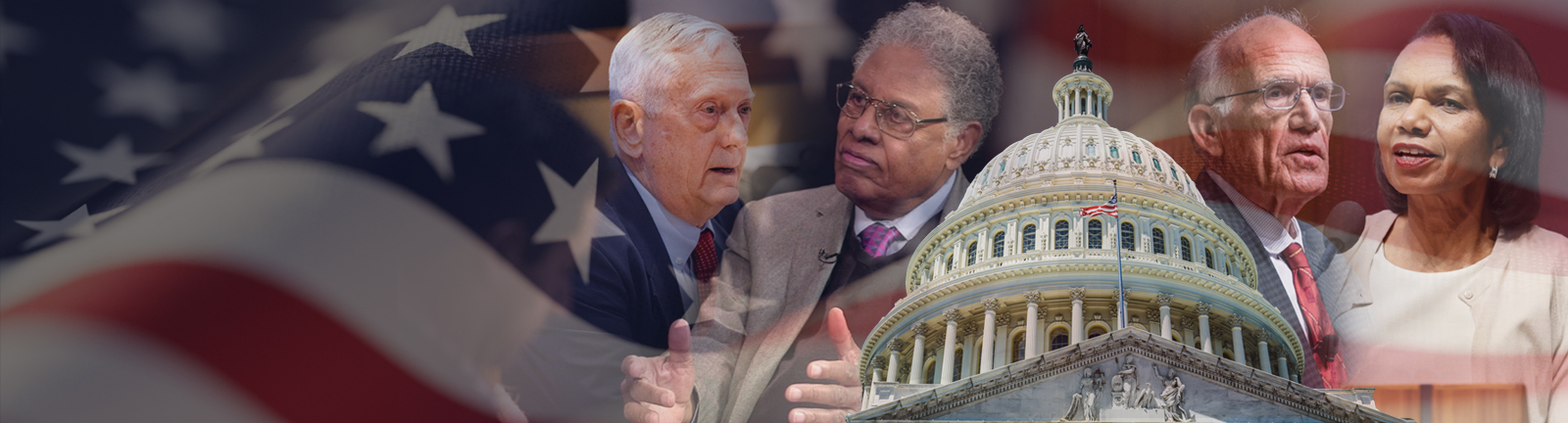
Today, the GoodFellows speak with former senator and University of Florida president Ben Sasse about the trust challenges facing Congress and American higher education; Elizabeth Economy explains how China is trying to win the future with a coordinated strategy spanning the Arctic, cyberspace, and international institutions; and Andrew Roberts speaks with Pulitzer prize–winning Hoover historian David Kennedy about the statecraft of Franklin D. Roosevelt.
Revitalizing American Institutions
Two institutional sectors are in both steady and rapid decline in terms of public trust: Congress and academia. Ben Sasse, former US senator from Nebraska and president of two universities, joins GoodFellows regulars Niall Ferguson, John Cochrane, and H.R. McMaster to discuss what ails Congress and how to fix it, based on his eight years in the Senate. Sasse also discusses how America’s educational system has set a low bar for readying students for higher learning and life after college. Then, the three fellows weigh the merits of the Trump administration’s new National Security Strategy and what strategy there is (or isn’t) regarding Venezuela and drug trafficking; the shortcomings of fuel-efficiency standards; and whether they’d buy an American-made “tiny car.” (“No way,” says our resident former tank driver.) Watch or listen here.
Confronting and Competing with China
In a new article for Foreign Affairs, Senior Fellow Elizabeth Economy outlines “Beijing’s strategy to seize the new frontiers of power.” “American policymakers have only started waking up to the full extent of China’s success at building power in key areas of today’s world,” writes the former Commerce Department senior advisor on China. She warns that the United States “is not just abdicating its role in the current international system. It is falling behind in the fight to define the next one.” Economy focuses on China’s activity in the Arctic ocean, outer space, and cyberspace—three frontier areas for 21st-century geopolitical competition—as well as its efforts to displace the dollar as “the most traded currency and the dominant reserve currency” by promoting the use of the renminbi or local currencies. Connecting all these areas are international institutions, which Xi Jinping seeks to alter “in ways that reflect Chinese economic, political, and security interests.” Economy concludes by outlining how the US can compete across these key domains. Read more here.
Revitalizing History
On a new episode of Secrets of Statecraft, historian and Distinguished Visiting Fellow David M. Kennedy discusses Franklin D. Roosevelt’s leadership as he guided the United States through the twin upheavals of the Great Depression and World War II. Kennedy explains how FDR reshaped federal power, responded to mass economic hardship, and slowly steered a largely isolationist nation toward global responsibility. The discussion highlights the weaknesses of the pre–New Deal government, Roosevelt’s innovative (and sometimes improvised) approach to rebuilding institutions, and the ongoing historical debates over what he was trying to achieve and how successful he really was. Overall, the exchange paints FDR as both a bold domestic reformer and a key architect of the postwar international system that defined American leadership for decades. Watch or listen here.
Writing for a new issue of The Caravan, Senior Fellow Russell A. Berman examines persecution of Christians on religious grounds in the Middle East. Berman argues that since religious freedom “has a special place in the American creed . . . opposing religious persecution has understandably become a goal of American foreign policy.” Berman focuses on religious freedom issues in Nigeria, Egypt, Turkey, Pakistan, and Indonesia. He finds there is a common denominator of “systemic assaults on Christian communities” in these nations, despite their significantly different “legal and constitutional structures” as well as their differing demographics and geographic features. Berman leaves readers to consider a parting question: “Should Washington, with the foundational commitment to religious freedom, care about religious persecution in distant countries?” Read more here.
Answering Challenges to Advanced Economies
In a column for Defining Ideas, Distinguished Visiting Fellow Michael D. Bordo explains that the legislation dubbed the Genius Act has paved the way for stablecoins, a new form of digital currency to be provided by the private sector. Bordo points out ways in which this innovative form of currency can succeed, while also noting historical pitfalls that erupted during attempts to create “no questions asked” currencies in the United States and Canada. Stablecoins appear poised to be part of a safe, uniform system, provided that the system is set up under monetary and regulatory intervention, he writes. Bordo says the financial system still needs to guard against contagion and external shocks, keep an eye on the role of the central bank, and anticipate flaws yet to be uncovered. Read more here.








Related Commentary