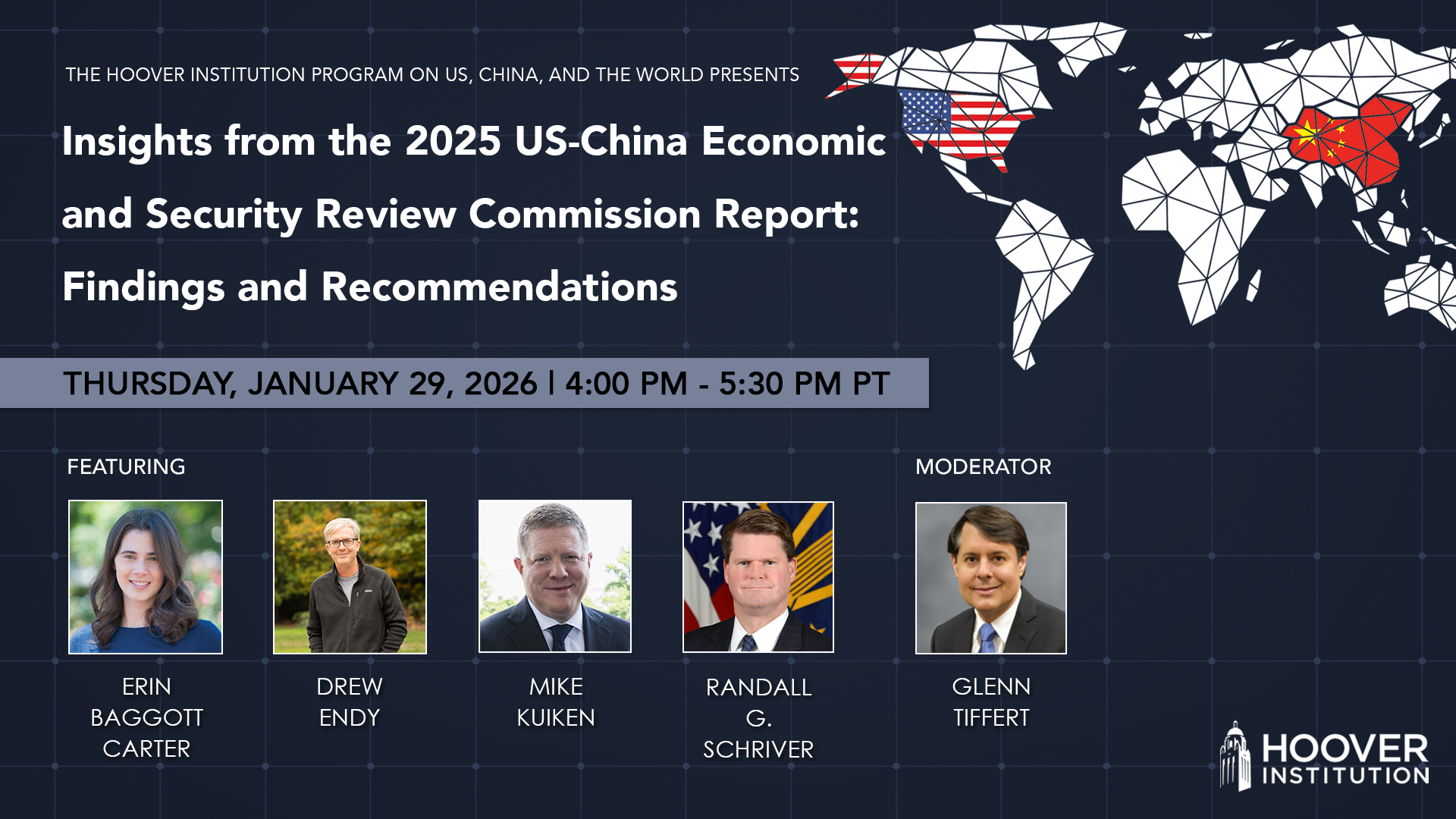
The Hoover Institution Program on the US, China, and the World hosted, Insights from the 2025 US-China Economic and Security Review Commission Report: Findings and Recommendations, on Thursday, January 29, 2026.
This event features leading experts from the Hoover Institution and the US-China Economic and Security Review Commission for a discussion analyzing the key bilateral economic and security challenges faced by the US and China and their impacts on the broader international landscape. Congress created the US-China Economic and Security Review Commission to monitor, investigate, and report on the national security implications of the bilateral trade and economic relationship between the United States and the People’s Republic of China. Its annual reports to Congress address and make recommendations about pressing issues such as trade practices, technological competition, military strategy, and human rights concerns, with far-reaching implications for policymakers and stakeholders around the world. The Commission’s 2025 Annual Report was released in November 2025.
To view the report, click the following link: https://www.uscc.gov/annual-reports
- So let me welcome you all here to our first big event of the new year, which is an amazing opportunity to, to bring actually some of the leaders of the US China Economic and Security Review Commission here to Stanford. We couldn't take you to them. So we brought them here to Stanford to talk about their latest report, the 2025 Report to Congress. This is an annual report that they issue, and it's really, I think, one of the best statements of US policy and, and thinking about China within the government. This is a almost an academic quality rigor in the work that they bring. These are like deeply researched reports, extremely well written in many respects. I think it's really the standard for, for what our government can produce, and it, I think is to the credit of, of the chair and the vice chair for helping pull that together and the other commissioners and the staff that they have. I, I wanna start by introducing the four panelists today very, very briefly. I could go on a great length about all of their achievements, but I want to get into the meat of the report as quickly as possible. We'll start with with the honorable Randy Shriver, who's chairman of the board of the Institute for the Indo-Pacific Security, but he is also chair of the US China Economic and Security Commission. In 2026, he served as Assistant Secretary of Defense for Indo-Pacific Security Affairs from 2018 to 2019 and earlier as Deputy Assistant Secretary of East Asian Pacific Affairs at the Department of State. He founded the, what was originally the Project 2049 Institute, but is now known as the Institute for Indo-Pacific Security. Mike Kiken is distinguished visiting fellow here at the Hoover Institution, and he's 2026 vice chair of the US China Economic and Security Commission, and a distinguished visiting fellow. Here he advises the special Competitive Studies project and serves as on anthropics National Security and Public Sector Advisory Council. A little bit later in our session, we're gonna be joined by Hoover fellow Aaron Bagot Carter, who's an associate professor of political science at the University of Southern California, and also affiliated with Stanford Center on Democracy Development in the rule of law in the US and US uc, San Diego's 21st Century China Center. And then finally, drew Endy, who's a science fellow here at the Hoover Institution, where he leads the Bio Strategy and Leadership Initiative. He's also a professor of bioengineering here at Stanford University, and his work combines biology, engineering, and public policy to address the challenges of rapidly advancing technology. We're gonna dive into the report in just a few minutes, but in order to set that up, I'd like to ask Randy and Mike, really to start by giving you all a chance to understand the commission, the work that it does, the role that the commission plays in the policy process, and then maybe to walk us through what each of you believe are a few of the key takeaways in the most recent report. So Randy and Mike, over to you.
- Great. Thank you. I can start. Glenn, thanks for having us and pulling this together. You know, we advise Congress, but Congress listens to y'all more than they listen to us. So it's important that we get out and talk to folks about our findings and the report and our recommendations. So, appreciate this opportunity. We are one of the older congressional commissions. We were founded through legislation in 2000.
- Yep.
- And, and stood up in 2001
- 25 years this year, baby.
- That's right. We're having all kinds, you probably got the Flyers 25th anniversary. So one of the older commissions. We represent congressional leadership by virtue of our appointments. So we're six Republicans, six Democrats appointed by leadership in both chambers. So Senator Thune gets three appointments. I'm one of them. Schumer gets three. Mike is one of them, but also Jeffries gets three and Johnson gets three. We serve two year terms, and we come together to produce an annual report, which is informed by hearings that we hold and travel. We do travel in the region of the Indo-Pacific, often visit Endo Paycom for the military and security aspects of that. And everything is sort of geared towards this annual report, which thank you for the compliments. I I think it's a tremendous report, and I can say that and not sound immodest because it's really the staff that puts that together, does all the research and, and the excellent writing the commissioners have a role in, in sort of editing that. But, but the primary role of the commissioners is then to come up with recommendations based on what the staff has produced and what we've heard through hearings and travel. And then we put that forward to members of Congress. And I always like to say when we release the report, it's not an end point, it's a start point. So we've been busy briefing members of Congress doing public events, podcasts, and the like. And so we're, we're at that critical stage where we're trying to position ourselves for potential legislation in the coming year. We're, we're really aiming a year out with every report because of the recommendations, if they're gonna be most impactful, meaningful, have to end up in legislation, which is the next cycle. And, and usually the NDAA since that's about the only thing that passes these days. But Mike, what did I miss? And, or, or how can you correct me?
- No corrections. The only thing that we, the really funny story is the origin story. It's right around the time where congress is debating WTO session.
- Mm.
- And if you go back and look at the legislative history, it's amusing because it's basically clear that Congress has decided they don't trust two entities. One, the Chinese government and two, the executive branch. And so they create this commission basically to keep sort of a watchful, a watching eye, constantly watch a full eye on those two entities. It's like a classic sort of congressional story, you know, there, there's probably a negotiation. Somebody was like, I'm sick and tired of this and we're gonna do this commission. So it's, it's sort of a classic congressional income. That's the only thing I would pile on.
- Say your thing about over the horizon and,
- Oh, yeah. So one of the long time serving commissioners was a guy named Mike Wesley. He was on the commission for, I mean, almost 25 years. And he sort of oriented the commission over the years to think about, don't think about the alligators closest to the boat, look at the horizon and look over the horizon and, and let's make sure we're increasing the literacy of, of members of Congress and the larger sort of national security community in Washington on the issues that are going to be coming up in front of them. Not today, but it is sort of in the future. And it's been helpful over the years because it, when when things happen in sort of the US China dynamic, there's often ideas to fall in on for members of Congress. So like outbound investment was just one of these things where the commission came up with this recommendation when I was still actually in the Schumer operation. And it finally was finally signed into law this year in the National Defense Authorization Act. And again, it was a, it was something the commission came up with years ago, and it's something that sort of went through a, a deliberative cycle and ended up in legislation. So that over the horizon view that sort of giving the feedstock to members that they can fall in on is, I think is a really important role of the commission. I think. And I, the one thing I didn't realize when I joined the commission is, you know, I sort of like, you know, got ready, I, I like a partisan warrior for Leader Schumer for seven and a half years. And when I got there, I rolled up my sleeves, I was ready to like, you know, start knocking my elbows around with, you know, Randy. And it was like, we, we were talking about how we're gonna find, you know, bipartisan agreement and consensus on things. I was like, wait, what are we doing? And it was, it was a, it was, it was actually wonderful to sort of see that like we were debating issues in a very serious way, and we weren't finding the most common denominator outcomes. We were saying like, you know, how far can we sort of push this idea but still like, have consensus? And so I think that that atmosphere is like super refreshing. And I think, you know, your sort of reflection on the, on the report shows that, I mean, it is working and it is a secret sauce that we work hard to maintain.
- Does that speak well of the commission or Ill of your former,
- I mean, both. Not Ill,
- Well, you know, maybe you can run a master class on how to get that done.
- Yeah,
- Yeah.
- Think with Randy, I only teach with Randy.
- You all are, are models for doing it. And the report is really a model piece of scholarship. So let me, let me ask you to each sort of pull on your favorite takeaways from the report, the issues that were most meaningful and important to you, because as you say, you've done a great job of horizon scanning, getting things on the agenda early so that I think the members have a little bit of consciousness and mind share on the topic before things really blow up. And so you've done a good job of educating them and preparing them for what's gonna probably end up on their desk in legislation year two, three from now. So what are your favorite takeaways or what do you think is most impactful there?
- You'll probably talk about the one, right?
- Sure.
- Yeah. So we, we have a process where we determine a top 10, which is, you know, very sort of sophisticated and mature. We just get in our room and we vote and raise hands. And so Mike will talk about the, the number one recommendation we had this year. I tend to focus a little more on the security issues, the military issues, former navy intelligence officer, former DOD person twice. And sometimes that's at a general level of how the pla a's doing in modernization. Sometimes it's more specific to particular contingencies. And we had a couple recommendations related to Taiwan this year, which are, yes, about Taiwan, but really about where the PLA is going and, and what we think we need to do to, to keep pace, if not, you know, keep an edge for the purposes of deterrence. One was, we call it the show your homework recommendation. We have a law of the Taiwan Relations Act that most people, if you know anything about it, you say, well, yeah, yeah, we sell arms to Taiwan, which is true. We, we are obliged by law to provide weapons of a defensive character for sufficient self-defense of Taiwan. But there's another part that says the US main must maintain the capacity to resist force if asked to do so by National Command authority. So Ino Paycom having capabilities, having a plan is not a choice, it's not a policy option, it's actually a legal requirement. But to our knowledge, they've never been asked to prove it. Come in a classified setting, unclassified setting, and tell us why you're confident you have the capacity to resist force in a Taiwan contingency. And if you can't, the, the purpose is not to put anybody unfairly under a spotlight. If you can't please identify the gaps and let Congress know where to fill in. And that's important that the Indo Paycom commander has the ability to do an unfunded priority list every year, but it's not necessarily Taiwan specific. We want this to be given Congress's role in, in oversight. And given the role that they gave themselves in the Taiwan Relations Act, we think that this was a important thing to ask the administration. Number two, one of the major initiatives from Indo Paycom and the Department of Defense, right now, by the way, I say Department of Defense, our authorizers still authorizes as Department of Defense. So this is not a slight against anybody, well, maybe a little bit, but we say Department of Defense. The, the Department of Defense has been pushing posture initiatives in the Indo-Pacific. We play an away game every time where a distant power, we have a hundred thousand four deployed forces, but they're heavily concentrated in two places. Korea sort of busy and occupied with the, with the Korean Peninsula and Japan. And most of that is occu is, is consolidated in one place, Okinawa. So to fight in a, what what's called an A two A D environment, anti-access area, denial environment, ballistic cruise missiles, we need posture, diversification and dispersal opportunities. You only do that if you have the agreement of the governments that are the sovereign owners of those of pieces of real estate. But you need facilities. And so Indo Paycom has been working, well, it's actually a whole of government to develop sites in Philippines, particularly in Northern Luan and Pawan, the places with proximity to the Taiwan Strai, places like the Japanese southwest island chain with proximity to the street. But that's been coming online very slowly. And our proposal is that since a lot of this relates to Taiwan, why not have Taiwan pay into a fund that helps boost our posture initiatives? They buy weapons, they buy training, they buy all kinds of things. How about them contributing to deterrence by virtue of, of helping us in these posture initiatives. So those are two that are specifically about Taiwan, but really about the direction of PLA and what we think we need to do to maintain deterrence.
- Right. There's a lot of Philippines in this year's report actually.
- There's, there's a whole other plan Philippines, which is, you know, I I, I look forward to getting into that too.
- Super Mike,
- The number one commission recommendation this year was economic state craft recommendation. And actually ran, Randy and I wrote an op-ed that was sort of the feed stock feed corn for this idea, which was after nine 11. One of the things that happened, you know, in addition to sort of invading Afghanistan and all sort of the, the, the military elements of that was we did a huge reform of the intelligence community. And we also did a huge reform of the sanctions community and how it's sort of, how it's sort of powered and, and, and it's sort of operational capability. And I think the conclusion that we came to as a commission was that we're not in sort of a, you know, a one year, two year economic statecraft sort of conflict. This is going to be an enduring sort of conflict that we have. And we haven't done anything to reorganize the executive branch in a way that allows it to really operationalize things and the tools that it has. We've did that with sanctions after nine 11, but the tool that we see talked about all the time these days is export controls. And so, I dunno if anyone's here has heard about the Bureau of Industry and Security, if you've actually ever gone to visit the undersecretary, it's like the darkest hallway in the commerce department. I don't even know if the lights work. The office is a, it is a dark dank room.
- It's a very unhappy place to days.
- I mean, yeah, so like, my, my point is, is like, you know, this is the, this is apparently the weapon of choice right now for this economic statecraft battle, and yet we're not resourcing it. And not only are we not resourcing it, but we've never made it part of the intelligence community. And if you've worked with the intelligence community over the years, and this is what happened after nine 11 with the sanctions community, is if you don't, if you're not an entity inside of it that can drive collection requirements, you're basically either tin cupping around begging for sort of intelligence and begging for your collection requirements to get handled. And so a big part of the recommendation is say, let's take the Bureau of distribution security and finally sort of make it an element of the intelligence community. And then the other thing is, if you really look at the like, broader export control community in the executive branch, it's essentially a bunch of warring futile states,
- Right?
- DOD plays a role, state department plays a role, treasury plays a role, commerce plays a role. I'm sure there's other cats and dogs, USTR undoubtedly plays some sort of peripheral role. And so what we've sort of said is we need to think about orienting this into one organization so that there's unity of command. You know, Randy, Randy from the military perspective always talks about sort of Indo paycom and this idea of unity of command. And so taking that, that concept, applying it to the ex export, or sorry, economic statecraft community, was something that we wanted to be very thoughtful about. And so we sort of took the piece that Randy and I taught, wrote saying, you know, BIS intelligence community, and said, this isn't big enough. We actually have to be a little bit bigger about this. That the, the a recommendation itself has lots of good ideas in it. The, the hard part is going to be sort of like, how do we get Congress to sort of adopt this idea? Anytime you go into sort of export controls, just like you have the war in futile states in the executive branch, you have committees in on in Congress who have very different views about how this should be done. And you also have jurisdictions of these committees that are very sensitive issues in Congress. So we gave them a big idea instead of sort of the traditional Washington industrial think tank industrial complex. Like let's just change the dials a little bit and let's see what happens.
- Yeah, I, I think it's a very intriguing and powerful idea, and I think the moment is ripe for serious consideration of it. You know, the, it's interesting you mentioned nine 11, because the last time that I can think of a major reorg happening along these lines was the creation of homeland security really, and the consolidation of so many different authorities and agencies that had been previously dispersed into a single home. And perhaps there's a cautionary note in there these days, but you know, it's, it's worth thinking about that, you know, perhaps we want to avoid a truly crisis situation before we kind of get out in front of that and skate to where the puck is going to be.
- I mean, like, you can see the success of the sanctions reforms in the response to Ukraine.
- Yeah.
- Like the sanctions community at treasury and across the interagency is truly operationalized. They were able to do a amazing job very quickly, right? The export control committee or community is not resourced to do that, both from a dollars perspective and from just butts and seats perspective,
- Right?
- And so like, we have to think about re sort of reinvigorating or just invigorating this community.
- So then the question really is how do you reconstitute workforce? Because in the last year there have been tremendous staff reductions across a lot of those components. And the question really is, I think if this wave your magic wand and say, if you were able to achieve something like this a year or two, three down the road, do we actually have the institutional capacity in place to make it work? Or would we have to do a lot of rebuilding as opposed to just rewriting authorities and moving desks around?
- Well, I think if, if we got authority to do it tomorrow, you're gonna MacGyver the thing together based on what's already there, for sure. Which is what Department of Homeland Security was. And there are cautionary notes, not only in terms of what's happening today, but at that time it was a pretty difficult process. But look, I think you always talk about futile states across the interagency there, there's difficulties intra department, you know, BIS is the loan entity within commerce that's not trying to promote sales and promote exports and trying to sell everything to everybody for the purposes of helping the business community. They're very similar phenomena happening within treasury, within state Department, right? So The, the, the art of economic state craft and getting harmonization across all this is, we think critically important. You would absolutely have to go out and reconstitute a, a workforce to do this well and requires a degree of expertise that is being sapped through retirements, through rifs. And you know, when, when the federal government started cutting through the Doge process, they hit an easy button, which was let's go after the probationary workforce because we actually have the authority to, to fire them. We won't get challenged legally in the way we might by the unions and, and others if we go after tenured professionals. Well, what did you do when you did that? You, you got rid of the young people. You got rid of the people that were on the front end of their careers because those were the people in probationary status, first job, second job early on in their careers, right? Whether or not we create this economic statecraft institute, we are going to have to start hiring young, smart, talented people again, no question. And you know, the government has already sort of figured this out. And so what they're doing is they're contracting, they're doing a lot of things to bring talent in, which is probably more costly than having kept the workforce in place to begin with. But they're already figuring out that they've cut really essential people with really unique expertise that, that we have to recapture.
- I wanna seize that point because we get a lot of Stanford students here who are incredibly bright and they're considering careers in public service, but they read the newspapers also. And I try to tell them that actually government, you know, will perhaps overcorrect and wake up and realize that it has missions that it needs to fulfill and it doesn't have butts in seats to fulfill them. And so if they play their cards right, there may be a hiring search, there may be an opportunity for young, hungry, talented people to enter government and build careers the way they did in years past. And there's a tremendous opportunity there. So that might be the silver lining for what we're experiencing right now. So let's turn, you raised the question of Taiwan and international security. How are we doing in the Taiwan Strait with regard to peace and stability? And then let me ask you to pivot for your own reflections on the purges that we've seen in the Central Military Commission in China. Is this a stabilizing influence? Is this something, what do you think is driving it and what do you think it means for China's ambitions in the region?
- So being at a place like Stanford University, I should give a grade an A through, well, you, you really don't give Cs and Ds and hey, come on, we know bs. But I would say it's not an A through F it's an incomplete that this administration has picked up on first term work and excellent work of the Biden administration on helping Taiwan modernize it, its force in more appropriate ways for the threat. So you probably hear of the so-called asymmetric counter invasion capabilities, I think that has been successful, but a work in progress helped by Taiwan spending more on its defense. I already mentioned the posture initiatives. I think those are, you know, the Biden administration added four OC sites enhanced defense cooperation agreement sites in the Philippines. And these ones are the ones with proximity to Taiwan, Luzon and Pawan. I, I think when Admiral Papapa talks about hellscape, it's a, it's a nice sort of catchphrase and it creates a certain imagery, but in fact, we're always playing in away a game. We will always be out masked. We have to go in the direction of some blend of unmanned autonomous capabilities to be able to compensate for time and distance and, and being out masked. Now that's all good, but as the humorous will Rogers said, even if you're on the right track, you can still get run over if you're not going fast enough. And so I think a lot of this is, is it coming online quickly enough and are we going to be able to do this at the speed of relevance to maintain deterrence? And I think that's a real question which relates to the, to your second question, you can get really smart China analysts in a room and people that, you know, spend a career as, as China watchers and, and qualify as genuine experts who will be on different sides of this. This is a, this is a power move. This shows that Xi Jinping is large and in charge and it doesn't matter, you know, four star, it doesn't matter if you're a combat veteran, doesn't matter if our fathers were friends, I'm still gonna fire you for failing to, to bring modernization efforts to the point where we can operationalize Taiwan quickly enough that not rooting out corruption in a robust enough way, et cetera, et cetera. And some will say, no, this is a, a man who's paranoid that doesn't like the perception that people are developing independent bases of power. If you look at PLA purges, these are the, the most recent two. But in fact, three defense ministers, many members of the central military commission through time, through his now into his third term at the three and four star level, pretty significant, even at lower levels, very significant purges. So to me, I see a little more of that paranoid side and thinking that the military should not be this sort of independent power base that could either threaten him. And I'm not saying a coup was, you know, imminent or that it's really even something that we should spend a lot of time and attention and resources toward. But a military that has an independent view, a military that can push back, a military that can go in and say, boss, we're not ready, or Xi Jinping doesn't want any of that,
- Right?
- He wants unquestioned loyalty. And I think the, the degree to which he is sought loyalty over professionalism, over competence, all of that is a track record to me that suggests somebody is very anxious if not paranoid about the PLA,
- The, I was waiting for Randy to do it. He didn't do it. He's got this line where he usually says they've moved from exercise to rehearsal And just this borrow line, PP you stole from him. I, I don't steal it. I quote him, borrow, well I'll quote him too. And so I mean, we're really seeing that. And, and then this weekend, this past weekend, the Chinese fluid drone, it had an incredible altitude that was above Taiwan. Taiwan air defense systems. I mean that's called operational preparation of the environment in the military sense. And so we are seeing the Chinese constantly move the goalposts on the status quo in Taiwan. And I think in Washington we see these things almost as like microaggressions and we think they can be handled in sort of like baby steps and diplomatic channels, but at some point we do really need to be thoughtful about this as this continue as this goalpost continues to move on us. And then the second thing, and I, that I would just mention is when I interviewed with Chuck Yest, he asked me about my Dutch heritage and, and you know, interrogated me on it and told me I needed to read this book called the Island of the Center of the World, which is about Manhattan and how it was sort of settled by the Dutch. I was thinking about that. I was listening to Randy because Taiwan is really the island of the center of the world today. And think about a scenario where all the sudden all the chips that the AI companies are buying and sort of all of the other advanced tech companies are buying are no longer available to us. There is no other place on earth right now where you can buy, you know, a chip for, for our iPhone. And that is an incredible scenario when you think about it. The Japanese are about to get rapid us you know, hopefully up and running, hopefully the, the facility in in Arizona will be up and running, but like it really has become the island of the center of the world. And I sometimes think in Washington, you know, we think about it in the context of a conflict, but we don't sort of unpack it and say, well wait a second. If you take Taiwan and China, all of the legacy trips on earth come from there and like look around this room, the lights that are in my eye right now have a legacy chip in there or a foundational chip in it. My iPhone has an advanced chip. All of those are coming basically from two places. And that is China and Taiwan.
- Right. Stranglehold on the global economy in a sense.
- Yep. - Let me invite Drew and Aaron up to the stage and we'll expand the conversation and while they get situated, you know, one of the first hearings, if not the first that you had last year, which is reflected in the report, is
- Glen, you even have the co-chairs of it
- Is Yeah, exactly. Which is, which is it, it was focused on made in China 2025 who was winning. So that was literally the title of it. Drew appeared talking about biotechnology,
- The staff got very mad at us for putting a question mark at the end of it.
- So let me ask you who is winning and why and where.
- I mean, I think the answer, so the, the reason we ask like who is winning is we wanted to sort of take a look at made in China 2025, it's a 10 year plan, how are the Chinese doing? I think the report card that we put out, which is available on our website is basically like they had some incredibly ambitious goals and they didn't make, they maybe didn't make all of them, but they did incredibly well. And you know, one of the reasons we had Drew was because an area where they made incredible investments was to do well in pharmaceuticals. And the consequence, or either planned or accidental is that they built this infrastructure layer in the bio economy for their country. And it is now they're sort of racing, potentially racing ahead of us at a very, very fast speed. And I think in biotech they're doing very well. I think in quantum, I think we don't know how well they're doing, but the assumption should be that they're hiding their hand and they are aggressively pursuing a crack to public key encryption, I think in aerospace was the other area and we had a space hearing separate from this, but in, in the aerospace community, it's an area we don't pay a lot of attention to in Washington. But I think there's a lot of dependencies that remain there. Europe and, and the US still provide an incredible amount of parts and technology into their aircraft programs. And then where were the other big areas we looked at, Randy?
- Well, I, I think the thing I would add to what Mike is, is talking about is it also revealed something about a system versus a system,
- Right?
- I'll, I'll take the United States every day of the week twice on Sunday and all the, all the warts and all, I'll take it over China, but their system does certain things very well and they are able at a national level to prioritize. They're able at a national level to resource and they are able to, at a national level to take a comprehensive approach to a problem set. So if they're, I don't want to take any of of of Drew's material, but you know, in, in biotech it's not just what they're funding at the research level, it's what they're doing in primary schools. Yeah. It's what they're doing societal to, to make this field attractive. You know, do you want to be a pro athlete, a rock star or do you wanna be a, you know, biologist, you know, the Chinese system can do very well at that system of prioritization and resourcing. They're not 10 feet tall, but they sure can do that.
- Yeah. They're executing across the full stack in a very intentional, thoughtful, and driven way.
- I mean, - Quantum is, they're simply trying harder.
- Quantum is a perfect example too. We have this sort of very diverse academic space in quantum where we're pursuing all of the different pathways to a quantum computer. The Chinese have gone all in on superconducting and that means that they're sort of allocating all resources opposed to sort of the, this, this, you know, hodgepodge of programs that we have. Maybe it's better to have our way of doing it. Maybe it's better to have their way of doing it. But it is, it does help you sort of see the differences.
- So let's pivot then to biotech and bring Drew into this conversation because in some ways I think biotech is a microcosm for what you were just describing and it's incredibly important as a foundational technology. I think, you know, kudos to, to the commission for putting it on, on the radar because I think biotech has not yet achieved the, the sort of level of mind share in the ordinary American's brain that other things like semiconductors or quantum or electric vehicles may have drew. Let's start with why we should care what the stakes are and then really what your prescription for American competitiveness could be. Are there things that we can learn from China in humility that we should be adopting? Are there reforms to how we've done business in the past that we should adopt in order to, to hold onto our edge in a few areas and perhaps recovered in others?
- Yeah, thanks Glenn and, and Mike and Randy for your service and work biotechs. You know, you think of it as a canary in the coal mine or a bellwether. It's both an old technology and an emerging technology and it's one that, you know, invented in the United States 50 years ago here at Stanford with genetic engineering, but still very, very young, right? And so China takes a look at biotech and is is going, hey, well we have a chance here, right? It's, it's not that we have to overcome, you know, half a century or a century of legacy. It's like this is a green field to compete. So when we think about how the US is doing broadly in terms of holding our edge or or winning, if, if that's how you wanna frame it, bio biotech's a very interesting domain. Now it plays in a couple different ways. Biology itself operates at the intersection of energy data and stuff. Jules bits and atoms, you know, like a photosynthetic organism harnesses energy, fixes carbon and makes things right starting with food, fuel and medicines. But increasingly anything we can encode in DNA, right? It's a general purpose technology. Beijing operates with the reality strategy, like how do we organize the provisioning of jus bits and Adams energy information and stuff sufficient for our country. And to the extent we can pull that off to create leverage elsewhere, they're fairly straightforward about that. And so I look to Beijing on bio and it maps very nicely to a government that's got a reality strategy. I go to DC I see politics right now. Now the commission is incredibly important 'cause doing non-partisan longtime scale work. And I want to acknowledge, you know, you talked about some of your recommendations, I guess you left for me to celebrate the fact that recommendation number three from this year's report is around pharmaceutical supply chain resilience and getting that right. You think rare earths and chips or supply chain, supply chain problematic antibiotics, things that protect you from spitting up a tube when you need a tube to keep breathing. Like all these medicines that we take for granted, the majority of them are not coming through supply chains we control. So that was recommendation number three. I think recommendation number four was to really get at the foundations of how we compete and win both on bioscience, biotechnology and bioeconomy. Everything from how we make measurements and standards for the Bioeconomy recommendation number four is calling for a tology lab at nist, this part of the Department of Commerce, which is an absolute gem, but often ignored. So it just, you know, why do we care about biology? We are of biology. Biology is a strategic domain. It's becoming a general purpose technology. These are words that are easy to string together and hard to wrap your mind around. If you come back to Taiwan, here's the fantasy version of a longtime scale future. The reason Taiwan's, the island in the center of the world with respect to computing is because we've made computers hard to make right? And we've made computers hard to make because we use top-down patterning like a kid at the beach making a pattern in a sand with a stick. But now it's machines from the Netherlands, right? And and it's still that top-down high precision engineering, you know, the semiconductor research corporation has a 20 year roadmap for doing bottom up self-assembly using biomolecules to template the production of semiconductors. Technically it's impossible today. It won't solve a supply chain problem within 10 years, but 20 years it's imaginable. You could unlock biology as a general purpose technology and have a complimentary path for growing computers, which means you could operate that process not in one spot on earth, but anywhere you needed to do it. Much more resiliently. And it's only, it's only through the commission's work, frankly, where I've had any chance of, of starting conversations in the current political context of DC that's, that's looking more strategically on longer timescales to how we might think about biology as a strategic domain,
- Right? I mean, and so one of the things I'm struck with this administration is how we seem to be breaking with past orthodoxy about how the solutions to our economic competitiveness challenges posed by China lie outside of purely free market based solutions. There are things like, you know, the trade war of course and the serial resort to tariffs, but also in the rare earth and semiconductor space, we're doing things that previously we might not have done because we were too reliant ideologically and, and I think strategically on, on market-based solutions. The state's now an active market player in a way it wasn't. So orthodoxy has really been shattered. I mean, Intel's now a state owned enterprise for goodness sake, and we're taking a cutoff every invidious chip sale to China. And so is there a way where we go forward in the space economy, in the bio economy in which the state sort of reinvents its traditional role and helps us either as a backstop, as a way of smoothing out the, the the valleys of death compete with a bit of fire against fire with China.
- I mean, Randy and I on a, on a a different topic, Randy and I were lamenting some of the tools of the Cold War the other day. I mean the Defense Production Act. People forget this thing's existed since World War ii. Every department and agency used to have a deep, what they call the DPA officer a human that was basically like, I have this problem Mr. Secretary, I need DPA to solve it, the secretary go talk to the DPA a officer. And like those tools have always existed in our government. We're just seeing them being used again. So like I, I don't want to go after the administration too much on using these tools because these are tools that we've had in the toolbox for good reason for a long time. And so using them is important. People always forget about, and this is one of the other recommendations on biotech about the Department of Energy loan program office. This office has existed for a decades and it does incredible work to find companies that are in early stage that have incredible technologies and really just need some cash to make sure that they can get a demand signal to private industry to say, or private finance to say, folks invest in these companies. So one of the recommendations is like we have to think about the department of Educ, or sorry, department of Energy loan program office as it comes to its reauthorization this year and make sure we're drawing the circle around biotech because they're sort of in a, in a, in a winter sort of like the AI community was for years. And like there's reasons for that Theranos was a disaster. And there's some other things that have happened in the community over the years and then there's still the lyra sort of hangover as well. But we do need to sort of surge resources into it and, and you know, the administration, Dario Gill and, and Paul Debar and those guys are doing good work to sort of think about those tools that we've had in the toolbox for a long time and reinvigorating them.
- So Drew, let me ask you to grab your magic wand and, and ask for the things that you think would really turn the corner on the trajectory we're on in in the bio economy. The,
- Yeah, I can be specific, but I wanna start with two broader recommendations. One is, as a domain of emerging technology, there has never been a domain more overdriven by immediate utility in application than biotech. Biotechnology is a domain of last resort. If you have a horrible disease and you can't cure it by going to the hardware store, you go to the bio technologist and beg, right? And what that means is for 50 years, the good people working to advance biotechnology have experienced this unbelievable pressure to solve problems right now. And it's why at an appropriations level across the federal government and the democracy, especially the funding goes to agencies that are curing diseases right now. And our newest federal agency in the biospace ARPA h which is terrific in and of itself is cure more diseases for more Americans faster. And who would be against that, right? We all want that, but there's never been a domain of emerging technology where we've competed in won by spending money like that for every other domain of emerging technology. We've taken the limited public money and we've invested it in the engineering foundations that let the science become technologies that the private sector can bring to market. It's how we got strategic computing, it's how we got ARPA net becoming internet, right? And we're just out of order in terms of our appropriations. And the reason a problem is because biology is a general purpose technology, it's infinite applications And it's just like, that's why the, there's like huge amounts of requests for budget. So I, I think we could shockingly like do more with less by, by reallocating public treasure down the foundations of the science and engineering at biotech. That's thing one, thing Two, in general, there's certain things you have to pull off. And this is building on what Kiken said. When you try and get to full scale economic impact or full scale provisioning to what the defense department needs, you have to get capital deployed to get your manufacturing process operating at scale. And one of the things you can think about is, well, let's get congress to appropriate all of it, right? But it's like, you know, if, if you think about this for biology and biomanufacturing, that might be a hundred billion dollars over five years. That's a lot of money. You know, and, and we wanna sustain that every, you know, the next five years, the next five years. It seems to me like there's other mechanisms that we could use to incentivize and empower the private sector to deploy private capital to pick up on scaled manufacturing. So one idea we floated over last year was what we call bio bonds for the bio belt, tax free bonds at the state level that let private sector capital allocators pick up on stuff and make go no go decisions around how do we get this factory resourced,
- Right?
- And so I think that's complimentary to some of these other loan programs. Now, specifically, number one recommendation, which I was pleased to see is number three in the commission's report. I mentioned it already, a ology lab at nist, you know what the unit of resistance is for electricity and wires the ohm, right? What is the unit of measure for DNA being read out in a cell? Herp we don't know yet. And you could not have chat GPT, you could not have GPS, you could not have anything electronics without the ohm as a way of coordinating measurement of wires getting wired up, right? So, so physics got a physical measurement lab at nist, we get the kilogram, the meter, the second the ohm gives us GPS and everything else. Chemistry. The next foundational science got the material measurement lab at nist. Biology needs a bio measurement lab at nist, it needs to be half a billion dollars a year, quarter billion dollars a year. There needs to be hundreds of people working on. So without a doubt recommendation number one, it's high leverage, huge return on public investment. I won't go through the whole list, but I'll just give you another example. We've heard about ai, it's having a moment AI's landing in biology. You can take DNA sequences and train large language models on them. So instead of chat GPT in English, you have a, a tool that you prompt and emits DNA sequences. The thing about a DNA sequence is it's very hard to speak DNA, you know, like we can speak English or French or Chinese or Spanish, but like very few people can speak in T-A-A-T-A-C, GAC, tt, A-T-A-T-D, you know, it's like, like, and, and so the only way to make sense of this stuff is to build it and test it. So if we wanna have world leadership in AI and bio with large language models and whatnot, we, we need large language laboratories, places that do high throughput, world leading testing of, of computer generated designs. And so that was another recommendation that showed up in, in my testimony a year ago. And, and I think that's something that fits nicely within Project Genesis and what Dario Gills hopefully pulling together through DOE and and the national lab system.
- So are other people building those things now? Is there a race on to kind of
- Oh, we're losing by a lot. I mean, I it's hard to overstate the situation.
- Yeah,
- You know, we've, we've scratched that a little bit, but like in my assessment, China has taken an all of nation approach. Randy covered it pretty well. You know, it's like the, the, the kids are being incentivized to pursue careers in biotechnology, right? They've taken an all of nation approach to biotechnology for 25 years, going back to the sequencing of the human genome. They're crushing it. You know, my colleague Chen Liu, who, who who is in Shenzhen now operates the Shenzhen Institute of Advanced Technology, it's a national laboratory for synthetic biology, had lunch with him in Europe recently, and he's got a team of 2,500 staff and 2,500 students and postdocs. He has 5,000 people. I have five PhD students at Stanford, right? And, and the national lab up the road is still doing wonderful work, but it's optimized for the imperium of physics. Nothing against that. And, and we, you know, like across all the natural sciences, China has building national laboratories without the legacy portfolio going back to Oppenheimer, which is what we're carrying here. The other thing I'll say, just in passing, you cannot understate the motivation for s and t leadership that that that that is apparent in Beijing. You, you know, in, in one, this is a little bit simplistic, but at least I'll just get out in case we wanna unpack it. You know, think about what the United States did in response to Sputnik. We had one event in the Cold War that really freaked us out. We created ARPA and never again be surprised by a nation's technology, okay? Compare that with a century of humiliation and leveraging that for political power so that the CCP gains benefits simply by representing that it's in the lead on science, nevermind the security ramifications of the economic competitiveness or any of the geopolitical leverage. Intrinsically, there's a political return by being a leader in science. And you're not, you're not leveraging just one satellite orbiting before we got up there. It's a whole century of capital you're leveraging and I'm, I'm just of the opinion we have, we're slow to wake up if we're, if we're gonna frame this as a, a competition, you know, these guys are on the curve, but we are very slow to wake up to what we're against, what we're up against. Even in the engineering school at Stanford. We think we have the best engineering school in the world. Now that may be true, but according to US news and board report, we're now out of the top 20, I think, right? And, and the top 10 are all, all outta Asia with nine of the 10 in China. And we're just sort of asleep. I, I really, you know, it's like we don't, we don't know, we don't know what's coming at us word, you know, speak.
- We got Drew all fired up.
- Yeah.
- So he's ready to go.
- You know, that, that's, that's a perfect transition, the system level competition angle here. And I, I wanna bring Aaron in right now because Aaron, you spent a lot of time following competition and information and influence spaces globally, but also within the United States. And there's a large section in this, in last year's report from the commission on the competition in Southeast Asia, in particular in the Pacific Islands. I wonder if you could talk a little bit about how China has made remarkable inroads economically, culturally, diplomatically in these spaces and the withdrawal of the United States from some of them, and how that's impacting not only the system level competition, but also sort of the, the contours of the kind of world we we're, we're we're living in, and what you think the way to get back in the game might be in a way that is good for the region and also good for the United States.
- Yeah, absolutely. And, and it's a real pleasure to, to be here and to be commenting on this fantastic and important report. So I think, I think the answer to that is really multifaceted. And I think that you can look at that issue in a number of ways. So one has to do with the, you know, the struggle for soft power between the United States and China and what that means around the world. Another way to look at that is, is economics. The actual share of investment that sort of is appealing for these countries coming from the United States compared to China. And those, those are two major issues. But third is a sort of more broader conversation about what the international order does look like and what it should look like. So to touch on each of those areas, I think that in, when you're thinking about soft power, the, the idea that the United States should be seen as a sort of liberal, the leader of the liberal international order has been something that's been a bedrock of fourth foreign policy for quite a long time. China is very much offering an alternative to that sort of concept. So in particular, you see, and there's a wonderful paper out of Yale by Dan Mattingly and his colleagues that found that if you, in a survey experince sort, this was distributed across 16 different countries and you gave readers the sort of typical readers in these countries, propaganda articles from the Chinese apparatus talking about the strength of the China model and economics, it was tremendously persuasive. So people who read that propaganda believed that China's economic model was a representation of a way forward for their country and they became more critical about what the US was offering and the global liberal order more broadly. So I think that that sort of propaganda is very effective. It's also very inexpensive from a geostrategic viewpoint. It's a great investment if you're an autocrat and you want to shape world discourse about these issues. So I think that on that area, in that area in particular, the US has really been on the back foot. There hasn't been an effort to promote, you know, ideas about what are the benefits of a free and open Indo-Pacific. So I think that sort of strategic consideration is very important. So that that's one area. And in terms of economics, China's economic investment in these countries in Southeast Asia, but also in developing countries around the world is tremendously large. And if you speak with political elites, even opposition figures in those countries, a lot of them see that that economic opportunity is so important that the US is again, on the back foot and sort of being someone who's at the table sort of offering new investments, sort of transportation information infrastructure, those sorts of investments are tremendously important and influential in shaping who's actually the, you know, the partner that one can work with in sort of an expedient manner. So I think that's, that's a tremendously important issue too. And third, this is all going around in the sort of swirling climate of what should the, you know, international order look like in there. I think that the US Malaysia recent trade deal was a really interesting lens into this issue. So in particular, so the US you know, the recent US Malaysia trade deal had I believe 48 stipulations about things that Malaysia would need to do, and only three that the US would do. And in a sense there were some major winds of this trade deal from the US perspective. So, you know, the core issues were the idea of trans shipment, the idea that it's important to enforce these export controls and to do so, it's really important to ensure that China isn't simply moving its exports through Southeast Asia into the United States. That's a tremendously important issue and also tremendously difficult to sort out what share, you know, if you're gonna say a benchmark and the Trump administration goal is 30% of this product, if it's manufactured in China, then you know there's going to be huge extra transshipment tax. You know, if you're talking about how do you determine that 30%? Is it by weight? Is it by size? What about services? So all of these sorts of issues are very, very difficult to actually judge sort of technically speaking, but nonetheless, it's a very worthy goal. So I think that working on that issue was, was incredibly important, but at the same time it created a lot of domestic pushback in Malaysia. So the way that this was negotiated was very rapid, very secretive. And you saw a lot of Malaysian political figures, particularly in the opposition after the, after the trade that was negotiated, say that, look, this is, you know, this is clearly just a great game, international politics, Malaysian's being carved up and this, this doesn't serve our interests. We're just being pushed around by the United States comparing this 48 versus three stipulations in this trade agreement. So, so where does that leave us? I think that one of the issues that we should consider is how the US wants to go about pursuing national interest in this broader environment. And I think that in Southeast Asia you have a number of nations who are huge trade partners with China, right? China's a force they can't ignore. And I think that Singapore, there is actually a really good example of the dilemma faced by many of these countries, which is, you know, Singapore is always going to the United States and saying, don't make us choose, don't force us to choose between the US and China. You might not like the choice that we make and it's unnecessary. We hope to benefit from both sides and we, you know, we should think about the potential pernicious impacts of that trade very clearly as well. So for example, a research project or paper that I did here with Breck Carter, we found that Huawei investments in these digital technology transfers had very pernicious effects on digital repression and autocracies, but no negative impacts that we could discern in democracy. So we have to be aware of sort of host country or recipient country dynamics as well and potential pushback that these, you know, potentially more coercive seeming US initiatives might have on changing the dynamic and forcing these middle powers to look for potentially other, you know, friends and partners in the area.
- Yeah, I, I, I wanna bring us around two developments freely in the last two or three weeks, in particular, mark Carney's speech at Davos, which in some ways was sort of, I think, stating the obvious that the old liberal international order that the jungle has grown back to, to quote Robert Kagan and the sense that, you know, nations are now in it transactionally, which I think is a very comfortable position for the, the current administration. It's exactly how they feel about a lot of their relationships in the world. How much truly has fundamentally changed, we've seen a long line of leaders like Carney just went to Beijing, Starmer is there now getting very little in return, almost sort of, you know, thumbing their noses at the United States. How much is on offer for them from China ultimately, and how much structurally is, I mean, is going, will change for them at the end of the day? Do they really have options other than the United States? And is it then just a matter of how we play it, how we execute our relationships with them rather than, you know, the, the sort of atmospherics of it?
- So that's a great question, A really big question too. So I think that one, one of the ways we should think about that is in terms of our diplomatic capital in goodwill, right? So I mean there are going to be requests that the US wants to make of, you know, allies and friends and partners and they're going to be much less likely to, to follow through or sort of to work more cooperatively. So I think that we're going to see a lot, you know, more move to sort of a multipolar world order and certainly less goodwill with a lot of these countries. And you know, in so far as you believe that a lot of, you know, the, you know, free and open in the Pacific is in the US interest. It's important for the US to sort of work in cultivating that. And I think that its relations with the quad are actually quite interesting in this respect. So, you know, Trump, you know, famously sort of resurrected the quad, but in the second Trump administration there's, it's been interesting dynamics, right? So both the 2017 national security strategy and the recently released 2025 national security, they both mentioned the quad once and Trump too. So on his very first day in office, Marco Rubio met with quad quad leaders or quad foreign ministers. And so there was this early focus on the importance of using the quad as an organization to contain China or sort of respond to China. But that very quickly, that focus died down over time. So, so we see a lot less. So there was in November actually of 2025, the quad was supposed to host a meeting and India was supposed to be the host. This is supposed to happen annually or has in recent memory happened annually and India declined to host it. And the reason of course is the tariffs that the US has imposed on India, which are actually higher than those it's imposed on China. So, you know, in Japan is very unhappy as well with this sort of $550 billion that it is going to be sort of investing in the US on rather unfavorable terms. So I think that, you know, the mindset of doing these bilateral deals, you know, may sort of come with some relatively short term economic benefits. But I think that the US may be losing a significant amount of ground in how it's thinking about long-term support and sort of realignment towards China broadly.
- Randy and Dudley has views here, but one of the things that please, I would just chime in on is when, when we sort of thought about China in all of the major interactions of the last 25 years, one of the things that we always hear back is that the Chinese have always looked at our ability to build coalitions around things that are important to us and then watch us march down the road to get them done and accomplish them. You know, sometimes we screw things up along the way still we have a coalition, the coalition sticks together and that essentially boxes out China from whatever, you know, the activity is. As I was just listening to Aaron, that was the first thing that sort of came to mind, which is, are we losing that ability to build coalitions? Because that has been sort of, you know, going to the commission secret sauce thing. It's been one of the sort of secret sauce things that the US has been incredibly capable of, of doing, feel however you want, about the Iraq war. I worked for a boss that fought against it, but the Bush administration did build a coal, an international coalition that that, you know, was successful in terms of accomplishing the task it wanted at the UN and then other sort of international bodies. So as we sort of see that fray a little bit, I do think we need to be very deliberate and thoughtful as to whether or not that is the best outcome or a bad outcome. Randy, you should probably talk about Southeast Asia since you're better at it than I am.
- Well, I, I guess I'd make a couple points. I think there's a narrative about this administration, which is, is probably largely grounded in, in reality, but there's also the tendency to want to juxtapose against things that are not necessarily reality. For example, I I think most presidents are transactional. I think most presidents are America first or some definition of it. And I think what's been built over the course of decades is, is a lot more resilient. We're definitely testing it in ways, but if you look at the Indo-Pacific and you say which relationship is worse off since the Trump administration came in. I mean Taishi is at 73% popularity and we have new cooperation in the southwest island chain. Yes. Hard feelings that we shook 'em down for $550 billion. We'll see if that actually ever gets its way to the United States and invested. I know some diet members who have some opinions about that in Korea. We're defying gravity. We have a progressive government and a Republican president that are getting along. Famously, we have not only agreements, the president's not talking about pulling forces off the Korean peninsula anymore. He is actually talking about we need the Koreans for ship building. Albanese comes to Washington and talks about critical minerals and and supply chain integrity that, that we need help on. Marcos comes to the United States and we have renewed agreements, largest battleton exercise we've ever had. Right? So I can sort of point to alliances and partnerships and say there's some feeling that all this generates that is, is concerning and are we draining down a reservoir of goodwill very quickly in ways that may eventually be consequential? I think that's a risk. But to date in the Indo-Pacific, I, I think we're a little better off than most people wanna give us credit for Now, Southeast Asia, Southeast Asia doesn't want to choose, they generally don't want to choose in public, in private, they're making very important choices. And Singapore is a great example, you know, very reluctant to stick their neck out in any ways that might suggest they're leaning. But when they refurbished a pier in Singapore, they extended it to accommodate US aircraft carriers. Last time I checked Singapore doesn't have aircraft carriers. That was for us. We have more military personnel from Singapore training in the United States than any other country in the world. Any other country in the world imagine that. And how small Singapore is. So I think you've gotta, in a way sort of disaggregate and look at Southeast Asia and look at not only the benefits they're getting from China. I mean transshipment is a controversial issue for us. If you go to Indonesia, if you go to the Philippines, Vietnam, in many ways it's controversial for them because it's displacing domestic production and manufacture of the same goods that are coming from China due to over capacity and being resold to the United States. So it's a little more of a complicated picture, I think. So I, I guess I choose to be a little more glass half full here, but I I share the concerns. Understand the concerns, and I really think there's a lot of pressure on our agencies, our, our military, our institutional relationships. 'cause that's where the resilience is gonna come from.
- Thank you. So before we go to the audience q and a, I want to give Drew and Aaron an opportunity and a lightning round if there's something we haven't talked about that's in the report in this session that you'd like to pull on that was especially impactful that you, that you'd like to put on the table for the audience to know about. I
- Love a good
- Round. Yeah, let's, let's give you guys an opportunity to do that and then I want to come to you all for, for a preview on what you have in store for the year ahead. What are the issues that, that congress is gonna discover they need to pay attention to? Yeah,
- Sure.
- Yeah.
- Two things. You know, title, my written testimony before the commissioner a year ago was strange competition. Competition comes in different flavors, winner take all converging competition where we both get to a good place diverging competition where you get an advantage and you race away one time prizes. And, and I think, you know, when we collapse everything into the word competition, we lose a type of nuance. And in my little niche of biotechnology is just a sliver of this. You know, we've not yet fully understood the nature of competition and, and, and you know, you know, you could get me to do spicy hot takes on it, but I just wanna admit I haven't seen a lot of, you know, fully fleshed out strategic thinking on, on the nature of competition and different types of competition. Another thing I wanna bring forward, which I don't think is in the report, but is definitely a, a big topic within, within biotech is safety and security, right? And, you know, there's certain things that I would wish for Washington and Beijing to cooperate on the biological weapons convention, bio weapons more broadly, bio-terrorism. I think there's an important role for the two nations to lead the world because they both have for different reasons, a shared interest in living in a world where they're not offensive bio weapons, you know, so, so just, just want to get a couple more things out in the open for awareness and consideration.
- Super Aaron,
- I thought, I thought the vast majority of the recommendations were fantastic and incredibly detailed in my, I certainly the Vast majority Yes, actually. And they, they, they were really helpful. But I'll pick one in particular that I thought was fantastic. So, so, you know, so there was recently the agreement to sell NVIDIA's H 200 really advanced chips to China. A lot of people were concerned about that, you know, that, and that has sort of a sort of long historical shadow too. So you may not know, but there is this amazing story about rare earth magnets. So back in 1995, there was this GM subsidiary in Indiana that developed this amazing technology to sort of create these rare earth magnets. It was very, very powerful and is used very widely today. And so that was in the early nineties and the 1995, the Clinton administration decided it was fine for GM to sell this subsidiary to this international group of investors, two of whom were sons in-laws of Deng Xiaoping. A few years later in 2001, the all of the firm's technologies were moved to China and, and in 2004 the firm in Indiana was totally shut down. So I think that was like a wonderful microcosm about how technology transferred is really impactful and some of these long-term scientific geo, you know, geostrategic developments. And I worry that the sale of the H 200 chips are, are going to proceed along similar lines. So one of the recommendations of the report was to allow the renting of these chips through cloud computing. And I thought that was a really fantastic and actionable workaround for something with potentially very long range implications if we choose to sell these ships.
- Super, it's a compliment to Leland Miller and Chris Levin and Chris Levin. Thank you.
- Yeah. So over to you two for what's in store.
- Oh man. We got a goodies like you wouldn't believe.
- Yeah, well I'll start, you know, the commission has some things that we have to report on every year by virtue of the law and what Congress asked us to do. So you'll always have a chapter on Taiwan, you'll always have a chapter on Hong Kong, but we have discretion to select other areas. And I think a great example of that last year was also space, which we haven't even talked about. That's one of Mike's favorite topics. So this year our first hearing is on India and the US India relationship and, and how we're looking at China and potentially cooperating or not cooperating across a, a spectrum of issues, economic security. We're gonna have a hearing on the undersea domain, which is full suite submarines, anti submarine warfare, but also communication cables, also undersea mining, seabed mining, et cetera, et cetera. So look at where we are in the competition there. We're gonna look at, I
- Think we're coaching now, aren't we?
- I believe that's correct.
- Correct.
- So tune in and then I like
- What you see here. Tune in.
- Yeah. Western Hemisphere. We're doing a hearing on China and Western Hemisphere and we're gonna do some travel to the region as well. One of the things that
- We are in the region,
- We are very much resident here and what's going on is in our neighborhood is
- Very, we even picked the topic before. It was cool.
- Yeah, well that's your job. So watch this space. Yeah. What else did I,
- I mean those are the, the three hearings we've decided on. There's, there's still a few more we have to make decisions on. I think one of the things that I, I hope we'll talk about this year is convergence. We've done some good work in Randy mentioned space. Drew informed us on biotech. We've done some good work on quantum the year before that we had, but again, before it was cool we said the US should pursue an artificial general intelligence program. And, and now you're sort of seeing, not sort of seeing, you are seeing Dario Gill through Project Genesis essentially pursue that exact endeavor. I think as we sort of look ahead now, one of the things we're gonna start seeing is how does some of these things start converging and how does that convergence accelerate things that are happening in the respective ecosystems? And so I think that's one of the through lines that you're gonna sort of see us pull into the, into the, into the front, under the front pages. And then just since Randy mentioned space, and I think this is also sort of straight across the board here, I think the analogy and, and Drew helped me come up with this analogy just by listening to him over the last few years, you know, we've been humming along and sort of a hundred miles an hour down a highway in terms of our innovation ecosystem and we're still cruising along and I still, you know, glass half full. I still totally believe in the, the American innovation machine. I've traveled to factories, universities, research and development CI or facilities that we don't, you guys don't even know exist and all kinds of other places. And like the machine, it works, but it doesn't run on ferry dust, it runs on money. So we're cruising along, here's the problem. And everyone's been on a highway when you're cruising along at 60, 65, 70 miles an hour and that car all of a sudden appears in your rear view mirror and you are like, holy cow, that car's going fast. And then before you know it, it has blown past you, your window rattles and you're like, oh my god, that car was going really fast. That's what's happening in the, in the sort of competition space with China right now. They're not always really far behind us in the rear view mirror. Sometimes they're real close up, but they are coming fast. And so when that car passes at 150 miles an hour, I mean hitting the gas when it passes, you doesn't do anything and it needs persistent constant investment. And that's how we really need to think about the s and t ecosystem, the sort of engineering ecosystem that layers on top of that and all of these areas. And so that I think is gonna be the narrative that we sort of pull into the 2026 report and how we continue our work
- Knitting it all together. Thank you. Over to you and the audience here for your questions. And please
- Thank you. My name is Takahiro. I have a very quick question about the human resource aspect we discussed about equipment or facilities, but it seems like United States have read by the entrepreneurs very specific individual to create innovations. So how could we, American universities can maintain comparative advantage to produce more innovative leaders in compared to Chinese universities. If you have any question, like more creativity or innovations not about ranking, it's not about number or publication. It seems like innovation coming from United States. So do you have any suggestions for American universities to educate these innovative individuals? Thank you.
- You know, listen, after World War ii, there's this guy named von Bush and one of the things that he was sort of tasked with by FDR and Truman was to say, we've created this giant war machine, the wars is winding down, what are we gonna do with all these people? And so what he did was make sure that we created the National Science Foundation and ecosystem that would allow these academics and all these very smart people to continue their good work. When we did chips and science, which originally started as the endless frontier, which was essentially Vrb Bush's endless frontier, the intent was to sort of surge resources into that. We, we didn't really successfully do that. And so I think we need to keep realizing that whether it's this academic ecosystem or sort of the engineering ecosystem takes two things. One, it takes people and two, it takes money. And so as, as universities sort of think about how to get people, I think one of the things they need to do is band together and really make sure that Washington understands that like resources are required to keep this machine going. And you know, places like Stanford, places like MIT, places like Indiana University, the University of Michigan, like you name the institution, play a vital role in making sure that American leadership, whether it's in biotech chemistry, physics, or any of the other sort of major areas of science is vital. Francis,
- I have a question from the online audience. One of our speakers have talked about how the quest to remove China from the US supply chain is good for the us. How should we think about that when it comes to products where China does not dominate and that are not of critical significance? What is the value of raising our own costs to hurt China unless there is real benefit for national security or economic resilience? Well, if
- I understand the question correctly, should we be, should we have some discretion and some prioritization over where we concentrate on supply chain integrity? And I think we should. And having dipped a toe in this a couple of times, it's incredibly hard to have a clean supply chain. And even if you neck down to some very specific product, let alone something that's more complicated,
- You gotta give the analogy about DOD and your experience there.
- That's, that's exactly where I was going. We've done far too many of these things together. Might be my work wife. When I was at Department of Defense in the first Trump administration, we started to ask the question of our defense primes, how vulnerable do you think you might be with respect to supply chain and, and China's provision of components, parts, pieces that go into US weapon systems. We thought the answer was going to be bad concerning like, ooh, you know, 40%, okay, big number, but we can work with that. The response was much more troubling, Which was we have no idea. And the reason they had no idea was because you get to a second tier supplier, you might have some visibility, you get to a third tier supplier, fourth tier supplier, you have no visibility and nobody ever asked. And you know, industry that is all about profit and cost optimization doesn't want to ask those questions unless they're really sort of forced to. So it's a really hard thing to do and I think that alone should drive us to prioritize. But secondly, you know, I, I think most of us, even if people that would be categorized as more hawkish don't suggest we should completely decouple. Not only because it's not realistic, but because it's not desirable a market of 1.4 billion people that we want access to. Obviously we have a president who's fairly obsessed about soybeans, but there are other aspects of this relationship that are mutually beneficial that I don't think we, we want to turn a blind eye to. So I think all of that points in the direction of being very selective of where you're gonna drill down and make sure that you have sort of clean China free for the most part. Supply chains.
- How's that I, everything you said I agree with, I just boiled down to two things there. There's sort of two camps in Washington, well there's three camps, the strategic de couplers, the decouples, and the folks that just want status quo. And I think Randy sort of just walked, did a nice job of walking through the sort of concept of strategic decoupling and where do we need to think about supply chains that we need to have resilience and, and sort of separation.
- So curiously you said strategic decoupling, not de-risking.
- Yeah, sorry I, these are Washington blob terms that I always reject, but Okay, go ahead.
- Okay, so I was wondering if that's intentional, if you have a position on that.
- No, I don't. I mean these are like I, this is, this is one of these things where you like you go to these think tanks in Washington and people are like, oh is it decoupling or de-risking? I mean let's be honest, it's like, let's know what, let's know what's in the system.
- Yeah,
- Let's know where the risk is,
- Right
- And let's decouple. Right. Okay.
- The rest is semantics.
- I mean like it's conscious uncoupling. Yeah, yeah. Conscious uncoupling here we got a new one. There
- We go.
- Okay, so we've got four cameras now they're
- Multiplying.
- That's gonna be our next op-ed.
- You heard it here first. Okay, yeah please.
- Here at Stanford I wanted to return to Randy's point regarding the commission's recommendation of an economic statecraft institute and a strength in Biss. I've had the privilege of serving in the National Security Council's International Economics office, Intercon and in an ideal world that organization could serve as kind of a hub for economic statecraft development. And so I'm just curious why as we look at the US international economic policy process, is it different in execution than US security policy? Is there something inherent about economic policy or for example the US historical lack of an industrial policy? Is it just a matter of history and kind of path dependence among these multiple agencies? Is there something fundamental or is this just a bureaucratic problem?
- I think there are a lot of ways you can get at this and one of the ways be to take the bureaucratic landscape as it is and have a president say, this is the belly button, this is the entity I'm going to empower. Everybody listens to this entity and you can probably get a degree of coordination and harmonization that's better than status quo anti. And I think the Biden administration tried to do that with Kurt Campbell as the Indo-Pacific Czar and got everybody sort of, you know, oriented around the China challenge. Although they never said competition, sorry, they did, it was the Obama administration. So there you could do that. I think the problem is, and and your question sort of gets at, you know, what's different about this space? It's that intra-agency struggle. So commerce feeding into a central location, belly button, large and in charge entity is still going to be an agency with sort of a schizophrenic split identity. They wanna sell, they want to export, they wanna promote American business. And then there's this part of it that is like, wait a minute, we're supposed to be thinking about national security again, same at states, same at treasury.
- DOD
- And DOD actually that's true. The other is, you know, the constituencies that care about this stuff, it's not hard to get sort of the DOD enterprise and ecosystem rowing in the same direction. If you say the resources are gonna be there to do this thing. It is really hard to get the American business community, the people who are involved in entrepreneurship and people who, you know, have a bottom line to start thinking about rowing in the same direction if it comes at a cost. And so, you know, you've got a fighting chance if you start to build the bureaucratic infrastructure that compels that in in various ways. I think you have very little chance if you go with status quo ante and, and we're gonna get what we've been getting.
- I'd say two things. One, I think Deli probably put more life into that office at the NSC than anybody has in a generation. So he did, I thought he did very good work. The second thing I would say is all of the tools of our government in this ecosystem were built during, built to sort of fight the Cold War, right? And so like there's one thing you always have to remember that's a distinguisher between today and the Cold War. The Soviet Union was largely isolated from a global economy. China is not. China is like the machine of the global economy from a manufacturing perspective and, and honestly on processing and mining and, and vital to the global economy. And so, you know, we do have to wire brush and like this recommendation is sort of part of that endeavor. Wire brush, the tools that we've sort of fought the Cold War with and say, okay, which ones can we keep using? Which ones do we need to hit the refresh key on? And which ones do we need to say, oh my God, we need new ones and we haven't really done that. And so again, the the the first recommendation of the commission was basically like, here's one idea just to sort of get that conversation going. And the thing that, the thing that always happens in Washington is, you know, all the, the think tank industrial complex always comes out with, you know, let's change the dials by a degree or two or you know, adjust the volume from seven to eight. I mean, that's not where we're at folks. Like we are in a, a generational conflict with China. It's, and it's not, it's not hot conflict. It, it's an economic conflict and we had to be thoughtful about how we deploy the tools of government and the sort of other tools of the, of the, the American system.
- We, we have all kinds of euphemisms for what we do over the horizon. Beyond the inbox. Beyond the
- Inbox. I haven't heard that one. Oh wow.
- This, that's a good one. This is, this is having a quarterback with a really strong arm, throw the ball down the field as far as he can and hope that a receiver runs and catches it. 'cause that's where it needs to be. It's gonna be really hard to get there. It's going to require sprinting, it's gonna require somebody with gifted hands, it's gonna require a lot, but we're throwing the football down the field as far as we can on this one.
- We've got time for a couple more. Yeah,
- Thank you very much Glen and Francis for putting such a amazing panel together and the panel very informative and transparent really. But my question is about the concept of biosecurity. You mentioned and talked about the emphasis and recommendation on bioeconomic aspects and activating industrialization and manufacturing. I am wondering, especially Drew if, I mean last year I remember at Hoover we had this recommendation and reports on the idea of adding biosecurity and concepts such as bio intelligence to, for predictability of bio threats and all that would, I mean, was this something that the panel discuss, I mean you guys discussed or something of an importance at this stage? Thank you.
- I mean, I mean Drew should chime in. We, we did not get into the biosecurity conversation at all. I think one of the things that we're trying to do is I, I think there's this tension historically, and I I say this as someone who had a, you know, a Q-tip rammed up my nose to, to see if I had been exposed to anthrax. There's this persistent tension between the bio economy, sorry, the bio innovation part of the biotech community and the biosecurity part of it. And I mean, I think Drew actually talked about this, lemme just say in like a really direct way because we have an unpacked biology as a general purpose technology, people get scared by it very quickly in physics, in chemistry we can sort of program or code in those sciences. We don't, even though we do know, don't do know what DNA is in, in biotech yet. And so the level of sort of confidence on, on, on the security side hasn't come. And that means we don't do enough to stimulate on the bio innovation side. This is, this is my personal take. And so the, the commission's recommendations leaned heavy into how do we think about the bio innovation space. And it's largely 'cause of the context of which China has done so well in the made in China, China 2025 pro hearing that we had. So that's how, that's how we evaluated and didn't get into security. Randy, did I miss anything there Drew,
- Please. One of the lessons of the, the, the pandemic is we need to use biotechnology to secure biology, right? Like those vaccines were RNA vaccines, that's biology, that's a snowflake on the tip of the iceberg. It's also the, the source of threat. But if we do not have world leadership in biotechnology, if we don't have a world leading pacing bioeconomy, we have zero chance of of being in a good spot with respect to biosecurity. Right. And our report out of Hoover last October, biosecurity really, you know, tries to lay this out, you know, should also note that, that this commission is operating for the moment in parallel with the National Security Commission on emerging biotechnology, which is ending this year. Right. And you know, that report, which came out last spring, spring 25, is a snapshot in time. The term Mike taught me, you know, and did a pretty good job. And it's interesting that National Security commission report, even with that charge in its name, is looking at economic competitiveness, education. You know, how are we doing as a culture in all of nation as we're advancing this? I think it'll be important going forward to, to take this issue of how do we remain and attain world leadership in emerging biotech and responsibly use that to secure biology. Right? And it's not a done deal. This, this whole biosecurity is a very strange domain because it's a domain of of death and suffering that predates biotechnology, right? Like it used to be that we'd just die of infectious disease in large numbers before antibiotics. We still do, 3 million Americans will die this year of infectious disease, right? Approximately, or excuse me, in total. But, but because of that we just sort of like let biology happen to us and we don't really secure it like we do nuclear or in for SI info cyber, which are domains we, domains of security risk we created, right? And, and we're still culturally waking up to this, well we're happening to biology now, so we're gonna have to be vigilant and sustained and responsible in securing it. We just haven't accepted that responsibility yet. We were talking earlier today was that the Teddy Roosevelt was taken offline and it was a 10% reduction in force for the Navy in regions you care about and we all care about. And that's 'cause of an RNA virus. You know, it's like how, how quickly did we forget that? So anyway, it's not, it's just, I think it's a great question you're raising and it's, we we have a lot of work ahead of us on, on biosecurity.
- You know, there's a great opportunity to connect what you've been talking about Drew to I think the conversation that, that Aaron engaged in, in that bio. The bio economy has the capacity to provide public goods to the world in a way that the United States used to be known and celebrated for. That's right. And we've got examples of that, whether it's PEPFAR or other things that made a difference globally that earned the United States. I think a, a, a deep reserve of goodwill at relatively low cost and provides opportunities, I think for the United States to get back in that game in a way that's good for us and good for the rest of the world.
- I, and I hope we do. And I really appreciate what you were saying there. It it, that's why I was trying to use the language of Beijing's operating against a reality strategy. If you could solve reality, you can solve problems for people, it starts with your own people, right? But move it out and, and it's not just economic opportunity, it's gonna be to your question, public health and biodefense and biosecurity like who can solve the puzzle of biosecurity while a massive, you know, reservoir of soft power for, for navigating the world.
- I mean, the soft power stuff is incredible to me. As, as I was listening to Erin, she reminded me of this story that I think Randy and I both heard when we were in Indonesia, which was, Starbucks will never tell you this, but it was A-U-S-A-I-D program working with the Indonesians that created the Sumatran coffee that you either love or hate at Starbucks. And this entire industry in Indonesia is all the result of U-S-A-I-D and some early investments in local farmers and doing all that work. And like that's soft power. It doesn't happen overnight. It's a, it's a like a decade old investment. But that is the kind of soft power programs that make a real meaningful difference in economies. And like, think about Indonesia, it is one of the most populous countries in the world, which I didn't appreciate until we went there. And so, you know, it's one of these places where a little bit of a little bit of money creates an industry, that industry then, you know, feeds. I mean maybe all of us delicious or un you know, not delicious coffee depending on how you feel about Sumatra and beans.
- Aaron, you've been cited a couple times in the last few minutes. You know, I wanna
- Give Yeah, no, I think, I think that's a really good point. And so you sort of, you know, to add a more optimistic note into, into the discussion, I suppose. Well there's this interesting dichotomy between the effects of c CCP propaganda, which is very persuasive abroad on the soft power front and actual interaction with China on the economic side. Totally. So, you know, there are these amazing papers, you know, one, one of them is by this, this scholar, Goldsmith etal. And so what they find is that essentially when you have a Chinese, you know, aid or you know, economic investment project go in and they've measured that at like a very local level and they have surveys before and after this investment goes in. And what they're able to find is that after a local population is exposed to the Chinese aid project, they tend to develop more negative public opinion about China more, you know, criticism of corruption in the, in their locality. And what's extra interesting is that even though nothing changed about US or UK engagement, there's a huge spike in evaluations of like the western developmental model and that, so, you know, there's all, you know, and if you look cross country, there's all this evidence that the more you see economic trade with China, the more public opinion about China in that country decreases. So I think that's, that's an important thing to keep in mind here. Especially 'cause you know, there, you know, the very famous set of economics papers by David Al that measure the economic impacts of trade with China in manufacturing sectors in the United States. It was a wonderful paper. And what they found was that a a in these areas that were most exposed to labor competition with China, basically Chinese goods putting local workers out of outta work, you see a huge uptick in, you know, social services, uptake, unemployment, all these negative outcomes that then go on and transfer into politics, right? That affects their voting. They want to vote for, you know, legislators who are going to oppose that sort of trade with China. But the thing is, you know, in Southeast Asia also, as you see this trade with China increase, it's going to have the same follow on effects I think. So, you know, it isn't from the US perspective, it's not all doom and gloom in that China's doing so much to engage economically with these countries. Well we're not at the table. While that is in many, in, in many respects the case, China does have these own issues of its own that sort of impede the long-term cultivation of allies and friends, particularly in democracies.
- Hmm. And that's the great optimistic note to end on. I think there are a lot of opportunities there that are on the table for us to work with traditional allies and partners and make new friends around the world and move forward together. And so all is certainly not lost and it's just about sort of refocusing and getting back in the game. I want to thank our panelists tremendously for really engaging conversation.
FEATURING

Erin Baggott Carter is a Hoover Fellow at the Hoover Institution at Stanford University. She is also an associate professor in the Department of Political Science and International Relations at the University of Southern California, a faculty affiliate at the Center on Democracy, Development and the Rule of Law (CDDRL) at Stanford University’s Freeman Spogli Institute, and a nonresident scholar at the 21st Century China Center at UC San Diego. She has previously held fellowships at the CDDRL and Stanford’s Center for International Security and Cooperation. She received a PhD in political science from Harvard University.

Drew Endy is a science fellow and senior fellow (courtesy) at the Hoover Institution. He leads Hoover’s Bio-Strategy and Leadership effort, which focuses on keeping increasingly biotic futures secure, flourishing, and democratic. Professor Endy also researches and teaches bioengineering at Stanford University, where he is the Martin Family University Fellow in Undergraduate Education, senior fellow (courtesy) of the Freeman Spogli Institute for International Studies, and faculty codirector of degree programs for the Hasso Plattner Institute of Design.

Mike Kuiken is a Distinguished Visiting Fellow at Stanford University's Hoover Institution and serves as a Commissioner on the U.S.-China Economic and Security Review Commission. He is an advisor to the Special Competitive Studies Project (SCSP) and a member of Anthropic's National Security and Public Sector Advisory Council. He also consults with CEOs, boards, and senior leaders across investment, AI, defense, technology, and multinational firms globally.

The Honorable Randall G. Schriver is Chairman of the Board at The Institute for Indo-Pacific Security. In addition, Mr. Schriver is currently a partner at Pacific Solutions LLC. Most recently, Mr. Schriver served as the Assistant Secretary of Defense for Indo-Pacific Security Affairs from 8 January 2018 to 31 December 2019. Prior to his confirmation as Assistant Secretary, Mr. Schriver was a founding partner of Armitage International LLC, a consulting firm that specializes in international business development and strategies. He was also a founder of the Project 2049 Institute and served as President and CEO. Previously, Mr. Schriver served as Deputy Assistant Secretary of State for East Asian and Pacific Affairs.
MODERATOR

Glenn Tiffert is a distinguished research fellow at the Hoover Institution and a historian of modern China. He co-chairs Hoover’s program on the US, China, and the World, and also leads Stanford’s participation in the National Science Foundation’s SECURE program, a $67 million effort authorized by the CHIPS and Science Act of 2022 to enhance the security and integrity of the US research enterprise. He works extensively on the security and integrity of ecosystems of knowledge, particularly academic, corporate, and government research; science and technology policy; and malign foreign interference.