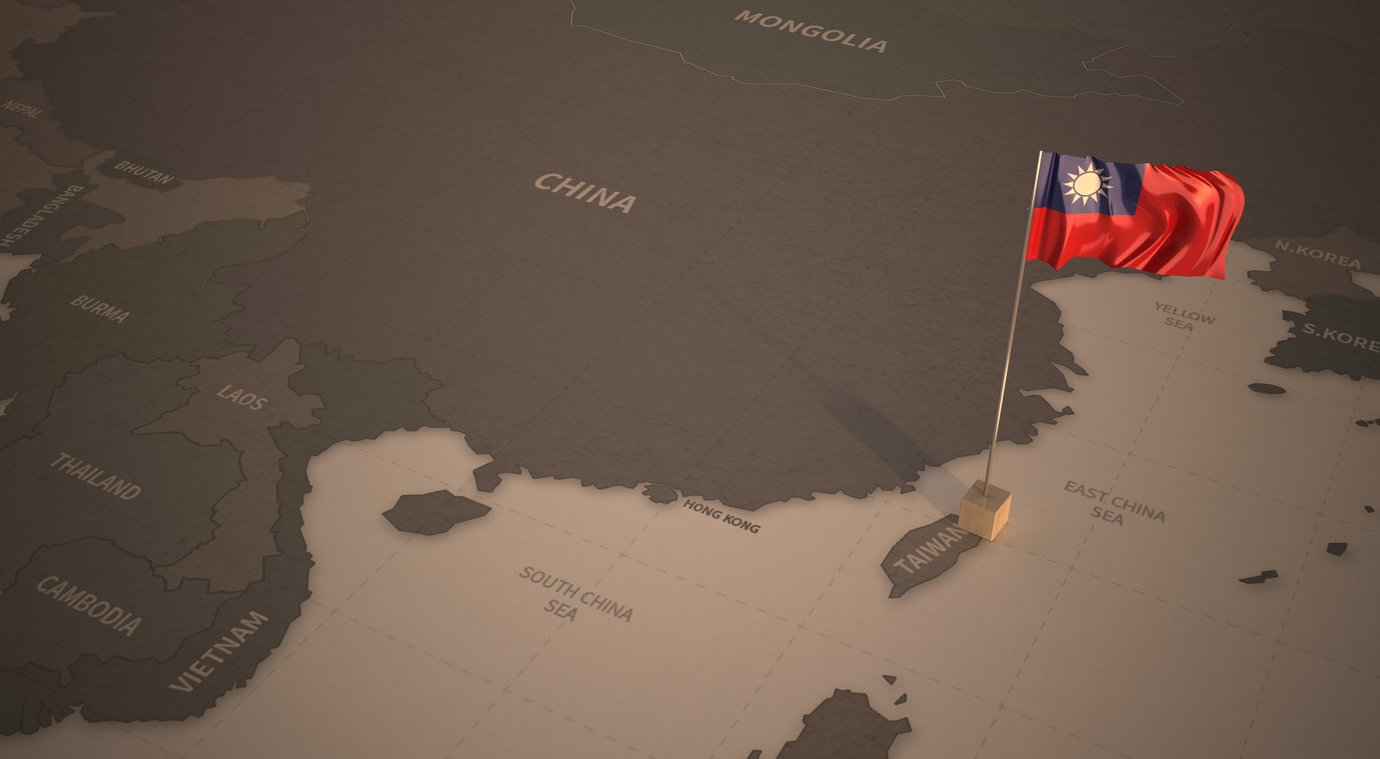
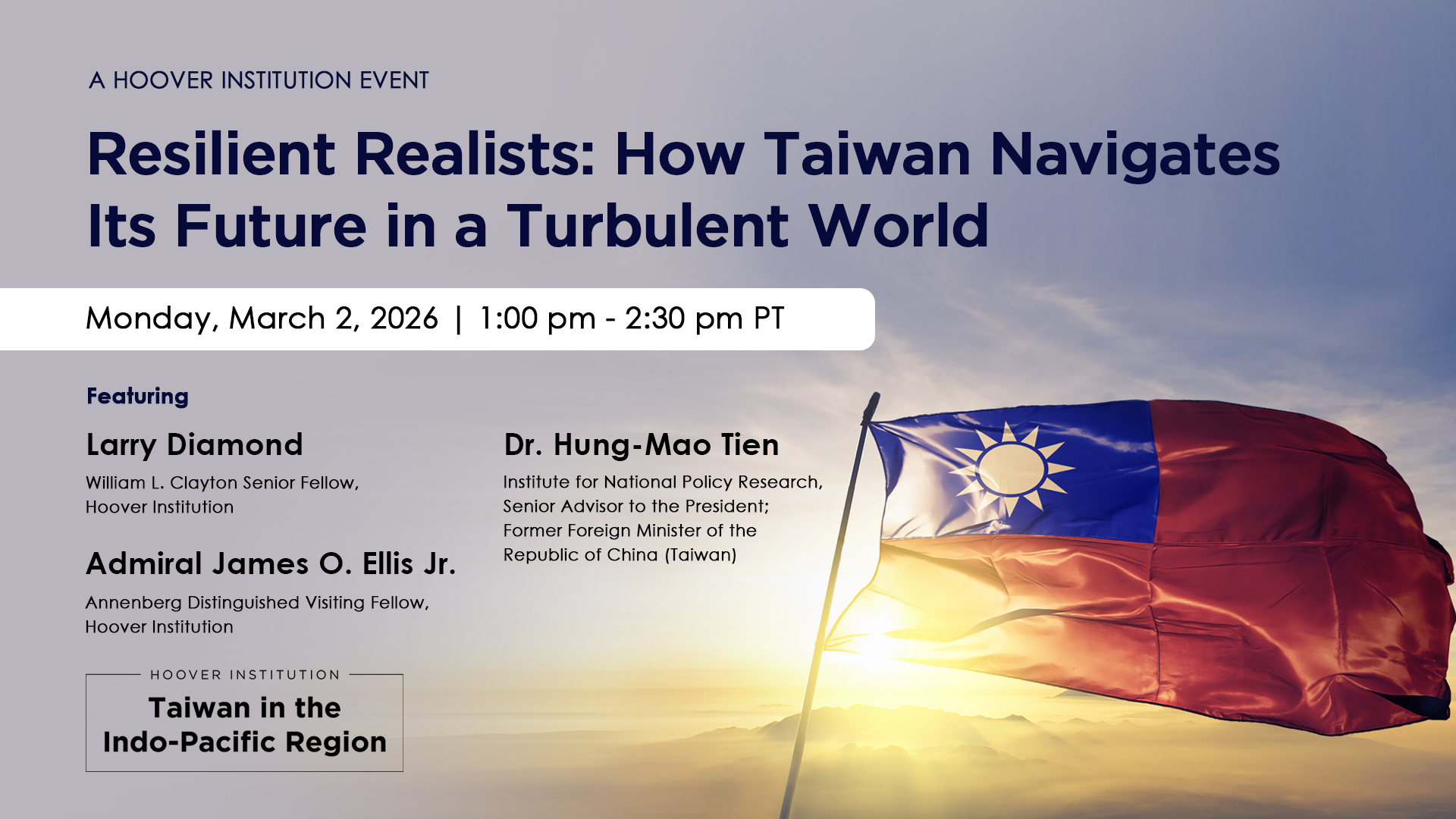
The Hoover Institution's Project on Taiwan in the Indo-Pacific Region held a public session on Resilient Realists: How Taiwan Navigates Its Future in a Turbulent World on March 2, 2026 from 1:00-2:30 PM PT.
Since the emergence of the COVID-19 pandemic, geopolitical competition between the United States and the People’s Republic of China (PRC) has rapidly intensified, and the global order has faced growing strains. Through it all, Taiwan has remained remarkably resilient. In the face of relentless diplomatic, economic, and military pressure from Beijing, Taiwan’s leaders have leveraged the island’s critical role in global technology supply chains, its reputation as a robust liberal democracy, and its strategic position in the Indo-Pacific to deepen engagement with key world powers. As many Americans question core assumptions of the post-Cold War global order, the PRC’s military power continues to grow, and the world stands on the cusp of a technological revolution in artificial intelligence, can Taiwan continue to navigate so deftly through turbulent geopolitical waters?
To address these topics, the Project on Taiwan in the Indo-Pacific Region at the Hoover Institution held a fireside chat featuring Dr. Hung-mao Tien, President of the Institute for National Policy Research (INPR) in Taipei and a former Minister of Foreign Affairs of the Republic of China (Taiwan). Dr. Tien joined in conversation by Adm. (Ret.) James O. Ellis, the Annenberg Distinguished Visiting Fellow, and Dr. Larry Diamond, the William L. Clayton Senior Fellow at the Hoover Institution.
- Good afternoon everyone. It's good to see you all here today. I am Ka Templeman. I'm a research fellow here at the Hoover Institution, and it's my privilege to manage the project on Taiwan in the Indo-Pacific region. And it's also my distinct pleasure to welcome a very special guest today who's come from Taiwan with a group of researchers from the Institute for National Policy Research. His name is Au or au, and he is the former foreign minister of the Republic of China on Taiwan. The title of today's event is Resilient Realists, how Taiwan Navigates Its Future in a Turbulent World. Since the emergence of the COVID-19 pandemic geopolitical competition between the United States and the People's Republic of China has rapidly intensified and the global order has faced growing strains through it all. Taiwan has remained remarkably resilient in the face of relentless diplomatic economic and military pressure from Beijing. Taiwan's leaders have leveraged the island's critical role in global SEC technology supply chains, its reputation as a robust liberal democracy and its strategic position in the Indo-Pacific to deepen engagement with key world powers. As many people today question core assumptions of the post Cold War global order. And as the prcs military power continues to grow and as the world potentially stands on the cusp of a technological revolution in artificial intelligence, the question before us today is whether Taiwan can continue to navigate as definitely as it has through the past several decades in increasingly turbulent geopolitical waters. To address these topics today, our project at the Hoover Institution is hosting a, we we're calling it a fireside chat, even though there's no fire that we will certainly engage in some, some chatting featuring our distinguished visitor here, Dr. Humma Tian, in conversation with the co-principal investigators of the Taiwan project. On the left we have Dr. Larry Diamond, the William L. Clayton Senior Fellow at the Hoover Institution. My left, your right, and on the audience's left is Jim Ellis, Admiral James O. Ellis. In fact, the Annenberg Distinguished Visiting fellow. Dr. 10 has a few prepared remarks I'd like to open the conversation up with, and then we'll turn to a three-way conversation between our distinguished panelists. So Dr. 10. Without further ado, let me invite you up.
- Thank you. Thank you, Mr. Templeman. To begin with, I would say hello, Admiral and Larry. Larry has been all friend. I hate to say all because I am all, I'm not sure he's all, but we have known each other for over 30 years, and I would like to make a few remark then the details of which will be opened up for forthcoming interaction among all three of us, or any question you may have, please feel free to ask. And I, I thought because of the nature of my current status, I better prepare something in writing so that I don't say anything wrong. I always feel somewhat at home when coming back to Stanford for whatever purposes. Conferences in French need this to say, I am incredibly delighted today to be here with you. Both at Stanford University and Hub Institution have had many memorable impacts on my earlier academic life. Both institutions have published my books. I have had many good friends here now, and of course before too. In my younger age, I spent many months of very happy life with my family here. That means spell out why I think Taiwan and across trade relations matter a good deal in our analysis of global and strategic security issues. Taiwan's geostrategic location is vitally important to the safe and free passage of the world's most important XI land stretching from Japan to the north through Taiwan, strai and South China Sea. To reach India Ocean and beyond. Each year, approximately US five to $6 trillion worth of goods and commodities travel along this sea, land China claims Taiwan is a Chinese territory. If true, the Taiwan Strait will be regarded as China's internal water, then free passage becomes problematic at the least. Taiwan is an inherent part of the US first island chains of defense in a western Pacific, presumably to deny China's namal entry into the heart of the Pacific Ocean, Taiwan democracy has consolidated. Following three peaceful transfer of national political power. It has unknown universal values shared by the world's democratic countries. Taiwan's economy is cross the linked to both the United States and China. Recently, the high tech sectors of the economy are shifting decisively away from China to the United States. About 75% of Taiwan's exports to the United States market come from this industrial resources contributing to almost US hundred and $50 billion in trade surplus last year. That is 2025. Some studies indicate that among the world's 50 leading technology companies, 10 of them are Taiwanese companies. In ICT semiconductor and AI industry, Taiwan has the most complete supply chains ranging from production materials, operation machines, IC design, manufacturing, packaging, and the final stage of shipping by air and sea. The total numbers of enterprises involved are estimated to be at somewhere between 2000 to 3000 companies. As of now, approximately 68% of global semiconductor chips are met in Taiwan and in the most sophisticated sectors. That is to say between those of two and M two, five and M available now as many as at this 95% are reported provided by Taiwan companies alone. At present time, TSMC is believed to be the leading semiconductor producer in the world and Taiwan's, nearly complete supply chains make the country and indispensable factor in the United States and other countries. Economic and military security calculations and crossway matters. Taiwan's Crossway policies continues to emphasize maintaining peace and stability in relations across the Taiwan state. Such a policy statement accurately reflects the overwhelming preference. Although general public in Taiwan, according to the opinion service president William Chin LA emphasized that Taiwan and China, that is the people's Republic of China, has two mutually exclusive state entities. The PRCS periodic result to military threat have been intensifying in recent months. Nonetheless, as of now, Taiwanese people appear to be same wine about this harassment. Beijing continue to actively attract Taiwanese investment despite the fact such investment I and bilateral trade have been have shown significant decline. China need to import a great variety of industrial component from Taiwan, including this sophisticated semiconductor chips. But in recent years, Taiwanese companies among mainland have been freeing to relocate their manufacturing basis in as young countries and India as well as back to Taiwan. By estimate thousands of factories here pour out of China, corporations still remain on a mainland, are reluctant to invest more money there. Chinese mainland are no longer regarded in a business community as attractive or even friendly prices to invest. Americans at large are no longer friendly to China according to to opinion service. Such sentiment is consistently illustrated in public opinion service in the United States Congress and the administration's high level policy circles US Taiwan, partly demonstrated in a congressional passage of many pro Taiwan bills. CCPs leaders, persistent provocative statement and aggressive policy conduct are alienate in majority Taiwanese. This is in contrast to pro Japan as well as pro United States. Sentiments which help remain on steady positive course US armed sales through Taiwan have become more permissive in respect to higher quality weapons and intelligent in exchanges. Closer military to military cooperation backed by both Republicans and Democrats are moving forward ably in recent years. US as the world is moving in a direction of deglobalize restructuring of industrial supply chains, they help draw us Taiwan even closer, especially in the economist technological sectors. Taiwan State conductor company, TSMC, its decision to construct six foundries for a product including ONM and three NM chips in Arizona is a crucial step toward better technological cooperation between the two countries. TSMC has promised to build two high-end outsource semiconductor assembly and test factories plus one R and D center. Consequently, supply chain industries from Taiwan are foreign there. That is to the United States. This commitment add up to a total projected investment of US $165 billion for T hs MC alone and much more once the supply chains are also tabulated. In total estimate more over the world's leading US AI companies such as NVIDIA and A MD have announced their plans to build both large data centers and r and d centers in Taiwan. Nvidia chairman, CEO Jensen Huang has publicly stated there, there won't be amedia AI industry at all without access to two TSMC chips. Amedia supply chain alone long may include about 350 companies in an AI supercomputer infrastructure ecosystem. Taiwan's geo security, democratic values, high-end industrial ecosystems are likely to gain more influence in the strategic calculations of the United States, Japan and other democracies in the Asia Pacific region and BL China's internal complex in political economic sector at home today make it, it seems to me highly unlikely for Beijing to seek a decisive military solution and across the dispute at the present time or perhaps in the immediate future, rumors of parties shift to exert more efforts on United front cybersecurity attack and infiltration tactics gaining broader attention in Taiwan. In conclusion, Taiwan's geographic location is strategically important to the United States anti defense strategy against the PLC's enable naval activities. It is also vitally important to global LAN tray as a consolidated democracy. Taiwan has an added value to the global democratic communities and its existence alone may also appear to those Chinese people who aspire to duplicate the similar Marlo of political development in the future of the mainland. Moreover, as AI semiconductor and other related ICT industry are becoming more crucial factors in industrial and defense department development of the world, I believe Taiwan can be regarded as a strategic people in world politics and security concerns. That's my view. Thank you.
- Well, thank you so much ung Mao for this sweeping and very impressive overview. Now we can drill down into a number of the themes you've articulated. You've suggested there that it doesn't look like China's getting ready to use military force soon, but we've heard some kind of sobering assessments of its other means of trying to subvert democracy and security in Taiwan. So what's your best assessment at this point of PRC intentions toward Taiwan and how it might execute them over a certain trajectory of time?
- This is a very, very important and difficult question to answer and you raise such a question probably not only to me, but to many in our audience.
- Yeah, - Some of them, some of you may have your own thinkings and answer as well. I like to hear them. It is extremely difficult to know how precisely the leaders in the PRC make decision. We all know that. So we have to try to observe activities like related to a possible intended policy direction at this moment in time for somebody who observe what's going on on the basis of published material. It seems to me highly incredible to suggest that if the PRC hire leadership is thinking about pursuing outlying military attack against Taiwan, why he has to purge all of the top military general and they are immediate supporting subordinate at this time, particularly in a critical sectors of the Eastern sea zone, in the eastern sea bulb where the military operation is supposed to be directly responsible for military attack against Taiwan. The high level officer having POed outright and China's rocket or artillery unit, no high level officials having all POed. So it doesn't make any sense to any rational thinker that if they indeed are getting ready to launch a military attack, why in the last second they had to wipe out those people who have been responsible for all the preparation have the best knowledge of coordinating the military exercises and then you arrest them. It's, it doesn't make any sense to me. Yeah. Secondly, my observations if what we have been reading from the medias are accurate, yeah. Some of the defensive weapon system supposedly provided by the United States to Venezuela and now to Iran, they don't seem to be working very well, and by now they should not like because the results are already known. If they're doing the same thing in application to the admitted attack against Taiwan, they should know the outcome will be my my own personal observation, which doesn't necessarily represent official thinkings or my country is like China under the current leadership is based on their own justification. The eventual unification or reunification with Taiwan is part of the reason why the dealership has to stay on power. So they'll continue to talk about it. They'll continue to make effort to do that. The question then is by what means will they do that? My personal observation, which I like to share with you as a possibility is a little shifting not away from eventual conquering of Taiwan, but a tactics which they employ are becoming somewhat different in emphasis. The emphasis is what you already suggested is by way of more reliance on internal political operation within Taiwan by way of what I suggested earlier, United France infiltration, cybersecurity attacks and propaganda and so disinformation and all of this to create internal political chaos and discredit the government and the ruling authority. This, this year, 2026 is particularly what I will suggest as a very sensitive year because number one, United States and Taiwan are both having election in November and the internal situation of both country that is the United States and Taiwan could appear to the leaders in Chi in China that us and Taiwan are internally chaotic, not unify weak, the government will be in a weak position to react, lacking our consensus. Yeah. So what I am saying is to suggest to all of you, which you may not agree with me, that you, if they do, they don't want to give up about Taiwan at all, and somewhere before the forthcoming November election will be a very sensitive period to observe of what they could do. What they could do may not be an outright full scale MINITER operation, but maybe some kind of a limited mini operation combined with internal political operation in a hope in an event, or I personally believe in an unlikely event that they create a puppet regime at home. This is something to that tech note because these days in time we have seen what happened. If you are good enough now you can target it on the leadership on the opposite side without involving the major military operation. That's equally important for us to think about how Taiwan should find some way to protect all of the important leaders in a military and political sector at home to prevent something like this scenario to become a reality. So that's my personal view and I share with you. I welcome your comment,
- Jim. Well, thank you young Mao and I add my welcome to that of Larry's. We're delighted to have you here and I the framing paragraphs for this, this session that we're holding asked the not so rhetorical question, can Taiwan continue to navigate deathly through turbulent geopolitical waters? I'm an old sailor. I like the maritime analogy there. Larry Hung Mile mentioned his relationship with Larry. He goes back 30 years, 30 years ago this week I came out of Manila with my carrier battle group, received instructions for then Secretary of Defense, William Perry, to proceed to the waters off Taiwan as a signal of US concern and resolve in the region as the PRC had begun to fire daily salvos of ballistic missiles into restricted areas north and south of Taiwan. This was the active phase of the 1996 Taiwan Straits crisis. Somewhat interestingly, I was later told by my intelligence officer that the Chinese leadership, the PRC leadership, thought that I had been specifically selected to go to Taiwan because of the name of my flagship, which was USS Independence, if only we were so clever. I happen to be in the neighborhood, but that's a sign of the enduring relationship between the United States and Taiwan that had persisted for many, many years and has only been amplified and strengthened as we look at Taiwan's incredible journey to democracy. So I guess my question, well, the first one would be what are the key elements of not just maintaining that partnership with the United States or that relationship, but how do we strengthen that partnership with a focus on defense going forward? What are the elements that you think are most important that have to be considered now that we can continue to grow this extraordinary relationship we've had for so many decades?
- I think living in Taiwan for some 30 years now, right before, before, before that I was in the United States and went back in mid 1990s. You know, I, I can say that people in Taiwan feel will feel much more self confident if they know America is absolutely reliable friend at a time of crisis. It is very tricky and difficult for American leaders to want to say it outright to say, okay, we'll come to protect you. Oh, no, we are not, we, we are not going to worry about you. That's on your own, which is not true. I know it's not true because I keep asking the question people told me in Taiwan, those who are well informed people told me the a IT, it's a US ambassador in Taiwan, the AIT t's new headquarter, you know how big it is. Somebody told me it's the third largest investment of any US foreign embassies, and it's fairly new that this suggests to you that United States is walking away by, in investing so much money building its headquarters in Taiwan, and I heard a IT is also looking more land to expand pen. So it seems to me for those who are better informed that no, I don't think America is walking away the United States for whatever reason, you know, is a reliable friend. So it seems to me that what is the congress has been doing has been continuing reassurances of Taiwanese people that at this US Congress is on the Taiwan side or do anything to help Taiwan. But the problem is that in American system, it is the administration's actual policy conduct that can the most important and not the White House and the State Department not always necessary follow exactly what the United States Congress has suggested. So that's a tricky part of that. On the one hand, I indicated earlier, as a former president, indicated four time and yes, we'll, we'll come to help Taiwan, you know, and other time we have heard other president say, no, Xi Jian is my great friend. You know, so this create on surface a sense of uncertainty. So if I could suggest to you some political realist, political scientists of Chicago would suggest that United States probably should make it more clear as the recent Japanese prime minister did, Ji a lady prime minister, if Taiwan is ever having problem, the Japanese leader consider not to be the issue of survival of Japan. US doesn't have to worry about survival because US is is, you know, dominant power in the world today. But somehow my personal thinking is perhaps United States can be more assertive, political, moral. So to make sure, yeah, that Taiwanese people a large understand that in a worst case scenario, United States will not get Taiwan alone. Not at all. Period. Okay. That's other part of that, you know, is by way of continuing all more widespread support in the defense infrastructure aspect, including intelligence, et cetera. You know, I, I think United States has been doing that in more recent years, but there are more that can be done. The last point that is very sensitive is United States actually has a lot of way of dealing with domestic politics in Taiwan. US has been very reluctant to use its inference within Taiwan's internal politics, which we are beginning to see some sign of change in that direction. Then the US could do something to signal that those who are extremely pro United States political forces deserve to be the support of American policy. Those who are outright against United States and in support of of our mutual hypothetical enemy should not be one that United States who care about. There should be more and clear signal about that, that would change the political equation at home. Maybe not well away, but perhaps in the forthcoming election in, in September,
- We were a able to talk a little bit this morning about some of these threats of propaganda internal subversion, the effort by this quote, potential hypothetical enemy to e essentially subvert democracy in Taiwan. You're a scholar of democracy. You wrote a book about the great transition in anticipation of it correctly and of course have edited and, and our partnership, a book on democratic change in the world. You also lead a think tank that's looking at these national security issues. So could you reflect on the dilemma which a democracy faces in the kind of context that Taiwan is in now that on the other, on the one hand, if you wanna be a liberal democracy, you have a constitution, you have a rule of law, you have freedom of the press, you have freedom of expression. But what do you do when you're quote, potential hypothetical enemy, your real world adversary, so close by across the strai speaking the same language with all sorts of, you know, common language and cultural traditions and people in the opposition party going back and forth to the mainland, you know, has these various means of projecting its will through sympathetic newspapers, television stations, economic actors, potential infiltration of, you know, the actual, you know, security establishment. How does a liberal democracy fight back against that and where do you see the law line being drawn between the liberal aspect of tolerance that just says whatever the viewpoint, even if it's influenced by a hostile actor, we have freedom of expression and you know, we also have to defend ourselves against subversion. How do you judge that balance?
- Dr. Diamond is probably at this present time, known to be one of the leading, if not a leading scholar or theories on democracy or democratic change. He's, he's a great scholar, that's why he asks difficult questions about democracies. He know that the name of democracy at a difficult time, at a non peaceful time, okay. My reaction to that is that the problems that Taiwan faces, the challenge coming from the other side of Taiwan Street can be divided into two parts for the sake of discussion. Number one, Taiwan as a democracy is just like United States a democracy. It's just the United Kingdom is a democracy. We all face the same problem. We are all open society, we are all believe in humanitarian treatment of people. We are all holding people, potential suspect until you prove they're guilty. We all want to respect a rights of your own citizen. So in that sense, Taiwan is having difficult difficulty establishing institution or pro persecution mechanism to deal with people who work for the opposite side or unfriended side or, or potential enemy to penetrate, to sabotage. Now you've seen that in a universal sense. You've seen that happen to the United States, to European Union, to UK and other country during the Cold War, how United States was so vulnerable to Soviet penetration and what is happening now to the Chinese penetration. So not, not only Taiwan alone, so many countries in Europe are having the same of handling that because it's an open society, it's a democratic society, a society that believe in human rights and rule of law. We all have said the same problem. So the question you ask me is in effect asking the question to all of the people in the audience. Many of you are perhaps more qualified than me to answer that question, but the second part of that question is having to do with regard to Taiwan in particular. Taiwan has the same problem like other democracy has in dealing with hostile, unfriendly, authoritarian government abroad. But Taiwan has a peculiar its own problem. It's peculiar in itself, namely, Taiwan has a lot of, you know, people who lived there continue to have to have strong memory of China, who continue to have family social tie to people on the mainland China whose parents may have some strong connection with China. So Taiwan by definition is a divided society to begin with, especially with respect to relation with China. For those of you who may not know in 1949, you know, communist regime took global China. The Ang KMT regime come from China to Taiwan. Two millions of them come with a regime together, and we stay in Taiwan now become the Diego resident of the Republic of China and Taiwan. Okay. But it seems to me that people forget about, those are the people who have social tie or their children still have memory of their social tie in China, in Taiwan, in China, and added to that is a complexity of the problem. So economy, economic interdependence. During the years of 1990 years and the first decades of this century, during that time, there was a almost in universal belief and in Taiwan too, that somehow there is a a lot of money opportunity to be met in China by investment there. Secondly, politically, if somehow we can make all Chinese middle class and someday their system maybe change, I submit that this was a very popular thinking of American in intellectual circle, which I was familiar with. They all believe that my many friends in the ad university in the East coast and West coast and Middle West, they all seem to think that this is where to go change China from within by all friend friendly support, only to find out later on, they turn away against you. Just think about how many Chinese scientists and engineer who work to support the regime in China today are actually educated in the United States with American money. Just ask that question. Whose fault? Well, thank you. I I'm not, I'm not giving me, okay, I have no, I'm just ask the question, but please, you know
- I'm wrong.
- Yeah, - No, no, we, lots of great questions, lots of great issues to, to table here. One of the key conversations we had this morning was how dramatically things have changed in the region. You talked about it president, and we talked about the changes in Chap in Japan, for example, first under Abe and now Inchi and some of the pronouncements that she's made. We've seen changes in the Philippines now that President Dete has left and President Marcos has returned. The attitudes are are changing. Obviously we talk about the partnership with the United States, which is and will remain, I hope, one of the key elements of important elements to Taiwan. There's a summit coming up the end of March and the beginning of April between President Trump and Xi Jinping. I'm gonna let you write the talking points for the United States. What do you think are the issues that we ought to be talking about? How do we do this in a way that's not viewed as provocative, but sends the right signals from your perspective as you addressed with us this morning that you think needs to be sent to reinforce the prospect of peaceful resolution of the, of the cross street issues and the continued success and prosperity of both mainland China and Taiwan. So what do you think, you know, there's an old fighter pilot maxim that says, if you're not seated at the table, you're probably on the menu. All right? You're not gonna be at the table then, but let's keep you off the menu and you tell me what the talking points ought to be.
- I personally don't know a President Trump and he would not ask me anyway. So, but for the sake of conversation, I think you are more qualified probably to, to make suggestion to the American leader who wanna meet the Xi Jinping about what should be done. I believe that American dealers most party believe that Taiwan state, Taiwan state should be kept peaceful, unstable. That's the ultimate objective. But how to do that, my general thinking is in the directions of that. The CCP ship does not really appreciate, certainly not respect any per any adversary or anybody who is very weak and come to knock at your door. If you are not strong enough, if you don't have something they really need to have, they'll never make any concession. The history has proved that just the KMT never learn about that at all. Now, how many times they have enter united a friend relationship with the CCP and fail. But if United States is willing, and obviously there's so many way US government can help Taiwan still now, and our current government leadership is determined and understand the only way to make peaceful and meaningful negotiation with the other side is that you are strong enough. You have the leverage, you have values that the need without which they will never seriously negotiate with you for any peaceful settlement. I know the Taiwan Strait question has been a long standing issue for a long time. You know, going back to you may, some of you may remember the Nixon candidate report about an offshore island, and you know, it has been always a regional and sometime a global security issue and will continue to be for quite some time to come and this the CCP leadership change, and I don't know how many people believe that the CCP leadership will change. I don't know, you know, I have no way of, of knowing that, you know, but it seems to me that assuming that there could be change of person, but the leadership structure and the way they make decision and the fundamental belief of the party does not change, then the only way you can try to maintain some level of peaceful coexistence in a Taiwan strait area by continue to build up one's own middle political, economic and military strengths to such a point that that other side know if they result to any violent action, the negative impact on themself will be so huge that the result, the consequences will not be acceptable to themself. Unless you can get to that point of building up what I will call the effective deterrent capabilities in a broadly defined sense, not just military, then it's very difficult for both sides to come to some kind of a meaningful negotiated settlement to as accept the situation as they are. I know Amal would probably not prefer to use the term status quo, but let's use other term, you know, so any status quo is changing anyway. It's, you know, it's a constant change that the content of status quo vary from time to time. I, I agree with you totally, but let's, I think what the government in Taiwan today is intent is intending to do, to build up the internal strengths, the defense capability and other aspects to strengthen ourself, economy, technologies and military, whatever. So that making sure that if the other side want to alter that picture, they have to pay a price that will be too high for them to be willing to pay for, or this, this is what I learned from a textbook in the United States, that you have to have effective returns, you have to be strong enough to deter the other side. You cannot negotiate from the position of weakness. I don't know, I like to hear your opinion now. Oh, no, that's
- A great summation. I think I already want to go to questions here. Yes. Okay. We are delighted now to open the floor to, to questions from, from our distinguished audience. So if you, if you have a, a question, please raise your hand and we'll bring you a microphone so that those that are not with us in person can, can hear and the recording can pick it up. So,
- Okay. Thank you very much Dr. Hung Mao. My name is Ben Sharma, I'm a alum of the university. I wanted to ask you a question. You, you touched on several points, the Silicon Shield, how important Taiwan is in the global economy, the, the changing of the, the wind with each administration and what that means to the, to the fate of Taiwan. I wanted to bring up a specific item that maybe you kind of obliquely touched on and, and that is Howard Lutnick has said that he wants the US to be able to produce about 40% of its own high-end semiconductors. And then the Trump administration, maybe even Trump himself, has said that unless Taiwan kind of pays for its defense, I think the figure is about a hundred billion dollars in, in defense munition purchases from the us That's kind of protection money in a sense. Then why should the US protect Taiwan if it's not willing to make that investment? And then there's been a timeframe that's been put out regarding this, and that's 2028, that the target is to try to reach that 40% figure by 2028, and that would colloquially, you know, make the Silicon Shield a little bit more porous. And, and then would the US be able to kind of, you know, maybe not be there in your time of need. So I wanted to ask you more pointedly these specific things that have been raised by the administration. How is Taiwan reacting to that and what kind of mitigations might there be on your side?
- Yeah, I think that's a very good question and a very timely question. In fact, and I can assure you to the base of my knowledge, I think the dealership in Taiwan fully understand that, yeah, the issue will go back to what we discussed earlier. Taiwan is a democracy, and we all know that in democratic countries, whenever the administration, the government want to spend money, legislative branch or the government control the pers you need their approval. Unfortunately, in the last election, the ruling party in Taiwan lost the control of majority sheet over the legislature, which sometime happen in the United States too and in other country, in Korea, in many other European country as well. That's the dilemma of Taiwan. Now, the administration headed by President Lai thus propose to invest by extra defense spendings or 40 billion US dollars that has been brought by the opposition party or parties. But my view is that it's not beyond solution. It could be resolved. It could be resolved maybe not too long from now. I I cannot guarantee that. But the process is working now, you know, so it is not the leg of will on the part of the government administration, the government fully understand that we, we have, we have to protect ourself. We have to try the best we can to protect ourself before we can ask the United States or and Japan to help us. That is fully understood. I can assure you that it's just a difficulty. Now we face a, as a democracy, it's broke in the legislative process. It once if and once that is resolved, clear the legislative process, then Taiwan is waiting not only to pass the current proposed budget, but it has promised either the date is by 2030, the defense spending will go up to 5% of GDP and for Taiwan is not small. Taiwan's economy is quite considerable. Now, last year it grew by the 8.6%. GDP growth rates the highest in Asia and it's projected that this 4% more and more growth rate this year. Yeah. So a substantial amount of the money of the government, and by the way, the Taiwan government is not shortage of money. It has very little external debt. It has the considerable foreign reserve. It's one of the largest foreign reserve it can use when it come, you know, to the necessity phase of crisis if that ever come. So yes, it's a problem. Yes, there is already an awareness that we have to do that. And by way of public education, through media school and then official policy statement, we all know, I think majority of the people in Taiwan, to the best of my knowledge, understand that we have to try the best to help ourself first before we can ask for Japan and Thai us or vice versa to help us. That's, that's very much understood. But there are some people in the society, in democracy, they don't want that. They don't, they don't want Taiwan to be crossed to the us you know, they, they, they are political preferences are entirely different, you know, so unless they commit a obvious legal violation, you you cannot, you cannot have a way of dealing with them. But, but this is, this is a dilemma right now. And then again, hopefully, you know, United States government hopefully will help us to untie the luck, so to speak. And once that is done, I think Taiwan has the resources and I, I can assure you to the base of my knowledge, Taiwan probably has the most complete supply chains or the most they needed industry in AI and semiconductor or the world, which I already talked about earlier. I'm not a specialist in high tech, but the general concept, I, I have spent considerable time studying about them. You know, thousands of small and medium sized company are all part of the ecosystem of the supply chain, which are not replaceable in other country. And they can be used and they are in here in part of a defense industry of any country now and in the future. And Taiwan has that if want, we want to do that to apply to defense industry, to help ourselves and hopefully to be able to provide whatever United States and Japan also need them.
- Dr. Tan, thank you. David Federer from the Hoover Institution. So when a group of us here at Hoover a few years ago did an analysis on the semiconductor supply chain, we call it the silicon triangle and the three points of that triangle where the United States, Taiwan and China, it's an obvious three body problem. But you've touched on another emerging triangle in the Indo-Pacific, the United States, Taiwan and Japan, with major changes happening there. If you were foreign minister today in Taiwan, what would be on your agenda diplomatically with Japan to deepen that relationship or issues that you'd like to address? And on the other side, are there things that we can be doing from a US perspective to encourage that? You know, there, there are doubts about the Trump administration's multilateral inclinations, but I think it is true that they believe it's important for our allies and partners to be strong. You just mentioned self-reliance. What could the US do to help Taiwan and Japan be stronger together today?
- Well, I have a colleague who is a specialist in Japan. If you wanna make some comment later on, either you could, but I would say that sitting here with, you know, anything related to military, I'm not qualified to comment and, but you raise the questions about US, Japan and Taiwan's, potential military or high tech, you know, comprehensive partnership. If we, if we don't use the term alliance, alright, people often forget Japan was a very strong industrial power even before the World War ii. You know, they were able to, to establish, to build very competent, you know, weapon system. But much of that, and those company are still there now. They have been handicapped by their constitution prohibit them to become re-arm to become a so-called normal country to develop, for example, nuclear capability or for example, to, to build up some kind of nuclear bilateral partnership with the United States. That is to say for Japan to become fully result to military build up. I believe they have the industrial capability of doing that. Japan people often forget the Japanese population is about France and UK combined together it's very large country. The US Japan Alliance Security Alliance may be the most important bilateral security alliance for the United States in the whole world because the indoor pacific region is becoming, by definition the most important security arena for American policy today and the future. And the U Japan share, the common economic and political and value system have a common interest. You know, they can be two economy and industry can be easily somewhat integrated without serious mutual suspicion. Another part of that, which people often forget that Japan has certain ingredients that are very crucial to semiconductor industry, particularly in chemist chemical products. There are certain chemical product, some of my colleague can answer that data if they wish. They are absolutely needed for semiconductor industry. And the Japanese virtual monopolize them, you. So if you wanna talk about high tech alliance of comprehensive partnership, trilateral partnership, it should not be us, Taiwan and China. It should be us, Taiwan, and Japan.
- Yep.
- Japan is American alliance. China is not, there's no reason why to build a security alliance, high tech alliance with China, which is not your friend. And especially now the Japanese has a prime minister who command the highest popular support of any prime minister since World War ii. And it is strongly and extremely pro United States very friendly. The United States just see how he President Trump and her together, I mean hand in hand, you know, just a brother and sister. And it is cross than in appearance. What you see between President Trump and any European leaders for, for that matter. And the Japanese leader happened to be a very strong supporter of Taiwan today. So the timing is perfect, perfect in the sense of the leadership of these three countries can actually work together if they wish, because they share the same common value and same common interests. And these three countries together can virtually dominate the high tech industry of the world in the next decade. Why not doing that? You know, and we, INPR, we have a bilateral annual dialogue with the Japanese counterpart. We'll talk about that, you know, and those message can, can filter through to the highest level in Japanese government too. We'll do that. And I, you know, with your permission, I'll, I'll suggest that all of you start to think about this may be the direction, what United States future technological development should go to try to bring Japan and Taiwan into the focus, organizing this comprehensive partnership. You know, you Japan, Japan and Taiwan can offer what United States need. And America still o is a big brother number one. No, nobody's gonna challenge that, you know, but you, you need the hardware manufacturer of those product. Without that, there is no AI industry without that, the high level defense industry in, in the United States may, may somehow feel short of the need or the kind of chip only Taiwan can produce in a reliable way the in Chinese.
- Well, I just wanna say before we move on to the next question, we are thinking about it here in Taiwan, here in in the Hoover institution as you are in Taiwan. We're thinking about it intellectually and we're thinking about pretty passionately. And I think that's why David asked the question he did. You're pushing on an open door in this regard.
- Yeah. Hi, John Lin, local resident Tony's American. I was wondering, is there anything that the Tony's government is doing policy-wise in terms of increasing investment or encouragement to make investments in a soft power to increase the backing of American citizens and others abroad to increase support for Taiwan? Much like how I think South Korea has done so well with the Korean wave in terms of cultural admiration in the US Yes. K-pop, KDRs, et cetera.
- I, I didn't catch food at your main point.
- There's one thing to get the government of the United States to support the defense of Taiwan, but in terms of cultural affinity or like, I think most Americans know that bubble tea and dint are perhaps Taiwanese. But I'm just wondering if there's a active strategy by the Taiwanese government to increase Taiwanese support abroad through cultural
- Means. Okay, thank you. I don't know my answer will be directly addressed to the essence of your question, but I will try. Okay. Sometime ago we have Korean friend, by the way. We do have think tank to think thing, bilateral dialogue with our Korean counterpart. Hmm. Some of our friend in Korea asked us the question, can you tell us why Taiwanese and yours so much support in the US Congress with the Korean don't, this is the opposite to your, your question. In fact, they think they're not doing enough compared with Taiwanese, we're not doing that great either, you know. But in essence, you know, if, if one has to think about possible reason for that, I don't necessarily agree with you the conclusion and anyway, but I would say that United States dissent armed forces to Korea for the Korean War and this stay on for a long period of time and still does stay on in Korea. The armed forces, the Korean population by and large exposed to the social contact with American, may have been more frequent than Taiwan. But let me assure, at one point in time, at least 80% of our cabinet member had advanced degree from the United States. Yeah. And even today, maybe more than half every, every cabinet has at least 50% or more.
- Most of them are PhDs.
- Most of them have PhD
- Contrast to the us. Yeah.
- Yeah, that's probably the problem. Too many PhDs, you know, so it's not a shortage of Taiwanese exposure to American culture. There are still, I can't say that we, we are state department official here, you know, there are still so many Taiwanese, even official who carry dual passport. Yeah. Our passport than American. Yeah. So I don't know how to compare that. I think that the Korea may also think that they are better cultural rated with American culture than the Japanese. We don't know, you know? But it seems to me that I would put Korea and Taiwan on the same footing in terms of contact with America and then social connection as well as a value association between both sides. But the Korean political situation and their geographic location and the problem they have are somewhat similar to ours, but very different in nature. They have to worry about North Korea, but, but somehow they're thinking about China. I will have to say the communities, China, the CCP regime, they're thinking about that is different from our government. Now our government is more straightforward, more, more straightforward for United States. But, but in terms of popular culture, I I, I don't think the Korean are necessarily more so than people in Taiwan. Those of you who have been tied to Taiwan, you know that. Yeah, it's,
- I I just wanted to make two points. One is that Taiwan does have a number of representative offices in the United States, including the Taipei Economic and Cultural Office and San Francisco, which we work very closely with. Its director general David Wu is right with us here. And I think he could elaborate on all the work they're doing to promote cultural exchange, you know, foreign study investment and so on. And part of what we're trying to do here at Stanford in this program is expose Stanford students to Taiwan. We do that with our programs cars does it with his teaching on Taiwan. We're in the process of another program on Taiwan that will be an even more teaching facing program at the Schine Asia Pacific Research Center across the street at the Freeman's Bogley Institute. Last summer cars and I took, what was it, 18 or so Stanford students to Taiwan. We spent 19 days there. I, I can tell you this, every time an American student goes to Taiwan, they don't wanna leave. And sometimes they wind up marrying the country, even literally. And you know, they learn the language, they learn it in frankly a more appealing place in a much more open society than the people's Republic of China. So I mean, part of what we need to do is just get more Americans to Taiwan to learn, to study, to engage, to trade, to go back and forth in terms of business opportunities.
- For those of you who like to eat food, Taipei is one of the best city, the best. That's part of the culture. Right.
- Dr. Tan, thank you so much for being here. Fefe Hong from the Hoover Institution as well, also a Taiwanese national myself. My question mainly follows on sort of, you talked about how Taiwan should build that effective deterrence capability earlier, but we see the deadlock in the LI right now and sort of like there's a lot of sort of public opinion attacking the parties, attacking each other. I would like, we would love to hear thoughts on like what are sort of the fundamental reasons and realistically why the green and blue party are still in this deadlock and what are some sort of solutions that we could potentially test out in a domestic society for this to end and actually move things forward. It seems like it's been a deadlock for the past 10 months and, but not really been moving forward. And what role can a US do? And really like also not for forcing one party to like step down, but make more compromise in this dialogue. Thank you.
- Could you repeat the question please?
- Yeah. Yes. The question is how can, you talked about the effective deterrent capability that Taiwan should build collectively as a island or as a country, but with like the deadlock with sort of the KMT and DBP right now locally, how could they move past sort of like these differences and, and like move forward and in your opinion, like how, how and when could they realize that capability?
- Internal
- Politic.
- Yeah. How do you, this question I was gonna pose as well. Do you see any way of bridging the extreme polarization right now between the blue camp and the green camp? And is there anything President Li could do in this regard? You know, what's the responsibility from the other side?
- Well, that's a good question. I'm not quite certain now when one can say that the polarization between DPP and the KMT right now is the worst in recent memory. It is not good. It is not good. And then we need to keep in mind that the KMT can be internally divided, okay? Can be internal divided. You cannot see, you cannot really describe the KMT as an internally coherent political party. Especially with respect, with respect to their attitude to Beijing and Washington DC There are those who came, MT whose personal interests and value affiliation is with the us. They're educated in the United States. Their family live in America. They may hold dual a passport. They go in and outta United States. They don't spend that much time in China. They don't have business other interests in China. There are those KMT members who disagree with, with a ruling party. That's normal in democracy. I would say that that's okay. I don't, as long as you don't ally with a hostile external force, that's fine. So the way I see it, you have to say that KMT is not precisely as what some people see it as it appear on newspaper. It is not, it is potentially internally divided. And the mayor of the largest city in Taiwan, Ty, who is a lady, she's coming to United States and the invitation of State Department, she's a KMT, okay. And she is the kind of opposition party I believe, I hope I don't put her on the spot. Okay. She's the kind of a political figure who can honestly disagree with ruling party on several policy issue. But she has no reason to betray Taiwan, you know, and she can work with United States because after all she has accepted invitation that she's coming to visit Washington DC and not only her, I'm sure many other will come. So, so in short, let me clarify. First of all, it is not necessarily the worst periods of polarization. It is polarized period. And secondly, if the DPP have done something in different way in a last election two years ago, it may not have lost the legislature to the KMT. There are several unfortunate issue that came to the surface that changed that. Okay. The third, the another important issue to look at that is that right now the ruling party is a minority in part because there is a third party which has sided with A KMT, but the third party has a member in the legislature. They are supposed to serve on two years term instead of four every two years. There's a turnover of, of the A, except this time may not be the entire A members, okay? But vast majority of the A members in the last two years who side with the KMD DEC decide today could conceivably change their position to decide to work with the ruling party in the coming months. Now it, it's a possibility, I cannot guarantee it will happen per se, but we see sign of changing. It does change, let's say out of the, you know, eight members of the third party legislator, maybe six of them change direction to decide to support the ruling party on the critical bill, such as defense expenditure or the general budget expenditure. If they decide to do that, then the government will be able to pass on whatever bill is considered to be important. No problem. So it's too early for us to conclude at this point to say that what you saw in the last year will continue to be saw in the last few months. My answer to that is no. It's in the process of change and most likely it will not be. So it seems to me that it is very important for our government leaders to understand that you have to demonstrate the ability to be able to handle the opposition in the legislature to assure our American supporter you that you have the ability to do that. And I think our administration at a high level understand that this is very important. You know, to be a reliable ally for United States, you have to show, you have ability to exert, to exercise internal political control. I think this is likely to happen in the near future. I am cautiously optimistic. Is that good enough? I don't know. Governor, what do you think? I think that's great. That what I think are we out of time? Right? I overate it.
- Okay. Can we, if I might presume to, to conclude, I think it was Winston Churchill that said, out of intense complexities, intense simplicities emerge sometimes we're guilty of making things more complex than they need to be. Ronald Reagan said it a bit more plainly when he said there are simple answers. There are just no easy answers. The stability of the Taiwan strait's gonna be decided by three interacting factors. Beijing's assessment of military feasibility, Washington's credibility and consistency, and Taiwan's domestic political cohesion. That's what it comes down to. The current administration, I think. And to answer the rhetorical question I asked earlier about conversations with the PRC and and Xi Jinping, I think it can strengthen deterrence if it pairs pressure on China with assurance and reassurance for our allies and partners in the region. If it accelerates capability, not just rhetoric, but real capability and it avoids sending the inappropriate signal, the Taiwan's security is negotiable. Taiwan's party dynamics, as we've discussed, will influence tone and tempo, but the core reality remains. I won't say the status quo because I don't do that, but I'll substitute peace. Everybody I think can adhere to that peace will hold only if Beijing concludes that coercion would fail politically, economically, and militarily. So thank you for being a part of this conversation today, and join me in applauding our distinguished guests. Thank you. Thank you.
ABOUT THE SPEAKERS
Dr. Hung-mao Tien is the President and Chairman of the Institute for National Policy Research in Taipei, and board member of several foundations and business corporations in Taiwan. He also serves as a Senior Advisor to the President of the Republic of China (Taiwan). From 2000-2002, he was the Minister of Foreign Affairs. He also served as the chairman of the Straits Exchange Foundation, the semi-official body in Taiwan responsible for direct exchanges and dialogue with the People's Republic of China, Representative (ambassador) to the United Kingdom, and presidential advisor to former President Lee Teng-hui. He has also served in an advisory capacity to Harvard University’s Asia Center, The Asia Society in New York, and the Brookings Institution in Washington, D.C. Dr. Tien has taught in universities in both the US and Taiwan as professor of political science. His numerous publications in English (author, editor and co-editor) include: Government and Politics in Kuomintang China 1927-37 (Stanford University Press); The Great Transition: Social and Political Change in the Republic of China (Stanford: Hoover Institution Press); and Democratization in Taiwan, Implications for China (St. Anthony’s Series, Oxford University), Consolidating the Third Wave Democracies, Themes and Perspectives (Baltimore and London: The Johns Hopkins University Press), China Under Jiang Zemin (Rienner), and The Security Environment in the Asia-Pacific (M.E. Sharpe). He received his Ph.D. in Political Science from the University of Wisconsin-Madison.
Larry Diamond is the William L. Clayton Senior Fellow at the Hoover Institution, the Mosbacher Senior Fellow in Global Democracy at the Freeman Spogli Institute for International Studies (FSI), and a Bass University Fellow in Undergraduate Education at Stanford University. He is also professor by courtesy of political science and sociology at Stanford, where he lectures and teaches courses on democracy (including an online course on EdX). At Hoover, he co-leads the Project on Taiwan in the Indo-Pacific Region and participates in the Program on the US, China, and the World. At FSI, he is among the core faculty of the Center on Democracy, Development, and the Rule of Law, which he directed for six and a half years. He leads FSI’s Israel Studies Program and is a member of the Program on Arab Reform and Development. He also co-leads the Global Digital Policy Incubator, based at FSI’s Cyber Policy Center. He served for thirty-two years as founding coeditor of the Journal of Democracy. Diamond’s research focuses on global trends affecting freedom and democracy and on US and international policies to defend and advance democracy. His book Ill Winds: Saving Democracy from Russian Rage, Chinese Ambition, and American Complacency (2019; paperback ed. 2020) analyzes the challenges confronting liberal democracy in the United States and around the world and offers an agenda for strengthening and defending democracy at home and abroad. His other books include In Search of Democracy (2016), The Spirit of Democracy (2008), Developing Democracy: Toward Consolidation (1999), Promoting Democracy in the 1990s (1995), and Class, Ethnicity, and Democracy in Nigeria (1989). He has edited or coedited more than fifty books, including China’s Influence and American Interests (2019, with Orville Schell), Silicon Triangle: The United States, Taiwan, China, and Global Semiconductor Security (2023, with James O. Ellis Jr. and Orville Schell), and The Troubling State of India’s Democracy (2024, with Šumit Ganguly and Dinsha Mistree).
Admiral James O. Ellis Jr. is Annenberg Distinguished Visiting Fellow at the Hoover Institution, where he oversees both the Global Policy and Strategy Initiative and the George P. Shultz Energy Policy Working Group. He retired from a 39-year career with the US Navy in 2004. He has also served in the private and nonprofit sectors in areas of energy and nuclear security. A 1969 graduate of the US Naval Academy, Ellis was designated a naval aviator in 1971. His service as a navy fighter pilot included tours with two carrier-based fighter squadrons and assignment as commanding officer of an F/A-18 strike fighter squadron. In 1991, he assumed command of the USS Abraham Lincoln, a nuclear-powered aircraft carrier. After selection to rear admiral, in 1996, he served as a carrier battle group commander, leading contingency response operations in the Taiwan Strait. His shore assignments included numerous senior military staff tours. Senior command positions included commander in chief, US Naval Forces, Europe, and commander in chief, Allied Forces, Southern Europe, during a time of historic NATO expansion. He led US and NATO forces in combat and humanitarian operations during the 1999 Kosovo crisis. Ellis’s final assignment in the navy was as commander of the US Strategic Command during a time of challenge and change. In this role, he was responsible for the global command and control of US strategic and space forces, reporting directly to the secretary of defense.