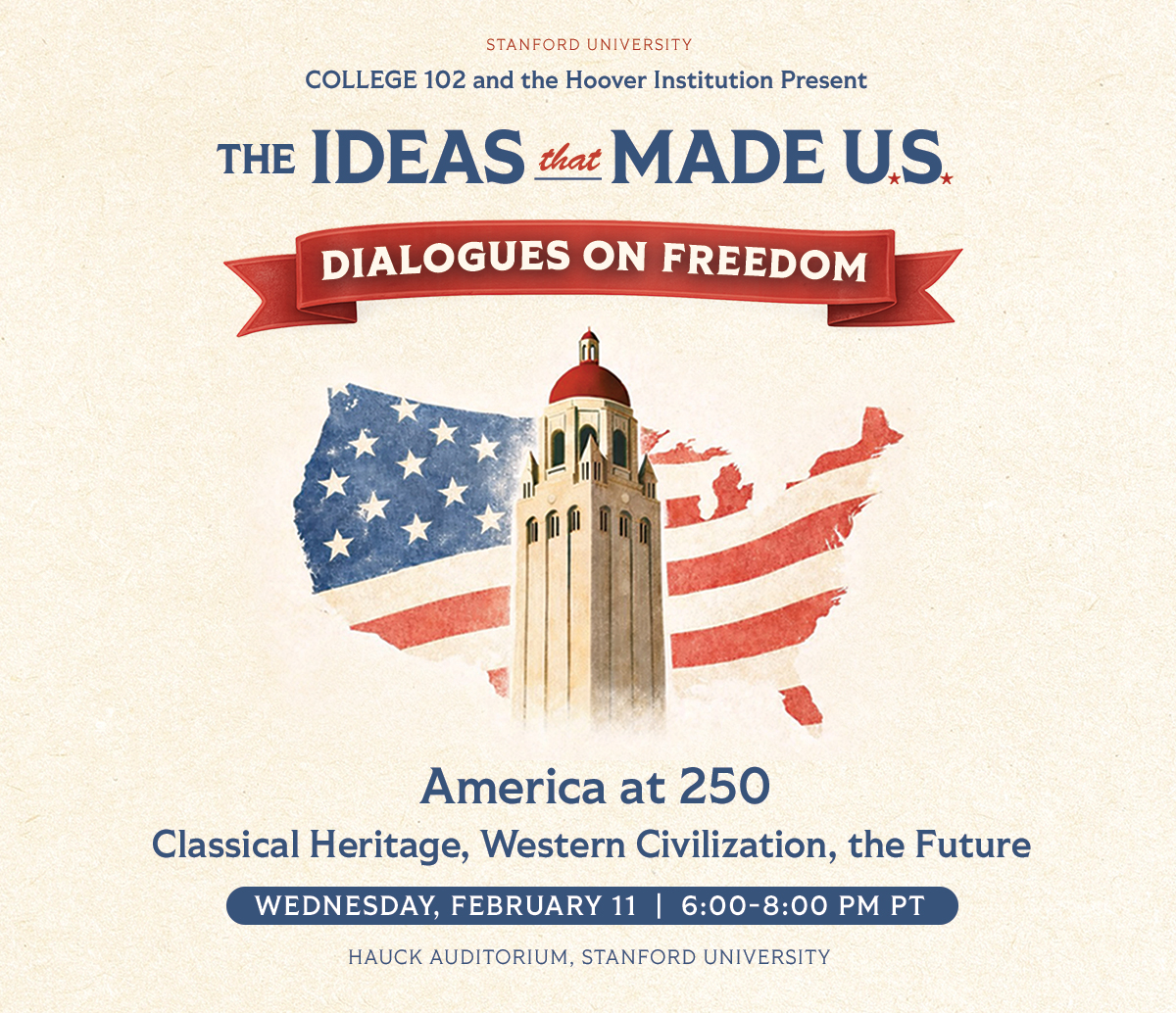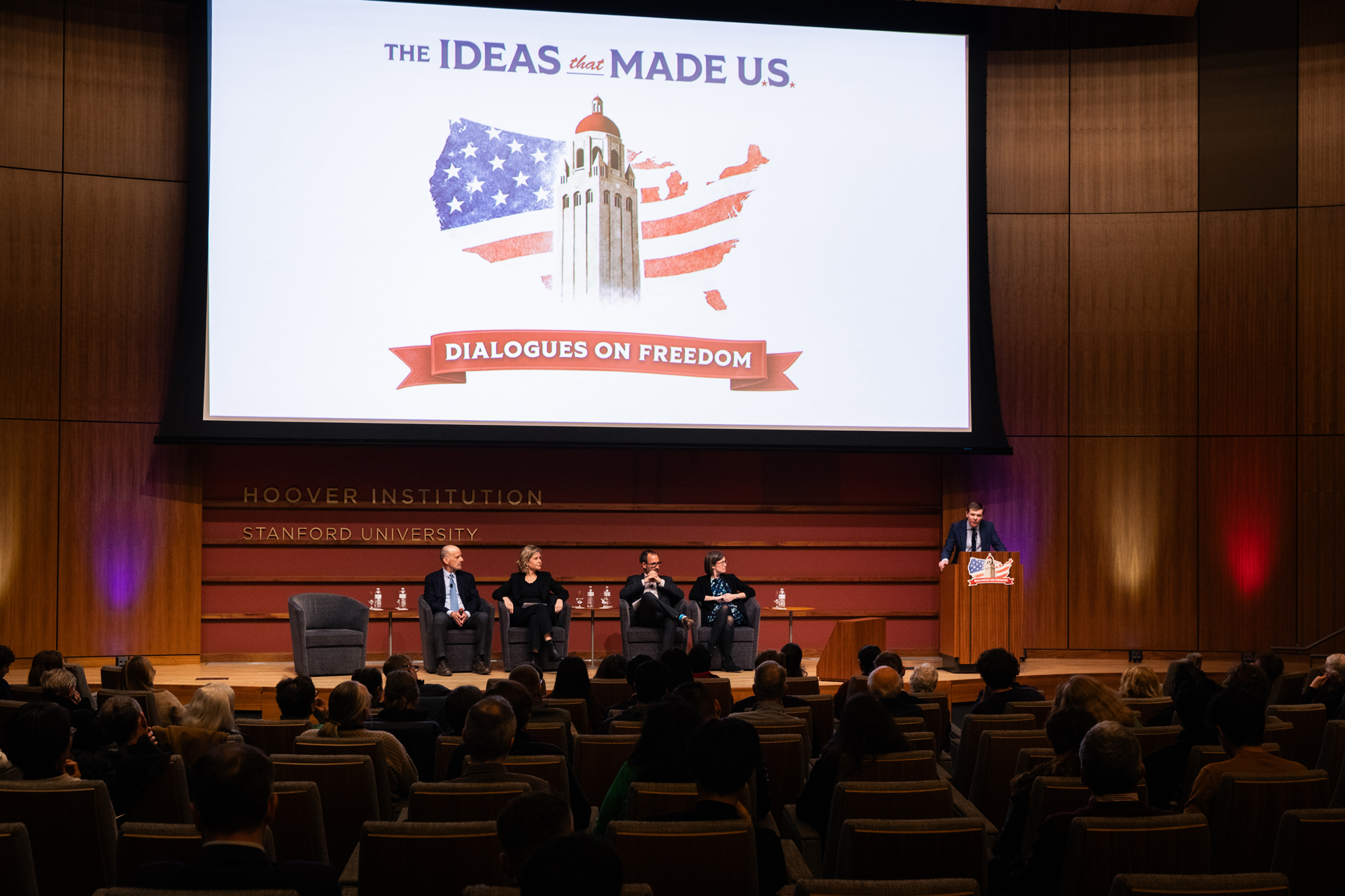
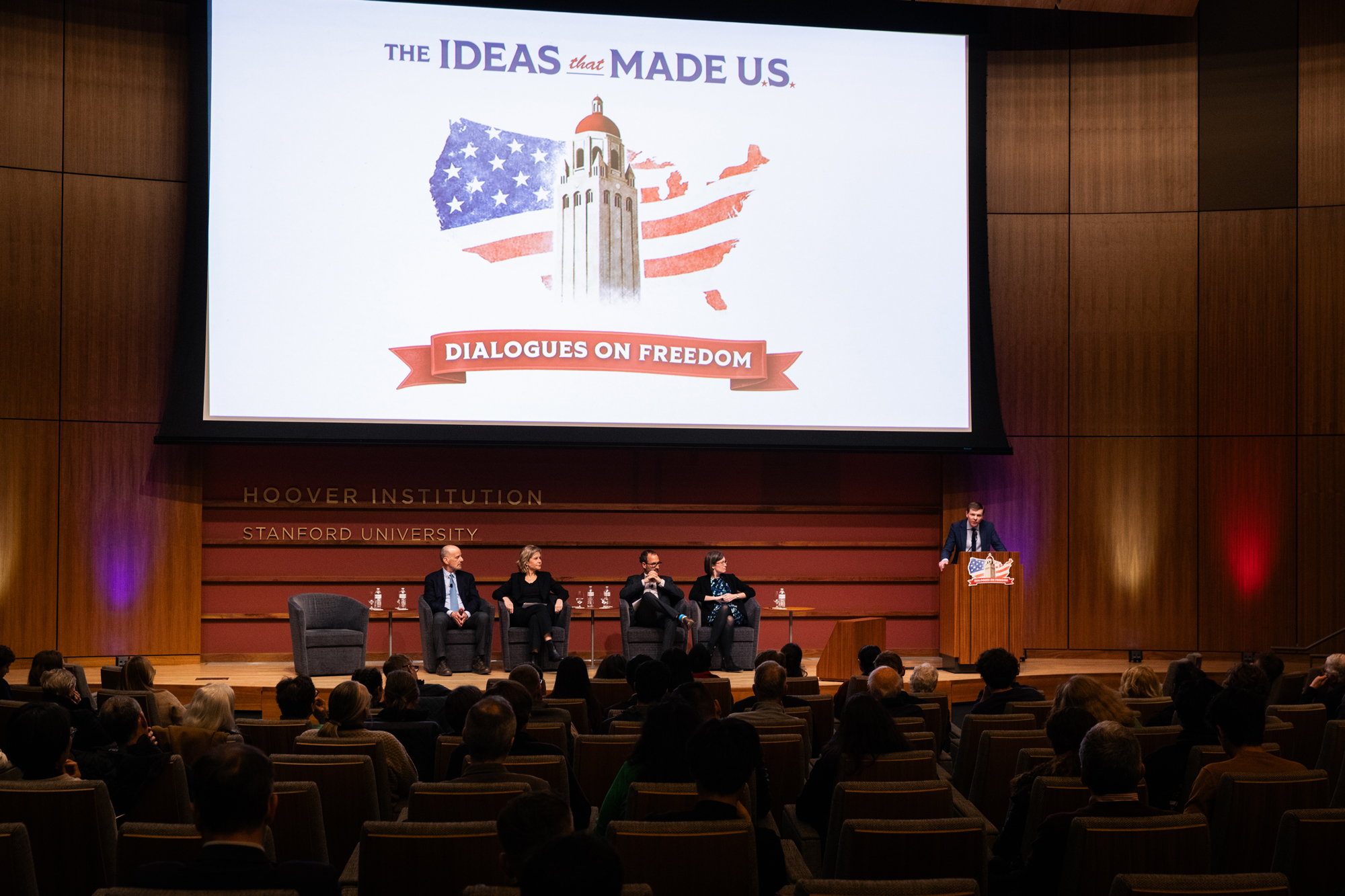
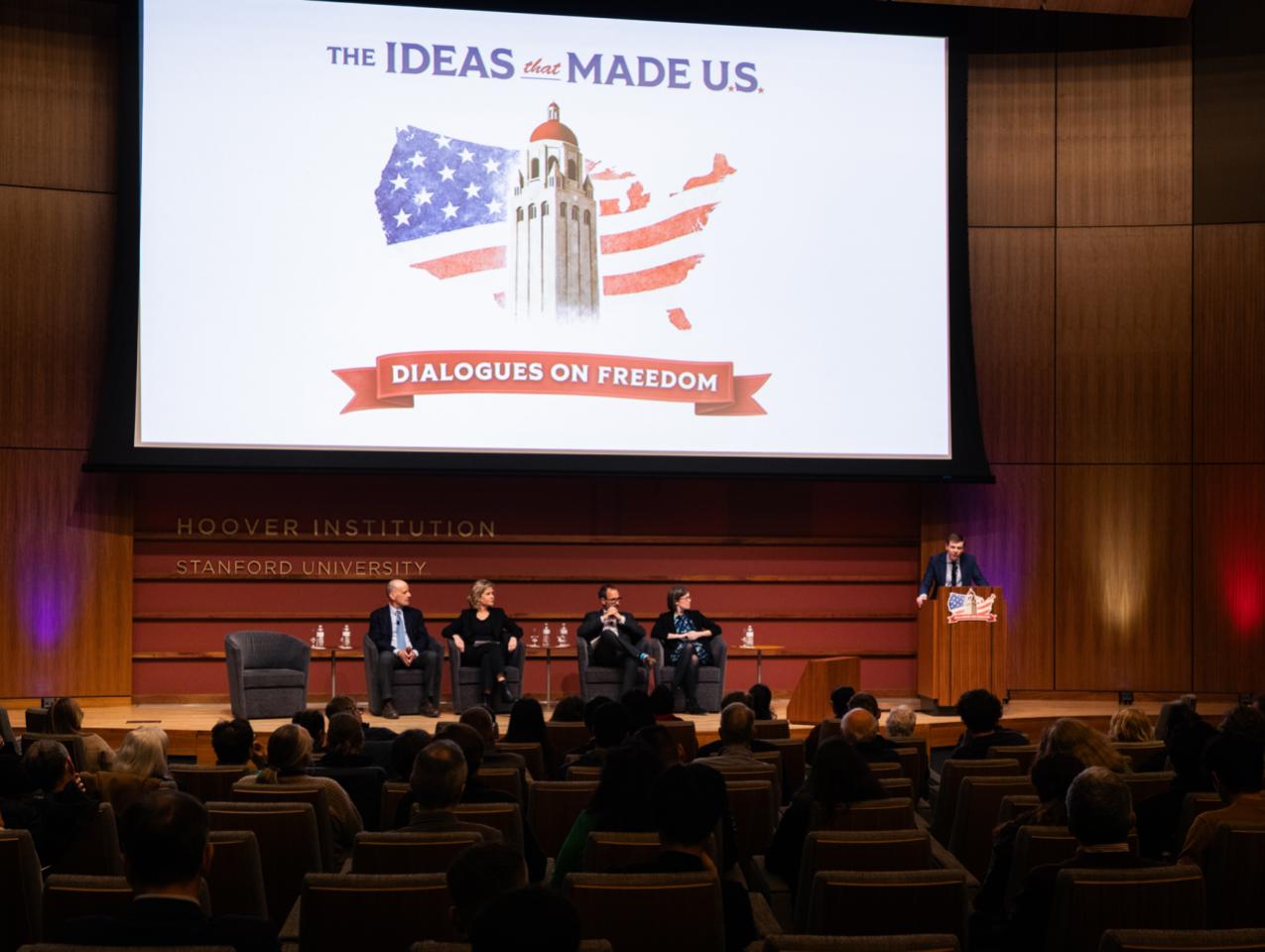
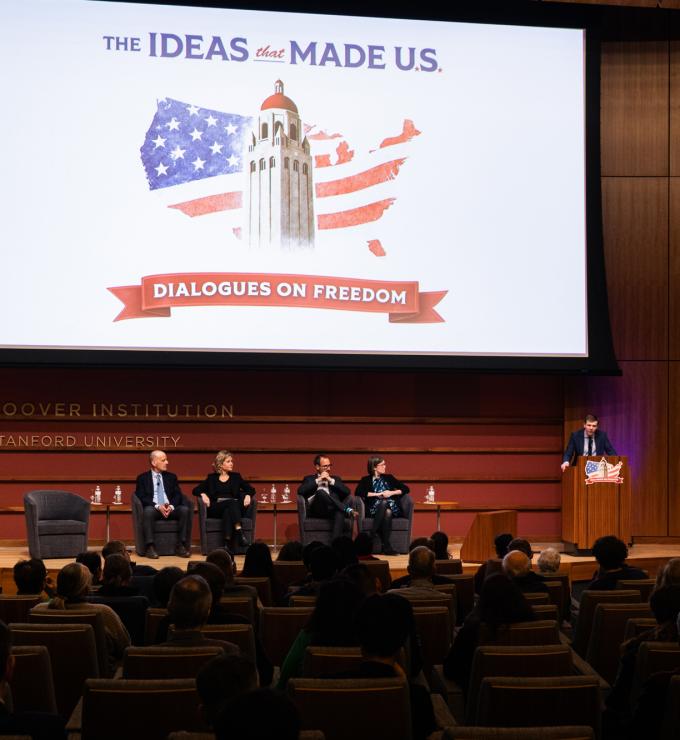
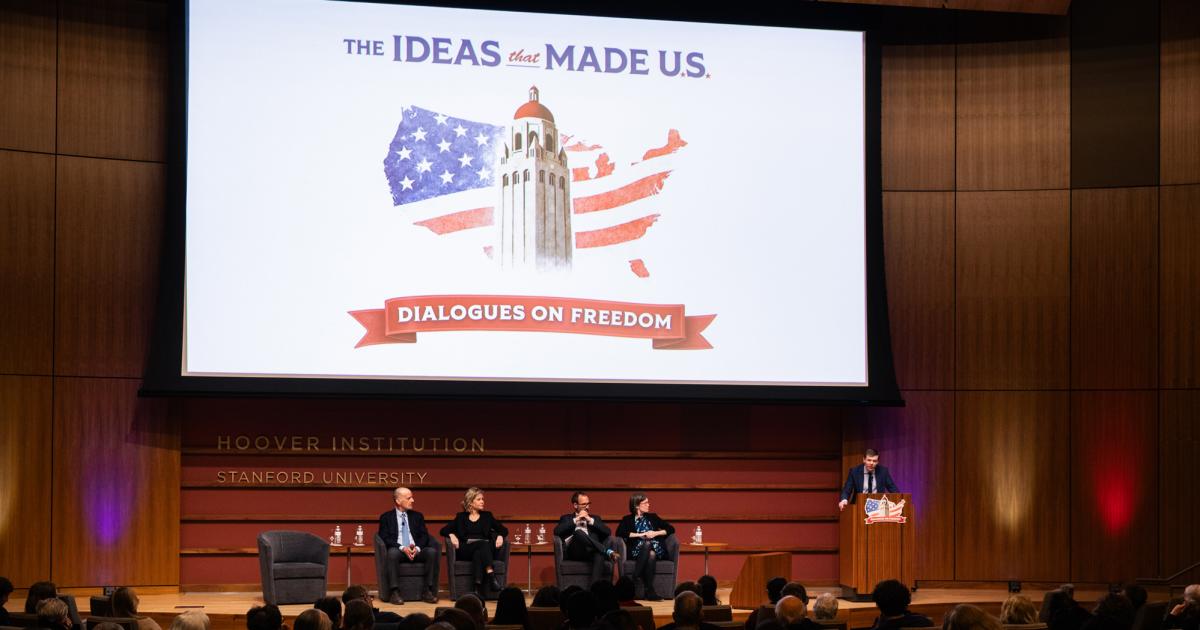
The Hoover Institution opened its yearlong commemoration of the United States’ 250th anniversary with a discussion on how Enlightenment arguments and classical models shaped the United States at its founding, and how those ideas still drive today’s debates on issues of freedom and citizenship.
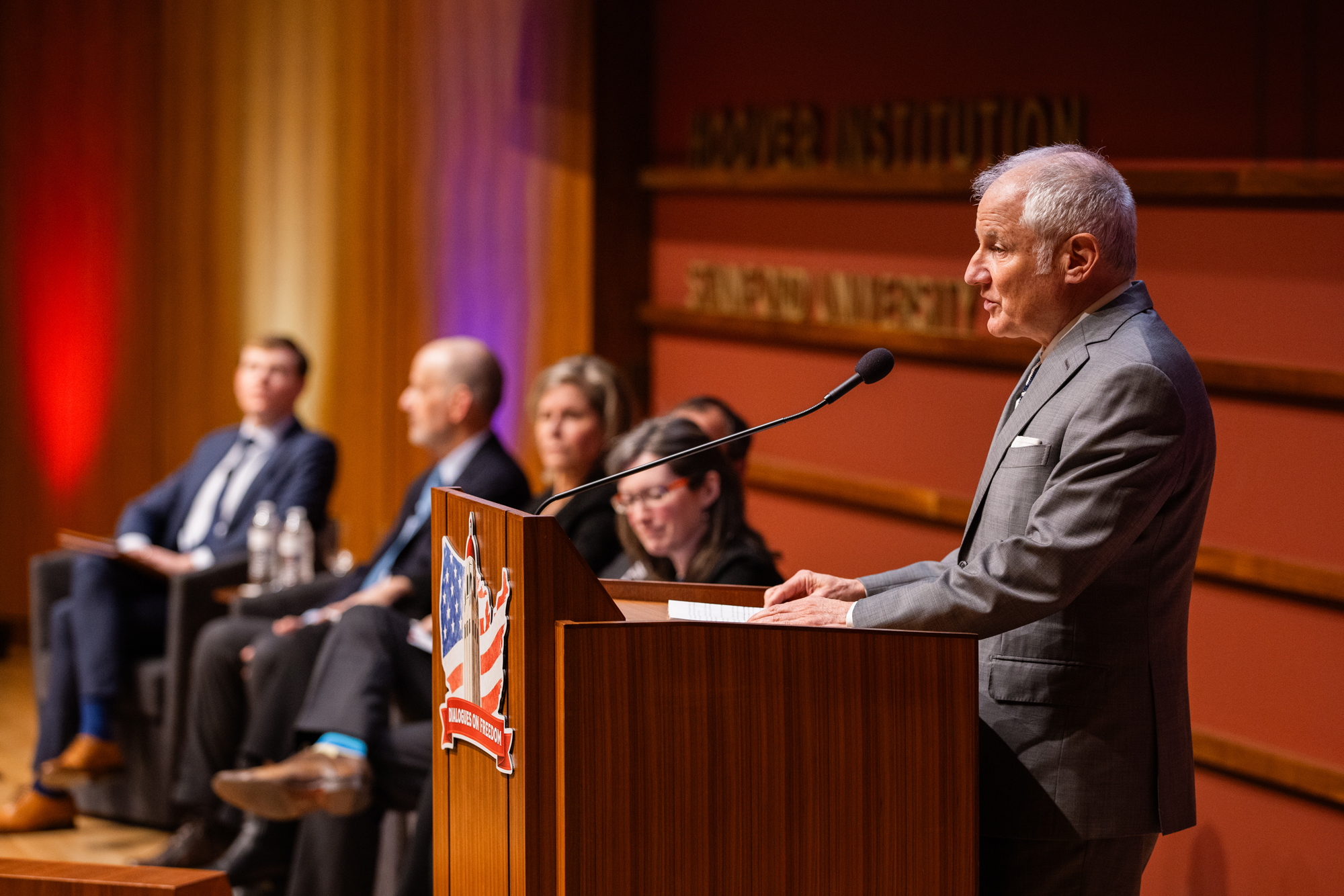
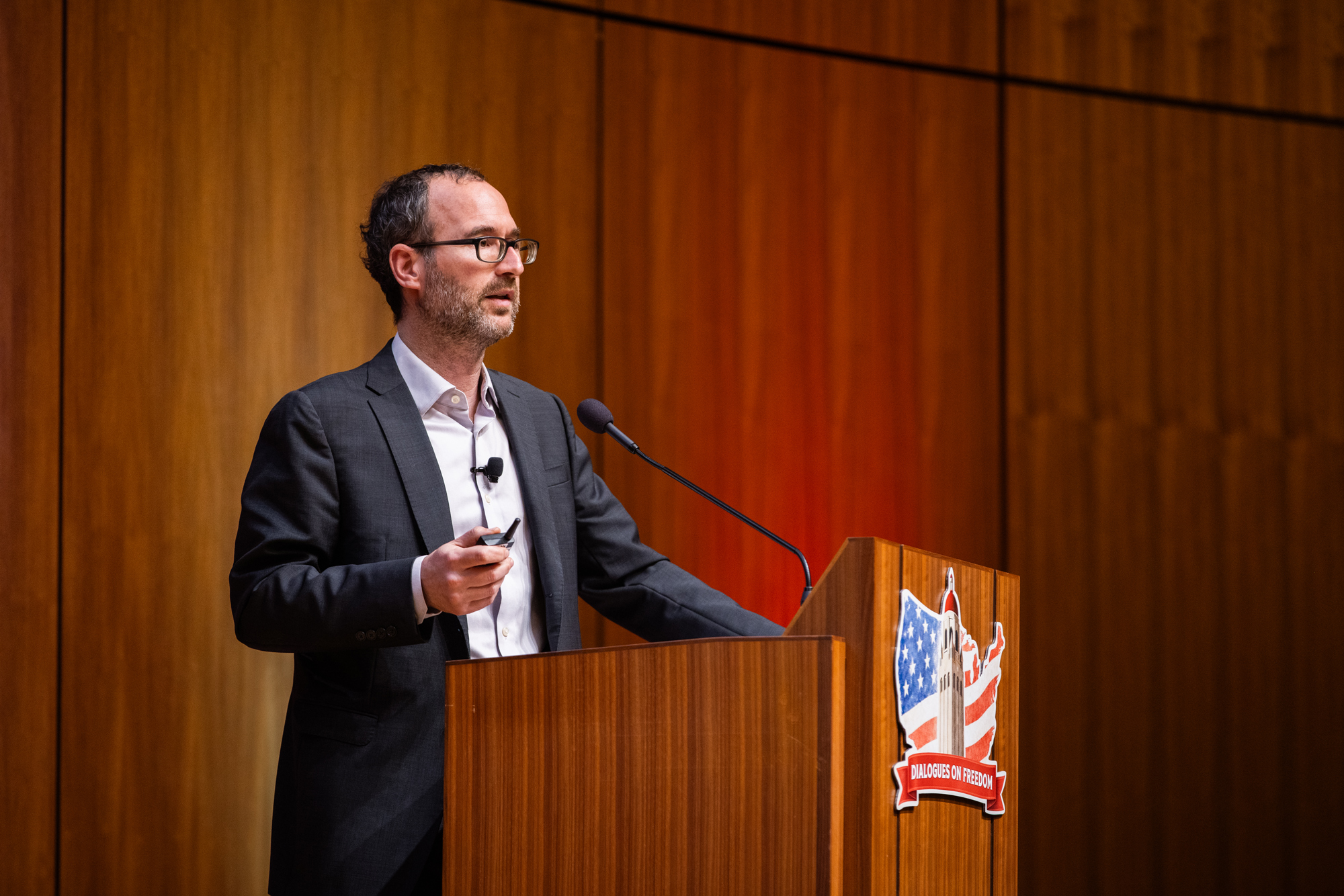
Hoover Senior Fellow Stephen Kotkin set the tone at Ideas That Made U.S.: Dialogues on Freedom at Hoover on February 11, 2026, with broad questions about national purpose and civic responsibility.
“We are here with you to talk about America,” Kotkin said. “Where do we come from? Where are we going? What is freedom? How do we advance freedom?”
Kotkin framed the anniversary as a chance to examine traditions that stretch back before the birth of the republic and to acknowledge that Americans still argue about what those traditions mean. He described disagreement as normal in a democracy, but he urged the audience to keep asking how the country can widen liberty without bringing about acrimony, polarization, or a future loss of America’s ability to govern itself.
He also emphasized the need for the American public to go deeper, to know how America’s traditions and foundations came about before criticizing or proposing changes to them.
“Our first proposition to you is that before you can decide whether to endorse or criticize a tradition, you need to know America's traditions,” he said.
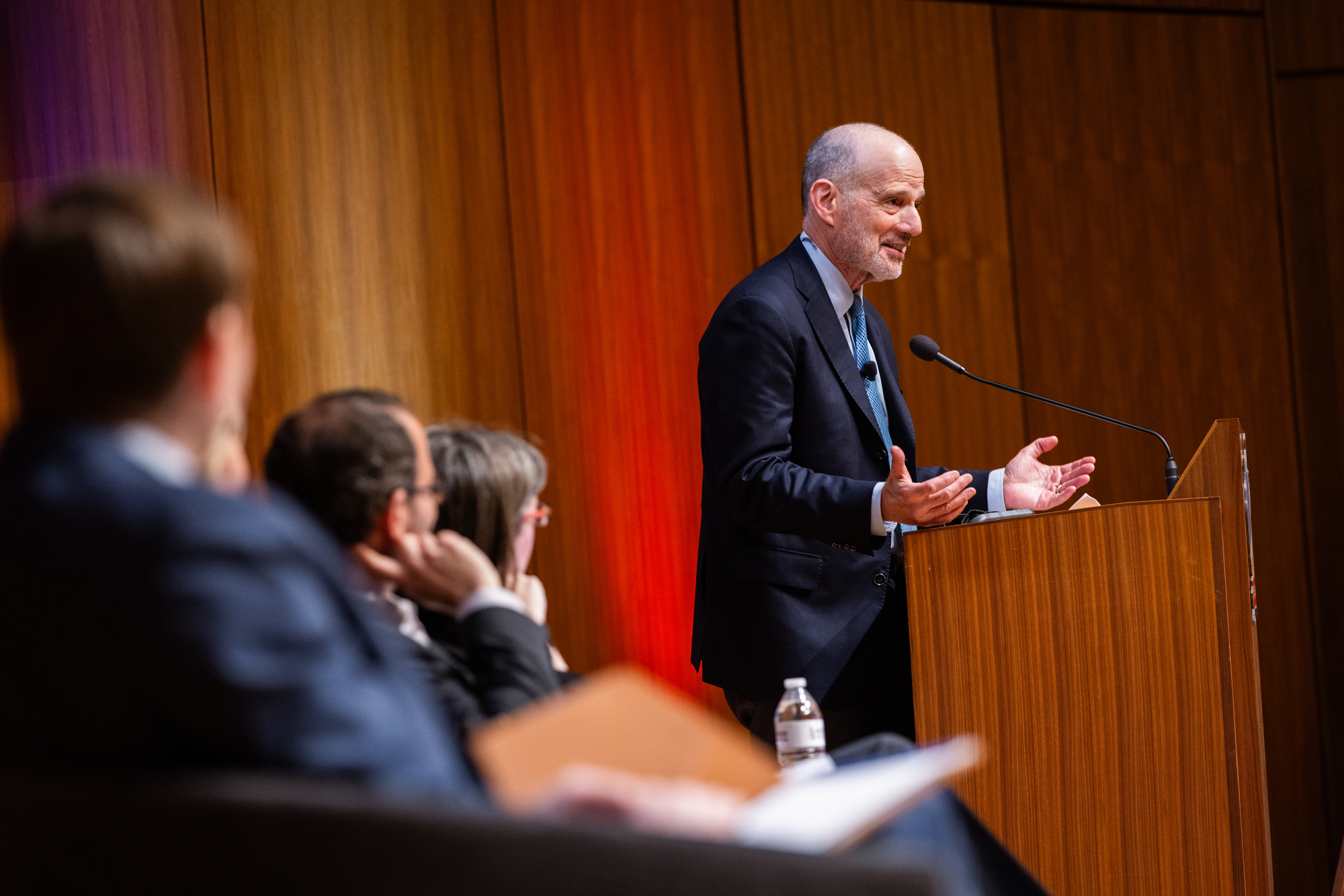
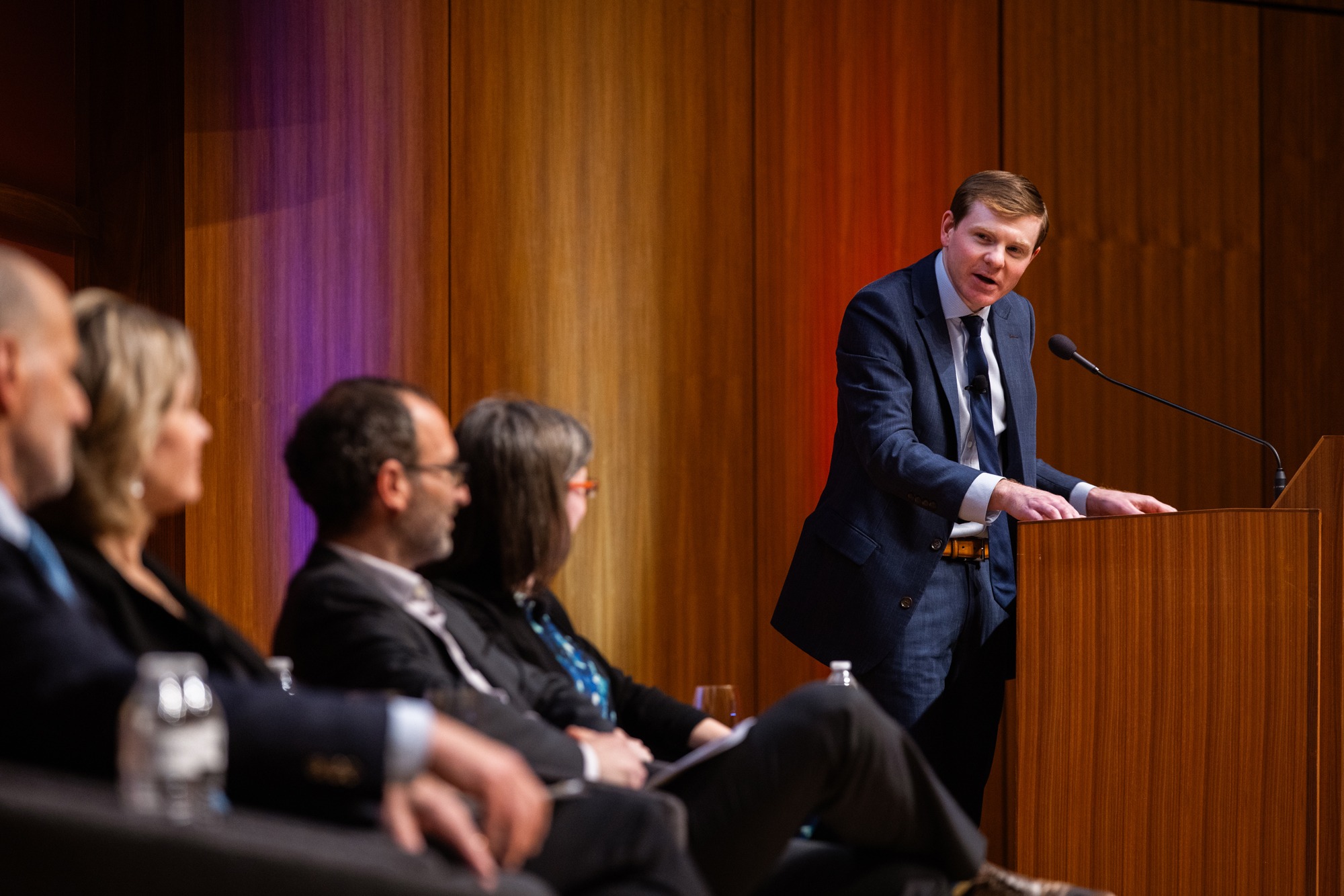
Echoing this sentiment was moderator Jonathan Gienapp, professor of history in the School of Humanities and Sciences, professor of law in the Law School, and a Hoover Research Fellow and Stanford historian, who said the goal of the yearlong program is to push past slogans and think clearly about first principles. He described the 250th anniversary as a moment to take stock of the nation’s ideas, or to “think deeply and seriously about its political, intellectual, and moral foundations.”
Fellow panelist and Stanford History Department chair, Professor Caroline Winterer, argued that the American founders looked much more broadly in the ancient world than classical Greece and Rome. She showed that the empire of ancient Persia profoundly influenced the founders’ thinking about military strategy, federalism, territorial infrastructure such as roads and governors, and even the postal system. She concluded by arguing that the example of ancient Persia shows that the founders were far more capacious in their political imaginations than we often imagine.
“Ancient Persia is everywhere in the imagination of the American founders,” she said, tying how the Persians expanded their territory and road infrastructure to how the Americans expanded westward over time.
Even the US Postal Service draws inspiration from similar efforts by the ancient Persians.
Stanford professor of French in the School of Humanities and Sciences and Senior Fellow Dan Edelstein emphasized the Enlightenment’s role in giving the American Revolution a moral argument that could reach beyond local disputes.
Edelstein also stressed that Enlightenment ideals did not mean the founders ignored history. The Constitution’s structure reflects caution about human nature and power. In his telling, the founders tried to combine high principles with a design meant to prevent abuse. Edelstein drew common linkage between the Declaration’s use of the term “free and independent states” with those words’ use throughout history, all the way to ancient times.
For instance, in ancient Greece, the word for free at first meant simply to not be a slave. It later evolved during the period of Persian expansion to mean “politically free,” or later, to “not be ruled by a tyrant.”
This language influenced how the Declaration of Independence was written, especially how it singles out and opposes tyranny.
This evolution of language to define freedom evolved further in Europe during the Enlightenment, before reaching the minds of the Founding Fathers ahead of the drafting and signing of the Declaration.
“The Greeks then managed to retain their independence, their freedom long enough to preserve and produce this literary culture that celebrated a certain idea of political freedom, all the way down to 1776,” Edelstein said.
Stanford associate history professor Anne Twitty explored how the Declaration’s assertion that “all men are created equal,” and other similar such phrases in founding texts, was, for the generation who created it, not merely an expression of principle, but a statement imbued with potentially explosive legal consequences, specifically for the institution of slavery.
The consequences such universalist language might have on slavery, she argued, were immediately apparent to the founding generation. In Virginia, delegates to the convention that produced their Declaration of Rights edited language in the original draft to ensure that assertions about the “free and independent” status and “inherent rights” of “all men” would be read to exclude those held as slaves. In Massachusetts, meanwhile, enslaved people used a clause declaring “that all men are born free and equal” in their state constitution to successfully sue for their freedom and juridically end slavery in the Bay State.
Today, she noted, we regard universalist claims about the equality and rights of “all men” as little more than rhetoric. But the founding generation saw them “not just as a source of inspiration, but as a legally binding text.”
Hoover Senior Fellow Barry Strauss returned to the founders’ close reading of ancient history. He described the classics as a source of warnings: Athens and Rome showed how republics can lose their footing when ambition grows and norms break down. Those stories from the Roman Republic and Greek city-states made checks and balances feel like more than theory. They felt like protection against patterns that had already played out before.
Strauss also stressed that the ancient world gave the founders a moral language. Ideas like honor, duty, and citizenship helped them describe self-government as something that requires character, not just rules. That emphasis, he suggested, remains a live issue in modern politics, where people often disagree about whether institutions alone can hold a free society together.
“Let's restore the centrality of citizenship as the guarantee of liberty and freedom. Let's return to the ennobling power of oratory,” Strauss said. “And oratory that while democratized and brought down from its highfalutin’ perch is nonetheless eloquent and uplifting. And let's rededicate ourselves to the liberating quality of education.”
A key point of friction on the panel was how to describe the relationship between these different traditions. Some speakers leaned toward the view that the founders made a workable blend. Others emphasized that the blend contained real contradictions that could not be solved on paper.
Kotkin closed by returning to citizenship as the thread connecting the classics, the Enlightenment, and American political development.
“As you heard, the category ‘citizen’ was universal in principle but exclusionary in practice,” Kotkin said, adding that “over time that universalism and principle became more and more actual, more real.”
Kotkin argued that closing the gap between principle and practice has always required struggle. In that sense, the panel’s history lesson doubled as a civic challenge. The Enlightenment and the classics helped Americans explain freedom. But the country’s record shows that freedom expands through argument, political action, and reform, not through good ideas alone.
The event was organized in concert with Stanford University’s Department of History in the School of Humanities and Sciences and COLLEGE 102: Citizenship in the 21st Century course offered by Stanford Introductory Studies.
The event launched a series of Hoover efforts that will continue through the anniversary year, with future discussions and published products focused on freedom, citizenship, and the ideas that helped shape the American republic.
Learn more about Hoover’s programming on the United States’ 250th milestone here.