


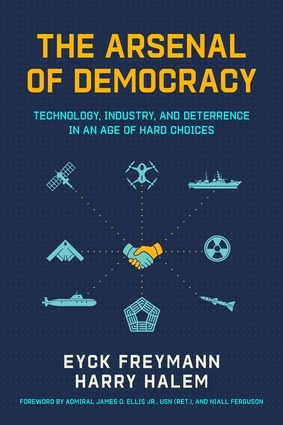
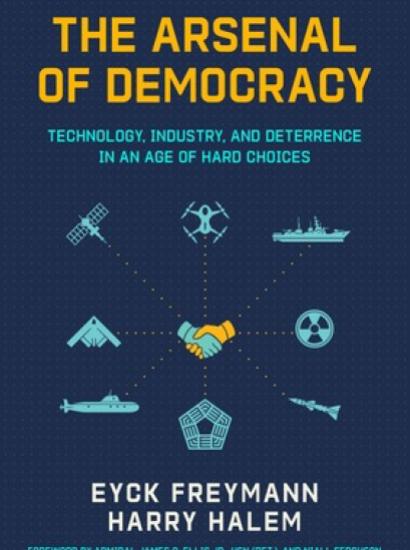

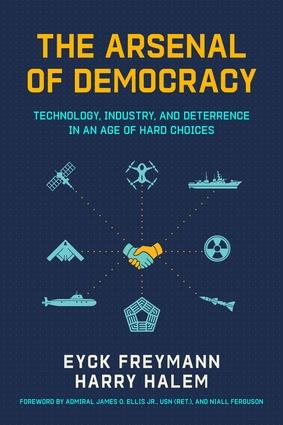
Hoover Institution (Stanford, CA) — The US military is at a critical inflection point. As China rapidly modernizes its armed forces and builds a vast defense industrial base, the United States must undergo a transformation of its own to maintain credible deterrence in the Indo-Pacific. The Arsenal of Democracy: Technology, Industry, and Deterrence in an Age of Hard Choices examines the intersection of military technology, procurement, and strategic adaptation, arguing that incremental reform is insufficient to meet the rising challenge posed by China’s military expansion.
Written by Hoover Fellow Eyck Freymann and Harry Halem of the Yorktown Institute and Policy Exchange, with a foreword by Hoover fellows Admiral James O. Ellis Jr., USN (ret.), and Sir Niall Ferguson, the book begins by framing the fundamental differences between land and air-naval warfare and how geography shapes conflict in the Indo-Pacific. It then explores how emerging technologies—long-range strike capabilities, unmanned systems, electronic warfare, space assets, and quantum sensing—are reshaping the modern battlefield. Drawing on historical parallels, it explains why the US military must avoid betting solely on next-generation technology—neglecting the need to integrate and adapt existing platforms—and instead build a force that leverages legacy systems alongside new weapons.
Beyond technological adaptation, The Arsenal of Democracy delves into the pressing need for defense industrial reform. It highlights how China’s massive industrial capacity has outpaced the US defense sector, which remains plagued by inefficiencies, bureaucratic obstacles, and production bottlenecks. The book outlines concrete recommendations for revitalizing the US defense industrial base.
Chapters explore key components of modern military power:
- How intelligence, surveillance, and reconnaissance systems will determine success or failure in a US-China war.
- Why munitions stockpiles rather than platform superiority will shape the outcome of high-intensity conflict.
- Why logistics is the greatest vulnerability in US force posture and its reform the single most urgent military challenge.
- The evolving role of naval power, including the future of aircraft carriers and the growing importance of unmanned surface and undersea vehicles.
- How bureaucratic dysfunction and underinvestment in the defense industrial base threaten the US ability to fight a protracted war.
- The role of space power in modern warfare and the implications of China’s nuclear expansion for strategic stability.
The book concludes with a call for urgent action, arguing that the United States must reassert its position as the arsenal of democracy to deter a future great-power war. Unless policymakers recognize the scale of the challenge and take decisive steps to modernize US force structure and procurement processes, deterrence may fail—potentially leading to the most destructive conflict of the twenty-first century.
Advance praise for The Arsenal of Democracy:
“By far the best guide to deterring and, if necessary, prevailing in a naval and air conflict in the Indo-Pacific. For policymakers, practitioners, and pundits alike . . . this book is the touchstone for what lies ahead."
—Gary Roughead, admiral, US Navy (ret.), former chief of naval operations and commander, US Pacific Fleet
“We ignore this book's lessons at our peril.”
—Chris Miller, author of Chip War: The Fight for the World's Most Critical Technology
“Sweeping, erudite, and highly readable, combining historical expertise, technological savvy, and solid military analysis [with] many smart and specific policy recommendations.”
—Michael O’Hanlon, Phil Knight Chair in Defense and Strategy, Brookings Institution; author of the forthcoming To Dare Mighty Things: US Defense Strategy Since the Revolution
“The essential guide to restocking our arsenal in an age of rapid technological change.”
—Michael Brown, partner at Shield Capital and former director, Defense Innovation Unit, US Department of Defense
Click here to order The Arsenal of Democracy: Technology, Industry, and Deterrence in an Age of Hard Choices.
For coverage opportunities, contact Jeffrey Marschner, 202-760-3187, jmarsch@stanford.edu.