















- Energy & Environment
- Regulation & Property Rights
- Answering Challenges to Advanced Economies
Interviews with Native American entrepreneurs reveal challenges of doing business on Indian reservations and the conditions under which enterprise can thrive.
Based on Terry L. Anderson and Thomas Stratmann, “Doing Business on Indian Reservations: Tribal Business Owners’ Perspectives on Entrepreneurship,” Indigenous Business and Public Administration vol. 3(2), (2025): https://doi.org/10.33972/ibapa.33
America’s First Entrepreneurs Rebuild Business in Indian Country by Hoover Institution
The Research Problem
American Indians have much lower rates of entrepreneurship compared to other racial groups in the United States. While Native Americans comprise 2.9 percent of the population, they own only 1.2 percent of firms.
Crow tribal member Bill Yellowtail explained that this was not always so. He captured the strength of Indigenous innovation and business acumen before colonization: They “thrived through history by relying on these innate strengths: strategic pragmatism, proactive adaptation, statesmanship and shrewd diplomacy, aggressive entrepreneurship, commitment to cultural identity, the dignity of self-sufficiency.”
Herein lies the puzzle. Why do such low rates of entrepreneurship persist in modern times? A key goal of the Hoover Institution’s Renewing Indigenous Economies Project is to understand the roots of current economic deficits, such as this, and how past systems that supported prosperity can be revitalized. Entrepreneurship, grounded in tribal knowledge and local leadership, plays a central role in rebuilding those systems.
What We Examined
We conducted eleven focus groups with 104 Native American business owners across five Montana reservations to understand their barriers. Participants included owners who had operated their businesses for at least six months and entrepreneurs who were either planning to start or had started a business in the past six months. This was a first-of-its-kind congregation for many entrepreneurs to discuss business climates and conditions on their reservations.
Participants identified factors that hinder or promote the establishment and success of businesses on reservations. They shared concerns about limited access to capital, bureaucratic land use restrictions, labor shortages, addiction, and inconsistent governance. Their responses reflect the economic pressures of day-to-day survival, often leaving little room for strategic planning.
What We Found
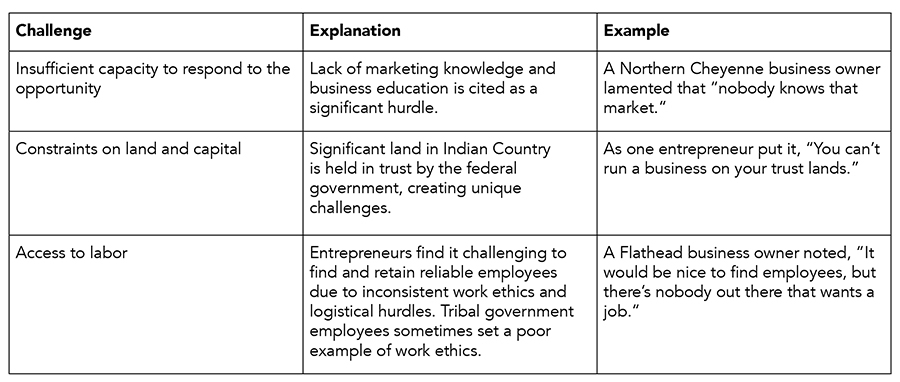
Entrepreneurs identified challenges stemming from both internal governance and external regulation. Concerns included nepotism, lack of judicial independence, unclear legal frameworks, and limited public accountability. However, many participants also expressed optimism and a willingness to grow their businesses if these barriers were addressed. The respondent comments can be organized within three key categories, as summarized in table 1.
Table 1. Sample Responses from Surveyed Business Owners
These responses underscore the importance of reforms that can improve access to capital, management capacity, legal predictability, governance transparency, and economic autonomy. Whether in reservations, small communities, large cities, or foreign nations, starting a business is a challenge without entrepreneurship for ideas, security for investments, a strong supply chain for inputs, confidence for suppliers and customers that contracts will be honored, and a rule of law that guarantees the government will not take property and profits without compensation.
Prior to European colonization, Native Americans demonstrated their ingenuity. Not only did they have productive economies made more vibrant by trade within and between individuals and nations, but they also had established rules of law that secured property rights to ideas, human resources, and natural resources. Colonization disrupted these traditional institutions and raised the costs of doing business in Indian Country. Removing the constraints identified in this survey of Indian entrepreneurs provides a path back to vibrant indigenous economies built from the ground up.
Lessons for Policy
The focus groups point to three entrepreneurship bottlenecks in table 1: capacity, land and capital, and labor, plus governance and legal predictability as a cross-cutting constraint.
Build entrepreneurial capacity. Expand practical business education, mentoring, and market-development support so owners can identify customers, price products, and manage finances.
Unlock capital by reducing trust-land frictions. Streamline land-use approvals and leasing, expand tools that make long-term leases financeable, and strengthen tribal lending channels so entrepreneurs can access working capital and investment financing.
Expand and stabilize the local workforce. Pair workforce training with support that improves job readiness and reliability.
Strengthen transparent, predictable governance for business formation. Improve oversight and transparency in permitting and contracting, reduce nepotism, and bolster judicial independence and commercial dispute resolution so entrepreneurs and lenders expect contracts to be enforced.

