


- History
- US
- Political Philosophy
- Revitalizing American Institutions
- Revitalizing History
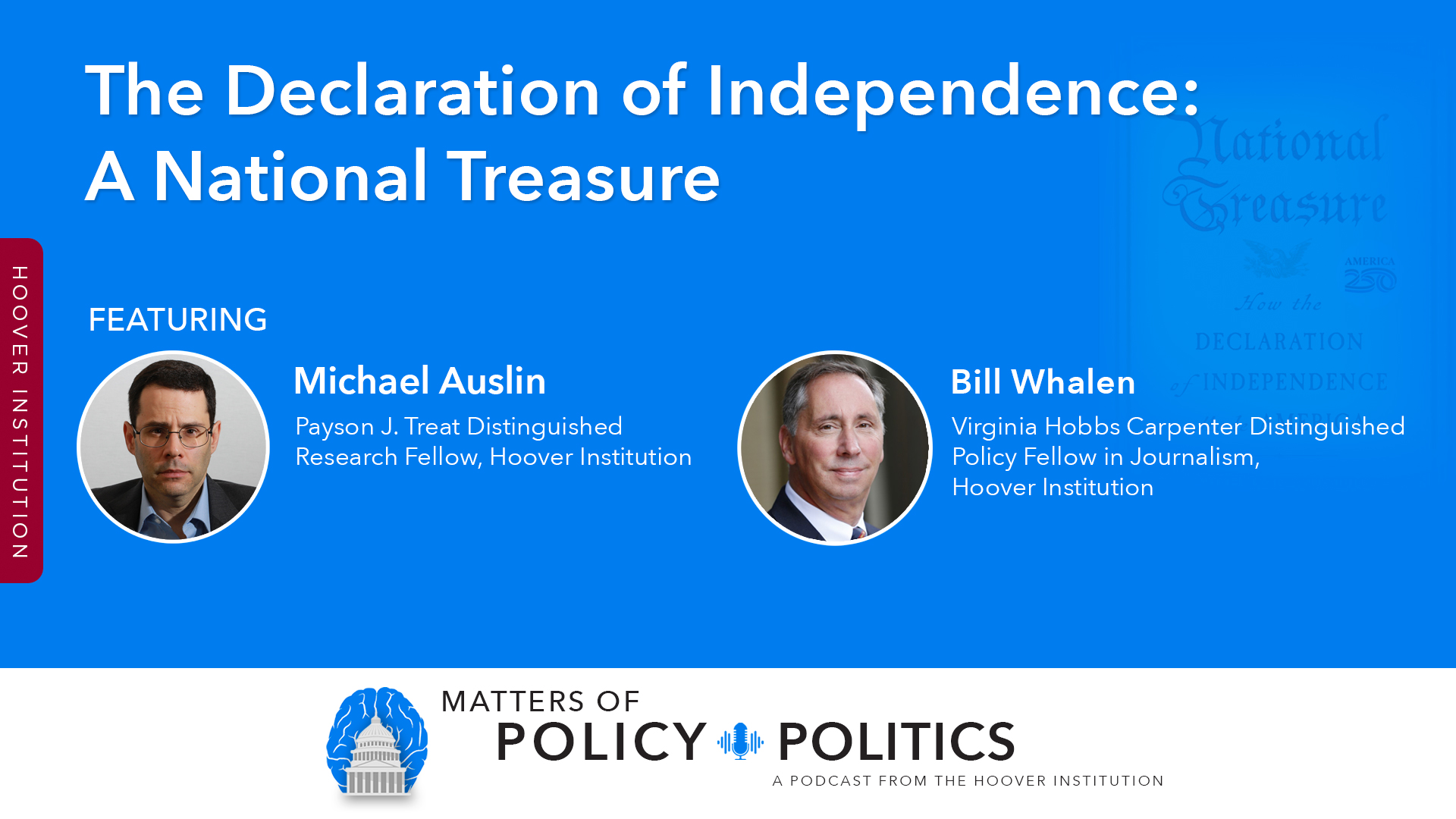
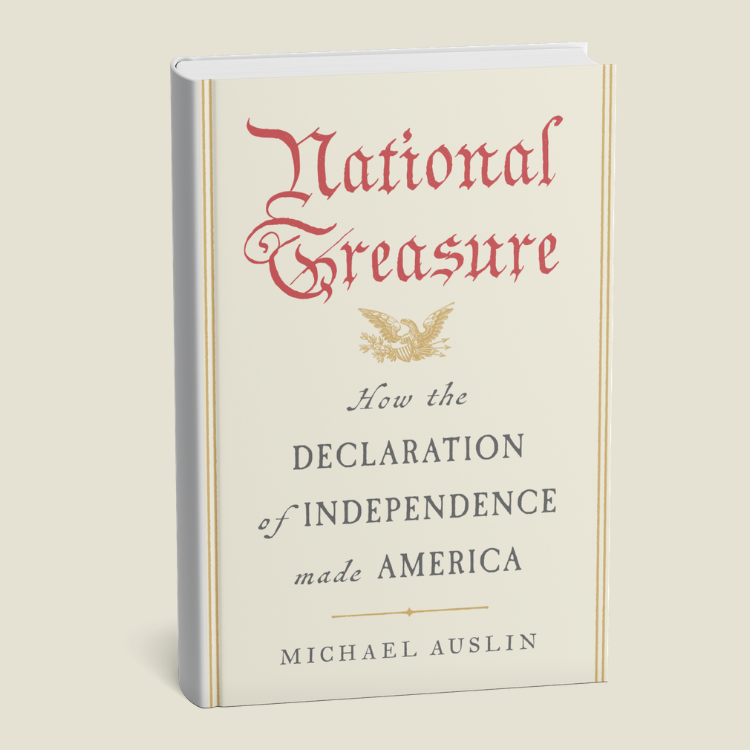
They quibbled over the language and the provisions, but in the end America’s Founding Fathers produced a 1,320-word document establishing a newborn republic’s belief in natural rights and self-governance. Were the founders who debated and ultimately signed the Declaration of Independence true visionaries or merely smart and realpolitik enough to find a new way to express the colonists’ longstanding desires for self-governance and liberty? Michael Auslin, a historian and the Hoover Institution’s Payson J. Treat Distinguished Research Fellow, discusses his acclaimed new book National Treasure: How the Declaration of Independence Made America. Among the topics discussed: the interplay between Thomas Jefferson and the committee tasked with producing what the author calls “a big bang of declaration”; the document’s various compromises required to attain unanimous consent; how the Declaration survived future wars; plus why other nations (revolutionary France in particular) drafting their own declarations fell short of the American standard.
Recorded on June 1, 2026.
- The 4th of July is fast approaching, which means if you're a fan of Liberty, it's a good time to revisit the remarkable document that is America's Declaration of Independence. But I've, there's plenty about the declaration that you don't know how it was drafted and how it's managed to stand the test of time as America has gone from a republic breaking away from an empire to, well, something of an empire itself. These days. We're going to talk to a Hoover Institution fellow and historian, whose new book explains what makes the Declaration well so quintessentially American and why it's still relevant in the world, far different from that than the founding Fathers. It's coming up next on a new edition of Matters of Policy and Politics. It's Monday, June 1st, 2026, near listening to matters of Policy and Politics, a podcast devoted to the discussion of Hoover Institution policy research, as well as issues of local, national and geopolitical concern. I'm Bill Whalen. I'm the Virginia Hobbs Carpenter distinguished policy fellow in journalism. I'm not Bailey Hoover fellow who's loitering behind a microphone these days In the spirit of trust, but verify, I recommend you go to the following website, which is hoover.org/podcast. And there you'll find a bevy of Hoover Institution podcast, including the audio version, the Goodfellows Show that I have the great honor of moderating. Now, folks, as the calendar has turned to June, it's safe to say that we're in the countdown mode to July 4th in the 250th anniversary of the founding of the American Republic. I reach July 4th. It seems as a chance to reflect on the marvel that is the American experiment. It also reflect on how a group of men from different walks of life, frustrated by a hostile overseas government wanting to choose their own path on questions of life and liberty, put their frustration into words. Those words. About 1300 or 20 of them we call the Declaration of Independence Moderate, to be joined today by a colleague who's literally written the book on the Declaration of Independence, Michael Auslin or Misha, as his friends call him as the Hoover Institution's Payon G Treat, distinguished Research fellow, a historian by training. He's the author of the recently released National Treasure, how the Declaration of Independence Made America, speaking of America and Americana, Misha Oslan also writes the Potomac packet, a Substack on Washington DC in American history among his owners, distinguished visiting scholar at the Library of Congress's, John w Klug Center, and the American Heritage Partners Research Fellow at the Society of the Cincinnati. Misha, thanks for coming on the podcast.
- Bill, it is always great to join you. I just wish we were doing it in person.
- I do too. Although I'd say here in California, not DC because it's June and now I'm getting into full weather whip mode, I'm off to South Carolina in a couple days and I'm already thinking ahead to heat and humidity things we don't have here in Northern California.
- It it, believe it or not, it is pleasant here on the Potomac. It, I've been sitting outside the past few days. It's just gorgeous. So we're taking it every, you know, every ounce we can until that tide water humidity comes floating up.
- Yeah, I do get nostalgic for Washington because I was born in Washington dc I was raised across the river in Arlington, Virginia, and I spent about the first half of my life working in that city before coming out to California. So I love reading the Potomac packet and all that you do in terms of talking about dc. What's interesting, Misha, is that you seem to have come down with the case of Potomac Fever, and I mean this in a positive way. Usually this is a derogatory term applied to politicians. A governor wants to be a president, he has Potomac Fever. I use it a different light. Potomac Fever to me are people who come to Washington in politics or whatever their pursuit, and they say, I'm gonna be here for a couple years, and the next, you know, they've spent 25 to 30 years of life because why they can find they can cash in on the place. And that's one of my first things I point out to people when they come to Washington, look around and just see how much money is at play here in terms of automobiles and construction and just the seems recession proof. But Michelle, your Potomac Fever in this regard, you were writing now about Washington, you're writing about the to ratio independence, and this is not your wheelhouse. Originally you were an Asian scholar, but now you've taken on this their aspect. What is it about Washington that got to you?
- Well, I think Bill partly is living here and now I've lived here this time. I was a student here, I was a college student here at Georgetown, so I always, I guess I had that original variant of Potomac Fever, which is, you know, you wanna come in and everybody either want to be, you know, the next John F. Kennedy or the next Ronald Reagan or Henry Kissinger. I left to go become an academic, but now I've been here again, almost, I mean, next year it'll be 20 years again. And I think the older you get, the more, at least for me, the more I began to appreciate the city as a city. If you can ever possibly begin to separate it from the hyper-partisanship and the politics of the moment, it really, it, it, it not only has an incredible history itself, but there's just so much, so much to do. And, you know, my career, as you mentioned, and as a lot of folks know, especially those who have been, you know, following Hoover and may have, you know, followed the stuff that I did. It was really on America, in Asia. So I was always looking at America abroad, what our interests were, our values, our history abroad. And you know, at a certain point, you, you maybe you just, you wanna come home in a way and, and start looking at those same sets of questions here. And, you know, being in Washington is a great, is a great place to do it. So I, I started some work on that and started the Potomac packet. It's the old, one of the old variant spellings of Potomac, P-A-T-O-W-M-A-C-K, which is actually how George Washington spelled it, the Potomac packet. And it's the name of the very first newspaper that was ever published in what became the Washington area. It was actually started being published before there was a Washington DC or a District of Columbia. And I just wanted to look at different aspects. I mean, even the geo the, the geology of the city is fascinating because it sits literally on a geo geological fault where the, where the Piedmont plane meets the, the coastal plane, which I, I didn't even know about this, but it explains the geography or the geology of the city. And so all those things I started looking at, but I was always interested in urban history and, and, and so for a, a different type of project, I I was down at the National Archives, which is part of the Federal Triangle if people know that, which is very, very significant in reshaping Washington in the 1930s. I was gonna write some stuff about that. And I, you know, I went to see the declaration and you know, I, I'd seen it obviously, you know, when I was a kid. And even though I lived in Washington, I hadn't gone back that much, but there was something just magnetic about it yet again, even though they've, they've changed how it's displayed. And then I started talking to the archivist who was an acquaintance, and she's telling me all these stories, and honestly, I just thought, I don't really know anything. I should buy a book on this. And I went to the gift shop and they didn't have a book on the declaration. Now there's obviously been books on the declaration, right? They didn't have a general history, the type that I just wanted to read or I wanted my folks to read. And before I knew it, that swept me off my feet, literally. And it was about two years ago that I, I stumbled across it. And so in addition to just being interested in the idea of, well, you know, what's the history of the declaration? I realized we were, we were really rushing towards the two 50th and, and as it turned out, no one else was writing a book quite like this. There are other books that are coming out on the declaration, almost all of them on the ideas and thoughts behind it. But very few, first of all, none of them on the entire history of the declaration, which no one had ever written from 1776 to today. And secondly, not just the ideas, but, but the, the parchment itself, the, the material culture and then how it's become a, a factor in our popular culture. And before I knew it, I was, I was just carried away and moved into Northern Virginia and spent, spent the last two years in a writing cave. And, and now it's out. And, you know, and I hope people will pick it up as sort of a love letter to the Declaration, but a love letter to America. And quite frankly, it, it's, you know, the declaration's history is America's story.
- So, Misha, I'm gonna be South Carolina twice this summer. The coming up week, I'm gonna be at the beach with family. And then August, I'm going back because one of my sister's grandsons have a birthday. I'm very close to him. He's named after me. So there's a nice little bond there. But he wants to go to the Charleston Museum while I'm there. And the reason is because there will be a copy of the Declaration on display. This is not the original Isha, this is a version printed by Peter Timothy, who was a local newspaper publisher back in the time of the revolution of Patriot of the first order. He was later arrested for treason by the British, and I think put in prison in Florida. First of all, here's the question for you, Misha. My grandson is 10 years old. How do I explain this document to him? In fact, what do you think he's gonna say in the first, first time he looks at that piece of paper? What, what do you think he's gonna say and how should I explain this to him?
- Well, the first thing he might say is, where are the signatures?
- Yeah. - That, you know, because this is not the, the, the parchment, the only one that was signed was the, the parchment that's in the National Archives. Right. And that wasn't the first declaration. It was, it was signed starting a month after independence. But what were, what were the first declarations were what were called broadside, basically single large sheets of paper on which the text of the declaration was printed. The, the first ones were done on July 4th, on the night of July 4th, by a Pennsylvania Philadelphian printer named John Dunlap. And this was at the order of the Continental Congress. 'cause now that they voted on independence, which was actually July 2nd, and then they adopted this announcement on July 4th, they had to tell everyone, they had to tell the world, they had to tell Americans they had to give courage to the Patriots. They had to try to sway over the undecided, maybe peel away some of those loyalists. And so they printed up about 200 of these, and he sent them right back to Congress the next day. And then John Hancock Dispa dispatched them around the colonies by post writers. And today, by the way, only 26 of these exist. The original John Dunlaps, you can see them at various places. I, I probably should put up a Potomac packet that has a listing of where you can see them all. But some have been taken out, you know, Yale for example, has has a copy that they usually don't display that's out right now. A lot of places are doing that for the two 50th. But what happens is, first the post writers go off on their appointed missions to, to to, to spread the news and have these things read publicly. And newspapers also begin to pick it up, starting in Philadelphia. And then the newspapers also get on, get on the road. So, so the local areas get the declaration anywhere from a few days to, in the case of Savannah, Georgia, well over a month later, and when they get them, they start printing their own. We actually don't have too many examples of printings from the south, particularly the South didn't have as many newspapers. So there were, there were very few, if any, newspaper printings in the South. I was trying to track down that a little bit better and, and, and still need to do that. But in the north, there were lots of newspapers and lots of printings when you, when you go up to Massachusetts in in particular. But New York, other, other of the colonies turned into states. And so local printers would get this copy and they would print it. Often they were doing it just because they would get one. And then they wanted to spread the word. And often, by the way, bill, these were being sent to ministers, first of all, they were almost usually read in, in a central town square, you know, a capital of a colony, capital of a, you know, again, what were becoming states. But that would've only reached a certain amount of people. If you printed up another, you know, a hundred or however many you did, and start sending them to the pastors, the reverends, the ministers, then you'd get the people to hear it because they'd hear it on Sunday. And in fact, when you go to look at some of these local printings, and you can actually ask, when you're in South Carolina, ask 'em to turn it over and show you if it's addressed on the back to anyone. Because when I was in the Library of Congress, they were pulling out several dozen of these for me, and they'd turn 'em all over and they'd say, see, this one was being sent to Reverend so-and-so up in Essex or wherever it was. And often with a note that would either a, either a formal printed note on the document or a handwritten note saying, please read this from the pulpit on Sunday. Sometimes there were actual orders of the, the Colonial Assembly would say, make sure you read this 'cause we want it to be known. Other times it was just scribbled on there. Please read it. So that's probably what your, your, was this your grand nephew? Right?
- My sister, my grand nephew, my sister's grandson.
- Yeah. That's what I'll probably see. And you can tell 'em, this is how Americans learned, learned that they were free, learned that they were now citizens of a new nation. And that as much as things were happening in Philadelphia or Boston and New York, they were happening locally around the nation because it was now seen as a unified 13 sovereign states, but a unified country. And he's taking a look at one of the very first expressions of that.
- Okay, I'd like you to play editor for a second. Edit the following sentence. Thomas Jefferson wrote The Declaration of Independence.
- Thomas Jefferson wrote the Declaration of Independence. He then gave it to a committee, which did some editing, though we don't know how much. Then it went to Congress, which did a huge amount of editing. And we're not sure who said what, but we do know what they changed. And Thomas Jefferson was not happy.
- Why was he not happy?
- So that's my edit. So now I can explain that he was not happy because he thought that these mutilations that were being done to his document really took away a lot of the power of the charges, the passion that he put into it. But the reality is, it it, the editing was all to the, to the best. And by the end of his life, of course, he asked that it be carved onto his tombstone. And so he knew that the final adopted official declaration, which were still his words, and it was still his structure and it was still his, his passion, but had been improved from, from what he, what he originally wrote, you know, the main, the main things that that bothered him. Congress took out his long impassioned condemnation of the slave trade, which he lay at the, the feet of, of George iii. They also took out a very hyperbolic and add o attack on the British people that would've made it, you know, if it had stayed in the official document, would've made it hard to, to have overcome the, the, the wounds of the war, as you know, which was difficult enough. There were, there were other edits, a very crucial edit, although we don't know who made it in his, in his draft, which we have his draft. And not only do we have his draft, which will go on display at the Library of Congress starting July 3rd, for the first time in 50 years, he wrote out other copies of the draft once Congress, the document. 'cause he was so incensed at what they were doing to it, that he wrote out about half a dozen copies to send to people. Right. And his, you know, friends and partisans of his to say, see, this is, this is what it really should have been before all those interlopers got their hands on it. So he was not a happy man by this. And you know, there's anecdotes of Franklin trying to comfort him and the like, which are all great. But some of the edits were really important in his first draft. He writes, the opening is when in the course of human events, it becomes necessary for a people to dissolve the political bans, which have connected them with another. It is then changed by someone. We think quite likely Franklin though it's not sure into when in the course of human events, it becomes necessary for one people to dissolve the political bans. And I think, I think that's crucial. I think it sets the tone not only for the document, but for American history. I call the declaration our great unity document. Often it's talked about as, you know, a liberty claim versus an equality claim. You know, consent of the governed and free and independent versus all men are created equal. And both of those are true. But I see over at a Unity claim, and it's why, for example, Jefferson writes, we hold these truths to be self-evident that all men are created equally. He didn't say, I hold these truths, or the Congress holds these truths. It's, we hold these truths and why the founders pledge to each other, their lives, their fortunes and their sacred honor. Not to the new country or to their states, but to each other. And so the edits that come out of both the Committee of five and Congress, some of which as I said, they take out certain things. They add more references to God, they tighten up his charges, his 27 charges. They make them a little bit more based on reality. They all make the document stronger. And of course, it's reflecting thoughts that had been expressed in different, both publicly and and written different venues. It's, it's not new as he Jefferson admits, but the music, the cadence, the spirit is Jefferson's.
- And does Jefferson got the job, Misha, because he is such a brilliant writer, or is it maybe a reflection on the fact that he is 33 years old, I believe. And so maybe the older gentleman can kind of push him around a little bit. But also, he's not Ben Franklin, he's not John Adams. Ben Franklin as a Titanic ego when it comes to writing. I don't think you take editing very well. John Adams doesn't play nice with others necessarily. I don't think he'd enjoy being edited. So is Jefferson the choice by natural choice or is he kind of the choice by default?
- Yeah, it's a great question. I think it's both. Yeah. He was known for, for his writing, particularly his summary of the rights of, of British North America, which had come out in 1774. He was not known for talking in Congress, but, but they, they knew what he wrote. But it's true, he was the young guy on the committee. Roger Sherman, another member of the committee is on the committee for Articles of Confederation. He's not interested. Robert Livingston is actually not in favor of independence at this point. So he's, he's not a good choice to write it. Franklin, not only you're correct, he actually says that he would never give a committee, he would never write anything a committee would get its hands on. He also has the gout at the time. So he's, he's not out. And then there's the famous supposed colloquy between Jefferson and Adams that, that Adams comes up with a few different versions later on where of course he's taking credit for giving it to Jefferson, saying, I put the pen in his hands. I told him I'm hated. And he's not, he writes better than me in a Virginia not to be at the head of the business. So I think, I think it's probably a combination. The truth is as well that, you know, Franklin's would've been workman, like Adams Adams's version would've been a, a indestructible constitutional structure. But Jefferson could write quickly and he could write quite, quite persuasively. And they're all on other committees. Jefferson's on four other committees during this period in June of 1776. They only have three weeks to get the whole thing done. 'cause co they're in a recess, Congress is coming back. And I think it just made a lot of sense. Give it to him, get the committee's views, turn it over to the Congress and where we look at it, you know, to even have a five minute discussion here today on it. It's not how they were thinking about it. This was something that had to be done. It was an administrative task and they just went at it.
- And how many days did it take Jefferson to produce the draft?
- Well, we don't know exactly because he, no one's taking notes the way that we would've expected. And it's not in his diaries. I was able, if you look at his account book, you know, so what he bought, where he was going, things like that to, to keep account of his expenses. You see a, so the committee of five is formed on June 11th, 1776. That's the day Congress goes into recess. Congress is coming back on July 1st. It's to try to get the, the colonies that weren't yet on board to swing over to independence, get a unanimous vote. And if you look at Jefferson's account book starting about July 11th, 12th, I'm sorry, June 11th, 12th, it goes silent. So before that he's writing, oh, I'm out to dinner, I'm buying stockings, I'm buying pen knives, I'm buying hats, I'm buying this. And that suddenly goes silent for about a week. And we also have a letter of him turning over a copy of the draft to Dr. Franklin as he calls him to get his views. This is around the 21st, I forget the exact date and write about, then the account book picks up again. So we can really sort of track that it's about a week to 10 days or so in which he's most likely writing this. It then goes silent again for a few days after he supposedly, or presumably not supposedly, after he presumably gets the draft back from the committee and then they turn it over on, on June 28th. It's that famous moment captured by John Trumble in his painting in the Capitol, which is not voting independence and not adopting the declaration, but it is rather the committee of five with Jefferson at the center giving the, the Declaration to Congress in a completely fanciful scene. By the way, bill doesn't,
- I was gonna say, is the trouble, is the trouble ported historically accurate?
- No, it's not even close. It's, it is so far from being accurate, it is so far from being accurate that someone as well-versed in the topic like John Quincy Adams called the, the painting An Abso an absolute disgrace to what actually happened. But it was so critically important is it was, you know, along with Washington crossing the Delaware, which was painted in 1851, I think it was one of the two most important paintings and certainly historical public paintings, if we can put it that way, in the 19th century. And so, even though it is a completely made up scene painted at the behest of Thomas Jefferson to put Thomas Jefferson at the center of the action, it is nonetheless one of the most important pieces of mythmaking that we have. And I talk a lot about it in the book because it, it is part of this sudden big bang. I should actually should have described it that way, bill, I didn't in the book, but it's a big bang of declaration declaration. Anna Declaration Ana, if you try to turn it into Latin, meaning this was the moment when the first artistic reproductions come out in 18 18, 18 19. The Trumble painting is first displayed in 1818 and then 1819 formally installed in the Capitol in in 1826. In 1821, or I'm sorry, 1823, the famous stone engraving. That's when you look at a, when you look at a reproduction of the handwritten declaration today, it's taken from the stone engraving that was commissioned by John Quincy Adams in 1820 and completed in 1823. There's this big bang of declaration, Indiana, I don't think it's a word, but we'll, we'll use it as such that turns it into a cultural object. It, it puts it into the American consciousness in a way that it hadn't been. In fact, it had been largely forgotten right, until the war of 1812. And its miraculous rescue from the burning of Washington in 1814. People didn't really reference the declaration anymore. They had forgotten it. And this moment with Trumbull, with these guys making the reproductions, the artistic reproductions with the facsimile, suddenly Americans know, number one, that there's an actual formal official parchment. They didn't even know that because it was just a paper of state kept secret by Congress. And secondly, they are now celebrating it. They're putting it up on their walls, they're buying these reproductions, they're buying cheap knockoffs, they're buying expensive reprints. It starts it this unique and enduring American tradition of making the declaration part of our daily lives, which is, which is one of the three declarations I talk about in the book and, and a part of the book that I really love because no one had ever really identified that and talked about it.
- If you watch the movie National Treasure Nicholas Cage, and I don't know if he's reached out to you to talk about the title of Europe, because there's a movie called National Treasure, which involves declaration independence. His character Misha looks at the document and then he reads the falling passage and he would have the audience belief that this is the nut graph, the key outtake in the in penance. I'm gonna read this passage to you, then you tell me if Nick Cage got it right or if there's a better passage. And what he focuses on is the following words, quote, when a long train of abuses and U us serve patients pursuing invariably the same object events as a designed to reduce them under absolute despotism, it is the right, it is their duty to throw off such government and to provide new guards for their future security. Is that it? Or you got something better?
- No, I think, I think that, well, first of all, I love the movie. Secondly, the title of the book did not come from the movie. It came from when I was in Japan. And the Japanese government designates the most important historical artifacts as national treasures. And, and I always thought we should do something like that. So
- By the way, the Washington guy Michel it has the obligatory bad Washington glitch in it, in which they are having a conversation at the National archives and the conversation cuts to them on the steps of Lincoln of Memorial. That's at least two mile walk.
- Oh yeah, yeah. I mean, and, and then, and then they're, you know, they're driving down Pennsylvania Avenue and the next thing you know, they're like in the, the suburbs or something district.
- Exactly. - No, no, totally. I I love, I love the movie. I I really do. I love both of the movies and no, Nick Cage has not reached out to me. I i, I wish he would and I'd love to get him a copy of the book. 'cause I I'm sure he is a listener. I hope he's a listener. And, and Nick Cage, I'll be happy to send you a copy of the book. I think what's interesting about that, that that is one of the key claims, of course, right? The consent of the governed claim. And I would argue that until the Civil War, that was probably the, the understood explanation of the power of the declaration, meaning that was the justification and, and the charges, though the charges, you know, in the document come after that line. But the charges, the setup, you know, power, rights come from God and government's only role is to protect those rights, not to, to detract from them in any way or quite frankly, even create new ones. But this, this is the role of government and therefore a government that does not do that is illegitimate. And, and the the people must consent. I would say that was the understanding of the document until the Civil War. The problem in the Civil War, of course, is that that was the justification of the Southeast. We no longer consent to this government, and therefore we are seceding. And, and they made their own declarations of independence wherein they verbatim repeated the 17 76 1 because they felt that they were the true heirs
- Since you brought up the Civil War, Michelle, let's briefly talk about how the declaration survives three wars, and one is the war of 1812, the second is the Civil War. Then the third one, oddly enough, world War ii, where I discovered it was moved to Fort Knox of all things.
- Yeah, yeah, yeah. I mean the, the, you know, and you can add a fourth bill, which is the first one, which is the Revolutionary War, right? Because it goes on the road with the continental Congress and they're running from the British for, for a good chunk of the war. They go, they go down to Baltimore, then they're, they're moving through, through parts of Philadelphia, Lancaster in York, they're in New Jersey. And at any moment, you know, the British obviously are trying to capture the congress, trying to destroy Washington and his army. They wanna capture the Congress too. And they either would've destroyed the declaration or sent it back to London as, as a, as a prize, right? So there, there are four wars, and, and that's part of the reason why it's in such bad shape, is it's being carted around. It's not, it's not in, you know, protective cases. It's, it's, it's affected by the, by the humidity and the rain and the cold and the heat. It's thrown wherever these papers are thrown, you know, whether it's in sacks or, or little chests. And then put in houses and then moved around. So that's happening all through the, the Revolutionary War, the war of 1812. The British decide the way to the knockout blow is gonna be to burn Washington, right? In August of 1814. And it's by the skin of its teeth, 24 hours that a truly brave clerk, Stephen Pleasanton takes the declaration, he gets a note from James Monroe, secretary of State says, the British are coming, the British are coming. You better protect the documents. But other people are saying, don't worry about it. And also Washington's in chaos, it's not an easy thing to do. He spirits it out of Washington, puts it in a, in a linen sack, and throws it in the cellar of a house in Leesburg, about 40 miles. I went to the cellar, I went to the house, and there it's sitting, you know, unguarded for weeks in the Washington heat and humidity of August. So it barely, you know, barely survives that. And then, and then again, it's just crammed into an attic when it comes back to Washington because the, the, the state department's been burned to the ground next to the White House. The Civil War is the, the one, one of the parts of the book that is forensically new. No one has ever asked the question, what happened to the declaration during the Civil War? And I looked at different types of evidence to, to find what may have happened to it, because the idea that it was left unguarded, which is what all the histories said,
- This, this shocked
- Me, made no sense to
- This shocked me, because I would've guessed before I read your book that thats Washington was a sitting duck going into the Civil War evidence, proximity to Virginia, how easily the Confederate could have rolled in there, and they could have done something very symbolic, like try to snatch the declaration, what a great PR two, I would've bet dollars to donuts that they would've moved it up to Philadelphia, New York. So why did it stay in Washington?
- Well, that's, that is the, the great mystery. And I, I just found it fascinating that no one had even asked the question. You're right, Washington is a frontline city. Yeah. The capital of the Confederacy, Virginia is across, is across the river. Not only that, everyone in Washington expected an invasion, especially after bull run. And Washington is a southern city. It's full of sympathizers and secessionists and, and spies and saboteurs. And at that point in time, the declaration had been hanging in the national, in the, was called the Old Patent office at today, it's the National Portrait Gallery. It had been hanging in the old patent office since 1841. It was part of what was called the National Museum, basically the forerunner to the Smithsonian. And, and then a lot of the Smithsonian was moved out. So it was just sort of there with the American historical artifacts. But during the war, first, the patent offices used as a barracks for union troops and union troops trash the place, then it's turned into a hospital. And so you've got wounded and doctors and nurses and people coming in and out. And the idea as all these histories just stated, both without qualification and without real comment, oh, the, the declaration was hanging there from 1841 until 1876 when it was sent to Philadelphia for the Centennial Exposition. It just seemed to make no sense to me if you knew anything about Washington's history. And, and it was a city by the way, where there was living memory of it being burned to the ground just 50 years before. So, and then on top of that, the cherry on the cake, so to speak, I guess, is that for Abraham Lincoln, the declaration was the single most important document in American history, the single most important symbol and statement in American history. And he says, on his way to Washington and Philadelphia, on his way to his inauguration in 1861, he says, I have never, he stops at Independence Hall. And he says, I have never had a political thought that did not emanate did not derive from the declaration. He built his entire philosophy, his entire policy on the promises of the declaration. And somehow were led to believe that this most fundamental of American symbols was left unguarded. And I believe it wasn't. And, you know, I put the evidence in there as to what I think happens, which doesn't, you know, change the, change the story, but it adds to it. And I think gives it a very human dimension and, and makes it really part of the Lincoln story about, about the sacrifice that he made, of course, to maintain the declaration. Then, as you note, by the way, in World War ii, it is once again secretly moved under armed guard, put on a train and sent to Fort Knox because by then, in 1941, just as in 18 61, 80 years previously, they're worried about Confederate armies marching on Washington in 1941. They're worried about Nazi bombers reaching Washington. And you read the newspapers, I have it in there, these big four engine bombers and the Nazis are gonna take over, the Germans are gonna capture the Azores in the Atlantic, and then they're gonna be able to reach Washington. And at that point in time, the declaration was in the Library of Congress on an outer wall. And they had been looking, they'd been doing very careful studies of ordinance and what the bombs were like in Europe during the Blitz and the damage that was being inflicted. And they realized that the Library of Congress would not survive, and they didn't know what to do. Now, the, the archives was there, but they also felt the archives was at risk, and the library wasn't ready to give up the declaration to the archives. Yet that was a big battle. And so the Librarian of Congress, Archibald Cle, comes up with the idea with his staff that the only really secure and, and easily, more or less easily reachable place for them is Fort Knox. So they, they secretly pack it up, secretly, bring it on the Baltimore and Ohio Drive, you know, ride it through the countryside at night, and then lower it into the vault in Fort Knox for much of the duration of the war. So yeah, you know, the, the, the, the, the document has, again, even into the 20th century, had this life of adventure. And even when it's brought back and finally put into the national archives in 1952, of course they've built a, what they hope is an atomic bombproof safe, the famous Mosler vault, which is directly under the rotunda. And you can still see the model of it in the national archives. You can see, you can, you can find some newsreel video of them testing the vault. And every night during the Cold War, it's lowered into the vault and the, the steel doors close over it. And to this day, every night it is put into a vault. And, you know, again, so we think of this as sort of static and immobile. And yet, because of its importance, because of the, the symbolic significance it has, it, it is protected by the most sophisticated James Bond level technology and, and security. It's, it's, it's really, it's really amazing. And at each stage they were trying to figure out the best ways to protect it, get it away from buildings that could burn down, put it on a wall, you know, put it between different panes of glass, ultimately pump it with helium, and now argon. It's, it's an incredible story.
- I have another sentence story to edit, Isha in that sentence is the Declaration of Independence is groundbreaking.
- It's groundbreaking. Where's that from? Did I miss that?
- No, I just made it up. The Declaration of Independence is groundbreaking. I want you to take that sentence and edit it to what the true reflection of it's, is it a groundbreaking document? Is it original?
- It is a groundbreaking document whose originality comes from a long tradition of American beliefs and statements on self-government, and liberty.
- Right?
- And, but it is groundbreaking. It's groundbreaking because it was the first one to do it in the name of all the American people. As, as understood at the time it was groundbreaking because it could be extended to those who were actually not included at the time. And no other document had done that. It was groundbreaking because no nation had ever had a birth certificate. They just, nations were or were not. The French nation was the English nation, was the Russian nation, Chinese nation, or this was the first one that said, we are a nation together. Even as they were figuring out what does that mean? 'cause we're 13, we wanna be 13 sovereign states. So they don't, it's not a federal system yet that's gonna come, you know, 13 years later. But it's groundbreaking from, from that perspective, it's groundbreaking in that it could inspire other countries around the globe to make their own declarations of independence against something that had never happened before. And it was groundbreaking because ultimately, even though within a very distinct political process, IE the question of abolition of slavery, the question of women's rights question of immigrant rights, it nonetheless ref expressed ideas that as Abraham Lincoln stated, became universal and became eternal. I, in ways that we still argue whether Thomas Jefferson fully meant all of that, whether the signers fully meant all of that. But at one level, it doesn't matter. It's, it's an interesting question, but it doesn't matter because for us it has become that. And for so much of the world it has become that. So it is absolutely groundbreaking
- Now to our British listener who's gonna say, well, Mr. Oslan, and this is all good in swell, but centuries before your declaration, we had the Magna Carta.
- They had Magna Carta. More importantly, I think they had the Bill of Rights of 1689 from which Jefferson, you know, easily cribbed, as did others. And that that is all true. One thing their documents did not do, of course, was create a nation. It didn't create a people because those peoples already existed. And in the case of Magna Carta, of course it was, it wasn't for all the people, it was, it was for the nobles to assert their rights against the king. And, and then from that, of course, much like our declaration, slowly over time, it expanded the Bill of Rights. I think the 16 8 9 bill of Rights after the glorious, glorious revolution, much more important. And for the colonists, this they felt was their birthright. They were Englishmen in North America, but they were Englishmen. So this to them was absolutely something that was theirs by right as well. Where I think the, it's, it's particularly significant is that the declaration, unlike the British documents, well first of all, it was not designed to be a governing document, right? It, it was not designed to set up a government that was the charge of the, of the articles of Confederation, which, which of course failed and were, were superseded the Constitution. But the thing we don't read today, the 27 charges were for Jefferson and the, the delegates to Congress and most Americans, that was the heart of the document, the stuff we pay attention to, you know, the words that changed the world, that was all just window dressing at the time. It might sounded nice, but they didn't really care that much about that. What they really cared about were these statements of justification, why we were taking or had taken the steps that we had taken to separate from Britain. But what was so significant, you, you read 'em today? Well, you know, okay, we don't, we we're not worried about that. Those are not the, the problems we have today. But in the broader philosophical sense, what they did was show how in a just government should not act, right? It didn't say this is how government should act because that wasn't the job of the declaration. But what it did show was how a just government and to use its own phraseology, a government by consent of the governed, did not act. And therefore it pointed the way towards how a just government should act. And I think that was very different from what the, the British were doing. Yeah. And in some ways, 'cause they're saying the king can't do this, and the capriciousness of of, of the king in the 1689 build also can't be can't be allowed or, or accepted. But in our case, it was, it was being put in a much larger framework for a, a government, what, what was to be ultimately a government for a new people. And it was justifying that people's beginning experiment in truly independent self-government. I mean, they, they were self-governing. But now this would be no longer under the auspices of King or Parliament. It was to be something completely new, or as you put it a few minutes ago, groundbreaking.
- Right. Now, if imitation is the sincerest form of flattery, then the Declaration of Independence has preceded a lot of flattery over the last two centuries. Numerous countries have tried their own declarations. Michel, I'm very curious about one in particular though, and that is f Frances here is France, which pursues a declaration of Independence. This would be, what, 13 years after the colonists come up with their draft. Jefferson Adams Franklin are, are still with us in 1789, I believe. And I don't think Franklin does not yet, but not yet. So they have a document in front of them. They have all these great living resources to tap into. I think Jefferson is, is he Ambassador France at that time? Or he
- He's there yet he is minister.
- So it could have been very easy for them to replicate the declaration and get it right. So what, where did the French go wrong?
- Well, you know, again, much like our revolution, that's still being debated. And, and it does show the difference in the Enlightenments that each country underwent, you know, our enlightenment, a British enlightenment, Scottish and English, much more moderate. Also one in which the religious element was much more prevalent. The idea that not only do our rights come from God, but that puts on men's actions. And again, you know, the, the greatest number of references to liberty, freedom, rights, and the like, is actually made in the pulpits. It's not made in the assemblies, it's not made on the streets, though of course it is done there, but it's made in the pulpits. This ours was a very religiously in inspired revolution. It had to be because that's how we thought about the world. That's how, that's how we interpreted the world. You know, Thomas Jefferson, the supposed atheist, which he wasn't of course as a deist, but he wanted the, the, the great symbol of the United States to be Moses leading the Israelites through the Red Sea from, you know, certainly from, you know, Puritan times, the idea of new Israelites and a new Israel, and leaving the old world, leaving Egypt to found a new, a new world was prevalent. That, that the Americans thought of themselves in that way. But this also mandated limits on man's actions, unlike in France where the radicals, the philos and the like, they were going to start the world anew year zero and sweep everything away. You know, Thomas Payne's famous, we, we hold it in our hands to begin the world anew again, you know, is about as radical as these things, as these things go. And you know, it really doesn't in many ways fit our, our, our declaration. It doesn't fit our enlightenment, you know, his diatribes against, against the monarchy and the like, of course. But really, you know, Thomas Paine is, is sort of on the leading edge of radicalism. And it's interesting because Jefferson, when he's in France, he's talking with the Marqui de Lafayette who is responsible for helping draft their declaration of the rights of man and the citizen. And Jefferson doesn't like a lot of the draft. He thinks it's too radical. He thinks putting property in is radical because that is, as they would call it, alienable. You can give away property, but you can't give away rights. So when you begin this expansion, it's creating, it's creating mischief. And I think it was Jefferson's biographer in the forties, Duam Malone, who rights something along the lines of, I'm paraphrasing him, but in America, Jefferson was considered a radical, but in Europe he was considered a conservative, you know, so he probably fell right, right in the middle. And as the French Revolution turns into the terror, and then of course the reaction, and then of course Napoleon, it just shows first of all, what can happen when these forces are unleashed but unleashed without the tradition as there had been in England of looking and, and Britain of looking to the rights of the individual. You know, again, you pointed out Magna Carta and you pointed out the Bill of Rights of 1689. These are things France did not have. And English common law, which was different from French law, English common law, which had the rights of the individual deeply embedded in that. And then again, I think as Calvin Coolidge pointed out in his very important 1926 Sesco centennial speech, it, it comes from our religious tradition, our belief in God. Think of something that Tocqueville picked up on, you know, in the 1830s, that our rights come from God, we can't really distinguish between our religion and our politics because we see the two as, as intertwined. And again, these set boundaries on what man can do. So the French didn't have that. And they do spin off into this, these excesses. And when they do, I think all it does is red redo to the credit of Jefferson, the credit of the signers to make our declaration this not just the spirit behind our, our entire experiment, but still the guiding light. Again, those charges what government cannot and should not do. And the French Revolution didn't have any of those breaks, or I guess today we'd call it guardrails. It didn't have any of the guardrails.
- What nation would you point to that is closest to the American experiment in this regard, in terms of their declaration?
- Wow, that's a good question. I don't know. You know, a lot of them had wonderful sounding declarations. Very few of them had declarations that had the, the philosophy of Jefferson's, first of all, the deep, the deep philosophical backing to it. Nor did they have the same experiment of the, the 27 charges. 'cause those were very particular to our condition, but again, gave indications of how government shouldn't act. And a lot of them sounded good, and then they sort of failed, or they were supplanted, you know, they would have multiple declarations or of course, reaction and autocracy in Europe and Latin America coming back, coming back to limit what they had been able to do with, with the initial revolt, revolt and rebellion. I mean, ultimately, you know, that's an interesting question that I, I, I'll be honest, bill, no one's asked me that yet. And I haven't, and I haven't really fully thought it through because I wasn't looking at this as a comparative experiment, which, which a bunch of academics do. And it's sort of the flavor these days, by the way, is to say how important the declaration was abroad and how influential it was abroad, which is not, not wrong, and it's not unimportant, but it can, I think at times, potentially lead to shifting the focus away from America. And I think I want the focus to be on America, not on, you know, look, ho Chi Minh quoted verbatim from our declaration in 1945 in his Declaration of Vietnamese independence, and he had no intention of respecting the rights of the individual or property or the like. So, you know, the fact that it's influential around the world is wonderful, but it also is, you know, it's a separate issue. So given that a long way to say, you know, I haven't really fully thought about it. I actually would probably say Britain and their unwritten, still unwritten constitution. But again, because it was the font of ours, and then ours was so influential in many ways that I do think, you know, these, these, the persistence of common law that becomes, that becomes case law, the religious element, you know, again, the philosophy of John Locke, you know, second treatise, which Richard Henry Lee said, well, this is all that Jefferson stole to write the declaration. I, I guess it's, it's probably something within the Anglosphere, you know, maybe, maybe it has been Canada up until recently, you know, maybe Australia, you know, it'd have to be a better comparativist. But I do think there is something about the Anglosphere, which I guess probably a term we don't use that much anymore. It was so popular, you know, a decade or so ago, two decades ago, that would make it more likely to really be much more of an analog. Even though of course, you know, when we go to the constitution in the federal system, it's completely different from their parliamentary systems.
- So one way to look at the events of 1776, Misha is to see it as a great exercise in whipping votes. That's WHIP, the whipper end, the, which goes from fox hunting. I believe, and I mentioned this in this regard, you look at how they came up with the votes to get this thing approved, which takes us back to our conversation about compromises and things left out such as slavery. But I point your attention, Misha to a gentleman named John Dickinson, and I mentioned Dickinson in this regard here, Hoover, several of us have been asked to write profiles, brief little, you know, summations of a favorite founding father at why, and I chose Dickinson, and I chose Dickinson for two reasons. One being everybody wants to write about Jefferson or Adams or Franklin or Washington. It's, you know, they're all the top picks of the draft, if you will. They're the stars of this thing. They get musicals and movies after him so forth. Nobody knows who John Dickinson is. Well, I take that back. If you go to Dickinson College, you know who he is. Maybe if you grow up in Pennsylvania or Delaware, you know, he is. But Dickinson is important, and for a couple reasons, hir one is that he is there from start to finish. He is writing about taxation back in the 1760s with the township ex. And he is there in 1776 during the conversation about the declaration. And you fast forward to the late 1780s, and he is involved in the drafting of the Constitution. You can thank him apart for every state having two senators, the Connecticut Compromise. But take us to 1776 and John Dickinson, and I'm very curious about his role in terms of the actual voting for the Constitution, becau of the declaration, because Dickinson is there, but his name's not on the document, is it?
- No, it's not. And, and, and not only, you know, is he important? He was, he was one of the most famous men in the colonies letters from a farmer in Pennsylvania, right? He was a leader in the colonial movement, but he felt that this was not the time for independence. And he stuck to his principles. What he also did was not blow up Congress, not de-legitimize it, but decide in a personal compromise that on July 2nd, the date of the vote for independence, when Pennsylvania, the delegate, the, the, the colonies voted by delegation. They didn't vote by individual. So you had to have 13 unanimous votes is what the Patriot side wanted, right? What John Adams wanted, he knew that Pennsylvania would remain split. And so he and Robert Morris, the, the famous financier of the revolution, also very famous and, and possibly the, the richest man in the colonies at the time with Save John Hancock, decided simply to not show up to absent themselves. They didn't abstain, they simply didn't show up on that day. And that allowed the Pennsylvania delegation to vote in the affirmative. And it turned out to be a unanimous vote. New York didn't have instructions, so they actually did abstain and then got instructions later and could vote in favor. But he, he blew up, as we would say today. He blew up his political career in one day after decades of being an intellectual and a, and a political leader. But he, he, he felt it was the wrong thing at the wrong time, but he did not, he was not willing to destroy the project. He compromised, he understood that at times you must set aside personal preferences or even when you think something that you are right, because there is a, there is a larger picture. And then he went home and he enlisted in the Army. So I,
- Yeah, I'm, I'm sorry. I wonder if they could have done this in modern times mission in this regard. I go back to 2022 in the Dobbs decision or a draft of that getting leaked to the press, some clerk this record, I imagine wanting to, you know, put his or her thumb on this. But can you imagine if we had social media and modern electronics back in the 1770s Isha, someone's gonna leak a draft of the declaration to mess with the southern delegation of the northern delegation. And you know, somebody related to Jefferson and Adams is gonna go on Twitter and go on some, you know, three o'clock in the morning, rant about the other guy. It would complicate things, wouldn't it?
- It would, it would be impossible. I think it would be truly impossible. Congress. Everything that Congress did, they signed oaths of secrecy,
- Right?
- Which is one reason that while we have journals, we don't have a lot of accounts. People did not want to be taking notes. First of all, they knew it was treason. Secondly, they had sworn to secrecy, right? And so there was no formal structure. The journals recorded mostly what was done, not what was said. I mean, there's, you know, there's obviously some indications in there. But really, you know, like verbatim accounts of the debate that was not happening. They took it seriously. Now, almost everyone, there was a patriot, even if they weren't in favor of independence at the time, the loyalists were not part of the continental Congress. They were not part of the, by then extra legal colonial assemblies, none of which were, you know, formally permitted by Britain or had been taken over by radicals. And the things that people like Dickinson did, you know, ensured that we actually were able to start the experiment. Jefferson, too, when they took out the condemnation of slave trade, of the slave trade, as I said, he didn't denigrate Congress or delegitimize it or call for it to be repealed and replaced or packed. You know, he wasn't saying, well, we need to pack the Congress with new supporters of the slave trade. You know, paragraph, he too accepted it. He swallowed it. He wasn't happy about it, but he understood there were bigger principles. And I think, you know, look, there was bitter partisanship. The partisanship would get worse. Look at what happened between Jefferson and Adams when they finally got into the federal government with Washington and then, you know, undermined each other. Didn't talk to each other for decades until they, they finally recaptured that, that friendship. But the lesson I think of John Dickinson, the lesson of the Continental Congress is that of compromise. It's that of unity at, at critical moments. And it's, it, it is a reason I think that they are still relevant, that the Congress is relevant, that the declaration remains relevant.
- Fisher, one thing I love about American history is that it's replete with irony. And let me try this arm for you for an exercise in irony. John Dickinson, whom the Pennsylvania College is named after, he is the rare founding father who frees his slaves during the revolution. This doesn't happen posthumously. He does it during the fight itself. He is anti-slap, but he has a college named after him in Pennsylvania, I believe Benjamin Rush is the one who wants his name on the title of college and Dickinson College, which is a very fine liberal arts college in Carlisle, Pennsylvania. Two, it's more noted, alumni Mission, or Roger Tawney and James Buchanan. Would you like to explain the irony of an anti-slavery such as John Dickinson having this ha on oncology that produces Mr. Tawney and Mr. Buchanan.
- So Roger Tawney becomes the chief justice of the United States and is responsible for the one of the worst decisions, judicial decisions in American history. The Dred Scott Case of 1857, which by the way, is, is one of the two things that most incensed Abraham Lincoln and propelled him back into the political sphere. So the Dred Scott Case as, as most people know, is Dred Scott was a slave, is his, his masters, as they would call it, then took him into free soil states, I believe it was Illinois and Wisconsin. And, and Scott sued for freedom, saying, because he was brought onto free soil, he should be a free, a free man with his family. And Tawny in wrote the decision of the court that not only denied that, but went beyond the merits of the case to essentially state that slaves and, and black Americans were not only not citizens as, as determined in the, the declaration, but that they were simply property. It, it was the instantiation of the idea of chattel slavery at the highest judicial levels. And it, it was a stain on the court and a stain on American history. And, and as I said, it, it, it is what helped propel Abraham Lincoln back into, into office. James Buchanan was the president, became president in 1857, the president right before Lincoln, who as the, the nation is fracturing over this issue and, and the radicals on both sides are, are, are gearing up, basically did nothing. And stated that, you know, well, the, the issue's been settled, time to move on, which, which of course was absolutely impossible and watched for four years while any chances of of reconciling were, were basically wasted. And the radicals. And of course you had the Kansas Nebraska Act of 1854, which had, had turned into, into bloody contests and, and, and conflicts around what was then, you know, the, the far west, you're, you're moving into the era of, of John Brown radical abolitionism and essentially the inability of the political system in any way to stop the cannon wall that is hurdling down the track. So there's a huge irony that, that those two alums of Dickinson College are, are there. But you know, as I've learned in writing a book on 250 years of American history, we abound in irony. And it's, it's, it's part of what has actually, in some ways it's given me hope because, you know, we've been through so much, we've been through all these, these things. The worst of the worst, you know, the Civil War, we've been through periods of, of Americans screaming at each other and attacking each other. It's not good. But we've, we've, we've made our way out of it with the, you know, the, the one exceptional, of course, the, the, the horrific never to be repeated tragedy of the Civil War. But over and over we've had clashes over politics, over identities, over ideologies, over ethnicities, over, over, over economics. We've, we, we've done it over and over. And, and, and what I found, bill, is that at almost each time, people refer back to the declaration again. That's why I see it as our unity document. It's not that everyone always had the same idea on, on what should be done, but they saw it as, because it wasn't the Constitution, because it wasn't the governing document, it was above politics, it transcended politics, and yet it could inform and influence politics. And for the most part, I think it was people saying, we want to be part of this nation, or we want fairness within the nation. It's not separate the nation, it's not sunder the nation that that happened, that happened once. But at all of these different stages, honestly, even the socialists, you know, they're, they're, they are making multiple really terrible imitations of the document just executable, you know, just in terms of style, you know, with sort of Marxist exportations and the like. And I'm talking in the nine, I'm talking post-Soviet, I'm talking Pre-ETS in 19th century, but there multiple examples I give in the, in the book of socialist movements, also adopting the document, the way that the suffragists had adopted the document and the abolitionists have adopted the document and the Temperance movement had adopted the document. It speaks to so many different people in so many ways over these really critical divisions within our, our, our life, our our national political communal life. And yet, at almost every stage, again, except for slavery, we have managed to resolve it and resolve these issues for the or or at least begin to work through them peacefully and often. And what shocked me up, up through the Civil Rights Movement is how often the declaration was referenced. I didn't know that. I, I figured people would talk about the constitution or talk about the capitalist system or, or whatever they might talk about. But it's the co it's the declaration over and over and over again from small town black newspapers to Lyndon Johnson to, you know, socialist labor agitators to women's rights movements to the, to the, to the, to the immigrants and, and to, and to heritage. What, what some people call heritage Americans, people who reach back to the Mayflower saying, you know, we're honoring the, the precepts of the declaration through our ancestors. It's really, it's really incredible to me that this single document is the one that almost everyone has come to. Again, not to separate themselves, but to knit together to resolve it. It doesn't mean it always happens easily. It doesn't mean it always happens correctly or fully, but it is what they come back to.
- So a couple questions here, Misha, then I'll let you bounce. Lee at Hoover have a lot of interest in civics these days. It's one of Condoleezza Rice's newfound passions for the institution. We're doing a lot of very good work. We call it restoring American institutions. Question for you, Misha. If you go back and look at old citizenship quizzes that take citizenship to get that in the United States, you have to pass a test. There have been declaration related questions in past citizenship tests, for example. Here are two of them. I found these are multiple choice qa. Oh, it's
- Okay. Now I'm worried.
- Oh, question, question one. Why is the Declaration of Independence important? I can read you all four answers if you want to, or I could bounce to the second question, which is name two important ideas from the Declaration of Independence and the US Constitution. That's my question for you, Misha, that are
- Great.
- If we were to have such a thing as maybe a civics exit exam for high school kids in America, what question or questions related to the declaration would you put on it?
- Well, those are two good ones. I would start with those. I would, I would probably ask depending, you know, on, you don't know how they would've been taught, but talk about some of the influences on the declaration. Where did it come from? Right? I think that that's important, right? You know, talk about the Bible, talk about the English Enlightenment, talk about, you know, talk about English common law. Understand that it wasn't created out of thin air and therefore could just as easily be, you know, ignored out of thin air. But it was part of our long tradition. So I would say, okay, tell us, tell us some of the background to the declaration. I would also ask, probably tell us how the declaration was interpreted, and this is what we've been talking about. Bill, tell us how it was interpreted later in American history by Abraham Lincoln or by Susan B. Anthony, or by Martin Luther King, or by, you know, immigrant groups down on the Lower East side of New York. I think those would actually be interesting questions to show the unity that the document has inspired amongst Americans. And that that's really the message that I hope people take away from the book. That it is a unity document and it, it calls upon us to think of ourselves as members of a political community. Look, you know, I say this a lot in the talks I give, you know, the founders were vain, brilliant, irascible, difficult visionary men who were so realistic that they certainly didn't expect us to love each other, but I think they, they understood that we could not hate each other and survive as a nation. And they wrote their document in that way, despite all of their own differences, that this was a document to bring Americans together, and that we need to recapture that. And so I'm less interested in the, the, the, the issue of the declaration abroad. I think it's a fine, it's a fine thing, but that doesn't affect us here as much. What I think is important is understanding the declaration and how each group in American history saw it not just as a tool for struggle, which is sometimes how it's portrayed. And especially in some, some of the recent exhibitions where it is a tool for struggle. Yes, it was, it was a tool used to create a more perfect union, but it was a tool to unify us. It wasn't just that everyone was thinking of themselves only in these own groups, and that they were in constant struggle with other groups, and that they identified themselves in that way. They identified themselves as Americans and wanted to be part fully of America. So again, it's that this document was to unify us, and it, it was to unify us among those who felt that they weren't fully given their freedoms, you know, even up through the civil rights era. But it also was to unify us among the millions and tens of millions of forgotten Americans who recited it every July 4th in their communities, the Boy Scouts and Girl Scouts who, you know, who read it and then pledged allegiance to the flag, the communities that were so happy that as I put in, in the book, that they had the same rights as the Anciently established East coast communities, even if they were on the banks of the Mississippi or the Colorado River, or beyond the Sierra Nevada, right? This, this was something that all could share in and made them all feel that they were part of this great nation. Not just that they were constantly at struggle with each other, because we were always imperfect. Everything is always imperfect. The question is, where was the perfection in the unity at the times that they were living in that they wanted to create or they wanted to partake of? And that, I think, is an untold part of what, you know, bill McClay and his wonderful book calls Land of Opportunity.
- A final observation, Misha, as a historian, I hope you understand that you're sitting on top of a franchise right now, that this could be the beginning of something much larger for you. And here's what I'm thinking, and please don't gimme that frown look as I'm making work for you. But if you enjoyed explaining why the Declaration of Independence matters, why it's still relevant, what went into making it, why not do the same with the United States Constitution, who's 250th is approaching and what about 13 years or so? Why not do a book mis show on the writing of the Gettysburg Address? I don't think Lincoln wrote by committee, but I'd be fascinated to know how exactly he cranked it out, what went into it. Or you could do the same with Martin Luther King's. I have a Dream speech in 1963 at the Lincoln Memorial. Or you could go presidential and you could morph any of these three inaugural addresses, which I think were all historically significant. Abraham Lincoln in 1865, Franklin Roosevelt in 1933, Ronald Reagan in 1981, all turning points in history, if you so any that float your boat,
- Bill, these are great, great ideas, which I will certainly take into account under consideration. I would say, though, you know, seriously though, on the, on the Constitution, that's one of the things that interested me is just how much or, or comparatively how little had been written on the Declaration versus the Constitution. And there's still coming out Akiel read of Mar Mars, second volume of his trilogy on the Constitution came out last year. He's, he's gonna have another volume out. Joe Lepore's written on the Constitution. Of course, Jack Reiko at, at Stanford itself is, is one of our greatest constitutional scholars. You know, these, there is so much written on the Constitution continuously. And, and, and in many ways, rightfully so, look, this, the Constitution is the, the battlefield on which we fight our political battles. That's the way it was supposed to be. The declaration is not, and so you don't amend the declaration. You know, you don't, you don't think about tearing it up. You don't, you don't talk about the declaration really in terms of originalism or original intent and, you know, a living dec. It is a living document, but you know, you don't speak of it in those terms. And so what interested me was that this, the, this sort of spirit behind all that, at least in terms of the broad sweep of American history, had received so much less attention. Like, I don't remember ever reading, and I, I just may have missed it, but I don't remember ever reading in, you know, the, my, the, the accounts of the civil rights movement, just how often the declaration was referenced. You know, of course it was talking about rights and therefore constitutional rights and all, you know, it turned out not to be a constitutional right, but the Civil Rights Act, but it was, the declaration was there from, from the get go. And so, so from that perspective, I actually thought there was really, there was a, a, a gap, a major gap, not necessarily in terms of the thought and ideas of the declaration. That's certainly been dealt with a lot by the academics. But this broader American story, the American engagement with the declaration. And so yeah, I could see you could go on. I'd like to, you know, I'd like to uncover some more of those more obscure speeches and, and, and presidential inaugural addresses in history. Like I said, Calvin Coolidge's 1921, sesquicentennial speech, I think is critically, you know, critically important. I think John Quincy Adams 1821, the 45th anniversary, we go now abroad in search of monsters to destroy, but then also links for the first time at a very high level, the declaration to our constitutional system. I think you could actually usefully trace trace through those. I think some of, you know, some of what Harry Truman is talking about in the 1950s is he's struggling with the, the nascent Civil Rights movement and the Early Cold War in trying to put our tradition in the declaration because he, he's speaking on the hundred 75th anniversary, which I have in the book, my favorite word, my favorite single word in the book, Demi semi centennial, that's 175 Demi semi centennial. You know, his, his speeches, not all of them by any means rise to the level of Lincoln's rhetoric. Of course, what really does, it doesn't, it's not as, you know, earth shaking as, we have nothing to fear as fear itself or as reconstituted as Reagan's new federalism in 1981. But in many ways they are the, the mortar between those big, those big bricks that, that we've built on. And I, I, I do think you're right, that you could really look, it'd be very interesting to, to look at a bit of the process, but also the reception of those, you know, we don't recite them and yet some of them are worthy of recitation.
- Yeah. In the case of Gettysburg address flat reception when he gave it. Yeah, yeah. That's all the reason.
- Yeah. Isn't that crazy? Absolutely. Absolutely. Well, and, and Washington too, you know, I mean, his first inaugural isn't, isn't well remembered. You would, you would think that would be something right away, everyone would leap on the first inaugural, and it's not very well remembered. And also, by the way, with that, his, his farewell address, which of course was never given as an address, but was printed in the newspapers, but critical. And by the way, Washington doesn't, if I may say just in our closing moments, probably the, I became the biggest fan of a founding father through this book on Washington. Even though he plays the, the, the tiniest role because he's not at the constitutional convention or the, sorry, the Continental Congress, he's off fighting the war. He doesn't sign the document. Most people think he does, he doesn't. And yet it is his, his prudence, his moderation and his inherent understanding of the spirit of the declaration that, that he expresses through his presidency to the farewell address, where above all, yes, we all remember he says, you know, don't get in, you know, involved in Entangling alliances, but above all, he talks about unity. His final address to the people starts or closes a circle in a way with the declaration. And he, and he states it is about unity above all. And and that's also why he's saying don't get involved in foreign adventures. 'cause it is going to shatter our unity. And, and we actually see that playing out right today. Not to say we shouldn't, but I'm just saying he had that foresight and, and I think, I think it is this Unity claim is the one that is the most enduring. I would like to think of the declaration for us as a people and the one that I hope during this semi quincentennial year, we all focus on, again,
- We have to go Aisha, but before I sign off, I do have to ask you the obligatory question. Where are you gonna be on July the fourth? Then if you're gonna be in the nation's capitol, are you gonna be down in the mall? Because if you're really a Washingtonian Micha, you don't go to the mall on the fourth.
- You don't, I've never gone to the mall. It's a, it's a great question. I'll be in New York on July 1st giving a talk at the Bryant Park Reading Room, which is an open public venue behind the New York Public Library. I'll come back on the second and, and do a few things on the second and third, and then I'm not quite sure on the fourth, I'm actually thinking, we recently moved into a new home and for the first time, I have a 20 foot flag pole in front right now. It's flying the Grand Union flag, which was the first flag of the, of the nation that was raised on July, on January 1st, 1776 by George Washington. It has the Union Jack in the, in the, the, the field and then the stripes. And on July, I was gonna do it on July 2nd, but I'll, I'll be coming back on July 4th, I think I'm gonna replace that with the Betsy Ross flag, even though there really wasn't the Betsy Ross flag. But it's, it's well known enough, and I think I'm gonna invite all my neighbors to a reading of the declaration. I wanna do it on my street, and I've gotta get the word out and say, anybody who wants to come by, we'll, we'll have some punch, we'll have some cookies. I'll raise the new flag of the 13 stars and the stripes, and we'll read the declaration. That to me, that to me would be a July 4th.
- That sounds great to me. Hey, Misha, I enjoyed the conversation,
- Bill, as always, it, it's a pleasure talking with you and I hope we will do it more often.
- You've got that you've been listening to matters of Policy and Politics, a podcast devoted to the discussion of policy research from the Hoover Institution, as well as issues of local National HQ political concern. If you enjoyed this podcast, please don't forget to rate review as subscribed to our show. And if you wouldn't mind, please spread the word, tell your friends about us. The Hoover Institution is Facebook, Instagram, and xpe are X handle is at Hoover ins. That's spelled H-O-O-V-E-R-I-N-S-T. I also encourage you to go to the Hoover Institution website, which is hoover.org, and sign up for the Hoover LER report, which keeps you updated on what Mic Olin and his Hoover colleagues are up to. That's delivered your inbox weekdays. Michael Oslan, mic Olin is on X. His ex Andel is oddly enough at Michael Oslan. That's M-I-C-H-A-E-A-L, Oslan, A-U-S-L-I-N. The book again, national Treasure, how the Declaration of Independence Made America Go Get it for the Hoover Institution. This is Bill Whalen. Till next time, take care next for joining us today.
- This podcast is a production of the Hoover Institution, where we generate and promote ideas advancing freedom. For more information about our work, to hear more of our podcasts or view our video content, please visit hoover.org.
ABOUT THE SPEAKERS
Michael Auslin, the Hoover Institution’s Payson J. Treat Distinguished Research Fellow and a trained historian, is the author of National Treasure: How the Declaration of Independence Made America. He also writes The Patowmack Packet, a Substack on Washington, DC, and American history.
Bill Whalen, the Virginia Hobbs Carpenter Distinguished Policy Fellow in Journalism and a Hoover Institution research fellow since 1999, writes and comments on campaigns, elections, and governance with an emphasis on California and America’s political landscapes.
Whalen writes on politics and current events for various national publications, as well as Hoover’s California On Your Mind web channel.
Whalen hosts Hoover’s Matters of Policy & Politics podcast and serves as the moderator of Hoover’s GoodFellows broadcast exploring history, economics, and geopolitical dynamics.
ABOUT THE SERIES
Matters of Policy & Politics, a podcast from the Hoover Institution, examines the direction of federal, state, and local leadership and elections, with an occasional examination of national security and geopolitical concerns, all featuring insightful analysis provided by Hoover Institution scholars and guests.
To join our newsletter and be the first to tune into the next episode, visit Matters of Policy & Politics.