





- Economics
- Political Philosophy
- Education
- Answering Challenges to Advanced Economies
- Reforming Education
- Understanding the Effects of Technology on Economics and Governance
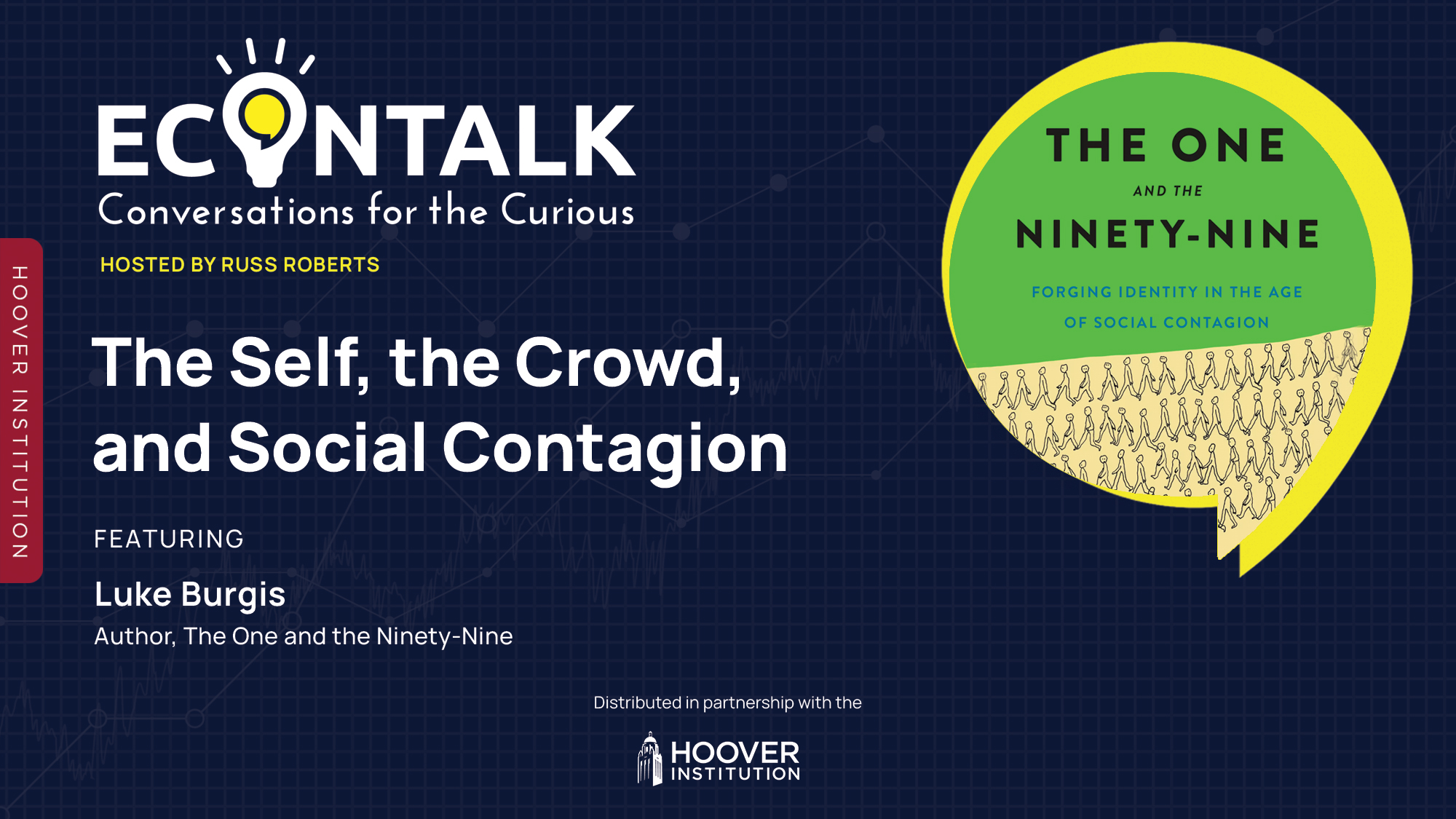
Finding community can be difficult. But author Luke Burgis thinks the real challenge begins once we’ve found it and we’re subject to social pressures to conform. Listen as Burgis and EconTalk’s Russ Roberts trace the tension between individuals and their tribes through the foundational frameworks, such as family and school, that help forge our identities. Burgis argues that the disappearance of traditional rites of passage bodes ill for major life commitments such as marriage, and recounts his personal journey from Wall Street through the Great Books in search of a strong, differentiated self. He also draws lessons for today’s communities from Saint Benedict’s 1,500-year-old guide for monastic life and describes the moving ritual he practiced with his father before he died.
Listen to the episode here.
- Today is April 28th, 2026. My guest is author Luke Burgess. His latest book is The One and the 99, forging Identity in the Age of Social Contagion. And that is our subject for today. Luke, welcome to EconTalk. Good to be with you. Thanks, Russ. Let's talk about the title. What is the one and the 99? The one is the self, the I, the subject, you and I as we exist as individuals. And the 99, you could think of as the crowd, the many, everybody else, you know, the group that we're, we're a part of. So this dichotomy between self and crowd has been something I've been thinking about for well over a decade. The title comes most explicitly from the Parable of the Lost Sheep in the Bible, where Jesus tells a story that's familiar to many people, but he, he says, strangely, which of you having 100 sheep and losing one would not go in search of the one, would not leave the 99 and go in search of the one. And I've heard it for almost my whole life, has always been something that has bothered me about it in some way, you know, from an economic standpoint, you know, really we're, we're going to put the 99% at risk to preserve the 1%. It doesn't make full sense. And there's also something I've heard very reductionistic, explanations of it. And, and I've, I've wondered if it doesn't have something, if even extracting from the biblical theological meaning of it, if it doesn't just have something very basic to teach us about what it's like to exist in communities, to exist in, in groups and in tribes. You know, the, the, the sheep often gets a bad rap. He's either, you know, the, the, the sinner he's lost. He, he needs to be saved, but what happened to that sheep? 'cause that sheep could be all of us at sometimes at some point. What happened while it was away was it changed? Why did it wander or leave in the first place that when it came back, was it different than it was when it left? That it exists in the, the flock in a different way? So I wanted to get inside the head of the sheep because I've certainly felt like the sheep at many points in my life as I've moved into and out of groups and wandered from them and left them for various reasons. And the tension, I guess, between the one and the 99 is what I was trying to examine. There's been, it seems like there's a, a book about tribes and how to find your tribe that's written every year, maybe every six months in the US It's really popular topic. But in my life, the hard part has never been finding a tribe. It's been, when I find a group, a tribe, like-minded people, that's when things really get difficult, where tension starts. And I've had to struggle to differentiate myself, understand how to exist in a healthy way within it. And that's what I wanted to explore. So the one in the 99 is trying to get at the tension between the self and the crowd, the way that crowds or groups shape us, the way that we shape them, and how to exist within them in healthy ways where we don't lose ourselves. So I, I did not know the parable. And you know, it's interesting that it's a sheep, 'cause sheep have shepherds, and let's put that to the side. I think that's more of the theological lesson. Sheep are the metaphor for mindless followers. So it, the other part about that parable that I love is the, it's one thing for the one sheep to get lost, but for the one sheep to decide to stake out its own path, its own journey. And to have the courage to do that is, is part of what your book's about. But it's not about being alone or being out, having no tribes as if tribes, there's something wrong with tribes. That's not the point. Right? No. And, you know, and the sheep and the parable is often described as as lost. And in my book, I don't operate under the assumption that it's, it's lost. That may be it intentionally wandered, because I'm talking about people, right? Yeah. And, and, and we leave groups and tribes for all kinds of reasons. So the idea is not, you know, leave the groups that you're a part of to, you know, stake out some solitary existence as an individual. I don't think that's possible. But what process of differentiation must a person go through so that we can exist in groups and as differentiated individuals who are also in communion with other people, right? Whether it's families, various groups that we're a part of. So it's, it's really about relationships. And the, the thesis of the book is kind of a relational ontology. And I, I firmly believe we can understand very few problems by looking at individuals behavior alone. We have to understand them in relationships with other people, whether we're talking about our family or, or, or, or, or at work. And, and exploring the relationship between the self and various communities that we're part of is the heart of the book with the goal not to differentiate, but what's the process of transformation that one goes through when they experience the tension of being in community and don't run from the tension, but allow it to shape who they become. This is a really beautiful idea, and you have a lot of interesting things to say about, we'll get to some of them, I hope. But what I'm curious, your reaction to this, it's not exactly a critique maybe, but we all want to not, we all, most of us wanna belong and we look, we seek out tribes that are like us or maybe that we might aspire to be like the people on the tribe as, as you write about in various places. At the same time, part of the reason we're doing that is to run away from what makes us unique. We're joining the tribe to escape the oneness of our existence. We wanna be immersed, we wanna be subsumed. And your book, in some ways is a, a creed de occur, a cry from the heart of, of that you lose something essential about yourself. Of course you're gonna be in tribes, you're gonna look for communities and so on. But at the same thing, you have to maintain your selfness, the, the one, the part of the view that is, that is that is unique. And I'm curious how you square that or think about the fact that a lot of communities have an immense amount of fine gradations. So if you think about the two that often come to mind, religion or politics. So in religion, you know, Christianity, there's, there's all these different flavors. And in Judaism and religion, I know best, there's all these different flavors. If you, well, there's three, right? Or you could say there's four Judaism or reform, conservative, Orthodox, maybe reconstruction. But within any one of those, there's communities with certain flavors that you feel more or less comfortable in. And a lot of people spend their lives looking for places where everyone is just like them. So they don't have any of the tension that you're talking about. How do you think about that? I, I exist in probably eight or nine or 10 groups that I would consider pretty core to my identity, my family, my church, the school that I teach at. None of them fully kind of capture who I am. And there's been a lot of great books that have written about this. You know, Christopher Lash kind of refers to the minimal self, Eric Hoffer, you know, people often join groups in unhealthy ways. He's talking about populism and mass movements because they're fleeing in unwanted self or a, a, a flimsy self that might not have a lot of moral convictions and hasn't spent a lot of time understanding what that self is really, really willing to stand for. And I think there's something about the modern world, and it could be technology removing as much friction as possible for modern life politics. Try kind of, the message is to, to remove the friction. Join the coalition where everybody, you know, is, is on the same page. Which, first of all, it's a fiction, right? If we're honest with ourselves, there's always tension even among the group that we think is the most like our tribe. And one of the points of the book is that our groups and communities will be healthier and stronger to the extent that people are exercising what I call a solid self in the book, the kind of self that's not renegotiating itself in real time, so that the group becomes like a flock of starlings. You know? It, it's just changing and everybody changes with it. And there, there seems to be nobody in the group that is sort of a, a, a reference point for something that transcends the group itself. So the inability to sit in tension is a big problem in our world. And, you know, there's, we're just, we're offered so many ways to flee it. So the, the, the, the tension is a big, a big part of it. And I am fascinated by stories of people that are willing to sometimes at great risk to themselves are, are seem to point beyond the logic of the group itself. And, you know, there's some fascinating connections. I listen to your podcast and Smith on this where with the impartial spectator. Yeah. And that is one example of having a a, a transcendent reference point. But I think even the impartial spectator, to the extent that it is mediated and internalized only by the group can also be a problem. And then what happens when the algorithm or AI becomes the impartial spectator? You know, it's not really one that's, that's, there's all kinds of things built into it because it's a mimetic machine. How do we exist in that kind of a world? And, you know, i I propose some ideas like value response. Like there is such a thing as responding to sort of objective things because they are good in themselves and not because my group says that they're good because they're not socially mediated. Very few people seem to have the ability to do that for whatever reason. And I explore from the realms of religion to politics, to education. What, what is missing that would allow more people to have the courage to respond to, I guess reality or to respond to things that have truth, good and beauty in themselves that are not 100% socially mediated to us. Yeah, and I mentioned religion, but of course in politics it's, it's much more intense. You know, if you have one review that's wrong, so to speak, you're, you're drummed out of the tribe. And similarly on social media, which you write about a lot, we're, we're constantly, if we're not careful curating our social media feed to just be exactly what we feel most comfortable with. But, but I wanna talk, I wanna talk about the family because I think you had some incredibly provocative things to say about the family. And there's a line in the book that's haunt has haunted me since our encountered it. You have a in between chapters, you often have quotations and occasionally illustrations and occasionally illustrations with a quote. And there's one, especially powerful, one of a, a parent leaning down to guide a small child. We see them in silhouette. And I think I have this right. The, the text says, the hardest place to stand apart is the place you were held. And it's a powerful way to talk about the fact that family and whatever values of religion, politics, ethics, commitment to family, all the different ethos, the whatever the plural that is that come with the family, we are, they're poured into us as children because that's the place we were held. We have a tremendous emotional connection. And I like to say that, you know, most kids either see their parents as role models or as anti-roll models, the thing they don't want to be. And you're making the observation there that it's very hard to stand apart, right? And there's a natural, I think there's two very, very intense emotions within, within us as children who become adults. But we're always the children of our parents, regardless of how old we are. One is to adopt through ESIS or whatever process the values of that family. But then if we do that, we don't feel like we're an independent human being. So we have the urge to stand apart, but it's very hard to do because the family's very powerful. So talk about that and, and what we can learn from that with in thinking about our as parents or as children. Yeah. I'm the father of a two and a half year old daughter and a four month old daughter. And I, I'm thinking about this all the time. Part of my job, I feel, is to allow them to be differentiated. People that have a, a sense of self and without being completely fused to me in the sense that they only wanna make me happy. 'cause I'm not a perfect person and I'm not a, a perfect role model for them, right? I hope they don't think I'm an anti role model. And the truth is probably somewhere in between. They, you know, we, every child strives for communion and differentiation at the same time, as do we adults, you know? But it starts as a child we want to be with and we want to be known as ourselves at the same time. And it's the inability to hold these two things intention where we, we often go astray. The family is just such an incredible forge of identity because we're just immersed in it. We're held in it for usually most of us, the first 18 years of our life. And that is usually where we either learn or don't learn to see where our emotions end and my parents begin. When I was talking about ideas here, we're talking actually about emotions and the sense of the sense of self, right? There's literally a fusion that can happen if we don't learn differentiation. So an example of this would be, you know, mom and dad are really upset about something. Can I be in the room with them and acknowledge that that's not upsetting to me. You know, I don't need to be upset or am I instantly subsumed into their emotions, right? Let's say it's politics, right? I grew up with, you know, my dad watching, watching the news and, and commenting on politics and sometimes getting upset. And you know, the instinct is, is kind of to, to mirror you know, what you're seeing, partly because you don't know enough, but this, this kind of transference happens subtly, usually without us knowing it. And one of the ways that discomfort is usually dealt with, or anxiety in a family system is through some form of triangulation Now, so one of the, i I points that I make in the book is like the smallest stable unit of relationships is not an individual or a relationship between two people. The smallest stable unit is three people. It's a triad because if two people have a conflict, it's very volatile. But as long as there's a third person somewhere, either in the room or somebody that they can talk about, or some they, they have an outlet, they can offload some of the tension and this sys systemic dynamic within families. So if it's a two parent home with one child, they're the triangle. If there's two children, there's more triangles and this, and we sort of like learn to either stand as a differentiated self or move to the various positions within the family where we don't have to do that. And this is a, a theory from, from Murray Bowen, who was a Georgetown psychologist that I thought was really, really illustrative of what I also see in society. It's like what he was observing in the family in terms of the way that we don't deal with problems, seems to be something that we take out with us into the world if we don't learn to be a differentiated self in the family. And we just assume the role that we are expected to play within the family. So you give the example, which I found really from Bowen of the, which I really liked, of the, the father asked the son if he wants to play catch, and the father thinks he's doing a big, doing the right thing, you know, he is spending gonna spend quality time. And of course playing catch with your kid is a, is a powerful example of, it's interesting how what it taps into. But the kid for the first time is actually excited about a something, he's got a high school writing assignment, I think it was Hamlet. And he actually, he likes playing catch, but right now he's really into Hamlet, he says, I don't think so. And of course not. Of course the the dad is crushed. He, he had this wonderful idea of bonding and quality time. And then his sis the boy's sister says, well, I'd like to play catch dad. And, and the father's thrilled. So he takes the sister out, they go outside and they're playing catch. And you can carry it on with the rest of it. But it's, explain if you can how that, what that has to do with, with society at large, finish that story and explain what has to do with society at large. Yeah. I mean, be before, before the, you know, in the story as, as the, the dad sulks away and says, well son, you know, I'm, I'm trying to play catch with you. I thought I was doing a good thing. And he, he sulks away, you know, the mom walks in the room and she doesn't want to deal with a, a sulking, you know, husband all, all night long. So she goes directly to her son and says, you know, you really should play catch with your dad. You know, it may, it'll, it'll make him happy. So she's kind of coming in the picture telling her son to do something to just ease the anxiety and the tension in the family because she doesn't want to deal with her husband for the rest of the night complaining about why her son didn't play catch. And then the son has a decision to make at that point, you know? So there's this enormous sort of coercion, frankly. And, you know, we don't think of it. This is, it seems like an innocent story, but the point of the story is that there is an amount of coercion, right? To conform to the expectations or emotional needs of another person in the story. And it, it just happens. These innocent things just happened day after day after day after 15, 16 years. It just shaped the kind of the way that our instinctual responses to what other people need from us. And you know, this plays out certainly in education, which I think has become incredibly conformist in many ways, right? We learn to play by the rules, we learn to make the teacher happy, we want to get along. We don't, you know, we, we don't learn to tolerate descent and anxiety very well in the classroom. You know, certainly in our politics, you know, parties or coalitions or groups, rather than deal with the tension of somebody that's not, maybe they're just not quite feeling right about a certain direction, it's just much easier to tell them to get out of there or, you know, it's, that's very much the message rather than sit in the tension of resolving it and recognizing that, you know, maybe we don't all feel the same way about this, that we have different convictions and we wanna work through it. So we very quickly sort of sort ourselves out into smaller and smaller units where we share quote the same values. And I mean, it sounds like a wonderful thing, but I, i, the, the, the, the, the point of the story and where it sort of trickles into the broader society is that there are often these sort of subtle, often emotional reasons why we do it. Because we're not willing to, we're we're, we're fused in some way, right? We're entangled in some mimetic way with the groups that we're a part of and untangling ourselves can be painful and it can require us to have very difficult conversations sometimes to be ostracized, to pay sacrifices. And I, I'll be, I mean, sometimes the sacrifices are economic, sometimes they're our job. But who, who is actually willing to put in that work? It seems like I'm seeing it less and less and less. And you know, I I I mean even movements like, like the, the, the network state right now, the, the internet gives us the ability to just look everywhere. We can possibly find it throughout the entire world to just organize ourselves into smaller and smaller units of like-minded people. And we'll write our own constitutions. I mean, let's see how long that lasts. Because in my experience, when we sort ourselves into these small tribes, that's when the hard work and the difficulty really begins. But what I like about what you're trying to say is that when you are uncomfortable with your tribe, whether it's your family or political home, or your religious community, sometimes, I mean, that's the essence of being a grownup in many ways, is, is to stand apart. It doesn't mean you, it doesn't mean you leave. Yeah. It doesn't mean you're not, you're opposed to the goals of the, of the community or the tribe. It means that you're a human being, you're not a sheep. Yes. And there are sometimes when you might have to leave, but what are the, what's the process that we go through to even test and discern that? And, and how many of us even really think or bring to conscious awareness the tensions that might exist? I mean, it seems like many times we don't even want to acknowledge the tensions, but the tensions, I mean, if we're being honest, there's always some tension in any, in any group, whether it's a family or, or a workplace. And, you know, I, I think like the, the unhealthiest workplaces that I've ever been in, never acknowledge it whatsoever. Everything's always just great all of the time. And to me, that's a sign of either insecurity or, or, or, or weakness. And the book is really a, a kind of a call to the individual to sort of be the one who can not by not by being grumpy all the time, right. You know, not by trying to be a contrarian, but by trying to be honest and sorting out the difference between who we are, what we believe, what we're willing stand for, and the dynamics that exist in the community and the community will be healthier to the extent that there can be differentiation while still being in good relationship with other people. And the healthiest relationships are ones where people can feel comfortable being who they are without sacrificing things that are essential. Yeah. I don't know if this is true or not, but in my experience, humor is often the way we deal with the tension of our discomfort with either our family or our religion or our workplace. We make a joke, but it's not a joke. It, it's, it's a cry from the soul that says, you know, I, I object, but I'm not gonna say I object because then, oh my gosh, I, I mean, I'm not, I'm suggesting I, I don't believe in the tribes, I'm gonna make a joke. But the joke is really a way of saying I'm uncomfortable. And it usually ends there just, there's just a little bit of humor and sometimes people react badly to it, but most of the time it's just shrugged off. But I think it's a, it's a flag. Yeah. And, and you know, there's the old, the court jester who's, you know, the only one that can tell the truth and it comes in the form of, of, of humor. But Yeah, it is, is certainly, I I was a, i I had the very unique experience of living in a dormitory like environment with 250 other men after the age of 30, which is a long story about why I was doing that. And I think probably it was a difficult environment because we had so much alike. And sometimes the more that you share the more the micro differences matter because the stakes are so small sometimes say about academia, it was certainly like that in the seminary, but it was also one of the funniest, most hilarious places I've ever been. Because I think when you're in an environment like that, it just lends itself incredibly well to good jokes and humor. Yeah. The, there is a movie to be made there, I guess that's, as far as I know, hasn't been made. The, the, the monk it would be called, and it would, it would be as a slapstick comedy. I've been trying to write That screen screenplay of pitch to Netflix for the last 10 years. You're serious, right? I'm, I'm, I'm half serious. I mean, I've thought I've, I've actually thought about it. Let's talk about education. You write the following quote, A core part of education is learning what we believe, what we're willing to commit to, and what we are willing to walk away from. A real education should shape your instincts about the person you wanna marry and the communities you bind yourself to more than it should shape your future resume. End. A quote that does not take place in most classrooms, that kind of education. No, because the education is content and knowledge transfer and not formation, you know, of, of the human person. For me, education is, is largely should be if it's done well in education, in desire, in what we want to pursue. And that means forming people to be hunters more than gatherers. Also, that makes education a lot more exciting when you're a hunter and you have some agency and some responsibility to play in what you learn rather than just being fed passively. And the real message in, in the little passage that you just read is we, you know, Tocqueville said that the science of association is the, you know, the, the, the mother science, right? The science of association. It's not, there's no subject in any school that I'm aware of at any level that has a class called, you know, the science of association or the art of association. I think it's just as much an art as it is a science personally. So we have to learn that on our own, usually in the family, at work, in the classroom. And there, when we associate with others, whether it's a friend group or a club or a a workplace, we are formed by that association whether we like it or not. You know, we are formed if we have the humility to understand that and we form it and a process begins. And I don't think there's enough emphasis on how the decisions that we make help help us enter into a process. We do sort of not, we hook ourselves to something when we make decisions. Let's say it's the first job that we take out of college. Now that doesn't mean that it's deterministic and that, you know, our, our some decisions will are irrevocable, some are, but it does mean that we will be shaped by that. And understanding how, and the process through which that happens is a big part of what adult life is like. Right? How, how does my decision to marry this person help me enter on a process for the rest of my life? Is this somebody that I want to go through life with and be transformed with and suffer with and cry with and laugh with? There is a process and understanding how things play out beyond the first step to steps two and three and four. We can't predict the future entirely, but based on somebody's character, we can have a pretty good idea of what that process might look like. That seems to me to be a really important part of what education is all about. And one of, I I am a mentor to about 30 students at any given time. I'm their academic advisor, faculty advisor. Many of them are trying to choose between two or three different jobs. And one of my favorite thought experiments to do with them is to say, look, imagine that all of these options that you're, you're weighing right now, you, you do of them for two years and they're by all kind of performance metrics, they, they all just fail, right? It's the kind of thing that you might not even wanna put on your resume. You're going to just completely change paths after that. So you can't take into account income, prestige, none of that matters. Which one of those paths will help you embark on a process that will help you become more of the person that you think you want to become. And that is an incredibly clarifying question. You know, I had one student trying to choose between a consulting job and trying to be a standup comic for comic for a year. Those are two incredibly different things. And what did the students choose Standup comedy? Did you encourage that or just help them think about it? I I, I, I really try not to, not to push students on either path. 'cause I don't want the responsibility unless with some really rare cases I'll, I'll, I'll step on the scale a little bit, but I I did not encourage that. So I, I love that language as I'm sure listeners are not surprised, but there are two things that come to mind. One is some people don't know what they want to become and they use their job or their spouse to figure that out. The other thought I had is that, you know, this generation, young people today, particularly in their twenties and even now in their thirties, they're not marrying, period. It's not about who do I marry? It's whether to marry and mo many don't. And how, how do you think about that with this framework? 'cause as you were talking, I was thinking, well, if I know I'm gonna be formed and you will be by your spouse, and it in return, your spouse will be formed by you. Is that just a, a project that's too uncomfortable in the modern world? This, you know, if education is, is the passing on of content rather than the forming of, of who you become or would want to become? Is marriage just another example of where we've moved away from, or at least romantic life, whatever you wanna call it, we moved away from this idea of formation. And, and why would that be? My theory on this is that we've lost rites of passage from a young age, right? The, the most important ones in life being things like a bar mitzvah or a confirmation or getting married, having children. These are, these are big rites of passage, right? We're, we're never the same after them. And if getting married is the first rite of passage, you never really had that experience before. I don't know if that's a good one to be the first one, if that makes sense. Right. So it, you know, the, the definition of a rite of passage is it is a process of differentiation through which you are transformed in some way, right? The old Van Gne definition was, there is separation from a, you separate from the tribe for a period of time. You go through a liminal stage, which sometimes can be very scary. Where everything is in doubt, you might think you're going to die, so on and so forth. And then there is a process of reintegration, either with the group that you left in a different status perhaps, or with a new group, maybe you leave and you go and you move to a different city and you join a different group. Those have been disappearing. And marriage is a very serious rite of passage, right? It's a radical lifestyle change. And if it's the first, if you've had no practice, I guess, in experiencing like what it's like to embark on one of these transformative experiences, then I think it can seem incredibly daunting and people are looking for some kind of a utilitarian proof that it's the right choice. You know, I I I had a very good friend of mine who wanted me to explain in some kind of an empirical way why he would be happier if he got married. And I couldn't give him the proof that he was looking for, and he ended up not getting married. And at some point, you know, that was a commitment that he was going to have to make. But I I, I think that it's, I think we're not looking early enough in our society. You know, I, I, there are all kinds of reasons. I'm not discounting the stability reasons, economic reasons, but if you don't feel like you have a solid sense of self, you don't have a certain sense of maturity, it's particularly scary. And the, one of the ways that you acquire a solid sense of self, a differentiated personhood, is by going through various rites of passage. Some of them small, some of them larger. And we, we just don't have, I mean, the rites of passage that we have are online, you know, they're, they're, they happen on the internet often, and those are weak ones. I just wonder what role our relatively passive isn't the right word, I don't know how to describe it. Our current education system, which is rarely about learning for the sake of learning, rarely about the excitement of, of learning, and certainly not about transformation. It's about passing an exam, getting, doing well in the SAT, whatever it is, getting the piece of paper you write at one point, quote humanities in the arts such as poetry, once trained people in the disciplined act of attention, of discerning what truly matters rather than being told what matters. That seems to be an enormous part of our, what's been lost. We're told what matters. We, we do determine it to some extent through our feed and what our curation of that. But the idea that you should educate yourself to think about what to pay attention to is a really surprisingly radical idea in 2026. We're not only told what to pay attention to, but certain things are given to us in mass amounts and we pay attention to them because a bunch of other people are paying attention to them. And especially our social feeds, if you're on social media and it happens through this mimetic process and untethered from reality or from what's actually important and in this kind of new media environment that we live in, it just, it actually seems to be getting worse. I I didn't think it could get worse than it was five or six years ago, but it, but it, but it really seems to be worse in the sense that there, there are people explicitly saying what the, what the media environment is and then doubling down on the mimetic nature of it. So training the census, the sensory perception, what used to be called the census communis, does not mean common sense. The census communis is, is the, the point at which our senses not just our five physical senses, but we have intellectual senses, right? To perceive truth. I would say that we have spiritual senses so we can, you know, we can read, we can read things at different levels of meaning. There's a literal sense, there's an analog sense, there's an allegorical sense. We have various intellectual, physical, spiritual senses. The sense communist is the, when they all cohere to give us a perception of reality, right? So we're not limiting ourselves to one sense, and I'm a fan of Marshall McCluen, so I fully believe he said, when he says, technology often extends one sense to the detriment of others. And that's one of the ways that it's causing us to lose the, the census communist, right? This cohesion of senses that allows us to see what's real and what's unreal, what matters and what doesn't. And education should be, in my opinion, the future of education is a training in recovering that census communes, right? The, the sensory perception to perceive the world and to cut through the noise. If education can't do that, then it seems like we're going, it's training us to just be responsive to the mimetic environment that we already live in. So somebody on Substack, James Vermillion, in response, actually to me, kind of talk episodes, wrote a beautiful description of this that captures some of what your book's about. He says, he talked about the cultivate quote, the cultivation of an inner life, substantial enough to withstand the world's poll. And you can think about that as the poll of the 90, your, your tribe, your community. But here at Shalem College in Jerusalem, we think that's what we're doing. We're trying to give people an inner life, substantial enough to withstand the world's pole. We think we're trying to discipline their attention to discern what truly matters. And you know, these are all kind of vague phrases that I would simplify by saying to think for yourself. And, and that is some, that's the too short. But one way of describing what it means to be the one in the face of the, of the 99. But it seems to me, after reading your book, that your education in these matters, this ideal of this higher level of what we might call education, is you're self educated. You went through the standard process that most people do in America, and then you found at some point late in your, I think twenties, that your life was, although on the surface, quite successful, deeply dissatisfying. And you embarked on a journey of self-education, an odyssey of sorts. And talk about that a little bit. And, and I would just ask you whether this process of quote real education usually is gonna have to take place outside of the classroom. It's gonna, maybe it once took place in the classroom, but in the modern world, it's, it's on your plate, you gotta take care of it. If you're listening out there, For me, education was a very passive experience, almost like something that had become gamified. Grades are like levels, and the goal of second grade is to get to third grade, and the goal of third grade is to get to fourth grade. And for whatever reason, I, I just thought it was something to endure rather than, you know, something to, to make my own. And I'm sure, you know, looking back there, there may have been ways for me to, I don't know, you hear stories, these, these kids today, you know, are building computers and coding when they're in fifth grade and, you know, taking matters into their own hands. But I think that's, that's incredibly sort of important to feel like you're a protagonist of your, your your own education and to be the protagonist of your own existence is incredibly important. And if, if that drive, if that passion to do that is beaten out of you consistently for 15 years or something like that, you will probably, you will have lost some life, some vitality. And that was me. I, I ended up getting into a good school, getting a job on Wall Street, starting a few companies. But because I never took my education seriously, I woke up in my late twenties realizing that I, I sort of lacked the, the foundations, I majored in finance in undergrad, which is fine, but I lacked the foundations to understand the ideas that underlied. I mean, I, for me, reading, I learned far more about markets by reading Rene Gerard than I do by reading most finance blogs. And I, you know, I started to sort of realize that there was first principles in a world of ideas, many of them classical ideas, philosophical ideas that I had just never got. And I was mad, I was really upset that, that, you know, that, that I, that I didn't learn those ideas. And I was in a position in my late twenties, as you said, to step away. And I, I took about a year off. It happened to coincide for me with a religious experience and sort of coming back to the religion I was raised with, but had fallen away from, in my case, Catholicism, and took me on quite an odyssey where I, you know, I discerned religious life for a while. I went back to school and studied philosophy and theology and then just did an awful lot of self-directed learning. And I had the privilege to do that for about five years. I didn't get any fancy degrees to show for it, but I don't care. But it, and it, it just, it changed my life because I, I felt like I now had the, I now had the foundation to step back and try to look at what was really happening from a deeply kind of human anthropological standpoint. I understood myself better and I felt like the protagonist of my own existence at this point, which I, I think is what education should help people understand. And if anything, I, I'm betting that AI through some kind of a via negativa is stripping away everything that is not human. And if, if we're lucky, it will show us what is most human. And it's why I think that the human is probably for as maligned as they are and all of the things that went wrong in humanities education, I think that they probably have a pretty bright future. Because if you embrace them and understand them and imbibe them well, they're incredibly exciting. Yeah, yeah. I couldn't agree more. I'm curious how you went about that process. You know, some people find a mentor who recommends books and you work your way through one and you don't fully understand it, or maybe you hardly understand it at all, and you try again, or you try another one, and there comes a point where you start to realize that you've, you're learning how to learn. But how did you do that? How did you go that, in that five year process? Did you make a lot of mistakes? Did you have a plan? How'd you execute that self-education experience? Well, when I was running a a company, I would go to a 24 hour Starbucks in Las Vegas almost every night and sit there until two or three o'clock in the morning reading classical books and following the footnotes, Such as, such as, Such as, such as the Odyssey, which came up earlier in the call, right? Homer, Plato Sevki, Adam Smith. I read the Bible front to back for the first time in my life. I went back to my bookshelf and picked up the books that I said I read in school and never did for my philosophy class, which did light something in me when I took it. But it took me about 10 years to go back to it. Socrates, just the, the, the very basic, the great books, like mostly the great books. I didn't have a list that I was picking from, but it was basically the great books. And I followed a lot of footnotes, which is to this day is one of the most exhilarating things for me, is I, I mean, I can't tell you the amount of gems that I've found in footnotes of books. And I hope that I've put some gems in, in this book too, because I, I enjoy, I take them very, very seriously. You know, when I went, when I run across an idea, I know that authors don't want to get into the weeds on it, and they'll just recommend another book to read. So that led me, that led me down a, a, a wonderful path. And I, yes, of course I had, I had some mentors that came in my life and, and then I joined seminary, so then I was just given up a whole bunch of books to read. So that was a, you know, but aside, even, even then, I was very much reading things. I mean, I read David Foster Wallace for the first time, so kind of a mix of fiction and nonfiction. Now you've mentioned ESIS and the Mimetic used the word mimetic. We've had a couple episodes on Renee Gerard on the program, and you wrote a book called Wanting, which I will hope to read soon, having read this book, which came before, explain what ESUs is, and briefly and a minute or less if you could. And then I want you to talk about an example politics say, or religion in a family. And the role ESIS plays in, in our, how we adapt to, to that ESIS Mimetic desire is the key term. And it means that while thinking that our desires are fully our own, that they're, they well up from some, you know, authentic self, that our desires are in fact borrowed or adopted from others. That desire is, is incredibly contagious and is a, is a fancy word for imitation from the Greek mi. So mimetic desire is imitative desire. They're the, they're the the ways in which our desires are shaped and formed through other people who model desires to us. And at the most basic level, this happens. And families where there, there could be, you know, admired parents who are both doctors or an older sibling that has a younger brother, he goes to medical school and, you know, the younger brother follows into medical school because he's a model of desire for him. It also happens in a negative way where there's kind of an unhealthy form of differentiation that happens. And because differentiation is a core idea in the one, in the 99, and I, I usually talk about differentiation in a positive sense. Like it's a good thing to become a differentiated self and to know where you end in others began or when the group begins. But there's an unhealthy form of differentiation that is related to ESIS and mimetic desire. And that's when we say, well, because this person thinks or likes X, because there's mimetic desire sort of naturally lends itself to rivalry, right? 'cause we want to be like other people, but not too much like them. So we say, if, if this person believes X, I cannot believe X, or if they, they like XI must like y And this happens in politics all, all the time, right? You know, an idea cannot be debated on its own merits. It's because because this party has embraced this policy, it would be mortifying for anybody in the other party to acknowledge anything good about it at all. Right? So, so you start your basis of differentiation is what another has, has sort of chosen first and colors often through envy or insecurity or pride, colors the choice before it's actually been evaluated. And that operates at the level of ideas. And it also operates, operates at the level of desires. And as an economists, you know, that sounds horribly off, you know, 'cause economists like rationality and economists like to model our choices as the thing that makes us as well off as possible and maximizes our utility. And, and then also as of course as ag agentic human beings, we like to believe we're in charge and we make our own decisions. And the idea that we'd be influenced by the masses is it's repellent. And yet, and yet, when we look at anybody, anybody, and we'd say that you don't know a stranger and say you have to predict their political beliefs. What's your, and you get one variable. You get to ask one question. The question would be, you know, what do your parents believe? Like, and of course there's the exception, the kind, the exact opposite as you say that the other differentiation where you say, I'm not gonna be like my parents, I'm gonna be my anti parents. But so many of us of course adopt the religion or the politics of our parents or our peer group or whatever it is. And that's so unattractive to us that we have to tell ourselves that Of course that would, that would be absurd. That's not why I believe what I believe, what I believe. 'cause I, I have all this evidence for it. It's true. And yet I think you have to confront the reality that this phenomenon is not a small thing. It's, it's interesting when, if you, if you take not just what their parents believed, but if you take 10 kind of hot button political issues, they make a list of 10. You pick the 10, let's say one of 'em is, you know, gun control. If I were just to ask a person like, tell me what you believe about the second amendment about gun control, based on their answer, there's a very high likelihood that I could predict what they would think or the position that they've arrived at on all 10. And I think I would probably be right about all 10, like 90% of the time, which is odd. Like what are the, what are the odds that they sort of independently sort of reasoned their way to all 10 of those positions kind of aligning? So this clustering of, of ideas and beliefs kind of through family resemblance in a sense, right? This is what people like us believe, right? This idea. So it's, it's deeply related to identity. And I would add, yeah, it's, it's, we're kind of ashamed of admitting our imitation or our ESIS as adults, which is very different than children. You know, my daughter is very, very happy when she can imitate anything, right? But it's, but it's, it's not called imitation when we're adults. It's called ESIS because it's underground. It's hidden and subconscious and we are, we're ashamed of it. Nobody wants to be known as an imitator. But it's not just the crowd that we are mimetic with or influenced by. It's more often individuals, like very specific people. And that's, this is where I think Gerard really hit on something. There are certain people that have an outsized influence on us that are usually far more important than the crowd as a whole for whatever reason, right? We might have a particular hatred of them, or we might admire them, but particular people come into our lives and shape our beliefs more than, more than the crowd usually. And Gerard would argue this is because we have some fixation or fascination with them, we're caught up in some kind of a memetic entanglement with them. So while the crowd is important, it's usually important to narrow it down a bit and understand, well, who are the people that I the most attention to? You could start with your Twitter or x feeded, you know, who are the people that I, I pay the most attention to? 'cause they do show up as individuals. They don't show up as the hive. And that's something that, you know, if you can't name any, you, they're probably pretty powerful. Yeah. And when we say those people who are right now are in the end of April in 2026, and it's not clear how the war in Iran's gonna turn out. And of course there's an immense amount of commentary about whether America or Israel is winning or losing. And, and I follow a whole bunch of people and I convince myself that I'm following them so I can learn what's happening. But the truth is, to some extent, I'm looking for comfort, not for insight. And if someone I find insightful gives me the wrong answer, the one I don't want, I just don't finish reading that, that post. I go, oh, well he's got a blind spot on that. Maybe they're not so Insightful after All. Yeah, maybe. And maybe I've, I've overrated them. It's a lot of what about you write about in this book, I call it growing up, it's about how do you overcome your childlike mimetic desire, your childlike desire to be loved, your childlike desire to be held? How do you stand on your own two feet? How do you stand apart and yet still be part of the group? And, and the book forces you to think about it. And it's, and it's a, a triumph for that reason. There's a part of the book that's a little bit, I'm not sure how it fits in, but you'll tell me which, but I loved it. It's the latter of humility. We won't go through all of it, but, but talk about what the ladder of humility is. And I just like this one line because I, I like the idea of it. I don't think I live by it. I'd like the, I'd like to leading with the head bowed down. It, it's an oxymoron, it's paradox. How can you lead with humility? How do you lead when your, your head is, when your eyes are, are toward the ground rather than toward, toward the heavens in in self-confidence and self-righteousness. And this whole idea of, anyway, I'll talk, talk about that. Hmm. Yeah. This comes near the end as I am thinking, you know, okay, so existing in community is really hard. There's a lot of tensions. What are the kinds of communities that have been around for a very, very long time in a stable state? You know, what, what can we look to, right? It's, I mean, it's, we need to have some model. And monastic communities are a very obvious example in my mind, right? I mean, stable communities that have lived lived, many of them according to the same rule of life for well over a thousand years now, right? So the Benedictine communities live by a rule of life written by Benedict of Nocia well over a thousand years ago, and they endure and are stable. And is there something to be learned from the rule of Benedict? Is it the greatest organizational manual ever written? Not just for monastic communities or religious communities, but like, is there something that we can learn from from that? So I went back and I read the Rule of Benedict from front to back. It's not very long, sort of 73 rules of life. You know, this is how you accept people that knock on the door of the monastery and say they want to enter very surprisingly says, well, you let 'em stand outside for a few days. You don't just let 'em in right away. You know, and then you, you let 'em in and you let them stand in the middle part. You don't invite them to dinner. And you see, if they keep wanting to come in, he's got all these, you know, you wouldn't think that of a saint, right? St. Benedict. It's very interesting rule. I I I, I mean I, I read it so you don't have to because it's not the most exciting read. But the, the whole rule I realized is about stable community. And there's all kinds of interesting parts to it, but it, it all revolves around humility. And he says, look, you cannot live in a community or in a monastery unless there's a, a degree of humility and charity. But humility is the foundation for the entire rule. Because pride is, is an ego, is what tears communities apart. And you seem to realize this very clearly in states explicitly that none of what I'm saying here works unless we are humble. And then there's a ladder of humility. And he says, now humility is not one thing. There are degrees of humility. And I can't remember exactly where it falls on the ladder. There are 10 steps on this ladder of humility. And he says it's a ladder that you descend to, to to, to deeper and deeper levels of humility where you have a certain level of, of, of acceptance and you can exist in this community. And to have the, you know, the, the, the, the head bowed, I think is specific to monastic life, right? So these, these rules don't map one, one to one onto the world that most of us live in, right? But the way that I read that particular part of the ladder is walk with your heads bound is as an anti-emetic, anti-emetic encouragement. You know, you know, don't try not to pay too much attention to what everybody else is doing, what your brother is doing to your right and to your left walk with your head down, I guess in the monastery, you know, prayer and recollection. And I think it's actually an antiemetic exhortation that he has there, right? The humble person can walk with their head down the hall of the monastery without, and saying, now that guy's doing, doing that again, what a dummy and, or this guy's, you know, have, you know, eaten that or what, you know, having lived in a seminary, I can tell you it's very hard not to have your head on a swivel so that you have something to complain about when you go back up to your floor and talk to your friends. So the whole thing is built on humility and I, and I think there's something to, to learn there. And then he has, you know, part of that here's a practical way that he says it's exercised in the monastery. He says, the Abbott of the monastery should always invite the youngest member, the youngest monk and novice to a meeting where an important matter is to be decided. And he should always be consulted because it's, it's only in our pride that we think that because we're older and wiser that God can't speak through the youngest person. Right. And, and so it's, it's a, it's a recognition. So it plays out in these very practical ways, but it's all guided by humility. And I think that if it was ever studied, there's probably some fantastic sort of business book that could be written about. I'm not gonna be the one to write it, but I think we could all benefit to, to take Benedict's rule of life very seriously when we think about how to exist in a stable community. 'cause you know, probably as something to teach us about marriage as well. Yeah, it's great. I, I, you know, I, in my experience, and I've been in many, many religious communities around the world for sometimes as a temporary member, sometimes as a longtime member, and inevitably, I dunno what it's like in the monastery, but inevitably there, they're troubled souls. You know, they're people who are cranky, troubled, fighting a battle. And, you know, the, the natural, the natural response one has is, is judgment. How could they talk to me that way? Or how could they react to that event in that way? And you put your head down. I don't think of it so much as, as not looking, but that's interesting. I like that. I think of it more of just, it's not about me. It feels like it's about me, but that's an illusion. It's about them. And I'm just gonna, I'm just gonna take it. You know, my, my ego's been hurt. I wasn't recognized. I didn't get the credit I deserve. Whatever it is, eh, forget it. It's, it's, it's, it's okay. I'll put my head down and keep walking. Anyway, I want you to react to another line in the book, which I really like, quote, A healthy community is not a fountain, but a forge. What do you mean by that? Institutions today seem to act more like platforms more than molds. This is a Yuval Levins idea. And communities are, and institutions are meant to form us, right? They're, they're, they're meant to be a forge and not just something that we take from not just platforms where we can, where we can take, you know, we should contribute to them knowing that they form us. And I don't think that we think of them that way. You know, we think of like, even going to a, a university, we think of it as just, what can I take from it to, to get a job? Or do I think, how is it going to, to form and, and, and, and, and shape me more than just being, you know, a, a roll tide shape me as being a, a fan of the football team. You know, how is it going to actually forge me as a person? And thinking of communities in that way is, is, is, is, is a shift. I mean, we think of them as a fountain. It just has the character of something that gives to us. And we don't think of them as something that we owe out of justice something to them. And we, we end up using them as platforms instead of communities that we can contribute. And that to me is a key distinction. I think it's partly why institutions are decaying. They're, they're, people are not act people don't believe in them to the extent where they're actually willing to give themselves to them. And there are many complicated reasons for that. I think many of them justified why people wouldn't want to give more to an institution. It's a longer discussion than we can have right now, but what is it gonna take to have institutions where we really want to contribute and to sacrifice for them and to give to them, because we know that ultimately there's a symbiotic relationship there. And they are a forge. You know, what are the institutions or communities that I would like my daughters to join? I'm already having to think about that right now. It's just soccer in the park. But it's gonna get more serious really soon. Speaking of parenting, let's close with one of my favorite parts of the book, which on the surface is just a personal story, which is the story of you watching a video of a Detroit Tigers, Kansas City Royals baseball game with your father night after night where he doesn't remember. He is already seen it. And I, you know, my dad, my dad did not have, I don't think he had serious dementia, but when he got older, his memory got weaker. And he would sometimes call me, I don't know if I've ever told the story before on the program. He was sometimes calling me and said, you know, I'm reading this great book. And I say, what is it, dad? And he'd tell me, and I think, and I tell him, I say, you know, I sent that to you 10 years ago 'cause I thought you'd like it. And he'd, he'd say, yeah, it's really interesting. We'd talk about it for a while. And mercifully or tragically or both he'd forgotten that he'd read it 10 years ago. And he hated it. Absolutely hated it either because I'd sent it to him and he did not want to like something I had sent him, or because it really did bug him, you know, in fact, it, it clashed with what he believed and he found that discomfort, you know, that was a discomfort. And, but now with a slightly clearer head, meaning cleared of the past and of ranker and other things, and, and you know, I had a very good relationship with my dad most of the time, but some of our books were a source of friction. The books we read together, and he read it like a child, it was really glorious that he could enjoy whatever was in it that spoke to him. And the part that made him mad 10 years earlier, he either didn't have access to anymore or he was a different person. I don't know. Or he just forgot, who knows? But tell your story. My, my dad developed advanced Alzheimer's, and it was worse than I realized, partly because my mom was this caregiver and she didn't really want to, you know, she didn't want to call me complaining, you know, but I, I, so, so I didn't really knew the full extent of it. She was leading with her head bow down. Yes, yes, she was. Yes she was. I mean, she was an amma, just an amazing person. And just poured herself out for my dad for years and, and really shielded me from a lot of that anxiety that it would've cost me. And I was living all over the world at the time. She passed away very unexpectedly. And I became my dad's primary caregiver, and I'm an only child. So it fell on me. I was newly married, and this was a, one of the most transformative experiences of my life. It shaped my sense of identity. It made me think seriously about my own memory and the role of memory in shaping our sense of self. I often think that, you know, one of the, the, the, the, the, the primordial sins is forgetfulness and in, in, even in my own case. And it was too late for me to do much about my dad. He was very advanced by the time that I took over as caregiving. But I, I at least realized that, you know, there was, there was time and he's still alive. And we've, we have a wonderful, beautiful relationship. Even though it often involves watching a 1999 Detroit Tigers baseball game that we've been watching together for or five years. He's seen it hundreds of times. It's just his favorite comforting thing to watch. Even when many people that, that lose their memory in Alzheimer's, they, they, they don't, they, they feel, and they remember how people and things make them feel. So we watch this game together many times when I, when I'm with him and, you know, it's all new and exciting for him. I react to it as if I'm watching it for the first time. And, you know, I've, I, I've done, I'm, I'm doing everything that I can for my dad. And there's no, and I think the beauty of it and the way that it's forced me to, to grow up is that I don't get, he doesn't, he doesn't know what I'm doing for him. I get no recognition for it. You know, even though sometimes I, I might like some, and we, we've, you know, he's, he's, he lives in this, in a, in a home with other veterans in a, in a VA home where he's actually had to learn to be in community when he's lived on his own with my mom for his entire life. So it's interesting that that all happened while I was writing this very book and watching my dad learn at the end of his life, learn to exist, and to coexist in, in the place where he lives. And it was rough when we started, and it's got a lot better since then. And one of the, the things that he said to me during one of my visits, as he said, and it kind of sums up everything that I've tried to say, is, you know, Luke, this being here is not supposed to be easy. You know, this is, this is going to take work. And it was one of those things. Every once in a while he says something that really surprises me and gives me the impression that he's thinking a lot about things that he can't articulate. And he has a hard time speaking. But he spoke those words incredibly clearly to me. And I thought, wow, my dad is continuing to teach me really important lessons, even, even at, at the end of his life. My guest today has been Luke Burgess. The book is the One and the 99. Luke, thanks for being part of EconTalk. Thanks so much for having me, Russ. Appreciate it.
ABOUT THE SPEAKER
Luke Burgis is a veteran entrepreneur and author. He is the founder and director of CLUNY, a multidisciplinary organization that integrates intellectual, spiritual, and practical knowledge (including business and technological)—that is a home to people seeking more meaningful ways to work and live.. Luke studied business at NYU Stern before doing graduate work in philosophy and earning an S.T.B. in Theology from the Pontifical University of the Holy Cross in Rome. He’s the author of The One and the Ninety-Nine: Forging Identity in the Age of Social Contagion and Wanting: The Power of Mimetic Desire in Everyday Life, which popularized the work of cultural anthropologist René Girard.
RELATED SOURCES
- Bi, Johnathan. “Johnathan Bi on Mimesis and René Girard.” Interview by Russ Roberts. EconTalk. November 21, 2022.
- St. Benedict, The Rule of St. Benedict: A Modern Translation (Updated, Easy-to-Read Language with Sidenotes). Translated by Peter Northcutt. Amazon.com. March 17, 2025,
- Bowen Center for the Study of the Family. “Differentiation of Self.”
- Britannica. “David Foster Wallace.”
- Burgis, Luke. Luke Burgis Official Website.
- Burgis, Luke. The One and the Ninety-Nine: Forging Identity in the Age of Social Contagion. New York: St. Martin’s Press, 2024.
- Burgis, Luke. Wanting: The Power of Mimetic Desire in Everyday Life. New York: St. Martin’s Press, 2021.
- Haven, Cynthia. “René Girard, Mimesis, and Conflict.” Interview by Russ Roberts. EconTalk. June 24, 2024.
- Hoffer Project. “Eric Hoffer.”
- Homer. The Odyssey. Translated by Robert Fagles. New York: Penguin Books, 1996.
- Klein, Daniel. “The Theory of Moral Sentiments, Episode 4—A Discussion of Part III.” Interview by Russ Roberts. EconTalk. April 29, 2009.
- Levin, Yuval. “Yuval Levin on A Time to Build.” Interview by Russ Roberts. EconTalk. March 2, 2020.
- McLuhan, Marshall. “Marshall McLuhan.” Wikipedia.
- Smith, Adam. Adam Smith Works Website.
- Vermillion, James. “Schoolwork as Soul Work: What Is Taught Beneath the Teaching.” April 22, 2026.

