







- Middle East
- International Affairs
- US Foreign Policy
- US Defense
- Indo Pacific
- Trade
- Confronting and Competing with China
- Determining America's Role in the World
- Understanding the Effects of Technology on Economics and Governance
Envisioning the Indo-Pacific as a single megaregion, stretching from East Asia through the Indian Ocean and the Middle East into Europe, has become increasingly central to contemporary geopolitical thinking. The concept reflects both economic and strategic realities: the dense commercial networks that connect Asian manufacturing, Gulf energy, Mediterranean shipping, and European markets, as well as the growing strategic competition over control of maritime trade routes and critical infrastructure. Yet the full significance of this emerging megaregion has not been adequately appreciated. The strategic potential of the India–Middle East–Europe Economic Corridor (IMEC) would expand dramatically if it were linked to the Three Seas Initiative (3SI), creating a north–south connectivity architecture stretching from the Indian Ocean to the Baltic.
Such a corridor would not merely diversify trade routes. It would reorganize Eurasian infrastructure around a maritime-oriented and market-based axis connecting India, the Gulf, the Eastern Mediterranean, Central Europe, and Northern Europe. In geopolitical terms, it would strengthen the “rimlands,” as theorized by Nicholas Spykman, against the continental powers associated with the Eurasian interior. The result would be a strategic system linking many of the world’s most important littoral regions through overlapping networks of trade, energy, digital infrastructure, and security cooperation.
The broader intellectual background reaches back to the classic geopolitical debates of the twentieth century. Halford Mackinder emphasized the strategic centrality of the Eurasian “world island,” while Alfred Thayer Mahan stressed the decisive role of maritime power and sea lanes in world politics. Carl Schmitt theorized analogous conflicts between land and sea powers. Contemporary infrastructure competition reflects the continuing relevance of these perspectives. China’s Belt and Road Initiative (BRI), with its continental and maritime corridors, represents one model of Eurasian integration. IMEC, particularly if linked to the Three Seas Initiative, points toward another: a more decentralized system centered on maritime access, diversified logistics, and cooperation among multiple middle powers and Western allies.
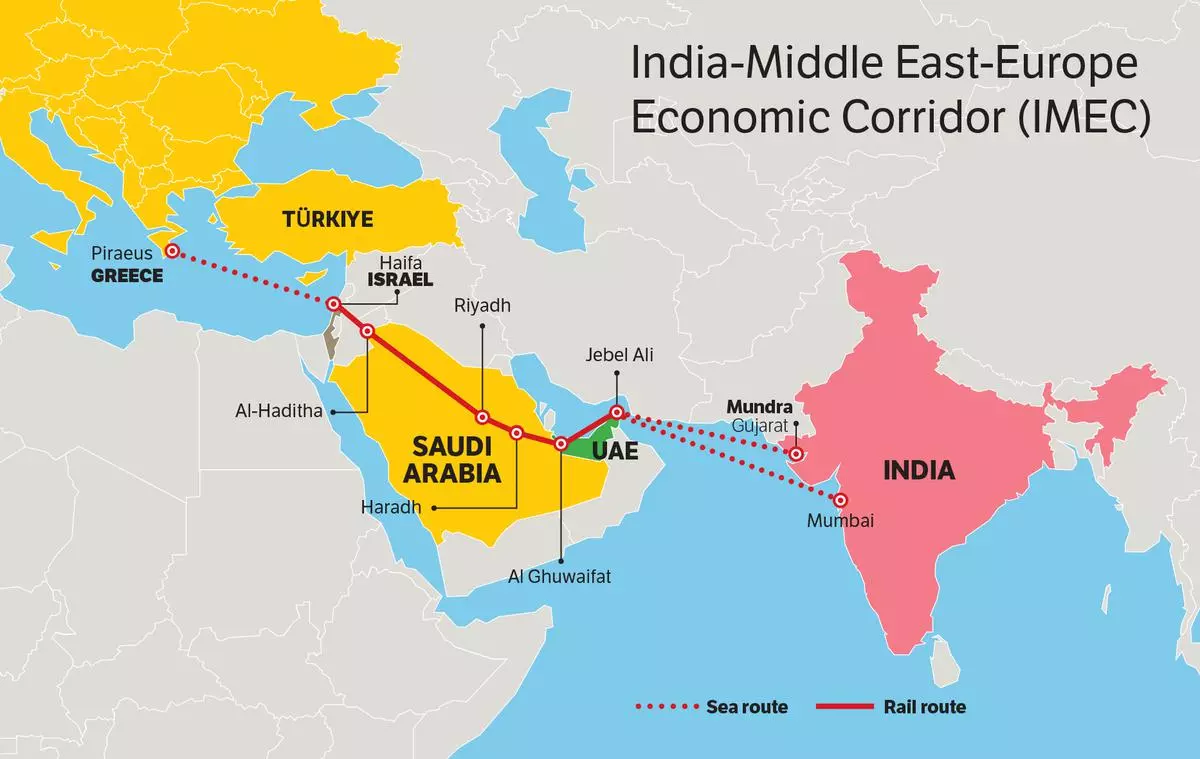
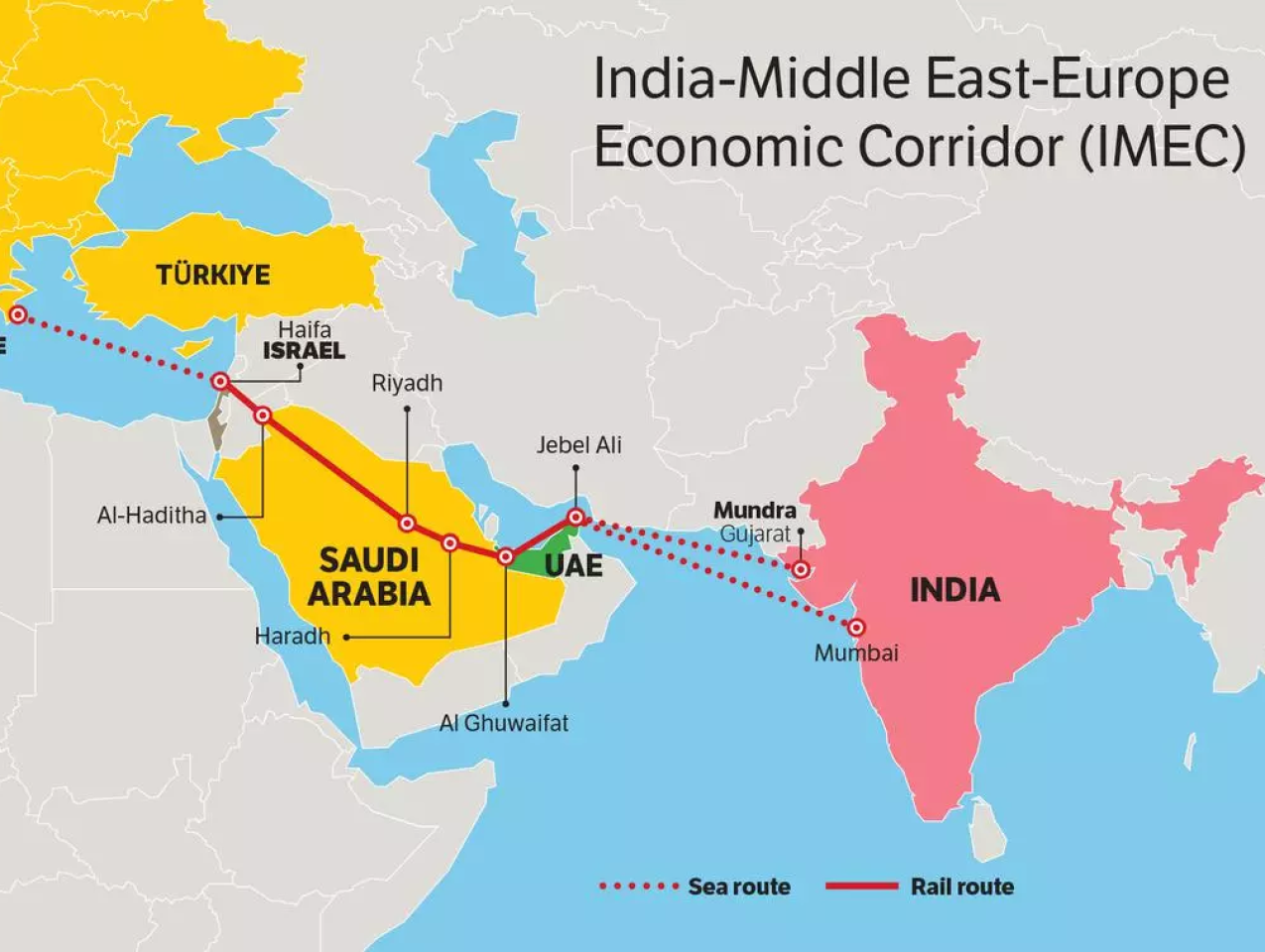
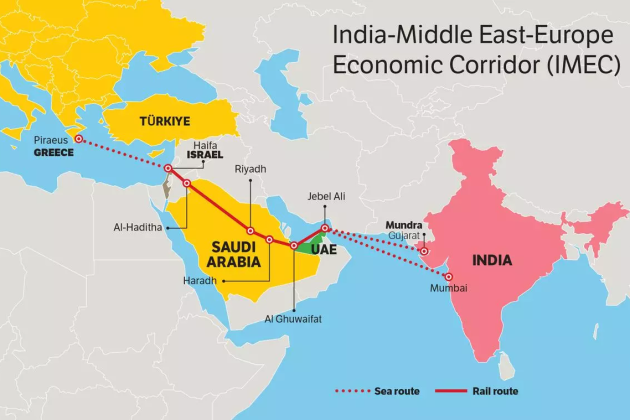
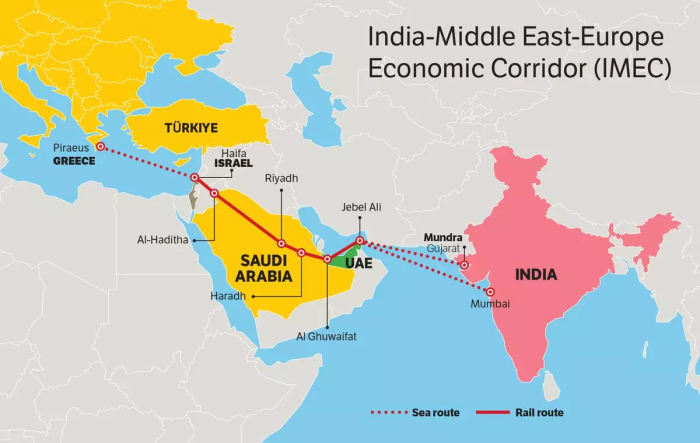
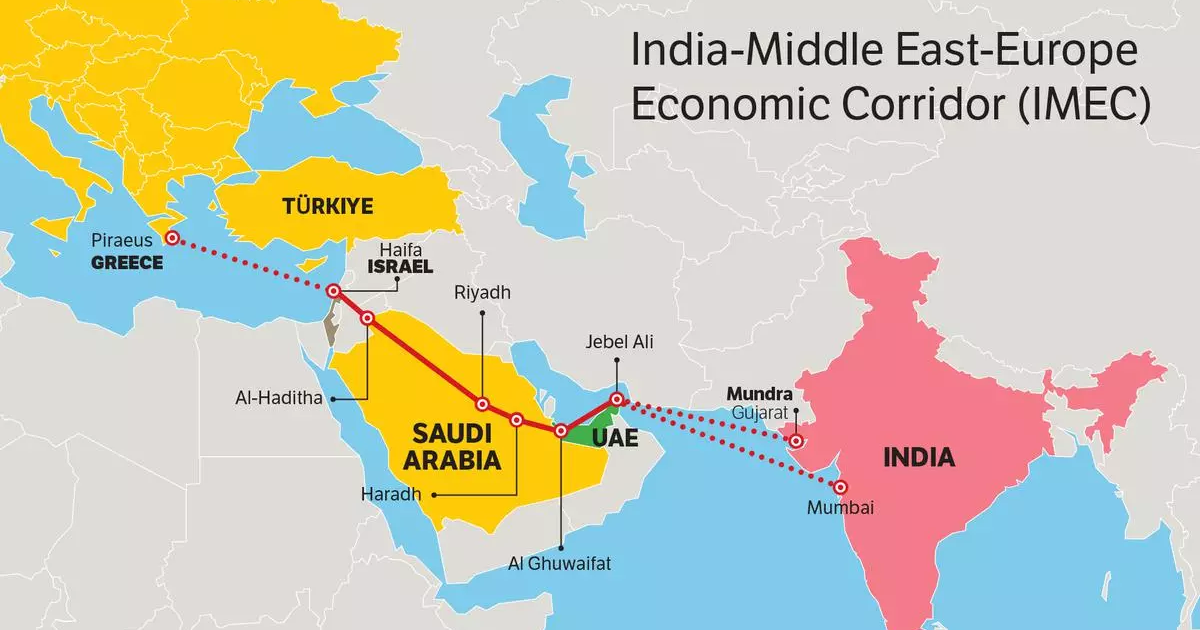
IMEC emerged from the September 2023 G20 summit in New Delhi as a proposed corridor connecting India with Europe through the United Arab Emirates, Saudi Arabia, Jordan, Israel, and Mediterranean ports such as Haifa, Piraeus or other southern European gateways. The project envisions integrated shipping, rail, energy, and digital infrastructure. The Three Seas Initiative, meanwhile, was launched in 2015 by Central and Eastern European states located between the Baltic, Adriatic, and Black Seas in order to strengthen north–south infrastructure integration within the eastern regions of the European Union.
The strategic logic of linking the two systems is compelling. IMEC currently aims at Southern Europe, but its economic and geopolitical significance would expand considerably if its infrastructure were extended northward through Central Europe toward Poland and the Baltic region. A completed axis could connect Mumbai not only to Mediterranean ports, but also to Gdańsk, Klaipėda, Riga, and Scandinavian logistics networks. Such a system would integrate the Indian Ocean and Eastern Mediterranean more directly with Northern Europe while potentially opening future access to Arctic commercial routes, which are likely to become increasingly important as climate change reshapes global shipping patterns.
The plausibility of such a linkage rests partly on geography and existing infrastructure trends. The Three Seas Initiative already prioritizes north–south transport corridors, especially projects such as Via Carpathia, which links Greece through the Balkans and Central Europe to Lithuania and the Baltic Sea. Greece’s accession to the Three Seas Initiative in 2023 is particularly significant because it creates a direct conceptual and infrastructural bridge between the Eastern Mediterranean and Central Europe. If IMEC reaches Greek or Adriatic ports through Israeli and Gulf connections, then much of the necessary northward infrastructure already exists in embryonic form.
Recent geopolitical developments have further strengthened the rationale for such a system. The COVID-19 pandemic exposed vulnerabilities in global supply chains. Russia’s invasion of Ukraine transformed European strategic thinking regarding infrastructure, energy security, and military mobility. Houthi attacks on Red Sea shipping demonstrated the fragility of concentrated maritime chokepoints. At the same time, in the context of the current Israel–Iran conflict, strategic and defense cooperation among several regional actors has accelerated, particularly among Israel, the UAE, Greece, and India. Across Europe and Asia alike, governments increasingly seek resilient and diversified transportation systems that reduce dependence on any single route or geopolitical actor.
One important advantage of a combined IMEC–3SI system would therefore be logistical resilience. At present, the majority of trade between India and Northern Europe passes through the Indian Ocean, the Red Sea, the Suez Canal, and the congested maritime approaches of Northwestern Europe. While this route remains highly efficient under normal conditions, recent crises have demonstrated its vulnerability to disruption. A north–south corridor linking India to Central and Northern Europe through multiple maritime and rail segments would provide an important alternative pathway. Such a system would not replace the Suez route entirely, but it could reduce excessive dependence on a single artery of global commerce.
The strategic implications are equally important. For decades after the Cold War, European integration remained disproportionately oriented along east–west economic axes centered on Germany, France, and the industrial core of Western Europe. North–south connectivity within Central and Eastern Europe lagged behind. The Three Seas Initiative emerged precisely in response to this imbalance. Linking IMEC to 3SI would accelerate investment in railways, highways, ports, digital infrastructure, and energy interconnectors across Poland, Romania, Croatia, Greece, and the Baltic states. In doing so, it would strengthen the economic coherence of NATO’s eastern flank at a moment when geopolitical tensions with Russia have once again become central to European security.
The military dimension deserves particular attention. Much of the infrastructure envisioned by both IMEC and the Three Seas Initiative possesses dual-use significance. Rail corridors, highways, and port facilities designed for trade are equally relevant for military logistics and strategic mobility. Since the Russian invasion of Ukraine, NATO has placed growing emphasis on the rapid movement of forces across Eastern Europe. North–south infrastructure linking the Aegean, Adriatic, Black Sea, and Baltic regions would improve operational flexibility while reducing dependence on vulnerable east–west bottlenecks. Such corridors would also enhance logistical continuity across critical areas extending from the Eastern Mediterranean to the Baltic frontier, including regions near the Suwałki Gap and the Black Sea basin. Direct connections to Middle Eastern energy resources would prove invaluable in a crisis context.
This strategic architecture would also deepen India’s role in European affairs. India increasingly seeks recognition not merely as a regional South Asian power but as a major geopolitical actor with global reach. IMEC provides India with a framework for projecting economic and strategic influence westward without dependence on Pakistan or Chinese-controlled infrastructure networks. Extending the corridor into Central and Northern Europe would integrate India more deeply into European economic and security structures while reinforcing partnerships with states such as Greece, Poland, and Romania, all of which increasingly view India as an important strategic counterpart.
The project also carries significant implications for the broader competition over Eurasian infrastructure. China’s Belt and Road Initiative has expanded Beijing’s influence through investments in ports, railways, logistics hubs, and digital systems across Eurasia, Africa, and the Middle East. These investments have generated growing concerns in Europe, India, and the United States regarding strategic dependency and political leverage. A combined IMEC–3SI framework would not eliminate Chinese influence, but it would provide an alternative model of connectivity linking India, Europe, and the Gulf states, through more diversified and less centralized arrangements. Such strengthening of U.S. allies would obviously be in American national interest.
Energy and digital infrastructure further increase the attractiveness of the project. IMEC proposals already include electricity grids, hydrogen pipelines, and undersea cable networks alongside transportation corridors. The Three Seas Initiative similarly prioritizes LNG terminals, energy diversification, and digital integration. A broader north–south architecture could therefore strengthen European energy security, facilitate Gulf investment in European infrastructure, and improve the resilience of transcontinental data flows.
Yet substantial challenges remain.
The most immediate obstacle is instability in the Middle East itself. IMEC’s core land route depends heavily on cooperation among India, the UAE, Saudi Arabia, Jordan, and Israel. The Gaza war significantly slowed momentum behind the project, while the widening regional conflict involving Iran has introduced additional uncertainty. The long-term viability of the corridor depends on some degree of durable regional normalization. Without sustained cooperation among key Middle Eastern actors, the corridor risks fragmentation.
Financing represents a second challenge. Infrastructure systems of this scale require enormous long-term investment across multiple jurisdictions. Rail modernization, port expansion, customs harmonization, digital infrastructure, and energy integration all demand sustained political and financial commitment. Europe already faces painful fiscal pressures stemming from defense spending, demographic aging, energy transition policies, and reconstruction in Ukraine. India likewise confronts major domestic infrastructure priorities. Gulf sovereign wealth funds may provide substantial capital, but political coordination regarding governance and long-term financing mechanisms remains uncertain.
A third challenge involves bureaucratic fragmentation and competing national priorities. IMEC and the Three Seas Initiative involve numerous governments, EU institutions, private firms, and international financial organizations. Greece may prioritize Mediterranean port development, while Poland emphasizes Baltic logistics. Italy may seek to channel trade through Trieste or Genoa, whereas Croatia promotes Rijeka and Central European states favor Adriatic access points. Such competition could weaken political cohesion and slow implementation, but none of the participants is likely to respond well to rigid centralization, as the example of the EU itself has shown.
Turkey presents an additional strategic complication. Geographically, Turkey occupies a critical position connecting the Eastern Mediterranean, Black Sea, Balkans, and Middle East. Ankara has promoted its own “Middle Corridor” linking Europe and Asia through the Caucasus and Central Asia. Yet Turkey’s increasingly tense relations with several potential IMEC participants — particularly Greece, Israel, and at times Saudi Arabia — complicate the emergence of a coherent regional framework. Any long-term north–south architecture stretching from India to the Baltics will inevitably need to account for Turkey’s geographic centrality and independent regional ambitions. It remains to be seen if the Turkish problem will resolve through an inevitable leadership change or if it is more structural and persistent.
The economic rationale for the extended megaregion also requires realism. Maritime shipping through the Suez Canal remains highly efficient and relatively inexpensive under stable conditions. Rail transport across multiple borders may increase costs unless customs procedures and logistics systems become significantly more integrated. For an India-to-Baltics corridor to succeed commercially, it must offer meaningful advantages in resilience, diversification, strategic flexibility, or delivery times sufficient to offset higher infrastructural and administrative costs.
European political cohesion poses another challenge. Western European states do not always share the strategic priorities of Central and Eastern Europe regarding north–south integration. On the contrary, “Old Europe” and “New Europe” are often at odds with each other. Germany’s traditional economic orientation has long emphasized east–west industrial supply chains, while France often prioritizes Mediterranean leadership and strategic autonomy. EU institutional support for IMEC–3SI integration will therefore require careful balancing among competing regional interests within a European Union already burdened by slow growth, bureaucratic complexity, and internal political tensions.
Russia and China will almost certainly view the project with suspicion. Russia has historically sought influence over Eurasian transit routes and will likely interpret expanded Central European infrastructure as strengthening NATO’s strategic depth. China may respond by intensifying Belt and Road investments or leveraging existing economic influence within Europe and the Gulf. Neither country is in a position to veto the project outright, but both possess sufficient tools for political and economic disruption.
Despite these obstacles, the broader strategic trajectory favors greater integration between IMEC and the Three Seas Initiative. The underlying drivers — supply-chain resilience, geopolitical competition, energy diversification, military mobility, and India’s rise as a global power — are structural rather than temporary. The project aligns with the interests of numerous actors simultaneously. India seeks westward access to European markets. Gulf states seek logistical centrality and economic diversification. Central Europe seeks greater strategic importance within Europe and NATO. The European Union seeks more resilient infrastructure networks. The United States seeks alternatives to Chinese-led connectivity and stronger cooperation among allied maritime powers.
The most plausible outcome is probably not a single centralized “India-to-Baltics corridor” governed by one institution. More likely is the gradual interconnection of overlapping infrastructure systems: Gulf railways linking to Mediterranean ports; Aegean and Adriatic gateways feeding into Three Seas transport networks; Baltic logistics hubs integrating into wider Eurasian supply chains. Over time, these overlapping systems could coalesce into a de facto strategic axis stretching from the Indian Ocean to Northern Europe–and of course from India to Southeast Asia, the other wing of the megaregion. U.S. diplomacy should encourage this development.
The question at stake is therefore larger than trade logistics alone. What is emerging is a potential reorganization of Eurasian space around a north–south system centered on maritime access, diversified infrastructure, and cooperation among market-oriented states–including security cooperation–rather than the older continental east–west models historically associated with imperial Germany, Soviet Russia, or contemporary China. Whether this vision succeeds will depend not only on economics, but also on political durability, strategic coordination, and the capacity of participating states to sustain long-term cooperation across highly complex geopolitical regions. The outcome will shape not only the future of Eurasian commerce, but also the broader balance between continental and maritime power in the twenty-first century.
Russell A. Berman is the Director of Hoover’s Working Group on the Middle East and the Islamic World, a Hoover Senior Fellow and the Walter A. Haas Professor in the Humanities at Stanford.

