


- International Affairs
- Security & Defense
- US Foreign Policy
- Key Countries / Regions
- Military
- History
- Democracy
- Europe
- Determining America's Role in the World
- Revitalizing History
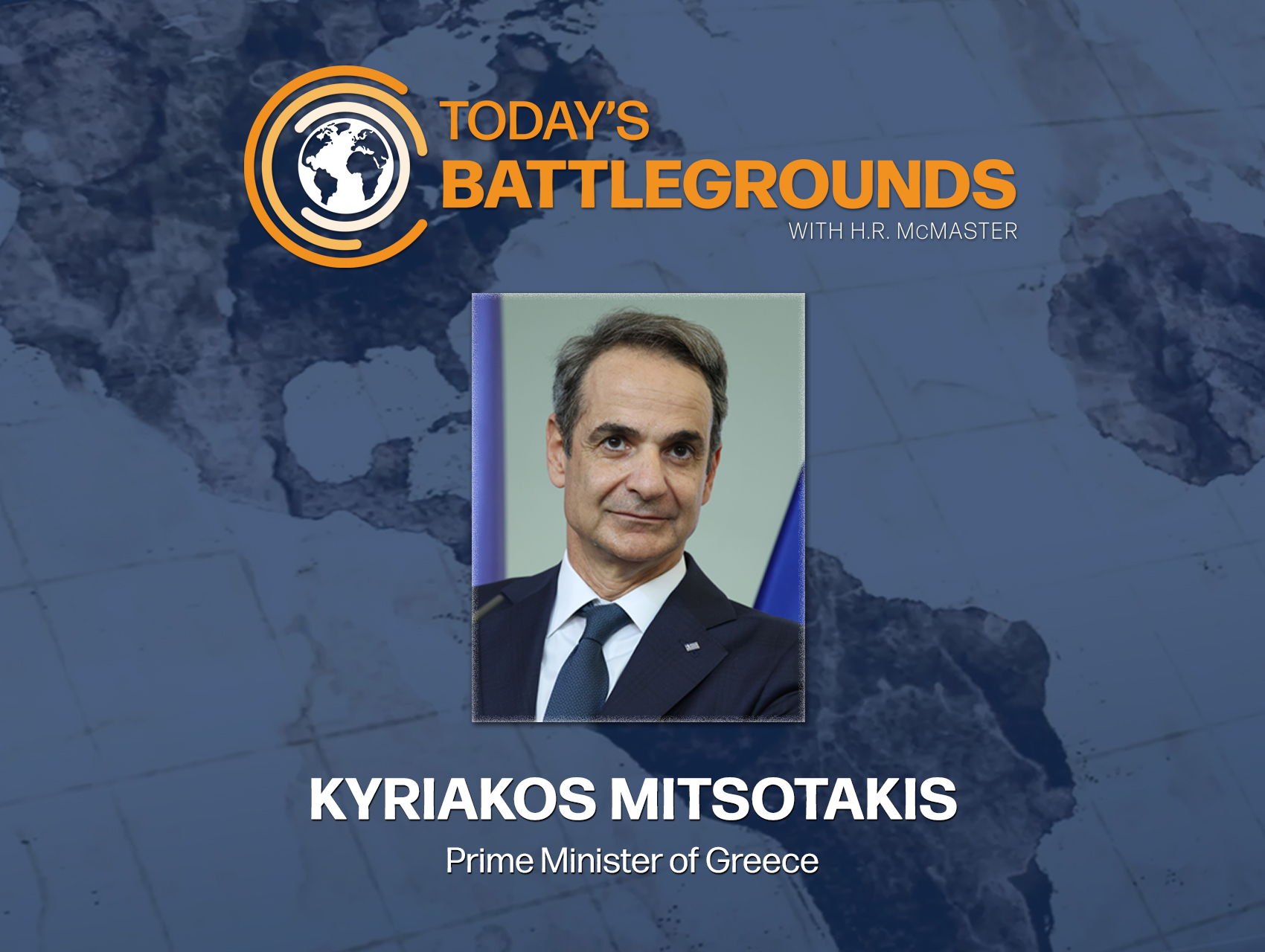
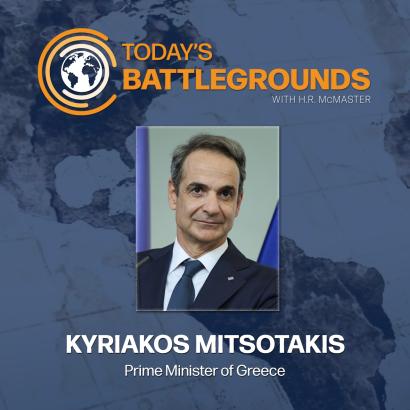
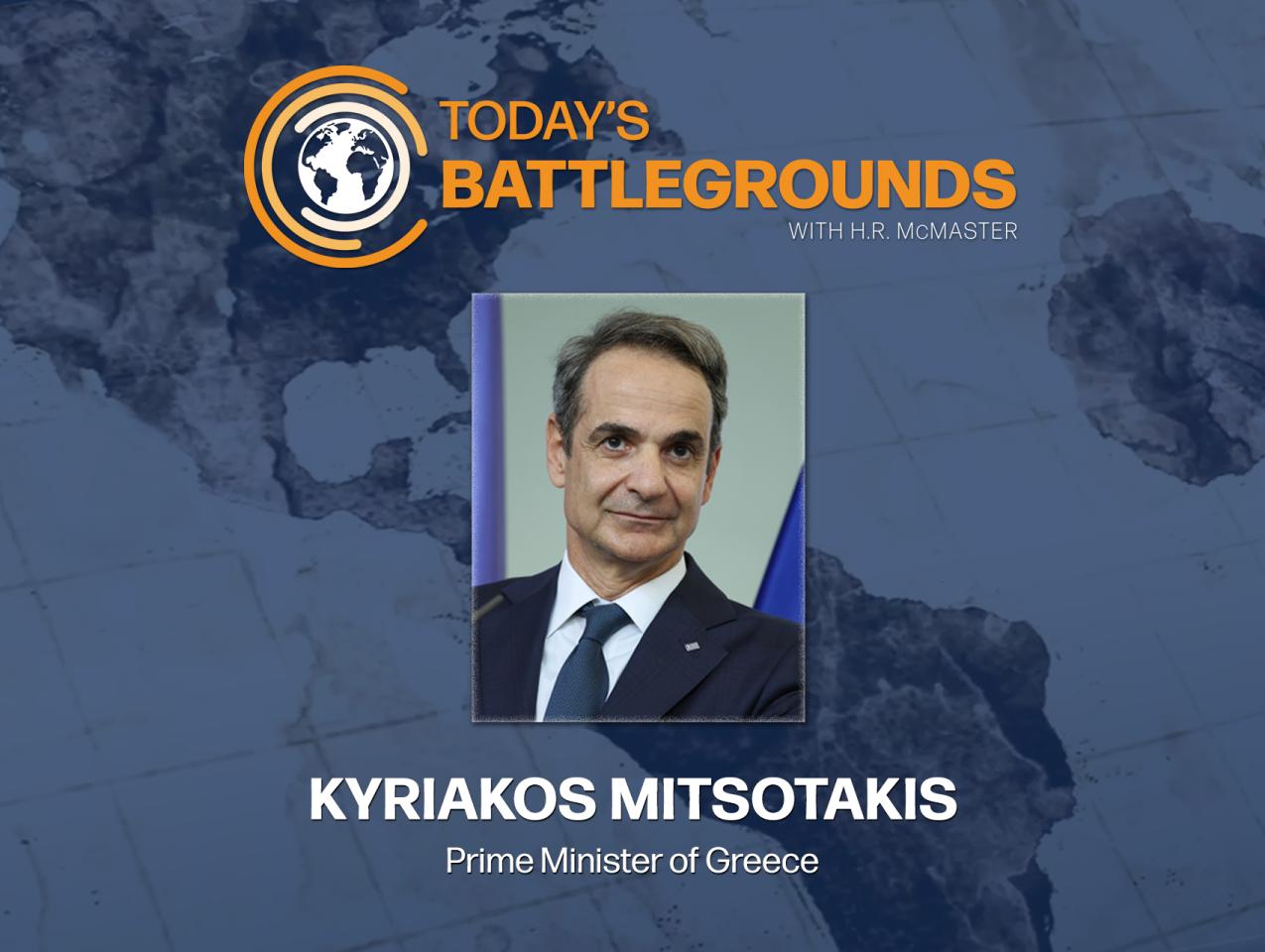
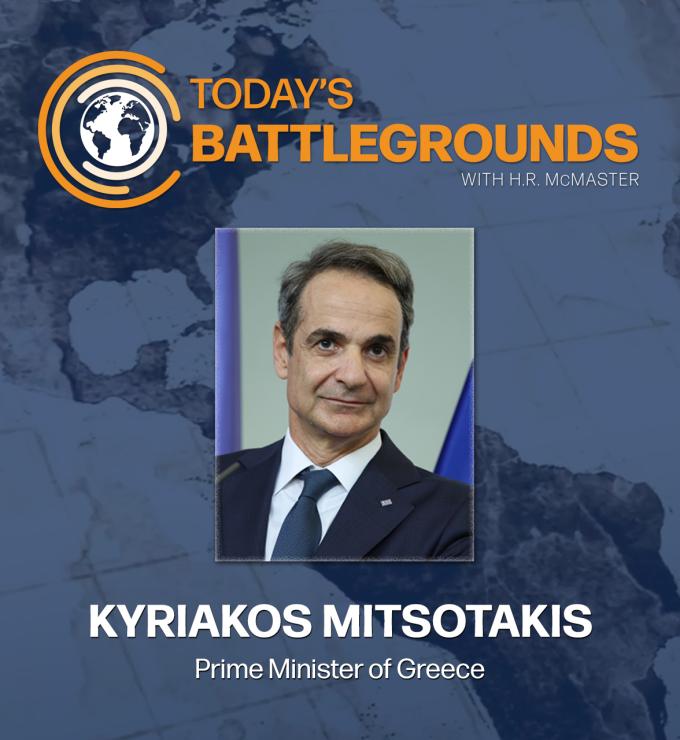
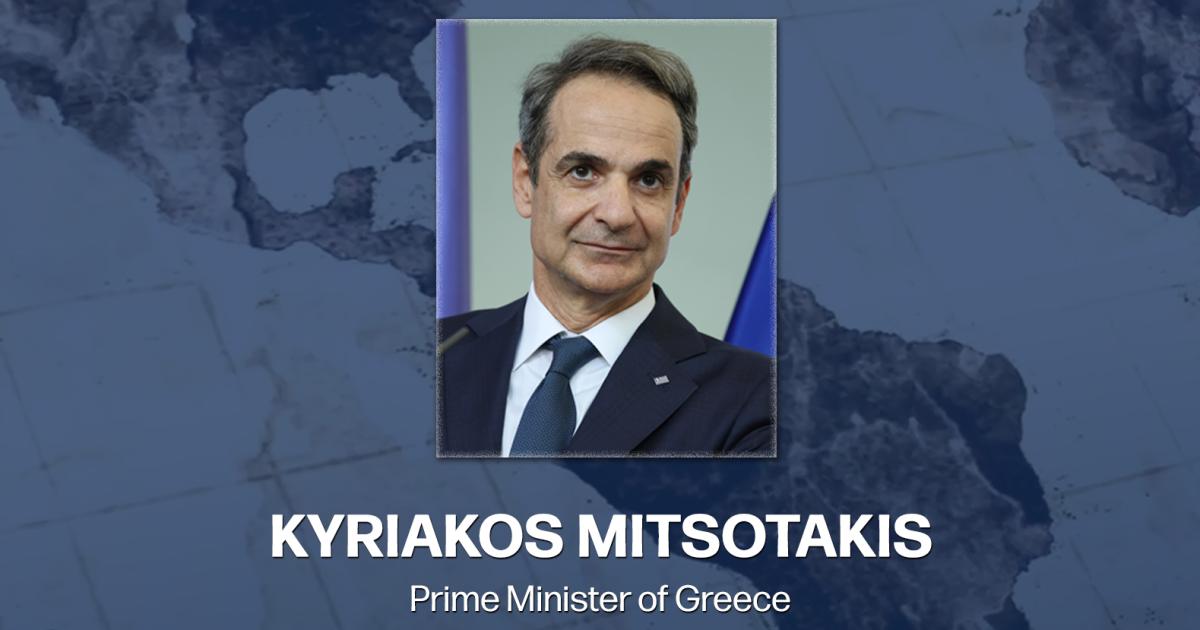
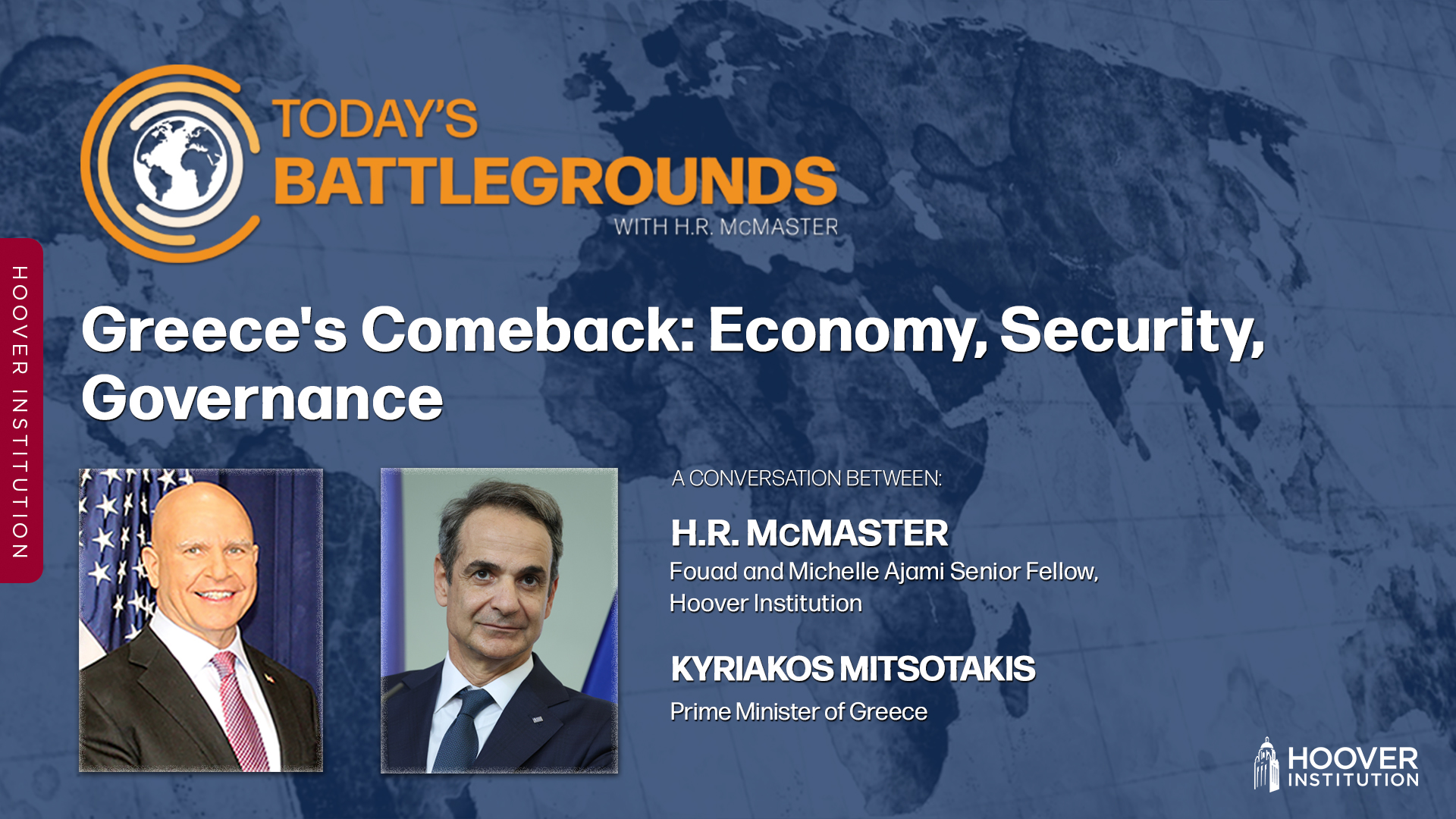
Join Kyriakos Mitsotakis, Prime Minister of Greece, and Hoover senior fellow H.R. McMaster as they discuss Greece’s economic resurgence, the country’s expanding role in international security, and the future of US-Greek cooperation.
Reflecting on the economic, security, and governance challenges reshaping Europe and the wider international order, Mitsotakis and McMaster discuss Greece’s efforts to modernize government, address migration and border security, and strengthen European competitiveness. They also examine transatlantic cooperation, Russia’s war against Ukraine and its implications for European security, instability in the Middle East, security challenges in the Eastern Mediterranean, and the evolving US-Greece partnership.
Recorded on June 9, 2026.
- Invasion of Ukraine by Russia was a reality check for all of us, especially for US Europeans. And the fundamental premise that you cannot change international borders by force. This was one of, you know, the, the lessons of World War ii. If this happens, you need to defend yourself, and you need to support the country that's defending itself. This is today's battlegrounds. Our discussions with leaders from around the world consider how history produced the present, and how we can work together to overcome obstacles, to progress, seize opportunities, and build a better tomorrow. On this episode of Today's Battlegrounds, our focus is on Greece, known formally as the Hellenic Republic. Our guest is Kos Mitsotakis, prime Minister of Greece and leader of the Center right new Democracy party. Prime Minister Mitsotakis earned degrees from Harvard and Stanford and worked in the private sector before entering public service in 2004. As a member of the Greek Parliament, since taking office in 2019, he has overseen Greece's recovery from the sovereign debt crisis and guided reforms that restored economic growth and investor confidence. Modern Greece is heir to a political and intellectual tradition that has shaped the world's since antiquity from the Democratic experiment in Athens to Thucydides. History of the Peloponnesian War and beyond, great contributions remain foundational to modern political and strategic thought. After centuries, under Roman Byzantine and Ottoman Rule, Greece won independence in 1832 and rebuilt a modern state on those ancient foundations. Greece's strategic relevance continues into the modern era. After the second World War, the country became one of the first arenas of the Cold War. And in 1947, the Truman Doctrine formalized a US partnership against communist expansion with American support, the Greek government prevailed in a civil war in which nearly 158,000 Greeks lost their lives. The partnership extended through Greece's NATO recession in 1952 and has endured for nearly eight decades. In the decades that followed, Greek democracy faced two major tests and rebuilt itself each time. In 1967, a military coup imposed a junta that ruled until 1974. Greeks ended the Junta, founded the third Hellenic Republic, and bound their country more closely to Europe through European community membership in 1981 and adoption of the Euro in 2001. Then in 2010, the sovereign debt crisis triggered the second reckoning as the Greek people. Nearly a decade of recession, austerity and political turmoil. Greece has staged a remarkable economic recovery while expanding its influence in the Mediterranean region and beyond. The naval base at Suda Bay on Crete supports NATO operations across the Mediterranean. Since Russia's invasion of Ukraine, the Port of Alex and Dr has become one of NATO's most important transit points for military equipment. Moving to Eastern Europe, Greece is building energy infrastructure to connect the Eastern Mediterranean and the Balkans to the rest of Europe, reducing the region's reliance on Russian energy, Greece's election to the UN Security Council for the 2025 2026 term marks. Its growing diplomatic weight in maritime security and regional affairs. We welcome Prime Minister Mitsotakis to discuss Greece's economic resurgence, the country's expanding role in international security and the future of US Greek cooperation. Prime Minister Kos AKAs, welcome to Today's Battlegrounds. Thank you for making time for me and our international audience. It's great to be with you. Well, thank you so much for having me, really looking forward to this discussion. Hey, I'd, I'd like to begin you logically, I guess, you know, in Greece and, and really the, the striking story of, of your prime ministership. I mean, since you've been there, you're almost, I guess seven years now and, and you have organized a, a fantastic recovery in the economy in a, in a recent interview in, in Bloomberg, you, you talked about that, you know, how Greece is, is producing a sustainable surplus. You're growing the economy and you're, you're, you're growing, you know, outpacing the, the rest of the Eurozone. And it's, it's been a, a fantastic turnaround. Could you maybe share with our viewers the biggest lessons you've learned over the course of this transformation effort and what advice you might have for other leaders who, who are facing situations like you are with kind of a, a debt crisis? It's been a fantastic turnaround. Congratulations, and, and, and we're anxious to hear how you did it. Well, first of all, thank you so much for your kind words. It certainly was a, a, a fascinating and rather bumpy journey as you pointed out. I've been in power now for seven years, and when the people, the Greek people first placed our trust in us back in 2000 and and 19, we inherited a situation where the reputation of the country was still to a great extent, tarnished by the big financial crisis. I should remind you of viewers that Greece during the second decade of the 21st century suffered the biggest decline in GDP in the history of any OECD country. Essentially, the country went bankrupt. We went through three stabilization programs, and our society paid a very, very heavy price back in 2015. We almost crashed out of the, out of the Euro zone. So my first mandate when I came into power was to return Greece to a sustainable growth path, while at the same time stabilizing our public finances and ensuring that Greece would never again be faced with a situation of significant macroeconomic imbalances. And indeed, if you look at our public finances now, seven years since we made our first commitment, it has, I think, been a very, very interesting story of fiscal discipline combined with a very, very healthy growth. If you look at our debt to GDP ratio, it has declined at the fastest pace in the history of any OECD country. By the end of 2026, we probably will no longer be the most indebted country in the, in, in the Eurozone. And for a country that has been plagued with, with high debt for many, many decades, I consider this power to be my most important legacy, not to inherit to the next generation an unsustainable degree of debt. Of course, you can only reduce your debt as a percentage of GDP if you produce primary surpluses and if you grow the economy significantly. And we've been able to, to do both. We've created more than close to 600,000 new jobs o over the past seven years. We brought down unemployment from 18% to 8%. When we first came into power investment as a percentage of TNP was at 11% when the European average was at 21%, we're now anywhere between 17 and 18%. So this has been an investment led growth that is bringing in both foreign investment, but also at the same kind mobilizing domestic investment. Of course, there's still a lot of work to be done. My main goal is through convergence with Europe when it comes to disposable income and GDP per capita. So we know that we need to continue to keep on growing the economy at a much faster pace than the rest of the Eurozone for the foreseeable future. But I think we've laid the foundations because unless you have fiscal discipline, eventually macroeconomic imbalances are gonna come back and by you and for me, restoring the credibility of the markets, ensuring that the capital markets place your trust in Greece, knowing that you have a competent government that is not going to succumb to populist temptations to return to a policy of unsustainable handouts, I think is very, very important. And probably a good lesson for other governments which are currently struggling with their own debt and deficit problems. There are quite a few countries in Europe now that are under supervision by the European Commission because they cannot bring their deficit under control. Thank God Greece is no longer one of them. Well, that applies to the United States as you, as you know, prime Minister Japan, others, I mean, and I think what you've done is I think, restored hope among many citizens that, hey, this can be done. And so I I, I also admire what you've done to take on the, the issues of government reform and to fight against clientelism corruption. You uncovered some fraudulent EU subsidies and, and other activities that were, that were also a, a drag, you know, on, on growth and, and productivity and diverting resources. And could you talk about how you took on that problem of, of corruption and clientele and self-dealing and so forth? First of all, I would, I journal the, the two are the certain extent connected. If you continue to sustain client holistic practices, the chances are that you will spend more than you actually have to, because essentially you are buying off votes using sort of unsustainable handouts. And I've never believed that this is a right way to do policy. So what we've done essentially is, is, is completely reformed the software of the government, establish a much stronger center of government at the office of the Prime Minister, make sure there is proper accountability when it comes to managing the efforts of the government and the coordination with all different ministries, you know, setting very clear annual targets, you know, have very, very clear reporting systems. All this may not sound like rocket science, but I can tell you that in the business of government, it is not always obvious that you can run a government using these sort of fundamental principles. At the same time, we went all in when it came to the digital transformation of the state. We were a digital laggard today, actually, we celebrated our six years since we implemented our www gov GR initiative. What is that? It's essentially the central portal for all government affairs. It has been a smashing success. It has allowed us to cut bureaucracy to allow people to interact with the state from their mobile phone. It has been truly, truly transformative. Not only because we respect people, we don't want them to wait in queues. We don't want them to sort of waste time dealing with the bureaucracy, but also because we manage to save a lot of money, but also uncover various sort of points of, of corruption, which are always hidden in complex bureaucratic processes. I remember during COVID, you know, visiting the states, you had these sort of handwritten vaccination sort of proof of vaccinations in, in, in Greece, everything was done digitally. We have a digital id. If you wanna book an appointment with any physician in Greece, you can do it through your my health app. So you just log in and you do it. It does help that we are not a federal state. We're a country of 10 million. So being able to run these initiatives from a centralized, from from the government center is actually something which is, which is doable. You mentioned the question of the agricultural subsidies. We've had, you know, perennial problems in terms of making sure that the right farmers receive the right amount of EU money. And it took us a lot of time to actually reform the system. And for the first time, I'm, I'm confident that we are moving in this direction. It's very, very complex. You're talking about hundreds of thousands of farmers that have to clear their arm plots of land. You have to register the true number of animals and goats that exist in, on all Greek mountains. And no one really bothered to look at the problem from a purely managerial point of view. But we, we did. Every transition is painful. Of course, in every transition there are people and every reform there are people who are gonna be unhappy because they're have been used to doing business in a certain way. But this has never been my by ma my mantra, you know, government is about change. It's about driving ambitious, an ambitious change agenda. And you know that every sort of big change is going to make some people unhappy. For example, one of the big successes of our second term has been going after tax evasion. Everyone would tell you that this cannot be done in this, I mean, with a perennial tax evasion problem, it's actually pretty common for many other southern European countries. You go to a taverna, you probably won't be issued a receipt giving the most simple example, well, this is no longer the case. We used a combination of sophisticated AI analytics, a lot of digital payment system. So we've tackled tax evasion. This is fair because whoever tax ADEs at the end of the day is free writing at the expense of those who are paying their taxes. But it also brought in a lot of money into the public budget. So it helped us with our primary surpluses. And at a time when we're faced with the big affordability crisis, being able to at least use some of this surplus to, to target those who are in greater need is, I would say, almost a luxury. Most European governments are forced to cut their budgets. Now. I at least have, you know, some money at my disposal. So it's a question of how I will distribute it in, in, in the most efficient way, always respecting social fairness. So we're in, not in, in a good position and we, we've proven that, you know, administrative reform and tackling what I call the deep state is something that can be done. Of course, there's still lots of battles to be, to be fought, but I think the overall culture and, and the attitude of Greek citizens towards the state has, has changed. I think there's a greater respect by the states towards citizens, because in the past, sort of, it was almost a given that you had to succumb to bureau, you had to play by its own rules. I think we turned the tape, someone said, no, we're gonna look at the citizens' problems, and if I can make the citizens' interaction with the state simpler, I should go outta my way to do it, because that's the way I respect, you know, taxpayer's money. Because at the end of the day, they're paying for the government. You know, minister, I've often heard you, you talk about the the false promise of, of populism and, and how important it's to be pragmatic. And, and I I think, you know, as people lose confidence in government, they're prone to these sort of, the, the, these sort of populous messages and, and false promises. You've been, you've, you've turned things around I think in terms of transparency, accountability, confidence in government. But among the problems you had, besides the debt issues and the, and the governance issues, you had the, the problem of mass migration and, and, and still do it in many ways centered on the ongoing war in Libya that's now, you know, decades old. And, and, and, and of course until recently, the, the serial episodes of mass fide and the Syrian Civil War and the, and the refugee crisis that, that created the, you know, the fall of Afghanistan to the Taliban. Could you maybe talk about the, the, this, the issue of mass migration and illegal immigration, because that's driving so much of the populism, a a across across Europe. I think you're right to point out that the big surge in right-wing populism in, in Europe is to a great extent driven by legal migration. And Europe was not open about the, the, the scale of the problem. We, from the very beginning of, of my term, took a very, I think, tough but fair approach when it came to migration to a certain extent. It was also a product of our own experiences back in March, 2020. We essentially were faced with an organized sort of attempt to weaponize migration and to send tens of thousands of desperate people across our border from Turkey, because that was the way Turkey at the time felt it could pressure the European Union. And we made it very clear that this is not gonna happen. So we used all means about disposal to protect our, our borders. At the time, Europe was primarily focused about what we call secondary migration. So what happens if someone enters the European Union, whether he should be in Greece, what happens if he comes to Germany? And I made it very clear to my European counterparts that unless we look at what we call the external dimension of migration, protecting our borders, making sure that it's not the smugglers who decide who enters the European Union, we will not be able to solve the problem of migration because we will simply be overwhelmed by numbers. So we, we protected our borders, we built a fence on our land border with, with Turkey. We supervised our maritime borders much more effectively. We've saved tens of thousands of people at sea. I wanna be very clear about that. No, this is an i important dimension of, of this, right? I mean, it's a, it's a humanitarian crisis as well. If you don't, It is also, but, but it's also very clear that my Coast Guard is not a welcoming for, for smugglers. So I will make it difficult for people to come into, into Greece, and I'm unapologetic about this. And if you're not entitled asylum, I will send you back. I will do whatever I can to send you back to your country of origin. Europe has changed its approach, and that's come much closer to this, to this, to this Greek position vis-a-vis migration. We now have a new European legislation, we're focusing on returns. We need to communicate to people who are not entitled asylum, that they should not try to come to Europe because we will do whatever we can to send you back. But of course, for those people who make it into Europe and who are entitled asylum, we will welcome them. And we've done so for tens of thousands of people. And if they want to choose to make Greece their home, we will welcome them. But this does not mean that we'll have an open border policy. At the same time, I think if you're tough on migration, on illegal migration, you should also be open about legal migration. So this is analogy of having sort of, you know, a big fence and a big door. I want a big fence for a legal migration, but I want a big door, which I control when it comes to legal migration. I mentioned before the figures regarding our employment numbers. We are already faced with employment shortages in the agricultural sector, in, in, in basic manufacturing, in services. So why not do bilateral mobility agreements with countries with whom we have a good relationship and bring in these people legally and safely, let them work in Greece, register them, have them pay their social security. It's a win-win proposition. But in order to do that, I need to, I need to sort of make sure that I, I tackle the problem of illegal migration. So I think we found a decent balance. Yes, we are always faced with challenges. For example, you mentioned Libya. We have a problem in Libya now. There's a new route that's sort of opening up from Eastern Libya to Crete. We're working with the Libyan counterparts. We offer them, for example, to train their coast guard. We wanna work with these countries. These people should not leave the Libyan shore because they're entering the, they're actually boarding boats, which are, I mean, completely, completely dangerous and certainly not seaworthy. So we want them not to leave the coast, or if they leave the Libyan coast, I want the Libyan Coast Guard to pick them up and return them to Libya. So we need to work with the countries of transit we're doing. So I'm still not happy with, with the, the results, but we will of course continue to, to address this challenge. But if I look at the overall numbers, they're significantly down compared to what they were, you know, some years ago. You know, you mentioned setting the example for the European Union on, on these, these changes to the, to the approach to, to illegal migration. And in another area is in the area of, of regulation. And I'm thinking of the druggie report on European competitiveness and, and how Europe does appear to be overregulated in a way that is stultifying economic growth and, and hindering Europe's ability to compete, especially in the area of, of new technologies associated with artificial intelligence, for example, and advanced manufacturing. Could you, could you share with our viewers your assessment of some of the changes the EU needs to make in the area of, of fostering economic growth and, and competitiveness? Well, first of all, I'm happy you mentioned the drug report. For those of you, for those of you of yours who don't know exactly what it is, it was a interesting document written by the ex Prime Minister, which basically highlights what Europe needs to be to become more competitive and points out to the fact that we've been essentially faced with a gradual but quite significant erosion in our competitiveness over the past 20, over the past 20 years. You mentioned overregulation. The truth is that we are clearly, we've clearly erred on the side of, of too much regulation when it comes to business environment. This is a big priority for the commission, essentially getting rid of unnecessary regulation. This is a big topic for us and for me, we have what we call the European single market. This is 27 member states. Theoretically, you can do business in all of those without any impediments in practice, it's not really happening. So let's look at how we can turn this market of almost 500 million customers into a true single market in the same way that you can do, you know, business between California and Nevada. And no one's gonna ask you for, for lots of, you know, sort of unnecessary paperwork. The same needs to be true if you wanna do business between Greece and Italy or Greece and Estonia. So for example, creating a, a new legal entity, what we call EU Inc registering a startup in any European country, and being able to operate seamlessly in all of the European countries would be a game changer for our, for our new tech companies energy. How can we be competitive in energy? It's a big factor of, of production, especially when it comes to manufacturing. Europe has a very strong tradition of high quality manufacturing, but it's been eroded not just by high energy, but also by issues of unfair competition, for example, massive imports from, from China. So all these issues are very much at the forefront of the European agenda. So if you think about, you know, Europe, what are our two priorities? It, the first is competitiveness, the second is defense. These are the two issues we're really focusing on as a European Union. And the topic which we will discuss at the next European Council, which will take place in, in a week from now, where we need to take some important decisions, not regarding the direction, I think the direction has been agreed. It's really the speed and the sense of urgency that we need to embrace to really move fast in, in a direction that we'll make Europe more competitive again. Because for example, look, we are big savers in Europe, but we're sending our savings to the US because we don't have what we call and investment union. We don't have, you know, capital markets union. If you want to list your company, you're much better off going to a Nasdaq rather than to any European stock exchange. These things need to to change because it's not just about public money or European money, it's also about mobilizing private capital. And unfortunately, you know, the smart money right now is not placing too many bets on, on Europe. And this is something that we, that needs to change. No prime minister, everything you're talking about here in terms of the importance of, you know, collective defense, you know, within Europe and, and nato energy security, growing our economies, countering Chinese economic aggression, you mentioned the overproduction and, and dumping of Chinese goods in, in a way that, that drives, you know, European and US and other firms out of business as just one form of economic aggression. This sounds like a, a positive agenda for the US and and Europe. And what kills me these days is how we're, we're, you know, we're, we're at each other in terms of, you know, gratuitous insults and, and tensions, which have been exacerbated, I think to a certain extent over, over the war with a, with i with Iran. Could you maybe outline your PO what your positive agenda would be for transatlantic relationship, which you're on the record of saying, Hey, I've, I'm a committed fan, you know, of the transatlantic relationship. Look, I studied in the us you know, I was just back at, at Harvard for my, you know, 30th, you know, HBS reunion. You know, I, I do believe that the transatlantic relationship has set, you know, the blueprint for, for a world, for a rules-based world order that not only provided stability and growth potential, but also worked well both for Europe and for the us. So I, I'm not one of those who discounts, you know, the relationship in spite of the current tur. I'm, I'm, I'm a realist, but I do believe that there are sort of win-win propositions, for example, when it comes to, to trade. There has been not a rebalancing as a result of the, you know, of, of the recent terrorists. But at the end of the day, we need to find more opportunities to, to train with each others, but also respect, you know, our, our respective rules. I do want the US tech companies to be active in Europe, but if Europe takes, for example, the protection of children and adolescents when it comes to access to social media, seriously, these companies need to respect that this is a priority for us when it comes to defense. You know, president Trump was right, and you know, something about defense to point out that Europe was essentially a free rider when it came to defense, not Greece, because little Greece always spent 2% of our GDPN defense because of our special circumstance when it comes to Turkey. But we are spending more on, on defense. And if Europe builds its own strategic autonomy, this is gonna be good for nato. The US shouldn't be threatened that. And yes, we will also develop our own domestic defense ecosystem, and if we spend more on defense, NATO as a whole is going to be strong. So I do believe that at the end of the day, there is a profound part that that ties us together. And when we look at also the big issues regarding global governance, I mean, the big challenges, you know, the benefits and costs of ai, AI at some point cannot be just, you know, a sort of a, a wild west of innovation without understanding that this is a technology that will have profound, you know, implications, which is unfortunately, I think the way the the US is, you know, is, is looking at it. So we'll continue to, to try to work with the US both as a European, but also as a Greek. We have a very strong bilateral partnership with the us which I respect that goes beyond a defense and, and, and security. And yes, and I I do also believe that when it comes to also issues such as, you know, managing China, especially the fact that China now has 30% of the world's, you know, manufacturing capacity and essentially the ability to destroy industries across the world globe and certainly in Europe, this is a topic that we need to take very, very seriously. We cannot just allow our industrial base to be completely annihilated simply because we're in search of always the cheapest product, especially when it comes to unfair trade practices. So there's a lot of sort of thought that needs to go into, into this. And I'm speaking here as as, as a European who's, you know, and I'm a free trader, you know, Greece is a shipping nation. We control, you know, 25% of the global merchant ships will live off shipping to a green extent. But free trade does not mean trade without any, any rules. And certainly establishing some sort of lead play field is, is, is important for trade to properly function. Well, prime minister, I I see this threat as, as, as based on really Chinese economic aggression, but this coalescing that we've seen in recent years of what I'll call an axis of aggressors, the two revist powers on the Eurasian land mass of Russia and China, who pulled into the fold, other, other authoritarian regimes. And we're talking on the day that Xi Jinping is, is, is visiting Pyongyang and North Korea has, has North Korean troops, 15,000 of them fighting on European soil and, and the kind of material support that we've seen China provide Russia and its onslaught against Ukraine, the, the support that China and and Russia provide to Iran in, in its, you know, long running wars against its Arab neighbors, Israel and the United States and others. So how do you see this axis of aggressors and, and what more could the United States and Europe do together and, and pulling in others into the effort to, to prevent these cascading crises from, from cascading further to what more can be done to restore peace at this moment? Well, first of all, I think the, the Ukraine war, the, the UK Ukraine, the invasion of Ukraine by Russia, I think was a watershed moment for Europe war return to the European continent. We thought that this would ever happen. For those of us least who grew up, you know, with the fall of the Berlin Wall, it seemed completely inconceivable that we would ever be faced with a war that is, I mean, it's, it's longer than World War I and with a huge number of, of, of casualty. So it was a reality check for all of us, especially for us Europeans. And the fundamental premise that you cannot change international borders by force. This was one of, you know, the, the lessons of World War ii, and that if this happens, you need to defend yourself and you need to support the country that's defending itself. Mono Russia. And we did that in, in, in Europe, and of course the US also did so, and, and rightly a and rightly so, because at the end of the, at the end of the day, we don't want to return to an environment where Mike makes right, and we're just, you know, the strong do as they, as they wish, and the weak succumb to the wishes of the, of the strong. So the fact that Ukraine is currently in a position to defend itself has developed completely innovative, you know, technologies with a lot of European support, both military and, and financial, I think is a, is an important statement to any aggressor. And in, in that sense, Ukraine has put itself at least in a position to be able to make it very clear that this war has, you know, a big cost for Putin. And the more he continues, the bigger the cost, because it doesn't seem to me that there's any real progress on the, on the, on the, on the military front. So I think this was an important precedent, and again, it forced us in Europe to take our security seriously. And when I speak about security general, it's not just Ukraine, it's, you know, the, it's the Middle East, it's Africa. We are in the southeastern corner of Europe. We are very concerned with what's happening in the, in the Middle East. If there's a crisis in Sudan, which there is, if there's a war done, a humanitarian crisis, inevitably it'll spill over into Europe through migratory flows. So becoming more, I would say, pragmatic and, and, and, and more realistic about the fact that we live in a complicated world and developing our own capabilities to even deploy hard power if necessary. I think it's an important stepping stone for Europe, for example, we have ships in the Red Sea protecting the seas against, through the attacks. Greece has a ship fit. These are the sort of initiatives that we should be able to, to support if ever there is, and hopefully there will be soon some sort of solution when it comes to uz. And if there's a need for a peacekeeping, not a peacemaking, a peacekeeping force, we should be able to step up. If our Arab, and I think, again, as a European, if our Arab friends are attacked, we should be able to support them materially support, not just say nice words, being able to really step up and say, okay, we, we stand by you. Because at the end of the day, this is not just a question of principle, this is also in our self-interest to do so. So I'm really pushing Europe to take insecurity more seriously. This will require committing more resources, and it should not just be national budgets. It could also be European money that could be directed towards projects of common interests. Security is the quintessential common good. So if there are European projects of security, of common security that make us all safer, they could be funded by the European budget. I, I would say, I should say they should be funded by the European budget. Well, premise. We've, we've already talked about a lot of really complex challenges to, to your security and prosperity, but we haven't talked very much about a, a pretty big one, which which has to do with Greek Turkish relations and, and, and, and the contested, I guess, arena of the Adrian Gian and the, and the Eastern Mediterranean. And, and, and this sort of approach that turkey's taken for a long time with this Blue Homeland doctrine, that, that they have expanded maritime jurisdiction across much of the Ian and, and Eastern Mediterranean. And, and, and tensions have been on the rise. I mean, I think initially, you know, as you came in as prime Minister, there was a bit of a, i i, I wanna call it Deante between Turkey and Greece, but it seems like tensions are rising. Could you maybe share with our viewers how you're, you're balancing engagement with Ira at this time over issues like sovereignty and the gian and, and, and, you know, what is your perspective on medi Mediterranean security regime and, and, and what should it look like? Well, Greek Turkish relations have always been complex, and I'm, I'm looking to a, i I would say a functioning and why not a constructive relationship with Turkey? We're destined by our geography to live by side by side. This is not, this is never going to change. You know, having said that, it is true that Turkey over the past decade has become a revisionist power when it comes to its projection of its sea ambitions in particular. And this is something that sort of collides with international law. So all I've said is very, very, very clear that, you know, greece's sovereignty and sovereignty rights will never be challenged. And our, and our sovereignty and sovereignty rights emerged from international law and from international treaties. And these cannot be questioned and should not be questioned under any circumstance. We have one big, big difference with Turkey, which is the limitation of maritime zones in Vigee and the Eastern Mediterranean. If Turkey has, you know, other claims we don't recognize, they're completely unfounded. And no Greek prime minister would ever be willing to enter any discussion or any negotiation regarding these claims. I've made these points very clear to President Erler with whom I have a functioning, and I would say good relationship. I've seen him, met him many times. And I'd say that over the past two to three years, there has been a reasonable detant. You know, we see spikes sometimes of activity and rhetoric. We saw one, you know, over the past month. I hope that, you know, it can again be contained, but I'm also not naive. I will strengthen my armed forces. I've done so systematically, they're probably in the best position that they've ever been. We need a strong deterrents capability. We need to invest in qualitative superiority wherever we can. And of course, we need strong alliances, not just we're members of the European Union. There is a mutual assistance clause in the European Union treaties, which I want to opera, rationalize, and make it, make it real, not just something we talk about. Theoretically. We have a very strong partnership with Israel. We have strong partnerships with the Gulf countries, so strong economy, strong defense, and strong alliances, but at the same time, functioning a willingness to engage with Turkey, but setting very, very clear red lives in terms of what can be discussed and what cannot be discussed, seems to me to be the right approach in managing Turkey. Minister, I'd like to talk with you a little bit more too about the, the US Greek relationship. I mean, you know, it's quite strong as you know, there, there is a, there is a, a fantastic Greek American community here at the United States, and, and, and, and these, these kinship ties lead, I think, to really deep affection between our, our countries. I see our bilateral relationship strengthening from a defense perspective, what's, what's your, what is your agenda for, for US Greece relations go going forward here? I think the relationship has never been stronger. And again, this is a, I think I believe a relationship that transcends governments and administrations, because at the end of the day, it, it's, it's founded on I think two pillars. The one you mentioned. I mean, there's an amazing Greek American community, which is an national bridge between our two countries. And the second is, you know, common security interests, especially when it comes to the, to the Eastern Mediterranean. And that is why Greece has lots of friends across the aisle in the US Congress. And this is a sort of a bipartisan approach, which is not just shared by, by the administration. And really, and we, and we can, and we, and we, we will do more. For example, you know, I mentioned shipping. If the US wants to export more LNG, which is a big, you know, priority for the, for the current government, and Europe wants to buy LNG, who's gonna transport this LNG again, 25% of the global LNG ships are owned by Greeks. So this gives us levered, if the US wants to import a natural gas into Europe, why not use Greece as an entry point? We've done, so we have this concept of the vertical corridor supplying our northern neighbors and going up to Ukraine. So if you want to build sort of, you wanna focus on iMac, this notion that there's a connection between India, know the Middle East and Europe, Greece, just look at the map. It's your natural entry point when it comes to continental Europe, even when it comes to just she business opportunities, I mean, we're open for business and there's lots of, you know, in interesting investment opportunities for the, for, you know, for American capital to invest in Greece. So this is a, it's a very broad relationship, I would say that goes beyond security and defense. But I do want to focus on the, on the Greek American community, because for the first time we gave the right to vote, you can actually vote by, by mail, which is didn't happen in Greece. It was done, actually, it's done for the first time in the next election. So we also want the Greeks have a right to vote to participate in our elections. They will be able to do so for the first time in the upcoming 2027 elections. And of course, historically, I mean, you'll be celebrating your 250th sort of commemoration of Declaration of Independence, but just look at, you know, how much the founding fathers was, were influenced by, you know, ancient Greece, and by how much, you know, I have this book right here, prime Minister, that I've been reading The Pursuit of Happiness, which, which, which show? Yeah. Oh, I Should, I should, I should read this. Who, who has written it? Let me, Let Me See. It's, it's Jeffrey Rose's a fantastic book. The sub, the subtitle is how classical writers on virtue inspired the lives of the founders and Defined America. So right on topic, Well, there you have it. There you have it. But then of course our, our founding fathers were inspired by the, by by Your Independence fellow back in 1821 when we fought for our own independence. And it's interesting that our founding fathers were actually communicating. There is, there are letters sent between Jefferson and man who was our intel, sort of that intellectual brainchild behind, you know, Greek independence. So it's a fascinating story. And of course we, we fought together on, you know, numerous times on, you know, two wars. You know, the America was to help with our reconstruction after the Second World War when Greece was ravaged by, also by a civil war. So these are very strong ties and we need to speak about them openly and, and, and leverage them Absolutely. And celebrate them. You've been so generous with your time. I have, I have one last question I'd like to ask you. Could you share with our viewers it what drew you to service and maybe a bit about your philosophy of leadership. I've heard you speak about, you said it one time, I think there, I think you said there's a big advantage in people underestimating you. And, and, and you've also talked about, you know, you, you, the need for a leader to be a unifier, to have what we call a a broad church, you know, that, that you're leading. But I know our viewers would, would benefit tremendously from hearing what drew you to service and your philosophy of, of leadership. Well, my path was essentially, you know, rather bumpy in the sense that I come from a political family. My father was, you know, prime minister. I was always fascinated by public service. But at some point, rather disappointed by the fact that my father lost an election, I decided that I wanted to pursue a career in the, in the private service. And for almost a decade, didn't want to hear anything about politics. So I cut my teeth in business and in venture capital. It was a fascinating lesson also for me. At some point, I, I realized that, you know, sitting on the fence and just expressing views about how your country can change, it's not a very constructive approach. So, you know, I did take the, the planter at some point, you know, I decided against the odds, I was a complete outsider to run for leader of my party. I ended up winning and ended up winning, you know, three national, two national elections. So a lot of people, you know, changed my party, made it more of a big 10 party, making it very clear that I am a modernizer and I will seek change rather than continuity. And I'm still so fascinated when I sometimes look back, it's been a, you know, a, a a, a long journey. Time does fly when you are in this, in this job. But, you know, the energy is there to continue because you know that it's actually quite easy to, to backtrack as a country. So I will be running for a third term and there are no term limits in Greece. And usually there are no term limits in parliamentary systems. So what I do want to run for a third term, because I still think there's work to be done. And because I wanna make sure that the changes will put in place are gonna be irreversible. We've, as I've told you, we've sacrificed a lot as a country. We've made great progress, but there's still issues. We are still faced with a big affordability issue as we speak today. There's still people who are struggling, lots of reforms to implement. You need to be comfortable with the fact that, you know, there's so many problems you have to deal with, you need to prioritize. But I think we've got the big, I think we've got the big things right in Greece, strengthen the economy, strengthen our defense, you know, digitize the state. These are important reforms that we can, that, that we can build upon. So every, I'd say every leadership story is, is, is different, but I think that what, what unifies them is sort of a profound need, that sort of desire that you can make a change and, you know, basically accept the, the burden of responsibility with grace because you have to be responsible and you have to take decisions. Our job is, I mean, our job is to take decisions on a daily basis, 10 of decisions, EE every day. So you not wanna get them all right, that's for sure. But the one thing you cannot afford is not to take decisions in our job. Well, yeah, I, I can't thank you enough for being with us. I'd like to give you just any final word, any last message you would have for, for our viewers. Well, thank you so much for offering me the, the, the opportunity. I'm a big fan of your podcast, so I hope that your, your viewers enjoy this. Well, prime Minister AKAs, I cannot thank you enough for joining us on today's Battlegrounds. And I wanna thank you for your, your steady and strong leadership and support of Greeks democracy, the US Greek partnership, and I, I really do think your modeling the kind of leadership we need to bring people together, reverse some of this, this kind of polarization we've seen in, in, in our political worlds these days. So thank you for joining us. It's been a real pleasure. Thank you so much. Take Care. Battlegrounds is a production of the Hoover Institution, where we generate and promote ideas advancing freedom. For more information about our work, to hear more of our podcasts or view our video content, please visit hoover.org.
ABOUT THE SPEAKERS
Kyriakos Mitsotakis serves as Prime Minister of Greece and leader of the center-right New Democracy party. Prime Minister Mitsotakis earned degrees from Harvard and Stanford and worked in the private sector before entering public service in 2004 as a member of the Greek parliament. Since taking office in 2019, he has overseen Greece’s recovery from the sovereign debt crisis and guided reforms that restored economic growth and investor confidence.

H.R. McMaster is the host of Today's Battlegrounds. He is the Fouad and Michelle Ajami Senior Fellow at the Hoover Institution, Stanford University. He is also the Bernard and Susan Liautaud Fellow at the Freeman Spogli Institute and lecturer at Stanford University’s Graduate School of Business. He was the 25th assistant to the president for National Security Affairs. Upon graduation from the United States Military Academy in 1984, McMaster served as a commissioned officer in the United States Army for thirty-four years before retiring as a Lieutenant General in June 2018.
ABOUT THE SERIES
Each episode features H.R. McMaster, in a one-on-one conversation with a senior foreign government leader to allow Americans and partners abroad to understand how the past produced the present and how we might work together to secure a peaceful and prosperous future. “Listening and learning from those who have deep knowledge of our most crucial challenges is the first step in crafting the policies we need to secure peace and prosperity for future generations.”