






- Economics
- History
- Politics, Institutions, and Public Opinion
- US
- Answering Challenges to Advanced Economies
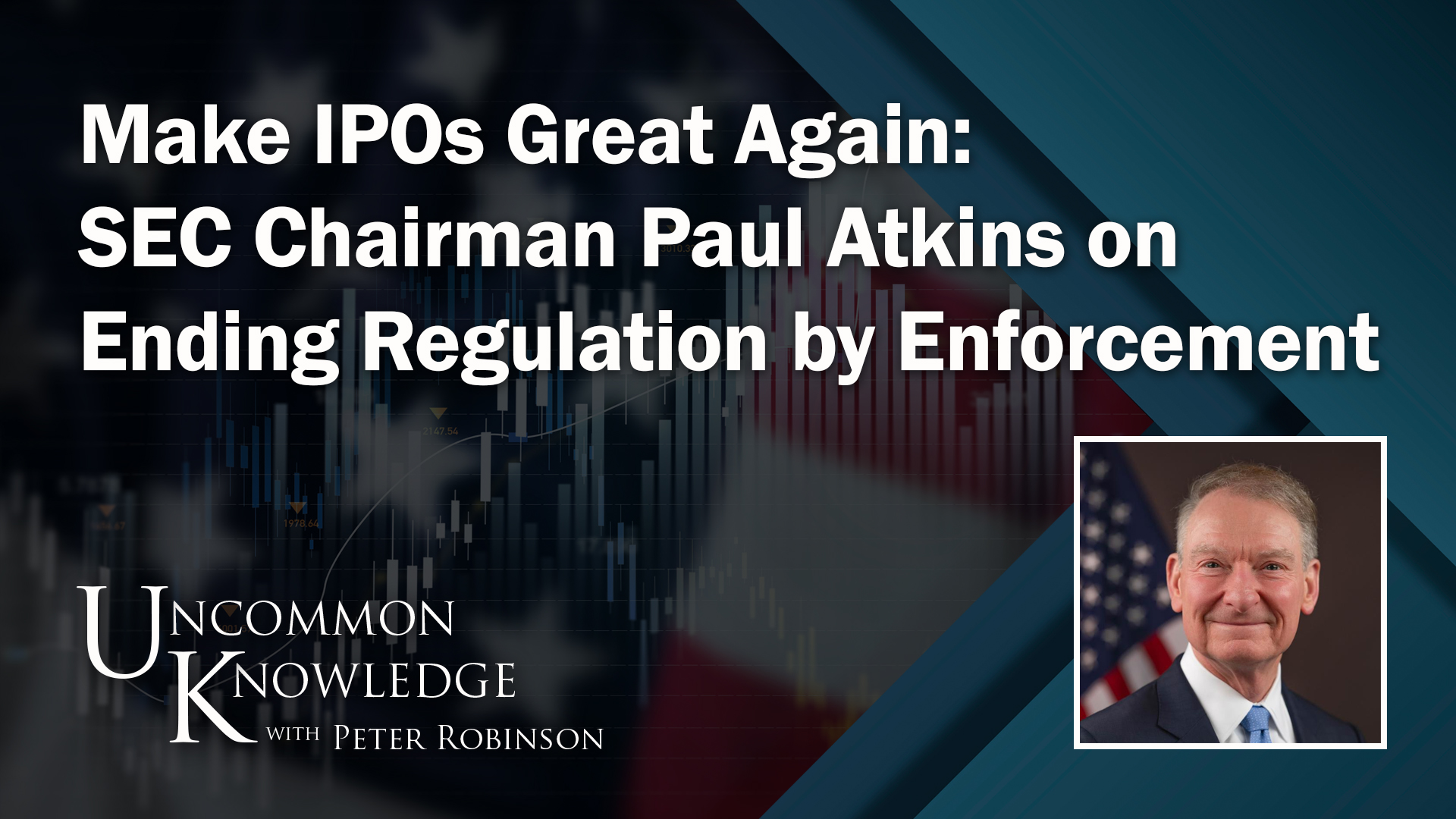
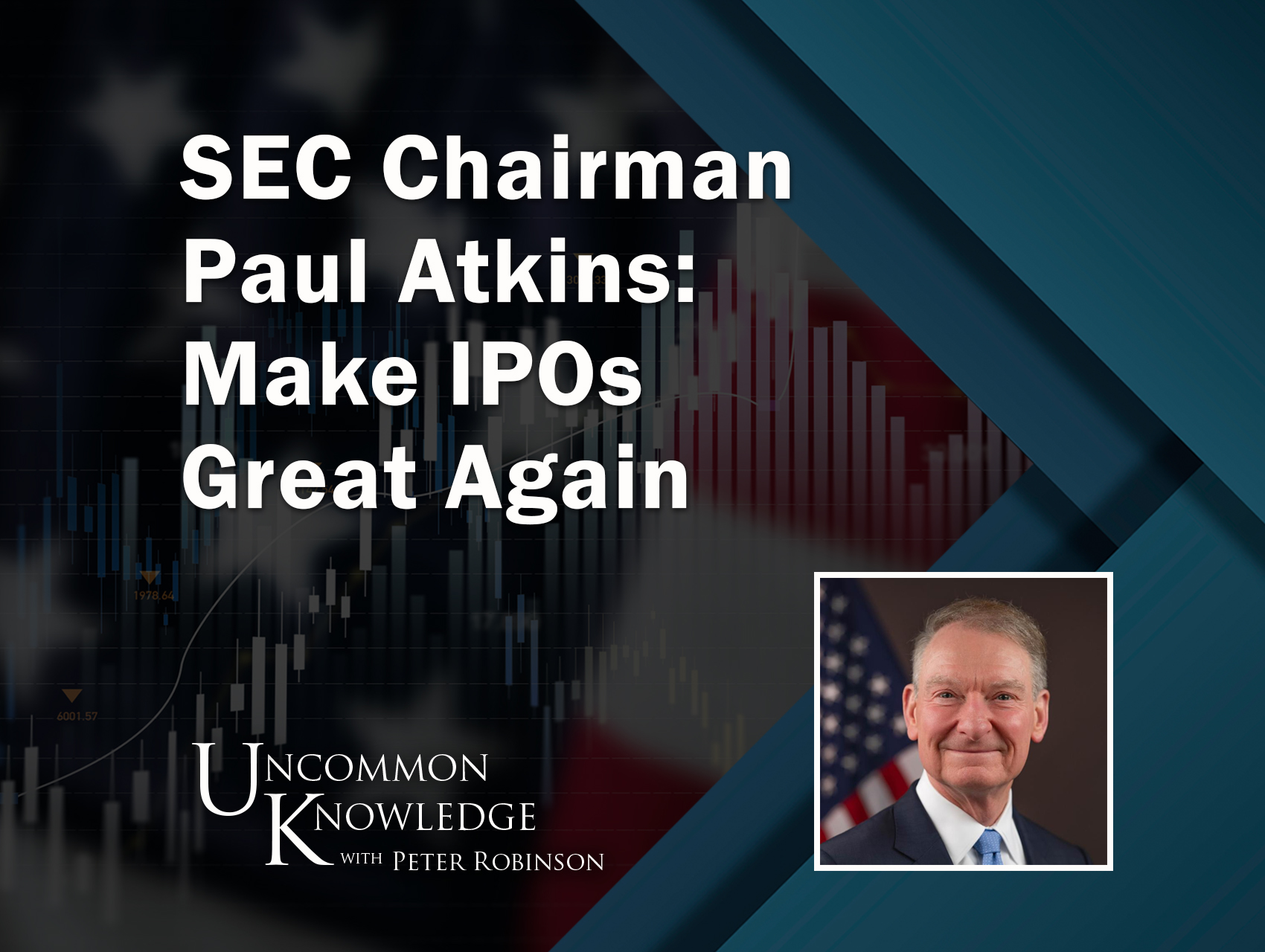
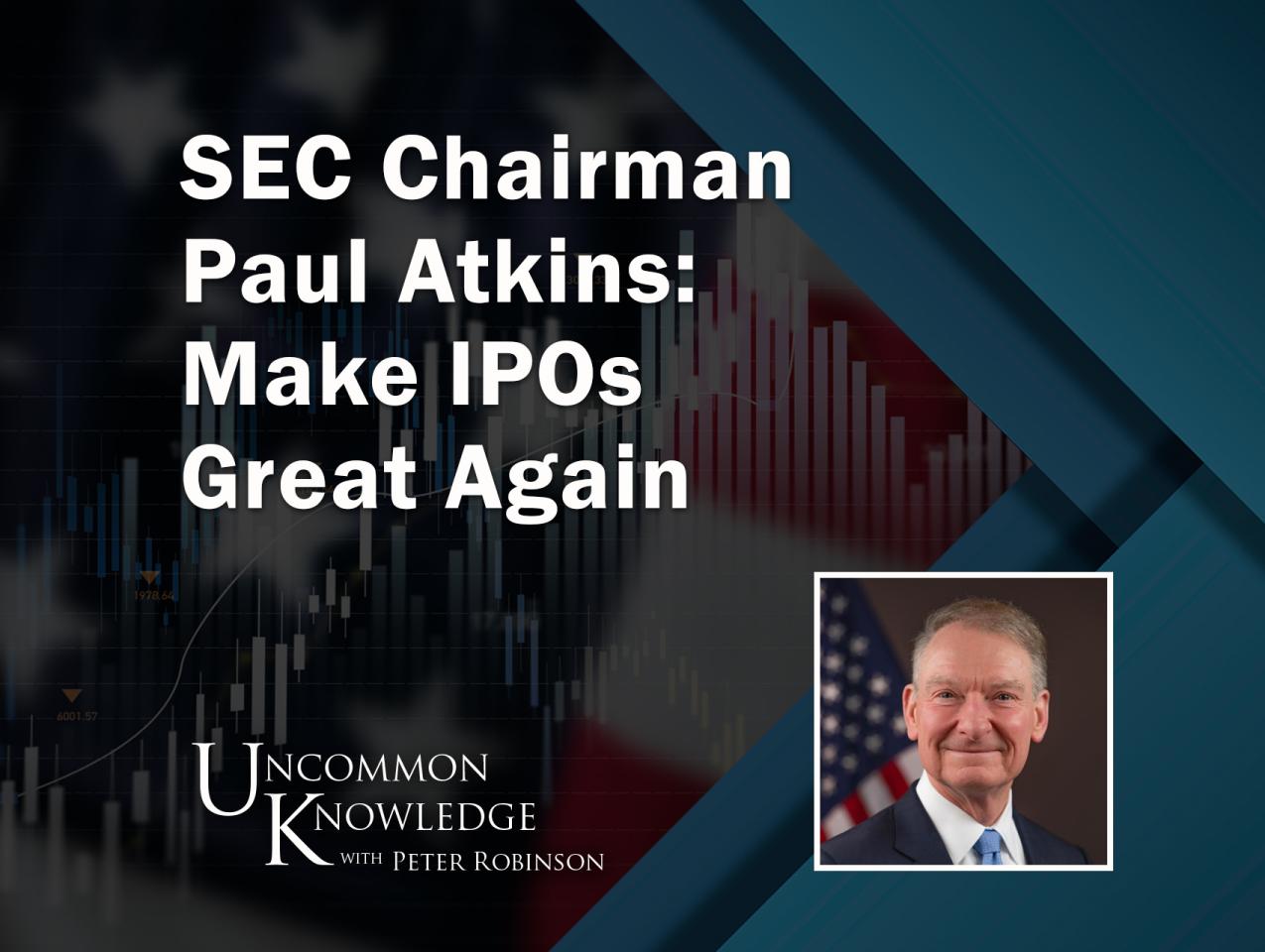
"America was an investment before it was a nation." That idea anchors this conversation between SEC Chairman Paul Atkins and Peter Robinson. Atkins argues that vibrant capital markets are essential to American prosperity and explains why he believes excessive regulation has discouraged companies from going public and innovators from building in the United States. The discussion also covers crypto, disclosure rules, investor protection, and the role of free markets in driving economic growth.
- With 4% of the world's population, the United States accounts for more than half the world's capital. The man responsible for overseeing much of our capital markets, Paul Atkins, chairman of the Securities and Exchange Commission on "Uncommon Knowledge" now. Welcome to "Uncommon Knowledge," I'm Peter Robinson. The Securities and Exchange Commission has played a big role in the life of my guest, Paul Atkins. In the 1990s, he served as chief of staff to then SEC Chairman Richard Breeden, and then as counselor to the next SEC chairman, Arthur Levitt. In the early 2000s, he served as an SEC commissioner, and then last year, President Trump nominated Paul Atkins to become chairman of the SEC himself. Mr. Atkins was sworn in on April 21st. Mr. Atkins holds his law degree from Vanderbilt, and I suppose I should note that he and I have been friends since his first stint at the SEC when I worked briefly at the institution myself. Paul Atkins, chairman of the Securities and Exchange Commission, thanks for joining us.
- Well, thank you, Peter, thanks for having me on your show.
- A few questions about what the heck the SEC is in the first place. Founded in 1934, the Securities and Exchange Commission now has an annual budget of some $2 billion and a staff of more than 4,000. The ultimate authority at the agency, a commission of five people divided by statute, three to two, between the two parties. Why was the SEC founded in the first place and what does it do today?
- Well, the history of it goes back to the other 20s, the 1920s, not the 2020s. In 1929 there was a big stock market crash. And so out of that came a whole series of hearings in Congress, the Pecora Hearings they were called, named after a New York politician. And so ultimately it was decided to set up an institution to regulate the capital markets, markets and especially the exchanges, New York Stock Exchange. There had been stories of inside dealing and other shenanigans in the 1920s.
- It was part of the New Deal institution, was it not?
- Yes, very much so, yes.
- And we're talking to a conservative Republican as chairman. I will come back to that, but so what does the SEC do today?
- Well, it looks after the capital market. So it looks after the stock exchanges, broker dealers, investment advisors, and mutual funds, and other collective funds, exchange traded funds, that sort of thing, as well as credit rating agencies. I mean, there are whole, public accounting firms via another organization that was established back in the early 2000s called the Public Company Accounting Oversight Board. So, I mean, the SEC looking at the whole kit and caboodle there, one could say, of the institutions that affect our equity and debt market.
- Right, but not bonds.
- No, no, debt markets.
- I'm sorry, the debt markets, okay. So can you, we'll come back to this question in a little more detail when I ask you about crypto, but what is a security in the first place again? I'm asking questions the layman would ask because our producer told me I had to.
- Okay, all right. Well, a security is defined in the securities laws as being, basically it has a whole list of stocks and bonds and other things, including what's called investment contracts. But the securities laws didn't define what an investment contract is. So that was left for the Supreme Court, which was presented with a case in 1946, called SEC versus Howie. Mr. Howie had an orange grove down in Florida. And so I guess a lot of northerners came down there to visit and they fell in love with it and wanted to invest in it. And so Mr. Howie sold interests in the Orange Grove. So, but he tried to structure it so that it wouldn't be a security and wouldn't be an investment contract, I guess, is what they were trying to achieve. And the SEC won the case, because the Supreme Court said, "No, this is actually an investment contract because of the promises that go around what he had made to people in order to send them their dividends that came from the common enterprise that Mr. Howie did." And there was an expectation of profit on the investor's side, and there were promises made as to how the profit would be gained. And so that now is still germane, this 1946 case about oranges. You mentioned crypto, it's still germane today. It's still the law of the land, and it governs what an investment contract is, and that's a security under law.
- All right, we'll come to that in a little more detail when we talk about crypto. The governance of the SEC, on a scale of one to 10, let me ask you about your job as chairman, where one represents King Charles, who's a pure figurehead, and 10 represents Xi Jinping, who's a dictator, where does the chairman of the SEC fall?
- Oh, somewhere in between. Maybe, well, closer to, let's not, closer to being a ruler of the roost. Because when the SEC started back in 1934, you mentioned the commission of five commissioners. So back then they really decided everything, like who the new clerk in the mail room would be or whatever, and opening hours of the commission and all sorts of things. Now things are much more complicated. We have 4,100 people, and as you mentioned around a $2 billion a year of budget. And so in 1950 after World War II and after the New Deal, at the end of the Truman administration, there was a big reorg drive by Congress and administration to reorganize the various government agencies to make them more efficient was the goal. And so the Fed is kind of similar to the SEC in this way, where the chairman really has control over the budget and over HR, the human resources. And then the commissioners, just like the board members of the Fed, are the ones who, they vote on rules and policies.
- But the policy agenda is yours. Generally speaking, isn't that the chairman who puts things forward to the commission?
- Yes, so I'll just stick with, I won't talk about any other agency now, but yes. With respect to the SEC, the chairman puts forth, before the commission, proposals regarding rules or policies or enforcement actions that the commission takes against private citizens or registered entities and things like that. And the commissioners vote on that. And so as you averted at the beginning, there are five commissioners under the statute, and no more than three of which can be of the party of the president.
- Now, I may be out of date on this, but at the moment it's you and two Republican commissioners.
- Yes.
- And two other seats, presumably both of which would go to Democrats, are now vacant. Is that correct?
- Yes, the last person who held one of the seats termed out, meaning her term had come to an end, and one can hold over up to a year and a half, and so at the end of '24 was when she left.
- So it's now three Republicans running the operation. Delights me, I must say, but presumably over the longer term, that's going to raise questions about policies that you enact and so forth. So how do those two remaining seats get filled?
- Well, it's up to the president, well, it's a little complicated, and can be done different ways, but the way that it's been done since, I don't know, sometime certainly under Clinton, and maybe under George HW Bush.
- Two decades.
- That for the minority commissioners of these independent agencies, the president would take a nomination from the head of the party of the minority party in the Senate.
- So we're waiting for Chuck Schumer to nominate a couple?
- It would be he, right. And I do have to, I just realized I made a mistake earlier when I talked about Caroline Crenshaw, who was the last commissioner to term out. Her term came to an end at the end of 25, not 24.
- [Peter] I see.
- And then so now Hester Peirce is one of the commissioners, and she also used to be a counsel of mine, as was the other commissioner, Mark Uyeda, back when I was a commissioner. But Hester's done a wonderful job, but her term ended last year in June. And so she has to leave by the end of this this year.
- All right, so there's some turnover, but you continue to operate while you wait for these.
- [Paul] Yes.
- [Peter] All right.
- And the commission has had, it's waxed and waned over the years.
- [Peter] This is not unusual.
- In Bill Clinton, his term, for a while there were only two commissioners, Arthur Levitt and Steve Wallman, and they were both Democrats. And so anyway, so things have, this is kind of a normal type of thing.
- Sort of a last overall question. Your friend and hero, Milton Friedman, whom I know we had dinner with Milton many, many years ago.
- He was a wonderful fellow. He and Rose were just so charming and smart and great.
- Here's a quotation from Milton. "Many people want the government to protect the consumer." That's the idea behind the SEC all those years ago when it was founded. "A much more urgent problem is to protect the consumer from the government." So Paul, here you are, a Republican. You've devoted yourself in one way or another to free markets. How do you handle the libertarian argument that really, in a perfect world, the SEC wouldn't even exist?
- Well it's funny. I remember when I first met Milton in San Francisco and knocked on the door of his apartment up there, maybe it was Russian Hill, I think. I can't remember exactly where it was. And so I opened the door and I said, "Oh, hello Dr. Friedman, Paul Atkins." And so he said, "You probably know what I think about your agency or what should happen to it." Something like that. And so but we had a very nice chat, but there really is a need for an agency, I think, like the SEC. You can argue about how it's constituted, or the rules, and that sort of thing. But the capital markets are pretty complex. And then just to have a random assistant US attorney at the Justice Department kind of do enforcement actions with respect to the capital markets and that sort of thing would be, I think, a tough thing to happen. So to have the idea of an expert agency that can, because there are bad people, obviously, who are in the capital markets, and who do things, they lie, cheat, and steal. And so I think it is important to have a rule of law, an enforcement of contract, and obviously that's the thing that drives the United States economy and drives our capital markets, and makes it actually the envy of the world where people, I think do think it's well policed. So that's.
- Could I flip the argument on you? So on the one hand, we had our old hero, Milton Friedman, who, in a perfect world, the SEC would not exist. The argument could be flipped right on its head and saying, given the size and complexity of our capital markets, I looked, as far as I can tell, our stock exchanges handle five to six times more capital every day than China's, which are the next largest in the world. That given the trillions of dollars in wealth, and the complexity of the laws, and the complexity of the trading systems, 4,100 employees and $2 billion a year is much too small an agency. This is like having one California highway patrolman on all of Route 101. How do you handle that argument?
- Well I don't think you need to have a cop at every street corner either.
- [Peter] All right.
- Okay, and there are tips and other things that come into the SEC to help direct enforcement interest and investigations. So I think frankly, compared to other places in the world, it achieves, despite problems in the past, and with with enforcement actions against, that were probably very ill-advised.
- So if I'm Elizabeth Warren sitting on the Senate Banking Committee, and I'm feeling in a kind mood toward you, I would be polite and say, "Chairman Atkins, is $2 billion a year enough? Tell me what you think you'd like. Just tell me what you think you'd like." How would you answer that question?
- Well, I think right now we are doing a good job with the amount of money that is being, because we're down in expenditures from a high watermark of several years ago. But we are bringing cases. We are looking out for investors.
- So you're happy roughly with what you've got?
- Well, I think that's always a give or take.
- Okay, fair enough. So Atkins versus Gensler. The contrast between the SEC today under Chairman Paul Atkins and the SEC under your predecessor, Gary Gensler, who served as chairman of the SEC from 2021 to 2025. I'm not interested in political fights here, but it seems to me that there's an underlying, just a straightforward difference in philosophical outlook between Gary Gensler, I don't know, I have to admit I don't know him, between Gary Gensler and you. A couple of quotations. Here is Chairman Gary Gensler himself speaking in 2024, not that long ago, to the American Bar Association, quote. "Every American benefits from our large, deep capital markets." So far so good. "But the benefits of our capital markets are highly dependent on regulation." Close quote. Now for Paul Atkins, here you are during your confirmation hearing. "The current regulatory environment inhibits investment. Unclear, overly politicized, complicated, and burdensome regulations are stifling capital formation. It is time to reset priorities." So explain what you're reacting against there, would you please?
- Well, let's just say, I don't want to.
- They dragged you through this, okay, we don't want to go through confirmation hearings.
- I don't want to focus on anyone what's gone on in the past. I'm looking ahead.
- [Peter] Right.
- And trying to make sure that we're addressing issues that have cropped up in the last several decades at least. Today we have half the number of public companies as we had about 30 years ago. So when I was a commissioner, it was 7,800, something like that public companies, now it's about 4,000 some odd. And so it's down 40% or so. And then we have half the world's capitalization. Which is saying something, and that's up a lot from that same 30 years. And so that is a product of the great wealth creation here in the United States, and let's just say that the rest of the world has not really kept up. And we've attracted capital from around the world, to sovereign wealth funds and private individuals, and the telecommunications revolution back in the '90s, internet and whatnot has really helped that. And then new innovations in the capital markets, and in trading, and then the competition that's there driving down prices in the market has all contributed to this. But at the same time, let's say that the SEC, which is primarily a disclosure institution.
- Right.
- Has veered away from what is material for investors as far as requiring information. And so part of that comes from the statute itself, which says that, for public company disclosure, that they must not allow their disclosures to be either a material omission or misstatement. So that material word is very important, and the Supreme Court has construed it, and this is Thurgood Marshall back in 1976 in a case called TSC Industries versus Northway. He basically defined for the court, what is materiality? And materiality is what a reasonable investor, so an objective case, not what you, or I, or BlackRock, or whoever thinks is material. It's what a reasonable investor basically should want to know in order to decide how to buy, sell, or hold his investment. And so that is what's driven Supreme Court jurisprudence since 1976 throughout various things.
- That's been the controlling opinion ever since.
- Right, and all the progeny after that, Basic versus Levinson is another key case, but I mean, so I'm not going to get into that for your audience. Their eyes will glaze over. But anyway, but basically the idea is to focus on that aspect, because Thurgood Marshall went on to say that the specter of having too much disclosure, the inundation of investors will do more to obfuscate things than to clarify, and to drown people in extraneous information. So unfortunately, I think that's what's happened, and in the previous administration, the Biden administration, the case in point was a rule that was promulgated on a climate disclosure. And that was the rule that would've swallowed everything else. And basically it would've at least doubled, even by the SEC's own admission, the cost and the size of disclosure. And it would've delved into things that were just, I believe, clearly immaterial and beyond what Congress had charged the SEC to do starting back in 1933, 34, and on. So to get back to your question, what is my goal here is to, one is to make IPOs great again, to focus on why do we have fewer public companies than we had 30 years ago? And so any kind of population, if you have either deaths eminent, so bankruptcies, for example, or constriction of the population through mergers and acquisitions, then if you don't have newbies coming in to help then support that, you obviously will have a declining population. So the private markets have grown extraordinarily over the last 30 some years, 30 or 40 years. And so what we need to do is get back to having people be attracted to the public markets, because it's valuable to have public markets for just the democratization of our capital markets. And this goes back to Margaret Thatcher's ideas and others. You want a large section of the population, I think, to be invested in American industry and American companies.
- Because it's important to this nation as a democracy.
- Ultimately. So remember, America was an investment before it was a nation. So you had the public companies that were stood up in Britain, in France, and in the Netherlands.
- To buy land.
- Well, or they got land from the crown.
- I see, all right.
- But they had, I mean, shareholders had to invest their money to put people on rickety wooden boats, then to sail across if they survived. Then they had to do that. Then they had to build their houses and everything else, and go about trying to feed themselves.
- I just want to know, if I have this correct, in your first few months, you canceled 14 major rules that your predecessor had proposed. One of these I think is the ESG rule that you just discussed. So that's the notion here that the SEC was, there was some overreach that needed to be scaled back. Have I got that right?
- Well, between, so since inauguration, May of 25, because I didn't get in until April 21st of 25. So in the beginning, the Mark Uyeda was the acting chairman.
- I'm sorry, all right. Under this administration.
- Under this administration. So a number of things, yeah, were changed there from the outset.
- All right, crypto. You're going to have to go very slowly through this, Paul, because this makes my head explode, but I know that it's of intense interest, especially out here in Silicon Valley. Paul Atkins, speaking earlier this year at the University of Texas. The way the SEC used to regulate cryptocurrency represented, and here I'm quoting you, "A big missed opportunity for the United States." Why? And what have you done? You've made important and dramatic, at least these are the words that are in my head, changes with regard to the SEC and crypto, but you need to explain this.
- Yeah, well, so crypto is yet another innovation that has, like the internet and Thomas Edison's telephone, or Alexander Graham Bell's telephone, Thomas Edison's light and electricity and all of that that he was worked on. I mean, the things that were in the 19th and 20th centuries.
- Right.
- All the advancements. So this is yet another one which is founded on a new idea of having what's called a distributed ledger technology, the blockchain.
- Yes.
- And which is like a big spreadsheet in the ether. And so it was a concept where there are give and take and balanced types of aspects to it to help prevent fraud and help to have multiple people validating the transactions that are appended then, to the blockchain. So that itself, I think, is the real step forward and has huge potential advantages, and I'm just talking parochially here, for the capital markets and for financial markets as far as speed, certainty of clearance and settlement, to have on chain settlements, payment versus delivery, delivery versus payment.
- Record keeping, utterly flawless.
- Exactly, and validated again by the various parties that are a part of that public blockchain. So that's all very important. I think a huge step forward. But, and so the various tokens that people, the coins or whatnot that people have come up beyond Bitcoin, I'm pretty agnostic about all of that, and that is the market will tell whether those will come and go and whether they'll thrive or not as to particular ones. But I think the distributed ledger technology is a huge advancement for efficiency, and for cost savings and certainty in financial services at least. So what's happened over the years, because it was very unclear in the previous administration as to whether or not it was a security, the tokens, and again, that was when people were looking, just compare it back to Mr. Howie and his oranges, as if they were looking at the orange as being the security rather than the whole ecosystem of promises around the orange grove. And so what did Mr. Howie promise to do, his company, vis-a-vis the investors? So because all that was uncertain in the previous administration, people tried, they were invited, "Please come in and talk to us. There's a form that we have on the SEC called an S1, and it's easy to fill out." It's not, and you have to have lawyers and accountants to help you do it. And the form's inapposite to a startup digital asset company. So that was rather disingenuous, I believe, and so what happened was, the upshot was, people left the United States to try to do their innovation abroad. So the president, back when he came into office.
- This President, President Trump, yes.
- He basically threw down the challenge, we need to bring innovators back to the United States so that they can, with American laws, and to develop innovations here on American soil. So we have responded to that, and I just have one example of how I think it's good to have the innovators here versus taking them offshore, because with the internet, people can still go and invest outside of the United States. So even if you chase things out of the US, Americans are still capable of doing it, even by masking what they do through VPNs and whatnot. But Sam Bankman-Fried, who went just offshore in The Bahamas.
- To the Bahamas.
- [Paul] To Nassau.
- Yes, yes.
- And so he obviously did a lot of things wrong with his firm. But he had made an investment in the United States of a company called LedgerX, which is a swaps, swaps is a type of a product in the futures and commodities world, and also the securities world. So it's a swaps trading platform for digital assets. So institutions who want to trade digital assets via swaps use this particular company to do that, their platform. So that was wholly owned by Sam Bankman-Fried, but because it was formed under the Commodity Exchange Act rules, which are promulgated by the Commodity Futures Trading Commission, one of our sister agencies.
- Which is, right, yes. Different agency.
- That it was formed under that, which requires segregated accounts for customers. So LedgerX was examined by the National Futures Association, which is certified by the CFTC to do examinations. So even with the implosion of FTX offshore, LedgerX didn't skip a beat. They're still in existence now. They were sold out of the bankruptcy estate.
- Right.
- And so that is a story of regulation that was fit for purpose and actually worked.
- [Peter] It worked.
- So it protected the customers of that, whereas everyone in FTX, I mean, there were financial losses there, obviously.
- Hugely. Now I had on this program a year or so ago, Brian Armstrong, this is pre you as chairman, Brian Armstrong, who is the founder of Coinbase. And the phrase that he used again and again was regulation by enforcement. That he's running Coinbase, which is a sort of, I don't want to use the wrong term, because there are all kinds of technical legal questions involved, but it's a kind of storehouse, or bank, or warehouse where you can put various different kinds of cryptocurrency. And the SEC under Gary Gensler, under the previous administration, was not engaging in rulemaking that permitted Brian Armstrong and other participants in the crypto market to know where they stood. They would do something, and then the SEC would sue them, and everybody would sit back to see what the courts decided. And that did not seem, to Brian Armstrong, to be either efficient or fair. And I gather that that's at least one of the arguments. That's one aspect, that's one view that you would share. I don't want to associate you with Brian Armstrong who has all kinds of, I'm sure, all kinds of matters pending before the SEC. But this notion of, I mean, to me it seems like a kind of ex post facto, that you're not told beforehand what the rules are, do something, we'll sue you, and then we'll see if you violated the law. That's crazy, isn't it?
- Well, that was the problem. So regulation through enforcement, so I won't talk about any particular company.
- Of course not.
- Of course, but that was the recurring theme. So that's basically why people left of the United States to innovate abroad, because they were afraid that if they then implemented their product in the United States, it could be viewed as a security, and the most important thing is they could not get, from any law firm in the main, I'm talking about the broad case here, an opinion that would say, "Oh yeah, go ahead, and you won't get sued by the SEC or another organ of government." So because of that, people just, they did leave.
- Even very competent, highly paid lawyers said, "I don't know."
- Right. Because the SEC basically said, "Well, you should be able to read the statute and figure it out as well as we can." So then that uncertainty plus then also the rhetoric and the actions that the agency took basically drove people offshore. So we've changed that. So we've ended regulation through enforcement. And I have really purposely worked with the Commodity Futures Trading Commission, and the president has appointed Mike Sielig, who was in my office as a chief counsel of our crypto task force, which I'm happy to say Hester Peirce set up before I got there, when she and Mark were there following the inauguration. And so I've maintained that in my office, and Mike was appointed by the president to the CFTC. So never in the past have the SEC and the CFTC worked so closely together, where we are bound and determined not to have regulation by enforcement be the practice here. We've just come out here recently with an interpretative release where we have looked at Howie and so we have that.
- Mr. Howie and his oranges.
- Mr. Howie and his orange. And so we have basically split the world, and you as a historian, you probably remember the Treaty of Tordesilla where the the Pope.
- Portugal and Spain get to divide.
- Divided the world in half. And so we've done that too, as far as, the Pope's not involved in what we're doing though, but anyway, but we have defined what is within the SEC's realm and what's in the CFTC's realm. And there's still squishiness around it. But not anything like before.
- So what we have here, crypto's innovation. It's what, 15 years old at the oldest, I think, roughly. And it comes on strong in the last five, six, seven years, and the law's behind. Now, I have to say that if I were chairman of the SEC, there's an amusing thought, but if I were chairman of the SEC, I might almost have chosen.
- You'd be great.
- I might have almost have chosen regulation by enforcement because it's easier. What you have done, this is the way it seems to me, correct me if I'm wrong, but what you have done to engage in this rulemaking, you have this entirely innovative development in crypto. You have here a 1976 decision and all its progeny of opinions. And this is legal work. This is lawyers doing what lawyers do, making distinctions, trying to figure out where this fits, trying to come up with rules that are reasonable, and efficient, and fair, and above all, legal. How do you get, I know you spoke earlier today here, you're on the Stanford campus, you spoke at the law school. How does that happen? Do you get a committee of law professors together? How does the legal work get done that the previous SEC didn't do and that you insist upon doing? This is legal work. It's lawyers being lawyers, correct?
- Yes, but that's our job.
- That is your job!
- And so our job is to, I think, well, the Congress has laid out our mission statement. It's investor protection, foster fair, orderly, and efficient markets, and look after capital formation. Encourage, enhance capital formation. And without capital formation, you don't have capital markets. Without investors, you don't have capital markets. And we need to make them as fair and efficient as possible. And so I think it all goes together. And by doing that, we need to foster innovation. We can't chase it away. We can't be mired in 1930s and 1940s think, as far as the way we approach issues. And we have to address, again, as part of my make IPOs great again type of approach is to enhance the attractiveness of our public market. So we do all of that by looking at our rule book. And so we have now what we're calling our ACT strategy at the SEC. So advance, clarify, and transform. Advance meaning, let's get out of this 1940s way of thinking. We need to modernize our rule book and make it fit for purpose. And that means accommodating new advances in technology. Just like I remember when Arthur Levitt came up with the idea of alternative trading systems for people to, it would not be exactly a stock exchange, but to accommodate trading among institutions. Richard Breeden.
- Our old boss.
- For whom we both worked. He was the one who approved the first, basically the first exchange traded fund. And that was the S&P 500, the SPDRs, and that had been wafting around the SEC for like three years. One day he came and put this big stack of files on my desk, and find out why this hasn't been allowed to go forth yet. So it turned out that the staff couldn't agree among themselves as to whether or not the market would accept this, and whether or not this new way of packaging the S&P 500, all the different stocks, and have them reflected balanced-wise in an ETF. And so Richard's basic question was, well, how do you think you're going to find out?
- Right, let the market try it out.
- You let the market try it. So anyway, so that kind of approach I think is what's necessary. So that's why, so by advancing our agenda and then clarifying, so let's clarify what is a security, what's a commodity, working with the CFTC on these issues, and then transforming. And so by trying to apply this way of thinking with respect to materiality like I talked earlier about, and then also looking at efficiency of the markets and allowing innovation to occur, then we can transform our markets into something that will be very beneficial for the American economy, and American investors, and for our population overall.
- So under the T, transform, we both worked at the SEC in the early '90s when Richard Breeden was chairman. And in those days, the New York Stock Exchange remained the dominant exchange. And most trades still went through stockbrokers or market makers on the exchange floor. There were still guys running around wearing those different colored smocks saying, "Buy, sell." Today there are 24 exchanges. The New York Stock Exchange accounts for only about a fifth of the total securities market, and the overwhelming majority of trades take place electronically. How do you still, how do you keep eyes on all of that? Particularly with regard, you've just hired a new enforcement director, I believe, but particularly you've got the SEC maker's rules, but it also has cops. It also has an enforcement division, which brings suit against people, against market participants that it believes may have done, that has a credible case that they've done something wrong. How has this changed technology? Why hasn't the change in technology simply overwhelmed the SEC's ability to stay on top of the market? I'm asking a layman's question.
- Right. Well, I think you have to really focus on what the SEC is all about. So at the core that we are, I mean, just going back to that story about SPDRs and whatnot. At the best, the SEC wants to foster competition and believes in free markets. So that's what now, that has come and gone depending on who's at the helm.
- Different administrations.
- But basically the SEC is a disclosure-based not a merit-based type of regular. Merit-based means you as a bureaucrat decide the merit of a particular investment, like yay or nay. And that is not our role. I don't think that's the government's role, frankly. You should let people decide what they want to do with their money, and then thereby encourage innovation, so that people can try different things and see whether or not, as in the SPDRs example.
- So on the Paul Atkins view, the more exchanges, whether things take place on the old-fashioned trading floor or deals get done, settlements take place electronically or through crypto, your view is the more the better.
- Have at it. And so there was, I think the SEC made a big mistake back in 2005, I believe the year was, when it adopted a rule, a regulation national market system. It's called Reg NMS, with a rule in it that basically wound up encouraging a multiplicity of trading venues, trading exchanges. So we have equities exchanges. Today we have, I believe it's 17 equities exchanges and 18 options exchanges. So 35 different trading venues. So this whole thing has made it very complicated for brokers to try to live up to what's called their best execution. They need to find for their customer the best execution for the order that the customer has placed to buy or sell a particular security. And so with this multiplicity, it gets very complicated and very expensive to run feeds to all the different exchanges, and then as these things trade, and the price varies seconds or milliseconds apart depending on what's going on, it's the SEC's rule from back there in 2005 basically focused on price alone. But as we all know, sometimes if you're buying peanut butter, you like Jif better than Peter Pan or whatever, and so you may drive an extra mile or two to try to get the exact type of product that you want and have the certainty of getting that, versus.
- [Peter] Price alone.
- Doing the price alone. So anyway, so those sorts of issues are at the core of what the SEC does. Sometimes it's gotten it right in the past, others are not so correct. But what my goal is, is to change that, and to address those issues in the time that's allowed. And by doing that, I think we will make the markets more efficient and then also help the public markets offer a good venue for people to trade and list their securities.
- Let's go back. A couple more questions here. Let's go back to this IPOs, and you've got your make IPOs great again agenda. IPO is initial public offering. Now, here are the statistics I came up with. They're close to yours, maybe a little bit different, but in the last 30 years, and I grant immediately that your statistics are better than mine, but here's what I got. In the last 30 years, the number of public companies, those listed in public exchanges, those that an ordinary American can invest in, can buy, sell stock in. Public companies has declined from about 8,000 to about 5,000. Sound correct?
- More or less.
- Order of magnitude. Today, over 85% of companies with revenues of $100 million or more are private, not public. And since 1980, the average age of companies choosing to go public has doubled. Now, we have a huge IPO coming up with SpaceX, and that's been getting a lot of press about how IPOs are coming back. But SpaceX is already 11 years old.
- Right.
- In the old days, it wouldn't have waited that long to go public. Here are Warren Buffett and Jamie Diamond in the Wall Street Journal a few years ago, quote, "The pressure to meet short-term earnings estimates has contributed to the decline in the number of public companies. And short-term-oriented capital markets have discouraged companies with a longer term view from going public at all." So Warren Buffett and Jamie Diamond seem to say it's the fault of the capital markets themselves. That can't be right, can it?
- Well, it's a complicated issue, and so that's what we're trying to address here. And the overall objective, of course, is to make US public markets more attractive for founders, investors, growth companies, innovators of all types. And so part of that is to address the cost of being a public company, and some of the the issues that basically make it unattractive, to make it more attractive to be a private company where you don't have a lot of the issues that public companies have to deal with. And so by reforming that, within the areas that we can at the SEC, meaning costs of disclosure, getting back to materiality, without, if you look at, I like to call attention to Entergy, which is a public utility down in Louisiana and Arkansas, their 10-K is 970 some pages long. And so that is just.
- The legal fees involved in assembling a document that thick.
- Right.
- That no human being will ever read. Possibly some large language model somewhere will ingest it all, but no human will ever read that.
- Yeah, well, bits and pieces of it people have, and then you combine it, then they have. But certainly, I mean, it is more of a turnoff than a turn on, I would say, to the average investor. And so basically people don't read it then. And so that's terrible. Our whole goal is to have disclosure that's meaningful for the investor. And if we have turned them off by basically fostering an environment that drives people to come up with all of this, and it's risk averse lawyers, and that's what they're being paid to do to try to protect the company from a claim later on, "Well, you didn't disclose it." "Well, actually, if you look on page 592 in the third paragraph, footnote two, then there you have it." But I'm joking obviously, but that's what it comes down with, with the course of have a bespeaks caution type of principle that is applied for disclosure purposes.
- I want to go back to this fundamental. It seems to me that you want more public companies, ultimately because, well, you want prosperity, but there's also some underlying value. It's good for America. It's just good for this country as a democracy to have a larger array of companies for ordinary Americans to invest in so that, is that correct?
- Well, I think if you look.
- It gets to the nature of the country itself.
- It does, and even when I travel to Japan, to the UK, and to Europe, I hear the same sort of thing about, how can we replicate what you all have in the United States, the success of your capital markets? Because these other countries have a lot of savers, but they put their money into their savings account and it makes a few RO per 100 RO every year. And that's okay. Compounding interest is better than nothing.
- Good for their grandchildren.
- But it's just, it doesn't help solve their pension. They have a pension crisis as well with a declining population, and how do you have this declining workforce then support the old folks who are retiring. And so that comes through investment. And so, but it's hard for them to replicate that. So that's why even over the years, with the privatizations that were in the UK, and France, and Germany and elsewhere, the idea was to try to have the population be invested into the nation's industry. So that's why we also want it here, I think. And it's good for America. And it helps build our economy. And that's been, again, like I said at the outset, America was an investment before it was a nation. So that's at the heart of it.
- Nice resting formulation. Couple of final questions here. As I noted at the beginning, the SEC has played a big role in your life. How did that happen? Did you know when you went into law school at Vanderbilt all those years ago that you wanted to be a securities lawyer? How did you end up devoting so much of your life to this institution and to the securities discipline?
- Well, I just fell into it, like a lot of people. So I went to, after law school, I went to a law firm in New York, and that was right in the mid '80s, a big boom in IPOs. And I though it was fun. It's a very collaborative exercise with the investment bankers, and the accountants, and the company's lawyers, and others to craft the description of the company and then see how it succeeded mostly, luckily, maybe a couple didn't. But anyway, that was all, to me, a good challenge. And so actually when I got engaged, my wife did not, said basically, in no uncertain terms, "I'm not gonna move to New York. We need to find another place to live." And so anyway, so Washington, this opportunity with Richard Breeden came up with the SEC. And then I stayed on with Arthur Levitt and then came back in as a commissioner, was asked by the George W Bush administration to come back as commissioner. First, I thought well, maybe not, been there, done that, but eventually agreed, and then now was asked by President Trump to come back. So right now I think it's a time period where we can achieve a lot, and we will achieve a lot. And I think it will benefit the American capital markets to get us back to our basic core mission. And that is, again, investor protection, fair, orderly, and efficient markets, and capital formation, and to cut costs, make things more efficient, and verify.
- And do you have time to do that?
- We do.
- [Peter] You do?
- Yeah, I think.
- So another of my final questions here. Gary Gensler went one way with the SEC. You're going in another direction. There's not much the agency itself can do, as far as I understand it, to prevent, if Democrats win the next presidential race, somebody to come in and undo your work. But Congress can enact statutes that make some of this more permanent. Is that correct? And do you hope to work with Congress? Do you hope to see Congress enact some of this agenda into statute?
- Yeah, we already have. We already are. And so the first ever statute was enacted last year, called the Genius Act, which addresses stablecoins. So that was the first ever statute that recognized digital assets, in particular stablecoins. And so that was, I think, a great victory, on a bipartisan basis, that was enacted and is being implemented now, and we're collaborating with our fellow regulators in financial services industry to get that done. Those are clearly not securities by statute, and those are consigned to the controller of the currency and the other bank regulators to look after. There's another bill that's up in Congress now called Clarity. Clarity, it would be called the Clarity Act if it were enacted. And so that basically focuses on the how we test and that sort of thing, and raising capital via digital assets is what that's about. The equivalent for the extension of the Securities Act of 1933 to be precise. So that's an important aspect to what's going on now in Washington. And so I really urge Congress to do it. It's being reported out of the banking committee, and so we'll see what happens.
- Senate banking.
- [Paul] Senate banking.
- I guess that's the only banking committee.
- And so anyway, so that's very important. But I like to think ideally that these issues should not be partisan, that they are, we're talking about investors, and how to enable investors to have attractive things to invest in, and not to have to go abroad, outside of the United States law to make their investments. And it's better to have, I think, capital coming from abroad to us, and entrepreneurs and everything else to do their innovation here in the United States. So that, I think, is a good national policy. And if you look back, Democrat or Republican in the main, the chairman of the SEC and commissioners, especially in 20 years ago or so, you couldn't really discern who was a Democrat and who was a Republican, and it didn't much matter. It's only been recently, I would say, that things have gotten more politicized, unfortunately. So I think that if we stick to our knitting, go back to the basics of what Congress has defined as our mission, and focus on material disclosures, and not doing merit regulation, I think that we will be a success for the American public, and that will survive changes.
- Last question, Paul. The 250th anniversary of the Declaration of Independence, which is a good time to reflect on the importance of capital markets even at the time of the founding. I made my notes here that there was a financier, Robert Morris financed much of the revolution. Alexander Hamilton worked to give the nation large, liquid, reliable capital markets immediately upon its founding. You made the point, which was a very good one that had never occurred to me, that the country, this country, the colonies were an investment before they became a country. Which brings me to the last question. In December, you gave a speech in which you said, quote, "We must realign our markets with their most fundamental purpose." Okay. What do you say to the person who hears that and says, "Oh, please. The markets, it's an insider's game. The real purpose of the markets is for insiders to get rich. The game is rigged." What is the fundamental purpose, correctly understood, of our capital markets?
- The fundamental purpose is to build the infrastructure in society, and the accoutrements of what we enjoy today through new innovations and inventions, and to make that possible by pooling capital and allowing entrepreneurs to take risks, and to strive for new products and innovations that make our lives better. And I think if you look at the history of the United States, and so starting from the beginning, as you just described, with the first settlers, and then the building of the railroads, and building of canals, European investors funded a lot of that, and that's where our whole auditing process came about, because they wanted to know what was happening with their money. Was it being stolen or whatever? Was it producing anything? And so that's how the big accounting firms started, through flinty-eyed Scotsman with their green eye shades and whatnot coming over to pore over books. And then others who tapped the markets, whether they be Thomas Edison, or Alexander Graham Bell, or the slew of entrepreneurs in the automobile industry and elsewhere, and then even more recently others who have tapped into that. So it's been, if you look at our cities, how the skylines have changed, and those buildings were built in large part by public markets, where investors invested and saw their investments grow. And again, I mean, look at industry after industry after industry. So that's a pro-growth agenda that builds our economy, that the government doesn't invent everything, and the government isn't ultimately the supplier of jobs. That comes from the private sector, of people investing and taking risks, and building an economy. And the government is there to provide structure, to defend contracts and to defend our borders, obviously, and the country. But then also to have courts to adjudicate disputes so we don't have vigilantes shooting at each other and that sort of thing. So that rule of law is so important, and the right to contract. And if you look at so many scholars, so one of my favorite is Hernando de Soto with his book, "Mystery of Capital." Where it's not that the third world countries don't have capital, they do have capital. It's just locked up. It's not transparent because people are afraid of kleptocratic regimes, and corruption, and so you trust people in your clan, in your family rather than others. The United States has thrived on openness and transparency, whether it be.
- Public markets. The whole public square is transparency.
- Or your house, I can find out how much your house is worth and then make an offer, and maybe you'll take it, maybe you won't.
- Actually, if you would, I'd be.
- [Paul] Yeah.
- I'm in the mood to move on, but that's a separate.
- But all of that is not, so in country after country, that is not necessarily the way things are done. And so all of that even on the housing side has led to securitization of mortgages that got us in trouble in the aughts, there with 2008, because of many factors. But in the main, that has been a huge driving force for affordability of houses by the American people. So all of this is because we have, at the base, a free market and the ability for people to engage in their dreams and to try to build them. And then to take money from investors to do that, and as long as they do it honestly and in accordance with the law, that can just produce huge, huge benefits for the country. So all of this is tied together, the reason why so many people want to come to the United States for investing, to move, or whatever. So we have so many things going for us that many of us take for granted, and I think we have to refocus on the bottom line basically. And that is the promise that the markets have here for the United States.
- Paul Atkins, chairman of the Securities and Exchange Commission. Thank you.
- Well, thank you.
- For "Uncommon Knowledge," the Hoover Institution, and Fox Nation, I'm Peter Robinson.
ABOUT THE SPEAKER
Paul S. Atkins was sworn into office as the 34th Chairman of the Securities and Exchange Commission on April 21, 2025, after being nominated by President Donald J. Trump on January 20, 2025, and confirmed by the U.S. Senate on April 9, 2025.
Prior to returning to the SEC, Chairman Atkins was most recently chief executive of Patomak Global Partners, a company he founded in 2009. Chairman Atkins helped lead efforts to develop best practices for the digital asset sector. He served as an independent director and non-executive chairman of the board of BATS Global Markets, Inc. from 2012 to 2015.
Peter M. Robinson is the Murdoch Distinguished Policy Fellow at the Hoover Institution, where he writes about business and politics and hosts Hoover's video series program Uncommon Knowledge with Peter Robinson. Robinson spent six years in the White House, serving from 1982 to 1983 as chief speechwriter to Vice President George H. W. Bush and from 1983 to 1988 as special assistant and speechwriter to President Ronald Reagan. He wrote the historic Berlin Wall address in which President Reagan called on General Secretary Mikhail Gorbachev to “tear down this wall!”

