

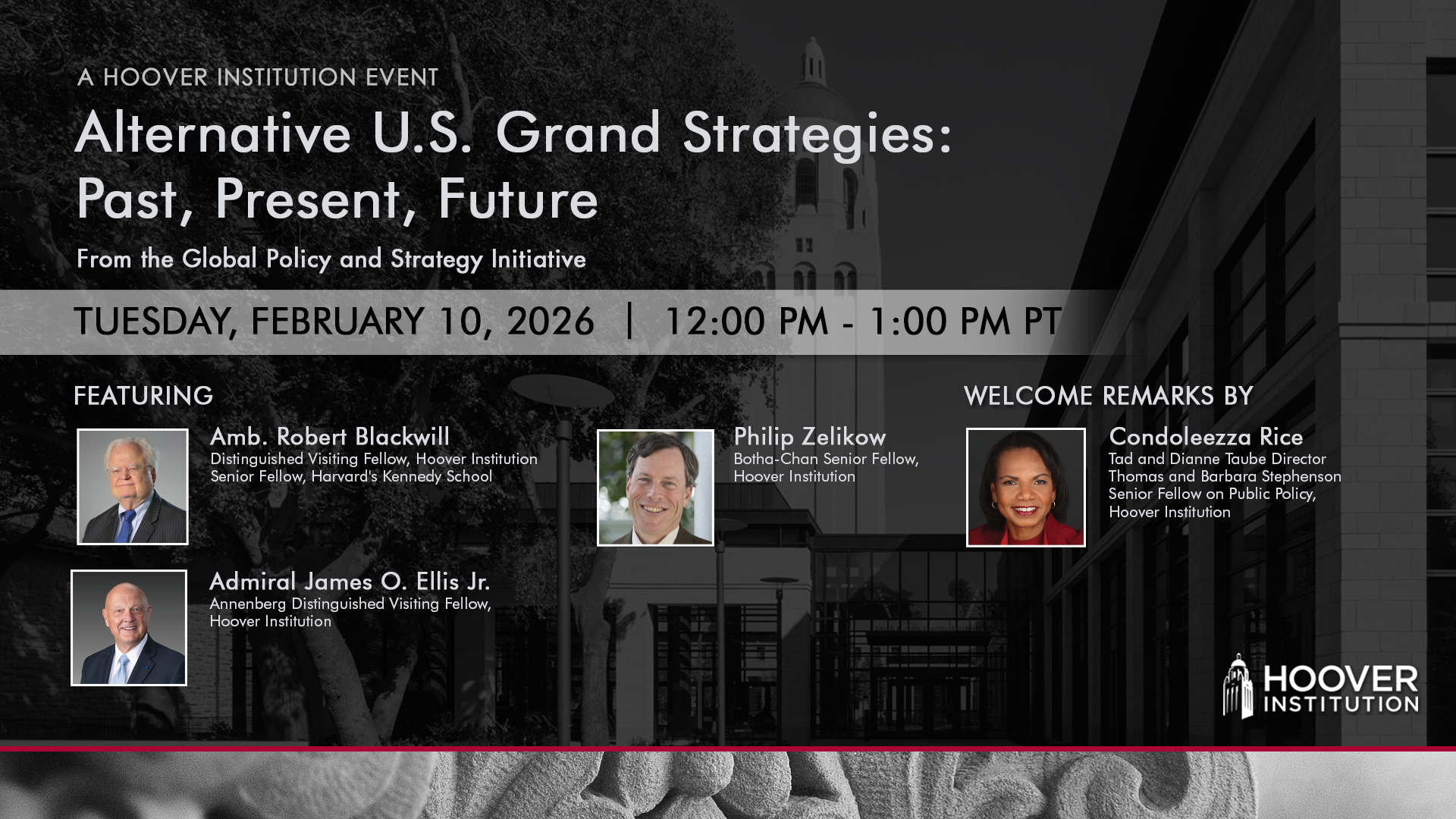
The Hoover Institution’s Global Policy and Strategy Initiative hosted a webinar to discuss Alternative U.S. Grand Strategies: Past, Present, Future on Tuesday, February 10, 2026.
In a new report for the Council on Foreign Relations, America Revived, Ambassador Blackwill argues that the United States faces the most dangerous international environment since World War II. He defines U.S. vital national interests, summarizes the history of American grand strategy, outlines and critiques five grand strategy schools (primacy, liberal internationalism, restraint, American nationalism, and Trumpism), and advances a new grand strategy—resolute global leadership. This approach merges the military power and global presence of primacy with the alliance networks, institutional engagement, and focus on legitimacy emphasized by liberal internationalism.
- Welcome. Welcome to this conversation about the choices that America faces in how it will engage the world. This is a time when the post-war and cold war security and economic order is being reconsidered, being challenged from the ground up. It's a time when America's central role in the world is being reexamined on many, many fronts. That is why I'm so pleased to have as a part of us here at Hoover, our distinguished visiting fellow ambassador Robert Blackwell. And his new report has done us the service of taking a step back and asking important questions about where we are today in terms of America's role in the world, the role of alliances, the role of global power, and how we will go forward. The Council on Foreign Relations sponsored Report, America revived a grand strategy of resolute global leadership identifies questions that we must answer, questions that we must ask about what we do and what we do not try to do to achieve global stability and global prosperity. That alone is a valuable map for today's shifting landscape, but of course it goes further to advocate for the right mix of American global leadership today. And I look forward to hearing more about that from this great report. Now I'm going to introduce Ambassador Blackwell in just a moment following Ambassador Blackwell's introductory remarks. Annenberg distinguished visiting fellow Ambassador Jim or Admiral Jim Ellis, who chairs Hoover's Global Policy and Strategy Initiative. And Hoover's Bachan, senior fellow Philip Zuko, will take up the mantle from Ambassador Blackwell. But I just have to say one word about Ambassador Blackwell. He has a long and distinguished career in public service service to our country, service, indeed to global leadership in the world. But I have to tell you that I first met Ambassador Blackwell when I was a young, yes, Bob. I was once young, a member of the national security staff of President George HW Bush, and indeed, along with Philip Zuko, we were under the tutelage of Ambassador Blackwell, who was the senior director for the Soviet Union, the Soviet Union. Just think about that. And Eastern Europe at the end of the Cold War from 1989 to 19 91, 92, it was an extraordinary time when many of the wishes and hopes of the United States since the end of World War II seemed to be coming into being when the Soviet Union was collapsing, when Eastern Europe was being liberated and when Germany was unifying. And what I remember most about working with Bob during that time was that he had an enormous capacity for understanding the essence of American power, the essence of American influence, and also how to make it all matter. So every day Philip will remember, we would start our staff meetings with what have you done to unify Germany today? It was a way of thinking about the relationship between values and theory and practice. And I will always be grateful to Bob Tutelage in those days. He was an enormous mentor to me and an enormous and important friend. And so I'm delighted to turn this over now to Ambassador Blackwell. Bob, we're so glad to have you as a part of Hoover and look forward to your discussion of this important report and to your engagement as America tries to figure out how to think about its role in the world. Bob, over to you.
- Well, thank you. Thank you Condi, and you both you and Philip show the strength of character that you survived working for me. Conceptually, before I discuss alternative US grand strategies, I want to briefly address the concept of world order and then US vital national interests. And I'll show you why I'm doing that as we go forward. As you know, and I'm sure all of the viewers know this world order refers to the arrangement at any given time of power and authority in the international system. It's always in transit transition. Never frozen countries make better or worse policy decisions. They grow more or less powerful and influential. Non-state actors emerge, decline, disappear when some say world order is dead or ruptured. As the Canadian Prime Minister said at Davos, they usually mean the liberal internationalist approach to world order pursued by every American president since World War II until Donald Trump and they say that is dead. An assertion with which I profoundly disagree, as you'll see one final point about world order in the absence of war, political revolution or plague, world order changes very slowly. You wouldn't believe that from the headlines, but it does to be specific. It does not change on the basis of a 2:00 AM tweet even from the American president. And it does not change because of a brilliant US military operation to capture the president of Venezuela World. Order moves on a much more fundamental basis than that. So the first step to adopt a grand strategy is to come to a view of the current state of the international system. Its major factors, threats and opportunities and longer term trends. Having done that, we next ask before we get to grand strategy, what are the vital US national interests connected to this world? Order until the resurgence of American nationalism and the event of Trumpism in the past decade, US vital national interests for 70 years after World War II were more or less defined by a bipartisan consensus. And let me just name the five. To prevent the use and re and reduce the threat of nuclear, biological, and chemical weapons to ward off catastrophic terrorist AALS or cyber attacks against the United States. Its military forces abroad and its allies. And notice the last phrase and its allies second to stop the spread of nuclear weapons, secured nuclear weapons and materials, and reduce further proliferation of delivery systems for nuclear weapons. Three, to prevent the emergence of a hostile major power or failed state in the Western hemisphere. Four, to maintain global and regional balances of power, especially in the region. Eurasian rim lands that promote peace, stability and freedom through domestic US strength, the projection of US power and influence and the vitality of US alliances. Again, notice alliances. And then finally to ensure the viability and stability of major international systems, trade financial markets, public health, energy supplies, cyberspace, the environment, freedom of the seas and outer space. So in my judgment today, China seeks to undermine all five of these vital US national interests. And President Trump plausibly rejects three of them having analyzed the current state of world order and identified vital US national interests. What then is grand strategy? You all could write it out on a three by five card. It's the collective deployment of diplomatic, economic, military, ideological, moral, and that's an important F fact and bureaucratic means to promote and protect these US vital national interests, a theory of security on how to make one safe in an unsafe world. Now with that as concept, my report asks as what US grand strategy will best protect and promote these vital US national interests in the current era. The report analyzes five alternative schools of American Grand strategy and then proposes my sixth school Resolute Global Leadership, the Primacy School of Grand Strategy, which includes neoconservatism a search that the United States must remain the world's unrivaled superpower in every region, in every dimension. And toward that end, pre prevent the reemergence of a peer competitor. The liberal international school envisions a US led open rules-based world order, and you're familiar with this, that champion champions the rule of law, liberal democracy and human rights, and uses US military force as a last resort to safeguard US vital national interests. The restraint school often associated with realism and offshore balancing and scarred by recent unsuccessful wars seeks to slash American global presence and commitments and argues that US military intervention is almost always ill-advised the American Nationalist School insists that the United States should concentrate its attention and strength on the western hemisphere that previous presidents have foolishly agreed to trade and security agreements that hollowed out the nation's economy and that only US power not alliances and global organizations guarantees enduring benefits for the United States and Trumpism. And exec eccentric version of American nationalism depends on the personal preferences of President Donald Trump. It radically redefines us vital national infra interests and emphasizes bilateral and transactional trade relationships, business deals and diplomatic successes with less attention to their substance over geopolitical considerations. And does that without collaboration with US allies or fidelity to core American national values including human rights. I wanna now go into more detail on Trumpism. I can come back to liberal internationalism. I think you are familiar with that, but I do wanna say that in that regard in my judgment, and this may be controversial with some of you, liberal internationalism has progressively weakened in recent decades. It failed to recognize and respond adequately to the rise of Chinese power. It failed to increase the defense budget and thus allowed China substantially to reduce the gap between the two militaries. It failed to halt China's militarization of the South, not China Sea, and to resist its mounting pressure on Taiwan, liberal internationalism failed to punish Russian aggression in Crimea and Donbas in 2014, which embolden Moscow's full scale invasion of Ukraine in 2022. It failed to quickly send the most advanced weapons to Ukraine to defend itself after the 2022 Russian invasion. It failed to confront Iran's proxies which grew in strength and capability across the Middle East. It failed to permanently cap Iran's AC acquisition of fissile material and to prevent Iran's enrichment of uranium well beyond the 3% threshold for civilian use. It failed to enforce its red line on Syrian chemical weapons use. It failed to avoid a disastrous withdrawal of US troops from Afghanistan. It failed to defend the international trading system that brought untold global prosperity when it abandoned the transpacific partnership and it failed to safeguard the US southern border. In short, I don't think Harry Truman would recognize this recent in feeble version of liberal internationalism. I don't think Jack Kennedy would recognize it and I don't think Bill Clinton would recognize it. That brings me to the contending pillars of Trumpism and I would just like to list them. We can discuss them in general. So there'll just to be assertions, first of all, it's counter-revolutionary. I regard the, the liberal internationalism, which was established after world Wari was the revolutionary change in American foreign policy from American nationalism with its emphasis on the Western hemisphere that had dominated US grand strategy since the founding of the Republic. So the Trump vision is counter revolutionary. It has no shared moral framework and he has said that explicitly it recognizes no rules of international conduct. In principle, it argues naked power prevails the law of the jungle. When I read Mr. Miller on that score, I thought of a recent trip to the Serengeti when one guide told me every night some animals eat and some animals are eaten. That sounds pretty much Mr. Miller's view of civilization. The president cons concentrates on bilateral trade business deals, not geopolitics, which he rarely mentions. He questions America's alliances, he prioritizes western hemisphere and its borders, which I too support, but thus is attracted to regional spheres of influence. He obviously detests Europe, which he again showed at Davos and shows far more respect for Vladimir Putin and Xi Jinping than our democratic allies. He seeks rapid diplomatic successes through threats and ultimatum. He proposes, and this is important, no increase in the defense budget. The budget that he submitted at the beginning of his second term was in real terms, in real dollars less than the last Biden budget. He rejects in principle US boots on the ground and no more wars. And he has no concern about climate change, which he calls a hoax. So that I think captures there are more than 300 footnotes in the report and it takes you where to go to find the origins of my conclusions in that regard. Now I'd like to contrast that Trumpism with my alternative US grand strategy, which goes under these pillars, preserve and protect the American constitutional order in principle and in practice, maintain America's military superiority and the willingness to use force on behalf of US vital national interest by substantially increasing the defense budget over the next decade and winning the high technology race with China, especially in artificial intelligence, to revitalize and reform a rule-based world order through sustained American leadership and intense diplomacy to prevent the use and spread of nuclear weapons, including through force to stave off China's hegemonic objectives by pivoting US military forces to Asia, from Europe and the Middle East, strengthening American alliances and leading a collaborative reform of the international trading system, it in wishes to intensify diplomacy with China to avoid war over Taiwan. Increase diplomatic and economic engagement with the Western hemisphere, promote vigorously democracy and human rights around the world without the use of military force except to avert genocide and to treat climate change as a profound global threat. If I may say in this Hoover institution setting, I believe one of my heroes for whom I was honored to work, George Schultz, would generally endorse these pillars. So in conclusion, I wanna contrast how President Trump and my proposal of resolute global leadership would instinctively address current issues in American foreign policy. This contrast seeks only to give an overall picture of the substantive thrusts of the two alternative grand strategies. So I'll go through them one by one very quickly. So contain China Trumpism? No, my proposal, yes. Defend Taiwan Trumpism. No, my proposal, yes in initiate a major increase in defense spending. Trumpism, no, my proposal, yes. Continued major military and political support to Ukraine. Trumpism. Question mark my proposal. Yes, confirm NATO Article five Trumpism. Question mark my proposal. Yes, except Iranian nuclear enrichment Trumpism. Yes, I think in the end, and yes, I would support that with proper verification and so forth. Use military force in extremists against the Iranian nuclear program. I, yes, I say yes. I'm not sure about Trump. If there were Iranian air defenses reform and bolster mul multilateral trade policy. Trump no, my proposal, yes, impose high tariffs to vitalize the American economy. Trump, yes, my proposal, no constrained to China for national high tech to China for national security reasons. I have a question mark for Trump, given TikTok and the Nvidia sales advanced chip sales to China, but yes, I would do it. Promote values as an important element in US foreign policy. Trump no, I would say yes, use force to spread American values. And that's a no from Trump and a no from me. Although since this was published at the end of December or finished to go to the publisher, he has used force in defense of Christians, he says in Nigeria and told the Iranian demonstrators help is on the way. So I'm not sure about the strength in international institutions. Trump no, my proposal, yes, offer the developing world a positive and sympathetic version of world order. No, I say yes and take substantial action to reduce climate change to Trump. No, I say yes as the report demonstrates the United States remains the most powerful nation on earth. So in that sense, the future is in our hands and in my view, the liberal internationals wor world order is not ir, irreparably broken. Those who argue that it is do not enumerate what elements of liberal internationalism and world order cannot be repaired and re reinvigorated. They are genuinely dead. Please name them one by one, as is clear in my remarks today. As I conclude, I believe Trumpism undermines the nation's prosperity, security, and legitimacy simultaneously because of its determination to go it alone in the international system. But I believe Donald Trump's foreign policies can be reversed. There are not at least so far structural in character. They can be prepared by the ne repaired by the next president working closely, as did all of his preces predecessors since World War ii, before Donald Trump with American allies and partners. Thank you for your attention. I look forward to your comments and questions.
- Well, thank you Bob Ambassador and sincere thanks again for joining us and congratulations on the Council on Foreign Relations special report. It's comprehensive in a timely perimeter, the ongoing global conversations about the state and future of the world order and America's place in it. It's hugely popular as we have over 300 folks that have signed on for this webinar remotely, and I would remind them that they can submit questions for the ambassador via the webinar q and a tool. Bob, my first question was going to be to take you to the conversation on world order, but you have very passionately kind of addressed the, the realities and your sense of optimism that it is not irrevocably broken. So I'm gonna move on to, to another area that I think is gonna be fundamental to, to bringing about the change that, that you so eloquently articulated in your fascinating historical review of past grand strategies. You've noted that Woodward Wilson Woodrow Wilson, in his pursuit of a version of liberal internationalism quote, failed to carry either the Senate or the country. As we can see in today's often strident conversations, political and popular perceptions are extremely important, absent and existential economic or security crisis. Where does that conversation begin beyond the political and policy elite and more convincingly with the American people?
- Well, I think, and you imply this, Jim, it, it begins with American politics and not with American strategists. And it begins with an American presidential candidate probably making the case against American international isolation against the eccentric policies of President Trump. And to continue to make that case through the election. The polls show that the American people wanna be engaged in the world. But when was the last time that a liberal internationalist made that case in detail to the American people? And I think not really since before President Obama. So that's where it begins. Now, much will depend on President Trump's successor in the Republican party, but I would only say this and it's epigrammatic to be sure. I think Donald Trump is a unique figure in American history. And I don't think that the many elements that I mentioned in Trumpism, I don't think all of them are going to survive whoever his successor is, and if it's Vice P, the vice President or the Secretary of State, both of whose names have been mentioned by President Trump, I don't believe that the more personal and idiosyncratic dimensions of Trumpism are, are going to survive his departure.
- Great. Well thank you for that here at Hoover, as you did. We recall finally the years of contributions that the late secretary George Schultz made here. And he had the knack of balancing realism and optimism and in remarks he delivered to the Commonwealth Club some years ago, I think it was 1985, he declared the civilizations decline when they stop believing in themselves. And ours has thrived because we never lost our conviction that our values are worth defending. Many of the conversation today, and you did in your earlier remarks, replace the term values with interests implying that values are, that are in the words of, you know, the recent National Defense strategy, a cloud castle abstraction perhaps, and part of a zero sum balance. And that you can have values or you can have interest, but not both. In fairness, you seem to be articulating a strategy that considers both, but acknowledge the tension that can arise in attempting to pursue them simultaneously. Are values and interests both achievable or is this one of the trade-offs of which you spoke in your, in your paper?
- They're both achievable, but there are tensions and trade-offs on individual issues. But I believe an American foreign policy without fundamental American values is an American, because every predecessor of President Trump has put American values in a context of shared virtue. And this president seems not to believe that. He seems to believe that right and wrong has no abstract meeting or no shared meeting among the American people. It is he who decides what is right and what is wrong. And that again, is unique I think in American history. Henry Kissinger wrote a book on this subject of world order and the last chapter describes at length this tension that you mentioned between interests and values. But any American foreign policy in my judgment, has to be based as Secretary Schultz said, as you quoted him on a fundamental realization that America stands for something. It isn't, it isn't endorsing the law of the jungle. And I'm hopeful that that's also the view of the American people when it's explained to them in more detail than it's been the case so far.
- Right. So you're essentially saying that not only is it possible, it's absolutely essential that America be both great and good.
- Yes. Well put.
- Thank you. One of the things I do here at, at hoover is the project on Taiwan and the Indo-Pacific part of the Global Policy and Strategy initiative. You mentioned it in your remarks, but, and at the risk of becoming too tactical, one issue you do call out in the chart in the comparison you just, you just made comparing your proposed grand strategy with with other candidates. And I know you and Philip have both written extensively on the topic of, of Taiwan, but how do you reconcile your assertion that we should defend Taiwan with the recommendation that Washington should intensify US diplomacy with Beijing to avoid war, which will require compromise on both sides and collaboration with China to address global problems? I guess essentially I'm asking wither strategic ambiguity.
- Well, I, I tried in the chart, which is near the end of the report, to be as clear as I could about what I would recommend to a president. And I'm not proposing the end of strategic ambiguity I'm, but the president would want to know in a crisis whether hi his principal advisors we're prepared to recommend that we defend Taiwan or not. And I indicated that I would at that moment, if in the White House, yes, say go to war with China, to defend Taiwan, it's an enormous issue. And one of course we discuss incessantly. I'm not sure that pre president Trump has the same view. He once said, and again this is in the footnotes, that Taiwan was a tiny little speck off the coast of China that stole our chip technology. Well, they may keep strategic ambiguity, but it doesn't sound to me as if that would be something he would li be likely to do. But the diplomacy part of it is we have to do two things. We have to strengthen deterrence and that has a major military component obviously and stopped this erosion of our advantages, including in around the first island chain, but also to intensify diplomacy with respect to avoiding war. I don't believe China wants a war over Taiwan, but, and we certainly don't, but the way to avoid it is through diplomacy and strengthened deterrence. And I believe deterrence has been weakened over the last decade plus with respect to Chinese views of Taiwan.
- Well, I think you make a great point ambassador about the importance of deterrence and sometimes we lose sight of that as we intellectually or in reality gid up for what might become a, a future conflict. But I guess the question I would ask, and, and again, it's more reflective of your, you know, decades of, of national service in the international arena. How well do you think we understand what it would take to deter Xi Jinping specifically and Chinese leadership more broadly? If you, if you think it goes beyond Xi Jinping, are we guilty of mirror imaging or do we have a a real insight as to as to how most effectively implement a strategy that that relies heavily as we all want to on the deterrence of future conflict?
- Well, I can't answer that completely without having access to the intelligence that the president gets with respect to the inner deliberations of the Chinese government. But I would imagine, I guess that it's pretty di minimis and so our views have to be based on hypotheses that cannot be proven. But I believe if you look at Chinese behavior since say 2010, there is no doubt that they've upped the pressure on Taiwan progressively. They, I think as an objective, and this has been in the press for the meeting in the spring between the two presidents will seek to persuade President Trump to adopt the Chinese position that one China means Taiwan unifying with China. And I hope, I think we all hope he won't do that, but one has to try to balance what we know and what we don't know. And I think your question implies that to try to get inside this tiny, tiny five person or so, maybe it's now four or maybe even three to know what they really are saying, we're probably not gonna have that as a basis. So we have to broaden our views, speculate, but try to avoid risks and to assume that that Xi Jinping does not mean it when he says that the PLA should be ready to use force against Taiwan in 2027 to assume that he's just talking for an international audience or for domestic consumption would be I think highly dangerous.
- Great point. One final question before I pass it to, to Philip. You talked about the value of allies and partners and, and I think most of us that have had a role in the international arena appreciate the incredible contributions that they have and, and continue to make to our collective security. But those of us that are having current conversations with them are hearing a lot of voices of dismay, as you might imagine, as I'm sure you are as well. Would you hazard a guess at a timeline to, to bring them back on side, if you will? Or is this like the laws of mathematics and physics where one exception, you know, violates the rule and, and now it's been torn once and therefore it could conceptually happen again? Where is that trust that George Schultz always used to talk to us about? And how long do you think it could take to rebuild that if in fact it can be?
- Well, I have bad news in that regard in the, in the tactical sense, I do not think that trust will be rebuilt during President Trump's second term. I believe we know who he is. I believe we know what he thinks about allies, which is contemptuous and therefore he will go on acting as he has been acting. And this, as you said, is eroding substantially the trust of our allies in the United States and in the American commitments. And this is crucial. I'll just mention one dimension of it, which will be familiar to the viewers. Extended deterrence depends on capability, but also on trust that our allies in order not to acquire nuclear weapons, trust that the United States will actually use a nuclear weapon in defense, not of American territory, but in a defense of allied territory. Charles Dega, of course never believed it, and it is a fragile trust and it's no, it's no coincidence that in South Korea and Japan, there's now a vigorous discussion of more than ever before in the post-war period of whether they should acquire nuclear weapons. So trust has to be reestablished, but in my judgment, that will be a task for the next president. I don't think this president is, we know who he is, we know what he thinks. And so I don't believe that he will, he will make any headway in that regard. And this one last point, which is this report was written and sent to the publisher at the end of last year, but I recognize what I'm sure the viewers are thinking, well, that's your view now, but what about President Trump's next three years in office? And in that regard, I simply counsel, see what he says and see what he does. He will go on traumatizing the allies in what he says, but let's see if he does actions, takes actions, for example, substantially reducing US forces in South Korea or in Japan or drawing down dramatically US forces in Europe or questioning again in action whether he would abide by Article five, if there's a crisis, for example, in the Baltic states. So I think all of us need to be less traumatized by what he says and although what does erode trust and concentrate more on what he does, and I'll just finish with this, Davos went a, a Twitter because of President Trump's statement that he would consider using force against Denmark to acquire Greenland. Not that he would, not that he did, but that he would consider it. And of course he backed off that. So we should pay as Ed Meese in the Reagan administration, stressed watch what he does, not what he says at two in the morning.
- Well, thank you Ambassador Philip, I invite you to, to take over and and bring a, a different perspective and an important perspective to the conversation.
- Oh, thanks Jim. And thank you Bob for producing this important report. One of the things I just wanna do right off is I wanna call out a particular contribution of the report. There are a lot of people who criticize President Trump's foreign policy, and so that's not unique about the report. I do think the report is unique in, in an important publication in distinguishing Trumpism from the School of American nationalism. I think it's, it's very widely perceived that Trump actually represents American nationalism. And you actually call out the fact that, you know what, actually he's got a different mix here and it's not a different mix just in nuances. It's a different mix in a deep conceptual way. I mean, even in when you opened up, you alluded to Trump's policies as perhaps as being just a, an eccentric version of American nationalism. But I think if I understand it right, the argument you make in your report is deeper than that. That that there's, you know, there are just core conceptual differences between Trumpism and American nationalism. And I just wanted to, if, if you agree with what I'm saying, I'd like to invite you to just take a moment to drive that. 'cause I I don't think that's the conventional wisdom.
- Well, it is my view and it's, let me just say in the first instance, American nationalism, which do do dominated as I said earlier, American grand strategy from the founding to essentially with a brief interregnum with Woodrow Wilson up to the beginning of World War II, wanted no geopolitical involvement in crises outside the Western hemisphere. And, and therefore American nationalists, although in public, most of them are quiescent, but some of them, some of the American nationalism condemn President Trump's energetic involvement in every region of the world for every conceivable reason. And this is reflected in what as former former Jedi Knights, you and I, Jim and Condi would recognize and probably the the viewers, some of the viewers, the compromised document, the national security strategy and the National Defense Strategy because you could see the American Nationalist School at war with the trumpet school and for example, and in some, to some degree even with the primacy school. So one of the reasons that I'm optimistic is that, and this may seem paradoxical, I think that the struggle ahead will not be Trumpism versus liberal internationalism. I think it will be liberal internationalism versus American nationalism after the Trump years. And I don't want to predict how that will come out, but it's the American nationalism and the report goes into much detail is simply fundamentally opposed to this from the very beginning, from the 1780s onward, is opposed to this energetic activism to involve the United States in other nations quarrels outside the Western hemisphere.
- So let me pursue that. 'cause then in a way, there's a way to read the report. And again, it's, as you pointed out at the beginning, this is a report about broad grant strategy and broad concepts. So it's easy to fall into a discussion, well what would you, what do you recommend about Iran tomorrow? Or what do you recommend about maybe Taiwan tomorrow? But your reports at another level above that as kind of a broad conceptual roadmap of how to match ends and means and, and attaining America's national interests as as you propose them. So you're making an argument then in a way that Trumpism is, w will have a debate between the am the purified American nationalism form, which maybe could be represented by vice president fans and actually some rev, some new purified version of liberal internationalism redux. In some ways you could have titled your report liberal internationalism revived, because your argument is that in liberal internationalism was basically sound, except that in recent years it was undercut that, that that liberal internationalism was no longer muscular, it was no longer committed to free trade. And basically by abandoning those key elements, it became this flacid palate version of liberal internationalism that kind of this wilting flower that then kind of left the door open for Trumpism. And then you'll see this reengaged debate between the pure American nationalism and some kind of new version of liberal internationalism, which could be espoused either by a Marco Rubio or by a relatively centrist democratic candidate. Is that then the, is that really then the kind of debate that you're teeing up on, which you're also now trying to take sides?
- You put it well, and the answer is yes. And as I say I am, if I thought that Trumpism in its current form had deep roots in American history and politics, I'd be a lot more worried. I think he's a unique figure. And so there are question marks here, where will the, the Republican candidate place himself and it'll be a him with respect to these two alternatives. And where will a Democrat place himself or perhaps herself with respect to this? And on the Democrat side, they, the report has been criticized by the Democrats, the practitioners in the administrations that were represented in the report as weak and flacid, but I don't know what they would say privately, but we need a reinvigorated liberal internationalism. That's the reason the first word of my alternative is resolute, which I don't believe. And each of the word is care. Each of those words is carefully chosen, resolute international, so not spheres of intra influence and not just the western hemisphere and then leadership, global leadership. So it's global leadership, it's the world and leadership. So I think that's the Beit ahead, but I can't forecast, and this is deeply worrying to me and perhaps to the viewers where President Trump is gonna take this country in the next three years. And I, I say Philip, that I believe that a resolute global internationalism can be revived in the next administration, but it does depend on what he does and how much he breaks, not just weakens, but breaks the conventions of world order that have existed since the end of World War ii.
- So my last comment, or my last question really for you and, and then we have a few minutes for questions from the audience, is the American people actually have the self-belief to do this. I mean, that is clearly the American, the co the American confidence in their own project and in their, and and in the righteousness of their own place in the world has visibly diminished Yes. Undercut by many things, including, including failures overseas. Yes. Which have, which have had a which may or may not have changed world history, but have had a really deep effect on American self-belief and self-confidence. So in a way you may have, you may have the hopes of the, of the role we should play, but as a practical matter, it seems like isn't the foundation of your grand strategy either measures or something that allow America to recover the c self-confidence and self-belief to play the role you're trying to cast for them?
- Yes. And that's hardly a given. That's hardly a given. And some who have read the report have said it's hopelessly optimistic for the reasons you imply that the American people no longer believe in the American dream and so forth. But what I say to them as a practitioner, as you and many others are on this, on, on, on this video, all right, if you think that's unreasonably optimistic, you tell me what the US role in the world and its implication should be. If, if you think that's too optimistic. And that's a challenge I give the, the readers of the report and most folks who say it's too optimistic don't have an alternative grand strategy except for the Amer, the pure American nationalists. And they do have a grand strategy. And, and I believe that's, that's unrealistic in the current global setting. But American presidents can't be satisfied only with counselors who say that won't work. They have to also then say, but this will work Mr. President, and what we're waiting for from others who are critical of this report or more generally is what will work. And I'll conclude this by saying, and it's it's intro to another long conversation. I do not believe we're headed for a multipolar world and I believe we're headed for a bipolar world in the United States and China, which will be very familiar in many ways. But if you do think we're headed for a multipolar world with a much diminished US role, then you have to answer how do these middle level nations organize to cope with the enormous power of China? And it's not, but coping with a benign China as the report seeks to indicate.
- Well, thank you Bob. Thank you Philip as well. We've now got time for a couple of questions that have been submitted. I'm gonna take the, the editorial rights and, and consolidate of them, but the first one, I think it, it appeared a couple of times is Europe is obviously under invested to an enormous degree in their defense capability. They admit that Trump's views that these allies are free riding on US power and spending. How do you reconcile such free riding with your concept of the importance of important role of allies going forward?
- Well, I don't think they're free riders and they haven't been, I wonder how many non US divisions Donald Trump could name that hit the beaches at Normandy. I doubt if he would know the answer to that. And as you look at the cold, cold war period, Europe in general, and Germany in particular, we're going to be the first line of defense. They were enormously fortified. We were a long way away. If there was a conventional war in Europe, they have underspent for sure. They're now because of the Ukraine war and because of Donald Trump, they are pledged to to, to spend more. But they are not free riders. And I support President Trump's pressure on them to do more. But doing more should be in a collaborative sense. And I think Europeans who say, well, we'll just organize ourselves without a US role in our defense are silly to pick a technical word.
- Great. We talked a little bit or a lot actually about, about supernational organizations and the, and the like and, and the need for, for allies and partners. How do you conflate those two considerations? I mean, whatever the next administration looks like. Do you see a continuation of of the extant supernational organizations such as the United Nations and the WTO and, and how do you compare that to, you know, the newer emerging relationships such as the Quad and, and you know, Aus and the like. What do you, how do you, how do you balance that in your idea of reform and, and improvement and retrenchment going forward?
- Well, I'll take that good question. I'll take advantage of it to say just another example of Trump's disinterest in alliances is his disinterest in the quad, his disinterest in alkis his interest instead on the dis equilibria between China, sorry, between India and its its protectionist economy and the United States. So again, another example of this concentration on trade issues, but the reform, I I have to say I I I just read a good piece, thoughtful saying, well, the United Nations should be expanded by five members and no veto power. And that's like me saying, I would like to have a 42 inch vertical leap. It is simply not going to happen and the security council is going to be moot as long as Russia and China seek to undermine US and Western objectives around the world. But much of the UN does good work and we should support that. We should be in favor of un peacekeeping even if the Chinese have a major role in that. But there's the, the WTO, there's the OECD, of course there's the World Bank and the IMF, these organizations produce, they export stability if they can be made to work. And I would like the next administration difficult as it will be to make a major e effort in each of these primary organizations to strengthen them. And that will require of course changes in their principles to some degree and their practices and conduct. But we should be willing to address that in the context of the effort to be plausibly sympathetic to the developing world, which has an ever greater percentage of the population and which will have more influence over time on the international, on international order. So that's a, another big task. And, but it's one worth trying. It won't be easy, but it's one worth trying. And I think until Trump won American presidents, whatever their political party did try to do that, did try to do that in general, some more than others. But the next president should make a major effort in that regard.
- Well, thank you Bob. We are, we are coming to the, to the end of our time. It's been a, a, a great conversation and I have not gotten to a fraction of the questions that were submitted by, by the remote participants and I, I apologize for that. But I do wanna thank you again, ambassador for joining us and thanks as well to all of those who participated for their contributions to this event. Again, brought to you under the auspices of the Hoover Global Policy and Strategy Initiative, a reminder you can download Ambassador Blackwell's study from the Council on Foreign Relations website. And a recorded copy of today's conversation will be available@hoover.org in a, in a few days. So again, Bob, thanks so much for, for being a part of this and engaging so effectively and well on, on the important document that you and the Council of Foreign Relationship have produced that's gonna inform this ongoing conversation, not just domestically, but internationally. Thank you.
- Thank you Jim. And thank you everybody.
ABOUT THE SPEAKERS
Ambassador Robert Blackwill is a Distinguished Visiting Fellow at Stanford University’s Hoover Institution, and Senior Fellow at Harvard’s Kennedy School. He served as deputy national security advisor, presidential envoy to Iraq, and ambassador to India under President George W. Bush. Blackwill’s latest book, coauthored with Richard Fontaine, is Lost Decade: The U.S. Pivot to Asia and the Rise of Chinese Power (Oxford University Press, 2024).
Admiral James O. Ellis Jr. is Annenberg Distinguished Visiting Fellow at the Hoover Institution, where he oversees both the Global Policy and Strategy Initiative and the George P. Shultz Energy Policy Working Group. He retired from a 39-year career with the US Navy in 2004. He has also served in the private and nonprofit sectors in areas of energy and nuclear security.
Philip Zelikow is the Botha-Chan Senior Fellow at Stanford University's Hoover Institution. For 25 years he held a chaired professorship in history at the University of Virginia, where he also directed the nation's leading research center on the American presidency. For seven years before that, he was an associate professor at Harvard University.