


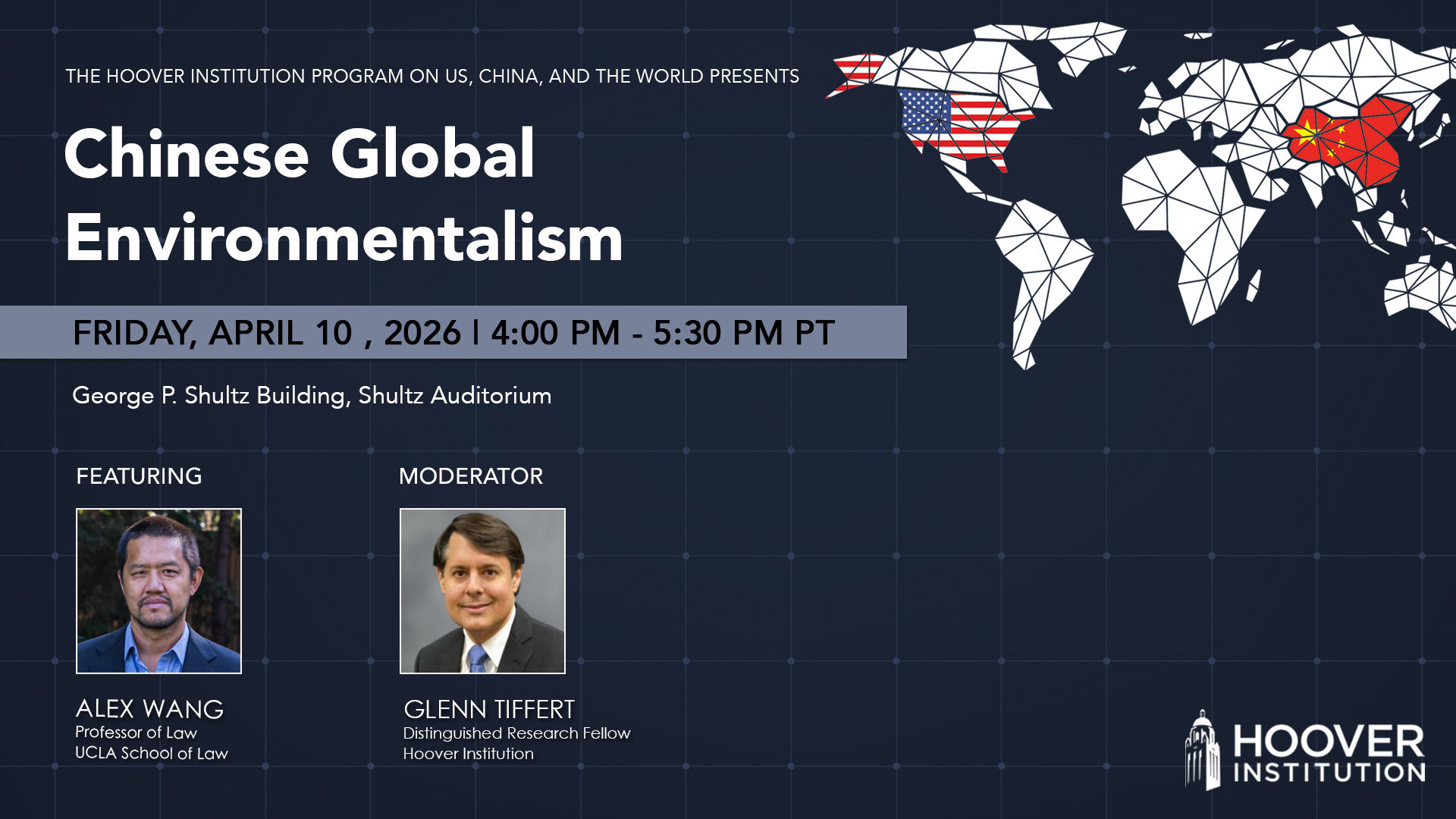
The Hoover Institution Program on the US, China, and the World hosted a discussion on Chinese Global Environmentalism on Friday, April 10, 2026 from 4:00-5:30 pm PT.
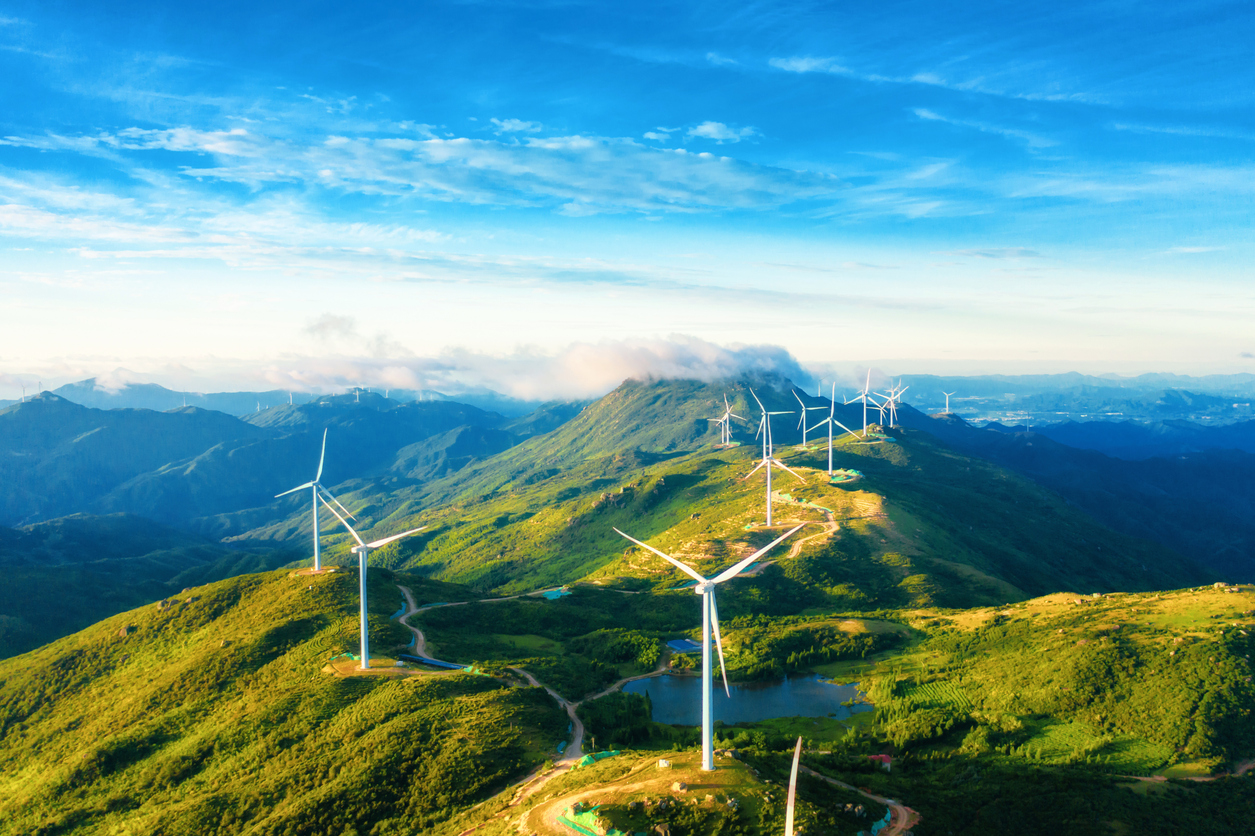
We find ourselves at a remarkable moment in global environmental governance. China actively supports green development on the global stage, while the US under the Trump administration rejects the Paris Agreement and actively opposes the development of renewable energy and electric vehicles. Professor Alex Wang of the UCLA School of Law will introduce his new book, Chinese Global Environmentalism, which examines how China came to embrace green development and how it promotes a developmental form of environmentalism that differs from Western conceptions. China’s approach promises to advance certain global environmental and governance norms, while reshaping others in ways that will continue to create tensions and conflict around the world. He will share case studies that shed light on China’s approach, including Chinese green investment in Chile, environmental conflicts in Kenya, hydropower development in Southeast Asia, global climate negotiations, and Chinese dominance in clean technology development.
- Thank you. Let me welcome you here today to the latest installment in our program on the us, China, and the World Speaker Series. I'm Glen Tifford, a distinguished research fellow here at the Hoover Institution and Co-chair of the USCW program. It's a great pleasure today to introduce Alex Wong, who will be our speaker today. Alex Wong is Professor of law, UCLA School of Law, a faculty co-director of the Emmett Institute on Climate Change and the Environment, and the Walter and Shirley Wong chair in US-China Relations and Communications, which means you probably need a really big business card. His research focuses on the law and politics of environmental governance and climate policy in the PRC on US-China Environmental Cooperation and Competition, and on the role of state owned enterprises in environmental governance. Some of his recent publications include explaining environmental information disclosure in China, symbolic legitimacy in environmental reform in China and US China Climate Action. Is it possible in the era of mistrust? At UCLA, he teaches courses on torts, Chinese law and politics and environmental law. He's been a visiting assistant professor at uc, Berkeley School of Law, a senior attorney for the National Resources Defense Council based in Beijing, where he helped to open and our DC's Beijing office in 2006. And that's how I came to know him in Beijing. In that capacity, he worked with China's government agencies, legal community, and environmental groups to improve environmental laws and strengthen the role of the public in environmental protection. He holds a JD from NYU School of Law and a degree in biology from Duke University. And so, Alex, the floor is yours. Thank you.
- Excellent. Well, good afternoon. Thank you for coming out here this afternoon. Happy to have a chance to talk to you about this book. You know, writing a book is a solitary experience, and so it's nice to get out into the community and have conversations about the work. I'm gonna speak for a, a little while to introduce the book, but then want to have plenty of time for, for discussion. So what's this book about? The, the book basically looks at the question of why is China talking about green development these days and how is it implementing it around the world? So that's the basic question for any, anyone who hasn't been following this. It's a, it's an introduction into these issues. How green is what China is doing, what does it mean for the way we think about China's rise now for people who work in these areas? There's still something for that audience in terms of, it gets into the details of exactly how is China pursuing green development around the world, what are the methods it's using? And it has a series of case studies through which we can take a look at the, really, the details of how China's behaving. So the, the components of what China's doing that I'm gonna talk about are really four different things, and I call all of these collectively Chinese global environmentalism. And so one of the components is sort of how is China, what is the Chinese version of environmentalism, which I've, I call green ideology here. Again, how green is it? What does it look like? What does it emphasize? Then I look at green diplomacy. How is China behaving in the UN climate negotiations? I have a case study of the Montreal Protocol, second green economic state craft. This is probably the area that's been in the news most frequently with discussions of China's dominance in solar, wind and other, and electric vehicles and other clean technologies. And so I'll talk about sort of the China's use of economic, you know, trade and investment and how that affects the relationship with other countries and how it affects geopolitics. And the third, I'll talk about green development cooperation. So this is sort of the Chinese equivalent of the U-S-A-I-D world or the international development cooperation world that the US really developed in Europe developed post World War ii. And it wouldn't surprise you that now that China is growing in economic and political power, that it would be developing its own version of that, of, of a development cooperation world. So what, what does that look like in what China is doing? And so through looking at this, I'm, I'm particularly interested in two main questions. One, what does it mean for the global environment, right? These things that China is doing. Does it help us solve climate change, air pollution, water pollution, these types of things? And then second, how does it affect the way we think about China in, you know, geopolitically? How do we think about China's rise, right? I think that's a question on a lot of people's minds. And as you know, the debates over this are, there's sharply divided views on this. And my book is a way to sort of intervene in these debates and sort of look at the different ways people are seeing China through this area of the environment. Another purpose of the book is also, it is meant not only for a western audience, but also to inform Chinese audiences. I've done presentations on this draft of this book in China, and it's meant to say to Chinese audience members, this is how the world is seeing what you're doing on the environment, right? And my interest in this is to try to, you know, build, build some basis for better understanding and to, to be able to move in a, in a positive way. The book is based on some new field research. It also draws on the, the academic work of a lot of excellent researchers out there. And it also builds on my experience working on environmental issues over a few decades. And I spent a lot of time on the ground in China with NRDC and other organizations looking at what was happening on the ground, engaging with a lot of different actors. The book is available, open access on the Cambridge University website. I I really wanted it to be read, but of course, if you're interested in purchasing it, it makes a great stocking stuffer. You can, you can buy it, it's concise, and then, you know, it packs a lot into a small space. Okay? So, so let's get started with that, with that as introduction. So, so let's begin at a high level, right? So again, as I said, the, the book is about the story of, of what's going on with China and the environment. And so one way to think about this is to say, to look at the transition in China on this issue, right? So as, as I say here on the slide, the environment was once one of China's greatest weaknesses, and it's now becoming a pillar of its global power. So, so what do I mean by that? So when I started working on the environment, 20, really 20 in earnest, 20 years ago on the ground, I was seeing a lot of situations like this, right? You know, scenes of extraordinary kind of environmental degradation, crisis in air pollution, water pollution, soil pollution, these sorts of things. One thing I've observed over the last 20 years is quite a significant transition within China and how they're dealing with the environment. And part of the story here is what's motivating that within China, right? So these are two slides from a New York Times article last year, and it gets right to the heart of things, right? One of the parts of the story here is that China's motivations for moving towards green development are in significant part developmental, right? So if you look at this slide, it's about how much China is making from the exports of certain clean technologies. So lithium ion batteries, solar panels, electric cars, you see the, the yellows, how much China's making from those exports. And the blue is how much the United States makes from those exports. On the flip side, you can see how much the United States makes from exports of crude oil, natural gas, coal, and how much China makes from the exports of those things. So very quickly from these slides, you can get a sense of the political economy dynamics of what you, why is China promoting these clean technologies? Why do we have the debates about climate change that we do in the United States? Why is the current administration emphasizing energy dominance through these types of commodities? Right? So, so that's a bit of the, the initial story, right? So it's important to note that we find ourselves at a, i, i think a remarkable moment in which on the climate change front, you have China still within, still in the Paris agreement and in the UN framework convention on climate change promoting CLI climate friendly technologies. And the US is out of those international agreements, and currently the, the administration is opposing renewable energy, right? So, so this is partly the context that I want to be talking about today, okay? So, alright, so a few other things to note before we get into the, the details. The book explains the ideology of Chinese global environmentalism as a state led top down effort that treats environmentalism as fundamentally developmental project. So that's good news in one sense, because if we believe that part of this is motivated by a business logic or a profit logic, there's no reason to think that China won't continue to promote the dissemination of solar panels, electric vehicles, wind turbines and that sort of thing. A lot. A question that often comes up when I'm giving these presentations is, is China serious about the environment, right? So in that respect, there's no reason to think China will not continue to promote the dissemination of these technologies. And as you may know, China is already a leading manufacturer of these technologies and also leading deployer of these technologies within China. But it's also true that this developmental approach to environmentalism leaves things off the table. So if you're an environmentalist, often there's discussions about lower consumption, conserving resources, these sorts of things, that type of environmentalism is not really part of this Chinese version of environmentalism. And it's worth noting that this Chinese story of green development is really different from the bottom up story that I learned growing up in the United States, sort of 1960s Earth Day citizen action, pushing the government to develop the modern environmental laws that started in the 1970s and are still active today. Some people called that American model environmental democracy, right? We can talk more about the origins of that term, but it's environmentalism with certain democratic values built in. And that's been contrasted with China's authoritarian environmentalism or within China it's referred to by a more neutral term, like top down design, for example. Okay? So what I'm gonna talk about in the opening remarks here is the three things that I do in the book. So the first thing I do is I survey sort of the ways that we talk about China and the environment. I think these will sound familiar to you, but it's worth unpacking them because, and any debate about China, these various discourses will emerge. And, and so I wanna unpack those. Second, I'm gonna talk a little bit about the history of how China got from where it was, say 20, 30 years ago to where they are now. I wanna emphasize a few points there, and then I'll talk about a few of the case studies at the end. And in the case studies, what the, the usefulness of it, I think is to see the ways in which they validate or don't validate one or more of these discourses. Alright? So, so I want to talk about these discourses first. Okay? So there's four negative discourses, three more neutral or positive discourses, and then one final one that can be positive or negative. Okay? So the first one I think should be pretty familiar to the audience. It's this idea of China as a site of environmental crisis, weak policy formation and implementation. When I went to China in 2004 on a Fulbright grant to work on environmental issues, I was reading Liz Economy's The River Runs Black, right? That had just come out, Liz Economy, who's here at the Hoover Institution. And you can tell right from the title the, the nature of the story, right? And from the title and the picture, China's a site of environmental crisis. These were the kinds of statistics that I was regularly citing in op-eds that I would write and the research I was writing. And this message was largely reinforced in lots of other pieces, right? The Bad Earth by Lov Shamiel MAs, war Against Nature by Judith Shapiro. And there was a sort of subtext of these books that also, that it was about political system that was contributing to this, right? That a non-democratic system was not going to respond to public demand for environmental amenities. And so that's where you sort of end up in this situation that, that you were, okay. So that's one, one discourse. And there's certainly elements of that in the, in the story in, as China started to elevate the priority of environment domestically, they started to promote what they call ecological civilization. You start to get improvements in air pollution, for example, around Beijing, Shanghai Guangdong, particularly when Xi Jinping comes into power around 2012, 2013, the narrative started to change a little bit. So other new line of critique emerged, which said, although China is solving some of its environment problems, you might not like the way that they're doing it. They're doing it with excessively authoritarian values. Not transparent enough, not participatory enough, not rule of law enough. And so probably the most sustained version of that argument is Ephe Lee and Judith Shapiro's, China goes green coercive environmentalism for a troubled planet. And again, in the cases you see elements of this as well. Okay? So that's one of the other narratives, that's that as China is going global, you also see other narratives emerging. Okay? So as China goes global, there are environmental concerns in probably three areas, right? So as China goes out into the world to seek resources, there's concern about China's, you know, seeking mind, you know, minerals, critical minerals, timber, other types of natural resources, and the environmental impacts of that, as Chinese citizens get wealthier consumption increases, right? Chinese are buying more beef, soy, these types of things that's leading to contributing deforestation in Brazil or other environmental impacts elsewhere. And then third, as Chinese companies start to go out and invest more in other countries to build roads, to build airports, ports, railways, their environmental impacts associated with that going out into the world. And books like Craig Simons, the Devouring Dragon, and again, Elizabeth Economy and Michael Levy's book, by all means necessary get at these dynamics. And there's a concern about also the economic and security risk for the United States and for the West, as China kind of goes out into the, into the world. And then the fourth, I would say, negative discourse is what in the book I call hegemonic displacement risk. It's basically simply the idea of that the United States may not like the consequences of if China overtakes the United States, right? So it's the sort of international relations realist view that as China gains in economic strength, that it is parlayed into military strength or, or, or coercive strength against other countries. I have a, the John Muir Heimer article in foreign affairs from 2021 article in which it's sort of a, a view of this in which it's, you know, he takes the position that in the 1990s the US should have tried to slow down China's economic growth because the economic growth has led us into the current situation where we're in, where there's worry about China overtaking the US and the, the US being concerned about the consequences of that. Okay? So those are the four, I would say, negative discourses. On the more positive side, there are a variety of discourses that are sort of gaining more traction these days. And part of this is sort of to sort of assess the ways that people are seeing China. How, how is China's soft power developing? How is China's reputation changing? Some people have talked about it colloquially as a vibe shift towards China, rather than the way that China's being thought of in the world is, is shifting. And so a couple of different ways that's happening. So one fairly prominent view in the environmental world is seeing China's environmental problems less as a political problem of political system, but as a development problem, right? As when China was, was poorer as its GDP grew, pollution would grow at some point it reaches a tipping point. And as its GDP grows, pollution starts to go down, right? Because it has now the resources to deal with environmental pollution. Maybe citizens are demanding more action. And then frankly, also China begins to export pollution to other countries in the same way the United States and Europe have in the past. And so there's evidence that this is happening, right? It's like improvements in Beijing, air pollution and that sort of thing. We're seeing this sort of dynamic take hold in China. The other more positive discourse is what I call in the book just good, good environment, authoritarian environmentalism, right? So there's a line of argument that in, in the academic literature and elsewhere that says, look, China is a place that is able to get things done, right? So this is in the simplest form, it's the businessman flying into Shanghai and looking at the infrastructure and saying, I, you know, I wish my country could could do this, but a academics have written about this. Mark Beason in 2010 had a wide, widely side sided article in which he says, at some point on something like climate change, democracies have not done that well in handling it. Some point you need someone to sort of say there's certain things you can't do, like say drive gas powered cars, for example, because of the economic, the environmental consequences. Another way this kind of line of argument has emerged in the public discourse is in Dan Wong's, very well-known idea that China's run by engineers and American is run by lawyers, right? So I find it even interesting and you know, 10 years ago people were focused on authoritarian environmentalism. Now the line is China's run by engineers, right? It shows a little bit of a shift in the way China is being seen. The the engineer's phrase sort of takes out the emphasis on political system, which the authoritarian environmentalism line heavily emphasizes differences in, in political values. Okay? So, and then the third either neutral or more positive discourse is what I call in the book pragmatic perspectives. And it's meant to just capture how the rest of the world is seeing the US-China rivalry. And it sort of emerged just from this idea that lots of other countries are not engaged in the same debate that's going on in the United States. And it's, and there's a less hawkish view in much of the rest of the world. And the logic of it's quite simple in that lots of other countries see China as a economic opportunity for trade and investment, for example. And so they're choosing to try to be non-aligned or to find more neutral positions so that they can take advantage of relationships with China, with the United States, with Europe in, in equal, in equal terms. And so in the book, I have a, a case study of the Tulane context, and I'll talk a little bit more about that. So people have coined different phrases, right? Like Jorge Hein, former Chilean ambassador has called this strategic non-alignment. But the basic idea is that many countries are trying to not pick pick sides, right? And so I highlight it because compared to the US debate, it's worth understanding that lots of other countries see the, the dynamics quite differently. And then the final point I make is something I call relational perspectives or relational legitimacy. And it's the simple point that when we look at China, it's not just what China itself is doing, that matters for how people see China, but it, it matters what other countries, you know, in the United States, Europe are doing. And so the discourse, re re regard to climate change has been affected significantly by US positions on climate change, right? So when China was being accused of not doing much on climate change, those criticisms have dampened as the US has backtracked from climate action. And likewise, the critiques of sort of rule of law or, or kind of political values have shifted as you know, there's a lot of tension over that in the United States as you, as you know, right? So, so I just know that, and I think part of the way this has emerged, I think in the past year when I opened my Twitter feed or the X feed, it's a lot of people tweeting about how China is beating the US in renewable energy. For some, for example, I think the discourse on that in some ways has gotten almost excessively positive because of often it's a implicit kind of critique of what, what Trump is doing. And so that dynamic plays into the public discourse, and this is just a way to sort of call that out and to name that. Alright? Okay. So those are the, the discourses and I'm, I'm happy to talk about those more. The other thing I do in the book, the second thing I do in the book, which I'll only touch on briefly now, is to talk about how China made a transition, arguably in the last 20 years, China's environmental situations by no means perfect, but they've substantially increased their, their action on, on environmental matters. The picture I have here is from a soil remediation site in Chong ting, a western province in, in China. And I just note that on the slogan here for those who can read it, it's the chief kind of propaganda slogan from Xi Jinping about eco ecological civilization in China, which roughly translated means green is gold, right? It's this idea that green is good for our development. And what I noted, you know, I'm from Los Angeles, I noted that it was interesting as I, we went to this site that in the size of Hollywood sign letters on the mountain, on this kind of soil remediation pile were these, you know, the propaganda slogan from from Xi Jinping. And so they were clearly at minimum trying to signal to Beijing that they were on board with the, the message, right? And part of this was, I, as someone who worked in this space for quite some time, noting that there was a real shift, right? 20 years ago when I was on the ground in China, if I would talk to local officials about why are you not promoting environmental protection more often? The the, what they would say to me is, look, China's just too poor now. We're not ready for that. You guys are richer, you can do it. We still need to de de develop at this point, you know, this was about 2018, the local officials were singing a very different tune saying they're all about environmental protection, right? We, we can question the, the sincerity or how, how well they implemented those types of things. But at minimum the sort of tone of things had had changed. And so on the historical development, just a couple of things to note, and we can talk about this more in the, in the discussion period. But internationally, what you see in a transition with China from let's say the eighties to more recently is that in international environmental negotiations, China started out much more in a learning position, trying to understand how the, the system worked, seeking resources on the international stage, and also playing a defensive move to avoid obligations that it did not want, that might limit its development. What you really started to see post Copenhagen after 2009, you started to see China as it was developing more of an environmental governance system. Domestically, it was starting to be more affirmative on the international stage, trying to show the things it was doing and trying to say that the things China was doing domestically comported with international environmental norms, okay? And the second thing I highlight in this area is the role of citizens and environmental groups, right? There's a tendency, certainly of the Chinese state to present this as mainly a top down effort as though the strategy only emerged from kind of the brain in Beijing, right? But having been on the ground and worked with policymakers throughout the country, what I wanted to at least note in the historical section is that there was a very messy political process where people of all stripes were trying to have their voices heard, to push things onto the agenda. Environmental groups who have very few resources or, and we're not very powerful, we're very creative in trying to push things onto the agenda to show that people cared about cleaner air, cleaner water, these sorts of things. And so I don't want that to be for forgotten that within the constraints of China's political system, there was this type of thing going on. Okay? And I'm happy to talk about any of the history about how China got from there to here in the discussion. The final thing I'll, I'll talk about before we move into the, the discussion period is a number of the, the case studies. So here i, I call it the Chinese Global Environmentalism playbook. These are the case studies I look at in the, in the the book I have these four top areas, ideology, diplomacy, economic statecraft and development cooperation, and have the number of case studies in in each one, okay? And again, part of the purpose is to think to what extent do those different negative or positive discourses that I talked about play out in these cases? Okay? So I'm not gonna talk about all of these, but I'll just mention a few of them so you get a flavor of what's going on on the ground. Okay? So on the ideology piece, it's worth just taking a look at this, right? So, you know, this is straight from the sort of communist party ideology, but it's meant to show, well, how are they presenting what they want the, the, the country to see about, they're focused on, on the environment. You know, my friends in in China don't necessarily always take this seriously, right? There's things that they just know that the official rhetoric is, is as such, but I think it does give you a signal of how the state wants to see what's the world to see what it's doing on the environment. So, so what are a couple of the messages? So, so what's this come from? This comes from the People's Daily 2022 article, most official of the official Chinese newspapers, and it was written by something called the Xi Jinping Eco Civilization thought research centers, right? So official think tank tasked with elaborating what ecological civilization means. And so a couple things you can note. So the first thing they say is, is that the party's overall leadership is key, right? So it's a top down effort. This is not no surprise that they emphasize party leadership, but then there are other things that are just trying to elevate the position of ecological issues, right? So three, adhere to the harmonious coexistence of man in nature. So where do they draw that line? As you might expect in the policy documents in the law, this is fairly vaguely defined. So a lot of the conflicts about people where they see that, that Chinese companies or actors have drawn the line in, in an airway too close to the man side of things, less to the side of nature. And so this is the area of hot contention, hot debate, you see in four and six here, these are all ideas of green being a sort of developmental concept, okay? And on the, on the sixth here, green development is a profound revolution and development concept. One of the ways you see that playing out in real life is that you may know that China, the party operates through these five year plans with targets for local officials and that sort of thing. And over some of my work has looked at the way that these targets, these sort of KPI targets over the years have changed to emphasize environmental priorities like energy efficiency, pollution reduction, carbon intensity reduction, and implementation hasn't been perfect, but it's, it's led to meaningful change in some respects. Okay? So, so that's a little bit on what the ideology looks like on the diplomacy front. I'm not gonna talk too much about this, but it's just noting that if people followed the 2009 Copenhagen Climate meeting, you might remember that China was widely, widely portrayed as the blocker of a deal at Copenhagen. And a few years later, around the time of Paris Agreement 2015, it had really changed the way it, it behaved in these meetings and was much more had worked cooperatively with the US to consummate the Paris agreement and China received some praise in the, the press and among commentators about its role in working with the US to, to produce the, the Paris agreement. And so this is part of the story here, is the way that China's approach to this has, has changed and also reflects changes in the ground and how China's domestic governance that started to focus more on the environment allowed it to do more on the international stage. The other case I talk about in here is the Montreal protocol, which is also a good example, less, I think, known to the general public, but it shows I think at least two or three things that I think are interesting or it highlights the way that developmental motives push compliance on environmental objectives, right? Chinese companies are actually quite interested in the Montreal in, in complying with the Montreal protocol because they needed to do so to be able to sell their products to Europe or to the rest of the world. So they were actually ahead of the state in trying to comply with this. I, in the book also highlights some enforcement and, and compliance problems in, in the last couple of years where scientists outside of China to discovered that what China was saying was happening with emissions of these, these banned substances was much lower than what was actually being monitored out in the atmosphere. That there was much higher amounts in the atmosphere and people believe that it was really coming from Chinese factories, right? And so there's something instructive about the way this whole incident played out in that Chinese officials dealt with this in a fairly combative way, sort of denying that there was a problem, but actually also at the same time, leading enforcement campaigns that demonstrably actually improved the situation. So later foreign scientists in other countries showed that the, the, the mission, the substance in, in the atmosphere had come down. So it, it's an example of how the way China was handling this issue, they were actually willing once they were notified of the, the problem to try to fix it, but they also handle it in a way that really increased global suspicion, I think. Okay. Then on the economic statecraft part, this is probably the most familiar to people right now because it's in the news almost every day. It's about Chinese dominance in clean technologies, right? So there's a lot of discussion these days about China becoming an, an electro state versus the petro states in the world, right? So what, what are the future dynamics of this? You know, will there be blocks where different countries support electro state concepts and others support the petro state? So I just wanna highlight two slides just to show if you have not been following this, just to understand the, the scope of this, right? The, the bottom line point here is that on the manufacturing of these clean technologies and the deployment of, of it, China is absolutely dominating, so dominating 80, 90% of the supply chains of these technologies and also deploying far more than any other country. So on this, the, this is a slide of solar panel, you know, sort of generation capacity. So solar panels out on the ground, right? So this was from 2024 and it shows total global solar capacity At end of 2024, China made up about 45 50% of global solar capacity. Th this box down here is particularly stunning. This darker orange one is what China installed in solar just in 2020 4, 277 gigawatts, which is about a hundred per 70% of what the US had in total. So the US had 163 gigawatts total, and China added 277 gigawatts just in 2024. To give you a sense of the, the scale of this, the other thing is China's EV exports, right? So China's now the largest exporter of, of cars around the world, and I think about 25% of them are electric vehicles. And this chart just shows you where they're selling electric vehicles, right? So just imagine all of those commercial engagements, all the consumers buying BYD cars or other Chinese cars, which are not available in the United States, right? I think I saw A-B-Y-D-S-U-V on the 4 0 5 in LA last month, but it had Mexican plates, it had driven, you know, someone on vacation from, from Mexico. But you can see that the important markets here are in Asia, substantial markets all throughout Asia and then in Europe is an important market. And then growing markets in Latin America, south America and, and other parts of the, the world. And as you may know, Canada had recently said that they would allow up to 50,000 Chinese vehicles into the country as an experiment. And so one of the things in the economic statecraft area is to think, well, what are all of these economic engagements doing to the relationships between China and these countries? What will this mean for the US auto industry if we have a walled off world in which there's no competition from Chinese cars? And is is the US just seeding these markets to the rest of, to to China, you know, the entire global market to the rest of China and the, the CEO of foreign and other CEOs of American car companies have commented on this, right? That this is a, a risk going forward. Alright? Right on the economic statecraft part, I also have a case study of Chile. Why, why did I chose choose Chile? One is that Chile has had fairly ambitious climate goals, right? For renewable energy, decarbonization, that sort of thing. And Chile has a number of points of contact along different aspects of sort of a climate strategy. So it's a very important country for critical minerals, right? So the clean tech supply chains, it's a big source of copper, a major source of lithium, right? So this is a picture of the aama desert lithium fields, which is sort of second largest source of lithium in the world after western Australia. And so China has been buying a lot of minerals from Chile, about 70% of Chilean copper. A Chinese company bought a 25% stake in the main Chilean lithium company. Chile is also creating a lot of solar and wind bases, right? To create renewable energy. And they're buying Chinese technologies for this. And Chinese companies are helping develop these projects. Santiago is the largest user of electric buses outside of Chinese cities, and they're all Chinese electric buses. And there are other things that are arguably are within the clean technology space, you know, China state grid buying up a substantial portion of Chi Chilean transmission grid and you know, that may play some role in sort of how Chile integrates renewable energy into, into their grid. And so, so those are kind of the engagements that Chinese companies are having with, with Chile, right? And then on the US side, what was interesting to me was that, you know, obviously the nature of the relationship between the state and and companies is different in China and the United States, right? There's significant activity by state owned companies, for example, that can get signals from the state in the, the us you know, the, the government can't tell the companies what to do. And what you were largely seeing was a lot of western companies for business reasons, selling their assets often to Chinese companies, right? Maybe their private equity bosses say, we need to cash out now. So they're selling their assets and Chinese companies are sweeping in to buy and the government is left to sort of just sort of try to push this way or that. And so for example, during my period of research, the chi, the US Southcom military commander was often in the news talking about how it's helping working with American lithium companies and trying to kind of squeeze out the Chinese, lithium companies. And there were a couple of examples of the US government step stepping in and trying to block Chinese deals in Chile. One was a, a, a tender for a company to make Chilean passports. So the US had intervened and said, if you accept this tender from a Chinese company, we're gonna cancel the, your priority visa status. You know, Chilean's will no longer be able to come in visa free for a certain amount of time. And so Chile backed off of that deal, went with a European consortium to make those, those passports. And then also during Trump won, there was a fiber optic deal from Chile to Hong Kong that Mike Pompeo helped to scuttle. And that's, if you follow the news on this has recently come back into the news, right? The current administration has canceled the visas of a future land officials because that fiber optic deal was revived. And you know, there's a business logic to that, that deal. There's, to my understanding, no fiber optic cable between South America and Asia right now. All e traffic has to go from South America through North America, over to Asia with, with loss of speed and, and efficiency and that sort of thing. And so there's a logic for that sort of fiber optic cable to, to go from South America to Asia, but the US has, has blocked and is playing hardball to, to block it. And so, you know, that's viewed in with in different ways within Chile, right? Certainly the more lefty kind of university professors and the lefty media kind of treated it as quote unquote imperialist plunder or that sort of thing. It wasn't looked at. Well, and I think, you know, Chi Chile, as you know, has a history of US intervention, right? In the 1970s, for example. And so the, the optics of this seemed to be strange and I think not well received by everyone within Chile, but Americans were not the only ones trying to coerce Chilean government, right? The Chinese government had its own actions. So I mentioned that a Chinese company had bought and has now bought a 24% share of the chi, the main Chilean lithium company. It was undergoing antitrust review when that that deal was proposed. And the Chinese ambassador of Chile was quoted in the press, the Financial Times article there saying that if Chile doesn't approve this deal, there would, it would leave negative consequences sort of a threat that something's gonna happen if you don't approve it. The deal was UL ultimately approved. So we don't know what China would've done there, but you see this kind of, the way that Chile is having to navigate this pressure from the, the big powers that are operating within its, its borders. And so again, this case study is, you know, what led me to it initially was just having conversations with students from Chile and others that just expressed a less hawkish attitude than I was familiar with towards China than I was familiar with in the United States. And I was curious in interviewing people and finding out why. And the logic of it I think is quite simple that economically Chile is benefiting a lot from the economic engagement with, with China. And so it wants to continue that. But if anything, well the risk that people expressed from Chilean interviewees was not the political risks so much, but just economic overreliance, right? Chinese trade now is about 40% with China. And so they were worried that that's too much. We they wanted to be about a third, a third, a third with North America and Europe. And it was now heavily too heavily weighted towards China and people were worried about the leverage that that would create on, on the Chinese side. Alright? All right. And then I'll just mention one last case study and then we can move to, to the discussion. And this is the last case study I have in the, the book and I treat it as sort of a bellwether of, of how China will deal with contentious environmental issues. So the, the subject here is dam building in Southeast Asia on the Ong River, which is called the Ong River up where it's within China. And you see here the dams that are being built like substantial number of dams, right? And there's been a organization China, China's helped spear the formation of this regional body called the Lanam Ong cooperation within, there's the lanam make on environmental cooperation. And so to me it's interesting to look at in a position in which China has significant advantages, right? They, they upstream they control the upstream of the river, they're by far the biggest economic power here. The downstream countries are really reliant on the economic relationships with, with China. How does China handle contentious environmental issues here? The the contentious environmental issues are, are probably two main ones, right? So as, as you may know, western environmentalists largely are opposed to large hydropower for the ecological impacts that it has on, on river systems. So here there's been conflict over weather, water management, water release management in the Chinese dams has led to drought and insufficient water downstream that's dynamic is very factually contested. And you know, I, I looked at it, but it was difficult to figure out if, if it was droughts downstream or due to sort of natural conditions or actually Chinese water management practices. But on the second issue, the impacts of dams on river health, it is fairly undisputed that there's a environmental problem there. And the nature of it is that these dams capture a lot of silt, right? So the silt that without the dams would annually kind of flow down flood the Mekong River Delta bring nutrients to that area, it would feed fisheries, it would help support agriculture. That silt is in significant ways being held up by the, the dams. And it's impacting particularly the kind of people who rely on fishing agriculture, the the rural people down in the Mekong Delta. And so it's interesting the way to see, well how has have those controversies been handled right in the discourse? So the, the institution itself has treated those environmental debates within a larger developmental framework, right? That there's an emphasis on this cooperation is very important for the development of this entire region. And that environment is put as a, as a, a sort of smaller component of that larger developmental story. Now whether you view that as as good or bad, negative or positive, we can debate that, right? So if you're a poor downstream country, you might think, well, look, I, my focus is on the development here, I want that. And part of the trade off is the environmental dynamics, the critics of that say, look, the Chinese institution is marginalizing the environmental issue, putting it kind of, you know, bearing it within this kind of broader kind of rosy developmental framework. And so, and then the other thing that I observed here is that on that second issue with how the dams are affecting silt and the health of the Mekong River Delta, the way that criticisms of it have been handled by the official response from China has been very combative, very ad hominem is sort of attacking the critics not engaging with the actual environmental problem raised, but sort of saying, you know, the critics are political, they're trying to just, you know, smear China, that sort of thing. And so that, that to me is not a very optimistic scenario. And so I, I end with that because it's just a reminder that this issue is a complex one and part of the book is to sort of say in response to the particularly hawkish views towards China, that it's a recognition that there are things that China is doing if you support climate action, if you support decarbonization, the role China is playing in clean technologies is incredibly important, right? Producing technologies the world needs and reducing the price of these things significantly. Solar panels over 10 years dropping 90% in price, right? So that changes the equation for what other, the rest of the world can do that they can buy these cheap solar panels. But it's also the purpose is to say, look, to only focus on that hides the fact that there's a broad range of environmental issues that we should have honest and frank debates about the dams. One is one and the variety of other issues that I raised in the book that just to highlight, look, environment is not only clean technologies and there are issues that deserve more, more focus. Okay, so lemme just end on two slides from kind of pictures from the field and then we can have more of a discussion. So these are pictures from my work when I was in Santiago. So one thing I just noticed when, when I was calling an Uber, right? So Uber is operating in Santiago and there was the Uber green option to try to get an ev and when I called an Uber green, it would either be a Kia Korean electric vehicle or a Chinese electric vehicle would show up this one by a brand called Trump Chi, which I had never heard of before, but seemed like a very nice car. It is from a Guangdong southern Chinese company. And so it's just a note that, you know, it was a surprise for an American to see all these Chinese EVs on the road and we don't have them in the United States because of the security and political dynamic. And it was just a note of the, that these cars are gonna be appearing in countries all around the world, but not in the United States. The final slide I'll show here, I thought this was symbolic of my research because I was kind of thinking about how China's reputation is being reshaped by what it's doing on the environment. So one of the days I was going out and doing interviews, I walked out of my hotel in the business district of Santiago and saw all these young Chilean women waiting behind these metal barricades patiently for something. I went out for my day of interviews and returned 10 hours later maybe, and they were still there looking a little more exhausted, but they were still there. So I said, what, you know, what are you, what are y all doing here? What are you waiting for? They said We're, we're waiting for Jackson Wong, Jackson Wong. So most of you have no idea who Jackson Wong is. I think a few people recognized, but he is a sort of pop singer. I, you know, via K-Pop Hong and went to Hong Kong. He was, he was performing in Santiago that night. And, and these young women were all waiting for his appearance because apparently he was staying in my hotel. And so I thought, well, oh, that's interesting, you know, this Chinese culture seeding around the world and there must be some impact on the way these young women think about China based on their engagement with Chinese pop culture. And then I walked across the street and went to my dinner meeting and saw this graffiti truck, kind of an anti-Trump truck. And I thought, well that feels very symbolic of something from my, my book. And so, so I'll end there and look forward to the discussion with all of you.
- Thank you, Alex, for a great overview of the book. I want us to step back for a minute and put environmentalism itself to the side and talk about it maybe as a case study Yep. In lessons we could draw about Chinese state capacity and Chinese governance. Yep. You know, there was a period of time, and I think you allude to it in your book at which, you know, the advice that that that Chinese officials were getting, and certainly Chinese people who were interested in environmental degradation and reversing it in China, and of course it was extreme when we were there and knew each other in Beijing, was that the strategies were very much of the western model. You fund NGOs, you do administrative litigation, you bring people together and file lawsuits against local polluting facilities. And for a period of time that, that there was a burst of scholarship around this stuff. Right. Does that continue or did that model hit a ceiling run its course get crushed, and then what led to the different strategy that turned the more successful implementation and cleanup?
- Yeah, so great, great question. And there's a couple of things to note, right? So my, my job when I was based there was promoting western American ways of doing environmental
- Yeah.
- Regulation. So again, you know, transparency of pollution information, you know, public participation in hearings and you know, have, you know, being able to file complaints about polluters and then using courts and litigation to kind of sue polluters and that sort of thing. China largely has, has accc, you know, accepted those tools somewhat, but within the larger kind of top down framework that we're familiar with, right? So, so I think they've taken the things that were useful but kept it kind of within the kind of control of the, the, the state in a, in a fairly tight way. And so the way that they've approached it in say the last 15 years has been very much through the kind of motive force of all this, i I would say is through the planning process with targets for governors and mayors saying you have to meet X target on pollution reduction and then having political repercussions and, and those sorts of things. And it drove a lot of behavior. Some of it was, you know, in the early years was, was kind of wild implementation mistakes and things like that. But slowly you could see over the years there was, you know, sort of more maturation of the way they approached it. And so things, you know, things on like Beijing air pollution, there's demonstrable improvement, right? You can look at NASA satellite data and look at it and see that the pollution has gotten better because they funded and, you know, coal-fired, you know, boilers and right. Once, once you decide to do these things, it's not rocket science to do it. You have to take out the things that are burning coal, replace it with cleaner things or installed equipment that, you know, that takes out the pollutants out of, out of the, out of the air. You know, I I think part of this is also to recognize that some of the narratives that we're talking about are, are obviously the idea that China is, is only top down and the US is only bottom out up is just not realistic, right? If, if you look at the US system, the, the role of the state, EPA cal, you know, Cal California's air resources board are critical to, to making things happen. There's obviously a a, a greater bottom up component role for NGOs and that sort of thing than there is in in China. But actually when, let's say California's regulators talk to Chinese regulators, they actually think about how to do this in similar ways. You set a plan, you set targets and you fund and you push and you enforce and these sorts of things. And so I like to think of it as sort of variations of, of things and there's more emphasis in China on, certainly on a top down approach and less, much less space for NGOs to, to operate obviously. But you know, on the, the state, the role of the state, there's, there's actually a lot of similarities.
- It's interesting that you, you mentioned that because in Europe and in the United States, you actually see in the last year or two retreat from some of those long term planning targets, you know, and China never retreated from them. Actually it doubled down on the execution
- Yeah. To
- Meet those targets. Now I'm really glad that you ended on the hydropower because I was wondering if you were gonna mention it, but there is one other area of technology that never came up and, and you know, the, the, one of the most interesting things about China is there is so much happening there all the time, not all of it entirely consistent, that you can find evidence for virtually any line of argument that you want to pursue. China is actually digging up more coal than ever before. It's burning more oil than ever before or using more oil than ever before, just for different things at the same time as it has this world beating solar deployment. What about nuclear? Yeah. Because China's building 30 odd nuclear plants at the same time and it hopes to globalize that technology and displace the traditional providers.
- Yeah. So, so I mean I think what you're highlighting is that China's energy approach right now is clearly an all of the above approach. It's truly an all of the and includes nuclear, it includes renewables, includes coal, includes oil, and so
- Yeah,
- From, if you're coming from a climate action perspective, one of the promises of the renewable energy build out is that the pace of renewable energy build out has exceeded electricity growth, right? So that you start to cut into coal and other types of, but I, I think nuclear, you're gonna see that as a piece of the action. It's not gonna be the main piece of the action. That's a really interesting area for, if you think about US China competition because, you know, certainly nuclear is contentious in the United States, but because of climate change there's been more, more openness from some of the environmental groups to the idea of nuclear. Although environmental groups would say, look, renewables are cheaper, more, you know, you know, faster, the, these sorts of things. But you know, maybe there's a, a role for the US to compete on nuclear technology, right? France has used nuclear quite substantially. And so as, as the climate situation gets more dire, right? Having non GHG producing energy is important. So nuclear may, may be a piece of it. So
- Before turning to the audience, I want to sort of end with a final question that kind of pulls on the thread you raised by Chile in particular, but other countries too who see China as offering things that are deeply attractive to them, like energy resilience at a price that they can afford, right? And very often development finance that goes along with that, even if the loans might be due 20 or 30 years from now, yeah. That's someone else's problem to worry about. But what are they offering those nations with respect to the value chain? Is it you're just gonna be a consumer of Chinese products forever? Yep. Which guarantees markets for China? Or is there a development path for the rest of the world that's being offered as well?
- Yeah, so global south countries are all talking about can we move up the value chain, right? We don't want to just provide minerals, we'd like to get involved in processing or even making, you know, manufacturing the, you know, and so you see discussion of this in Thelan context. The Americans, the Europeans and the Chinese were saying, we're gonna help you move up. The value chain officials visiting talked about this. The Chilean government, the last government, which was the, the left wing government had put out a tender for, you know, we'll give you concessions for lithium if you commit to building processing here. Two Chinese companies had come forward and offered to build. No other companies had come forward. No western companies come forward as far as I know. I've, I've seen recently those Chinese deals were scuttled after the initial announcements. So it hasn't been easy to get that going, right? And so that's the aspirational goal of everyone and every country has this in mind. Can we get more value within our, our country? But I think it's completely unresolved as to how you actually make that, make that work right now.
- Right. So are there lessons we can learn from China's execution regardless of, of what your, your read of climate change is? It seems to have set goals executed on them fairly effectively. Yeah. And now it owns some pretty impressive technologies and large market share. Yeah. What lessons do you think are transferable to the United States?
- Well, I, I think so. So if you look at competition, sort of US China competition in global south countries, one of the things you've seen is that, like in Chile, like in South Africa, like in a lot of countries, there's a lot of financing for Chinese companies to go out and to either do trade or investment. And it's kind of just like a, you know, like a snowball rolling down the hills, kind of building momentum. China has its belt and road initiative. There was an effort by the US and European countries and other countries to, to do a rival to this, right? So something called Jet P, right? That was, we're gonna do the same thing, you know, help you build infrastructure. But with the sort of Western values and from, based on what I've seen on the research on this, there hasn't been enough financing in the Western version of it. There's been a lot of discussion about the value, you know, our values are better on this, but it hasn't led to a lot of products, projects on the ground. So I think the lesson is, think about implementation and getting things done, right? Provide the funding and help build the capacity, right? There's a story here about industrial policy, right? I, I'm a heavy supporter of the inflation reduction act and the bipartisan infrastructure law, right? The dynamics of Chinese competition changed the rhetoric about industrial policy in the United States and in Europe and elsewhere. And there was an idea that the state could help build industries and to compete with Chinese industries. That was starting to get going, but it's, it's been rolled back this last year with the one big beautiful bill. So we don't know how that would play out in the United States. Europe is still continuing that and trying to, to do that, but it's difficult to compete with Chinese companies. And so, so I think part of the lesson is just, you know, I would like to see the United States attempt to compete rather than just attempting to slow China down. I think the slowing China down part has not been that successful Chinese companies can move to avoid trade barriers. They, they continue to adjust to the attempts to stop them. Why not invest to build strength rather than just trying to stop Chinese companies.
- Thank you. Over to the audience actually, for any questions please here, and we have a microphone coming to you. Yeah.
- First thanks for Great and very interesting talk. Yeah, thank you. You briefly mentioned call and I'd like to dig deeper in that issue because obviously, you know, creates a lot of pollution and climate change. Yeah. So, you know, I believe that we are still building coal plants. So my question is, do they have a clear strategy with clear goals and targets to reduce the burning of coal in, in China?
- Yeah. Yeah. So great question. I, and I do have a section in the book that deals with the, the extraordinary use amount of coal that's being used in China. So China, by far, by far is still the largest user of coal in the world, and it's still continuing to build coal fire power plants into mine coal. And so, you know, part of what I discussed in the book is, you know, how can we call China a climate leader, if that is so, right? So if you have discussions with people in China who know about this, so what they will say is that the policy aim is to shift coal more to a backup role and to have renewable energy kind of increasingly start to dominate. And so they have been funding the retrofit of coal plants to be able to be better at ramping up front, you know, operate at a lower level and the ramp up when energy is, is needed. And they're doing capacity payments. So you're, you're paying firms for just being available for when you need the power and things like that. So we'll have to wait and see how that, that plays out. Right. I, I think one thing you could view the coal dynamic, there's, there's obviously a transition cost issue, right? What happens to all the people who work in coal as you move away from coal? One way you could view it is that, you know, if that's accurate, what the people are saying that it, that coal is meant to be a backup and you're gonna slowly shift away, even though you're building coal plants, you're not gonna really produce, they're not necessarily gonna be producing coal power. Then it's a very sort of expensive way to sort of subsidize the, the continuing existence of those industries while shifting to renewable power. And part of this is, we're just gonna have to see how this plays out and will this really play out? There's obviously a concern that if you're investing in new coal power plants, people are gonna want to use them and make money. The capacity payments can deal with that in part because you, you're able to make money just by existing and not producing power. Right? But again, we, we have to wait and see how this actually plays out in, in practice. But China's emissions have gone down a little bit over the last two years in part because of the extraordinary build out of renewable energy. And the targets right now are that they're meant to peak emissions by 20, you know, sometime before 2030. So soon they will, you know, maybe the peak has already happened if this trend of slight decrease goes down. But the, then the next goal is 30 years after that, right? This sort of net net zero goal in 2060. And so from a climate planning perspective, you actually want the trajectory to go down very sharply. And it's not at all clear that, that that will happen. But you know, to my point of it matters, you know, what other people are doing as well. Obviously in the United States in a period of retreat on these kinds of, of goals, it takes a little pressure off of, of China. I mean, I don't think China's primarily motivated by what the US is doing, but certainly there's a dynamic that if other countries are pressing harder for this, that maybe China wouldn't feel the need to kind of push a little harder on this. And certainly that's off with the US completely out of the UN framework convention on, on climate change. But the coal piece is essential, right? And we have a little inkling of where it might go, but we don't know exactly how it'll play out over the long term. Yes,
- Please. Hila Vic from uc, Berkeley, I hope you don't have anything against us.
- No, no,
- No, no. That's, that's,
- Oh, well, Glen,
- Yeah,
- No, of course. I, I, yeah. Okay. Yeah.
- Anyway, I'm very glad that I came and, and listened to you. I have been working as an environmental engineer with, with China for about the same time that you, you were great. So couple, couple things. I mean, the, the, sometimes you see these minor things that happening. Okay. For example, coal production has went down by 1% in the last couple years. It doesn't seem like much, but it's not growing. Another thing that happened is just very recently that the, the government gonna shut down older oil refineries because they are not efficient. And they essentially, because there is always a, a loss when you refine oil and the, all the refineries, you know, lose quite more of it. So that's, you know, something that y normally you don't see much, or for nuclear power is probably four or 5% of the electricity, but it is the disposable electricity you can turn on, turn off, whatever. If they built more energy storage batteries or, or some, for example, they're building gravity storage essentially big blocks of, of concrete being lifted up and then let down. Okay. But something that struck my recollection was when you talk about the top down versus bottom up approach, and a lot of people say, well, it's, it's a top down by government edict. And, and I have a slightly different, you know, anecdotal Yeah. View obviously. But yes, it's true that the, the kind of NGOs were not that dominant or even perhaps very, very prominent in China. But there was a lot of recognition by, I would say, ordinary people. And that manifested in different ways. For example, these people would go and study.
- Could you pose a question?
- Yeah,
- I think,
- Alright, so, so it's a, a question about the top and down issue. Okay,
- Sure.
- You, you see that they, as I said, that they go, that's people students go and work in environmental projects or, or you know, you had a very big meetings on a city level where people were objecting. So what's, what's your take on on those undocumented?
- Sure.
- Top down, I mean bottom up approaches.
- I mean, when I, when I was on the ground in China, there was actually quite a lot of news about environmental protests. So I was working with environmental litigators and traveling around the country and, you know, one of the dynamics, it was a period where a lot of people were buying their first apartments and there was lots of incidents around the country where they would've just invested a lot of their savings in an apartment and suddenly, you know, there's a factory built right nearby or some major pollution source that not only they're worried about the health, but they're worried about property values. And not surprisingly, people went nuts and were willing to go to protest on it. And it was the kind of thing in which was not as easy for a local official just to crack down. 'cause it's not like a human rights issue. It was like a very bread and butter like practical issue. Like of course these people are gonna be upset that they just invested their life savings in this and you're, and you're polluting it because of poor planning at the city level or something. And so there was a lot of protests, officials in environmental officials in Beijing were regularly citing statistics about growing environmental protests. And that was part of the mix, right? You know, if, if you think of China's top priorities were economic growth and social stability, the protests played into the ways that officials were evaluated on could they maintain social stability, right? If they were poorly managing an area, they, they could be viewed as problematic leaders. And so they would care about that, right? So the response was mixed depending on the place, right? Sometimes it would be crackdowns, but sometimes it was concessions because there, there was a sort of mix of responses, right? And so that was very much in the, in the mix Pre Xi Xi Jinping in Theba era. And so we saw lots of communities very active and they were very clever. You know, often it would be, you know, there'd be people who had been retired government officials living in these places. So they knew they had friends in the gov. You know, it was a kind of very fluid environment where people were advocating in very sophisticated ways to try to protect themselves. And so that, that was very much part of the story.
- Were here. Yes.
- Thank you so much for a really inspiring talk. My race is also on China's environmental politics. So I really like the puzzle you mentioned in your book like 20 years ago, environmental is a challenge, but now it's a strength. So I'm, I'm trying to explain, maybe try to explain this puzzle. I'm thinking maybe Susan, she's classical concept of fragile superpower can have a perspective. 'cause if you look at globally China, of course in term of easy environmentalism, it's a superpower. It's very strong and stick capacity. But if you look at the domestic and the local level, it's, this deal has a lot of pollutions, environmental justice issues. And for example, beijing's air pollution actually come back. 'cause just last month it's been big news like Beijing has been rented, the, the, the most polluted city in the world. So, so, so, so I'm, I'm, I'm curious what's your opinion on this domestic and global paradox?
- Thank you. Yeah, so great question and, and You know, I, I think it's just a reminder that Chinese governance is very complex and there's lots of challenges, right? So, you know, I mentioned some of them in the book, right? So, so for example, the Montreal protocol enforcement issues, they, they've faced even in the current eco civilization age, in various places around the country, they were facing the old problem of local officials being in cahoots with the factories, right? You know, when they're doing an inspection, someone would call the factory and then they, they would hide the, the problem. So these things are still out there, right? And so you might be worried that there has been tightening on media, tightening on civil society, things like that, that might shut off some of the avenues for information. And one of the things I point out on the Montreal protocol example is that it wasn't great for China's reputation that it was foreign researchers that had to discover the problem, right? The China's internal system didn't discover the, or reveal the problem, right? And so that's a little bit of a black eye for, for China. And, and so it shows some of the fragility and even on the clean tech development, right? The, everyone's talking about so-called involution or right. This idea that these companies are fighting in a sort of spiral, downward spiral that is so competitive that no one, no company can survive so we'll. And you know, China is facing economic headwinds right now, right? And so not all is rosy within, within China. And so, so, so again, I think we're in chaotic times in the United States and in China and elsewhere. So we'll see how it all plays out.
- You remind me, there was a period of time, not really all that long ago, where citizens in Beijing used to go to the US Embassy's webpage to get the most accurate reading they could on the A QI because they couldn't trust the local reporting about what the air quality in Beijing really was. And that, I mean, I think that that was deeply embarrassing to the government and it helped I think, sort of push a little change certainly for the city. So that blue sky days were not a cruel joke.
- Yeah, yeah. So I mean, people may remember this, maybe it's about 15 years ago, the US Embassy put a monitor on its rooftop and started published public publicizing on Twitter air pollution data. And there would be days where it would be different than the, the Chinese data. And it led to, to news stories and protests that push things a little bit forward. And so quite an interesting development.
- Well, Alex, I wanna thank you very much. For those of you in the audience who still have questions, he's gonna hang around a little bit. We have a little reception in the back, but this is the book Chinese Global Environmentalism. It's available as he said, open access, and so please take advantage of it. It's a really nice readable introduction to the subject. Thank you for joining us, Alex.
- Thank you.
About the Speakers
Alex Wang is professor of law at the UCLA School of Law and the Walter and Shirley Wang Endowed Chair in US-China Relations and Communications. He is also the faculty co-director of UCLA’s Emmett Institute on Climate Change and the Environment. His research focuses on US-China relations and the interaction of environmental law and governance institutions in China, the United States, and other countries. He is a member and former fellow of the National Committee on U.S.-China Relations, and a member of the Council on Foreign Relations. He serves on the board of the Environmental Law Institute and is a co-chair of the academic advisory committee for the California-China Climate Institute, a collaboration between the State of California and China on climate change law and policy. Professor Wang was previously a senior attorney for the Natural Resources Defense Council (NRDC) and the founding director of NRDC’s China Environmental Law & Governance Project. He was a Fulbright Fellow to China in 2004. He holds a BS in biology from Duke University and a JD from New York University School of Law.
Glenn Tiffert is a distinguished research fellow at the Hoover Institution and a historian of modern China. He co-chairs Hoover’s program on the US, China, and the World, and also leads Stanford’s participation in the National Science Foundation’s SECURE program, a $67 million effort authorized by the CHIPS and Science Act of 2022 to enhance the security and integrity of the US research enterprise. He works extensively on the security and integrity of ecosystems of knowledge, particularly academic, corporate, and government research; science and technology policy; and malign foreign interference.