





- International Affairs
- Middle East
- Key Countries / Regions
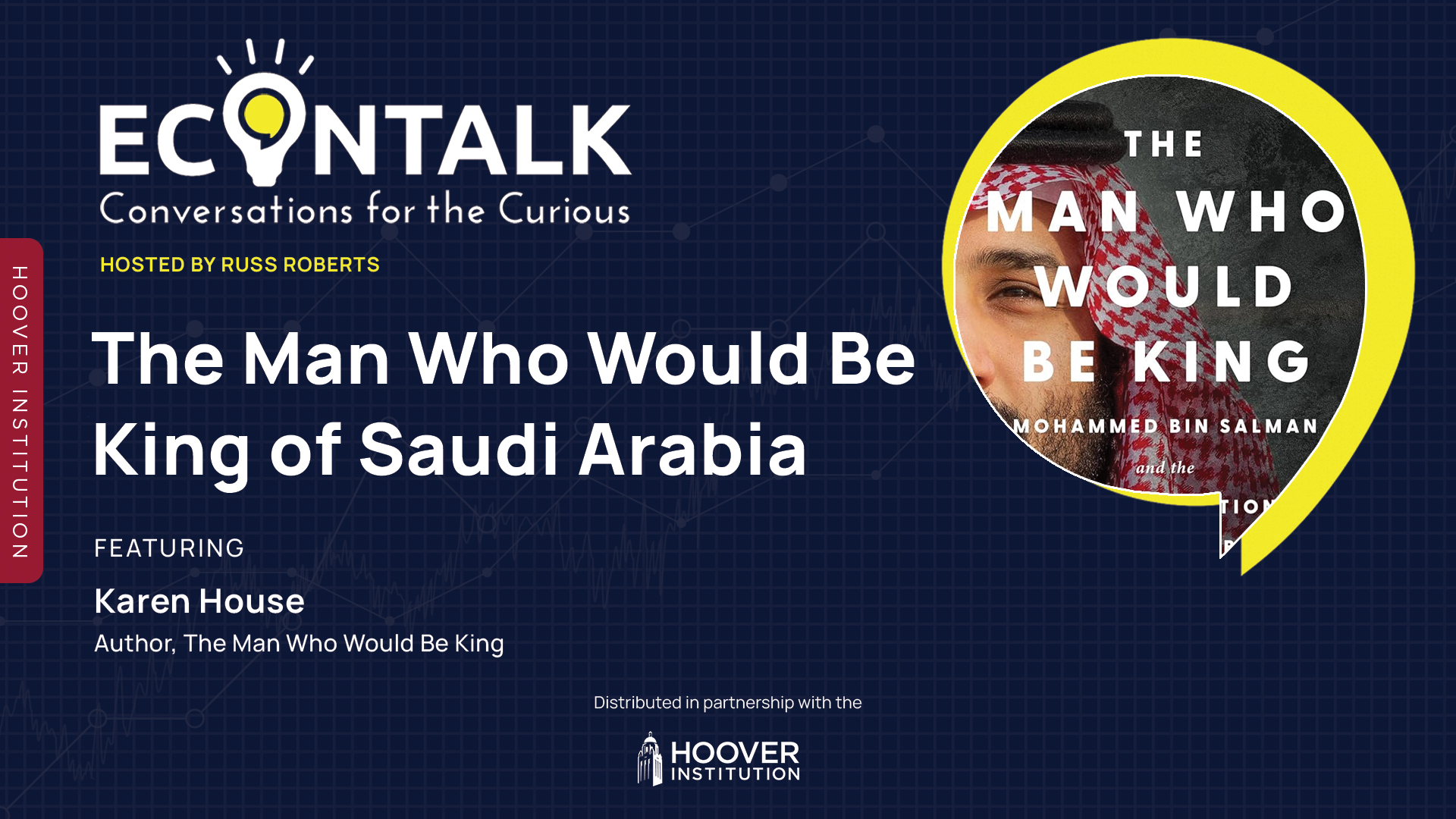
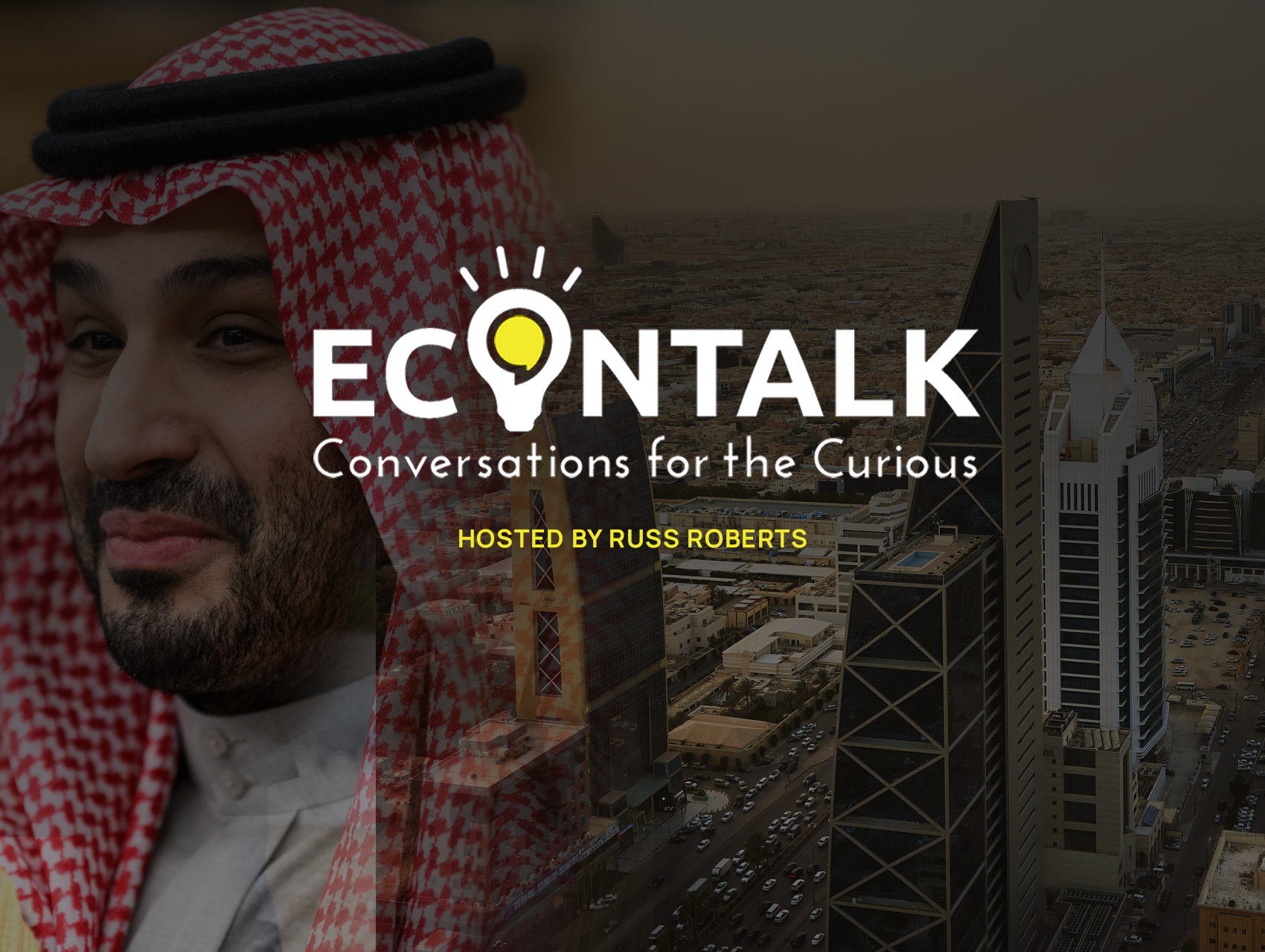
Crown Prince Mohammed bin Salman has been dragging Saudi Arabia into the modern world over the last decade. Journalist and author Karen Elliott House, lays out the Saudi leader’s motivations, hopes, and contradictions. Watch as she and EconTalk’s Russ Roberts explore the crown prince’s mix of cultural liberalization and political dominance and where his balancing act might lead his country in the future.
Listen to this episode: Click here
- Today is January 12th, 2026, and my guest is journalist and author Karen Elliot House. Her latest book is The Man Who Would Be King Mohammed b Salman, and the Transformation of Saudi Arabia. And that is the subject of today's conversation. Karen, welcome to EconTalk. Thank
- You very much.
- Your book is a portrait of Muhammad Ben Solomon, and I may be pronouncing his name incorrectly. You'll, you'll tell me. He is the 39-year-old Prince Crown Prince of Saudi Arabia. He is commonly known as MBS for his initials. He is the son of King Saban, the Crown prince, and indeed the man who would be king. Let's start with how his father came into power and, and how MBS is so much more than a Princeton waiting, which is, would be a normal thing to assume.
- Yes, crown princes in Saudi Arabia typically have just been bodies waiting to ascend when the king dies. But MBS is vastly more than that. His father was Crown Prince under King Abdullah, who outlived three crown princes and, and thus King Salman became king. I mean, he, he, most people never thought he would be because he was down the line, but the deaths of his brothers brought him forward. So he became king in January of 2015 when King Abdullah died. And MBS, who was his father's assistant at the Defense Ministry, his father was defense minister in Crown Prince to King of Doah, immediately began changing things in his father's new government.
- Now, that transition was complicated. We'll talk a little bit about in a second, but this family of, of kings and crown princes, you mentioned there were three, they're often more than one. They often, the kings of Saudi Arabia ha often have many wives and children, and sometimes that transition is violent. Give us a little thumbnail of how long, roughly that's been going on and that that family's rule and, and which brings us up to the present.
- The story. I have been going to Saudi Arabia for nearly 50 years, and the story, and what was written in history, all of that time was that the Al Sauds founded the Kingdom of Saudi Arabia in 1744 with the help of Mohammed Abdul Waha, the, the founder of Wahhabism, the brand of Islam that the Saudis had largely practiced under this king and this crown prince. They suddenly discovered that the al founded the first Saudi state in 1727, and all by themselves, Abdu Waha, you know, was out there, but he had nothing to do with it. But the time they met him, they were an established state and he helped, they helped him. So the co-founding went, went out the window, obviously, I think, because one of the first things that this king and his crown prince did was diminish the role of Wahhabism in Saudi Arabia. But since that time, whether you take 1727 or 1744, Saudi al sod rulers have been sometimes removed violently by their brothers, their cousins, their nephews. And so it's, it's commonplace. They lost power in the 1824 because someone killed someone and they regained it and then lost it again in the 1880s because the Ottomans overthrew them for being too rigidly religious. And so it is MB S's grandfather and King Salman's father that reentered, he fled, he reentered Saudi Arabia in 1904 snuck into Riyadh and his men killed the then governor of the province. And they fought a 30 year civil war to reunite all of Arabia under the au and he declared the kingdom of Saudi Arabia in 1932. So that is the group that has ruled since then and their heritage. And that, that gentleman, well, one the last thing on his children, he had 44 sons by 22 wives, and an endless number of, kind of one night wives and concubines, he, part of his knitting country together was to marry the people, the wives of the, the tribal chiefs he killed. So that everybody, in a sense is part of the, the extended al outside family.
- Which, which one was that? Who did that?
- Abdulaziz, the founder of this 1932 Okay. Kingdom that we're in now.
- Okay. And so to my eye as a, a newcomer to the Middle East, Saudi Arabia's, a little different from a number of the other players in the region. Some of them have storied pasts, which, you know, different leaders claim to be part of or not part of an obvious example would be Iran or Iraq, but, but some of them, or the product of post-World War II empires being dismantled Lebanon and Syria, Jordan being the most, and Israel being the most obvious examples where borders and, and the ruling groups don't have the legitimacy that other nations have, or at least it's up for grabs. Is Saudi Arabia in that sense a little because of this founding, going back to the 18th century? Does it matter? Is it a strong part of national pride?
- It, it was never, Arabia was never colonized like, you know, the French controlling Syria or Lebanon or the British controlling most of the rest of the Middle East. The British provided money to King Abdulaziz when he was trying to hold onto Saudi to the part of Arabia that he had gained control of. And then he, he was, had had to get rid of the, the family of King Hussein. King Abdullah of Jordan. His ancestors were ruling Mecca at the time. And that was part of King Abdulaziz getting rid of people. He, the British were supporters of the Hussein family and Mecca and of Ibsa, and eventually Eau got King, Abdulaziz got rid of the Hussein. I think they, you know, it, it is a different country because at some level, all Saudis I think do have pride in the fact that, you know, they, as Jesse Jackson would used to say, and the civil rights leader, I am somebody they see themselves as as somebody, even though a lot of other Arabs look down on Saudis, as, you know, tribal people with little education. I mean, that's obviously changed and, and is continuing to change as they educate their people.
- So Mb S's father came to power about 11 years ago, and we'll talk about the rather extraordinary changes, which I was unaware of until I read your book, that MBS has somewhat successfully it, it various areas very much successfully done. But I wanna just wanna start with your personal relationship with him. How many hours have you spent interviewing him? One-on-one and, and face-to-face?
- I've seen him seven times in an interview setting and a few other times at a, you know, a dinner somewhere where you can talk to him. He, he out there and, you know, I'm a reporter, so I never let go of an opportunity to talk to somebody, but, and lots of the interviews were two and three hours, so I would say probably, you know, 16, 18 hours of talking to him.
- And you made many trips to Saudi Arabia and met and talked to many, many other people, ministers and, and many others from the government, from other sectors. We're gonna learn in the course of our conversation that this is a very complicated man, a very ambitious man. But let's start with his political ambition and what he did when he came into, into the Crown Prince role, when his father came into office and the role that the Ritz Carlton played. 'cause it, it's a, it's a telling story.
- Yeah. I i, he was not, when his father was initially, they paid their allegiance, the brothers and ancestors due to the New King, when he was originally sworn allegiance, MBS was, as I said earlier, just his father's defense chief of staff. But he immediately called together four ministers and said, and began reorganizing his father's government. He wasn't Deputy Crown Prince, he wasn't Crown Prince, but he obviously had his father's approval, and it's part of this young man in a hurry. I mean, he said to them, you know, I want to get rid of all of these councils. They had that simply gummed up the works. They didn't actually like a cabinet for the president here, you know, they go through stuff and then the president's supposed to see, decide and sign. They just spun the paper, was his view. And so he said to these four ministers, I, I need this done. And they said, well, you know, this will take time. And he said, take time, but be finished by tomorrow morning. So they, they were, but you know, that's the, that's the speed at which he started out. And then fairly soon his father made him Deputy Crown Prince. So in 2016, when he unveiled his Vision 2030 reform agenda and removed the, it, that is an agenda to take Saudi off of dependence on oil and, and diversify it, the economy into many other things, including tourism and infidels. Visiting Saudi Arabia was something the religious did not approve of. So he, for many reasons, he sidelined the religious police and said, don't come on the street anymore. You are not allowed to arrest anyone. If somebody is truly, you know, doing something wrong, you can alert the police who will handle it, but you can't go around as they used to do with their sticks, you know, hitting women's legs or hitting the doors of businesses to demanding that they close for prayer. So that was a, a shock and a very popular one to people in the community. The next big shock was when he began calling people and saying, the king wants to see you, and then putting them in the Ritz Carlton Hotel for corruption, for money they had allegedly built from the government. And I'm sure in most cases it was true, because when I did my first book, everyone said that 30% of the budget, at least every year, simply disappeared. You know, it didn't go into anything. And that became very controversial in 2009 when there was a big flood in Jetta, and lots of people died because the money that was supposed to have been spent on sewage and disposal had gone into someone's pocket. So he began putting not just normal people, but senior business people, senior princes into the Ritz Carlton, and they were accused by the government corruption apparatus of X, Y, and Z. And that was a even bigger shock to the people of Saudi Arabia. And externally, I think, to see, and the Saudis liked this too. Most of the ones I talked to, to see the biggest names in princely heaven and the business heaven in, in a certain kind of hell at the Ritz Carlton Hotel, which is clear, is the fanciest, nicest hotel in Riyadh over days, you know, months, years, some of them got out, some of them still are not out. King Abdullah, one of his sons who had been the governor of Riyadh, refused to confess that he had taken any money and is still not in the Ritz, but in prison. So some people got out under house arrest, some people paid money, but it, it, it has left a very, I would say, what's the right word? A-A-A-A-A frigid fear in people that, you know, you, you have to be careful. You can't participate in corruption. I am sure there is still corruption going on because they are arresting people for corruption, and you read about it, but you know, how much of that is real corruption and how much of it is an enemy's list? I don't know. It may be all corruption, but at any rate, the Ritz Carlton Hotel was a far bigger shock to the Saudi people than the death of Jamal Khashoggi in the Saudi consulate in Istanbul.
- Okay, we're gonna get to that in a little bit, but the, the first two things you're talking about would, are shocking. And it was a, a clear signal that under the New King and his crown, or not crown prince, but the man who took power effectively, this, this young man in his twenties at this point, late twenties, as you say, it's a man in a hurry.
- Yeah. He was 29.
- And it's the end of business as usual, two extremely central parts of Saudi culture at this point. Right. The, the role of religion, literally in the public square, literally in the public square, meaning where people going around with sticks, checking women's clothing, headdress, headwear, businesses closing for prayer and, and then the arrest and prosecution of who knows what level of legitimacy, but a lot of people who disappeared for short and then some long periods of time. The other,
- The role of religion and the role of corruption. Two huge things in Saudi Arabia
- That had been central, obviously you said they were both popular. They, they weren't popular with the religious police.
- Yeah.
- And they probably weren't so popular with whoever owned the Ritz Carlton, because it's not so good for business to have a lot of rooms taken up by prisoners. But the religious police were accurately the religious, the clerics and others who, who wielded power over the population. They didn't like this. How did they respond? And, and how did MBS deal with that?
- What he told me is, I'm trying to get the religious to have a conversation with themselves, but obviously that conversation was, the light of intimidation was over it. Once you take the religious police and say, you cannot arrest people, they, they did not fire them. They're still, they still are paid, because that's the Saudi way not to upset people's finances too much, but the clerics who, the senior clerics who actually determine what they have, what they say is the right religious conduct, as you say, were not pleased. Some of those people found themselves in prison. Some of them were quietly removed because the top senior clerics, the Council of Oma, are appointed by the king. So if you want to keep that appointment and you want to keep all of the goodies that have gone with it, you learn to see religion through a different light. So some of them did not, some of them did, as I described in the book. Some of them did recant earlier things they had said and say, I was wrong to say that, you know, more moderate Islam is the right way to go. But some found themselves in prison.
- Speculate for a minute about the motivation of MBS in, in this maneuver on the religious front. Obviously he, he has, he's exposed to ideas and books and people and places that not the, that the average Saudi citizen is not. It's also a question of power. By reducing their power, he strengthened his own. Do you have any thoughts on, on this, why he viewed this as so important, given him the benefit of the doubt, assuming it was in some dimension he thought it was good for the country, not just for himself?
- Well, I think he, he did think it was good for the country because what he wanted to do in Envision 2030 was revamp the economy. And to do that, he wanted to allow women to drive and work. And both of those things were forbidden by the religious authorities. A woman could teach in a girl's school, but she could not work in a government office unless it was, you know, men and women were separated and most people were fearful of allowing their daughter to work in a, even a, the segregated environment for fear that at some point the men and women would have a business reason to talk to each other, and a religious policeman would walk in on it, and then your daughter would be ruined for life. So I think he did feel that it, yes, it removed a power center. And King Abdullah had talked about that, about a allowing women to work. He tried to allow women to sell lingerie in a department store. So to stand here and sell to you a gentleman, and the religious police said, no, no, no, no, no. And they shut it down. Whereas it's apparently okay for me to stand on this side of the counter and buy intimate lingerie from a man, it is not okay for a man to buy it from a woman, you know? So I think MBS, just like any of us would say, that's, that's silly, you know? And if you want to unleash an economic boon into the country, women are better educated by and large than women. 58% of university graduates are women, not men. So he did want, I believe, for economic reasons to allow women to work in private sector, government offices, et cetera. And it's amazing to me, now, you, if you go in a, a private office or a government office, you see men and women ascending in the elevator, jammed in against each other, a again, which would've just been horrifying. You know, I knew a lot of men who wouldn't get in an elevator if there was a woman in the elevator, because they didn't wanna risk any accusation of anything. Now they're all jammed in, headed up to their offices, and nobody seems to think anything about it.
- And, and you saw this personally in your own trips, then you read a little bit about it in passing. Yeah. You know, and how long have you been going to, to Saudi Arabia?
- 47 years.
- So when you went there 47 years ago, you conformed to the dress codes of the, of the,
- Well, 47 years ago, 1978, the country was conservative, but not religiously rabid. This was under king face. No, I'm sorry, king polled. So I wore a, a knee length skirt and a long sleeve blouse. And I was taken, when I landed in JTA the first time to the oil minister's house, Zaki Yamani. And I had asked to interview him. So I was thinking, this is an interview. It was a big party with women and men mixing alcohol. We watched the World Cup Soccer final from Argentina on satellite. You know, it was, it was a normal life. The women were wearing long dresses, but, and nobody said a thing about me not having an abaya or anything. What's an abaya? The abaya is, it used to be only black. It's now multiple colors. But what you shroud your body in so that men don't just see a moving black mountain is
- Your, is your face covered in the Aya
- No, that is, the hijab covers your hair, and the knee cob covers your face, and people no longer have to do that. The last time I saw the Crown prince, I was wearing my black abaya, and I walked in, you know, my head just like this. And he said to me, you know, don't have to wear that. And I said, yes. I mean, I think he would like fewer people to wear them, actually. But I find it convenient because you attract less attention if you're, you know, wearing your black Avaya. I also have a pale green one now, but
- So what, what changed between 1978 and 2016 when it went more fundamentalist?
- Two things happened in 1979. The s shah fell in Iran, and the Saudi royal family did not wanna go the way of the Shah. So they began to accommodate to what the religious officials told them, you know, get women off tv, get women's pictures out of the newspaper, cover women up, you know, all of these things begin to rear their head. And also in 79, a group of very, I, I don't know how religious they were, but at least they alleged to be took over the Mecca Mosque. And that was truly frightening for the Saudis. They, they tried to hide the news for, it took about two weeks to get the occupants out, and they finally had to call in the French, who used a poison gas to evict the people, because the, the man who was doing the prayer in the mosque was suddenly charged by at, with people with knives. And, you know, they put one to his throat. And it was, I mean, i, I, I don't blame the royal family for being frightened. But those two things, the fall of the shot, and then this attack on the holiest place in Islam by people whoe, they were the new mai, M-A-H-D-I, the new man from heaven to rural. And that obviously would've eliminated the, so those two things changed everything. And then I, in 1980, when I was there, I went to see Prince Turkey, who was the head of intelligence and a son of the late King Faisal and an American, an ambassador to Washington and London subsequently. But he saw me in my normal clothes, but his aide said to me, I can't drive you home. I can't drive you to your hotel in the front seat, my car, unless you cover up. And he gave me a, like a, a just a huge piece of black silk. And you were supposed to put it over your head and, and around you, and a scarf that you covered your face with. So I was totally swathed. And since 1980, I have worn an abaya in Saudi Arabia.
- Where did ab Bs go to
- School? Only in the kingdom. He went to the Riyadh school, a school that his father owned, and then he went to, to King Saud University and to King Saud University Law school. So, you know, that's why he knows a good bit about beyond growing up in Saudi Arabia. He knows more about Sharia law, the, the Islamic law that guides life and punishment in Saudi Arabia. So he's not, because of that, I think is intimidated by some cleric, as others might be.
- So we've got the religious police neutralized, we have the role of women. Again, this is, this is extremely abrupt. This is in the last 10 years. And a lot of this occurred right away. Right. And, and as
- Soon as 2018, the women got the abil freedom to drive.
- And that's just a sim symbolic of, of a representative of the, of a much wider rate of change as they were encouraged to go to work, they, they could dress differently than they had. And the culture around the citizens of Saudi Arabia becomes extremely westernized, as you describe it, rock concerts, amusement parks, sporting events. And some listeners will know about the forays of, of Saudi Arabia into the golf tour and, and, and trying to lure the best golfers of the world there. Ronaldo, although not in his prime, consider one of the greatest soccer players, football players of all time is, is playing in the Saudi League. This is an, a transformation of, of the popular culture. That is it, it's hard to think of a parallel. And was it disconcerting, exhilarating, both. How, how did the people on the street take this?
- Well, Saudis are not demonstrative people, you know, I mean, I think they are a, a society that is accustomed to largely doing what? Accepting that the ruler is the ruler, and you are only supposed in Islam, you are only supposed to criticize the ruler publicly. You can try to talk to him privately, but criticize the ruler publicly if he is doing something against Islam. So I think people, my impression from talking to people is that younger people, you know, MBS is age and below, he's now 39, the below 30 people, and 60% of the population is below 30. So they have no recollection except of this religious rigidity. And with it, they got the internet in the, you know, when they were teenagers or younger. So they began to see how the rest of the world lived, and they wanted a life more like that. I think their parents and grandparents, you know, are, were more shocked by all of this change. And they don't criticize it openly. And if you know somebody well from previous times, some of them will say what they think, but now it is clearly not socially acceptable or it's hazardous to your health to be out criticizing. So I think it, my impression is that the country is more conservative than what you see going on around you. I've been struck the last three or four times, the last several years of going back that you see more women now wearing black Avaya again, in the beginning, obviously a lot of 'em still did, but there was more of the, you know, beige and gray and un un unsnapped and you know, so you could walk around with it flowing back and show off your expensive clothes or your sports clothes, whatever you are wearing underneath. And now I'm just struck when you walk in public places, you see more were people, some young women, you know, with their head covered very tight, some with the scarf just draped, you know, looking quite glamorous. Some with the whole thing across their face and just their eyes showing and, you know, some with just normal clothes and you don't see people wearing short dresses much. But I think the society is, as time has, as this has played out, that they're getting a, they're the cons, the natural conservatism that exists in Saudi society, I think is becoming more visible. And for the young, what they want out of this was more personal freedom and a good job. So if the economy can grow and they can get good jobs, that's, that's probably very good for the government. The last time I was there, I heard more young Saudis in October, October 25, when I was last there, expressing that it's difficult to get a job because the government has a conflict between two goals. One is quote, saudiization increase the number of Saudis in jobs, and the other is the need for more sophisticated talents as the Crown Prince wants to move the economy to AI and high tech. And, you know, so more, more people are finding themselves with degrees in marketing and they're kind of a glorified tour guide somewhere. So if they can't get out of that, that you know, they're not going to rise up the income ladder over the next 20 years. I know some people who predict that there will be great unhappiness 20 years from now by the, the 40 year olds, because they won't have the kind of incomes they expect. And some people who believe that when King Salman dies, the country will move back a bit. That he, the Crown Prince will be under more pressure from the public to, you know, having leaned forward like that. To just tilt it up a little.
- And you mentioned Vision 2030, which includes, you summarized it in a phrase of being less reliant on oil. It includes some extraordinarily grandiose or grand, I guess, depending on your perspective projects, many of which have been scaled back dramatically from their original exuberance. Give us a thumbnail sketch of how successful that, give us a thumbnail sketch of how successful that diversification has gone in the last it's a decade roughly.
- Yeah, they have, on the diversification front writ large, they have had some and success mostly in, I would say tourism. Because there are, there is a, I don't know how familiar all your audience is with Petra in Jordan, the EAN ruins in Jordan, but they're spectacular. And Saudis have a set of bertan ruins called Hegra in a region called Alula, which is beautiful. And they have tried, they have built in Riyadh, Riyadh Boulevard, Riyadh world. So all of these, you know, theme parks that people can enjoy, that they have one outside of Riyadh, about 45 minutes called Cillo, which now has the world's highest roller coaster beating one. The largest one now is in New Jersey. Not an hour from me, I haven't been on it, but I wouldn't go on the one in Saudi Arabia, but I would like to see it. So, you know, they have a lot of stuff that people can, Saudis can enjoy, and they try to keep it priced so people can all go, that it's not just something for the wealthy, but the big projects to transform Naomi is the most famous one. The line, this city of mirrored city like this taller than the Empire State building and stretching the distance from 105 miles. So basically from New York City to Philadelphia. And that one has, you know, really been scaled back because they, it, the height of it messes up bird migration. And the length of it means contrary to the advertising that you could get from one end to the other in 20 minutes, you can't get from one end to the other if the train stops anywhere else to let people on, you know? So, and the architects who I quote at length in the book on, you know, yeah, this is, this is something, you know, and we'll have to figure this out, haven't been able to figure it out. So the government has scaled it back.
- It's also just a little bit pricey, the original designs, so that there's also been some recognition that maybe this is not the best use of money. Right?
- Yeah, yeah. I mean they, you know, right now for the kingdom, they need to fund all of these projects and their budget and this big building, they need a hundred dollars a barrel oil and oil has been going down. It's about in the $60 range. And of course, president Trump is trying to use Venezuela and oil and get it down to $50 a barrel so that American consumers will have cheap gasoline next year during the midterm elections.
- You're such a cynic. I'm sure it's, I'm sure it's well intentioned. I'm,
- I'm, I'm sure. But that's one impact he would be happy to see. Yeah. And, and you know, if he succeeds, that's not particularly good for Saudi Arabia. And the other thing that I think if you were, I, I'm going to Saudi Arabia soon, they must be very, very nervous about Iran with all of the tension in the streets and Trump saying, I'm going to intervene if you kill people. And the Saudis have tried, or MBS has tried everything to quiet the region down. I mean, he hasn't had help. There's Gaza, there's Iran, there's Yemen with the UAE in it, you know, so he, his quiet strategy is, is not entirely successful, but if something happens, the Iranians are now saying, and this is, you know, doesn't take a genius. They don't have to say it for the Saudis to know it, that if something goes wrong in Iran, the Iranians may choose to retaliate against American forces in Saudi Arabia. And we saw it in Qatar already. So it, and in a way, worse yet, if Iran should turn out the way the human rights people hope and become a democracy, I mean, a functioning democracy, you know, other than Israel wouldn't, I, I don't think, you know, that's at the top of, of the Crown Prince's wishlist. I mean, stability is at the top of his wishlist in Iran. I'm sure whoever is in charge,
- And, and he would certainly like to have Iran's power in the region reduce, but a revolution isn't quite what he has in mind would be, I guess the way to summarize it.
- Well, their power has been reduced, you know, so if he could just, oh, dramatically, you know, between Israel and the US and, you know, if he could have just stopped the clock back in June or not too long after, you know, it would've been good.
- Yeah. I'll remind listeners, we're recording this in January of January 12th, 2026. There are a lot of people, it may be wishful thinking, but there are a lot of people saying that there is a, a serious chance that Iran, Iran could, that the, that the ayatollah could be out of power, some kind of revolution besides marching in the streets, which is what's going on right now, I guess. We'll, we'll, by the time this airs, maybe we'll know. But let's turn to Jamal Khashoggi, who you mentioned earlier. Give us, give us a two minute introduction to that story. He was murdered. It had a, I suspect, I think you say this, a surprisingly negative impact on mbss reputation. I, I don't, from your telling of it, I think he was unprepared for that. He has never, he hasn't been blamed directly for the murder, but he quote, has taken responsibility. So give us a little bit of the background of that.
- Yeah, Jamal Khashoggi, I knew from, I don't know, probably 2004 or five, you know, when I was working on the first book, he was basically, I don't call him a journalist because he, he worked for the government and he was somebody that, you know, king Abdullah's people would have talked to people like, like me, you know, he was a very conversational guy. He knew a lot. He ran the Arab News at one point, and he ran an Arab language newspaper, Al-Watan at another point. But, you know, just a, I would say hail fellow, well met with a lot of curiosity and knowledge. So I saw him, and the last time I saw
- He was a Saudi him. He was a Saudi, right? He was
- A Saudi.
- You say he was working for King Abdullah? He was working for the king of, of Saudi Arabia at the time.
- Yeah,
- Yeah,
- Go ahead.
- Yeah, - Yeah. No, he was working for his government. And the last time I saw him, he was not saying anything nasty about the crown prince. Indeed, he might not yet have been the Crown prince in 20, I think I saw him in 2016 or 17. Anyway, he was annoyed that he was not being allowed to write, and he knew that that had to come from MVS. But he said, and he had a good sense of humor, he said, I hope, I prefer democracy, but at least we have KPIs, key performance indicators. Because MBS was famous for having an iPad with KPIs on it for every minister on what they were supposed to deliver. So he was making fun of, at least this was some accountability. MBS was tracking their KPIs. And just
- Just to clarify, you said 26, 20 20 16, 20 17, this is when MB S'S father is in power.
- Yeah.
- MBS is doing a lot of things, but he hasn't been nominally titled the Crown Prince, even though he is acting like one and doing many changes already.
- Correct. He became Crown Prince in 2017, I believe.
- Okay.
- Anyway, yeah. So then he moved to Washington, and I didn't, Khashoggi actually, Mr. Khashoggi moved to Washington, and I did not see him in the, the US after that. I saw him on TV some when he was in the us but then suddenly, you know, he turns up murdered in the Saudi consulate in Istanbul. The U us the CIA's report said that the Crown Prince, the government was responsible because nobody would do this without the permission of the government.
- What year, what year is this, Karen?
- 2018.
- Okay.
- And, you know, it was such a, for the Crown pence, he was here in the spring of 2018. He was in America, and he was hailed all over the country as this, you know, new active young breath of fresh air, crown prince breath of fresh air doing modern things, letting women drive and, and chaining the religious police, et cetera, et cetera. And then in the fall, Khashoggi iss murder, the contrast was, you know, huge people, people in Saudi Arabia. I was there shortly after we upset that the Americans were so hard. They said, the Americans are hard on the country, you know, we didn't do this. So they began to sort of at least side with the Crown Prince, because, you know, the Americans are being too nasty to us. Anyway, he, I I think he was, you know, a bit shocked by it. And if you recall, when he was in the Oval Office with Trump during the Crown Princess visit here in November, one of the reporters asked him something like, you know, how do you feel now that you murdered Khashoggi? And Trump jumped all over her and said he didn't even know it, et cetera. And the Crown Prince sat there calmly. And then he said he, he rightly, I think, chose to answer for himself and not let Trump answer for him. And he said something to the effect that, you know, it's a tragedy when someone dies. And you know, I have accountability, you know, and it
- Was on his watch, is I think what you said. He
- Yeah. Said, 'cause it's on my watch. Right. So he stepped up and, you know, instead of letting Trump defend him with, he didn't even know it. He just, he didn't say whether he knew it or not. He just said, you know, it's, in essence, it's a tragedy when someone dies and I'm taking steps to make it not happen again.
- But this murder derailed dramatically derailed mbss attempt to drag Saudi Arabia into the modern world and redeem the reputation of the country from a backwater, from a, a real, a fundamentalist religious theocracy to a modern state with women's rights and great sports, and a tourism attraction. And now it turns out it's, it's a thug ocracy. It's a place where dissenters get not just censored or jailed, but murdered. Do you think somebody made a bad miscalculation of how the west would view this? You suggested your book that it, it was maybe an operation that was attended to kidnap him and bring him back to the country. Right. Why, why was he, what what's your guess as to why he was targeted, given how it turned out so badly?
- Because I think they, you know, they saw him as a threat. I cannot personally imagine Hawaii, but their view was, he was in bed with Qatar, with the Muslim Brotherhood. He was taking money from Qatar. He was a Muslim brotherhood, sympathizer, and the Muslim brotherhood is bad. So I can see why they would think, you know, they do this as I write in the book, they picked up a, a prince and the man who was in charge of this operation to, against Khashoggi and the consulate, Mr. Katani, is the same wine who was posing as a pilot when they picked up a prince and brought him home. 400 pound Prince threw him down the stairs. He hasn't been seen since. And then Mr. Katani, the pilot shows up the next day and meets with the, the stewards on the plane and says, you know, my name is Mohammed Katani, and he lets them, he lets them go. And he was the head of the Royal Court press office when I met him. And is, you know, he was removed from that job after this Khashoggi incident. But, so I can easily believe that they wanted to get him back to the country and, you know, put him in prison or something. I mean, the human rights people would probably track that and protest, because Khashoggi was a well-known person. But you don't get the, the Saudis wouldn't get, I believe, normally as much negative press if someone is just taken back to the country and they sort of disappear and is he in prison or not? And, you know, as, as when someone is murdered and is body chopped up and taken out in suitcases.
- Karen, do you take, do you get money from Qatar?
- I do not. - I don't either. I think we're the last two. I, I, it's, I I, I'm kidding. Of course, but I know, I know. But, but a lot of people, and Qatar does have a lot of money, and they do spend it, we know about some of everywhere. We know about some of the places they spend their money. We know they spend a lot of money on American University campuses, and I presume they get something in return. Is it plausible that Khashoggi was a Muslim Brotherhood supporter, taking money from Qatar and advancing the, an agenda that was threatening to Saudi Arabia? Is there any evidence for that?
- Yep. I guess it's possible, but to my knowledge, I mean, I am, I'm not a sleuth reporter. I have never tried to to track that.
- Okay.
- But, you know, I mean, I don't, somebody might have taken money. This is why, you know, you can't, you can't take money from people. Yeah.
- It's, it's, however, this is the Middle East and taking money from people is a very old pastime. Here, I wanna turn, let's, let's turn to Israel where I'm sitting. And before October 7th, 2023 with the Shamas attack coming outta Gaza, there was a lot of optimism here about a potential normalization in the, of Saudi Arabia joining the, the Abraham Accords. And people have speculated, who knows, but people have speculated that Iran's proxy, Hamas, one of the reasons that Hamas attacked was to derail that that normalization, which of course, it, it has, at least for the last two years, w since then, Saudi statements. And it's hard for people, I think, to not remember. It's hard for people to remember. The statements are often not exactly what people actually believe, but are done to accomplish things. This is, As a journalist, you know this quite well, but most of us can forget that. But the public repeated statement that we get from Saudi Arabia these days, oh, and one footnote, as far as I know, Bibi Netanyahu would love to have normalization with Saudi Arabia as a piece of his historical legacy for obvious reasons. It, it would be great for, I think would be good depending on what it costs, though, not, not clear, but the public statement is that Saudi Arabia will not normalize with Israel until the Palestinian issue. And I'm not, there's a number of phrases I'm gonna use here, none of which are precise is resolved, or until there's a two state solution, or until there's a path toward a two state solution, or until there's a vision of a two state solution.
- The crown prince's exact words have been until there is a Palestinian state with its capital in East Jerusalem.
- Okay. So that statement, which could be retracted under the right carrots and sticks and who knows what, but what's your best read on what sa, I mean, you've said very clearly Saudi Arabia wants quiet 'cause they wanna have an economy that grows. It's, there are a handful of players in this region who see that as their goal and many who don't. What, what are your thoughts on, on where Saudi's views might actually be? The Saudi Arabia's, Saudi Arabia's views are the princes on this issue.
- My belief is he still, for reasons outlined, you know, would like to have relations with Israel. He does not see Saudi Arabia as part of the Abraham Accords, because those are small little countries. He is the leader of the Islamic world, the big Arab country. So he would be joining in, I think in his mind in a different league than the others that are in it. So I think he still wants it because the corridor of development, moving things through from the India into Europe, through the Israel, and not having to deal with the Iranians, I was gonna say Panama Canal, I started Yeah, the, the Suez Canal or the Iranians, the Suez Canal and the Iranians. Yeah. But I personally think that it, it's quite a ways off. I know there are a lot of people that predict that and that, you know, he's dying to do it and there's gonna be some sleight of hand among he and Bbe and Trump. And I think obviously Trump would like to have it as part of his legacy. That too.
- Yeah.
- But whether I think the next period, at least year for the Crown Prince is going to be one of being more cautious than usual because the king, even though he's very ill, is, is a respected elder. And without him, I think the Crown Prince is somewhat more vulnerable until he can establish him himself as, you know, the respected ruler, which sounds strange because me and everyone else says he's been running the country. But there is a difference, you know, between, you know, being, what's his name at Berkshire Hathaway and Warren Buffet, you know? Yeah. Warren Buffet and, you know, and some successor of his without Warren Buffet. So I think, you know, if, if the Crown Prince loses his Warren buffet, he'll have to, it'll still take a little time so that he doesn't, so that's one reason. Another is the, and it's part of the same, I guess, but young Saudis are very much against recognition of Israel, if you believe polls done by Western entities because, and I think, you know, there's no reason for him to, you know, go into the buzz. So I'm sure that the 90% who say they're against it, if he did it tomorrow, that number would drop to 40% or lower, you know, just because of the kind of obedience syndrome. But you know, there comes a time you're watching Iran, the obedience syndrome is diminishing. So, you know, for all of those reasons, and Iran being a huge other reason, you don't need to be causing new issues when Iran is as unsettled and potentially dangerous to your short term health. And maybe if it disintegrates, that's even worse and more preoccupying. So I think he will, I think he will be, I cautious for, I don't know when his father will die, obviously, but King Abdullah died at about 90 and six months, I think. And King Salman turned 90 of December 31st. So you know, that that gives him by history another six months. So, I mean, obviously I'm not God, so I don't know when he will pass on, but the, I think everything points to caution
- The gap between the leadership and the people and these non non-democratic autocracies. It's true in the countries that are in the Abrahamic accords, the leaders went, are ahead of their people, if you want to use that metaphor. Yeah. The average citizen, at least this is the, the received wisdom is that the leadership's much more liberal, much more interested in, in peace, much more interested in a more centrist, moderate version of Islam than perhaps the, the people in the street. I don't know if that's true of Islam in, in Saudi Arabia. But one last question about the Prince, then I want to give you a chance to make some, give us a, a, a final word. I asked where it was educated, because when I read your book, I'm sure you told me in the beginning, but by the time I finished, I'd forgotten, and I didn't get to check it before the interview. And listening to you talk about him and thinking about his overall perspective, he seems like an Oxford educated person from the Middle East, which is a long tradition, or somebody who'd gone to an Amer, an elite American university as a, as a young man because, because that his, his father would've wanted him to get exposed to Western ideas. So here's a guy who goes to Saudi universities, he's got an iPad with KPIs, which sounds like he's been to Wharton, but he hasn't. How do you understand that the innovative perspective he's taken it, it's, the entrepreneurial part of it is fascinating, right? His, his understanding or belief that he has to take an enormous leap, a radical change in a very un radical country to preserve its future, given its young people's demographic. It's a, it's what are his influences? That'd be a better way maybe for me to ask the question.
- That is precisely what led me to write the book. Where did he get these ideas? You know, he's not somebody that went to Oxford or Cal or MIT or Wharton. And he said he has, he is, as the book says, the sixth son of the king, the first of his mother's six sons, she's wife number three. So wife number one had five sons and a daughter. And there was a second wife that had a son who's the seventh son. He's after MBS. But the older boys, you know, went to, one of them went to Oxford. And you know, I I, the, the energy minister who's his half brother, is a very area date, you know, western kind of guy who loves Italy and has spent a lot of time there. And, and he, he didn't, and he said that when I asked him about these things, he said his mother is the one that his mother said to him as her eldest son, I don't want you to be an also ran to the first wife's boys. So he needed to step up and, you know, learn that she made them go to, to classes after school, that they had to read books and do book reports to their father. And that he seemed to have always had this sense that he sat below the salt, you know, that he wasn't somehow seen as, as good as the older princes, not just as
- That's his older, that's a table, a dining room table reference for those who, who, that's a very arc ancient, it means you're not seated near the head of the table.
- Yeah. So he, he seems to have a kind of ignatious, he told me that this is in the book, that he got a, an allowance of $500 a week, but that when he was 11, I didn't get any at my, any age. I had to iron shirts to earn money. But anyway, he got $500 and that he said, but you know, his cousins, his older cousins, most of them got 20,000, you know, so he, I think he just, he's a striver and he seems to be data driven. He told a story about how the deputy, the governor of Riyadh was concerned that a rearrests were occurring. And so he hired more policemen to arrest people. And he said if he had just looked at the data, he would've realized that what you have to do is find ways to reduce recidivism, you know, that it was different. It was the same people being arrested again and again, you know, it wasn't a bunch of, and he's very, he's very into data. So the KPIs and how, what are we doing and how are we doing it, and is it working? And I think, you know, most of the ministers, the minister planning is MIT educated. The, another one of the ministers is a Harvard law grad. They're all very different from the ministers I dealt with for the previous 35 years, who went to work at 11 o'clock in the morning, went home for lunch, went back from five to seven, and that was it. These guys are working all day long. You can see a minister now at eight or nine in the morning, which would never have happened. And they all are up till midnight because that's when he tends to conduct his meetings. You know, most of my meetings with him have been, you get there and wait, and wait and wait, and then you're in there for from midnight till 2:00 AM or something. So I think he, I think he is a really interesting in man for how, how does his mind work? And the other thing that people say about him was that because he had not much to do as a kid other than school and what his mother made him do when he got home, he played video games all the time. And that one person said, he believes that anything you can do in a video game, you can do in real life. And I think they said that seriously. I think there is some real truth to that. That's, it's part of why the line went on and on and on, was that, you know, it, whatever you dream, you should be able to do it. You know, that he asked one of could you, could we build the deepest building? You can build underground maybe, but why would you want to, you know, I mean, he's, he clearly has a very active imagination and whether, you know, it didn't come from the, the Saudi religious authorities who tell you, keep your mind done getting from here to eternity. And his mind is on e expansively on everything it seems.
- So, just to be clear, all the liberalization we've talked about, the role, the women, the reduction of power in the, in the religious police, the entry of extraordinary western culture into daily life, for many Saudis, the amusement parks, rock concerts, sporting events, this has not been accompanied by political liberalization. No. He, he is a harsh autocrat. And as you point out, many of his competitors or dissenters have either been put away or are not seen. And you ask a question at the end of your book that I wanna close with, is he a transformative historical figure or just another Arab tyrant close quote? What's your answer?
- I think he has a chance to be transformative if he listens to people around him. And how much of that, there's no way for me to know. Obviously, if I were in a meeting with him and one of his ministers, it wouldn't be the kind of meeting they'd be having alone. I don't, and I've never had a meeting with him and one of his ministers. I think there is a chance, I think it's getting harder because the money is getting harder. They're not getting the kind of foreign direct investment they need, partly because the region is didn't turn out to be peaceful and stable and Saudi and Israel, you know, so people are more reluctant to put money in. They have borrowing capability, but their own revenue is, you know, they're gonna be running deficits for the next, by their acknowledgement three years. And they're trying to cut back to get closer, to cut spending, to get closer to balancing. So in a word, in three words, I don't know. I think there is a possibility, but it is harder than it looked five years ago. And these next five years, I think are gonna be very critical test for 'em. It's easier to announce plans and spend money than to actually execute the plans and earn money. And that's the position they're in now. The, the second decade has to be about executing and earning, not spending, and big plans.
- My guest today has been Karen Elliot House. Her book is The Man Who Would Be King. Karen, thanks for being part of EconTalk.
- Thank you. I appreciate it.
ABOUT THE SPEAKER
Karen Elliott House is a senior fellow at Harvard Kennedy School’s Belfer Center for Science and International Affairs. Elliott House retired in 2006 as publisher of The Wall Street Journal, senior vice president of Dow Jones & Company, and a member of the company’s executive committee. She is a broadly experienced business executive with particular expertise and experience in international affairs stemming from a distinguished career as a Pulitzer Prize-winning reporter and editor. She is the author of On Saudi Arabia: Its People, Past, Religion, Fault Lines—and Future (2012) and more recently, The Man Who Would Be King: Mohammed bin Salman and the Transformation.
RELATED SOURCE
- The Man Who Would Be King: Mohammed bin Salman and the Transformation of Saudi Arabia by Karen Elliot House (Harper Collins, 2025)

