

- Key Countries / Regions
- International Affairs
- Indo Pacific
- US Foreign Policy
- Economics
- Answering Challenges to Advanced Economies
- Confronting and Competing with China
- Determining America's Role in the World
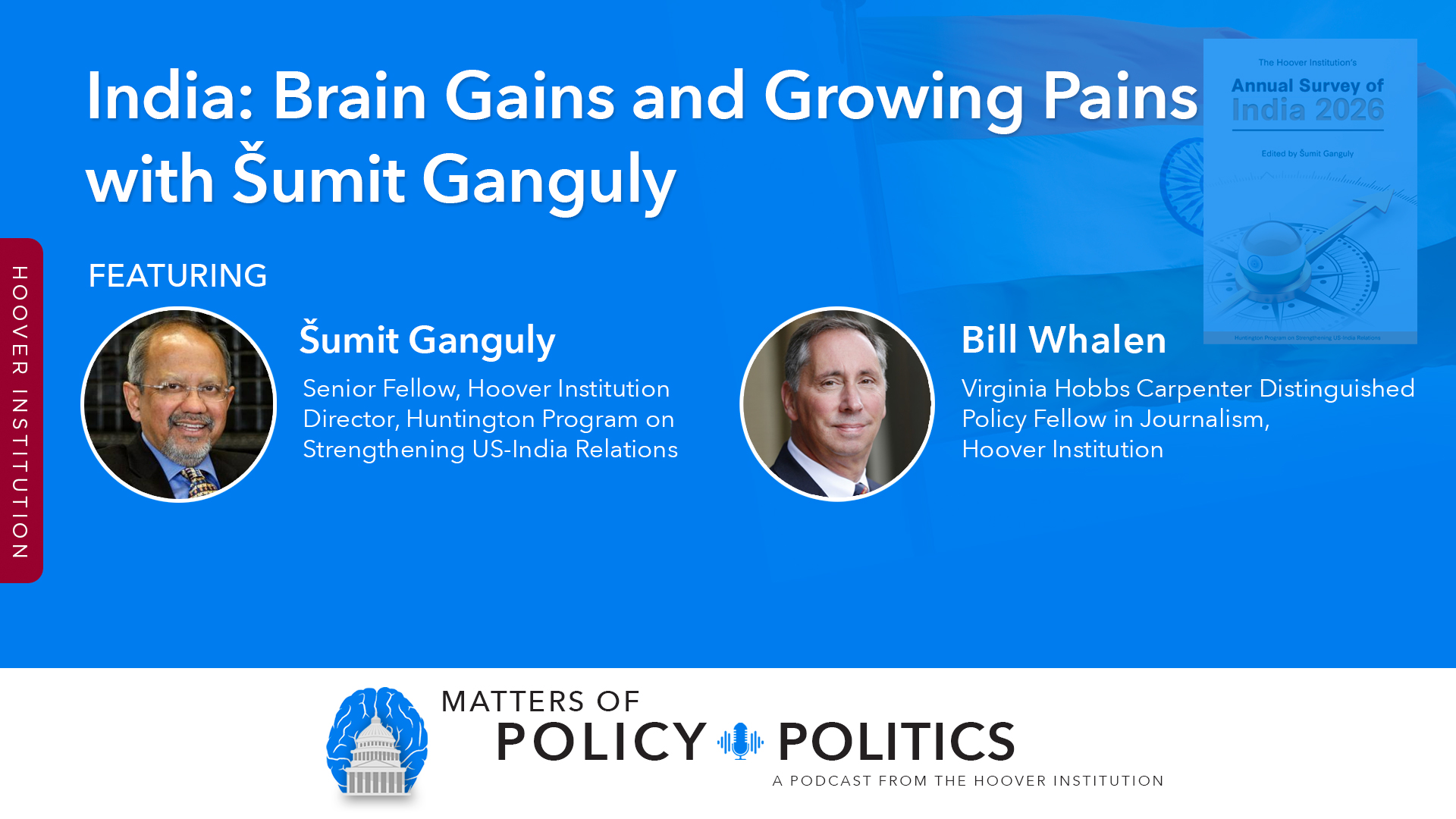
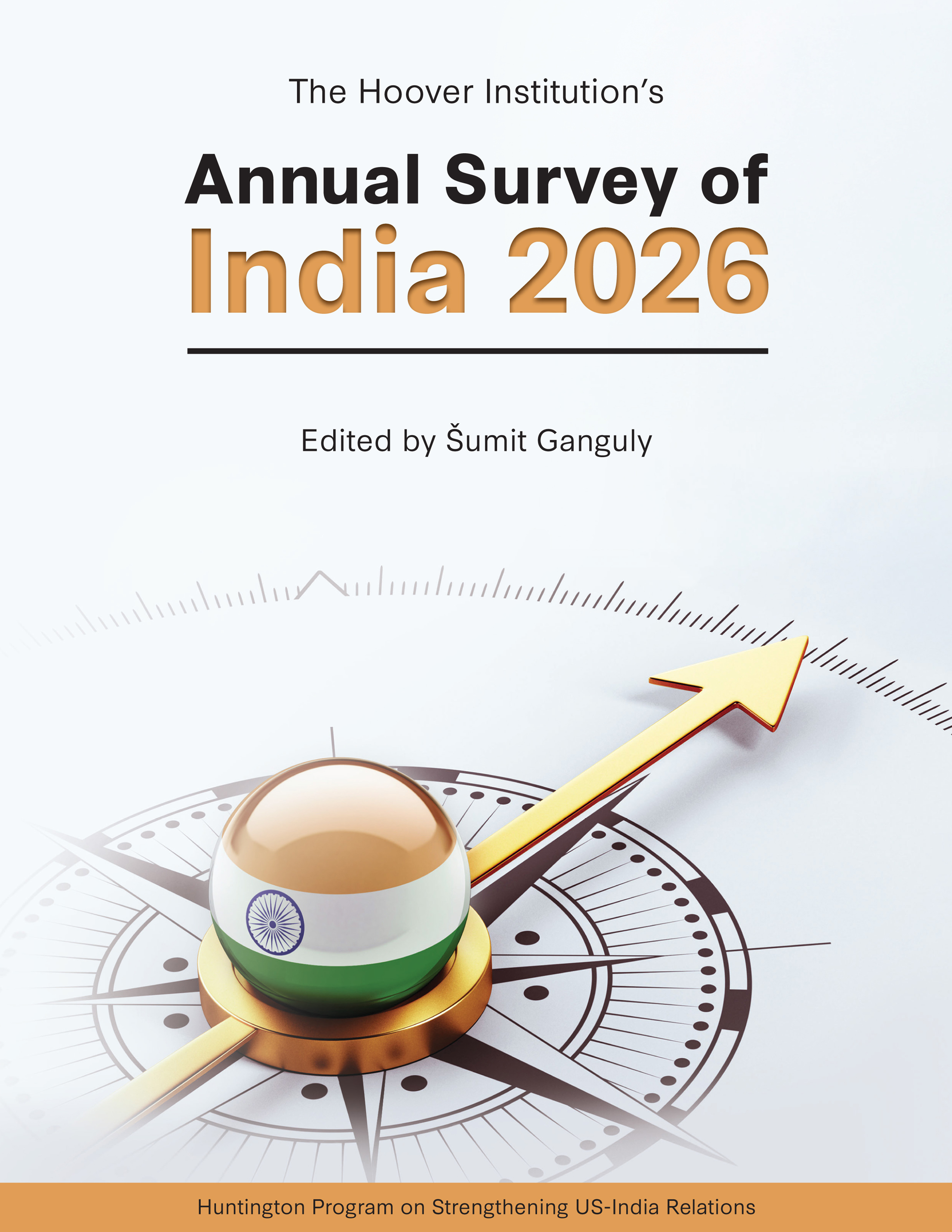
Two decades shy of its 100th anniversary of statehood, how is India progressing in its goal of becoming an innovative, prosperous, greener and developed nation? Šumit Ganguly, a Hoover Institution senior fellow and director of Hoover’s Huntington Program on Strengthening US-India Relations, discusses Hoover’s newly released Annual Survey of India 2026. Among the survey topics explored: an assessment of India’s economy; the nation’s uncertain foreign policy; Indian education at a “crossroads”; and the nation’s contemporary challenges regarding science, technology and innovation policy. Also discussed: how India’s “strategic autonomy” and oil needs are affected by the war in the Middle East; economic competition with neighboring China; Prime Minister Modi’s complicated relationship with the American president and US tariff policy; and India keeping innovators from relocating to the other land.
- India is the world's fourth largest economy and home to roughly one fifth the world's population. But it's also something of a mystery as to its role on the world stage and what the future holds as it continues to modernize and develop from within. Coming up next on matters of policy and politics, a Hoover Institution's senior fellow, will break down Hoover's annual India's survey, an eight part examination of India's landscape, focusing on political, economic, social, and environmental challenges. Stay tuned. It's Wednesday, March 4th, 2026, and welcome back to Matters of Policy and Politics, a podcast devoted to the discussion of Hoover Institution, policy, research, and issues of local, national and geopolitical concern. I'm Bill Whalen. I'm the Virginia Hobbs Carpenter distinguished policy fellow in journalism here at the Hoover Institution. I'll be your moderator today, but I'm not the only Hoover fellow who's doing podcast. I recommend you go to our website and check out what we have to offer. The link for that is hoover.org/podcast. You'll just see all kinds of great content there, including if I may humbly brag, the audio version of the Goodfellow Show that I get to do with Neil Ferguson, John Cochrane, and HR McMaster. In fact, we'll have a new edition of that coming out late on the 13th or early on the 14th. We're gonna do a 30 minute show on Iran. But today's podcast focuses on a different country, beginning with an I in that is India, home to the world's largest population, about 1.76 billion souls, or nearly one fifth, the world's population. It's a world's fourth largest economy. It's on a course where it hopes to be a developed nation by 2047. That's not a coincidence, and it's also the centenary of India's independence. Now that's 20 years in the future, but in the present and 2026, there are plenty of questions about India's future and its role on the world stage, helping us unpack this and more including the Hoover institution's ongoing interest in India. It's my honor to welcome back to the podcast Humid Ganglia, a Hoover Institution, senior fellow and director of Hoover's Huntington program on strengthening US India relations. It's also the Robin Teguar, a professor in Indian cultures and civilizations emeritus at Indiana University in Bloomberg Bloomington, where he served as distinguished professor and professor of political science and directed programs on India studies and on American and global security. He joins US Data talk about the second edition of Hoover's annual Survey of India, which came out earlier this week. It's a detailed examination of the country's current landscape, focusing on political, economic, social, and environmental challenges. Sumit, welcome back to the podcast. Great to have you back.
- Thank you very much for this opportunity yet again.
- So a little bit about India. Since 2000, it's economy has roughly quadrupled making it, as I mentioned, the world's fourth largest. It's also managed to reduce extreme poverty from 16.2% in 20 11, 20 12 to about 2.3%, 2223. That is impressive. It's modernizing. It's modernizing, its military, and under Prime Minister Modi, it is expanding its diplomatic footprint around the globe. Let's first start Shami. Let's talk a little bit about Iran, which is in the news and with India. I see that in terms of economics, about one half of crude oil imports, transit for India, transit through the Strait of Horus. I'm curious if there's a problem with Iran and oil, if that means India's gonna be more dependent on Russia. I'm also curious, you meet as to commerce and travel. If you are Air India and you're trying to fly west, that means you have to go through a Middle East corridor. That's gonna be a problem for you. So let's talk a little bit how to ran factors into India these days.
- The relationship with Iran has been quite complicated over the years. During the time of the Shah of Iran on an at a number of critical junctures, the Iranians actually supported Pakistan much to India's chagrin. But at the end of the Cold War, jumping ahead, almost 22 decades later, India successfully built a relationship with Iran, even though as a senior Indian foreign service officer told me, we have absolutely no illusions about the nature of the regime. And I said, well, in that case, why this relationship with Iran? And he said basically, for three reasons, we have a substantial sheer community at home, and we cannot afford the Iranians to, in any way radicalize that community because that could have terrible consequences for social stability in entire parts of India. And so we have to be quite adept in terms of dealing with the Iranians. The second is we need their oil. They are in close proximity to us, and our oil needs are burgeoning. And so we have to deal with the practical reality of obtaining oil from the, from the Iranians. And third, he said, we also need to ensure that Pakistan does not yet again, make inroads into Iran. So all these three factors have shaped our policy towards Iran in the recent past. However, starting with the Obama administration, under pressure from the United States, India steadily reduced its flow of oil from Iran and increasingly turned to the Gulf States and elsewhere to obtain its oil. Consequently, India's reliance on Iran substantially diminished. However, there is something that India was almost compelled to do, and that was to help build a port in, in Iran called Char Bahar.
- Right.
- Why did India agree to build this port? Largely to counter a Chinese entry into the Arabian Sea, where the Chinese built a port for Pakistan at a place called Guar. And this was largely an effort to checkmate the Pakistanis. But having done that, India's relations with Iran, while not problematic, nevertheless, has far less significance today, despite the issue of the Shia, which is a structural feature of the Indian political landscape. And it has substantially reduced its acquisition of hydrocarbons from Iran, mostly because of pressure from the United States, pretty much on a bipartisan basis. The question now remains is what is going to be the fate of the Port of Char Bahar?
- Interesting. One thing about the Iran situation is it forces countries to take sides. You either side with the United States and the West, or you side with Iran, but that means you're basically siting with China and Russia. So you're from the Prime Minister and you famously don't like to take sides. What do you do here?
- Well, for the most part, beyond sort of cosmetic gestures, like for example, the ship that was sunk by a torpedo in the last couple of days by the US Navy, that ship had come to India for a maritime exercise,
- Right?
- And I just found out a couple of days ago when I was in India that the reason the Indians had invited that ship was because they were trying to counterbalance their relationship, which is extraordinarily robust with Israel. It is a multifaceted relationship, which includes counter-terrorism, cooperation, intelligence, cooperation, acquisition of high, high technology, particularly in the realm of defense and even extending to something called drip agriculture,
- Right?
- Which the Israelis are perfected how to grow crops in semi arid areas. And there is extraordinary cooperation with India, right, in this, in this realm. So it's a relationship today, and it is kind of ironic that the relationship is so deep and wide because during the Cold War, the two parties had almost nothing to do with each other.
- That is, yeah. So this is the balancing act. So on the one hand, you have the Iranian war warship visiting India. On the other hand, the prime Minister was in Israel, I think, just last week, wasn't he?
- Yes. Yeah. And greeted with considerable fanfare. My Netanyahu, multiple agreements were signed or extended, and the opposition, which is mostly caught in a time warp, attacked Modi for his embrace of Israel and his unwillingness to to upgrade the United States on the killing of Khomeini. Modi was completely unperturbed by these criticisms and just went about his own way. You know, like that old Arab statement that, you know, the dogs bark, but the camel's pass.
- I like that. I like that very much. Let's talk about the survey, and first let's begin. Congratulations. I read it. It's, it's well done. It's the second time Hoover has done this now.
- Yes.
- Congratulations, you edited this. Yes. Let's first explain to the listeners what exactly we're talking about. They're gonna hear a survey and they're gonna think, what did Hoover do? We went and we surveyed, we did a poll of 2000 Indians. No, that's not what it is. It's eight chapters on India. Eight written essays, eight written explanations. Question for you, how do you choose the topics?
- Mostly on the basis of topicality their relevance? One could hardly have this Hoover overview of India without a chapter on the economy. One couldn't possibly do without a chapter on India's defense policy or India's foreign policy. So those were the most obvious ones. The others we decided would be largely on the basis of, well, did we cover this earlier? And if we covered it earlier, what is it that we did not address? So there's a chapter on science and technology, which is extraordinarily detailed and covers the entire waterfront. Last year we had a chapter on demography, but we decided to dispense with it, even though it was an extraordinarily well written chapter. The only reason we decided to dispense with it is, well, in the past year there have been no dramatic demographic changes. And why rehash pretty much what was in the report last year. So why bother? So we dispensed with that chapter. On the other hand, we kept the chapter so on healthcare and education, because in both those realms, there have been significant policy initiatives, and consequently we felt it was necessary to sort of update people and keep people apprised of, you know, dramatic changes that are underway in both of those two policy arenas.
- And Sid, how does this fit into the larger picture of the Huntington program on strengthening US Indian relations?
- It fits in, in the following fashion, that there are a number of people who are interested, Indo US relations, and consequently want to have an in-depth understanding of key sectors of India's society, politics, and economy. But lack a sort of a one stop shop Otherwise, to learn about Indians. India's defense policy, you might have to go to the International Institute Institute of Strategic Studies is website in London and look at it, but then certain things are proprietary. So you would have to pay to find out more about Indian defense policy because there's a paywall and it's not a trivial amount. Or for that matter, if you wanted to know how India's economies performing, you could go to multiple world bank sites, but the emphasis on the word multiple, you'd have to go to several sites to get this kind of overview, which we are providing in basically eight to 10,000 words. So the whole idea is to have a document available to those interested in Indo US relations, but don't have the luxury of going to multiple sources and then carefully vetting these sources. Each of these chapters are written by specialists. They are all well known in their fields. And despite that, when I got the initial drafts, I took it upon myself to carefully winow these chapters and to carefully to ask questions, saying, well, you make this statement, you make this assertion, this claim, but it's not adequately sourced. So you need to provide sufficient sources and more evidence to bolster this claim. And thereby you are assured of a certain rigor that this is, these are not sort of extended op-eds, this is evidentiary, this is based upon sound research.
- Yeah, I hope the process went well. You know, academics don't always enjoy being edited.
- No,
- They don't. They don't. They don't like to hear the words, we need to cut this out.
- Oh, trust me, this is something that I've had to confront. And in a couple of cases had to go through multiple iterations to get them to conform to what I was asking. So no, it's, you are absolutely right. It frequently proves to be an uphill task, but having taken this on, you live with it.
- Yes. I won't name names, but I had a very, a famous fellow several years ago, submit an essay to me to run on a Hoover website. I had to edit it, and I asked for 1500 words and he gave me 5,000. What do I do?
- Yes, I encountered the same problem. I won't mention names, but we had set a limit of 8,000 words, and one individual turned in 13.
- Well, I wimped out at the end of the day. What I did was I cut it into three pieces and just put first in a series at the top. That's all I could do. That's a solution. I know that one person very interested in India at the Hoover Institution, and it's the person at the top of the pyramid, and that as our esteemed director, condo, Lisa Rice. I assume you've talked to her about India on multiple occasions. What is her interest in India? How does it tie into her worldview?
- This is a fascinating question. Her interest in India goes back to the time when she was advising the Bush campaign
- And the campaign. So, so 2000,
- Yes, 2000. And candidate Bush at that point asked her that, you know it, I seen these highly successful Indians in the Houston area. And you know, they're all professionals working in the petroleum industry. So they're engineers or geologists. You have doctors, you have university professors, and yet we hardly seem to have a relationship with the name with India. How do you explain this? Well, Gandhi being a trained political scientist, and an able political scientist said, sir, it's because they have a nuclear weapons program that is outside the framework of the nuclear non-proliferation treaty of 1970. And this is a huge impediment in our relations because we, domestic law prohibits us from doing certain things with India. There are sanctions in place, and there are, there are legis, there is legislation in place that limits contact with India in a number of areas which could have a spillover effect on their weapons program. And the Indians don't particularly like this, and they keep us at an arm's length. And, and Bush apparently told Herb, you know, this is something we have to fix. And of course, it couldn't be fixed in the first step, tragically, because of nine 11, the administration was understandably preoccupied with securing the country and going after the perpetrators of this horrific attack on the American homeland. So while relations with India were improving, the, that impediment nevertheless remained. But the administration in its secondary incarnation to its credit, went back to the issue. And I will tell you something, which will knock your socks off, because Condi told this to us. She said, when we first went to India and told them that we were prepared to make an exception for them and waive the provisions that prohibited them from participating in the normal nuclear, global nuclear industry and working with us in a number of areas, she, they were absolutely dumbfounded. They thought this was some clever ploy that the US was coming up with. And there was something sinister underlying the seemingly generous gesture. I mean, they were to use a quintessentially American word, they were gobsmacked. Hmm.
- But were they, were they, were they inherently distrustful of Americans or inherently leery or suspicious?
- They were inherently distrustful in large part because there was a bipartisan consensus that under no circumstances are we going to legitimize India's nuclear weapons program, which was outside the realm of the NPT. And consequently, the notion that a senior administration official would come bearing these gifts, you know, it's like beware of Greeks bearing gifts to, you know, go back to the Trojan War. The, they were extremely skeptical, but after some consultations they said, okay, we are willing to talk. And then of course, the protracted negotiations started. And as you may be aware, my colleague Ra Mistri and I just edited this book on how the deal was done. And if I may be so bold, this might be the subject of another podcast on another occasion.
- What is the title of the book?
- The title of the book is the US India Nuclear Accord History Analysis and Reflections.
- And where do I get it?
- Oh, you'll get a copy.
- No, but where can the listener get it?
- Oh, where can a Stanford University press Okay, Stanford. It's up on the website and we are privileged that Gandhi agreed to write the forward to the book.
- Very good. I wanna talk more about the US India relationship, but let's gonna to, let's get to tie to one of the, the chapters of the survey. So let's get into the survey. I picked four topics to cover with you.
- Okay.
- We'd be here, we'd be here all day if we did eight. And our listeners should know that my friend is playing under a little pain. He came back from the doctor. So hopefully you're in good shape. You're not on medications or maybe being on medications and make for a better podcast. I don't know. So let's discuss four topics in the survey. So the first one, the assessment of India's economy. And what's, what I liked about this was the author wanted to take both an inside look at India, but also an outside look as well. And here's the question, Shami, does India have an economic strategy?
- It has an economic strategy, but as any competent economist will tell you, there is the problem of what's called path dependence. It's a concept that was actually developed here at Stanford in the economics department. The, the concept of of path dependence suggests that once you create certain institutions and institute certain policies, you can change them. But once they become embedded, it's like turning a super tanker around,
- Right?
- And that's part of the problem that in India's faced with, there are certain interest groups which have become so powerful over the years that they can practically exercise a unit. Vito, I'll give you one concrete example. The government, the Mohi government to its credit about three years ago, wanted to change India's farm laws and make them more market friendly and competitive. The farmers from a couple of rich agricultural regions came and blockaded the major highways leading to the capital New Delhi. And they would not leave for months together. I mean, they literally set up camp along the highways with tents and cooking facilities and water. And ultimately the government, which was very keen on passing this farm bill, ultimately backed down because they realized the power of the farming constituency in Northern India. And nothing was done to its credit. The government has brought about certain important reforms, particularly in its second term in office. For example, a new bankruptcy law, which enables businesses to function much better and to regroup after having declared bankruptcy, you know, which is common in the United States. Firms die out and to the extent possible pay off their creditors. And there are specific legal provisions for doing this. And India did that. Another thing that the government has done is something called the GST. This is a system of taxes which will affect the entire country. Until the GSD was passed, the one would see trucks entering another state lined up for about a mile. Why? Because to enter the next state, they had to pay certain tariffs, internal tariffs, mind you.
- Right?
- This was just maddening and attempts at reforming this had failed because some someone's Oxford was going to get gored,
- Right?
- But the government to its credit has created a nationwide system. Now there are, there's some good natured grumbling about if, if it could be improved in this area or that area. But that's typical of any democratic legislative process that, that it does not trouble me too much, even though certain industries which are taxed at a higher rate than others have complained. And the government has tinkered with this generalized system of taxation and that will be eventually fixed. But getting it done was an extraordinary achievement in my view.
- Now India is attempting a green transition. Have, has India tried something akin to the Green New Deal here in the United States? Has the transition been smoother than here in the us? Which has been to me very choppy, very complicated.
- In India too, it has been choppy and complicated for a couple of different reasons. One, most of the solar panels that India has deployed are purchased from China. And relations with China, to put it mildly, have been troubled. And consequently, there, there were moments when access to these solar panels was, was not steady or reliable. And the Indians are worried about that. That's one issue. Second, it cannot make a quick transition because it is still acutely dependent on coal.
- Right?
- And India has substantial reserves of coal and conse. Consequently, the, the, it it, while it is talking about a more rapid switch to renewable energy, its ability to accomplish that has been hobbled because of its burgeoning energy needs and simultaneously no quick alternative to moving away from coal-fired plants.
- Right? Also, coal is cheap and coal also represents jobs.
- Yes, exactly.
- Alright, explain how economic growth works within India and the Indian style of government. You have a central government, you also have state and local governments.
- Yes. And the it, it's almost like being able to do natural experiments. You look at two states which have more or less the same endowments, but one state is surging ahead and the other is steadily falling behind. What's the explanation? The quality of governance and the quality of policies. So even though you may be, you may have abundant risk resources, political mismanagement has led to the flight of industry stagnating unemployment figures actually not stagnating a stagnating economy and growing unemployment with people fleeing the state for opportunities elsewhere. I just came back from a conference, a week long conference in Bangalore, India, which was India, Silicon Valley. And one of the more fascinating things that this ho hotel I was staying in was the disproportionate number of waiters, waitresses, cooks, other service personnel, all from India's northeast. And I asked a friend at the conference, what is it that these people at over a thousand miles away from home, and these are mostly young people who are working and this is not a language that they speak, they have to resort to English because the locals will not understand a northeastern language, wouldn't understand a word. And they, my friend said, said, it's simple economics. He said The opportunities that exist for these young people in the northeast are not a patch on what they can get over here. So they would rather leave home, which is a thousand miles away and come here because there's no death of opportunities and no dear of work and many of the locals won't work in the service industry.
- Alright. And then finally, under the guise of assessing the economy, navigating the economic competition with China, I'm curious in this regard, are you suggesting that China and India are they competing, making similar goods? But I'm also curious in this regard. You have a growing population in India. You have a shrinking population in China. India has a, a burgeoning workforce. China has a problem developing a young workforce.
- Yeah. Demographers often highlight these stark contrasts.
- Yeah. - But by the same token, what India has failed to do is to create large numbers of factory jobs,
- Right?
- This is India's most striking failure and thereby has failed to absorb large numbers of people from the rural areas into burgeoning urban centers where like in China, that there's not nearly the scale of of factory jobs. My colleague Ra Raja, who teaches at the University of Chicago's business school and is a senior fellow here, Rago, believes that it's too late for India to get into that game of manufacturing at this stage. He argues, and I hope I'm not misrepresenting his views, he argues that what India should focus on is the development and the blooming of the service sector. And the service sector will then absorb people and pull people out of poverty.
- Alright, so let's tie this now into another category, another topic covered in the survey education had a quote crossroads, that was the word that you chose here, crossroads. So
- Yes.
- What what is the crossroads exactly?
- It's at multiple levels because education is a patchwork quilt in India.
- If
- You go and, and you can afford a private school, you can get education comparable to anything you could get in an advanced industrial society.
- I assume it's an image of the British system of a British prime.
- Yes. Yes. But that's a tiny sliver of Indian society, right? That can get access to that. Public schools are extremely uneven in certain states. Teacher absenteeism is widespread. So there is a school notionally that's funded by the government, but little or no scrutiny about what is being accomplished in that school. So often children are in a grade, say sixth or seventh grade, but their skills resemble those of third graders and public schools in certain parts of India where, which are better governed, are actually quite decent. But you cannot say this on a nationwide basis, and particularly in the poor northern states, there one pathway to a middle class life, namely a meaningful high school degree or beyond, just doesn't exist for a substantial portion of the population. So that's why India is really at a crossroads, unlike the states of East Asia, which had invested a great deal in primary education and thereby created a floor, whether we are talking about South Korea, whether we are talking about Taiwan, even Vietnam and Indonesia to varying degrees accomplish this. And India neglected that form of primary education and now is trying to direct resources to improve primary education, secondary and tertiary education. India again varies from state to state and some of the universities are absolutely world class, particularly those dealing with science and technology and
- Management.
- But liberal arts universities, particularly those which are government run, are a caricature. Fortunately about, for about two decades, India has opened up higher education to the private sector. And now you are getting any number of people in the Indian middle class sending their children to these private universities. And I visited them and a couple of them, if you sort of blink your eyes, you might think you are at a campus in southern Florida.
- Alright, A statistic that really caught my eye here. Engineering. Yes. So here, here in the United States, we have a problem. We don't produce enough engineers, we don't produce enough teachers, we don't produce enough nurses. India is producing plenty of engineers. According to the survey, about 1.5 million students each year graduate with a degree in engineering. But only 45% that only 45% are employable.
- Yes.
- What, what is going on here? What
- Happened is any number of fly by night schools opened up in India,
- Okay?
- Which promise you a degree and get you a de degree, but the skills that you obtain leave a great deal to be desired. And that explains this terrible discrepancy between the number of people who actually graduate and the number of people who can find meaningful gainful employment.
- Okay. Two more education related questions to meet and then we'll move on to other survey topics. One is it appears that India has a supply and demand issue in terms of a lot of students, but not enough universities. And so the University of the government in New Delhi back in 2023 decided to allow overseas colleges to set up shop in India. And I believe 19 have done so. Nine are with the uk. The question here is what exactly are they bringing into India and are there any issues in terms of what can and cannot be brought into India? I'm not talking, but it would just seem to me you're trying to produce a smart, productive country. You're trying to raise people's standards a better education. I'm not sure that giving out 2 million gender studies degrees a year is gonna help things,
- Heaven forbid. I mean that's the last thing India needs and there is a constituency for consuming that, those elements of so-called education. But fortunately, most Indians are far more pragmatic and are interested in cer, in acquiring certain saleable skills that will enable them to compete in the marketplace. So one hopes that the ruination that I saw of English departments across the country where they do everything else other than to teach English or American literature, I hope that trend will not wind its way to India. When I was an English major in college, there were like 15 faculty members. And I even recall having a seminar on Milton with just three students. I didn't realize what a privilege it was until today. So one hopes that more conventional topics will be offered and will be taught rigorously. They will introduce an element of competition with Indian private and public universities, and particularly public universities and will offer a degree at a lower cost than having to travel to the uk, to France, to Germany, to the United States, to Australia. That all this can be avoided and parents also will feel a bit more comfortable with their children are going to school maybe a hundred miles away rather than 5,000 miles away.
- Right. And finally, let's talk a little bit about what is called in the United States the brain drain. This refers to Midwestern states in particular, the best and brightest kids grow up and they attend college sometimes in state university, but they move to one or two American coasts. And the problem is the state loses its resources in the process. Maybe India has an analogous problem, but here's how I look at it. I've been here at Stanford at Hoover for 25 plus years and I remember literally one of the first weekends I came here, I just decided to walk around the Stanford campus just to get the lay of the land because you need to walk around Stanford just to understand where things are because it's a very confusing campus. All the roofs look the same. There are very few landmarks other than the Hoover Tower. You need to learn, learn how to walk your way around. And I had an epiphany, a discovery of sorts over on one side of the campus, big vast lawn, and you know, who's out on the lawn, a bunch of Indian chaps playing cricket. And that wasn't long after that that a friend took me down for to Sunnyvale. And we went to a bar and we watched a cricket match. Then we had dinner in India. Now this is not just an isolated thing in northern California. I looked up some numbers here. California's population has been rather stagnant since COVID about the last five years. But if you look at the Indian American population in California EE from 2013 to 2023, it's grown by about 50%. What that tells me, people are coming into California to study and they're staying here. So how does India get people back to India?
- Yeah, this is a absolutely vital question that you have raised. The only hope lies in that India is finally recognizing the importance of bringing talent home rather than simply exporting talent. Right? And this has all also been made possible by the steady, no, I won't say steady by the fitful liberalization of the Indian economy. Since a major financial crisis in 1991. Entrepreneurship is no longer seen as a pejorative word. It is actually seen as something desirable and worth pursuing. Furthermore, there is a small propensity and a growing propensity to take risks, which is inherent in a capitalist economy and the possibility of failing, but then reconstituting itself yourself and coming back to fight another day. The fear of failing led generations of Indians to seek the safe harbor of a government job, which guaranteed you lifetime employment, didn't pay very well, but gave you healthcare, gave you pretty much lifetime employment and a steady salary. But the drawback of that was it also dampened any willingness to take risks, to be an entrepreneur, to to pursue something novel. And that's finally happening. I don't have the statistics that my command at the moment, but just on an anecdotal basis of, of what I saw during the course of a week in Bangalore, which is one of India's most entrepreneurial capitals, was mind boggling. An array of new with cuisine from across the world. I, one night at the hotel where I was staying, I went up to a rooftop restaurant and it was a warm evening. So I ordered a beer and then I noticed the beer is being produced in these massive steel vats on the roof of the hotel and
- Microbrew. Yeah,
- Microbrewery.
- Yeah. - And I asked the young woman who was serving us, I said, do you have any Indian beer? And she shook her head because what she understood by Indian beer is simply typical bottled beer.
- Is that, is that tiger beer?
- Tiger is one, Kingfisher is another. Taj al is another. Yeah. But the fascinating thing is she brought me a 12 ounce glass of lo beer, literally brewed five feet from where I was sitting. Now some entrepreneur decided to do this and take the risk. This beer was comparable to anything I've had in Europe. And 20 years ago this was unimaginable in India. So there are these little ecosystems that are emerging where Indians who've already accomplished a few things in this country are know, are going back and are seeking venture capital to start new industries and to find niches which are underserved in India. So the, when I left India in the 1970s, hardly anyone who came with me ever went back because the opportunities in India were so limited, right? But now we are seeing something which someone at I believe at Stanford has coined this this term called brain gain.
- Brain gain,
- That you're seeing a recirculation of people who come here make, get an education, make a pot of money, and then think that I could do even better in India for the simple reason there are any number of venues which are largely untapped.
- Okay. Alright. Two more topics to get through. We're getting there. Just two down
- Two. No, it's fine.
- Okay. Alright. So our third topic here, it's science, technology and innovation policies for development. India's contemporary challenges here. Put very simply as the report tells, this survey tells us this is science as a solution to poverty, hunger, underdevelopment, superstition apparently as well. Here's what I found in the survey as I read through India does not lack through programs and initiatives I found under the category of what's called science technology innovation policies and the Modi government nine flagship programs, 17 STI policies, getting back to science, technology, innovation, all kinds of clever names here. Ee, digital India, green India, clean India, skill India. The list goes on. What is the common theme here?
- The common theme here is a desire to basically transform the country through these initiatives. The problem in India today is not the lack of initiatives or ideas, right? The problem is implementation. There is to use that old English expression, there is many a slip between cup and lip that there are well conceived plans. But implementing them at putting them into action, there is a huge gap. And in part it's because of bureaucratic slot. It in part because there is a certain level of distrust and and unwillingness to take risks. There's a certain inertia that societal inertia that exists because this whole notion, well we've always done things this way, so why should we now undertake something that's risky? But nevertheless, the government is trying to incubate a whole range of programs and hoping that various forms of public and private partnerships can ignite a sort of a wildfire across the country to produce economic development.
- Then SHA also found what are called mission oriented innovation programs. 17 of these I counted deep ocean mission semiconductor mission geospatial mission, biopharma mission, lots of missions, but do the mission, but do the missions have destinations?
- These missions are all very well-meaning, but so much depends on the ability and the willingness of those in charge to to, to, to carry through the, on these goals rather than simply trying to meet cosmetic quotas. That's the real challenge that India confronts.
- Right? So what this strikes me as EE is it ties into the final category we're gonna talk about, which is India's foreign policy made global uncertainty. Now, we've touched a bit on Modi and the balancing act here, but I wanna spin this more in terms of developing developed India as it's called. I'm gonna butcher the Indian language here. B or something close
- B, yes. Okay. That means a developed India.
- Alright, I didn't get it exactly, but I think I got on the green.
- You got it pretty good.
- Thank you very much. So here's the challenge. Very simply, in order to reach the goal of developed India by 2047, the centennial of the founding of the country, you're gonna have to have higher annual rates than the current average of six to 7% growth in over the past decade. Which as the report pies out, as the survey points out, as it would require what it calls deft diplomacy. So explain how these two things tie together diplomacy with trying to get to the goal of, of a, of a developed India by 2047,
- The deaf diplomacy will involve attracting investment into India in key sectors of the Indian economy.
- Right? - It will also involve technological cooperation with say a country like the United States or certain Western European countries that have niche products and capabilities and getting them to invest in India to boost India's technological technological capabilities in certain areas. India's doing quite well. One of them say is in information technology, another is in the realm of pharmaceuticals. So there are already a niche areas where India's making significant progress. But if there's one criticism that I have of India is that while it's great to attract foreign investment to obtain technology from abroad to indigenize that technology and harness it for economic development, the one thing where India is woefully falling behind on is innovation. While you have Indians doing a lot of the grunt work, say for example in information technology, I can't think of a single Indian innovation either in software or hardware. This is, it's mostly emulation or doing things a lot more cheaply. But what India really needs is a spirit of innovation, which is critical to capitalist development.
- Is, is is there another country you would point to that India should consider looking at
- Place that it should be looking at? Is this land the us Okay, the the in the us. You know, a friend of mine once told me she was a professor at Berkeley, she once said, America is a place where you can always reinvent yourself. And I thought that was one of the most insightful statements that anyone could make. You know, there are second acts in American life.
- I was about to say that is probably the silliest thing ever said that there are no second acts in America. Wrong, wrong,
- Wrong. If there is one place that there are second acts, it's
- Here. Right? Well look at, look at the current man of the White House, which is probably a good way to wrap up this podcast as we're talking about deaf diplomacy, economic growth, tariffs.
- Yeah, tariffs of course for India has been a major problem,
- Right?
- And it would require another podcast to talk about how this came about, right? But fortunately, unlike during the Cold War when the Indians just picked up their marbles and went home. This time I was, I've been amazed at their willingness to negotiate. And apparently until the Supreme Court struck down the tariffs in its recent decision, the Indians were ready to sign on the dotted line. Since the Supreme Court decision on the tariffs, what has what has now happened is that the Indians are saying, look, let's carefully study the implications of this decision, but we are not walking away during the Cold War because of the lack of a meaningful, substantive, viable relationship with the United States, the the Indians, frequently, their approach was, well, if you're not gonna make any concessions, we are just going packing our bags and going home. And in fact, at one point during the Doha round of the trade negotiations, the Chinese deftly used the Indians as a stalking horse to torpedo the Doha round. And the Indians were foolish enough to think that this kind of an alliance with the Chinese could actually give them negotiating clout. The Chinese were simply doing this because they didn't want the opprobrium of having the, the, the trade negotiations collapse and they thrust the Indians into this role and then left them sitting high and dry. The Indians are not doing that anymore.
- Okay, SMI Gly, congratulations on the annual India survey. Question one is the 27 20 27 survey begin
- The, it's already started. I've already contacted like three people to write chapters and this time I'm rotating people out because I don't want people to become complacent and think, well, there's always the Hoover and Will survey and I will be handsomely paid to write it. So just to introduce an element of competition and innovation, both of which I highly regard, I have asked a couple of newer, younger people to enter the fray and of course they are delighted beyond measure
- And not to give away company secrets, but I assume it's gonna be eight topics as usual. But how many of the current eight do you think will make the cut next year?
- I think four out of the eight.
- That sounds like a good formula to just kind of bring four in the, in four new ones in the mix each year.
- Yeah. Yeah.
- Okay. Well, Shae, I've certainly enjoyed this. Again, the, it's called the Hoover Institution's India Annual Survey. It's the second one of we done hopefully will be many more in the future. And hopefully we'll have you many more times on the podcast 'cause I certainly enjoy talking to you.
- Thank you so very much, bill, for this opportunity.
- You've been listening to matters of Policy and politics, a podcast devoted to the discussion of policy research from the Hoover Institution, as well as issues of local, national, and geopolitical concern. If you enjoy this podcast, please don't forget to rate, review, and subscribe to our show. And if you wouldn't mind, spread the word, tell your friends about us. The Hoover Institution has Facebook, Instagram, and Xbs. RX handle is at Hoover in, that's spelled H-O-O-V-E-R-I-N-S-T. I also think you should go to the Hoover website, which is hoover.org, and sign up for the Hoover daily report, which keeps you updated on what you meet Gong Lee and his Hoover colleagues, you're up to, and that's delivered to your inbox weekdays. The Hoover annual survey of India 2026 ended up by is available@hoover.org. You find it by going into, you can find it by going the search box. Simple as that. For more in India, go to the tab at the top of the Hoover homepage, it says Research and then look under research programs. And there you'll see strengthening US India relations. We'll back next week with a new episode of matters of Policy and Politics. With the eyes of March in mind, we're gonna be talking about the events of March 15, 44 BC and society's ongoing fascination with all things Ro for the Hoover Institution, this is Bill Whalen. Till next time, take care and thanks for listening.
- This podcast is a production of the Hoover Institution, where we generate and promote ideas advancing freedom. For more information about our work, to hear more of our podcasts or view our video content, please visit hoover.org.
ABOUT THE SPEAKERS
Šumit Ganguly is a senior fellow at the Hoover Institution and director of its Huntington Program on Strengthening US-India Relations. He is also the Rabindranath Tagore Professor in Indian Cultures and Civilizations, Emeritus, at Indiana University in Bloomington, where he served as distinguished professor and professor of political science and directed programs on India studies and on American and global security. He was previously on the faculty of the University of Texas at Austin, Hunter College, the Graduate Center of the City University of New York, and James Madison College of Michigan State University. He has also taught at Columbia University, Sciences Po (Paris, France), the US Army War College, the University of Heidelberg (Germany), Northwestern University, and the Rajaratnam School of International Studies at Nanyang Technological University (Singapore). He serves on the board of directors of the American Friends of the Alexander von Humboldt Foundation.
Bill Whalen, the Virginia Hobbs Carpenter Distinguished Policy Fellow in Journalism and a Hoover Institution research fellow since 1999, writes and comments on campaigns, elections, and governance with an emphasis on California and America’s political landscapes.
Whalen writes on politics and current events for various national publications, as well as Hoover’s California On Your Mind web channel.
Whalen hosts Hoover’s Matters of Policy & Politics podcast and serves as the moderator of Hoover’s GoodFellows broadcast exploring history, economics, and geopolitical dynamics.
RELATED SOURCES
- Hoover Survey of India 2026 (Hoover Institution Press, 2026)
- The US-India Nuclear Accord (Stanford University Press, 2026)
- Huntington Program on Strengthening US-India Relations
ABOUT THE SERIES
Matters of Policy & Politics, a podcast from the Hoover Institution, examines the direction of federal, state, and local leadership and elections, with an occasional examination of national security and geopolitical concerns, all featuring insightful analysis provided by Hoover Institution scholars and guests.
To join our newsletter and be the first to tune into the next episode, visit Matters of Policy & Politics.