







- Law & Policy
- Politics, Institutions, and Public Opinion
- Judiciary
- Revitalizing American Institutions
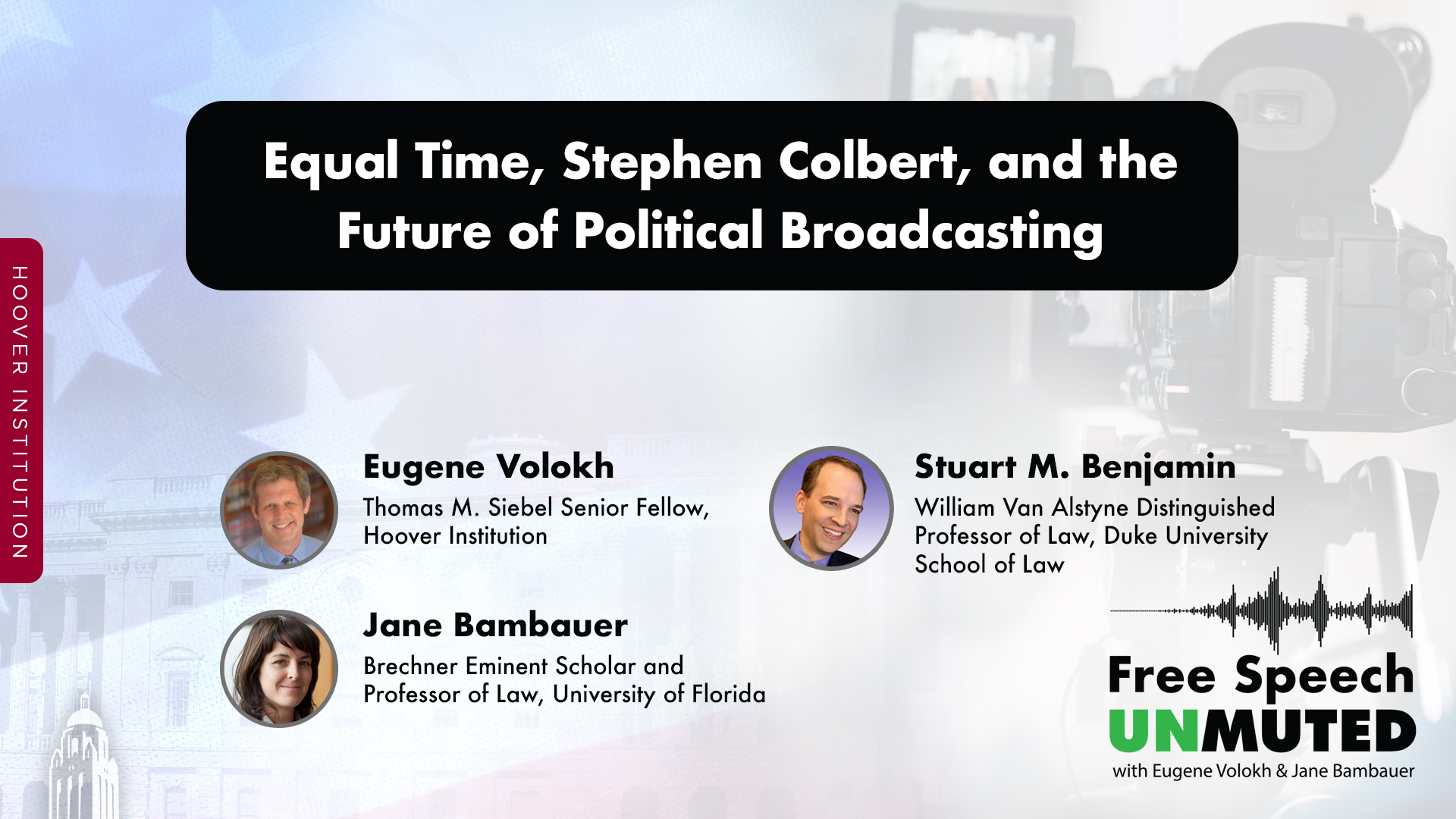
Eugene Volokh and Jane Bambauer are joined by Duke Law professor Stuart Benjamin to discuss the constitutional backstory behind the federal broadcasting Equal Time Rule and why broadcast media has long been treated differently from newspapers, cable, and the internet. From Red Lion to the collapse of the Fairness Doctrine and beyond, the panel explains how we ended up with a broadcast-only regulatory regime—and why that consensus may now be unraveling.
They also dig into the latest controversy involving political candidates appearing on shows like The View and late-night television, the FCC’s renewed scrutiny, and what it all could mean for the future of media regulation. Would today’s Supreme Court uphold broadcast exceptionalism? Or is this doctrine headed the way of the eight-track tape?
- Hello and welcome to Free Speech Unmuted. My co-host is Jane Bambauer from the University of Florida. I'm Eugene Volokh from the Hoover Institution at Stanford. I'm formerly, well, I guess still emeritus to UCLA Law school, and we have a special guest here, Stuart Benjamin, who is a professor at Duke Law School and who is an expert in the specialized law having to do with federal communications and particular federal communications and broadcasting content regulation. And we're gonna be talking today about some of the controversies in the news having to do with the equal time rule and various evening, or let's say various television talk shows and what it says with regards to they're inviting political candidates on. So I wanted to start by asking Stewart to give us the lay of the land on this. So it turns out, and many people in the audience may know this, although they may not know the full scope of it, the rules for broadcast radio and television over the air broadcast radio and television have long been very different from a First Amendment perspective than those four newspapers for the internet or for that matter, even for cable television. And Stuart, tell us a little bit about that difference. Now, I know that this is difference is quite controversial. You have criticized this different treatment. I'm generally no fan of this different treatment, but tell us what, what the Supreme Court and what other courts have, have generally said about this. Great,
- Thanks Jean and Jane. Happy to, happy to be here. So this, this began when, in 1927, the Via statute, the government said that it controlled all the spectrum and gave out only licenses to use spectrum. This was first discussed extensively in a case from 1943 NBC versus United States, in which the Supreme Court said that the spectrum is uniquely scarce. And so it requires that the government control the spectrum and, and thus that, thus the licensing regime makes sense. And then fast forward to 1969, there was a challenge to what is known as the fairness doctrine in the court. In Red Lion, again, relying on spectrum scarcity said that it is totally appropriate for and legal for the government to impose the fairness doctrine on broadcasters because in, in, in light of this scarcity, there won't, there has to be some rationing of voices. And this was also consistent with a, a view of the First Amendment as actually empowering the government. And so the government actually had an appropriate role in ensuring that we, the people were exposed to a wide range of voices. Now, at that point, there was no reason to think that there was anything unique about broadcast regulation. And so five years later, when the Supreme Court considers Miami Herald v Tornillo involving the exact same kind of rule as applied to newspapers, of course the briefs in, in support of Tornillo cited Red Lion pa, right? Red Lion is a good principle that applies across the board. And the, and the Supreme Court did not discuss Red Line and, and said that it was absolutely unconstitutional to have the exact same sort of re regime that applies to print, then broadcasting. So all of a sudden something that could have been a rule that applied across the board wasn't same kind of thing happened with respect to indecency. Some of the things just to get ahead of where we are with some of the, of the things that Brendan Carr has done, or he wants to prevent certain kinds of harmful programming, which is separate from equal time. But in any event, that would rely on a case called Pacifica in involving the broadcasting of indecency, Supreme Court said, broadcast is unusually, is unusually pervasive. And, and so the government has a, an interest in regulating it. And then Congress and it's wisdom chose to regulate indecency on every other major means of communication, telephone, cable, television, the internet. In every one of those cases, Pacifica was pa in the, in the government's brief cited over and over again. And in every one of those cases, the court said, no, no, no, actually this is different. Broadcasting is special. So we have this regime of the specialness of broadcasting. And again, to be clear, red Line is more directly relevant to equal time. I'm just trying to give the big picture. We have a regime that is now broadcast specific. It wasn't designed necessarily as being broadcast specific. Many people after Red Line was decided, thought it would be a springboard to a very different vision of communications regulation that would empower the government to apply all sorts of things that would be like equal time rules. It's just not how the case law developed. Now, if I can just give one more minute. Now, on the statutory side, the equal time rule applies to broadcasters, but you could easily imagine that a later congress, if the case law had worked out differently, would've then extended that and applied that to cable again, to cable television, who knows what to the internet, et cetera. Given the way the case is developed and given, you know, various, various changes on the court and and off, I think that that that was never gonna go anywhere. And so it just never went anywhere. So we now have a, a constitutional regime that is broadcast specific and a statutory regime that is broadcast specific.
- Well, great that you laid it out for us. Maybe not a great regime, by the way, I should say for the benefit of, of our listeners who, who don't speak Latin Stewart when he was saying cited pass or passives d pronounced different ways. It's the way we lawyers learn, learn this, this mixture of English and Latin. It basically means cited throughout, throughout a document.
- The joke just for the benefit of listeners, the joke being in a brief, if you sign, if you cite something on eight different pages, you list the eight different pages. If you cite it on every other page, you don't even bother listing the pages. So you just, it's just understood. It's throughout your brief.
- Exactly. But, but Stewart's point was that all of these broadcast precedents were cited throughout in all follow on cases where people tried to apply them to, to newspapers, to the internet and such. And the court said, ended up saying over time, Nope, nope, that's broadcast, that's different. So we do have this, this weird regime, and we do have the statute tell us specifically about the equal time rule. Because the broad, the, excuse me, the fairness doctrine of course was, was rejected even though it was upheld by the Supreme Court in 1969, in the 1980s. It was rejected by the Federal Communications Commission as in fact as being in fact unconstitutional even though the Supreme Court had upheld it. But in any event, the FCC was entitled to say, we no longer think this is called for here, but the equal time rule is a statute and it's still there. And it's different from the fairness doctrinal, though not completely unrelated. Tell us about the equal
- Title. Sure. And let me also, and let me connect out the way it was interpreted on the fairness, doctrine, rejection point. So, so this is a statute, I mean, the first version of it was in the Federal Radio Act of 1927, but the version that we know was, was codified much later in 47 USE three 15 A. And it says that a broadcaster, if, if a broadcaster allows a political candidate to use its statement station, it shall afford equal opportunities to all the other candidates for that office. But importantly it has exemptions. And so that does not apply to bonafide newscast news interview, news documentary or on the spot coverage of bonafide news events. So there are these exemptions to the requirements. If you are not in one of those exemptions, so you have one candidate on, then you have to give equal airtime. So whatever it is, the the first candidate got, the other candidates have to get. So if you want to have a candidate on, and you don't wanna have all the candidates on, you want to fit into one of these exemptions. 'cause just to be clear, if you don't fit into one of these exemptions, then you have to have the, you have to afford the candidate's opponents the same opportunities that you gave to the, to the candidate that you had on, on, on, on your show,
- Right? So it's not a, the equal time rule is not a prohibition on having candidates on, but it's kind of a tax on having candidates on because if you have on a candidate whom you wanna have on for various reasons you think their audience might like, or you just, you just want to support them, you then have to pay the tax in the form of having the rival or rival to the candidate on if they so ask. And so it's, it's a burden on, on the ability to put on, to put the candidate on your program. And probably all things being equal would tend to push broadcasters away from having candidates on because they don't wanna have, nobody likes to pay taxes, they wanna have to pay the tax. But of course there is this exception for, for bonafide in news. And the question is, what counts as bonafide in news? Tell us what has in the past counted as bonafide in news and what's going on with it. Now
- The big change came in the Reagan administration under the FCC in the 1970s embraced the fairness doctrine, which again, plays out very similarly actually to equal time. It also in effect poses the tax then on, on, on carrying some things. And that was what was in, and it was that rationale that the court used in tornillo to invalidate a similar rule for new, for newspapers. So it was in the Reagan administration that they abandoned the fairness doctrine and that they broadened out these exemptions. And that is not a coincidence. I think that the Reagan administration probably thought that, I mean correctly, the equal time rule relies on exactly the same constitutional theory as the, as the fairness doctrine. And, but they couldn't repeal the equal time rule because it's in a statute. So what do they do? What do they have the authority to do? They have the authority to interpret the equal time rule as narrowly as possible. They, they can't get rid of it. So what do they do? They start broadly interpreting it. So the first big broad interpretation involved a show involving someone named Phil Donahue, who, who had a daytime talk show where he would have guests and then he would go to the audience and he would talk to people in the audience. And sometimes he would have wanted to have political candidates on. And so, so they filed in, in, in the, in the FCC and the FCC initially said, no, you don't fall into any of these news exemptions. And then the FCC then versed itself, obviously under the, under the influence of the, of the Reagan chair and said, no, you actually fall under the news exemption, under equal time rules so you can have on a political candidate without having on their opponents. After that, there were a bunch of other cases involved. I don't know how many listeners will, will, will remember Jerry Springer, whose, whose programs generally tended toward titles like, am I really the father? And this was how, this was not news. Nobody, nope, nobody claimed this was news in any way, but nonetheless it it, it fell under the exemption for those unusual times when it might have a, a political, a political candidate. And then politically incorrect with Bill Maher, which was a discussion show was a politically inflicted, dis a discussion. But it talked about lots, lots of other things. The Tonight Show with Jay Leno and, and then perhaps the one that was the most hard to say, but this, this one might have been the most notorious, it certainly produced the most laughter was the Howard Stern Show when one of the great repost to that from, from somebody who was, who was critical of this, said, I'm, I'm quoting here when guests are selected by the size of their bust, it is not bonafide and news programming. And so after that series of cases, and this is the, so these I've, I've just run through cases that, that started in 1984 and, and Howard Stern was in 2003, it was quite clear to everyone that they were interpreting this news exemption very broadly, very caly and effectively were meaning that it would, it would rarely apply. And again, I think it was, it was a sense of the FCC wanting to constraint itself. It wanted to constrain itself in the context of the fairness doctrine, and it wanted to constrain itself in times of the, of the equal time rule. And this was a way of exercising that constraint. And the really interesting thing is that constraint held from Reagan through Trump won through Biden until, until January 20th, 2025. You know, this, this was a, this was a long consensus about in general constraining FCC broadcast regulation. I have, I have an article forthcoming in Eugene's journal on this very issue that was a longstanding consensus that that is now, that has now been disrupted. And let me turn now to the fccs implementation that it developed over the course of these various proceedings involving Donahue, Jerry Springer, et cetera. There were three and only three stated standards. One is that it's a regularly scheduled program, okay, that's not a very high bar. The second is that the producers of the program control the program. They mean producers as opposed to the broadcaster. So it doesn't look like, like the broadcaster is pulling the strings behind the scene. Again, that's a low bar for all of these programs. The producer controls the program. The third is that the producer's decision on format content and participants are based on newsworthiness and not an intention to advance or harm an individual's candidacy. Now that third element you could imagine having some bite. And what's interesting is nonetheless, when Arnold Schwarzenegger wanted to be on the Tonight Show, they said, oh yeah, this is clearly not about Arnold Schwarzenegger. It's, you know, it's fact that Arnold Schwarzenegger is a, is a prominent person. And when Howard Stern wanted to have various candidates on, it was, oh, Howard Stern, Howard Stern wants ratings, he's, you know, et cetera. And so again, you could imagine that somebody might look at what some of these shows did and said, no, I think the reason you're having this politician on is to help their candidacy. And the FCC consistently resolved that in favor of a broad exemption in favor of the broadcaster and therefore in, in favor of the broadcaster not having to comply with the equal time rule.
- So that's very helpful summary, summary of the, the law and how, how things have traveled in some measure up until the most recent recent steps. So let's turn to them. So right now, this is all in the news because of the controversies involving both involving representative tele Rico who is running for the Texas Senate seat on, on the democratic side, but in the primary right now against a representative, Jasmine Crockett is his main main adversary, although there's, there's another third, third candidate in the primary as well. And he was on the view and that drew a reaction from the FCC. There was talk of him being on Colbert and then, then he wasn't. And an interesting question is who's behest exactly, but tell us, tell us about that and how it fits within that legal framework.
- When he was on the view at that time, Brendan Carr had some rumblings that maybe this was not consistent with the equal time rule. Nothing at least that we know of. Nothing particularly came of that. And then more recently you had the Colbert incident where, just to be clear, what Colbert said, I have no reason not to believe him, was that if he had tall Rico and he would have to have on the two people who were running against him. And, and the answer is, so it, it was not that CBS said you can't have Al Rico on period. It was your point about attacks. If you, if you, if you wanna have Al Rico on you, you, you're now gonna have to devote three times as many minutes to this sex to, to this Texas race as you had planned on, on devoting to it. And you know that just, just for somebody who has a show that's obviously they're gonna gonna gonna change the calculus. And then more recently the Brendan Carr has announced that they are in fact investigating the view, suggesting that maybe the view has not complied with the equal time rule by having on er Rico now to a point that you were implicitly getting at earlier, there's only technically a violation of equal time rule if somebody asks you for equal time and you deny it to them. But, so why would car be doing this? I think he would, he, he would in fact be saying we want someone to ask them for time. We, we will look favorably on someone who asks for equal time if their opponent has been on one of these programs of you, Colbert, et cetera. So there's not a technical violation. But the irony of this is the person who has most conflated that in the recent past is Brendan Carr himself, who after Kamala Harris was on Saturday Night Live said this violates the equal time rule when the answer is no, it doesn't violate equal time rule unless she was running against Donald Trump at that point, unless Donald Trump asked for for equal time and his and has denied it. But you, you can understand colloquially why this, it is treated as a violate should equal time if you have only the one person on, because the, the assumption is you wouldn't, you wouldn't allow their opponent to go to go on. So that's at least the, the background of why some people conflate or or confuse what is the actual violation of the rule. Because just to be clear, nobody wants to have to devote three times as much airtime to a, to a race as they had, as they had planned to. And so that then just changes the calculus of what you're willing to have on your show.
- Alright, so, so now I think we have the big picture laid out. It took a while because there's a lot to lay out. So from a first Amendment perspective there, the law does indeed give the government more authority to, to regulate broadcast radio and television. Maybe if the issue comes up to the court again, maybe the Supreme Court will say that was all a mistake. Certainly some justices have argued that Justice Thomas had argued that Justice Ginsburg had argued that it with regard to indecency. But right now that seems to be the rule. There's also the a statute that is, that does indeed mandate provision of equal title Congress did say so, but the statute has this exemption that the FCC has at times read more narrowly way back when then started to read very broadly and, and now is is reading narrowly again. So, so that's, so that's the issue. So on the one, so on one hand, you know the statute is out there. On the other hand, you know, the FCC has read it narrowly before, maybe it should keep reading it narrowly or maybe that was a mistake. So tho those are some of the questions I wanted to ask a bigger picture issue. I'd love to hear your thoughts, Stuart. I think I know your thoughts, but the audience doesn't know your thoughts and I'd love to hear Jane's views on this as well. So, so the equal time rule has one advantage over the old fairness doctrine. It is pretty clear. It doesn't just does maybe except for the the bonafide news exception, it doesn't say, well, for any kind of controversial issue you have to have responsible alternative views. And then whose alternative view do you present when there are so many different ones? If there's a race, there are usually particular candidates on the other side, although maybe in a primary it could be a lot. In this case there are three. So, so it's, it's relatively clear, and I take it, this would be the strongest argument I think for this, which is that when it comes to broadcasting regulations, there are actually two kinds of broadcasting regulations. One is the ones we've been talking about, like the old fairness doctrine, like the equal time rule. And those are the regulations that impose a modest burden on a tiny fraction of the population. Those people who have broadcast licenses. And there's a second kind of regulation, which is, it is illegal to broadcast without a broadcast license that imposes a massive burden on the overwhelming, overwhelming majority of population. So if I am, god forbid, running for office against, say Jane and I happen to have the ear of some talk show host or something like that, then the talk show host could have me on and then, but could, but if he could say no to Jane and Jane would have no, no alternative, unless she also has some friends who are talk show hosts. And if she just decides, oh, I'm just gonna go out there and broadcast myself the way, if it's a newspaper, you could maybe print up leaflets, hand them out on the street corner or whatever else it would be illegal for her to broadcast herself. So the argument would be that when it gets to elections, which are competitive things, where the, where the point is to have some relative equality between the candidates, at least when it comes to governmentally kind of supplied or supported resources, that when you've got this kind of, this kind of competitive process, it should be, it should be made fair. And once the government says, look, most people can't broadcast, you get the special, only people with a special government provided license can broadcast. The government ought to be able to say, well, if you do get the special government provided license, you've gotta be even handed in your treatment. The candidates. That strikes me as perhaps the stronger argument I could imagine making for the equal time rule. What do you think about that?
- So a few things. So first I do think, and many other people think, I mean in some ways the key move here was the government's. If say, Dixie, we're gonna license, we're gonna license spectrum as opposed to,
- And if say Dixon is Latin four more or less, just because we'd said so.
- I I I will try to, I'll try to use less la la less Latin. It's
- Okay, it's okay.
- I
- I just need to be there to interpret
- And I'm
- Bilingual.
- So, so the, so the first thing is I, I do think a lot of this depends on the government's decision to license. And by the way that goes back, part of the reason I was emphasizing this NBC versus the United States case, which is why in the world does the government treat this differently from, from land? So, you know, economists find that ridiculous. So fine spectrum is scarce, everything that has more demand for supply than there is supply is scarce. And so there's nothing special about about spectrum in that point. So, so the first thing is to say yes in some ways the, the licenses are, are, are doing a fair amount of work. Having said that, I think there's two problems with the, the, the argu, the how much we can prove by the, the license argument. One of theoretical one and then one more practical one, the theoretical one is, okay, so what if the government says we're really worried about about steel and so we are gonna claim ownership of all steel in this country and, and we're not gonna let any imports in of steel. And by the way, that means then anybody who wants a printing press, it was made outta steel. So you'll have to come to us to get a license for the steel and we'll give out licenses on some reasonable rational basis. I don't have the slightest doubt that the Supreme Court would say, no, sorry, you may be able to license steel, but you don't, that you, you can't leverage that into control over over newspapers. So I I don't think that the mere fact of the license ultimately really answers the, the theoretical question. And then there's the practical point, again, something that will be, that will be news probably to most of the listeners of this program. But in the 1970s, the three major television broadcast networks had a market share of more than 90%. So it really was the case that if your political opponent was on the local television station and you were not, this was a really serious problem for your political campaign. It's just not the world that we, that we live in anymore. Where for the vast majority of Americans, a broadcast station is just another, sorry to say another channel actually. It's just another stream that that, that they have, that they have access to. And so it just seems to me it's really hard now to make an argument that there's anything, there's anything particularly special about the, about the role of, of broadcasting. And if I could just add in that regard, note that Brendan Carr has never, has never suggested, oh, by the way congress, I think you should also extend these rules to cable television, for instance. So one way in which viewers I hope realize, so Fox News is, is a cable television program. So it is not subject, nothing on Fox News or otherwise could ever be subject to the equal time rules because it's not a, it's not a broadcaster. But if we think this is a great set of, a great set of rules, okay, why don't we go ahead and license the, the cable television stations as well and and then leverage that, leverage that. Similarly, I just think it, it, it, it, it again, just the practical point is it's just, it's it's hard for me to see, to use a technical term. I don't think this was Latin much oomph in an ar In an ar Not Latin. Not Latin. Oh, I thought it was Latin. Maybe it's pig Latin much oomph today. In in in in the argument that, that you, you Eugene are articulating.
- Yeah, I mean, I was gonna say in our hypothetical campaign against each other, Eugene Yeah, you can go to a broadcast show on a, B, C, but luckily I know Joe Rogan, so
- Oh well, better yet.
- Yeah, so, so actually that that I I wanna ask another question about the pragmatics before turning you back to the First Amendment question. Stuart Eugene referenced the broadcast license as something that's valuable, as if it's a, you know, so it's a massive burden that another show wouldn't be able to broadcast. Why is, and I, and so I get the sense that one reason we have this fight is that all of these shows, even though they can be streamed, even though they can be on cable or or you know, could, could potentially be on cable and could certainly be streamed over the internet, the license is still valuable. So can you, can you just explain why broadcast is still so such a valuable technology? So it,
- It's a great question. So first things first, it turns out that broadcast stations, which again once had 90% and just three networks had 90% of the audience still has about 20% of the, of, of the market share. Which, which, which may or may not surprise you. And, and there are some populations whom broadcast is a, is is a bigger deal. So broadcast watching tends to skew older
- And they won't go like the, they wouldn't travel with their show to a different transmission. Well, they might, I mean they, they might,
- But I mean, you know, for some people this is just, this is, this is, they have got, they have grown up watching their, their their local television news and that's the, and that's the show they're gonna, they're they're gonna keep on watching and then, you know, the idea would be, and then they leave it on during the day and that's how they catch the view and that's how they, and that's how they see the, you know, the Tonight Show or, or anything else. So look, I, I do think that there is, there is still some power to, you know, to to, to broadcasting. I just, let me put it to you this way. I, I mean this is yet a different level of the pragmatics. If I am the campaign advisor to Jasmine Crockett, do I actually push for the, the equal time opportunity? I might not, this is part of the reason why Brendan car might one or two, but it doesn't mean she's actually, I might not, because I might say I don't think there's that many viewers and I think I will, I might come off as kind of the, the sore loser, you know, malcontent. And so I actually don't, I actually think I'm just better off not even not even pushing this in the first place because it just isn't that many voters at the, at the end of the day.
- Let's go back to the First Amendment question though, in that context where the licenses might be of waning value, though not valueless for the reasons you say, and there are so many other options, cable, internet, et cetera. Do you think that the Supreme Court, even, even on the same facts and assessing the same rules that they've looked at before in Pacifica or or in the Red Lion would come to the same conclusion today?
- I do not. I should, I should say when I was just starting out as an academic back in the, in the dark ages, I made a bet with Larry Lessig about the, the, the Supreme Court overruling red line. We both thought they would overrule it. The question was whether they have an opportunity to, and they haven't and they haven't had an opportunity to overrule Pacifica. And there's a reason for that, which is that the FCC has done so little, right, again, it's pulled back so much
- Right, - That there isn't much to sue the FCC over to, to either challenge redline or, or or Pacifica. I will note that this did come up, there was a, a a, a brief rise in FCC enforcement on indecency. And so this involved Cher a a and on the Golden Globe and, and, and Denise on the Golden Globes as made it to the Supreme Court. They ended up not deciding this case on First Amendment grounds, but at the oral argument, justice Alito said in, it's an argument for why they shouldn't get into the First Amendment issue. He said, you know, isn't broadcast gonna go the way of the eight track tape tape player anyway? And so why would we even need to get into this First Amendment issue since it's dying? I have to imagine that the broadcasters in the audience at the Supreme Court, were not amused by that question from, from Justice Alito. But yeah, I think that most people think if they actually had a chance to squarely to, to squarely reconsider Red Lion Pacifica, they would, they, I I think most people think it would overrule Pacifica. And I think most people also think they probably overrule Red Lion. And so one way of thinking about the fccs constraining itself is, I I I think it was originally done 'cause Reagan, the Reagan FCC really did think this was just an intrusion on, on, on the First Amendment. But an additional reason as the years have gone on might be, and we're gonna, and we, the FCC are gonna lose if we, if we try to get more aggressive.
- Do you think even that the, the fleeting expletive, like the fleeting, fleeting expletive case was the most recent of these kind of very content oriented cases that the Supreme Court decided? Is that right? Am I right about that?
- Okay. Yes. And that's, that's where Alito said that or argument, but they didn't get to the First Amendment issue.
- Oh, that's the one. Okay. So and so. Oh, okay. Got it. Okay. Yeah, 'cause that was in the co that was in the internet era and yet it's okay. So they avoided the right,
- They decided, decided to do process grounds. They had, they had another constitutional provision they could throw in there.
- Okay. I was just gonna say, this has been very interesting and I hope enlightening. It's been enlightening to me. I hope it's been even more enlightening to the audience. And I wanted to thank Stuart very much for, for coming on our program.
- Sure. Happy to do it,
- Jane, thank you as well as always. And thanks to our, our listeners for listening and we'll be having more in the weeks to come.
- Thank you all. This podcast is a production of the Hoover Institution, where we generate and promote ideas advancing freedom. For more information about our work, to hear more of our podcasts or view our video content, please visit hoover.org.
ABOUT THE SPEAKER
Stuart Benjamin is the William Van Alstyne Distinguished Professor of Law and co-director of the Center for Innovation Policy at Duke Law School. He specializes in telecommunications law, the First Amendment, and administrative law. From 2009 to 2011, he was the first Distinguished Scholar at the Federal Communications Commission.
Benjamin is a coauthor of Internet and Telecommunications Regulation (2nd ed. 2023, 1st ed. 2019) and Telecommunications Law and Policy (multiple editions), and has written numerous law review articles. He has testified before House and Senate committees as a legal expert on a range of topics.

