






- Energy & Environment
- International Affairs
- Military
- Security & Defense
- US Foreign Policy
- Determining America's Role in the World
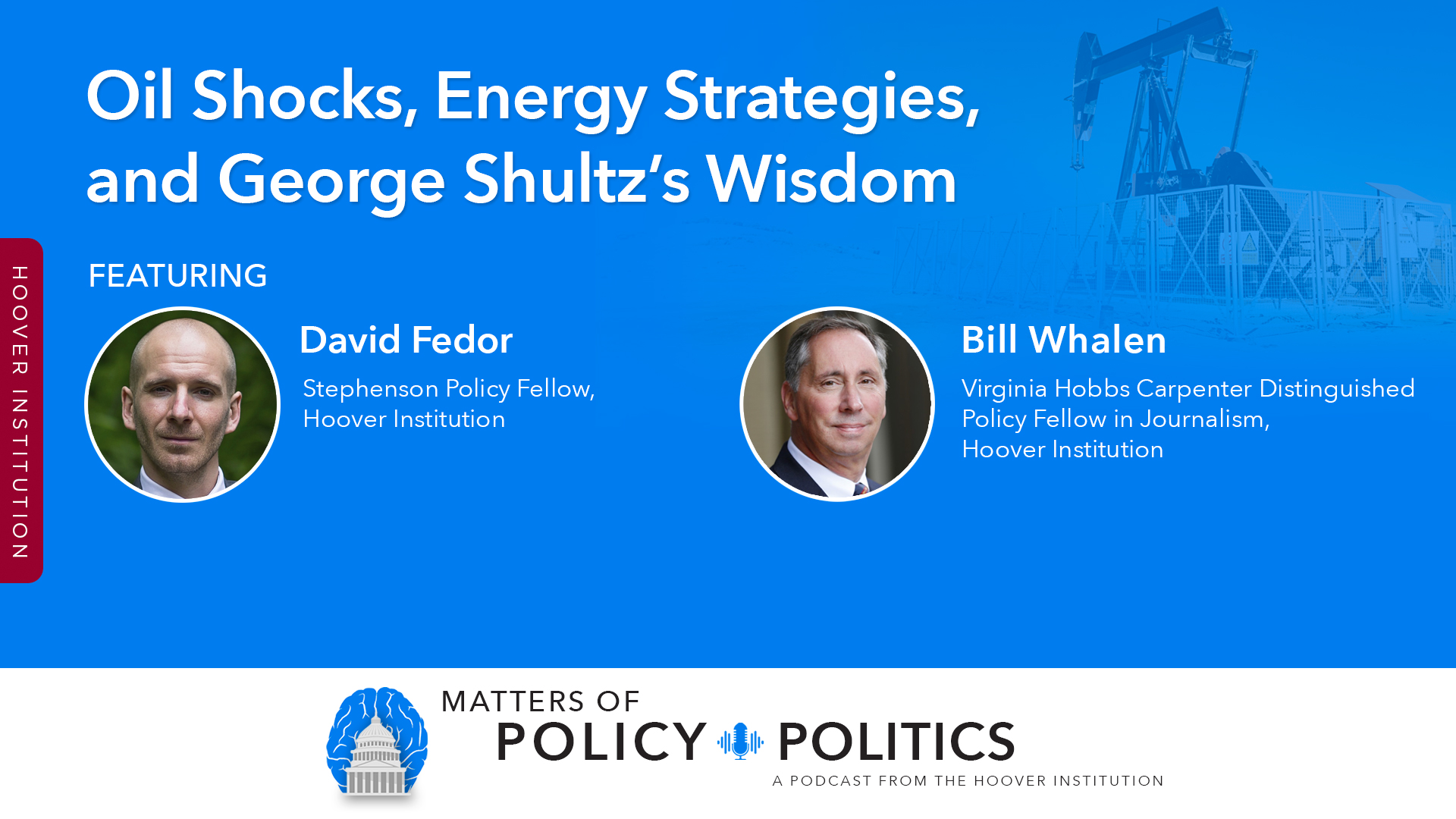
A worldwide oil shock triggered by hostilities in the Middle East raises questions about the viability of America’s energy strategy and the ability of the US and other developed nations to ride out the current storm. David Fedor, the Hoover Institution’s Stephenson Policy Fellow and a member of Hoover’s George P. Shultz Energy Policy Working Group, puts 2026’s oil drama in historical context (2008 and the 1970’s), explains why Californians pay more at the pump than most Americans, and touches on a few policy items that have Hoover’s attention: the state of US-India energy relations; a nuclear reactor approved for Wyoming; Indo-Pacific nations hamstrung by limited supplies of LNG; and Taiwan’s energy security. Fedor, who worked alongside Secretary Shultz for nearly a decade and a half, also touches on his mentor’s intellectual curiosity and how Shultz might parse these troubled times.
Recorded on March 13, 2026.
- Unless you've been living under a rock or not driving a car, you know about the oil shock and the aftermath of hostilities in Middle East. What about energy in the bigger picture? Does America have a strategy and how are other nations coping with uncertain supplies of oil and liquefied natural gas? Coming up next on Matters of Policy and Politics, a Hoover Institution scholar, a member of Hoover's Schultz Energy Policy Working Group discusses the world's energy needs and why we have had a hard time kicking the oil habit. Stay tuned. It's Friday, March 13th, 2026, and you're listening to Matters of Policy and Politics, a podcast devoted to the discussion of Hoover Institution policy research and issues of local, national, and geopolitical concern. I'm Bill Whalen. I'm the Hoover Institution's Virginia Hobbs Carpenter Distinguished Policy Fellow in Journalism. I'm not the only fellow who is podcasting these days. I encourage you to go to Hoover's website and check out what we have to offer. You can find that by going to Hoover.org/podcast, and there you'll see just a whole fleet of remarkably great podcast, including, if I may say so, the audio version of the Goodfellow Show that I have the honor of doing with Neil Ferguson, John Cochrane and HR McMaster. Now, if you're listening to this while you're driving at your car, look at your gas gauge, because if it's low, like most Americans, you're dreading a fill-up, and count me in that camp after this podcast is over. I have to go fill up my SUV. It's gonna be about a 15 to 20 gallon fill-up, and here in California, that is gonna be a very painful experience. And if you happen to be passing by a filling station, your eyes are not deceiving you, prices are up. This is not something new in America, however, certainly not to more experienced motorists. Back in 1973, the world's leading oil concerns at OPEC stopped exports to America during the Yam Kapur war. Gasoline prices jumped by almost 50%. Fuel was rationed. Richard Nixon as the nation to cut back on its energy consumption by, and I kid you not, not hanging Christmas lights. The question this time around, as another war plays out in the Middle East, if we're in for a prolonged oil shock, what does it mean for America's energy strategy? And for that matter, is there an American energy strategy? Joining me today to discuss painted the pump energy strategies, plus the Hoover Institution's study and the world's energy outlook, it's my pleasure to welcome to the podcast, David Fedor. David Fedor is the Stevenson Policy Fellow at the Hoover Institution where he supports fellowship research within the George P. Schultz Energy Policy Working Group, Hoover's National Security Oriented Global Policy and Strategy Initiative, and the joint Hoover Asia Society Working Group on semiconductors and the security of the United States and Taiwan. David, thanks for coming on the podcast today.
- Happy to be here, Bill.
- So question, how did you get to Hoover? Where did we get you from? Who did we steal you from?
- Good question. George Schultz recruited me to Hoover about 14 years ago. I was a student here at Stanford considering a, a future life and academic research. And I saw Schultz around campus talking about energy issues, and I thought, "You know what? This guy has his head screwed on right." I didn't know anything about his history beyond sort of headlines. I was a child of the '80s. But I came to know him over the years, and I'm glad I did.
- Did you actually have to sit down for an interview with the great man?
- I did. And a- as you'll remember, Bill, and I think many of us here at Hoover, those bright blue eyes would stare right into your soul as you sat across from him. I remember many mornings, both in the interview and later on the couch in his office in the corner at the Herbert Hoover Memorial Building. And you had to be on your A game when you were in front of Schultz.
- You really did. And I know what you're talking about with the piercing blue eyes. He didn't blink his eyes a lot either, so sometimes he would just look at you. And I remember being in a meeting with him one time, David with a group of fellows, and he was looking at me, and I didn't know if it was one of those things where he was trying to figure out who I was and what I was doing in the room or I looked particularly stupid that day but he just, he would just look at you. The other great talent he had, and boy, I could talk all day about George Schultz, because what a fascinating man. He had just this brilliant mind, David, that was able just to kind of get to the heart of matters. I occasionally, I'd get called into a meeting with him when somebody would come to Hoover offering a ballot initiative, and they'd want to come meet the great man and- Sure. ... get his endorsement. So he would sit there very patiently. They would talk for half an hour on why their particular initiative was, you know, the greatest thing since sliced bread and was gonna change the world as we knew it. And then at the end of the presentation, Secretary Schultz would kind of sit back for a second and you, of course, live this more than I did. He would say in his very common ignified voice, "That was a very interesting presentation." And then there'd be positive go, "However, I have the following concern." And then just like pulling out the one piece of straw from the fat shut that brings the whole thing down, David, he would just kinda immediately just kinda blow up the initiative. And the poor people just walk out of their crestfallen. Happy to have met him, but just realizing it'd be kinda taught a lesson.
- That's, that's right, Bill. And, you know, I think about George Schultz for sure in, in weeks like this. You know, I came to work with him on his then energy policy task force- Right. ... which was set up around 2007 when oil prices were very high. We're getting back there now and Schultz would look back to his history. Actually, you know, when he first worked for President Richard Nixon, one of his first jobs was to lead a task force on the oil import crisis in 1969. You know, Eisenhower had warned that if we imported more than 20% of our oil would be in trouble from a national security perspective. So Schultz led a, a group to come up with recommendations on how to mitigate those risks. As he said, they had a lot of good ideas. They ended up on a shelf. They didn't go anywhere until the oil crisis hit. And then people sort of brought it back out, dusted it off and said, "Good ideas." But, you know, Schultz observed that energy policy was sort of like a rollercoaster in this country over the decades that, that he was involved in the public and private sector. Certain attention would go to one thing and then shift to the next, but if you didn't have a balanced approach, thinking about what do you call the three legs of the stool, the environmental impacts, the cost impacts and security impacts, eventually you get mugged by reality. So, you know, weeks like this, we're, we're certainly in a rollercoaster if you look across administrations and if you look at the price of WTI crude over the past two weeks, I think you'll see another rollercoaster. I think we're sitting about $95 today and who knows where we are a week from now when your listeners are listening.
- We have twice now referenced the energy crisis in 1973. David, you mentioned that there was a problem in 1969 when Secretary Schultz went to work for Richard Nixon. We did a good fellow show recently with director of the Hoover Institution Condo Lisa Horizon, what she reminded of was in the summer of 2008. This is gonna sound very familiar. Iran announced that it, it had a missile that could hit Israel. She came out and said that the United States stand by its allies, i.e., If you do something, you're gonna get hit. Iran then fired another missile. And what happened, David's oil went up to $147 a barrel. So this is, you know, as Yogi Bear would say, this is deja vu all over again, but let me ask you this, David. So here we are in this day and age. The United States is the number one producer and number three exporter of oil. United States is also the world's number one producer and exporter of natural gas. And yet here we are at the mercy of oil. So why is it that we are at the mercy of this 100-mile stretch of geography called the Strait of Hormuz?
- Sure. And maybe it's helpful to separate oil and gas there because we are seeing differences, actually, and how this is playing out in the US today.
- Yes.
- You know, easy answer on oil is that it's a globally integrated market. We are the number one producer of oil. We're also the mo- consumer of oil.. We have net exports of both what we call sort of petroleum products the, the motor gasoline, the diesel, the jet fuel that we make from crude oil, but we still also import crude from different sources around the world to match the configuration of our refineries. Of course, as a highly financialized sector you and I can trade futures for delivery and Cushing, Oklahoma. Those are tied to real volumes. You can do the same for, for Brent and Europe and the North Sea. So, you know, we're, we're not insulated from what happens in global markets because of that integration. It's really not just about gasoline and diesel even, but it's a whole molecular infrastructure of what you can do in transforming the hydrocarbon atom that goes into our fuel tanks but it also goes into our chemicals industry, plastics, et cetera. So that's, that's one reason that we're still at the mercy of what happens around the world. People talk about, you know, can we just shut off imports and exports and keep it all for ourselves? Probably not a winning strategy. I'd argue we would not be the world's number one producer of oil. If we had that kind of an outlook, it would immediately kill investment for domestic production here in the US as well.
- And David, California has to bring oil in from other lands, correct? That's
- Right. Yeah, you know, California is always a special story. And part of it has to do with infrastructure.. You know, we are physically separated from most of the other states in the Union for crude oil production and for refined products and the distribution because of lack of pipelines. We have our own requirements for gasoline and diesel here in California that require a special blend and we're actually linked to the, to the Nevada markets and the Arizona markets, but otherwise we're a small island. So actually we're more reliant, I think, than the rest of the country on imports of crude from other parts of the world. That basket changes over time. And increasingly, we become reliant at the margin on even imports of refined products like jet fuel or gasoline or diesel because it's hard for our refineries to keep up with the demand given business challenges they've faced in this state over time, which seem to be getting worse.
- I have a niece visiting from South Carolina, David, with her seven-year-old twin sons. So first of all, wish me luck in surviving the twin boys. They're sweet kids though, actually. I joke. But I know that when she sees the price of gas out here, her eyes are gonna bug out because in South Carolina, you're used to seeing a three at the left of the of the price. And I'm gonna go fill up and fingers cross it is where it was a few days ago when it was 599 for premium. So it's the question, I guess, so why don't you answer f- on my behalf, why is gasoline in California so much higher than the rest of the nation? Yeah.
- I mean, you touched on the prices and I was just looking at the AAA numbers today. So Friday Friday the 13th, we're looking at crude oil prices around $95 a barrel and they've been up and down by about plus or minus $25 over the course of just this week. That's translating to a national gasoline average in the US of $3.63. That's a retail price. That includes different grades that includes taxes, et cetera with quite a lot of variation across states. You mentioned South Carolina.. As of yesterday, they're sitting at an average price of $3.35 a gallon.. 335. Here in California, we're averaging $5.42. So almost a $2 premium, you know, buck 90 over a low cost state like South Carolina and about a buck 70 or buck 80 even over the national average. We ... Our differential tends to even grow a little bit more when there are spikes like this. Okay, so what goes into, to a gasoline price? Of course, there's the underlying costs of the crude and the margin that refiners make when they refine the crude into useful products basically how they get paid for their services. That's called the crack spread. The cracked spread across the country is, is relatively high right now. That tends to happen when you have shortages. You know, demand, we say for a l- for gasoline is very inelastic. People still need to get to work. People still need to get to school even when price goes up, and so you don't see a huge demand response when prices rise, so even small disruptions in the market come up with big price swings. In California specifically we have more more taxes. You know, that's probably the biggest component. You know, everyone has a federal gas tax of, of 18 half cents a gallon. That's been standard for a while. Most states add on about 30 cents in state and local taxes on top of that. And California its higher is closer to 60 cents per gallon of, of state and local taxes. So that adds one one premium over the national average, you know, a 15-gallon fill-up. You're probably paying an extra $7 per tank in California over the national average just because the difference in state taxes. Another component that's getting a lot of attention right now in, in California and Sacramento are some of our environmental fees that go on, on top of that. Right. Two, two big components are the, the cap and trade program and the low carbon fuel standard. We can go into detail on, on either of those. But those add another five to seven dollars per gallon. And then I mentioned earlier, California's special reformulated gasoline blends, often referred to as carboh. This was adopted in the mid '90s as a way to reduce smog particularly in Southern California. Because that standard is different from the other refineries in the US it's more subject to disruptions from in- state refineries or from global disruptions, and that adds a price premium as well.
- You wrote a piece on this for the California Post, which for our listeners who are not aware of that is actually a startup by the New York Post that covers California exclusively. And in your column, David, you had a very interesting concept, and that was how to get money back to drivers, and what you talked about was something called the Greenhouse Gas Reduction Fund. What is that?
- Sure. So I mentioned the cap and trade program bill. This started under the, the landmark AB32 legislation, which George Schultz is actually a big supporter of, I should note.- Right.
- Governor Schwarzenegger signed it..
- That's right. You know, he felt that back to sort of the, a balanced approach to energy policy, that it's important to think about the environmental impacts of energy policy choices alongside the economics and security impacts.. And Schultz felt that the most responsible way to think about the climate impacts of burning gasoline and diesel fuel was to let the market address it by putting a price on the carbon emissions and then stripping away other regulations that would otherwise force in, industry or consumers to go left to right, let them make the choice, but price in the cost of the externality. And that's what AB32 in the cap and trade system was meant to do. Basically, it puts a target cap on the total emissions of greenhouse gases in the state across different sectors, and then over time, that cap is reduced. Large emitters i- industry, et cetera, have to then buy or acquire permits in order to do those emissions. Sometimes those permits are given away for free to existing industries. Actually, the refining industry and other large emission emitters are grandfathered in. But the fuels they produce are not. So we pay for the carbon content of the gasoline and diesel that we consume in our cars through, by having to pro- the distributors have to procure permits. They buy those permits at an auction that the state runs and the cost that, of those permits is reflected directly in the price of gasoline. So that, that cap and trade system is responsible for about maybe 25 cents a gallon of, of the gasoline that you buy in state and not reflected elsewhere in the country. That money along with the permit re- auction revenues from other sectors across the economy go into something called the Greenhouse Gas Reduction Fund. Probably most Californians aren't aware that they're paying money into this fund, which is frankly seen probably more as a feature than a bug in, in how it was designed when these early emissions trading programs came into, to place, not many people thought about the revenues they would generate. You know, you sort of thought about the cost, but it was sort of a, a, a, a feature that there was revenues on the backside and, and many in state governments, not just California, elsewhere around the world, realized that it kind of created a a, a play fund that they could spend on pet priorities that might not otherwise get the support of the voters. In the piece I highlight in particular, I think one egregious case that's the, the beleaguered California high speed rail project which gets by law about a quarter of those revenues. It's about producing about $4 billion a year, that greenhouse gas reduction fund. And so high speed rails been getting about a billion dollars per year off of those revenues.
- Yeah. I'd be very interested to see, David, in the next few years, if there's a, a ballot measure which seeks to change high speed rail in California, just bring it to a halt and just redo the funding on it. But let's talk energy strategy now, David. We're in a very volatile political era which our listeners obviously know. If you go back to 1988 moving forward, there's a pattern, Republican, Democrat, Republican, Democrat, Republican, Democrat, and now we're back on Republican right now with Trump. I went back and looked at energy policies from these various presidencies. Trump, Trump came into office and very promptly issued about a half dozen executive orders focused on, focusing on maximizing domestic oil, gas, coal production. That's reversing Biden nearer climate regulations. Biden comes in in 2017, he issues executive orders. David, he's focusing on clean energy, climate change. Trump comes in in 2017 before that. Yeah. And what does he do? Issues executive orders boosting domestic energy production. Obama comes in, what does he do? He goes after regulation, clean energy. There's a pattern here, but the question, David, as the time goes by, is there a cohesive American energy strategy or do we just keep vacillating depending on who's in, in the Oval Office?
- Yeah. I mean, I, I think you put your finger on it, Bill. It's, it's emergent. There is no cohesive strategy. You know, o- of course, the way that we would address changes from administration to administration would be through legislation.. And Congress has taken bits and pieces of this, but probably the last big cohesive effort at a US energy strategy was the Energy Policy Act of 2005. And so you get a sense we're, we're reaching back pretty far here over 20 years to point to something that we can call a cohesive energy strategy. You know, the Trump strategy today is in, in a way more bipartisan that you, than you might think. How so? The, something new has emerged that has helped to clarify, at least in the near term, what I think Americans and both political parties are, are trying to achieve. And that's this really fundamental shift from a world where we had pretty flat growth in energy demand, certainly in the power sector. We've had about flat growth for the past 20 years, a combination of economic factors and improvements to energy efficiency. Now, with the emergence of artificial intelligence and the data centers that will be needed to power both the training of these models and the use of these models to improve our productivity in everyday life we're looking at a return to energy demand growth, certainly in the power sector. We're going from half a percent growth per year. Last year we were up to 2% and forecasts are to get up to levels of three or even 4% growth in the coming years, largely on the back of these data centers. I think there's a recent estimate from Anthropic over the summer. They estimated they needed about 50 gigawatts of new capacity in the power sector just for incremental growth from data centers from Anthropic, OpenAI Microsoft, et cetera through about 2028. So that's, that's significant growth, and it is aligning minds in a way that actually I haven't seen in a while. It hasn't addressed everything in energy policy. You know, e- e- energy is a, a, a big capital expenditure game. It's a long-term investment game. And you pointed to the, that rollercoaster between administrations. It, it, it's funny, actually, the, it's the, it's the large oil and gas companies that you see as sort of a stabilizing force between administrations saying, "Wait, no, we have to make 20, 30-year investments. We don't make four-year investments." So the policy certainty is something that Congress can still help on. But I'm seeing a little more coherence emerging on the power sector as we start to think not just about whether we're optimizing around a climate objective with ideas like net zero, which is highly politicized, but rather supporting overall economic growth and trying to contain affordability issues at the same time, which is something that both parties in abstract can get around and we'll see if the politics work out to actually get supporting legislation.
- I understand David, Virginia is a good state to look at for this. The former governor, Glen Youngkin was very aggressive in trying to bring AI to the state, but now the question is, you bring AI to the state and, or the Commonwealth, I should say, but you bring AI to the Commonwealth and do you have a grid that can match the demand?
- That's right. I mean Virginia's been ground zero for data centers even before AI. Something like a quarter of their grid goes towards data center demand compared to 4% of the US national average grid has been going to data centers. So this is postcards from the future coming from Virginia. You know, I expect that concerns on electricity prices will be a major feature in this electoral season. It's, it's a valid conversation. It'll probably also be overdone. The truth is that electricity prices in the US were set to rise before we had new AI demand. AI will be scapegoated for this but actually AI provides an opportunity to address some of the deferred maintenance and investment that we've needed in the US grid. The, the firms who need compute whether that's, you know, the Meta's of the world Alphabet, et cetera, the fact is they're, they're more wealthy than utilities are, and they can afford to pay more than your normal price sensitive consumer can, particularly one on a fixed budget. So if we can get the regulations right and I think they're willing to do this, you've seen statements from, from President Trump himself about promises by the large tech companies to pay at least their fair share. You can imagine a situation in which these companies are built, bringing new generation to the grid, and they're paying for that. And in fact, they're paying for more than that through grid upgrades that need to happen anyway to support growth and which they are willing to pay for in exchange for getting on the grid fast, because that's really what's motivating them. They're willing to pay more if they can get on the grid fast, and there are a lot of efforts at the federal level and at state level to figure out how to do that in a way that is fair.
- One more question about Trump energy strategy, then I want to switch, David, to what we're doing here at Hoover with the Energy Policy Working Group. You and the working group look at the Trump approach to energy. Is there anything in the docket that you would like to tweak or is there anything missing from the portfolio that you think should be in there?
- Well, of course a lot has happened coming out of the executive. As I mentioned, Congress has a lot left to do- Right. ... to make this something that lasts more than, than a single administration, something that is actually investible. A big piece of this, I think, will be on the potential for permitting reform. You know, back to the idea that we're in a, an environment of energy demand growth we need to make it easier to build in this country that will also help contain the costs. And I think that there's consensus on both sides of the aisle. You know, I think those folks on the left have been asking for a long time to make it easier to build electricity transmission which has been thought of as typically supporting new renewable build outs, but it also supports new gas generation. It can support new nuclear. Those on the right have been saying, "We wanna make it easier to build new pipelines for natural gas for oil and products, as we touched on with California, for example." They haven't quite been able to come together but there's a window now, I think, in the next six months, or potentially even into the next Congress, to come to some sort of a grand deal around permitting reform that makes it built, easier to build linear infrastructure of all sorts to build new power generation infrastructure. One more piece I'd add in terms of the unmet agenda for the Trump administration on energy policy, they've embraced this idea of energy dominance, and you started with the fact that the United States is an energy superpower. We've moved from this idea of energy being a point of weakness that we had in the 1970s really crystallized by those, those gas lines to one of strength. And some of the rhetoric the administration has focused a lot on what that can do for US domestic national interests, as it should. Here in some of our work at Hoover, we think a lot as well about the fact that the US has returned to being energy superpower, but a lot of our closest allies and partners around the world have not. There's still in vulnerab positions, whether that's in Europe or whether in the Indo-Pacific. So how can we think more creatively about using that US energy abundance in service of not just our national interests here at home, but some of our diplomatic and security goals abroad? And I think there's a lot that can still be done there.
- All right. Formally, it is the George P. Schultz Energy Policy Working Group, David, when was it created? And I think you just gave me the mission, but if that's not the mission, tell me what the mission exactly is.
- No, that's right. So, you know, George Schultz set this up back in 2007. You mentioned high energy prices at that time. I think into 2008, we were at $100 a barrel of WTI on average across the entire year. It spiked to 150. So well in excess of being where we are today even without thinking about the changes in inflation. And and he, he, he chaired that up until his, his passing in 2021. Admiral Jim Ellis is now the chair of the, what's now the Schultz Energy Policy Working Group. And at a high level, we continue Schultz's legacy. I think often we, we find ourselves asking what would George Schultz say or do about situations in the news today? I don't know the answer. You know, Schultz was always forward looking and he always updated his priors. But I do have a sense for the sorts of questions that he would be asking, and that's what we try to do at the working group. We think about the return to the United States to a position of energy strength and what we can do with it in a world where certainly energy security has, has come back to the fore as we think about our relationships with allies and partners.
- Jim Ellis is a four-star ameral who's a carrier skipper. So I think you're in good hands.
- Right. Yeah. You know, these two issues have come together and national security and energy policy i- i- i- in ways that it's, it, it, it's too bad that it came to this in a way. You know, you, you'd like to be in a, in a peaceful world where you can think of these in, in separate realms, but today, energy security is national security, and I think that's certainly been driven home since the full-scale Russian invasion of Ukraine in, in, in 2022. We probably oversampled on the the environmental climate leg of the stool. Certainly in Europe, that was a problem. And as Schultz said, we got mugged by reality. Energy security is back, and now energy affordability is very much on everyone's agenda as well. And it's, you know, in conversations today, it's, it's being discussed as a a potential bottleneck on President Trump's ability to pursue to its logical conclusion, this conflict in Iran, Iran's season, an opening to really strangle the global economy through their str- their hold on the Strait of Hormuz where about a fifth of the world's oil and gas transits every day. And they are, they're pushing that as much as they can. Luckily, the US being in this business energy strength helps alleviate some of that pressure.
- Let's talk about four items, David, that are germane to the world of the energy policy working group. Item number one being US-India energy relations. About a month ago that India agreed to stop buying Russian oil in exchange for a US trade deal. Washington is now saying that India can buy oil from Putin if it so chooses. Then earlier this month the president announced the US is getting its first oil refinery, David, in 50 years. It'll be in Brownsville, Texas. It'll be refining American shale oil. And the interesting part here is who's funding this endeavor? It's gonna be funded by Reliance Industries, which is owned by the Indian billionaire, Mukesh Jambani.
- That's right, Bill. You know Candy Rice and Jim Mattis here at Hoover often talk about the US-India relationship as being the most important relationship of this century. If you think about the pillars of what underpins that beyond the rhetoric of us being the largest and oldest democracies you know, defense, trade and defense goods is one of those digital services is a big part of that relationship, and the third pillar is really energy.. That's the biggest part of our trade balance today, and I think it's one of the most substantive opportunities in our relationship going forward. Here at Hoover, we've thought a lot about both nuclear and natural gas in that respect. India is an importer of natural gas. It's only a small part of the energy system today, about 7% of their primary energy demand. They're looking to grow that. A lot of folks focus on the growth of the renewable sector in India, and that's true. India will build a lot of solar but India's also gonna be consuming a lot more natural gas, and the US can supply a lot of that natural gas into the future. So that's gonna grow and will be a, a major market in a way that I think probably hasn't been appreciated by both the sort of expert class and governments in, in both sectors. So that will draw us closer together over time. Incidentally, India gets about half of its gas from cutter, or it did get about half its gas from cutter so pointing to the fact that United States can be a reliable supplier. The other big thing that's happening in India is in their nuclear sector. They have about eight or nine gigawatts of existing nuclear power plants. This is a sector that's been largely closed to private sector investment. It's been largely closed to international investment despite the conclusion ... Version of the 2006 US-India nuclear deal, which Condeleza Rice helped a broker. Recent legislation just out this past December in India, opens up that sector to both domestic private investment from some of the large Indian firms. You mentioned Reliance. Tada is another one that's interested in investing in nuclear than India. And it opens it up to international investment, including from US firms and the ability to bring in US reactor designs. So a big potential market both for US reactor designs and frankly, a way to tap into a low cost Indian supply chain for nuclear, which could help bring down our own costs. Of course, we've seen the, some of these negotiations around Indian purchases of Russian crude oil and the relaxations on the sanctions. That probably would've happened anyway. You know, I, I think this was sort of the Trump administration getting out of the way of a gray market crude that would've found its way to India given the high prices. But clearly this has been an area that both President Modi and President Trump have seen as an issue that they can work on and have mutual benefit as they try to stabilize economic relations between the two countries.
- You mentioned nuclear energy, David, and that's the second topic I wanna get into. Question, have you ever been to Kemer, Wyoming?
- I, I look forward to going. Bill mentioned Kemer, have you spent time in, in Wyoming, Bill?
- Just Jackson.
- Right. So this is the site for the, the terror power project. A, a lot's happening in, in, in nuclear power in the US today. You know, folks in the industry talk about more happening in the last, you know, 24 months than probably the last 24 years combined. We've had false dawns of nuclear renaissances before but the difference this time is, is that issue I touched on earlier the return to electricity demand growth in the country. The pie is growing again. And the, the, the problem in the nuclear sector in the US has not so much been a lack of technology or know- how or, or or even the fuel cycle that, that folks pay a lot of attention to either on the front end or the backend spent fuel management. It's really been one of getting the economics right. And when the pie is growing and when you have new players in the system who have capital, folks like Meta, folks like Alphabet who actually are better capitalized in the utilities- Right. ... that has created a lot of enthusiasm for getting some of these new nuclear technologies, like the Gen4 plants you mentioned TerraPower that Bill Gates has backed Xenergy is another one that are now in we're building demonstration reactors, the first demonstration reactors for these projects. They'll be very expensive. The first, the first units will be very expensive, but now for the first time, I think we have credible pathways for how you get to that first very expensive union, down what we call an end of a kind cost, you know, building the eighth, ninth, 10th reactor where you learn over time, you bring down the cost per unit and you get to a product that's actually bankable and affordable by a broader swath of buyers, including utilities who are more price sensitive.
- Right. So this is the first construction permit ever issued by the Nuclear Regulatory Commission for a commercial non-light water power reactor I'd note. But, you know, David, getting back to the notion of this whipsaw at the of the federal government and, and this constant energy policy change if you wanna go nuclear, if you wanna expand nuclear, isn't there a very small window here right now? If, say, a democratic regime comes along in 2029, and presumably they will not be very pro- nuclear.
- Yeah, you know, I think nuclear has been a bit of a, a jump ball. And w- w- what we've seen change even before the Trump administration is more of a bipartisan embrace in nuclear. I, I think you still have folks i- i- in the, in the Democratic side of the aisle that are, are more skeptical of nuclear either because of sort of historical concerns about safety and, and a sense that it wasn't an environmental-friendly technology that's changed, I think, particularly from youth who have been more focused on climate and they look at nuclear and they say, "Hey, here's something with zero carbon emissions. Why isn't this a technology of choice?" And then on the right, you have folks who have long wintered in nuclear and are, and are pushing an energy abundance agenda for which nuclear is a pretty good answer. So I, I think there is actually a bipartisan coalition, certainly in Congress around nuclear that will survive from administration to administration, but nuclear has despite that they've lacked a champion. You know, you, you didn't see President Biden championing nuclear despite making some policy choices that, that might have helped it along the way in the way that you've seen from the Trump administration. So there is a short window both in terms of political support and, again, that market shift. The, the, the AI firms that are driving new demand, that are bringing new capital, that are signing PPAs that improve the economics of these new Gen four reactor startups, SMR startups, or even traditional sort of AP-1000 large-scale nuclear plants. Y- you know, if, if you have a, a stumbling in their demand growth around AI or the economics around it, they're spending hundreds of billions of dollars in capital to try to support this build out you could lose that window. And in, in the meantime, that demand growth is not being met by nuclear, you know, it's being met mostly by natural gas. Right. Nuclear, even in the best case, will take five to 10 years to start deploying. So it's, i- in a way, it's the best situation that nuclear has seen in a long time, but there are a lot of hurdles to get through to take advantage of this moment that we have.
- Let's talk liquified natural gas LNG, David, in particular LNG and the Indo-Pacific. If you look at China right now, David, obviously they have a lot at stake here with the strait of hormones being closed, but they're sitting on about three to four months worth of oil reserves, so they can, they can soldier through this for a couple months, at least in theory. But you look at the LNG side of the coin, South Korea. South Korea's working LNG inventory and import terminals covers about nine days of consumption, David. Japan has the best two to four weeks worth. These are not strategic reserves, David, but these are operational buffers.
- That's right. You know, we mentioned the oil crises in the 1970s. We were caught off guard by that. The response was the creation of the International Energy Agency, which followed on from actually the Paris Energy Conference with which George Schultz and Henry Kissinger co-chaired. The International Energy Agency did a lot of useful things around the stability and security of oil markets. They did things like institute standards for member countries that say you have to have a certain number of days of storage 90 plus days of storage for your import needs of oil. That way there's a disruption in the market. Everyone has a buffer and there's sort of a collective action problem. They had standards around information sharing and mechanisms for joint drawdown, which actually we've seen activated in the past few days, one of the largest drawdowns ever. When there is a disruption somewhere on the earth, everyone is linked by that globally integrated nature of the market, and so it helps if all the buyers can start tapping into the reserves at the same time. These are very useful elements. Now, the IA never did this for natural gas. For a long time, gas was a regional market, mostly linked from one field to one source of consumption by a fixed pipeline. Pipeline's still very important, but what we've seen, particularly in the last 20 years, and especially as the US has unlocked huge amounts of natural gas through hydraulic fracturing of shales, is the emergence of a much broader global, liquified natural gas industry where gas can be shipped across the world by, by ocean surface. Our partners in Asia have become particularly reliant on these LNG imports. You mentioned Japan and Korea Taiwan is another. China has gotten into this game and has actually financed some of our growth and LNG exports from the US Gulf Coast. But their, their economies rely on the, on the security of, of this gas. They had concerns in the last administration that US environmental goals might over time remove the US from the natural gas export game. That's not in the card certainly now, but, you know, I think that we still need to create mechanisms maybe it's not through the IA, but through some of the biggest sellers, including the US and Australia and the buyers like Japan, Korea, Taiwan, emerging markets in Southeast Asia where 80% of the LNG in the world goes to think about securing that market and building analogs to the sort of oil security mechanisms that have worked well in the rest of the world for gas today. We had major crises after the 2022 Russian invasion of Ukraine and global gas markets, really spooked a lot of consumers in Asia, and now we're seeing that again today.
- And let's stick with Asia, David Taiwan in particular, Taiwan energy security. Earlier this month a North Carolina Congressman, Pat Harrington, interesting guy, by the way, David, he's a West Point graduate degree in nuclear engineering, so no full he. He introduced to Bill David. It's called the Taiwan Energy Security and Anti-Embargo Act, prioritizes US LNG exports to Taiwan, encourages bilateral efforts on advanced nuclear technologies. Obviously, Hoover has been looking at Taiwan. We do trips over to Taiwan with fellows constantly. What is the energy policy working group thinking when it comes to Taiwan?
- So if we take a step back and think about the US-Taiwan relationship you mentioned at the intro that I've spent some time looking at our semiconductor security concerns. That was a major feature in the Biden administration culmination of the CHIPS Act and investments by Taiwanese semiconductor firm, TSMC and Arizona. These are very positive developments for the competitiveness of the US semiconductor supply chain. At the same time our reliance in connection to Taiwan on, for semiconductor production is closer than it's ever been. I, I think that's actually a good thing. It's, it's good that that Taiwan has these strengths in semiconductor production. They are one of our closest partners. From the Taiwanese perspective, America is their best friend, so there's a natural symbiosis there, and I think it probably improves overall security the more that US and Taiwan are integrated across government business and civil society on issues like this. But with the emergence of not just smartphone ship production, but back to AI, Bill, how many, how many times we can say it in this conversation we're more reliant on Taiwan than ever. And in any politically relevant timeframe, the US AI ambitions run directly through Taiwan. And so that brings us to Taiwan's energy policy. You know, Taiwan has been largely ignored by the international energy world. I think that back to the IEA, for many years, they did not even really report statistics on Taiwan's energy system, but today it's really central node of the global economy. Taiwan has a net zero plan. People in Taiwan are very environmentally conscious. Despite not being part of the UN FCC process, they, they still are, are motivated by that. And that's resulted in an energy policy that has been heavily oriented towards development of renewables. You mentioned resistance to nuclear in the US. Well, in Taiwan, there's also a, a vocal minority that has been resistant to nuclear, and that has actually resulted in the shutdown of Taiwan's nuclear power plants the potential to bring them back online. But with the rapid growth in their semiconductor sector and, and other electronics, alongside some of these existing energy policies, it's resulted in very low reserve margins for electric grid and a lot of potential to think more seriously about how to improve the resiliency and security of their, of their energy system. Not just in cross-straits continuity situations, Bill, you mentioned embargoes. Of course, that would be a, a really big problem. But even in day-to-day situations there's, there's room for potential in, in improving the security and reliability of Taiwan's energy system. So here at Hoover we're working with counterparts in Taiwan to help them think about options for not just the cleanliness of the energy system, but the security of it as well.
- All right, David, if George Schultz were with us, he would be 105 years old. I believe his birthday's in December. I want you to channel your inner George Schultz in this regard. He would see this as a teachable moment for this country. So what is the George Schultz teacher moment at this moment?
- Good question, Bill. You know, i- i- if I think of Schultz t- two things emerge. You know, Schultz talked about both what he called the power of the ought- Yeah. ... about, you know, sort of having an idea about where you wanna go not just following what he called the telltale, which way the winds were blowing, but moving according to a compass bearing. So knowing what you were trying to achieve and not just get caught up in the day-to-day. On the other hand, you know, a, a lot of people have an idea about where they wanna go. Schultz combined that with a sense of pragmatism.. You know, he felt responsible for actually getting things done and not just railing against the injustice of the situation. And and would think about, you know, okay, if I wanna head in one direction, that's good. How do I take the first step there, even if it's a small one? And then from the first step, how do I take the second step? So he, he cared a lot about process consulting with his staff as part of that, consulting with other principals within the administration. And so, you know, I think that's one of my big takeaways if I think about where we are today. We, I think we have a sense of maybe where we, we wanna go, what we're trying to achieve. The question is sort of pragmatically how to best actually get that done using the mechanisms and institutions of government using consultations with business and, and civil society. And I think that's still a work in progress and something that has to be learned over time.
- And what does the Energy Working Group have coming up in the near future, David?
- We'll continue to engage on some of these issues of sort of diplomatic and, and geopolitical concern. We have a, a, a workshop coming up in i- in May here at, at Hoover where we're looking at the state of energy in the West and focusing on the potential for permitting reforms, you know, how we can get things built. And then a big thing we do every year now, Bill, is what we call our global energy statecraft workshop, where we bring together fellows from both inside Hoover, from experts, from industry and from government, and think about these opportunities for applying American energy strengths to our geopolitical challenges around the world. We've been doing that both here at, at Hoover and at Hoover's new offices in Dallas, Texas at Old Parkland, and we look forward to being back there this fall. Hope you can join us.
- I'm looking forward to it, David, and I sure enjoyed the conversation today.
- Thanks, Bill.
- You've been listening to matters of policy and politics and podcasts devoted to the discussion of policy research from the Hoover Institution, as well as issues of local, national, and geopolitical concern. If you enjoyed this podcast, please don't forget to rate, review and subscribe to our show. And if you wouldn't mind, please spread the word. Tell your friends about us. The Hoover Institution has Facebook, Instagram, and Xfeeds. Our ex- handle is @HooverInts, that's spelled H-O-V-E-R-I-N-S-T. I also encourage you to go to our website, which is hoover.org and sign up for the Hoover Daily Report, which keeps you updated on what David Federer and his Hoover colleagues are up to, and that's delivered to your inbox weekdays. If you wanna know more about what the Hoover Institution is doing in energy policy, very simple, go to our website, again, hoover.org. Go to the research tab at the top of the homepage then head over to where it says topics, and then click on energy and environment, and brace yourself. There's a lot of great stuff to read. For the Hoover Institution, this is Bill Whalen. Till next time, take care. Thanks for listening.
- This podcast is a production of the Hoover Institution, where we generate and promote ideas advancing freedom. For more information about our work, to hear more of our podcasts or view our video content, please visit hoover.org.
ABOUT THE SPEAKERS
David Fedor is the Stephenson Policy Fellow at the Hoover Institution, where he supports fellowship research within the George P. Shultz Energy Policy Working Group; Hoover’s national security–oriented Global Policy and Strategy Initiative; and the joint Hoover–Asia Society Working Group on Semiconductors and the Security of the United States and Taiwan. For nearly a decade, Fedor served on the Hoover staff of former US Secretary of State George Shultz. Formerly at Asia-Pacific Economic Cooperation’s Asia Pacific Energy Research Center in Tokyo, Fedor has worked in economic and security policy analysis across the Indo-Pacific. He holds BS and MS degrees in Earth systems from Stanford University.
Bill Whalen, the Virginia Hobbs Carpenter Distinguished Policy Fellow in Journalism and a Hoover Institution research fellow since 1999, writes and comments on campaigns, elections, and governance with an emphasis on California and America’s political landscapes.
Whalen writes on politics and current events for various national publications, as well as Hoover’s California On Your Mind web channel.
Whalen hosts Hoover’s Matters of Policy & Politics podcast and serves as the moderator of Hoover’s GoodFellows broadcast exploring history, economics, and geopolitical dynamics.
ABOUT THE SERIES
Matters of Policy & Politics, a podcast from the Hoover Institution, examines the direction of federal, state, and local leadership and elections, with an occasional examination of national security and geopolitical concerns, all featuring insightful analysis provided by Hoover Institution scholars and guests.
To join our newsletter and be the first to tune into the next episode, visit Matters of Policy & Politics.

