- History
- Indo Pacific
- Revitalizing History
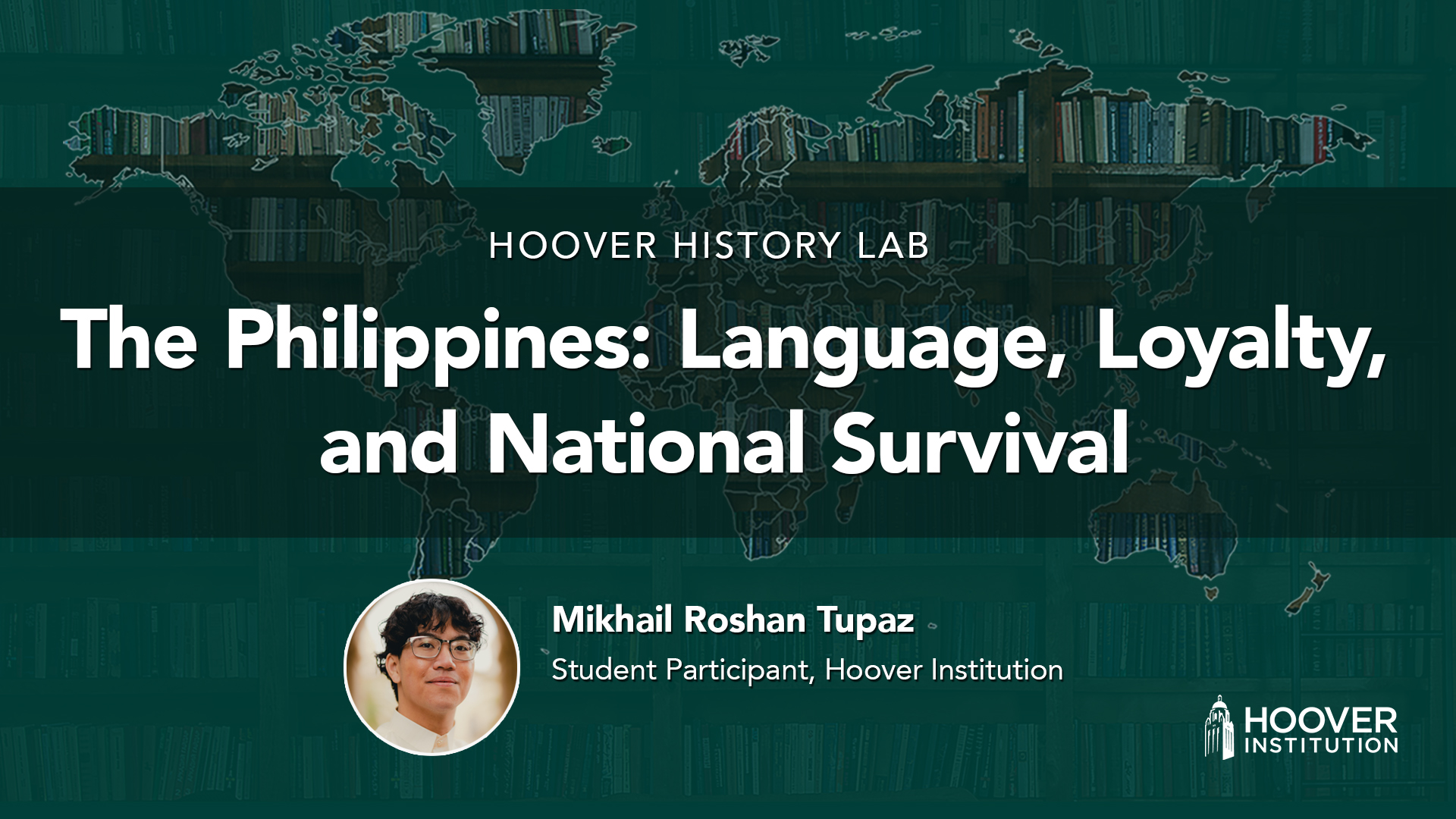
The Philippines’ language system emerged from a long history of colonial rule, internal diversity, and the growing dominance of English in education and economic life. As English became more closely tied to mobility and overseas employment, Filipino and indigenous languages lost institutional ground, with serious consequences for national cohesion and long-term development. Constitutional reform and stronger mechanisms for enforcing language policy offer a path to protect national heritage while preserving the practical advantages of English proficiency.
- Since the end of the Philippine American War, the English language has remained a double-edged sword for the Philippines. On one hand, it has served as an asset for global interconnectivity, economic opportunity, and mobility. On the other hand, the Philippines reliance on English for economic and global opportunities has resulted in an erosion of indigenous languages, cultural identity, and national cohesion. The relationship between Philippine national identity, economic development, and language is complex. It has been shaped by numerous historical factors, including ethnolinguistic diversity, Spanish colonialism, English, linguistic imperialism under American rule, and the socioeconomic pressures of a globalized English speaking world. Today's INE economy, unsustainably relies on both English and skilled worker immigration. The lack of institutional support for native Filipino languages, even the national language, Tagalog based Filipino has created conditions in which fluency in these native languages proves insufficient for socioeconomic mobility. English has become a necessity for career advancement and stagnant wage growth at home has driven English speaking professionals abroad. This loss of Filipino talent to foreign labor markets dooms the country's long-term prospects for economic development. Where of all, with the decline of indigenous languages, Filipino culture and identity may disappear with it. Nearly 50 indigenous languages currently face alarming rates of decline posing an existential threat to these communities. A robust Filipino language policy is crucial to political stability, national cohesion, and post-colonial economic development. If young Filipinos continue to associate English with opportunity and Filipino languages with limitation, an erosion of civic commitment to the nation will persist. The solution lies in the Philippine constitution as the supreme law of the land. The Constitution shapes the trajectory of language policy planning, and the nation's aspirations. The current 1987 Constitution lacks clear, enforceable language protections. Subsequent language legislation has been piecemeal, reactive, and vulnerable to the agendas of shifting administrations. A constitutional amendment can enshrine all Philippine languages as integral to and inseparable from the national heritage by honoring the nation's diverse voices. Constitutional reforms reinforce the shared national project showing that true unity emerges not from uniformity, but from mutual respect. To ensure the implementation of constitutional reform, the current mechanisms that enforce language policy must be strengthened through funding relative independence from the administration, and an expanded mandate bolstering these existing native language institutions can instill in the Filipino people a pride in their mother tongues, while maintaining the advantages of English language education and proficiency. In short, to ensure its survival, the Philippines must reimagine what it means to be Filipino.
ABOUT THE SPEAKER
Mikhail Roshan Tupaz is a senior majoring in International Relations and double-minoring in Linguistics and Modern Languages. His research interests include the role of language policy in the creation of a national identity, particularly in the Philippine case, the possible avenues for linguistic justice and revitalization in the modern world, and the nascent dialogues of Pan-Asianism and the creation of national identity in the late nineteenth century, with relation to the Philippine Revolution.
RELATED SOURCES
-
Mikhail Roshan Tupaz, “Reforming Philippine Language Governance: How Language Parity Can Revive Filipino Nationhood,” Hoover Institution, Hoover History Lab Policy Brief no. 2505, October 2025.
ABOUT THE SERIES
Policy in Brief by the Hoover History Lab analyzes contemporary global policy challenges, offering insights and providing possible solutions through a historical lens.