
















- Comparative Politics
- Politics, Institutions, and Public Opinion
- Europe
- Democracy
- Answering Challenges to Advanced Economies
- Determining America's Role in the World
- Understanding the Effects of Technology on Economics and Governance
The recent Gorton and Denton by-election that added a new Green Party member to the House of Commons was not mathematically consequential to a Labour government with an enormous majority. Nevertheless, the results connected with several key themes in contemporary British politics: the rise of populist “third party” movements; the declining fortunes of centrist parties; and the demographic realignment of party politics. Similar dynamics are found in the United States and across the global north, so this Green victory in the Greater Manchester area deserves our attention as does the defeat of Viktor Orbán in Hungary.
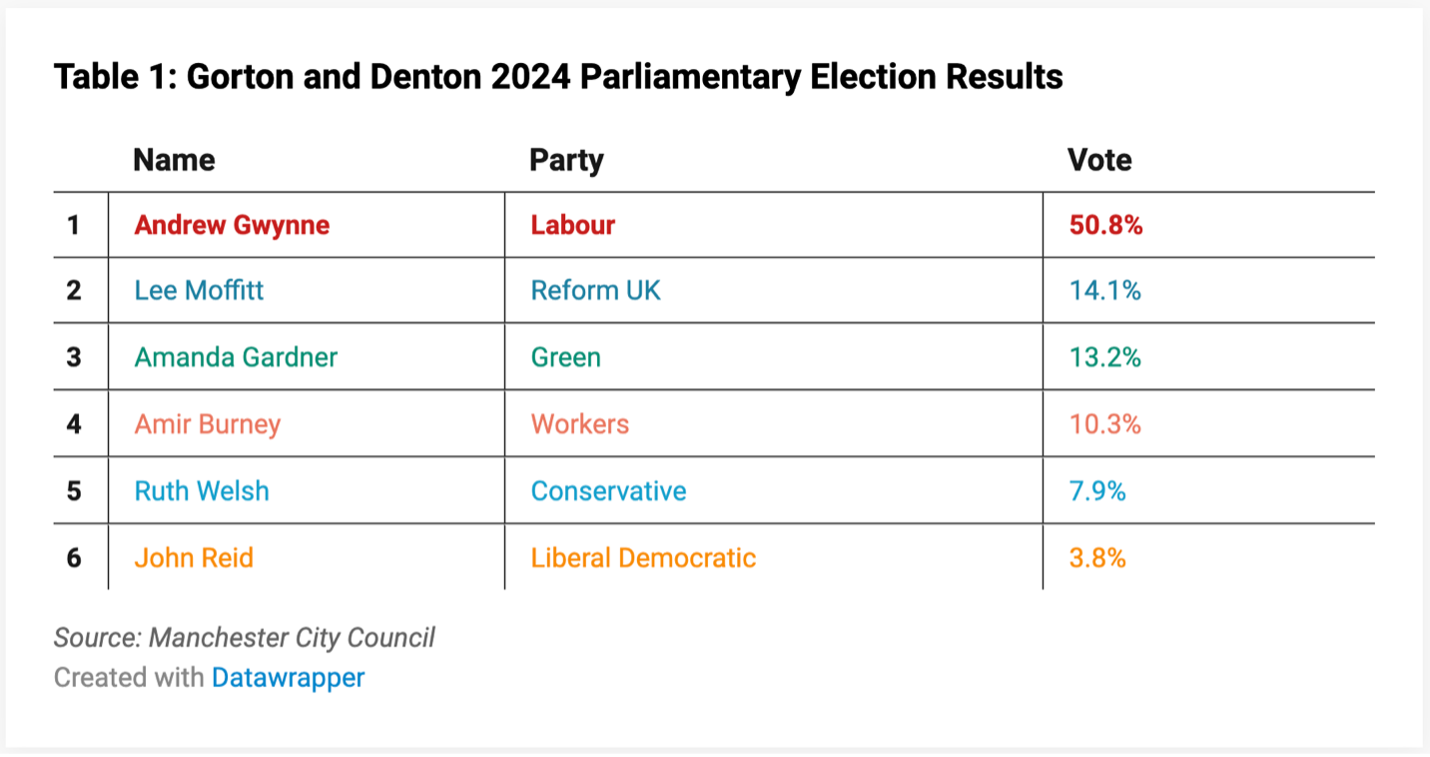
The United Kingdom held the election February 26 to replace an outgoing member of parliament, the Labour Party’s Andrew Gwynne. He had received over 50 percent of the vote in the 2024 parliamentary elections, so the seat was considered one of the safest for the party.
Nevertheless, the Labour nominee was defeated by Hannah Spencer, the candidate of the populist-left Green Party. There were other surprises: even as Nigel Farage and his populist-right Reform Party have received immense and sometimes fawning media coverage, Reform’s candidate was defeated by 12 percentage points, contrary to many pundit and polling predictions.
This was the first time in English by-election history that neither the Labour nor the Conservative candidate came in first or second place. Both candidates also “lost their deposit.” (In parliamentary elections, candidates pay a £500 fee to appear on the ballot, which is returned if they receive at least 5 percent of the vote. To “lose” a deposit is a widely accepted indicator of a very poor showing, especially for a major-party candidate.) This adds evidence to the thesis of populist parties putting electoral pressure on the traditional parties, with a subsequent “hollowing of the center.”
For Prime Minister Keir Starmer and his Labour government, who are facing low poll numbers, there are now fundamental questions about how to govern. If the political center is indeed hollowing out, some say Labour should move to the right to chase Reform voters. Others see the Greens as the greater electoral threat. This dilemma is shared by center-left parties in many nations.
Coups and tactics
In addition, the defeat of the Labour candidate gave the media and pundits a reason to continue their longstanding negativity toward Starmer, which began even before the 2024 election. The succession of five Tory prime ministers in fourteen years gave the chattering classes a taste for internal party coups, and they will not be satisfied until Starmer leaves 10 Downing Street. While we see “a British press determined to let Nigel Farage play on easy mode,” as a writer remarked in the New Statesman, Starmer is blamed for almost everything and credited with little. Whether his displacement would be good for the party or the nation is only occasionally considered.
Furthermore, the contest provides insights into how tactical voting is shaping contemporary election outcomes. Because British politics has more progressive than conservative parties, a common claim is that a divided left can be its own worst enemy. Tactical voting provides a way to “unite the left” in order to defeat the populist right.
This has been suggested not only as an explanation of the Gorton and Denton outcome but also for that of the 2025 Caerphilly by-election for the Welsh legislature (the Senedd). The latter was similarly portrayed as a close contest between a progressive party (Plaid Cymru, the Welsh national party) and Reform, fighting to displace an unpopular Labour Party. And as in Gorton and Denton, the Reform candidate lost by a decisive margin (over 10 percentage points), contrary to many predications.
Taken together, these by-elections are consistent with some common narratives in British politics (class realignment and partisan dealignment) while raising doubts about others (particularly the media drumbeat of Reform’s unstoppable path to power). This singular but meaningful election deserves a closer look.
By-elections send a signal
A by-election is the equivalent of an American special election for the House of Representatives; voters in a constituency choose a replacement for a member who, for one reason or another, has vacated the office. These rarely coincide with other elections, so the full attention of the British political, media, and pundit classes is focused on one specific contest.
The Gorton and Denton contest did not have any practical implications for parliament, as Labour holds more than 400 of 650 seats, and even several dozen by-elections defeats would in no way endanger the party’s majority. The loyal opposition, the Conservatives, currently hold only 116 seats and show few signs of electoral life, although the favorability ratings of Tory leader Kemi Badenoch have been steadily improving.
While any single constituency is inevitably unrepresentative of the overall population, the outcome can give clues to the national state of political play. It would be a mistake to think of by-elections as simply protest votes against the party in power. Research indicates that they are complex phenomena that reflect both national and local dynamics, and recent history suggests they can reflect emerging political trends.
In the 2019–24 parliament, twenty-three such contests took place. The incumbent Tories fought to retain fourteen seats but were successful only three times. They lost seven to Labour and four to the Liberal Democrats. By contrast, Labour retained five seats and lost two, one to the Conservatives and one to George Galloway’s Workers Party. Taken together, this collection of by-elections proved fairly predictive of the 2024 elections: Labour strength, Conservative collapse, and Liberal Democratic gains.
The recent by-election might therefore have some implications for the next parliamentary election, although useful patterns can emerge only through a larger sample. In the current parliament, only two have taken place, and Labour lost both: one to the Reform Party (Runcorn and Helsby in 2025, by a small margin) and one to the Green Party (Gorton and Denton, by a large margin). These two results are consistent with general narratives of Labour and Starmer’s unpopularity, the shaky status of the center-left (Labour) and center-right (Conservative) parties, and growing support for populism across the ideological spectrum.
The meaning of by-elections is often questioned on the grounds of relatively low voter turnout. However, the number of voters in the Gorton and Denton contest was slightly higher than in the 2024 parliamentary elections, and turnout in the Caerphilly by-election in Wales was 6.1 percent higher than in the 2021 Senedd elections. Thus, the defeat of Reform Party candidates in both contests cannot be dismissed as representing the choices of a small number of unrepresentative voters.
Who were the voters?
The Gorton and Denton constituency is within Greater Manchester and was created for the 2024 election in a process that Americans would term a redistricting. This area is part of the red wall, the Labour Party’s traditional strongholds in the English Midlands and north.
In 2024, the Labour candidate won by an overwhelming margin (table 1). Andrew Gwynne received 50.8 percent of the vote, followed by Reform at 14.1 percent, the Green Party at 13.2 percent, the Workers Party at 10.3 percent, Conservatives at 7.9 percent, and the Liberal Democrats at 3.8 percent. Any challenger would therefore need to overcome a margin of over thirteen thousand votes, and the constituency was accordingly Labour’s 38th safest seat.
As the UK does not engage in gerrymandering, Labour’s strength in Gorton and Denton was not an artifact of politicians choosing their voters, the practice so beloved by the US Supreme Court. As the BBC noted about the constituency, “Its historical voting record is clear. Labour has dominated in parliament, and the party has always controlled the local council too.”
Media stories about the election often noted that this was “one of the most diverse constituencies in the country and has some of the most deprived council wards.” The hybrid name is a clue to its bifurcated nature. Gorton is a neighborhood within the city of Manchester while Denton is in the neighboring borough of Teaside. Denton is a predominantly white and working-class area, while Gorton has a higher share of Muslim and student voters. These differences would often be referenced in discussions of the election outcome and its meaning, especially given the larger context of growing nativist politics.
The outcome
The pre-election media coverage and pre-election polling both predicted a close result. Many pundits and pollsters saw the election as a toss-up between Hannah Spencer (a plumber and local councillor) of the Green Party and Matt Goodwin (a professor turned pundit) of Reform. The New Statesman’s Britain Predicts model showed Labour, Reform, and the Greens as essentially tied, although it also found that tactical voting considerations had the potential to change the outcome. (The betting markets, a resource analysts should not ignore, were more favorable toward Spencer.)
In the end, Spencer won with a very comfortable margin that registered somewhere between a surprise and a shock (table 2). She handily defeated Goodwin by a dozen percentage points, contrary to most expectations. This also constituted the first parliamentary by-election victory of the Green Party, and in a constituency that was the party’s 127th target seat.
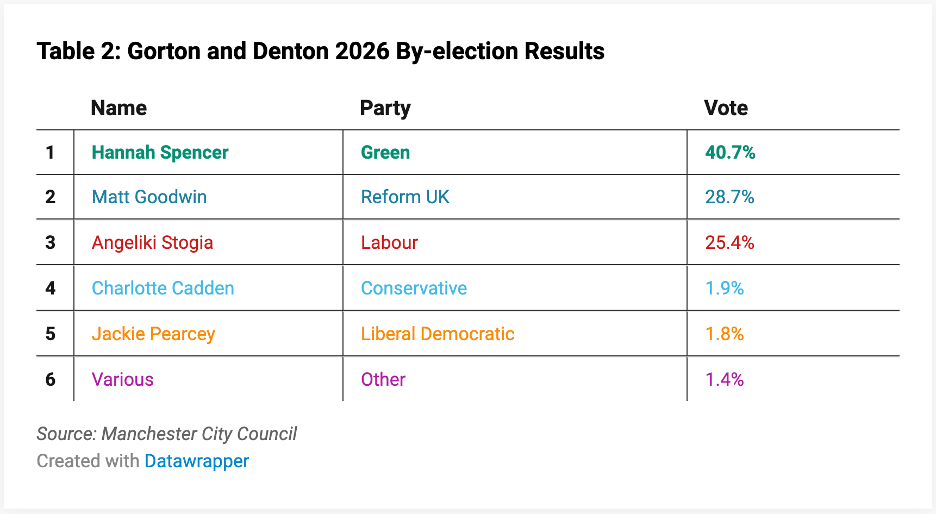
Angeliki Stogia, a local councillor who represented the Labour Party, placed third. As the election approached, some in the party thought it might pull out a victory by attracting undecided tactical voters. This was not entirely unreasonable, given the relatively high number of undecided voters in the final week of the election, but they apparently broke for Spencer.
A comparison of this contest with the 2024 parliamentary vote shows that the Greens increased their vote the most, by 27.5 points, while Reform grew by 14.6 points. Labour’s vote almost exactly halved (-25.4 percent). Assessing the traditional British variable of electoral swing, the shift from one party to the other, is difficult in a multi-party context. In addition, the left-wing Workers Party did not run a candidate in this by-election, which complicates comparisons.
When we broaden the analysis from individual parties to broad ideologies, further patterns emerge. By adding the total vote for right and center-right parties (Reform + Conservatives) and left and center-left parties (Greens + Labour + Liberal Democrats + Workers Party [2024]), we see that the former increased by 8.6 percentage points while the latter declined by 10.2 percentage points. Comparisons are not exact, as the by-election featured a variety of additional parties that each received very small slices of the vote. The “left” vote was still more than twice as large as the “right” vote in 2026 (67.9 vs. 30.6 percent), despite the enormous Labour collapse. Taken together, these changes do not signify a broad ideological landslide. However, the Guardian reported before the election that “Gorton and Denton is 440th on the Reform target list, according to an insider,” which suggests the shifts seen here might translate into victories in more promising constituencies.
Given the divided nature of the constituency, one suggestion is that Reform did well among white working-class voters in Denton while the Greens made gains among Muslim and student voters in Gorton. While this is a question that awaits additional research, a Labour postmortem reportedly concluded that “Labour lost significant numbers of white working-class voters to the Greens in Gorton and Denton,” which suggests that populists of both the left and the right can compete for this electorate.
Next week: A closer look at the candidates and the post-election spin in this significant by-election.

