













- Economics
- History
- Political Philosophy
- Artificial Intelligence
- Science & Technology
- Answering Challenges to Advanced Economies
- Understanding the Effects of Technology on Economics and Governance
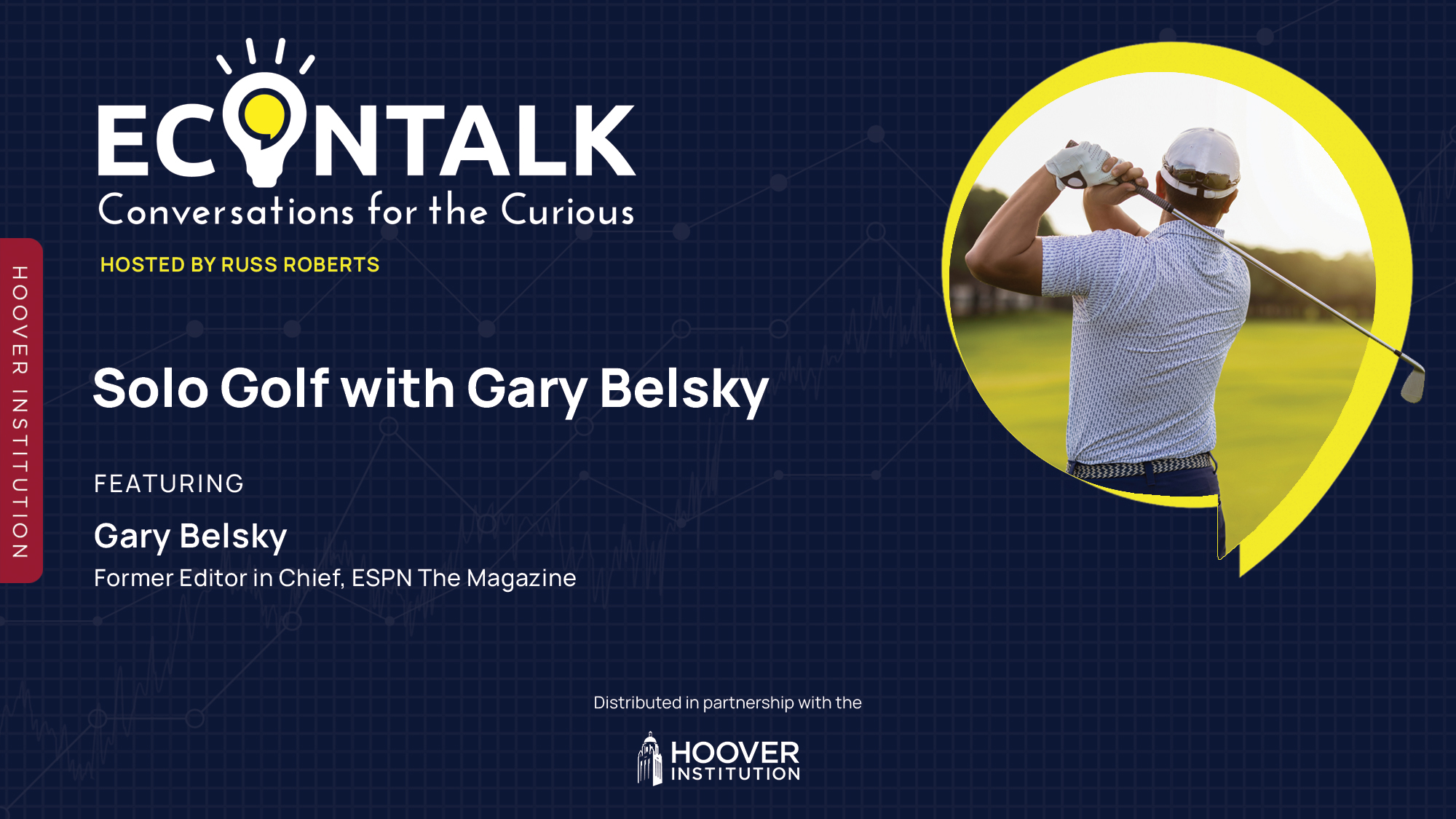
No rush, no noise, no one else on the golf course: solo golf is an entirely different game, offering physical, mental, and spiritual benefits that playing with others, can’t. Listen as author and former editor of ESPN The Magazine Gary Belsky and EconTalk’s Russ Roberts discuss how golfing alone can create flow, develop physical mastery, and enhance self-awareness. Along the way, they explore what makes golf different from other sports, what it reveals about our character, and why even non-golfers may love its solo version for the lessons it imparts about life.
Listen to the episode here.
- Today is March 25th, 2026, and my guest is author Gary Belsky. This is Gary's third appearance on the program. He was last here in April of 2016, talking about the origin of sports. His latest book on our topic for today is Solo Golf. Gary, welcome back to EconTalk.
- Oh my God. Very glad to be here. Can I ask you a question? Oh, sure. Is there like a, do you have like a thing like Saturday Night Lives? Ha. Saturday Night Live has where if a host has, you know, hosted five times, they get a jacket. Like, you know, I know that there have been people who've been on many more times than me, but is there a threshold in which they, you know, we become kind of part of a club? Sure. Any kind of talk club, I'd like to, can we make it three?
- Well, three. And then plus, if you've won, say the masters, you get a green jacket. Yeah. So you've only got, you're halfway there. You've got the three appearances. Yes. We're gonna talk about your book, Gary. We're gonna talk about golf, but really like the game itself. Your book is a vehicle for deeper things, friendship, disappointment, joy, introspection, meditation, contemplation. So let's begin with solo golf. What is it?
- Solo golf is not, is what I call a, it's not a foursome, a threesome or a twosome. It's a lonesome. I don't mean playing as a single, which is a thing in golf off, you know, I'm a, I'm a highly social person. I make this point at the beginning of the book that I love playing golf because I love playing with friends, present, company included, and, and nephews as well. But solo golf is the act of playing golf by yourself on a course, or at least on a whole, without anyone there. And it is a, it can be a transformative experience because golf, the golf industrial complex by definition, wants you to go out with other people. They want four, almost every golf club or golf course in the world once you, once four golfers to go out every eight to 12 minutes as many days of the year as they possibly can. Even private courses where if you belong to a private club, especially if they're, you know, at certain times of the year, you can, it's a little bit easier to go out on your own. They still generally discourage it because courses are meant to be shared, I think. But courses in some ways are best enjoyed when you are playing it by yourself. I have a line in the book. There's no, in, in some ways, there's no lonelier place in the world or emptier place in the world than a, than a golf course with nobody on it. And the second loneliest place in the world is a golf course with one person on it. That's what solo golf is playing by yourself, playing alone.
- And you yourself, how many times roughly have you solo golfed?
- I don't know if I could count it, but dozens.
- So I should let listeners know that I used to consider myself the best golfer in the world who only golfs three times a year. Hmm. Now I'm the best golfer in the world who hasn't golfed in a decade. I think I could get out there tomorrow and probably shoot a 1 35, you know, which is incredibly impressive. For those listeners who are not familiar with golf, the, the, the goal is really to, to get around the course hitting the ball about 72 times. That would be so-called far four
- Times 18.
- Yeah. Right. Roughly there are courses that have 70 per bar and other things, but 72 is the standard. So, but my point is that I really enjoy golfing, but I'm officially out of the habit. And I love golfing with you. And we have not golfed in a long, long time, but we have golfed a number of times, I'd say, I'm guessing five or six times. And so if you said to me, let's go golfing, I'd be happy to join you if life permitted, I'd look forward to it. We'd have a blast. Why would I go by myself? You and I enjoy each other's company. We talk about everything and nothing when we go golfing, which is half the fun. Why would I go by myself?
- Well, before I answer that, I want to, I wanna note something and I wanna note it. I once worked for a very long time with a guy named Brendan O'Connor, who was our golf editor at ESPN when I was at the worldwide leader in sports. And Brendan would always correct me. 'cause like you, I use the term golfing as a, as a jaron, I guess. Is that what it would be? Yeah,
- I think that's, yeah, I think it is.
- And he would say, play golf. That, that real golfers don't say golfing, they say play golf. But I also say golfing. The, the reason to play by yourself. I mean, there could be many reasons to play by yourself. You could be traveling as I often am, and all of a sudden realize, oh wait, the weather outside is kind of crappy. And there's, I can probably find a really not well attended course in this area, meaning kind of a bad course. And if I call them up, they will probably rent me clubs and I can go play a at least a few holes. And there's just something about that that first of all is sort of a little bit fun, a little bit serendipitous, a little bit adventurous. But the reason to play by yourself is because it's a, it's an entirely different experience than playing with other people in almost every way possible. You know, we divide the book, the book is kind of divided into three different parts. The largest part is me explaining why it's so different. But essentially it's, it's a, it's kind of a meditative, introspective, contemplative experience that's unlike almost anything you generally encounter when you're playing golf with other people. And really unlike almost any other sports activity ex except, you know, I guess maybe like shooting hoops outside by yourself, you know, like in, you know, on a, on a spring summer or fall night, something like that. But it's, it's just, it feeds the soul in a way that a round of golf with other people doesn't, doesn't mean that a round of golf with other people doesn't feed your soul. I, the, the sociability of, of a round of golf, even with strangers, is something and can be itself kind of a really meaningful experience. But when you're playing by yourself, it is, it's the closest thing to like a yoga practice for me. It's, it's, it's just a beautiful, quiet, thoughtful experience. And those are not words I would generally, you know, attach to, to the sport of golf.
- Now you just mentioned in passing used to, you were the editor and chief at ESP in the magazine, which was an eclectic sports magazine and a, and a pioneer in, in many, many different areas. Did you cover golf much when you were there? And did you get pressure? You know, of course you're a golfer, so you kind of enjoyed golf things and putting in the magazine, but did you sometimes get criticized for doing too? This is a totally off the topic, obviously the book, we'll come back to the book in 30 seconds, but
- No, no, no. I, I get, it's a great question. First of all, yes, we did cover golf. I'll tell you the two most memorable golf stories we ever did were actually participatory stories, which I'll tell you about in a second. But generally at ESPN, and this is really true even of the, of in, in, you know, in the, in the espn.com and on TV as well. Like, you know, you're gonna spend most of your time in most of your resources covering the most obvious sports, right? Football, baseball, basketball, hockey, ESPN. Obviously to some extent, some of the coverage was dictated by who the television network had contracts with. Not in a bad way, but if we, but if we were broadcasting hockey when, you know, then we would probably be, do a little bit more hockey in the, in the magazine or on or on insider, which we also ran, you know, the, the premium website for E-S-P-N-X games, action Sports was something that we also did coverage of, partially because ESPN invented action sports, right? But our rule generally was that as long as we thought 10% of our audience would find the story compelling, that was reason enough to do it. As long as we also covered the major sports, and we had this sense that turned out to be true, that proved out in readership surveys and focus groups that with sports like golf or wrestling or, and I mean both kinds of wrestling actually, we covered both the entertainment kind and the, and the hardcore sports kind with those kinds of sort of quote unquote minor sports readers who didn't care about it would forgive you because they just assumed that somebody else liked it. And as
- Long
- As you were giving them their quotient of football, baseball, basketball, hockey, motor sports, they were like, okay, I guess somebody must wanna read about snowboarders. So that was kind of how we thought about it.
- It's like EconTalk, if it's an episode on golf, it'll be interesting. So Carry on. What were you gonna tell us? A couple stories. The,
- So the, the, my two favorite stories that we did was we had an editor, a young editor at the time who had played collegiate golf. She's now at 60 Minutes actually as a producer at 60 Minutes, but she was a collegiate golfer. And so we, she entered a tournament, an LPGA tournament. And by the way, that, that golf editor that I mentioned to you, Brendan O'Connor, he was her caddy. But the story was really about what it was like to compete, you know, as a, as a former athlete in an LPGA tournament. She didn't make the cut her name as Sarah Turcott. She was an excellent editor and a phenomenal golfer. She didn't make the cut, but the story was fantastic. So I remember that story a lot. We went down there to, to watch her play. Actually, that was just sort of cool to be rooting for someone in a gallery, rooting for them because you knew them. And the other story we did was, there's a legendary ESPN writer named Tim Kuhn. He's still there. He's just phenomenal. You can write about any sport. He really gets you inside an athlete's mind and inside a team. But we had Timmy, who hates to be called Timmy, but let me call him Timmy. We had Timmy once caddy in a professional golf tournament that, that shows you the trust that we built up with athletes, because you had to con, we had to convince a professional golfer to let us replace his caddy with Tim, who went to some version of Caddy school to do it. And it's a phenomenal story, if you wanna read it, mostly because of how difficult it is to caddy. Oh my gosh. In a professional golf tournament, the pressure on you, the things you have to do, the, you know, if you know how we all have these experiences of playing with a friend who's a real stickler for etiquette and rules, you know, you can't walk in that line or, you know, just, there's always that, that golfer, I'm not that golfer as you would guess, who is a, a, a stickler for etiquette, but if you're a caddy, you really have to know oh yeah. Not just the rules and not just the course And not just the green. You have to understand the, the, the unwritten rules of, of, of golf too, because you cannot be pissing your, your, your golfers partner off in the middle of a round because you did something wrong. So that bo both those stories to me were, were fascinating, but we, you know, we, I would say 10 times a year, we profile, we did previews of the majors. We profiled a really hot golfer. You know, I was just a big, I was amazed. I don't think she gets nearly as much attention as she should. Not Anika Sorens, who was, you know, arguably the greatest female golfer ever and, and who did get a lot of attention. But there was a golfer named Lorena Ochoa, who was from Mexico, I believe, and she was just phenomenal. And Lindsay Berra, Yogi Vera's granddaughter, who wrote for us, did a profile of her. And she basically was at the top of her game, arguably one of the best golfers, male or female in the world. And she got married and wanted to start having kids, and she just quit because she had done what she wanted to do and had no problems walking away. And the story, we, we did a story about her when she was still playing, but I just remember admiring the way she approached the game and then admiring the way she walked away from the game. Anyway, so yeah, we covered golf. Oh yeah.
- Cool. I I wanna ask you one other digression. You mentioned in passing that you went to the, the gallery and watched your reporter, your, your reporter try to make the cut. Yeah, I think it was
- The Michelob Light open, by the way. I think literally, I think that's what it, what it was.
- Have you ever gone, have you, besides that, have you ever watched golf live a Sirius golf bench?
- Yes. I, there was a senior tournament in St. Louis that I watched a little bit of it, but not, not, not as much as I should have. You know, when I was at, at ESPN, both when I was rising up the ranks and then became editor, I generally wanted to be the kind of boss who you get credentials at ESPN. You can't just go, because you work at ESPN, you get credentials. And I was generally, and all of leadership at the magazine was the kind of leadership that we wanted to let our editors and writers get the credentials.
- Sure. - And so, I, I didn't take up, I didn't take, I should have gone to Augusta. I was, you know, I, I, I wanted our golf people to go to Augusta, so I didn't, I didn't go to nearly as many events as I could have where there was, where credentials were tight.
- But I'm just thinking, you know, maybe at the end of this conversation, we'll talk about golf on tv, which is an interesting thing. It it's, it's still quite popular. I did a little research before our conversations and as popular as it was in Tiger Woods' heyday, which was sort of the peak of, of golf viewership on tv. But when you watch on tv, the, the camera moves on to the, it follows either the leaders or there are many different ways you could watch golf on tv. And they, they often will splice in different halls that are going on that are interesting for various reasons. But when you're in person, it's a very, very, very different experience than watching it on TV because usually you're camped at one hole and yeah, you don't know what's happening in the rest of you. There's a leaderboard, you can sort of keep track, but it's a very unusual spectator sport compared to, say, tennis or the majors where you're watching two teams play. But, but to stand there, sit there and watch these, this human frailties, which what it often is, is an interesting spectator experience that I've, I've never talked about anybody who's ever been passionate about it, but they're obviously people who are very passionate about attending golf live. I don't understand it. I'm, I'm fascinated by that.
- Yeah. Well, there's, there's different experiences. Even when you watch it live, even if you're camping out at holes, oftentimes what people will do is they'll camp out for a certain period of time at a certain hole, and then, you know, later on they'll, they'll try to get somewhere else. But even what does it mean to camp out? Because you could be camping out where somebody's teeing off.
- Right? You still,
- Or you'd be camping out at the greens. Right? Yeah. So, you know, there, we, we wrote about this back in the day at espn. We would, you know, we gave advice because there's a, you know, there's, there's different schools of thought. Some people say it's just a better experience if you follow a group, and remember, usually you're following a group, you're not following one person, you're following at least two. Sometimes depending on the tournament, you could be following three people, and then you at least get a little bit of variation. But, but also you're getting, you're getting to see all the holes and you're getting to see all of the shots, albeit from one, you know, two or three golfers. But there's just, it's just a different, it's just a different philosophy. But you're right, it's, it's, it's in some ways mu the, the difference between watching it on TV and the difference between watching it in person is as stark or as wide as for any sport because Sure. You know, people always ask me, what's your favorite sport? And I always say to player to watch. And then if they say to watch, I say in person or, or on tv. 'cause there are differences. Yeah. You know, there's, I love hockey, love it on tv in person. It's the most exciting sport to be in a good seat in an ar in an arena, but in, but the, it's still, they feel like the same game you're watching it, it it, whether or not you're watching it on TV or whether or not you're watching it live golf. It's like you said, it's very, very different. And ultimately, I think I would encourage somebody to sort of do both, right. To, to do a tournament where they follow a, a twosome or, you know, one golfer, and then also to try to do a tournament or split the tournament up. Or remember you can do it on, there's four days usually right. To do it where you are just sitting at a particular hole and seeing how different people play it. Right. Yeah. That's the excitement. And of course, like nobody's gonna, nobody's ever gonna gonna regret being on the green at a major, the 18th green, you know, to see the end of the tournament. So it's just sort of, you know, it's personal preference, but they are very different experiences.
- So before I read your book, I wouldn't have imagined, we're going back to your book now we're going back to solo golf. It's such a, a, a dramatic thing because, you know, it's solo golf is when you're on the course by by yourself. So you just don't have people to talk to. But that's of course not what it is. And reading your book forced me to think about how crucial it is. It's not just the social part of golf that makes normal golf different from solo golf. It's the fact that people are watching you. Yeah. And when you golf by yourself, if you go to a driving range and, and hit, hit a bucket of balls, you're gonna play differently than when your friends or strangers are watching you. And it's stressful can be, can be stressful because you're performing, which is a weird thing. And I was, so, I was trying to think, you can comment on that, but I also was trying to think about what's the analog to solo golf in other areas of human activity? Is it like singing in the shower versus singing at a concert? Is it, is it like the difference between writing I do in my diary or journal that I don't publish? 'cause I don't have to worry what you think of it. And my, you know, by far, the best analogy I could think of was fishing. It's really fun to go fishing with a group of people. There's often alcohol involved, which there is often in golf, it's sociable, it's relaxed, it's, it's often full of banter. But fishing by yourself is an extraordinarily different thing. And it's not just because no one's watching, but the golf thing, the weird part of reali of reading your book is you realize, oh my gosh, a huge part of my game is the stress and exhilaration and shame of the, the ball lost in the woods. The time I make a par three. Which is my,
- And also by the way, yes. And also by the way, the assistance of, if you and I keep our head down, that often means we don't know where the heck the ball went. And so it's helpful to have somebody else, my friend, you know, my, my sort of my friend David Kahn just has, he's my age, but somehow he has the, and I have 20, 25 vision. And I don't think he does. But man, this guy can spot a ball no matter where it goes in a way that, that I could have binoculars and be watching it like an eagle and not be able to find a ball. He's phenomenal. And that's a big advantage. But I, I, I have, I tell a story about, I I, I think I make it third person, but it's about me that speaks to the issue of what you're talking about, the self-consciousness and why it's so stressful. Which is that I was playing with a guy who had, who was a, a very good minor league professional golfer, that is to say I knew him through a friend. And he played, I played with him somewhat regularly in the nineties. And he played on the mini tours, a couple of, you know, so he made a little bit of money playing golf. He never really made it to, to the, you know, to the, to the show. But he was a very, very good golfer. Just a, a, a different golfer than I was. Like, it was an entirely different, you know, he plays a game with, which I'm not familiar right, that, that, that line. But one time I said to him, and he understood immediately what I meant. I was like, what's, what's the one difference I said between you and me? And what I meant when I asked him that was what's the one difference between golfers like me and, you know, hackers, amateurs, enthusiasts, and a golfer like you, you know, a professional. He was a guy who could go to any, you know, any course and, and potentially shoot par or even below par. And he knew exactly what I meant. And he said, oh, that's easy. And I said, what? He goes, when you, when I'm over a shot, all I am thinking about is that shot period. He goes, when you are over the ball, all you are thinking about is every shot you took before in this, in this game. And, you know, in this, you know, round and maybe all the other rounds. And you're also thinking about me and you're thinking about other people watching in the other holes. And, and I would argue that the stress, you and I feel the anxiety is what you're trying to lose. If you get to be, when they talk about focus, it's not just focusing on, on the, the shot and the many, many things you have to think about in golf that are I listed to them in this, in the book at one point. Just all the things about setup and waggle and hand position and hip turn and shoulder. You know, just when you go through it, it's astounding follow through. And, but not just thinking about that, but we're also just thinking about like, who's watching?
- Yeah.
- And what are they gonna think and what did they think? And oh my God, what's the matter with me and am I ever gonna learn and why do I play this game? So I think that's a big, and in solo golf, I, I lose almost all of that. It's one of the reasons why it's, first of all, on the mechanics of the game, I'm, it's just a calmer experience. 'cause it doesn't, it doesn't count. And literally, I, I have a, a sidebar in the book that I should point out here. That the one, you know, one of the issues with solo golf is it does not count for your handicap because you need witnesses for your handicap. But also the stress that you talk about is gone. Now I want you to imagine you and I have had some fun times playing golf and I don't think we stress too much about each other. No, we
- Don't.
- But any of the stress that you have on a golf course that's sort of normal for golfers like us, it's gone. 'cause you are just by yourself.
- So. We'll,
- And nobody's watching 'cause nobody's watching.
- The best golfer I used to golf with, occasionally with a very serious golfer. And he would, he would typically break 80, he'd score around 80. Oh wow. Maybe a little bit below. And one of the stresses there, and it's just an interesting aspect of golf, is that if you and I are doing some activity, let's say bowling and, and you're a great bowler and you're gonna bowl a two 40 and I'm gonna blow, I'm gonna bowl a one 18, the fact that I'm bowling a one 18 doesn't bother you in the least. In fact, probably makes you feel good. You're rolling a two 40. But when I'm golfing a one 20, which is around what I usually would golf, my shots are going in places they shouldn't go, which delays this person I'm with. And it requires a very special person who can make me at ease and not feel guilty that I'm slowing him down. And and that's an aspect of cell phone call that, as you say, isn't present because the show watching.
- Yeah. And I would also say that much more of that is in our control. And I'm putting you and me in the same camp, much more of that is, is in our control in the amateur golfer, in the, in the hacker's control than they realize. Right. Like, I'm, I'm quite good now at playing with very good players, partially because I understand where to when to pick up the ball. How do we by the way, not to sort of make, not to be needy, not to have them have to validate you right. To just sort of be, to go about your
- Business, Gary, that was excellent,
- Right. To go about your business and that, and if those golfers, the really good golfers, see, even if they don't know you, if they're strangers, if they see that you understand how to play with them, then it becomes fine. Yeah. Right. You know, and you can, you notice sometimes when you're playing with golfers who are not very good or and who don't understand what to do when they're playing with golfers of just orders of magnitude, different levels of skill, then you, you realize that's the, the issue is not their play. It's their not understanding of how to play with others, when others are considerably better. Life is about getting comfortable in with that in everything. So that hopefully, you know, by the time you die, you're like, I'm pretty okay with anybody watching me do anything, you know, with a couple of things accepted because I sort of feel like I either do it well or I'm okay with not doing it well because I understand who I am and how I got there. Yeah, that's, and and in a funny way, the solo golf experience is kind of part of that journey, I think.
- Well that's the, that's the imposter syndrome problem that right. Some people have, and I was gonna say we have a, we have an upcoming episode with Alled McLean Jones on Tom Cruise and Physical Mastery, and we discuss issues of the things that our bodies can do that we can't explain easily what Michael Ponya calls tacit knowledge. And golf is a weird practice of mastery where we try to break it down into things. Actually we try to describe, turn your hips this way and do that, this, that and the other. This complicated, somewhat pretty well understood process of striking a golf ball Well. And we're in a world where that kind of physical mastery is, seems to be in certain dimensions dying away. And in golf, for example, I I just, I found this out preparing for our conversation, simulated golf, playing golf on a screen in your basement is just exploding. Yeah. For, for some obvious reasons. But with, you know, with the digital world increasingly dominating the physical world, it's gonna be interesting to see whether golf becomes less appealing or even more appealing because it is so physical and it's a part of our lives that we hardly ever come in contact with the i the idea of executing something that's physically demanding and and also requires coordination. It's not just a strength or a stamina or endurance question of, you know, a difficult hike or anything like that. Golf is this weird mix of coordination and, and understanding and it's, I don't know how it's gonna do going forward.
- And golf, you can practice a lot and not improve in a certain way because if you're not getting the mechanics right for you, it just doesn't click. And it's, and the margins of error in golf, you know, are so different than they are in most other sports. I haven't really gotten to your answer your question yet, but, you know, I, that story, there's a story I tell in the book that like you, I think sometimes I write books because I want to get some of the stories I've been telling all the time onto a page. And the story I tell in golf that's kind of both a fair story and not a fair story, is a story that was told to me when at the peak of Tiger Woods greatness. And somebody was trying to explain to me, a professional was trying to explain to me just like, you know, the margin of error factor in golf. And, and this person said, you know, if you shoot a 70, if you average 73 in golf, which is basically a little bit over par, which is phenomenal, but they said if you average 73 in golf, you'll be the most popular player in your local course of your country club. And they said if you average one stroke better, 72, you can go to college for free. And if you average one stroke better than that 71, you can probably make a living playing golf. And if you average one stroke better than that 70, you can be a millionaire. One stroke better than that 69. Remember, we're only four strokes away from where we started. You can be a multimillionaire and if you average 68, you'll be the most famous person in the world. Which is what Tiger Woods was averaging, you know, in 2002 for a season. And he was, you know, arguably the most famous person in the world. And you're thinking like that is, doesn't seem like a very big difference between a guy at a club and the most famous person in the world. But of course it is. But it speaks to, you know, the funny thing about golf is if you, is that you can hit a ball and if you mishit it on your club face by a centimeter, two centimeters, the outcome could be 70 or 80 yards wide of where you were aiming. Forget about the distance part. And that's just an extra, you know, nobody misses a basketball shot by 40 feet. They might, they might throw an air ball, but it doesn't look like they were aiming for the exit of the, of the stadium. Do you know what I mean? Yeah. And it's just, it's extraordinary. But I think you're right. As, as I, we've talked about this, I think before you and I just in private conversations, I think recent years have seen an explosions in the sales of pocket watches and fountain pens.
- Yeah. Yeah.
- And I believe, you know, I think, I believe, and I think people who know better than me believe that it has to do with kind of analog versus digital, right? Sure. That people are looking for analog experiences. So if I were the, you know, if I were the grand Puba of the golf industry, I wouldn't, I would sort of, I understand and embrace the digital simulation of golf and then somehow also frame my game as that stuff is fun. It's also fun to write with a fountain pen.
- Yeah. - It's also fun to use a pocket walk sometimes to pull that out of your pocket, have the business of flipping the lid and there's a golf equivalent of that. Like, I think you're right. I think golf has an opportunity, especially by the way, if there's more options to do physical golf that don't require you to spend five or six or seven hours of your day. I, I'm, I'm still, you know, I I'm, I'm still amazed that people don't lean in more into that the executive golf courses, you know, those nine holes. I think somebody, if somebody could come up with a golf experience that was not top golf, which is great, but which is just basically your, it's a version of a driving range, right? Where you're aiming at targets. But if somebody could come up with a six hole golf experience, they might get some attention. They might, that might, that could be a business. Because part of the problem with golf is people don't have six hours to spend or five hours to spend. And there's a way in which I think people could, would, you know, I, I sort of make the point that one of the, when you asked me how many rounds of solo golf I played in my life, and I said dozens, some of those rounds were six holes.
- Right?
- Because some, you know, a, a good part of the book is explaining to people how to play solo golf. 'cause it's difficult to do. But one of the ways to do it is to go late in a, in a, you know, to go late in a round and sort of say to the, you know, when to, to, to, to say to the, to the starter, Hey, I just wanna play, can I start it at one where they're not starting people anymore 'cause it's getting late in the day. I just wanna play five holes. And sometimes you can, you, you might have to pay for it. Sometimes you can just flip the starter a few bucks and you can just play five holes and who cares? You're not, it doesn't count for your handicap. You're not gonna be able to, you're not trying to tell somebody what you shot in your solo golf round, because anyway, what does that even mean? And sometimes it's just really a good experience to go out there and just knock off six, six holes by yourself. And so in general, I think what as, as people are thinking about playing golf for real or playing golf in a simulation, there's ways to sort of think about it as you can get that physical experience over the course of an hour and a half. And it can really compliment your digital golf experience. But it's funny to that, you know, I think you're right that they're different and it, it's, it could be an opportunity because the physical game is so much different than the simulation game. Yeah. Even if the swing motion is the same, in theory,
- It's, it's striking that there's not more innovation on golf courses like sand traps. Yeah. That was interesting. Or water hazards. But there's no, I, we, we could spend some time speculating that, but we'll, we'll leave that for another time.
- Well, by the way, that's a really astute point, especially since, so golf sort of takes a lot of pride in this sort of hu you know, sticking to tradition when of course if you took a shepherd from Scotland or China or Holland, you know, all of whom roughly contemporaneously were sort of inventing the game of golf with shepherd's crooks and sheep dung and random holes in the ground that they were taking aim at. If you brought them to Baltusrol or Augusta and said, this is the sport you invented, they'd be like, what? Like, they, they look at these pristine courses and they would, they, they might understand that it's the same game. I think they would, but they would also be like, this is not the game I'm, I I'm playing at, you know, mate. And it's funny because one of the, again, one of the secrets to playing solo golf is to actually seek out bad courses, courses that aren't well attended. You know, public courses that, that don't have a lot of money because there's just not as many crowds there and you're more, you know, there's not as much many golfers there. There's not, the, the crowds aren't as big and so you can maybe get a solo round in, but those courses are harder. And I have turned that into a really fun imagination game in which I'm playing golf a little bit closer to the way that it used to be played. Right. When you're in a fairway and you land in a rough patch or in a hard pan in the middle of the fairway or just, you know, a a a mud hole, you're thinking like, yeah, this, you know, I could be bummed about this. Or I could think like, I'm in Scotland and it's 1575
- Your time travel.
- I'm, I'm, I'm ignoring the king's order not to play golf. Which at one point the king of England had to make that a, a law because they wanted people to be practicing archery, not golf. And I'm, you know, I'm, I'm playing golf like it was meant to be played. So it's funny that golf used a tradition because the game we play now is in some ways very far from the game they played when the sport was invented.
- I wanna come back to your point about the difference between a, just say a college golfer shoot in 72, it's only four strokes to be the most famous person in the world. If you could average a 68, I think one of the appeals of golf, I don't know if this is my insight, but I I probably heard it from somebody else. You know, most, most sports, either the way you play them is nothing like the best people in the world play them or it's vaguely like it. So in the case of a football, I can't on the weekend go out and and experience an inferior version of tackle football. Right. It's just not available. Yeah. I, I can play tennis with you and it's true that, that I will serve just like Roger Federer serves. He, I'll toss the ball in the air and I'll hit it with my racket. It'll go slower. Right. It'll be less accurate. But it's, it's something like Roger Federer and of course returning your serve, which I will probably be able to do Roger Federer reserve. I'm probably not gonna touch it. And, and so there's a, even though it's similar,
- Not not probably. And if you do, and if you do touch it Russell, it will hurt. I'm
- I'm, I'm
- Quite serious.
- You're so cruel. Of course. So, but golf has this phenomenon where when I'm putting, I'm putting exactly like Tiger Woods, in fact, right. He's cons more reliably. He puts much more reliably or used to put much more reliably Still does than I do. But it's the same thing. The correct, the stroke is the same on, on a par three. I could take out a, a seven iron or nine iron and hit the ball within 12 feet of the cup, eight feet of the cup. Not very often. But I can do it. And every once in a while I do do it. And of course that's one of the great satisfactions for the three times a year or 10 times a year amateur who's shooting the 75 or the 80 and isn't close really to the 68. And for the 73 person, they're 6 72 hitter. They're doing a pretty consistently just can't do it as often. So it's an interesting example. And it's part of the reason I think people like watching golf is that, I mean, I think they like watching football 'cause they realize I can't do that.
- There are moments where when you are, it's funny, I don't ever think of it off the tee on a, on a par three, I think of it more where every once in a while I will have an approach shot. Yeah. You know? Sure. With a wedge. And I will just, I'll keep my head down. My mechanics will be great. I I do the swing I'm supposed to, and when I hit it, I know that I've hit it well and that it comes down and the exact right arc on the green. And I'm like, oh, that's how you're actually supposed to do it. And it, and I'm not sure anybody, any other golfer like you said, you know, would've would take it and w would wanna exchange their shot for that in that moment. I would argue that golf has a phrase that doesn't exist in any other participatory sport, which is golf shot. Right. When somebody hits an amazing shot. It's true. You can even say it about yourself, but somebody else will say, that's a golf shot.
- Yeah, exactly.
- And nobody ever, you can have a great, you can have a, you can have nothing but net in basketball. There's lots of things, but there's no phrase in any other sport that basically means that's exactly how it's supposed to be done at the professional level. Right. Right. You know, sometimes they call those be back shots. Right. The it'll, you know, I'll be back because I've made that often it happens on the 18th hole where like, you just hit this one shot, you're like, oh my God, I think I figured it out. But golf shot speaks to exactly what you're talking about, I think, which is this weird opportunity to sort of go, oh, that must be what it feels like to do this at the highest level. And I, so I I think you're, I think you're right. It's a, it's an unusual sport. I I often find it's also just a sport where like, you know, the great thing about sports in general is that the maintenance guy and the CEO can have a conversation in the bathroom about the Cardinals game, I guess you could say the Red Sox game. But I don't know why anybody would talk about American baseball. Yeah. But but they could have a, you can have a conversation about the, you know, that, that that Knicks Pacers game. Right. With anybody in, and by the way, the CEO, if the maintenance guy, if the, you know, is talking smart, we'll listen.
- Yeah.
- You know, we'll go Right. And, and participatory sports, there's not that many opportunities for people to sort of play socially with people in a kind of bringing people together way. But golf does offer that. Right. You can be out on a golf course and at some point you're, you're playing with a, you're playing with strangers sometimes and you don't know who's who. And
- That's true.
- If somebody's playing well, they're just like, you know, mad props sir for playing as well as you play. That might be a CEO and that might not be, but you don't have, there's not many sports where you can sort of do that sort of play with strangers. You can't, you could do it in bowl, you could in theory do it in bowling, but nobody does that. And we don't, you know, we rarely have corporate bowling outings. EE even too, nobody does a bowling, nobody does a bowling match, you know, for a, a sales call. Right, right. But
- They,
- But golf, you know, serves a lot of purposes culturally in a way that people I don't think, who don't participate in it quite under understand.
- But it comes back to the point we were talking about earlier. You can, I should have won 20. And of course there was one time on a nine hole part of my day, I shot a 49 in that nine holes, which was like the greatest, my greatest day is as an adult athlete, probably horrible score to those who don't know golf very well. It's a atrocious score. But when I'm shooting a 60 on nine holes or 65, I can, I can play with the 80 guy and, and the, the, the very good amateur golfer. And he can have a good time, even though we're gonna spend a little bit more time not walking in a straight line than he's accustomed. And there's no other sport like that. You, I can't, Roger Federer can't play tennis with me. Right. In any, it can't be fun for him. There's nothing fun about it. Right. But, and I'm not saying Tiger Woods and would or would have fun playing golf with me. He wouldn't. But somebody who's I
- Disagree. I think he would, I think he would. Because I think the conversation would be interesting. Yeah.
- Maybe,
- I think because you'd be a, a, a, a, a welcome recipient of his advice and wouldn't be giving him any and as long as you under and as and as and then two things, one a, as long as you understood how to keep the pace appropriate. Yeah. Correct. Whatever that meant. Yeah. Sometimes it meant like a drive the wind of the woods. You'd be like, you'll be like, you know what, I'm just gonna walk this round and watch you this all. Yeah. And the other thing that I think speaks to what you're talking about is if you understand how to be a human being, an adult human being on the course while you're doing it. Right. Like there's, you know, if it's just clear that you are, you know, everybody talks about you play golf with somebody, you un you know, you understand how they are in life. It's kind of true to some extent. It's true in any sport. Somebody who's, you know, you
- Chess, you get a chess, you
- Get a
- Poker.
- Right. Scrabble you get a bit of a sense. But in, but with golf, like, you know, you walk with somebody and you sort of see how they handle mistakes. Yeah. How they handle defeat, how they handle somebody else better than them, their, their graciousness, their respect for the game, their respect for golfers that come after them in terms of how they rep, there's a lot of, there's a lot of nuance in the game that tells you something about the person you're playing with that makes you go, I like this person. Yeah. Or I don't like this person, or I respect this person. Right. So I actually think Michael Jordan would've a good time playing with you for all of those reasons. 'cause I think you, I played with you, I think you meet all those criteria.
- Well, it's very kindy, but you just said Michael Jordan, you met Tiger Woods and if it was Michael Jordan, he would, he would win, you know, 21 0, I would have horse and he would have no letters. So. Right. Golf is different. Although I would lose, there's, you make a number of suggestions in the book for how to make solo golf interesting. Or golf in general more interesting. When you're playing by yourself, you don't, you can make your own rules in various different ways. You make a really remarkable suggestion that on the surface seems kind of, eh, it's a nice idea. It's kind of interesting. But I, the more I thought about it kind of haunted me. You call it no score golf. You say ignore scoring entirely and focus solely on execution. Measure success by how well you hit certain shots or how creatively you recover from tough lies, end of quote. And I was thinking about that. It's like, I'm not sure I'd enjoy that. I I, or maybe it'd be the greatest thing I've ever done. It would be so weird. I think it would be the not to keep score.
- I think it would be the latter. I often keep score while I'm playing solo golf.
- You often when I don't or you don't. Yeah,
- I do. Because I, you know, the, the, the cool thing about golf is it's like this sort of, every hole is a test. They think I'm supposed, they think a very good, they think a good golfer can do this in five strokes. Yeah. Let's see if, let's see about me. And I'm, you know, and, but sometimes I don't. And it's more enjoyable because I'm not, you know, in the beginning I'm kind of vaguely aware of what, how I've been scoring sort of. But then if I do some other things that I recommend sometimes, like if I'm, if it's the right situation, by the way, sometimes you can be playing solo golf and other people are not. So you have to think about what you're doing relative to other people. You're gonna either butt up against somebody or, you know, not usually, you don't usually have to worry about the people behind you. But when I'm playing solo golf and there's nobody around, like sometimes I'll just be like, I'm gonna hit three balls from this lie. Or you know, from right here. I just wanna sort of see like, what happens if I do a cross handed, what happens if I do, you know, if I, if I'm thinking more about turning my, whatever the case may be. But in general, when I'm not keeping score, I'm just, I just, but I remember is, oh yeah, I did that sand trap on seven really well. Oh, I, I, I really liked how I sort of, you know, was putting, when I did, when I putted three times, I don't mean a three put, but I putted three times from a particular position on 13, because I sort of wanted to see what happened. If I did you, if I worked on pace and went right at the hole, or if I worked on the line a little bit more and went to where the curvature of the green would do me. Like, I, you'd like it, it's different. I don't, I don't do it every time. But it's freeing in a different kind of way. I, I mean that's what's funny about these kinds of exercises in general, which is you just don't realize how, you know, we're so socialized as human beings, you know, babies are babies do what, as you know, I like to spend a lot of time around around babies like my, my nephews and niece's kids or my friends' kids, you know, and they're just amazing. Mostly because they are not self-conscious, you know, newborns, you know, up to a certain age, they really are not self-conscious. And it's just so funny. You realize, especially when you're playing solo golf, how much what you do is based on sort of how you're socialized the expectations, the rules. And there's a, there's, there are ways in which, where you're just playing for yourself and you're, you're not being selfish. You're not ruining a grain. I don't mean anything like that, but you're just doing the thing for the thing itself.
- Yeah.
- And it's, it's extraordinary when it, sometimes you get into these flow zones that are just incredible. You know, I I, I think I finished the book off talking about my, my, my greatest score ever, which is 10 shots better than my second greatest score. And I've never even approached it. And it was such a, i I was having such an experience. It was a solo golf round was is the point. I was playing with rented clubs in one of the hardest courses I ever played. The University of New Mexico championship course. I was reporting a story for Money Magazine when I was, when I was there. And I remember when I got to the turn, I was scoring on every hole.
- It's the 10th hole. But I
- Didn't add, I didn't add up my score. 'cause I was like, I am in such a flow state. I do not want to know, you know, I had a sense, I I knew this was the best nine holes that I'd ever strung together and graded on a curve. You know, I was Arnold Palmer, but I'm old enough where Tiger Woods wasn't even a thing you would say back then. Right. But I didn't even, I didn't even, I was in such a flow state because of the solo golf experience and because of sort of the absence of constraints or self-consciousness that I didn't even want to count my score at the turn because I didn't wanna disrupt it. And those are the moments where this, the whole thing is really worth it. And sometimes it just, you can, you can get it, you know, I've just been stressed and I'm like, I need a round by myself. And the round is only five holes in Omaha when I'm reporting a story about Warren Buffet and not having much success getting to him at the time. And just found a course in tu in, in Omaha that, you know, had room, let's just say. And it was just my blood pressure just lowered by 10 points. Because by the end of that, by the end of that hour and a half, I didn't play a full round. I was just sort of like, oh yeah, I know what it's like to sort of stay within myself to think clearly to take things as they come. Right. And I was able to apply that to a frustrating professional experience that I, you know, that where I was just sort of uptight because they had sent me out there for a thing and I ended up producing and reporting and solving one of the best stories of my career, one of the stories that sort of made my career. And I would, I have solved it anyway. You know, maybe I don't know, but I like that if I like the fact that this sort of weird meditative practice contributed to it.
- Well, let's talk about that a little bit more. I, I read that Gen Z likes solo golf for the mental health benefits. We've talked about a lot of different aspects of it that, you know, no one's watching and there's no stress for that. And you don't even have to keep score and you can enjoy just the, the flow of it and and so on. But it's a, you mentioned it's a little yoga, like is it really? You know, I, I mentioned fishing as a, as an example when I used to fish, which I used to do a whole, a lot and a lot of it was by myself. I never thought about it as a meditative, contemplative thing. It, and, and golf is, and fishing have something in common, which is you could spend an immense amount of money on the equipment and while you're doing the activity, you can be immersed in the activity itself. It's not meditative in the same way that yoga is, it's actually, it's an am It's an incredible escape when, when it's in its best mental health format for me. But talk about that for yourself and, and, and what that's yeah. What that feels like.
- It's a, it's a really good question. It, there's a, a couple of answers to it. One is I've been a, a yogi, you know, practicing yoga. I'm not a yogi, but I've been practicing yoga for 22 years, 21 years. And you know, it's what's incredible about yoga is that, and everybody has this experience, no matter who they are, is that some weeks you're, some, some practices you are just more limber. You're able to do more things and some you're not. But sometimes you just get in, you know, it's a very physical activity. You are sweating. It's hard, but you just get into a flow, a rhythm because the, because the teacher is called a particularly good sequence of poses or it's working for you or whatever the case. And you're just like, you just realize like you are flowing. Right. I do vinyasa yoga, which is a, which is a flow, which is a very hard physical flow kind of yoga as opposed to holding the poses for long periods of time. You are flowing from pose to pose. There's different ways to approach yoga. And so it can be that way with golf. Like you are just flowing. Like you just, you know, you're swinging well, it's a, it feels very, you're aware of your physicality, but you're also kind of not completely conscious of it, if that makes sense. So in one, so that I never have that, to be honest with you when I'm playing with people, because you have to do other things when you're playing with people. Yeah. You have to talk to them. Yeah. You know, you have to, you have to look for their ball, you have to adjudicate disputes, whatever the case may be. But the other way is, you know, I have a term I use. I don't think, I can't, I've never heard anybody else use it, except if they've heard it from me. I can't believe I invented it, because if I did, I should write a book about this or something. But I call it yoga off the mat. Like there are things you learn in yoga, which is basically like some days, those, those days where you don't have the flow, it's the opposite. Like you're thinking like, oh, my knee is just not gonna do this. Or it hurts. And yoga, by the way, the practice of yoga, which is much, you know, 20% of yoga is about the physical practice that in America we think is what yoga is. The rest of it is spiritual and mental. But one of the things you learn if you are doing yoga a long time is like those days when your knee is hurting, like the, the appropriate yoga response is to not try to force your knee or even be bummed. It's just to sort of go like, oh, my knee's not working this much these days. And that also happens when I'm playing by myself. It's yoga off the mat, but not exactly in the way that I mean it. 'cause I can use, I say yoga off the mat sometimes, you know, you breathe into the pose as a phrase in yoga, like when it's not working. The first thing you try, if before you sort of say, it just may not be my day to do that pose, is you just sort of alter your breath. Right? And so sometimes it work, something's happening. I will, you know, I can get, you know, a client can call and I can get anxious about it. I will just try to like, sort of take some deep breaths and it's incredible how that can help. But in golf, what you find sometimes is like, it's not working. And what you do is you are able to sort of go like just not working. That was just a really bad shot. Or you, you are just not, for some reason, you are consistently sculling the ball, whatever the case may be. And rather than getting mad at yourself, you're just observing it and you're, you know, you might, as you walk to the next shop, be thinking like, I wonder what was going on there. And it's hard to explain. But in that, in that way, this kind of yoga off the mat way, it feels very yogic because you're not criticizing yourself, which is, you know, how often can you do that when you're playing yoga? You're like, you hit the perfect tee shot and then you go to the second shot and you just, you hit a shot. That's not the perfect approach shot. And you get mad at yourself. Where if solo golf works well, you rarely get mad at yourself. 'cause even when you're working on a good hole or a good round, you're just like, oh, that was interesting. I really, it's, I got ahead of myself. Or it's, I was so cocky that I got, didn't focus as much as I had been. That's what I mean. And I think it very much is, it feels very much like yoga to me.
- It's such a
- Yoga I know from, so I, I'm not speaking out of my pocket.
- It's such an appropriate metaphor. Pull back, pull together what we were talking about earlier. I, I think that's a very incredibly profound thing you just said, which is when you're doing solo golf, you, you rarely get mad at yourself. And that's because you haven't let anybody down except yourself. And you're very forgiving of yourself, you know? Yeah. Meaning all of us. And when you're playing with other people, it, and it's very interesting because they don't really interfere with your game at all. What?
- They don't care.
- That's a separate issue. But between golfing alone on a course, where no one's around and golfing with three of your best friends or three strangers, they're not really hitting the ball for you or doing anything to hinder you from hitting the ball. You're just doing the same activity. And yet when you're doing it in front of people, when's much, much harder to forgive yourself when you mess up. And that's a lesson for life that's kind of very hard to, to absorb and, and to learn. Right. When you're on your own, you know, it's the, I love this expression dance as if no one's watching. And and should you dance that way when there are people watching? Should it be the same? Most of us can't do that. Some of us can, but similarly, you should golf with your buddies as if you're playing solo golf. But that's, yeah. Unbelievably difficult. And you could argue it's the goal of solo golf is to put your head into such a place that when you're golfing with your friends, you hit the ball the same way. And most of the time we can't do that. So there's a lesson there.
- Yeah, for sure. I mean, I will say the 'cause to the question you talked about before, it's, it's a, it's a, it's a principle of yoga as well, right? I think like the, you know, the, the reason I made that analogy to from, from solo golf to yoga is because it's a, it, it, it people, it's a principle of, of of yoga as well. It's one of the reasons I think my why people, some people like yoga because of what it does. It, it keeps you limber. But some people like it because it trains your mind to towards acceptance, but not in the touchy feely way. In a way that actually is realistic and practical in how one should go through life. And by the way, once you go through life, that helps you be ambitious, that helps you do all sorts of things that are not, you know, you know, woo woo. Yeah. Because the, the more you can accept who you are, what your strengths are, what your weaknesses are, the more likely you are to sort of allocate one your resources sort of better, by the way. But Russell, before we go, I, I feel like we're obligated. I think each of us should tell the our favorite. I mean, it's your, it's your podcast. But I think each of us should tell us our favorite golf joke. Do you have a favorite golf joke? I, I give mine in my Yeah, it's so funny book, but I wanna know what yours is.
- Well, it's so funny because as I'm sitting here and I realized we're getting near the time to stop and I'm thinking, I wonder if I should ask Gary to tell a favorite golf joke. Oh. And, and I would tell mine. But, but I, I realized it's a G-rated podcast and you know, some of my favorite golf jokes are either inappropriate or in not in good taste. And I, so what I was gonna actually do is challenge you to tell a g-rated golf joke that is not offensive in any way. And
- I got it.
- You have one. I'm not, I I have to think about mine, by the way. I I will mention that the jokes that most people know about golf, most people's golf jokes, which I'm not going to, I'll repeat here to me, are often not funny. They're, which is a drawback.
- That's a problem. Yeah.
- You know, like they involve playing golf at night, that joke, that's not funny. Oh
- Yeah,
- That's not, that's right. There's the joke. They often involve harm to a spouse that's often not, or
- Just disregard to a
- Spouse. Right. Which is not funny. There's the, the Yom Kipper Yom Kippur golf joke, which I don't find funny. The punchline. Who's he gonna tell? We'll leave that. You can look that up on the internet.
- I think that, by the way, there is a, there is a joke that involves religion that actually I think is both g-rated and not insulting, which I can get to. But I'll tell you my g-rated joke and you can think if you want and you can think about yours and then we can,
- I, I think as the host, I'm gonna let the guest tell the joke and then we'll take it home. Go ahead Gary.
- So Bill is golfing at a club and he's got a caddy. And Bill is not a very good golfer. And you know, it's about, he's at the 17 and he's in, in, in a, in a bunker and he's, he's at the 17 and he's 14 over par. Like he's, you know, he's not, he's not doing very well. He's 24 over par. And at some point, you know, he sort of asks his caddy what he thinks he should do or how he should approach the shot. And the caddy gives him advice and Bill listens and swings and the ball just hits the lip of the bunker and rolls back down to his feet. And he looks at the caddy and he says, you must be the worst caddy in the world. And the caddy says, I don't think so. That would be too much of a coincidence.
- Not bad. Not bad.
- Okay. It's G-rated and it doesn't insult anybody but the
- Golfer. It's pretty good. My guess that is when Gary Belsky, his book is Solo Golf. Gary, thanks for being part of EconTalk.
- Thanks for having me. Russell.
ABOUT THE SPEAKER
Gary Belsky, the former editor in chief of ESPN The Magazine, is the president of Elland Road Partners, a media consulting firm, and the New York Times bestselling author of eight books, including most recently, Solo Golf: The Zen of Playing Alone and How it Can Transform Your Life.
Before joining ESPN, Gary worked at Money, Crain’s New York Business and St. Louis Business Journal. A longtime contributor to ABC's Good Morning America and CNN's Your Money, Gary won the Gerald Loeb Award for his investigation (with Phyllis Furman) of the Crazy Eddie consumer electronics chain.
RELATED SOURCES
- Belsky, Gary. Gary Belsky Website.
- Belsky, Gary. Solo Golf: The Zen of Playing Alone and How It Can Transform Your Game. New York: Hatchette, 2024.
- Turcotte, Sarah. “The Long Shot.” ESPN Page 2, December 5, 2007.
- EconTalk. Sports Archives. Library of Economics and Liberty.

