


- International Affairs
- Security & Defense
- US Foreign Policy
- Key Countries / Regions
- Military
- History
- Democracy
- Determining America's Role in the World
- Revitalizing History
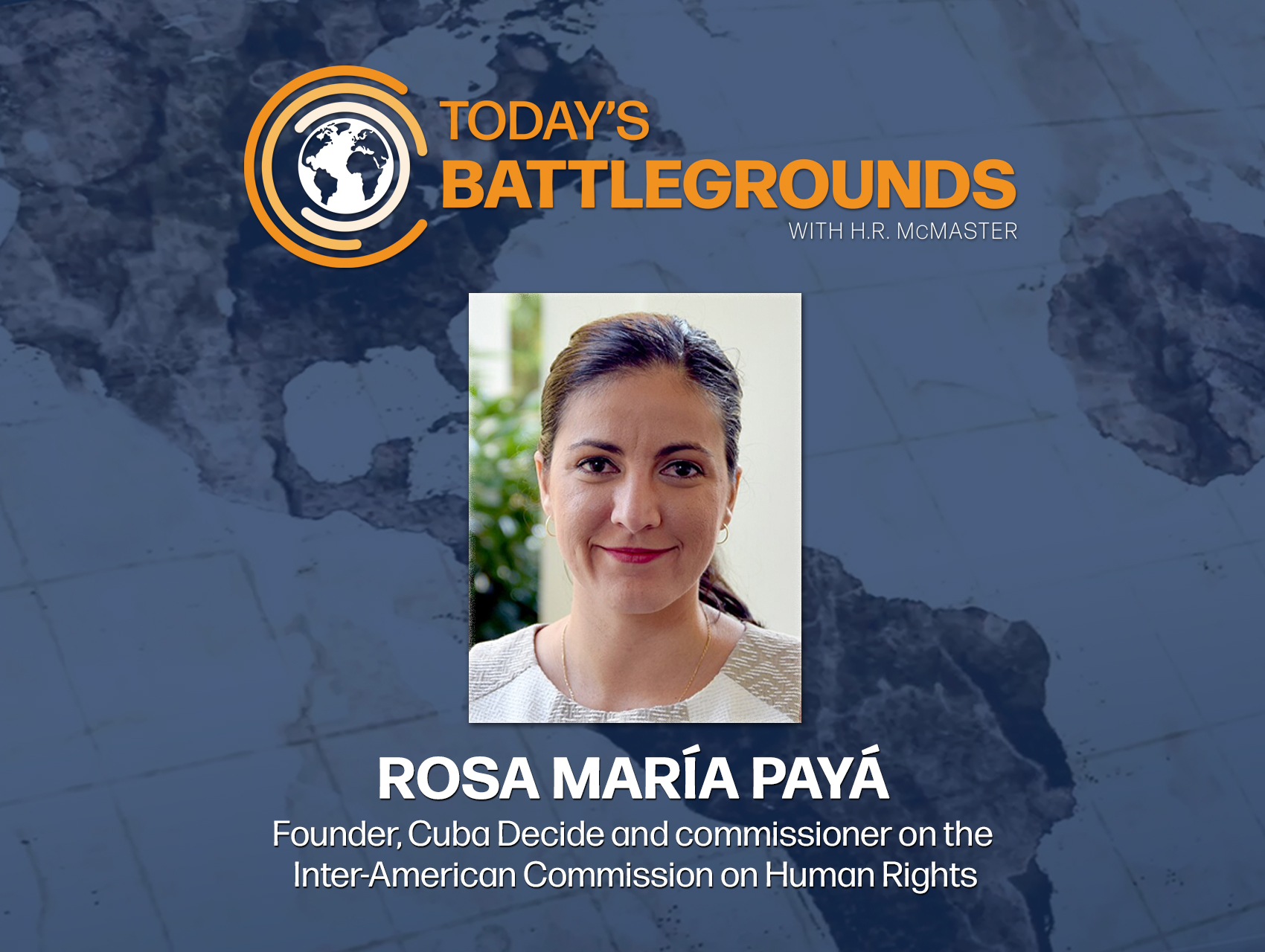
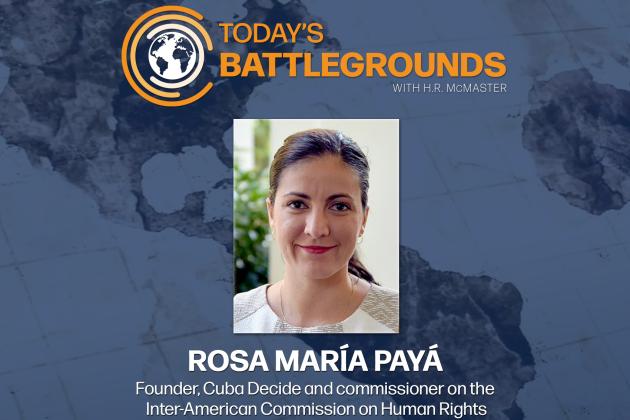
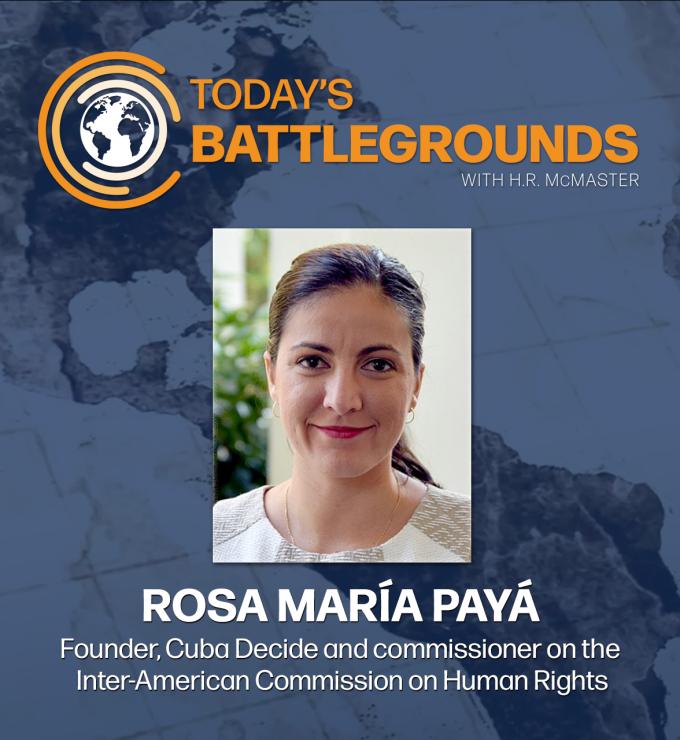
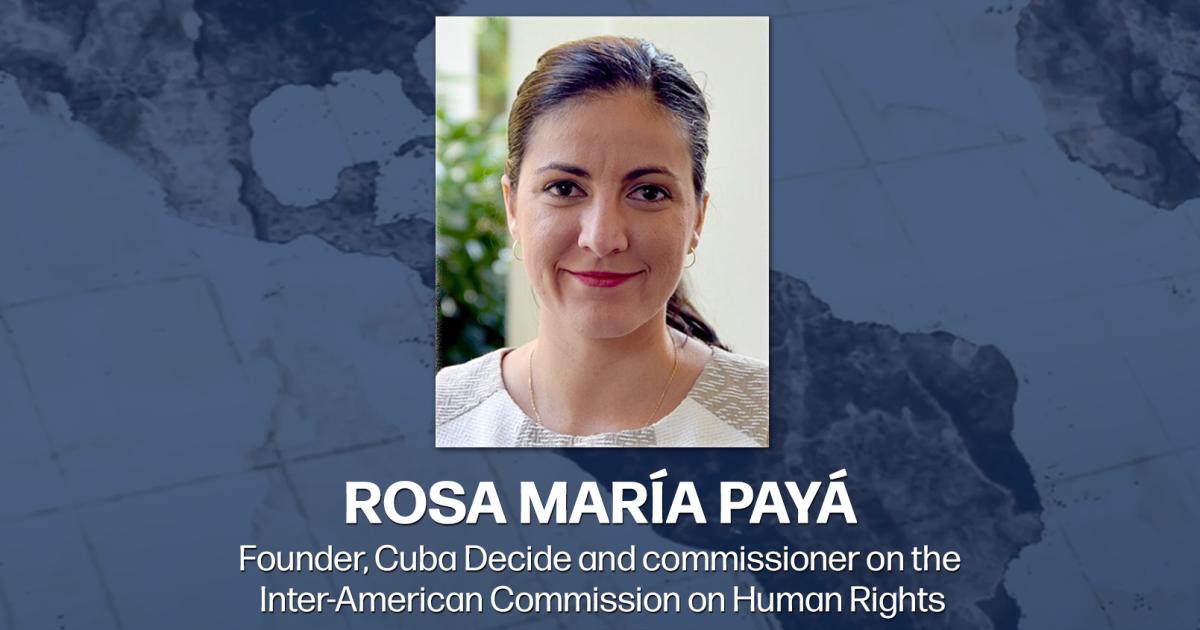
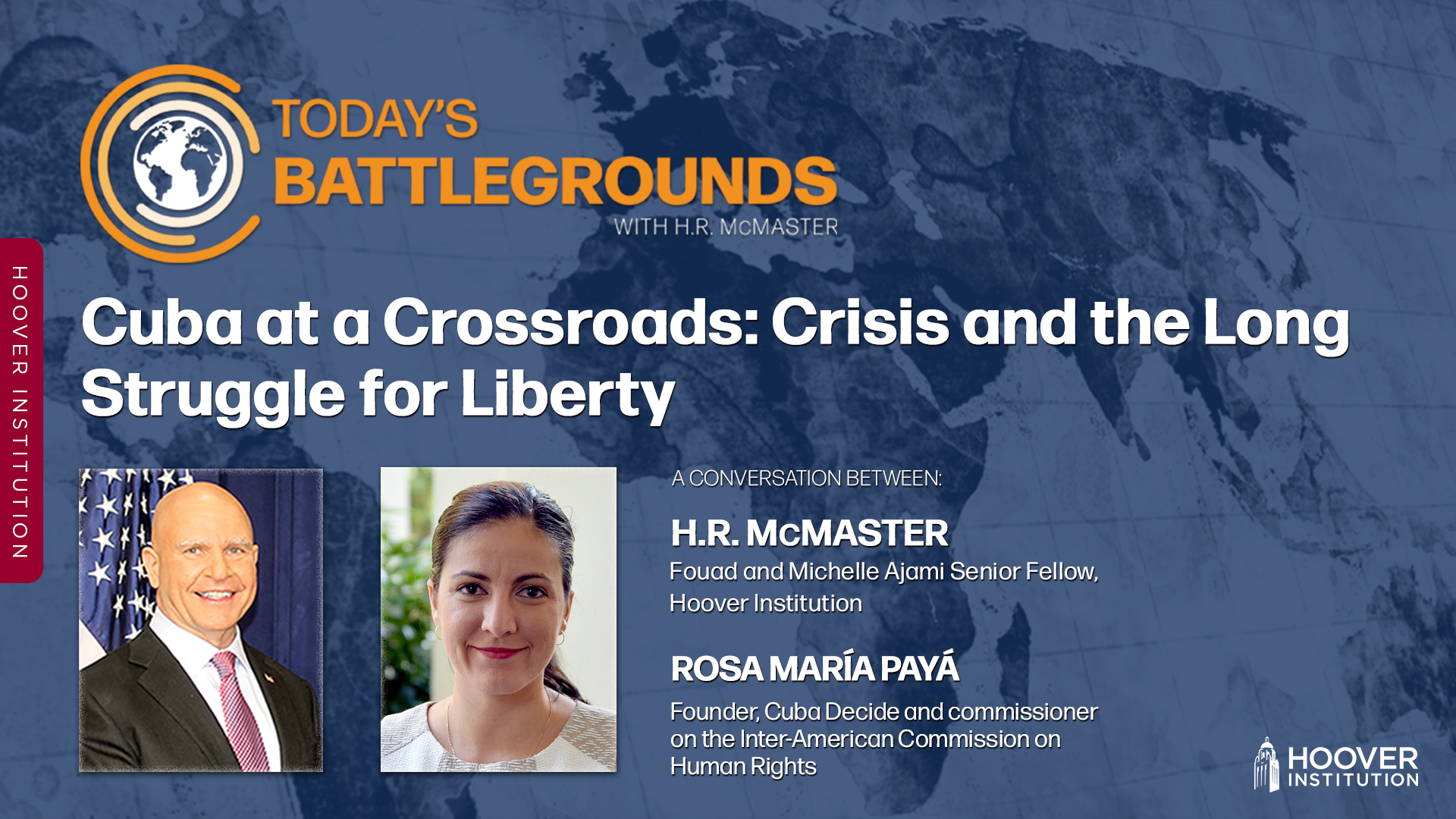
Join Rosa María Payá, founder of Cuba Decide and a commissioner on the Inter-American Commission on Human Rights, and Hoover Senior Fellow, H.R. McMaster, as they discuss US-Cuba relations, Cuba’s deepening economic and humanitarian crisis, its internal challenges of governance and repression, and prospects for a more peaceful and secure future for the Cuban people.
Reflecting on the current crisis in Cuba, Payá and McMaster discuss worsening humanitarian conditions facing the country, including blackouts, food and medicine shortages, and mass emigration. They examine the legacy of Payá’s father, Oswaldo Payá, and democratic opposition movements such as the Varela Project, the Cuban regime’s use of repression and surveillance to maintain power, and the role of young Cubans demanding political change. The conversation also explores US policy toward Cuba, the effects of sanctions and international pressure, Cuba’s relationships with authoritarian regimes including Venezuela, Russia, China, and Iran, and the conditions Payá argues are vital for a democratic transition in Cuba.
Recorded on May 4, 2026.
- The Cuban regime made impossible Democratic stability in the hemisphere made impossible democratic stability in Latin America.
- This is today's battlegrounds. Our discussions with leaders from around the world consider how history produced the present, and how we can work together to overcome obstacles, to progress, seize opportunities, and build a better tomorrow.
- On this episode of Today's Battlegrounds, our focus is on Cuba. Our guest is Rosa Maria Paya, founder of Cuba, decide, and a commissioner on the Inter-American Commission on Human Rights. She is the daughter of Oswaldo Peah, who led the Ella Project, a citizen initiative that invoked Cuba's own constitution to demand a referendum on free elections, free assembly, and free expression. The regime responded in 2003 with what became known as the Black Spring jailing 75 activists, many of them for Ella organizers, Oswaldo Preya pressed on with his work until he died in a 2012 car crash that the Inter-American Commission on Human Rights later concluded was caused by agents of the Cuban State. Rosa Maria has continued her father's work documenting abuses before international bodies and building support for a binding plebiscite on Cuba's political future. Cuba was a Spanish colony for nearly four centuries. After Columbus landed on the island in 1492. The brutal system of slave labor and colonial exploitation provoked repeated uprisings that culminated in three decades of war for independence led by Jose Marti until the United States entered the conflict in 1898 and helped end Spanish rule. American forces stayed on the island until 1902. When Cuba stood up a new republic, a succession of elected and military governments followed until Fulgencio Batista seized power in a 1952 coup ruling through corruption and repression, until Fidel Castro's gorilla movement toppled him. On January 1st, 1959, Castro built a one party state aligned with the Soviet Union, seizing private property, jailing or executing opponents, and driving hundreds of thousands of Cubans into exile. The regime's, abuses and its embrace of Moscow prompted Washington to back a failed landing of Cuban exiles aimed at top link Castro at the Bay of Pigs. In 1961, the following years, Cuban missile Crisis brought the world to the brink of nuclear war, and Washington imposed a trade embargo that remains in place today when the Soviet Union collapsed in 1991, Cuba entered the special period of food shortages at blackouts. The country survived by opening its beaches to foreign tourists and leaning on Venezuelan oil subsidies. Once Hugo Chavez took power in Caracas in 1999, the Cuban Communist Party has held onto power through repression and foreign patronage, even as the country decays around it. After the largest protest wave in six decades erupted in July, 2021, the government jailed hundreds with an estimated 1,200 political prisoners still behind bars. Nearly nine in 10 Cuban families live in extreme poverty, most skip a meal a day, and only about 3% can obtain needed medicine. The deprivation has driven an estimated one in four Cubans to leave the island since 2020. To keep its grip on power, the regime has deepened its alignment with Russia, China, and Iran, hosting a Russian Naval Flotilla in 2024, and leaning on those partners for economic lifelines that keep it afloat. We welcome Rosa Maria Paya to discuss US Cuban relations, Cuba's deepening economic and humanitarian crisis, its internal challenges of governance and repression, and the role of us adversaries in sustaining the regime as well as prospects for a more peaceful and secure future for the Cuban people.
- Rosa Maria Pi Benito, welcome to today's Battleground. It's great, great to see you again, and thank you for spending time with us
- Gracia. Thank you so much, general for having me.
- We have a lot to talk about. Obvious, obviously, what I'd like to do is, is, and our viewers want to hear what the situation is like in Cuba today. So we might start with the present and then work our way kind of backward, and then at the end maybe ask you to, to take a, a a look into the future with us based on the great work that you're doing in Cuba decide, and, and, and the tremendous courage you've demonstrated and fighting for freedom. It's a real honor to have you here. So I of course, we we're following the economic crisis that we've seen in Cuba. It's really an economic crisis, I guess you could say. It goes back to the beginning of the nineties with the collapse of the Soviet Union and, and, and, and, and the support, you know, from the patron of, of the Soviet Union. But then of course, with the Cha Eastes, it kind of picked up again, you know, as, as Chavez and then Maduro were looting their own country. They were providing support for the Cuban regime, but now that's kind of dried up. Could you maybe just describe the situation today in Cuba from an economic perspective, the, the perspective of the Cuban people and, and what we should know about it?
- Yes, thank you for that question. And, and the, the humanitarian crisis in, in the island right now, it's more a humanitarian catastrophe. There is no a single basic service that the state is able to provide from the energetic power grid to the hospitals. There are, in many cases collapsing over o over the, over the people. There are not medicines, there are there, there is no food. And, and, and, and, and the, the Cuban people are struggling to have any kind of normal life on the island right now. There is this conception that this catastrophe is something new for the Cuban people, that that's basically run, eh, the humanitarian crisis in Cuba has been there for decades. Actually. It, it was very hard during the nineties, but the country never actually recover. Other misconception is that this humanitarian catastrophe started four months ago with the capture of Nicolas Malu. That's basically wrong too. That's practically wrong. The Cuban people have been enduring a very harsh humanitarian crisis for the last five, six years, that, that was very intense during COVID and then was worse and worse. The national blackouts in Cuba didn't started in January, eh, 2026. They started in 2023, and before that whole Cuba was just suffering intense blackouts. So that what we are, what we are facing these days on island is an unsustainable situation in which mothers don't know what they will feed their childrens in the night. In many, many cases, in the majority of cases where the population has been shrinking during the last, during the last years, especially during the last five, six years. And when we talk about, eh, when we talk about eh, shrink in the, in the, in the Cuban population, we are talking about a demographic tragedy. To give you an idea, at the end of 2024, the regime itself that by the way, always lie, the regime itself recognize that between the end of 2020 and the end of 2024, at least 1.6 million people, were not in the island anymore. Population banish the experts at the end of 2025, were talking about a decrease in population of more than 2 million people to have the whole picture in mind. At the end of 20 20 12 of, of 2020, the Cuban population estimated was 11.3 million people. Today, experts struggle to talk about more than 8 million people. The only group that is growing in the island. It's that, that is all older than 60 years old that talks about the dimension of the catastrophe. Those are not only the Cubans who fled, there are millions of them. Those, those are also the Cuban who have died die. And, and what is, what is even more shocking and, and what talks about hope is that despite the hunger, despite the lack of medicines, despite the fact that the regime cannot keep the lights on in the, in the country, and despite the severe repression, despite that, more than that, more than 1,200 political prisoners right now suffering in jail, despite, despite this catastrophe, Cubans are demanding freedom and are risking themselves in the streets in order to achieve that freedom. And that talks about a conviction. And the conviction is a general one. And that conviction is that the only way out, the only way to overcome this crisis is to get rid of the dictatorship.
- Rosemarie, could you talk about the state of that Cuban government? Of course, you know, your family is, has paid a high price. You know, your father was such a, a courageous person, you know, who was, he was I think seven years old at the time of the revolution. I remember, you know, reading about, about his story, about how he was inspired by the, by the Prague Spring in 1968 and, and began the movement and movement into, gosh, Christian lib right? Or so. It was his first movement that he formed. He was a very faithful person, dedicated his life to it until he, until his death in 2012, probably at the hands of the regime. And how, how does this government stay in power? You're talking about a, a severe crisis today, but you also mentioned they, they've been in a crisis before. How does the Cuban Army, and how did the Castro regime and the Cuban army keep their grip on power?
- They are in power because they use violence and repression to protect their power. The only reason why the Cuban regime is still in power is because they are in power by the force. The Cuban people has been in the streets several times, demanding freedom. At one point, the whole country was in the streets demanding freedom. My father led a civic movement of tens of thousands of Cubans that try to use the system against the system to guarantee human rights. I'm, I'm talking about tens of thousands of, of Cubans in a moment, in which having a cell phone was a crime in my country that dare to put their names, their ID numbers, their address in, in a, in a, in an initiative of a law, in a project of law to change the system towards, towards democracy.
- It was the Illa Project, right?
- That was the VA project,
- Villa project. And, and, and this was, this followed, I think soon after Pope John Paul's visit to, to Cuba also, you know, and, and your father was inspired by that, and he was incredibly courageous to gather all those, gather all those signatures. And I should note for our viewers, you know, he was no, you know, he was no stranger to the repression of the regime. He was sent to a labor camp in nine, in, in 1969. You know, so, so he stuck with it. And, and, you know, your, your father and the Verre project, they were trying to use the constitution to force a transition in the nature of the, of the Qan army and the Castro regime. And your, your father, as you mentioned, gathered, you know, over 10,000 signatures on this document, which should have triggered the, the reform. What, what happened after that? How did the, how did the regime respond to that, to that courageous movement?
- Look, believe something very radical in the midst of communism, he believe that, that the human rights are not granted by the regime, but that are inherited to the, to the human nature. And he dedicated his life to fight for those rights for all Cubans that he consider their brothers and sisters in the midst of communism. To have that conviction and to act on it, it's as an act of war. And I'm saying this very responsibly because my father founded a peaceful movement. But this is not a passive fight. The Cuban regime has been violent against every Cuban that have dare to rise their voice for freedom, and in many cases, to rise their voice in a, in a direction, a slightly different front. The official line of the, of the Communist Party. My father, together with many other Cubans led a peaceful movement, but a radical one that was aiming to change the system towards free fear and democratic elections. To where an, towards an environment in which each Cuban had the right to live according to their will, their sentiments, their decisions, which is what, till today for generations, we Cubans have been denied for doing that in a legal way, even following the rules of the regime. He was persecuted, he was arrested. His, his fellow dissidents and opposition leaders were thrown in jail and torture. And he was finally killed in an attack that has been, that has been finally condemned by the Inter-American Commission on Human Rights as an ad of murder from the part of the state, a, a, a decision that could only, could only come from Fidel and Raul Castro, then solve the decision of killing, of eliminating the person that at that moment was invited him because he was the symbol. And, and, and, and, and not only the symbol he invited the Democratic alternative of the Cuban people, of course, together with many other Cubans that were part and that are part today of that, of that movement. The way that the totalitarian regime in Cuba has to deal with the Democratic alternative is to try to eliminate it.
- Rose Maria, your, your father, Oswaldo, he was a very faithful person. He worked with, with clergy, who he inspired and inspired him. Could you maybe talk about the state of, of the, of the Catholic church in Cuba and how the regime has, has tried to, to, to crush religious freedom because they see it as a, as a threat to their, to their authoritarian power?
- From the very beginning, the eh, communist revolution was a movement against faith against the Catholic Church, but against all sorts of churches, against any, any alternative experience or expression. To the alternative, to the communist, to the Communist Party, they persecuted the priests and the nuns, they expelled them. They, they went against the Christian leaders, the Protestant churches. They went against the UBA priests, the Afro-Cuban religious people on, on the island. They went beyond that. They went against anyone with an alternative expression. They created, they created forced labor camps to persecute young people and, and, and, and to force them to abandon their faith. That was the first prison of my father. My father was thrown in jail because these forced labor camps were jails when he was 17, his crime being Catholic. And he was together with all Catholic priests, with, with, with young Fox that likes the Beatles and had long hair with gay people. Anyone, anyone with an alternative expression was condemned to those forced labor camps that stayed in place for decades in, in Cuba. So that when, when, when my father was a little older and, and, and, and, and was married and was young, decided to dedicate his life to try to change that reality. And he founded the, the Christian Liberation Movement, which is Christian in inspiration. It was not, and it is not a confessional movement is a movement that, that respects and adopt the, the principles of the Christian humanism. Now, the reality is that being part of a church in Cuba is also being persecuted. The reality is that the institutions that that represent faith in Cuba are persecuted, are subject to eh, vigilance, to threats and, and are systematically conditioned by, eh, by the, by the Cuban Communist Party till today, the way in which they repress, eh, churches and specifically the Catholic church in Cuba has evolved, changed over time. There are not anymore priests that, that have been sent to forced labor camps, but they are regularly visited by the Cuban State Security agents. They, the Communist Party has a whole department dedicated to the suppression of the freedom of religion. It is called Laina, Dito s the Office of Religious Issues. And its task is to persecute threat and, and, and surveillance. All those in Cuba that practice a faith, they are, at the end of the day, the regime is afraid of any independent free expression and is especially, especially fearful of those that live their life with faith, especially with faith and something different from what they try to impose.
- Rose Maria, you, you've covered a, a lot of these tools of repression, right? Throwing people into prison, the use of these security forces, the repression of religion. But, you know, the, the Cuban Army also controls the economy. I, I remember when I first went to Washington as, as President Trump's national security advisor, we examined some of the assumptions that had underpinned the Obama Administration's policy, this idea that if we opened e an economically to, to Cuba, that that would strengthen opposition because there'd be a, a commercial or, or a mercantil class that would, that would grow and could oppose the regime. But instead what happened is it actually strengthened the regime because they controlled all of the revenue, even from tourism and, and, and the hotels and everything. So could, you could maybe talk about the, the Cuban Army's control of the economy and maybe a little bit about how they've kind of destroyed the economy through corruption and mismanagement.
- They have systematically applied the recipe of control over prosperity. And in the case of the, of the Cuban regime, that control is totalitarian. When we talk about, when we talk about the Cuban state, we are talking about families, which is basically one family and some associates and a few representative that controlled the military conglomerate. And that conglomerate controls pretty much the whole economy of the island, with some exceptions, but pretty much the, the most part of a, of the, of the economy of the state. And they do so through the military conglomerate, but also through criminal activities, criminal activities that go from trafficking persons through the Cuban medical brigades to trafficking weapons as we saw in the Panama a few years, a few years ago, to selling intelligence to nefarious actors as Russia, China, Iran. And you know this pretty well general, because you have had to have access to the, the discoveries on the intelligence penetration of the Cuban regime in the US government. And we are talking about the largest intelligence penetrations in the last 50 years as we speak. Victor Manuel Rocha is in, in, in jail in Florida. Who was him? He was an ambassador to Olivia of, of, of the United States. He was, and at the, at the National Security Council, at one moment, he was advisor to the Southern Command, and for 50 years he was working for Fidel Castro. And he was not the only one. And I, I talk about him just to provide the dimension of this regime that have been punching beyond its way for decades and ha and it has been allowed to do so. So of course, that when President Obama implemented an engagement based on unilateral concessions, the produce of that was a better funded, more empowered, repressive apparatus that kept acting against the best interest, especially the national security interest of the, of the United States. But beyond that, we are talking about a regime that has made impossible, and I'll repeat this. The Cuban regime made impossible democratic stability in the hemisphere made impossible democratic stability in Latin America. The only reason why we are talking about liberation vene liberating Venezuela today is because the Cuban regime was allowed to prop up UWA Chavez and then Nicola Maduro, and, and to, and to capture all the areas of a civil military life in Venezuela, and to impose a counterintelligence that was totally controlled by the Cuban region for decades. The reason why they are torture centers in Nicaragua is the same. The instability that we have seen in Ecuador, in Colombia, in Honduras, in Bolivia and counting, can be traced till the, till the Cuban regime. And when we talk about distance, it sounds like, like a movie. It sounds like, hmm. Really that island that cannot keeps the lights on. Well, yes, that island have been running because those activities, the region has been in power because they exchange repression for oil and, and, and, and, and other subsidies to be able to remain in power.
- I remember when Maduro came to visit the United States, almost the entire delegation was Cuban of Cuban origin. And, and, and it was all his security and intelligence. And, and of course what you're talking about is how they destroyed their own country, but prioritized sending resources abroad to destabilize others from sending their military to, to, you know, to Africa. In the, in the, in the, in the height of the, the cold, the Cold War. There are Cubans who are fighting alongside Russians in Ukraine now. And, and then as you're mentioning the, the intelligence penetration and the Cuban Army penetration in support of these far left progressive dictatorships, some of which luckily have been reversed or have been weakened now, but it, it really is. Cuba is a source of, of pain and suffering for the Cuban people, but also a source of pain and suffering across the hemisphere and, and even beyond.
- That's true. That's true. And, and, and, and, and we talk a lot about the Americas that I believe have been the more, the most impacted by the Cuban, by the Cuban region. But let me, let me rephrase this by the fact that the western democracies tolerated the Cuban regime for 60 decades, right? It, it, it backfired badly, especially in Western Hemisphere. But they didn't, they didn't subscribe only to the western hemisphere, the, the exporting of repression and instability. Go to Africa, go to Southeast Asia, and as we speak, the the largest, the the largest population of foreign nationals fighting in the Russian Army in the front in Ukraine today is Cuban. Yeah, right as we speak, there are a espionage base from China in Cuban national territory as we speak. The Cuban regime is still supporting the eh, aah regime in, eh, in Iran. And they have been for decades doing so, and they have been for decades also selling and disseminating a propaganda that is basically, that is basically created around an international coalition against the west and against the us
- Yes. Oh, gosh, there's so much to talk about here that I wanna get into. And also the, the narcotics trafficking from the western hemisphere to Europe, largely controlled by the Cuban Army and the Islamic Revolutionary Guards Corps of Iran, which is a big money maker for, for both of them
- As we speak. The eln, supposedly a Colombian illa, then the generated into Narco Illa that was founded and created by Fidel Castro in 1963 in, in the, in the mountains of the Esca Bride in Cuba, and then exported to Colombia to be founded in Colombia in 1964. And that criminal group is still control a portion of the Venezuelan territory at the border with, with, with Colombia. When we talk about the Cuban regime, we are talking about the head of the authoritarian octopus in our hemisphere. We are talking about, talking about the Berlin Wall of the Americas, and that is why it's urgent to turn it down.
- Rosemary, I wanna talk more about okay, how, how we do that in the future. But first I want to ask you, why is it on, you know, US college campuses and, and, and elements of, I guess, the progressive left in America that they fetishize or romanticize the Cuban regime, you know, or, you know, it's, it's just aste astounding to, to me or, or Sheikh Guevara, for example, you know, who, who, or were, you know, people who murdered and oppressed others? I, I know that must frustrate you. Could you maybe explain your experience with this kind of thinking? I mean, I actually think back when I saw, when I saw President Obama doing the wave with Ro Castro at a baseball game, I couldn't believe it. You know, and, and then, and, and as, as the administration, I think was reflecting, you know, a lot of this sort of romantic notion of, of of, of the Castro regime and the Cuban army,
- It's very frustrating. It, it answer or it is, it's, it's, it's the effect of, of several elements. I I wish I had all of them because it is, it is a serious disconnection from reality, and it has very, very real and, and, and very damaging consequences. For instance, it has the consequences of the disengagement with, with the reality of suffering of, of the Cuban people. It has the consequence of zero solidarity with those that probably are the most similar to those kids. And in the, in the US University campus, which are the Cuban kids that are in the streets demanding freedom and being tortured just for screaming the word freedom in the streets, the, the huge propaganda machinery that I believe is the Cuban regime. I think that is one of the greatest propaganda machinery of the, of the 20th century. And we are, and we already ended the first quarter of, of, of the 21st century. It is, it is, it is the propaganda apparatus that transform a murder, a murderer as Shera, a killer of Cubans as shera into an icon of the international left. And more than that, into a, some sort of pop icon of the, of the global youth, when that it is, it is a, it is a apparatus that transform, eh, murderous narcissist of Fidel Castro in, eh, in, in the reference of even the Democratic left around the world. And that was the reference for decades. So a big portion of why we are seeing the confusion, the disconnection with reality that we are seeing not only in the, in, in, in some sectors in the US but but around the globe, is because this propaganda machinery have been acting without counterpart for decades. What is the counterpart to the propaganda of the Cuban, of the Cuban regime, what we Cubans could do from the island on their torture? What, what the Exide community can do, an exide community that have been also demonized by that propaganda. It's a very, it has been a very, a, a very unbalanced situation, and no one else have been talking about the reality of communism in Cuba, and in many cases about the reality of communism and the consequences of a socialist economy. And, and even when those consequences are, are very real and are catastrophic and are 90 miles away from the, from the US shores. I think that we should also take into consideration that that propaganda has been accompanied by intelligence, penetration has been accompanied by, by the, the activities of a regime that is never acting alone. That that has been coordinating actions with Russia now before that, with the Soviet Union, lately, also with Iran, with China for decades, with Venezuela during the last 25 years. And that provided hundreds of thousands of dollars of millions of dollars for that propaganda machinery, for the repressive apparatus and for the corruption of the Castro family and the bunch of generals that have been there for, for, for six decades.
- And, and sadly, Rosemary, I would add Mexico now under the Moreno party, you know, is providing support also to the regime. Gosh. So, okay. We've, you've told our viewers so much about, about the nature of the regime, you know, the use of security forces imprisoning, innocent, innocent people, the control of the economy, the propaganda and intelligence arms that advance these false stories, this, this false narrative. And then also how, how Cuba provided support for other authoritarians and received support from other authoritarians. I'm just reminded that, you know, China keeps writing checks to, to the Cuban army regime, and, and Russia was only country to get in some oil recently to try to sustain them. So what I'd like to ask you is what more can be done at this moment, you know, to, to support freedom and liberty within, and the people who are advocating for it, people like you, from the outside, people on the inside. What can, what more can can be done at this moment to weaken the, the Cuban Army's grip on power? How do you see the situation now after, after the arrest of Maduro and the isolation of, of the Cuban army from some of these sources of external? What, what more can be done at this moment and how do you see this moment?
- Thank you for that question, because we need maximum pressure over the regime, over the persons that, that have the power of making the decision of shutting down kids in the streets or submitting to the will of the people. And at the same time, we need recognition for the democratic alternative and support for the Cuban people. I, I talk about three points, right? Maximum pressure over the, over the regime elite to force them to submit to the will of the people, recognizing and supporting the democratic alternative and directly supporting the Cuban people that are demanding freedom. Why these three are necessary. And I believe that they are, they are progressing as we speak. We live in, in a world in which for decades now, we hasn't have a real successful transition to democracy experience. And, and that could be due to several elements, but one of them, in my opinion is the lack of leadership coming from the western democracies in support for the peoples in the world that have been fighting for freedom froman to Venezuela, to Cuba and and beyond that reality changed with, with the new, not so new anymore US administration under the leadership of President Trump and, and secretary and Secretary Rubio, I believe that are, that, that, that the three elements that are mentioned that I just mentioned are essential for change. And the first one, the more important one, is the eloquent organic national demand for change coming from the Cuban people. And that one is very eloquent. The Protag rule here relies on the Cuban nation. It is a nation that lives on and off the island, and that is convinced that we need to get rid of the dictatorship, and especially those that are on island right now are risking everything they have, which is, they are bodies to try to change that reality. The second element that is necessary in order to change, to happen in an orderly, successful way, is the existence of a, a, a democratic alternative as unifying as possible. And that exists in Cuba today. In, at the beginning of March, we announced the signing of the Freedom Accord, which is an accord and announced a transition plan that gathers the main democratic forces on and off the island working together around this transition plan, working in commissions that, that take care of each area of national life to be ready to lead the transition process, the moment the, the power fractures. And the third element by the general, the third element is the international real pressure over those that are in power, and they are ready to use their weapons to stay in power. That pressure can be built from the Democratic alternative and the Cuban people, but requires the international action. And that's what we are seeing, that the US government is willing to, to implement. The combination of these three elements, I believe, are a winning strategy. It's not easy. The regime is used to violence. The pressure needs to keep building up, but the Cuban people have an alternative, the determination, and now an ally that can help us to get to the successful democratic transition that the world and not only the Cuban, so much need right now.
- Well, rose Marie, that's a wonderful call to action. I love your three points. I think we should all do everything we can to work on, on them. Hopefully we're amplifying your voice, and I just keep, I, I'm thinking about how proud your father must be of you, you know, because I think of the work that he did when he, he wrote a transition plan, a nine chapter transition plan. Exactly. Simplified it to, I think a five, a five point plan at some point. But, but your family, you know, has been involved with this, so many courageous Cubans for so long. And so I'm, I'm hoping that this, this is the moment. Can you maybe share your thoughts on, on the time horizon here, the, the pressure is mounting on the regime. I think that's clear. You mentioned that you feel, you feel confident about the organization of the opposition movement, and it is clear that that, that the Trump administration is isolating the regime from sources of external support. What, what, what is your prognosis? I know it's impossible question to ask after, you know, six decades of, of brutal authoritarian rule, but do, do you see change on the horizon and, and how do you see it maybe happening?
- I, I see change in the horizon. The situation on the island is unsustainable. I believe that we will see change in our case. We will be part of generating that change in the next 12 months. That's, that's, I believe, a realistic timeframe. Of course, everything or, or not, all the elements depend on us. What, what we can promise is that we will be pushing with all that we have to, to generate and to be part and to, and, and to lead that, that change in the, in the, in the direction of, of the freedom, the democracy and the, and the, and the rebuilding of the republic. That, that the Cuban nation can be, what would be very important, what would be even, even from transcendent point of view, relevant for the world today, is that the rest of the Western democracies join the US in this effort. And finally, finally, after almost 70 years, decide to take sides with, with the Cuban people, because change is going to happen in Cuba. It, it is an unsustainable situation, and it is existential for the Cuban people. Right now is the only way for the Cuban nation to survive is to change. So it's going to happen. Let's hope that the eh democracies of the West are going to be part of the solution and finally take actions and, and join forces with, with our best ally right now. That is, that is the US government.
- Well, Rosemarie, you're an inspiration. Thank you for everything you're doing for, for the Cuban people, for Humanity. On behalf of the Hoover Institution, I can't thank you enough for your courage and for helping all of us learn more about, about this important battleground for building a future in which the Cuban people can choose their own destiny. Thank you so much for being with us.
- That's all that we aspire to, to be, to be finally owners of our own destiny. It has been an honor. General, thank you so much for having me.
- Battlegrounds is a production of the Hoover Institution, where we generate and promote ideas advancing freedom. For more information about our work, to hear more of our podcasts or view our video content, please visit hoover.org.
ABOUT THE SPEAKERS
Rosa María Payá is the founder of Cuba Decide and a commissioner on the Inter-American Commission on Human Rights. She is the daughter of Oswaldo Payá, who led the Varela Project — a citizen initiative that invoked Cuba’s own constitution to demand a referendum on free elections, free assembly, and free expression. The regime responded in 2003 with what became known as the Black Spring, jailing 75 activists, many of them Varela organizers. Oswaldo Payá pressed on with his work until he died in a 2012 car crash that the Inter-American Commission on Human Rights later concluded was caused by agents of the Cuban state. Rosa María has continued her father’s work, documenting abuses before international bodies and building support for a binding plebiscite on Cuba’s political future.
H.R. McMaster is the host of Today's Battlegrounds. He is the Fouad and Michelle Ajami Senior Fellow at the Hoover Institution, Stanford University. He is also the Bernard and Susan Liautaud Fellow at the Freeman Spogli Institute and lecturer at Stanford University’s Graduate School of Business. He was the 25th assistant to the president for National Security Affairs. Upon graduation from the United States Military Academy in 1984, McMaster served as a commissioned officer in the United States Army for thirty-four years before retiring as a Lieutenant General in June 2018.
ABOUT THE SERIES
Each episode features H.R. McMaster, in a one-on-one conversation with a senior foreign government leader to allow Americans and partners abroad to understand how the past produced the present and how we might work together to secure a peaceful and prosperous future. “Listening and learning from those who have deep knowledge of our most crucial challenges is the first step in crafting the policies we need to secure peace and prosperity for future generations.”