







- Middle East
- International Affairs
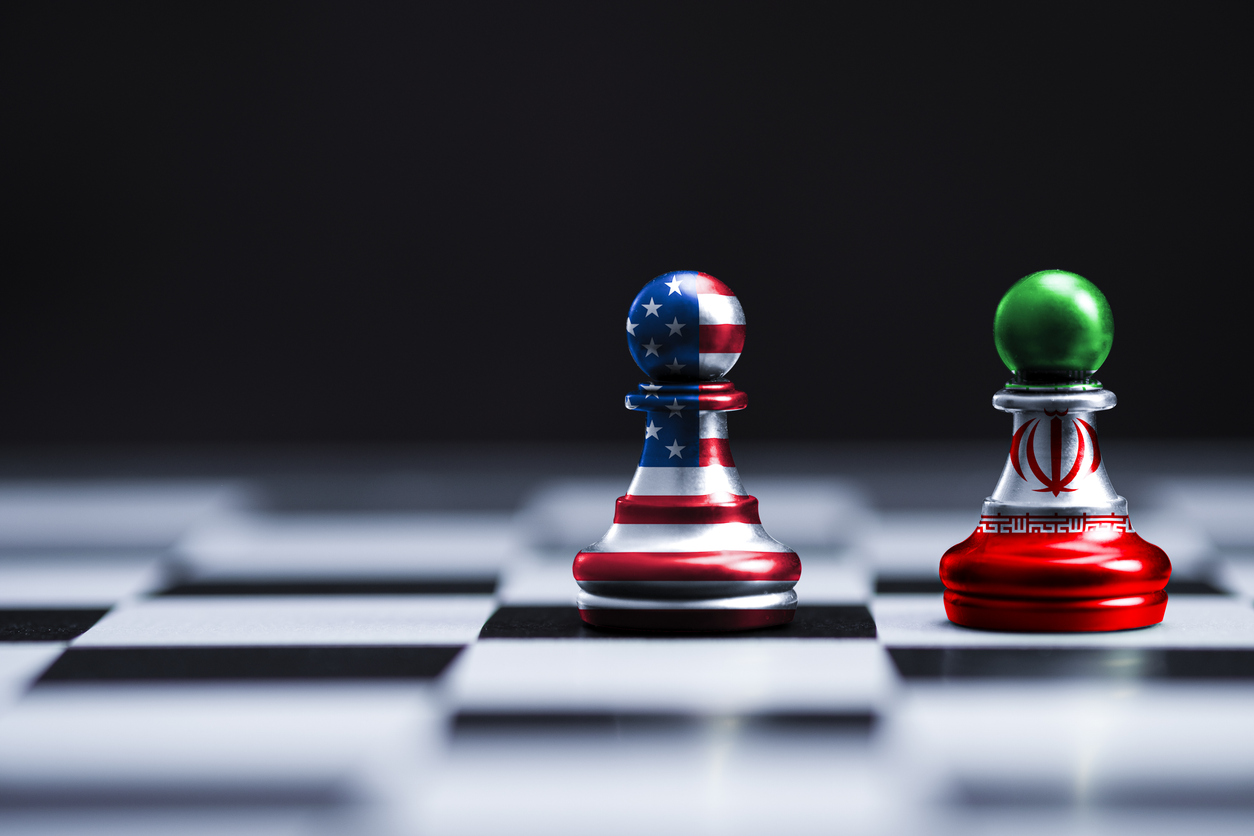
Sam Samani and Matin Mirramezani discuss their article Iran’s Exports Under Sanctions: The Myth of Maximum Pressure that explores the evolving dynamic of sanctions on Iran over the past two decades.
You have published an analysis of sanctions on Iranian exports and raise important questions about the scope of their impact. Can you please walk us through the history. How did sanctions emerge in the wake of the 1979 revolution and what impact did they have?
The first sanctions on Iran emerged from the hostage crisis, not the revolution itself. Notably, it marked the first invocation of IEEPA (the International Emergency Economic Powers Act), the legal backbone of modern sanctions architecture. President Carter froze $12 billion in Iranian assets and barred U.S. businesses from working with Iran. Those sanctions were lifted under the Algiers Accords, with only modest restrictions through the 1980s.
The next major escalation came in 1996, when Conoco explored an Iranian oil deal through a foreign subsidiary. The Clinton administration stopped the deal, but France's Total stepped in to take the contract. Congress responded with the Iran and Libya Sanctions Act (ILSA), introducing the first instance of secondary sanctions, which prohibited non-American firms from doing business with Iran. The U.S. ultimately issued waivers to European companies in exchange for their cooperation pressuring Iran, establishing an early precedent of sanctions on paper, selectively enforced in practice.
Nuclear-related sanctions ramped up through the 2000s, but policymakers initially left the Iranian Central Bank untouched, partly because Iran's oil revenues were soaring during the post-financial crisis recovery. The turning point came with revelations of the clandestine Fordow nuclear site and a foiled plot to assassinate the Saudi Ambassador in Washington. The EU embargoed Iranian oil; Congress passed the Menendez-Kirk Amendment targeting oil sales. Combined with the shale revolution's effect on global oil prices, the pressure proved decisive, bringing Tehran to the table and producing the nuclear agreement.
Can you put the “maximum pressure campaign” of the first Trump administration in perspective?
The maximum pressure campaign during the first Trump administration was in some ways short-lived but very effective. Several things contributed to its effectiveness. For one, it was a deliberate, planned campaign that really put the years of know-how from building and enforcing the sanctions architecture to work. It recognized that buyers, including a number of American strategic allies, needed time to transition off Iranian oil. This was a crucial lesson from the initial round of sanctions. Another contributing factor was the amount of leverage the United States had over the global financial system, including China. Companies and financial institutions still had the muscle memory of sanctions compliance, so this wasn’t as much of an uphill battle as the initial imposition of sanctions was. In fact, even after sanctions were lifted in response to the nuclear agreement, banks remained highly sceptical of doing business with Iran.
To put the effectiveness in context, by 2020, Iran’s oil production had dipped to its lowest levels since 1981. Only 40 years prior, the combination of revolution and war had been able to bring down Iran’s oil production to that level. Iran’s oil exports were under 0.5 million barrels per day. If in 2018 you had one large tanker (VLCC,i.e. Very Large Crude Carrier) taking Iran’s oil to the global market each day, by the end of 2020, you probably had one tanker each week. At the same time, you also had historically low oil prices. If you recall, this was the height of the pandemic, and there was a period when the oil futures plummeted to negative territory.
What took place during the Biden administration?
The start of the Biden administration marked a significant breaking point in sanctions efficacy. Our quantitative analysis shows that Iranian oil exports began a period of rebound and growth at the outset of the Biden administration. From our vantage point, there was an initial policy decision to loosen sanctions enforcement in a bid to renegotiate a nuclear agreement with Tehran. Those efforts did not yield any results. But regardless, reinstating enforcement became significantly more costly over time. The Russian invasion of Ukraine sent oil prices up and U.S.-China relations got more complicated. In this context, Iran’s oil exports kept growing and even surpassed their highest levels under the implementation of the nuclear agreement.
Can you tell us more about how the U.S.-China relations factor in?
China absorbs over 90 percent of Iran's crude oil sales. Putting pressure on Iranian oil exports inevitably requires targeting Chinese firms. Sanctions enforcement may eat up diplomatic capital better used on other matters. At the same time, China's economic decoupling from the U.S. has progressively reduced the coercive leverage that dollar-clearing once provided. The arrest of Meng Wanzhou, the CFO of Huawei, in 2018 represented perhaps the last moment at which the U.S. was willing to pursue high-cost enforcement against a major Chinese entity for Iran-related violations. We note that other Chinese firms, such as Sinosure, the world's largest export credit agency, have allegedly facilitated at least $8 billion of illicit Iranian oil trade in 2024, and no enforcement action has followed. It reflects a calculated judgment about the costs of escalation with Beijing.
There are also strategic allies of the U.S. in this context that are central to facilitating Iranian oil flows. Malaysian waters off Johor have become the world's largest hub for dark fleet ship-to-ship transfers of Iranian crude, with incidents rising from 280 in 2023 to 679 in 2025; yet Malaysia provides the U.S. with South China Sea partnership and signals intelligence cooperation. Singapore hosts maritime service providers that facilitate Iranian tanker operations; it also hosts Changi Naval Base and has $8.38 billion in active Foreign Military Sales. Washington has consistently chosen to pursue narrowly targeted enforcement rather than systemic pressure against these partners.
How much do you think sanctions evasion has played a role here?
Evasion is a key contributor to Iran’s growing oil exports. Over the years, Iran’s sanctions-evasion infrastructure has been maturing. Roughly 82 percent of Iranian oil cargoes undergo at least one ship-to-ship transfer before reaching their destination. Iran-to-China voyages averaged 50 to 70 days before the war, compared with roughly three weeks under normal conditions, a significant but ultimately manageable friction cost. Yuan-denominated settlement through Chinese regional banks has substantially reduced reliance on dollar-clearing, which is the primary enforcement lever in the OFAC (Office of Foreign Assets Control) architecture. Shell-company invoicing routed through jurisdictions with weak KYC (Know Your Customer) requirements completes the evasion circuit. This infrastructure has significantly reduced enforcement capacity, and restoring meaningful enforcement would require not merely more designations but also marshalling more resources and political capital.
Can one see the current blockade as a potentially more effective method to have the impact that sanctions policies promised but did not deliver?
Certainly, the blockade is the physical manifestation of what the sanctions on the oil sector have tried to achieve. It constitutes a fundamentally different category of coercive instrument than financial sanctions. Where OFAC designations operate through deterrence, military action targets infrastructure directly and creates a barrier that cannot be circumvented by shell companies. The critical caveat is that such an approach is a lot more costly and carries escalation risks of a different order than sanctions designations. Besides the cost of maintaining the blockade by the U.S. military, Iran’s demonstrated willingness and capacity to close the Strait of Hormuz is putting a lot of pressure on the global economy.
Looking at how effective sanctions were by 2020, there seems to be a pathway to reliably enforce them if there were a willingness to spend the political and economic capital. As we’ve already discussed, things have changed since 2020 when it comes to the balance of economic power. So it may not be possible to reach the same level of efficacy. But from our vantage point, economic pressure does not seem to have been faithfully utilized prior to the military escalation. The Trump administration ramped up sanctions designations once it returned to office, yet Iran’s oil exports continued largely like before, prior to the current war.
Comment on the Iranian economy. How important is oil export? If export restrictions were lifted, would the economy quickly improve?
The Iranian economy as a whole is meaningfully less oil-dependent than it was a generation ago. Oil's share of GDP has fallen from a peak of 40% in the mid-1970s to under 10% today. Non-oil exports have been growing almost every year.
The government is a different story. Oil is fiscally indispensable to Tehran. In the 1404 budget, that is to say 2025-2026, oil exports provided 20% of the government’s general budget. But that understates the real figure. A significant amount of oil is designated for barter, which gives additional funds to the military and security apparatus. When you add the cash and non-cash oil contributions together, the Iranian government is overwhelmingly dependent on oil to sustain its coercive apparatus.
Oil is nationalized and flows to the government through the National Iranian Oil Company. It doesn’t pass through the private economy in a meaningful way; it goes from the wellhead to the government's budget, and from there into military spending, subsidies, and contracts awarded to IRGC-affiliated entities. The private economy has had to survive largely without oil revenues precisely because those revenues are captured entirely by the state and its affiliates before they can circulate broadly.
The practical implication is that sanctions squeeze the government's fiscal and procurement capacity far more acutely than they squeeze the broader economy. The government then has to cut costs or find alternative revenue sources. Both require political capital that the government does not have. Iran's tax base is still too limited and distorted by state ownership and IRGC economic dominance to substitute for oil revenues effectively. That is why both instances of government adjustments to its budget have been met with widespread protests. In late 2019, the government’s decision to cut fuel subsidies in response to depleted oil revenues triggered the Bloody Aban protests. Reforms to the government budget to increase tax revenues in late 2025 instigated nationwide economic protests, which culminated in the deadly protests earlier this year.
The inverse is equally important to consider. When oil revenues recovered after 2021, the primary beneficiaries were the government and the IRGC, not ordinary Iranians. The economy did not broadly improve commensurate with the export rebound because the additional revenues flowed into military capability and barter procurement rather than productive public investment or private sector development. Growing oil proceeds translated into an expanded military arsenal and a more sophisticated domestic surveillance system, not broad-based economic growth.
Matin Mirramezani is Manager of the Iran 2040 Project and co-author of The Struggle for Development in Iran (Stanford University Press, 2022). Sam Samani has served as a Research Assistant at the Carnegie Endowment for International Peace and as a Student Fellow in the Hoover Institution's History Lab.

