








- Economics
- Economic
- Health Care
- Answering Challenges to Advanced Economies
- Understanding the Effects of Technology on Economics and Governance
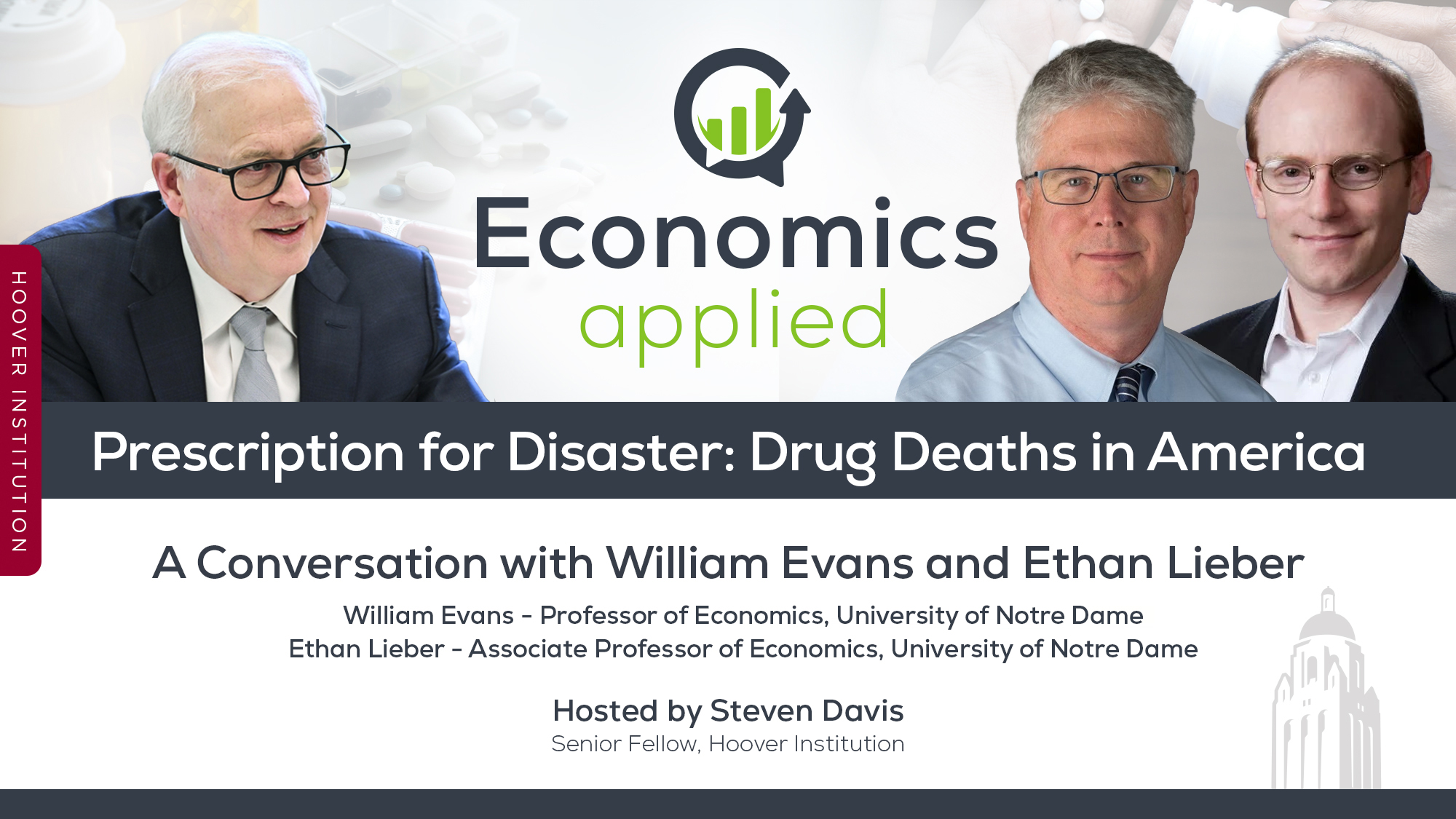
Steve speaks with William Evans and Ethan Lieber about the heartbreaking rise of deaths due to drug misuse in the United States. A major shift in prescription practices for pain management after 1995 drove higher levels of opiate use and misuse and contributed to an explosion of illicit opiates in the 21st century. It’s a disturbing story of professional misjudgments, deceptive marketing, policy mistakes, and unintended consequences. Reforms in prescription practices, while overdue, will mitigate but not solve current-day problems of drug abuse and misuse.
Recorded on April 9, 2026.
- Here's a staggering observation. The death rate from drug misuse in the United States rose by a factor of 10. From 1979 to 2022. 2022. The rise is concentrated in the 21st century. What the heck went wrong? Two researchers at the University of Notre Dame link the rise in American Drug Deaths to prescription practices for pain management. We will discuss their research on today's show. Welcome to Economics Applied, a podcast series sponsored by the Hoover Institution. My name is Steven Davis. I am the Thomas w and Susan B. Ford Senior Fellow and Director of Research at the Hoover Institution. I'm joined by William Bill Evans and Ethan Lieber. Bill is the Keo Hesberg professor in the Department of Economics at Notre Dame, and a co-founder of the Wilson Sheen Lab for economic opportunities. Ethan is the Dylan Hall Associate professor and director of graduate studies in the economics department, also at Notre Dame. Welcome to you both.
- Thanks very much for
- Having Peter. Thanks for inviting us.
- So you have both studied the rise of drug related deaths in the United States over the past few decades. So perhaps we could start, if you could just give us the basic facts in this regard so that we, so that we have a foundation for our discussion.
- Yeah, so I, you gave the most staggering fact, which is the incredible rise. So between, say the mid 1970s and the late 1990s, there was a constant increase in drug deaths, was pretty linear. And then starting in the two thousands it ballooned and there's been three real distinct phases of the drug crisis in, in that 21st century time period. The first component of it was really a rise in the abuse of prescription medication that is typified by, you know, the abuse of Oxycontin. There was
- A Oxycontin being an opioid that was,
- It's prescrip. Yeah. That was it's primary characteristic is that it was a extended release formulation. So the milligram content was incredibly high and people were able to sort of break the extended release component of by squashing the drug and snorting it, and it became very popular for abuse. There was a short interlude then where there was a big shift to heroin, and then after about three or four years of a problem, it became a fentanyl problem. And so the type of drugs have changed considerably, but the magnitude is what really characterizes the drug epidemic. Just the sheer deaths there In 2021, we, you know, for the first time had a hundred thousand deaths a year associated with drug poisonings, and it's gone down a little bit in 2024 and it looks like it's gonna be even a little bit smaller in 2025.
- Okay. But that's a, that's a good round number to keep in our heads. We're talking about in recent years, something on the order of a hundred thousand deaths of Americans per year due to either misuse or abuse of drugs.
- Yeah. And then like back in 1980, there was like 6,700 people were dying a year.
- Okay. So this is a huge problem. It's a huge social problem, obviously has important economic consequences as well. But I I, I wanna, I wanna just make sure I understood the, you focused on the 21st century and I guess of that tenfold increase since 1979 in drug deaths about fivefold of that is in the 21st century. So is that, if I got that right, so that it really is, it was already a problem that was kind of creeping up on us, but it got a lot worse in the 21st century. And from your description, it sounds to me like it started out mostly with the prescription of opioids in legal use.
- Yes. Well, the diversion of legal drug.
- Okay. But that's what I was gonna say then. Some of that was diverted.
- Yeah. - And some of it apparently, I'm guessing people who were addicted through prescriptions then what, why'd they turn to heroin? What was the upsurge in heroin from and fentanyl Was that people who lost their prescription or people discovered, how did that ha what's the connection there? I just didn't quite get it.
- So in 2010, so that drug that bill talked about Oxycontin, the one that was really commonly abused, they created a reformulation of it that made it harder to abuse. Okay. And so essentially people are substituting over to ah, an alternative. And it turned out heroin was relatively cheap and available. And so a lot of people moved in a classic
- Example of unintended consequences
- Of
- A well-meaning policy change.
- Yeah. Okay. And so that really got people out of, a big part of the supply was coming from sort of the illicit market before, and then it really moved over to the illicit side and it sort of continued there since roughly 2010.
- And, and then the fentanyl part was that some kind of technical innovation? Why the transition from heroin to fentanyl?
- Well, fentanyl had been available primarily on the dark web where people would order it and would be delivered the, but the fentanyl is relatively easy for a decent chemist to make as long as you have the precursors for it. And the transnational drug organizations that operate out of Mexico, they were just able to import the raw ingredients and make it in very large quantities and start shipping it across the border. So to some degree it was a, a supply chain issue. They were able to obtain the precursors and, and make it in bulk.
- Yeah.
- And became,
- It's also very potent. Correct. So you don't need that much of it to create a lot of supply. Is that correct?
- Yeah, that's exactly right. Okay. So it is far, far stronger than Oxycontin or many of the prescription drugs that you will have in mind. And so it's, you know, a much smaller quantity to traffic. It's cheap to produce like it, it is just economically a lot easier.
- Okay. And I, I think this is an important fact, at least in my thinking, you can tell me if you disagree, to keep in mind about the drug problem overall, which is some of the sources of supply are intrinsically quite inexpensive in terms of their, the literal cost of the raw materials very hard to detect because they're very potent. So you can transport what is effectively a large amount in a small volume. It's just, it's just keeping that in mind when you think about efforts to restrict the supply side. That's enormously challenging, if I got that right. Do you agree with that?
- Yeah. So, you know, in, when a lot of the illegal drugs were based on agriculture, you could fight the supply by dealing with the agriculture of it. But this is a very different animal in this context because of the relative ease with which the precursors can be obtained in order to make the drugs.
- So it's not like opium, you burn a bunch of poppy seed fields and you've at least temporarily reduced the supply. That's, that's not the story here.
- Yeah, that's right.
- Okay. So I, before we get to your research though, you're, you're hardly the first ones to work in this area. There's, there, you know, you, you've worked in this area before the p we're gonna talk about today, but so have many others because, you know, this, this problems related to, to drug misuse have been intensifying for, for decades in the United States. So there's, there are lots of sto explanations, stories, evidence already on the table as to what drove the tenfold rise in drug use since 70 drug deaths in the United States in 79, the five roughly fivefold increase since in the 20 century. So what, what are the main explanations that have been advanced before, before your most recent research? Can you just give us those so we have a baseline for thinking about the contribution of your work? So the
- Economists like to think of the world as being driven by supply and demand. And so there are naturally supply and demand type stories. So one of the original stories was if you take a look at the demographics of who's dying in the geography of where they were dying, they tend to be concentrated in places like West Virginia, Western Pennsylvania, Eastern Ohio, northern Kentucky. These are areas that have been hit hard economically. They tend to be concentrated in pe in groups with low education people that have really lost out in the job markets. So there was this notion that, that there was a high degree of destruction of institutions that people relied upon. And so there was an encouragement towards shifting to drugs or alcohol or the case might be, I think, you know, there's some validity to those stories, but I, I don't, I think most of the research was suggest, it's hard to explain the magnitudes with demand driven stories alone
- Demand, just to make it clear to our non-economist audience, the demand for the things that are delivered by pain management or just getting high from opiates and or low, whatever the case is. I'm not, yeah, I'm not a user, so I'm not on top of the, the right lingo there, but, so that, that economists put that in the demand bucket.
- Yeah, I think that's right. So Bill's referring to the, the case in Deaton deaths of despair type of story here.
- Yes. Could be deaths of despair, but it could also be just people who I, I don't think this is the main story even suggested by the proponents, but there could in principle be a rise in the, the underlying demand for pain management therapies. For sure. And that's, you know, that's the reason I say that's not the case is the economy at least has moved away from the kinds of manual labor jobs demanding physical labor that are likely to give rise to serious injuries and so on. That would call for pain management. So it's more the deaths of despair, version of the demand side stories that had some currency. Is that correct? Okay. But you're Bill's already said he is, he doesn't think that's the main thing that explains the, the rise in drug death. So I presume you're, you, you, you have in my supply side stories, that's the other part of economists basically tool books.
- I think the supply side, there's really two things that are happening initially. The first, and part of what we try to do in our paper is that there was a reevaluation, the use of opioids as a medical treatment. So if you take a look at the late eighties, early nineties, the people that were typically using opioids were people that have relatively acute pain. They, you know, had some kind of accident or severe burns or post-surgery and cancer patients,
- People at the end of life
- And people at the end of life. And, but at the same time, there was a lot of people who were in chronic pain, neck pain, back pain, whatever, joint pain, whatever the case might be. And there was a thought that we needed to deal with this. And one of the effective ways to deal with it would be the medical use of prescription opioids, I think to which is what we focus on in our paper. Before we get to that though, this sort of set the embers for a particular problem and in the, as doctors were reevaluating their use of prescription drugs, this new drug came along Oxycontin that promised to have less of a risk of addiction. That was a pill that you only had to take twice a day because of its extended release ca capabilities. And on that, you know, glowing embers, you were really throwing some gasoline on the problem. And so the first part of the, of the crisis really was this interaction I think between the changing prescribing habits of the physicians and the, you know, the, this new vehicle that ended up to have incredible amount of abuse, abuse potential.
- Okay, so lemme let me restate that in different words. There was an underlying unmet demand for pain management by people who were in chronic pain that wasn't, that there was a perception that wasn't, and maybe it was a correct perception that that wasn't being adequately handled, addressed. And then this drug or Oxycontin came along and similar drugs that promised through extended release to, to help people manage chronic pain management in a way that would be less addictive, less prone to abuse that second, the second part of that first part, may, may, may be right second part of that proved to be wrong, seriously wrong if I got that right.
- Yeah,
- Yeah. So it's, we may come back to this, but it's, it's, i I am struck by the fact that the medical profession somehow reevaluated ma made this reevaluation of the potential to address chronic pain without setting off problems associated with addiction and abuse. Somehow that, that reevaluation came about. And it's, it's clearly in hindsight wrong. So it kinda makes me scratch my head. How could they get it so wrong? It's like, it's like a gross violation of the hippocratic oath. First do no harm. There's an awful lot of harm done in the wake of this reevaluation of prescription practices. And I don't fully understand how that came about. There's a natural desire to alleviate people's pain. I get that. But there had been a reluctance to use opioids for that, for chronic pain management prior to the mid 1990s because of concerns about addiction. And somehow those, those concerns got lessened or set aside. I, I don't fully understand why.
- So at at least part of the story is that the, a number of pharmaceutical firms were out running studies and whether the studies were good or not can be debated, but they were going to doctors with studies and saying, look, these things are not nearly as big of a problem as we thought they were. And here's the study to back it up and you've got a bunch of patients in pain, you should prescribe our drug. So there was a whole enormous amount of essential pharmaceutical detailing and advertising to physicians to convince them that the fears that we had before were kind of overblown.
- I see. And so there were obvi obvious commercial interests involved in growing the market for Oxycontin, for example, by the suppliers of Oxycontin. The doctors, apparently a large number of them were persuaded by this. And then, you know, there's another element of this story, which it seems worth art articulating explicitly, which is many people trust their doctors, they're not the experts on on these things. They, they put a lot of trust in their doctor doctors and that that trust is sometimes misplaced and doesn't mean the doctors were doing anything malicious or in intentionally harmful. I'm not suggesting that. But there, there was a pretty serious failure here as I understand it. And you've, you've just, Ethan you've just sketched the broad contours of it, but I it i it does just strike me. What a major, what a major mistake this is and one that has played out for decades now and is is very hard to fully address now because some of the consequences are hard to reverse.
- Yeah. So just in terms of, you know, why doctors went down this path, you know, there were these two very large medical organizations that were devoted to pain and they're, they were the ones that were really led the way in terms of reevaluating the use of opioids for chronic pain. But it ends up that a lot of their funding was coming from pharmaceutical companies in the first place. They ended up to be defendants in the opioid cases that have gone through the courts over the last decade. And so it's in, so the doctors were in some cases being duped. In other cases I think they weren't reading the science that was actually being placed in front of them. So in the case of Oxycontin, which was produced by Purdue Pharma, pharma, their detail reps were going to doctors and saying, here's this study in the New England Journal of Medicine by Porter and Jake that says the chance of a addiction as a result of receiving opioids is really low. What this study was, was really a 100 word letter to the editor in the New England Journal of Medicine that followed post-surgical patients in a hospital setting that were receiving opioids during their hospital stay. And so this is not the way you would be prescribing opioids for people with chronic,
- Right. So there's, there's two failures there. First, the Purdue Purdue Pharma in the example you described is Yeah. Is beha is selling their product in deceptive way, but secondly there's the doctor who's actually failing to go follow up and say, there's not a real study here, there's just a letter to the editor or something like that.
- Yeah. So that to me that, that the doctors, you know, would say, look, they were, they were providing this information to us and it wasn't relevant in some respects 'cause it wasn't about chronic pain, but a lot of 'em didn't follow up.
- Yeah. So did, did, did this type of dynamic involving a change in prescription practices that led then to ultimately a, a sharp rise in opioid addiction and drug deaths, did that dynamic play out in any other countries or is this a uniquely American story?
- There's some other countries that have had an opioid problem, but the problems with addiction in terms of the prescription drugs did not show up in, in most other areas.
- Okay. And this is, maybe this is outside the scope of I think your paper, but another question that comes to mind. It's well known that compared to most other rich countries, us experience with mortality trends has been unfavorable in recent decades. How much of that is due to just the rise in drug drug deaths in the United States relative to other countries? Is that a big part of the story or a small part of the story?
- So if you take a look at sort of middle aged males, especially low educated ones that are, have had the really big increase in mortality compared to what's happening in other countries, it ends up that what case and Deaton called deaths of despair, alcohol drugs, deaths associated with alcohol suicides and drug overdoses end up to be a large component of what's driving that effect. And so it, it, i, it, it it, for, for middle aged males, especially low educated ones, that ends up to be a big component of the
- Okay. So this is a material part of the overall
- Yeah.
- Subpar performance of American mortality experiences compared to other rich countries in recent decades. That's what I'm hearing you say. And it's, it's worth noting that some suicides, for example, might be people driven to despair because of their addiction. So it's, there's, there's that potential connection as well. Okay. So let's, let's, let's, Dr you, you've kind of given us the broad sense of what you've found, but I want to drill into some of your detail, the details of your study. And so you can tell us what is the reasoning, the chain of evidence that led you to the colu conclusions you've already sketched out. And here, let me just note the, the title of your study, it's Prescription for Disaster, the SSDI rate Pain and Prescribing Practices or Practicing Prescribing Practices. Sorry, I got the title not very well. SSDI refers to Social Security Disability Insurance. And, and that paper was just published in the Journal of Human Resources, you know, a very well regarded journal and, and in in economics and the broader social sciences. So what, what tell it give, give us a sense of how do we know, how do you think, you know, that the change in prescription practices that started in the mid 1990s played a key role in triggering this, this horrendous path that we've gone down as a society?
- So I guess the, the evidence in the paper, I think there are a couple different components. So the first one, so I'm just gonna go in the order of the title for you. The S-S-S-D-I rate, so it turns out that the SSDI rate in a county in roughly 1990 is extremely predictive of future drug death rates. Right. So if you take a high SSDI county compared to a low SSDI county, the high SSDI county is gonna have an explosion of opioid death rates relative to the low SSDI county.
- Okay. And these are people then SSDI, high rate means many people in that county are, are collecting disability benefit payments through the Social security disability insurance program. That's correct. So they, they've been, they've been identified by a doctor or some other healthcare provider as having a serious disability. Got that. Right.
- Exactly.
- Okay.
- So if we start off with that connection, then the natural question is like, okay, what is the SSDI rate really capturing here? Like why are these things correlated? And so we can go through and think about, well may, you know, there's a bunch of evidence out there on like what leads to higher or lower SSDI rates in, you know, county A versus county B. And so we go through and sort of look to see which of these things end up explaining the difference in the opioid death rates. And so you can knock down things like local labor market conditions or something about access to health facilities and just a multitude of other things you might have in mind. And the thing that sort of stands out is that the SSDI rate, it appears to be a good proxy for just how much pain there is in the county. Right. So like,
- So I'm gonna just be take a little slow. So
- Yeah,
- The, the demand side stories, the death of despair and so on, you're kind of saying it doesn't look like that's the main thing because local economic conditions don't play a big role and also if, if I got that right or is there more to it?
- So I think, I think that's right. We can also, something we do in the paper is we put the other, you know, we put non-drug suicides and we see whether SSDI rates differences or explaining those over time. And we look to see whether differences in social security disability insurance rates are related to alcohol deaths over time. And the difference just isn't there in the same way. I see. Right. So you get like a huge divergence for opioids, which means there's a tight connection between the SSDI rate and future opioid problems. Okay. But that connection's just not there for these other
- Okay. There, there's a subtlety to what you're doing here. I want to spell it out to make sure everybody follows. You're taking the 1990 extent of social security disability insurance and say a county.
- Yep.
- And 1990 is important. The choice of 1990 is important here because it precedes the change in prescribing practices. Correct. Which comes in the second half of the nineties as I understand it. Correct. So you're looking at the 1990 SSDI rates, and you're telling me now that's kind of an indicator for what the underlying baseline demand for pain management is.
- Exactly. So
- There's a demand element to this, but there's demand which, which is different in different counties. And then there's the change on the supply side, which comes to the prescribing practices. Yeah. And it has a different impact on different counties as I understand it because the underlying latent demand for pain management is different across these counties. Yes. Is that the story?
- That's exactly right. Yeah.
- Okay.
- Okay. And so once we have this connection between pain and future opioid issues, then we back it up to the Okay. Changes in prescribing practices.
- And to go back to Bill's embers metaphor
- Yeah.
- In some of these counties there were a lot of embers and some in other counties there weren't very many. Right,
- Exactly. So
- Then you throw the, you throw the spark or, or the fuel, however you, whatever metaphor you want to want to think about it. And it plays out quite differently. It plays out in the whole country in aggregate, but it plays out differently across areas.
- Yes.
- Is that, is that right?
- Yeah.
- Okay, go. So go ahead Ethan. So the, that was, is that, that was one major kind of aspect of what you did, if I got
- That right. That's right. That's a big piece of it. And then so the the next piece of it is, well, are doctors treating patients with pain differently over time? Right. And so essentially what we can do is the, the thought experiment is, let's say we have a patient who has chronic back pain in 1980, what's the probability that they walk out of the doctor's office with an opioid prescription? Right. And we can sort of ask that same question as time passes. What's the probability in 1980? What's the probability in 19 85, 19 90? And if you trace that out over time from 1980 through the late 1990s, there's no difference. Like some, some small fraction of people with chronic pain, back pain, whatever it is, end up with a prescription, but then it really starts to take off in the late 1990s. And so it increases a tremendous amount. I think it's doubling or tripling roughly over the next 10 years. And
- Okay, so
- That's, so
- You can, you can, in other words, you show that the guidance around prescribing practices that was coming from professional organizations actually was manifested in the, in who got prescriptions for what.
- Yeah.
- Okay. And, and in doing that, you're, you are able to control using the data you have for their underlying health conditions of the patient and you can show controlling for those patient conditions and I presume controlling for demographic characteristics of the patients as well. Is that correct?
- Yeah, yeah. - You can show there's this big surge in the, in the use of opioids.
- Yeah. In the late, late eighties, early, if you came in with a condition that indicates likely chronic pain, so migraines, back pains, joint pains, arthritis, things like that, about 7% of those people were walking out with a prescription for an opioid from that doctor visit. If you go ahead to around 20 12, 20 13, about 23, 20 4% of the patients are walking out with a prescription. So there's their, you know, three and a half fold increase in, in the prescribing for those underlying conditions that are likely to produce chronic pain.
- Okay. So the, are the, so now the, are these the two main elements of your evidence and your analysis that leads you to the conclusions that changes in prescribing practices? Are the that's the key thing that changed.
- Yeah. So then, so we then we try to put them together and we say, so the notion is if there's this massive change in prescribing practices, which is gonna be, you know, more nationwide based, and then you have these local disparities in the degree of pain as measured by the social security disability insurance rate, we should see a much greater epidemic in these high SSDI counties over time. So we put that evidence together by tracing out what happened to drug deaths over time as we've changed the prescribing practices. And what we're finding is that there's substantially higher mortality and we, we had much worse epidemics in those counties that had really high levels of pain as proxy by the SSDI rate.
- Okay. And, and this remains true as I understand it, after you make your best efforts to control for many other potential explanations of the overall phenomenon across the country and its variation across local areas.
- Correct. Okay. And I mean, the other thing too is, so we've done a lot of work previously on the origins of the crisis in terms of the release of Oxycontin. And there seems to be this added effect that the impact of Oxycontin is, is still there. The effect of the doctors is operating in a sort of independent way. And so both of those effects really driving the early stages of this.
- Okay. So you're not saying that the, the change in prescribing practices is not the entire story, is that correct in your sense? Yeah,
- No, I mean, in areas where they more heavily marketed Oxycontin, you're getting a much bigger impact as well.
- I see, okay. So the,
- And so there, that's why the effect seems to be added.
- I see.
- But you,
- So we had, yeah, so we had a earlier podcast episode on that, on the, on that recent article in the quarterly Journal of Economics, that, that does talk about the variation across local areas in the extent of marketing by Purdue Pharma and perhaps other pharmaceutical firms as well. So, so you're, so that's also a part of the story about the local variation. Yeah, yeah. It's not just, it's not just at the, that as of 1990, the early 1990s, the underlying demand for pain management treatment different across areas of the country. I got that correct.
- I i, I guess I'm uncertain of the question all, all I, the, there's two things that are happening, doctors are prescribing more, and then in some areas doctors have a more abuse, a prone Yeah. Apparatus that they can be prescribing. So,
- Yeah. Well let me, let me put it this way. In terms of the demand and the supply side of the story, there was an overall shift in the supply side, meaning prescribing practices. This earlier work that I referenced says that the extent of the shift on the supply side also differed across local areas. Okay.
- Yeah.
- And that is distinct from what you were emphasizing in your study. In your study, as I understand it, you are emphasizing the fact that as of 1990, there is a lot of variation across parts of the country in the underlying latent demand for pain management.
- Correct.
- Then you hit that with an overall shift on the supply side that plays out differently in different parts of the country because of the interaction between the overall supply side shift, the, the change in prescribing practices and the heterogeneity initially in the underlying demand, the embers, the, the extent of embers waiting to be ignited further.
- Yeah. So
- That's how I understand it. So, okay. So this is all a, it's a very sad story. I, I think we've covered the main things, but I, I do wanna ask you about a, a few things that we haven't covered explicitly. One is the role of just regulatory policies to what, to what extent, and maybe it's, it wasn't part of the story at all, but, but to what extent did changes in regulatory policies in contribute to the changes in prescription practices? Or is that not part of the story?
- No, I, it is, it ends up to be a big part of the story that's occurring in the background. And so if you go back to the early nineties when some people were saying there's this epidemic of untreated pain, and you were to ask doctors, why are you not prescribing opioids for chronic pain? They would say, because the state medical board would take away my license. 'cause this is not approved method of treatment for these people.
- Hmm. - And so the only way that this occurred is because state medical boards relax their notion of how do you treat chronic pain. And so there had to be a change, an underlying change in the regulatory environment in order for this to happen because this epidemic of untreated pain was really driven by people's fear of the state medical boards. And that's the reason why they weren't prescribing them. So I, the regulatory environment ends up to be, I think, a really important component to this story.
- And okay. And are the regulator or these, these regulatory boards, they're kind of a quasi regulatory agency. Are they in turn being influenced by the professional associations and by the pharmaceutical firms? The story that look Oxycontin is not really that addictive or, or how are, how, why are the regulatory, the medical boards, any these states, why are they changing their stance?
- There's been some surveys of board members that, and I I think there's, they were influenced heavily by the notion that maybe we've overstated the risk of addiction. And so I think that was important in terms of the way in which they thought about the thought about the use of opioids for chronic pain management.
- Yeah. So we, we had an earlier episode with Rebecca Allensworth, in which we talked about the role of medical boards and who staffs them. And they tend to be, they staff by doctors practicing physicians who, who have full-time, full-time jobs aside from the medical board. So they're not professional regulators. They, this is a side job, it's not their main job. They may not be experts in addiction or assessing whether a particular drug is addictive. So that was what that was a key theme of, of, of Rebecca's. She has a recent book on this topic, key theme of her book about how it is that the occupational licensing system, including medical boards, works in the United States. So it speaks to another weakness in our overall reg regulatory apparatus as I understand it.
- Yeah. I mean it, I think the whole drug epidemic, there's a lot of unintended consequences. And so treating chronic pain with opioids a reasonable idea, but it had a tremendous number of unintended consequences. We, we knew that methamphetamines were particular problems. We knew that meth was being produced in Mexico. The Mexican government prohibits the importation of the precursors for methamphetamines. So they changed the way in which it's made, and they move to the P two P method, which ends up to be an incredibly disastrous formulation of methamphetamines, the whole reformulation of Oxycontin and the forced shift to heroin. So there, there's a, there's an awful lot of unintended consequences going on in, in the drug epidemic.
- Right. So am am I correct that there's been a reassessment now within the medical profession about there, there's been a shift towards a little bit more caution in the prescription of opioids for pain, pain management? Is that correct or not?
- Yeah, I mean, we, the closing line to the, the, to the paper that we have is the Journal of American Medical Association says, you know, we contributed to this problem and we have to be the solution. And I think there's a recognition that there is, that we have to train doctors better in terms of the way that they use this drug, especially for people that are gonna be using it for a long extended period of time.
- Okay. Well I'm glad to hear that, but, but I'm, let me, let me press you on the follow-up question. Suppose we were to go back to prescribing practices that prevailed before the mid nineties. Before the late nineties. That's not gonna solve the problem now as I understand it. Is that correct? This is not a reversible, this, this is not an easily reversed problem, Ethan, I see you're shake, shaking your head. You
- Want
- To take that
- One? I I think that, I think you're right there, right? Because we've moved away, I mean, for a number of reasons, but because it has moved into the illicit market, like changing what doctors are doing is not gonna call it a marginal thing, but it's not gonna address the fact that, you know, the vast majority of deaths are coming from illicit opioids at this point. And so whether or not my doctor gives me an opioid after I have a minor surgery or back pain or whatever, that's not gonna change that. Like, it, it would change it slightly in the sense of maybe I'm not gonna get towards the margin of going to the illicit market and using drugs. Right. But that's a pretty long run argument, I think.
- Yeah. Okay. So this is a pretty depressing note.
- Yeah. - Here you're basically saying, so we, we've, we, we more or less caused this problem for ourselves. It's more, I'm taking it, it's more or less a homegrown American problem. It's pretty, it's not completely unique to the United States, but it's a much bigger phenomenon in the United States than most other countries. Even if we fix the initial impetus for the problem, we're stuck with the consequences and no obvious way to get rid of them. Is that,
- Yeah.
- Is that mean, is that a fair statement?
- I mean, it, the, what's driving deaths right now is fentanyl use. If you take a look at a lot of those deaths, are people using fentanyl as their drug of choice. But a large component of it are people taking cocaine and methamphetamines that are laced with fentanyl. So whether intentionally or unintentional, it's uncertain at this point, it's turned into a poisoning epidemic where people believe they're taking cocaine and it's cocaine laced with fentanyl or believe they're taking meth and it's meth placed laced with fentanyl. And so where we started and where we end up are two very different places. And so solving that prescription problem, it is only gonna change things a, a minor, a minor bit now given the way that the crisis has progressed.
- Okay. So it started out as a problem in the, in the prescrip, the legal prescription of drugs. It's morphed into the abuse of illicit the abuse or misuse or accidental misuse of illicit drugs. And that that part of the problem's not gonna go away if we fix the prescription practices.
- Yeah.
- Okay. Do you have any have any positive notes to leave us on other, other than there's been some recognition by the American Medical Association of the role of the healthcare establishment in creating this problem in the first place?
- So there I, I mean the only, the only good news is that if you can change the supply things can, you can really make a difference. So drug deaths peak 107 deaths, 107,000 deaths a year in 8 19 82. Since then it's fallen considerably. It's still a huge number.
- You said 1982, does that I I'm
- Sorry, I'm not, I'm sorry. Why did I say that In, in 2020?
- Yeah. Okay. That's why
- I, I don't know why I said it. Each 2022, it peaks at 1 0 7, it's gone down a lot since then. It was an interesting article in science by a couple of people who have studied the drug crisis for years. And they think the big drop that's occurring is because of a reduction in the supply of fentanyl that for whatever reason that has been disrupted somehow. And so if you take a look at sort of seizures at the border, they've gone way down e even though there's still aggressive enforcement of it. And so if you can disrupt the supply, you can have a big effect on it. But I, the, the big question is how do
- You supply Yeah, but I'm skeptical about that. I I obviously disrupting the supply can, can make the drug less available, more expensive.
- Yeah. - But as we discussed earlier, the, as i, the, the precursors for fentanyl are not that hard to obtain or manufacture as I understand it. And the dr the drug itself is very potent. So the ability to suppress, to indefinitely suppress the supply of fentanyl seems that that's an enormous challenge. That's an
- Enormous problem. No, it's, so
- It kind of drives me towards thinking about a different type of demand side policy, educating, trying to persuade people about the enormous risks here, including the risk that you take cocaine, but it, you think you're taking cocaine, but it's actually laced with fentanyl. I, I just don't, the the supply side constriction policies, you know, we've been trying versions of those since what, since is it Nixon's war on drugs? Was it? Or just say No, I mean there's this, this goes back a long ways that doesn't seem like a, a viable long-term strategy to me, but may maybe I'm missing something.
- No, I, no, all I'm saying is that if you can stop the supply you seem to get
- Yeah. It's just a big, if that's the thing. No, that's
- The big if
- It's a big if. Okay. Alright. Well we've, we've discussed the contours of this problem. You guys are economists as we talked about at the outset, and it's, it's as if, you know, we're, we're sometimes called the dismal science. And so you guys weren't satisfied with talking about the usual dismal aspects of economics. You had to search to the medical healthcare realm. And the story there has got some dismal elements as well. But I, I appreciate your research. I I, I do think this is an enormous social problem, but it's also important that we understand the problem and how we got to where we are because misdiagnoses of the nature of this problem and how we got to where we are will also lead to, I think, to ineffective policy responses. And to me, at least the overall message is this is largely a homegrown American problem.
- I I would agree with that assessment.
- And, and it's not that there were no nefarious actors that participated, especially in the supply of illicit drugs, but that's not really the main of the problem. And we, if we, if we think of that as the main source of the problem, we're not gonna fix it.
- Yeah. Your, your notion about the digital science though, I, I like to think of it a little bit more positively in that using simple tools like supply and demand and thinking about what drives markets incredibly powerful. And so I think the fact that the tools of economics allow us to examine problems like this that were thought to be well outside of economics is actually a very positive story for the
- Yeah, that's, that's an, that's an excellent point. I take that point. It's a great one to close on. So we are, we are bringing the tools of economics to, to bear on these truly first order social problems and, and helping us understand how we got into this mess and hopefully shedding some light on how we can get out of it. So thanks, thanks a lot. That's a great way to end and I appreciate that.
- Alright. But
- Take care and keep up the good work.
- Thanks for having us.
- Thanks for having us. Okay.
ABOUT THE SPEAKERS
William Evans is the Keough-Hesburgh Professor in the Department of Economics at Notre Dame and a co-founder of the Wilson Sheehan Lab for Economic Opportunities. He is also a faculty affiliate of the National Bureau of Economic Research and the Abdul Latif Jameel Poverty Action Lab. His principal research interests are in labor economics, the economics of education, public finance, and health economics.
Ethan Lieber is the Dillon Hall Associate Professor and Director of Graduate Studies in the Economics Department at Notre Dame. He is also a Research Associate in the health care program at the National Bureau of Economic Research. His research interests are in the field of health economics, including information frictions in health care and the intersection of health care with public finance and industrial organization.
RELATED SOURCES
- William Evans and Ethan Lieber, “Prescription for Disaster: The SSDI Rate, Pain, and Prescribing Practices.” Journal of Human Resources, January 2026.
- Alpert, Evans, Lieber and Powell, “Origins of the Opioid Crisis and its Enduring Impacts.” Quarterly Journal of Economics, May 2022.
- Caroline Arteaga and Victoria Barone. “Republican Support and Economic Hardship: The Enduring Effects of the Opioid Epidemic.” Quarterly Journal of Economics, February 2026.
- Rebecca Haw Allensworth, The Licensing Racket: How We Decide Who Is Allowed to Work, and Why It Goes Wrong, Harvard University Press, 2025.
ABOUT THE SERIES
Each episode of Economics, Applied, a video podcast series, features senior fellow Steven Davis in conversation with leaders and researchers about economic developments and their ramifications. The goal is to bring evidence and economic reasoning to the table, drawing lessons for individuals, organizations, and society. The podcast also aims to showcase the value of individual initiative, markets, the rule of law, and sound policy in fostering prosperity and security.
For more information, visit hoover.org/podcasts/economics-applied.

