













- Middle East
- International Affairs
- US Foreign Policy
- US Defense
- Determining America's Role in the World
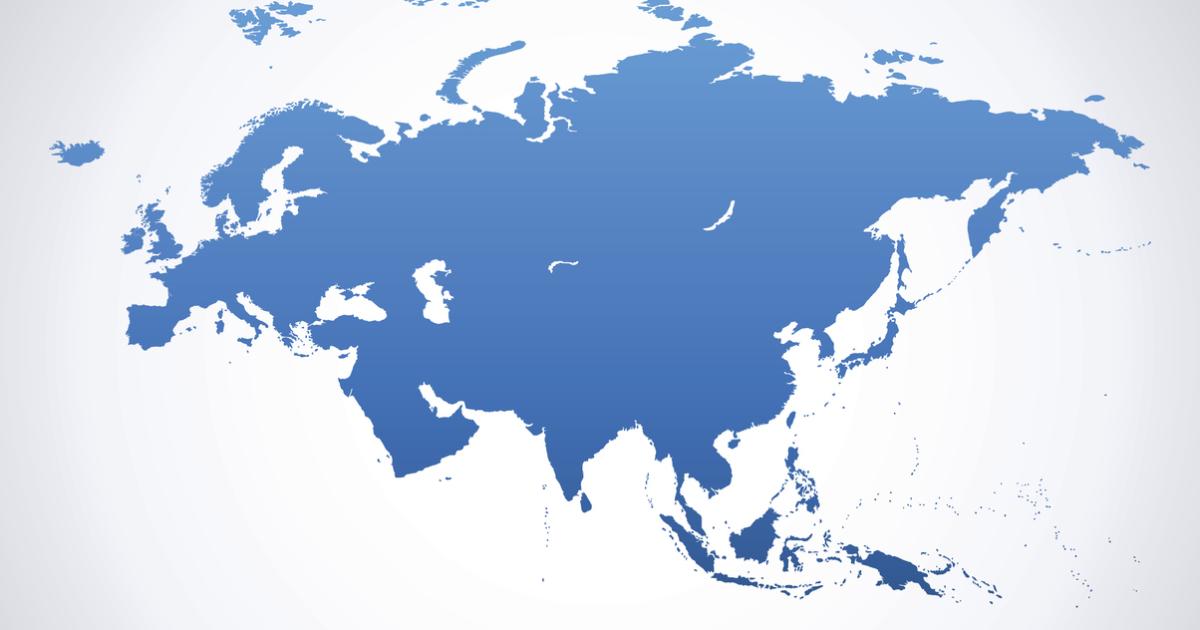
In recent decades, America’s view of the world has been through a lens of conflict. Europe revolves around the war in Ukraine. Afghanistan, Iraq, and now Iran frame our perception of the Middle East. In Asia, it’s Taiwan and, perhaps, depending on China’s episodic military mischief, the South China Sea. Cynically, perhaps that perspective is a result of fixating on screens and social media posts and not taking the time to absorb the map of Eurasia. Failing to see that vast landmass as a web of Eurasian histories, interests, and geographies that interacted well before our founding a quarter of a millennium ago is strategically unsound and economically shortsighted.
Eurasia is the land of the “great game,” where in the 19th century the British and Russian empires vied for influence in its heartland, and where others have maneuvered, clashed, and cooperated throughout history. The imperial moniker may not readily come to mind, but today’s Russia, Iran, and China still see Eurasia and their respective interests through imperial eyes. Memories and desire for influence and control are alive and well. The weaker countries - Russia and Iran - are embroiled in costly conflicts. China, although facing domestic headwinds, does not doubt that it is the dominant Eurasian player and sees Eurasia as the chessboard of the great game.
As China plays its regional long game, the U.S., in its current security and defense strategies, has expressed a desire, apart from the Western Pacific, to leave the security of the parts of Eurasia - Europe, the Middle East, and Asia - to others. That is a mistake.
The southern maritime rim of Eurasia, stretching from the eastern Mediterranean through Southeast Asia, is more than a mere linkage. It is the maritime hub of Eurasia. It is where four strategic chokepoints enable and affect the global economy: the Suez Canal, the Bab-al-Mandab (the Red Sea’s southern gateway) and the Strait of Malacca. Energy resources and other hydrocarbon-based products from the Middle East, as current events attest, are vital commodities. Critical minerals mined in Africa and shipped to markets via the maritime mega-region's sea lanes will become increasingly strategically consequential. Undersea cables and seabed minerals on the floor of the Indian Ocean are and will become more strategically significant.
This southern rim of Eurasia, its maritime hub, should not be seen in its piecemeal parts of West Asia, the Middle East, South Asia, Southeast Asia, and East Asia. It is a maritime mega-region. This vast maritime region is on the cusp of emerging as a massive blue economy.
A strategy that abandons and cedes that massive blue economy to others is shortsighted and irresponsible.
What is the blue economy? Seaborne trade to be sure, but that is more than ships plying the sea lanes. It is building and repairing ships, strategically and commercially important modern ports, and related maritime infrastructure and businesses, as well as physical and data systems that enable the transportation of seaborne cargo to domestic and global markets. It’s the movement of data and trillions of dollars in financial transactions that move on cables lying on the sea floor and the capabilities to manufacture, maintain, and repair those conduits of wealth. It’s the extraction of oil and gas from offshore rigs. Soon, it will include seabed mining and the associated critical-mineral processing infrastructure. It is a protein source harvested by coastal and ocean fishing enterprises and fleets, and by the growing aquaculture industry.
The maritime hub of Eurasia must be viewed through two lenses – security and commerce. Which one is used first is key. The war in Iran and the blockage of the Strait of Hormuz will prompt an initial focus on the security lens. That is also consistent with our recent over-militarized approach to strategic thinking. Yet now is the time to take a longer view and think economically. If we seek to revive our maritime imperative and our moribund maritime industry, we should focus on the blue economy of the southern Eurasian rim mega-region.
Over a decade ago, in institutionalizing its Belt and Road Initiative (BRI) strategy, China recognized this maritime linkage and its potential. Despite wishful thinking about its demise, the BRI continues to advance, with less emphasis on brick-and-mortar projects and greater focus on the digital and energy sectors. Ports and shipping remain a focus, and Chinese shipbuilding, both commercial and naval, surpasses all others. Chinese oceanographic research ships routinely survey the Indian Ocean. Oceanographic research is certainly happening, but the voyages also map underwater cable networks and survey potential seabed mining opportunities.
The mega-region’s blue economy matters. It matters to the littoral countries that benefit and prosper from their direct connection to it. It is of global interest because resources shipped from the mega-region, communications that run through it, and resources that lie on the Indian Ocean seafloor impact the global economy.
Central to the mega-region is India- a hinge, if you will, and the logical anchor of the mega-region’s blue economy. Links to Israel, Gulf Arab nations, and Southeast Asia, as well as the QUAD, the strategic partnership with the U.S., Japan, and Australia, and numerous partnerships with Indian Ocean organizations, make it so. However, the potential of all those relationships has yet to be fully realized.
The U.S. and India concluded a civil nuclear agreement in 2007-08. While it has unfortunately stalled, it can serve as a precedent for the U.S. and India to pursue a broad bilateral ‘blue economy’ strategy for the mega-region. Such an initiative will have more facets, intersections, and opportunities than the nuclear agreement. It will attract more industries and participants. It will stimulate broader economic and technological cooperation that can knit West Asia and East Asia together and serve as an alternative to China’s continuing push and influence in Eurasia. It will be the needed economic foundation and rationale for meaningful security cooperation in this increasingly important mega-region. Security cooperation that views the region as an integrated whole rather than as split between West and East Asia.
The opportunities and potential riches of the blue economy in the mega-region are extraordinary. Who leads in shaping the mega-region will be strategically advantaged and that leadership will determine the economic and security trajectory of Eurasia for decades to come. It’s time for the U.S. to look anew at the importance and opportunities of Eurasia’s southern rim, to revitalize our relationship with India, and to seize the moment.

