







- Middle East
- International Affairs
- US Foreign Policy
- US Defense
- Determining America's Role in the World
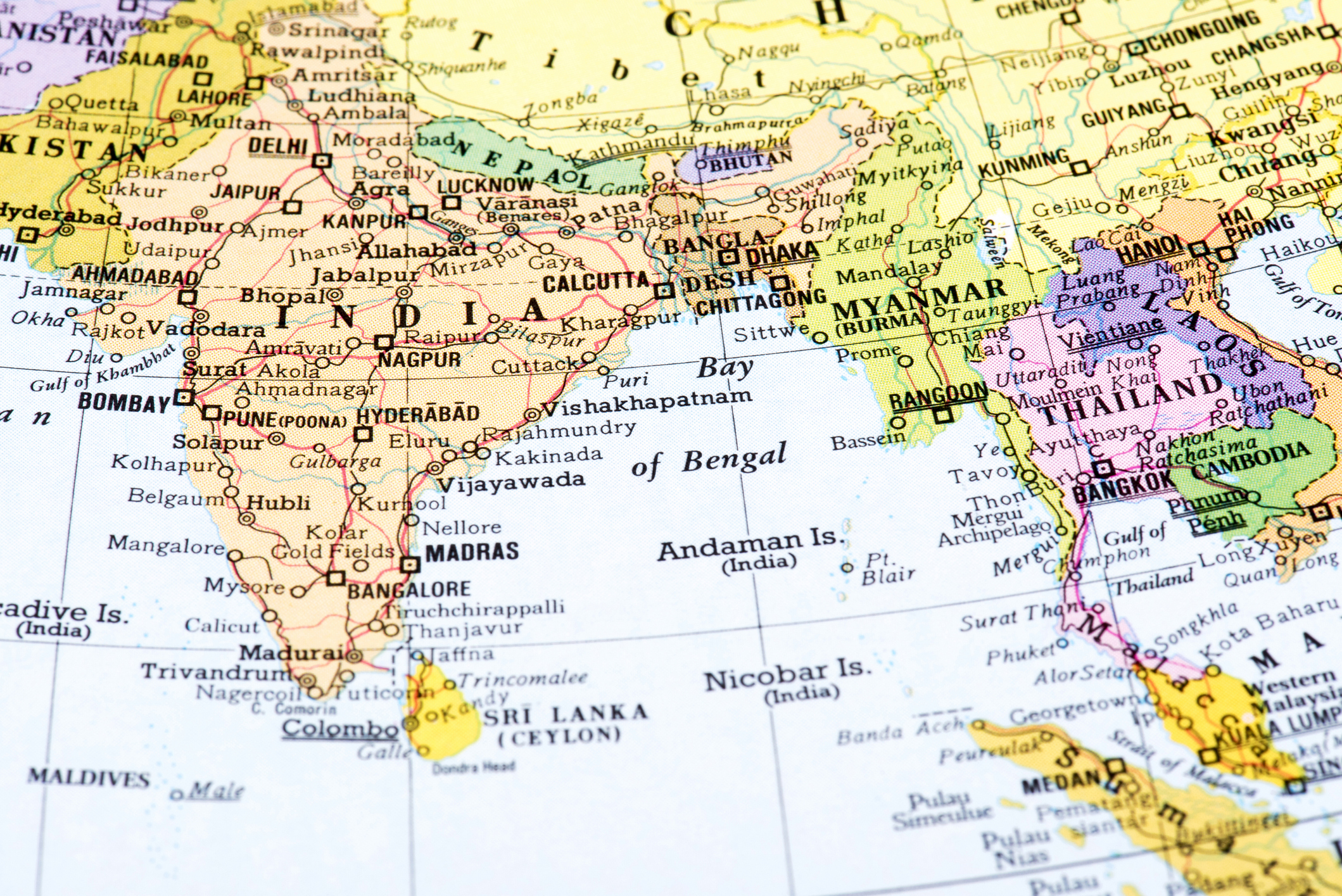
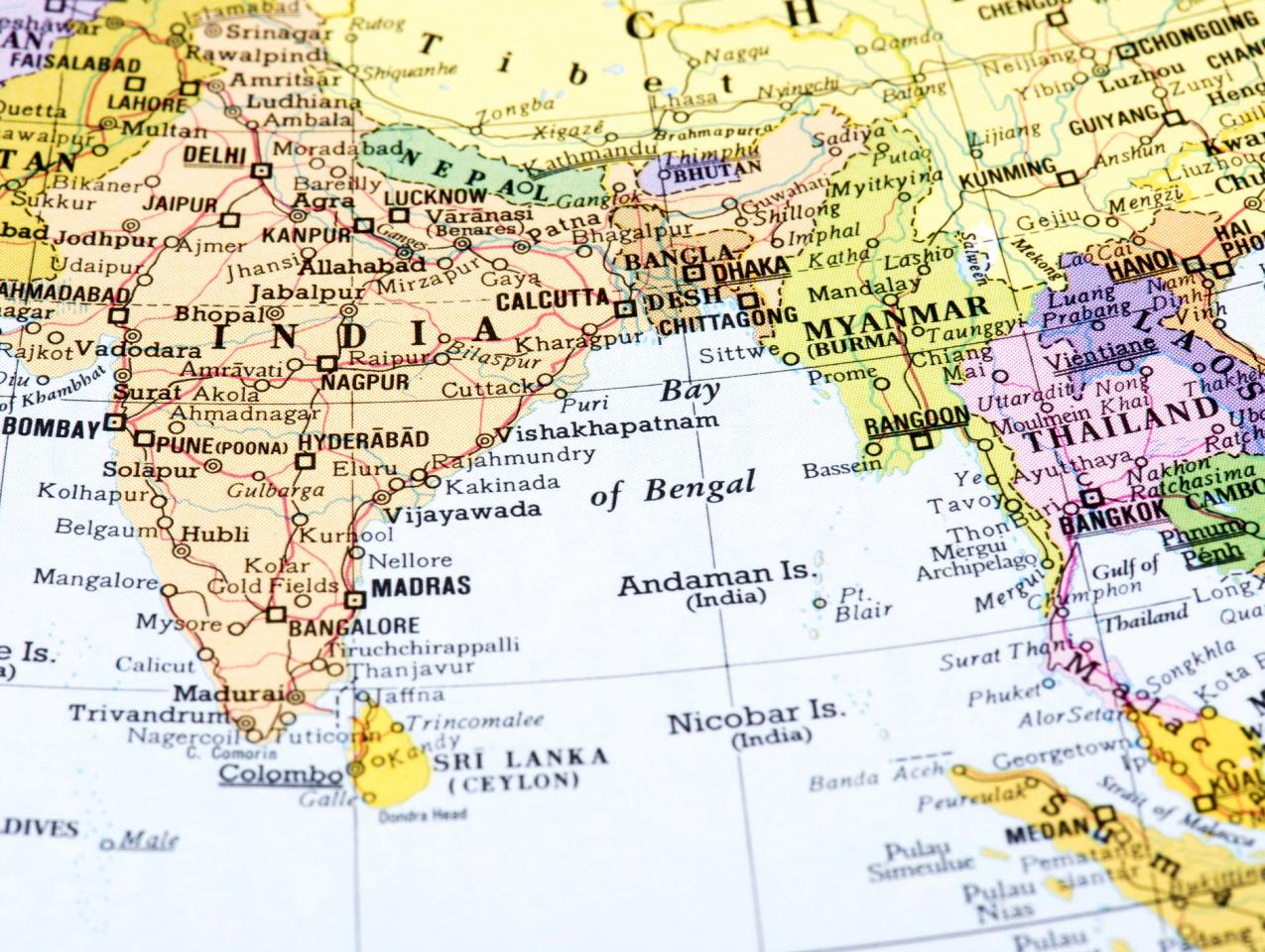
India is frequently characterized as a "hinge state" because its strategic choices, economic trajectory, and diplomatic alignments have the power to decisively shift the balance of the international order. As a major democratic power that maintains "strategic autonomy," India occupies a unique position where it can partner with Western alliances while simultaneously engaging with rising revisionist powers like China and Russia.
India’s “strategic autonomy,” is both a deliberate choice but also an outcome of how the two super-powers China and the USA view and treat India. China does not wish to see India rise as it does not wish to see another rival major power in Asia. Despite repeated attempts by Modi to befriend Xi Jin Ping, China has carried out multiple border incursions and worked rigorously in South Asia against India’s interests.
After almost 50 years of frosty relations, the US has been warming up to India since 2000. George Bush began a policy of rapprochement with Delhi that has been maintained by Washington up to Trump’s first administration. In his second term, Trump has changed course and no longer sees building India as a counterweight to China. The administration now views India as a future rival and will not do anything special to help its rise. [2]
India had hoped to increase India-US trade to $500-600 billion by 2030. That may yet materialize but Trump’s tariff policies have made it harder. India is widening its options with a historic trade deal with the EU signed within a year, where trade talks had been going on for 20 years and no one expected a positive outcome. India has also signed nine other free trade deals and should consider joining the CPTPP, where neither the USA nor China are members.
India maintains defense ties with Russia – though it is no longer as dependent on Russia as it was and now buys substantial defense equipment from France and Israel. It attempts to lead the so-called Global South. During its G-20 Presidency, it pushed for and succeeded in getting the African Union invited as a member, on par with the European Union. It is a member and, this year, the Chair of BRICS+ and attends the Shanghai Cooperation Organization (SCO). India has not signed on to China’s Belt and Road Initiative but is a founding member and second largest shareholder in the Beijing-based Asian Infrastructure and Investment Bank (AIIB) and the BRICS Bank called the New Development Bank based in Shanghai. India remains wary of China, however, and the relationship can best be described as Competitive Cooperation.
India is no longer non-aligned as in the past[3], but it is multi-aligned. The country can swing depending on the issue, such as maritime security, energy needs, or technological standards. Its energy needs are prioritized for 1.4 billion people. It was willing to give up its purchase of Iranian oil (during the Biden administration) and even reduced its purchase of Russian oil, but the Iran war has brought all these arrangements into question. India will have to diversify away from the Gulf. The decision of the Indian company Reliance to invest in a Texas refinery (the first new refinery in the USA in 50 years) indicates India expects to have close energy ties to the US. But it will also now certainly keep its options open to buy more Russian crude and may also buy more Iranian oil.
With a $4 trillion GDP and a sixth of the world's population, India's internal development and trade policies will increasingly impact global growth. India’s GDP is projected to reach $8 trillion by 2030 (third largest), $25 trillion by 2040, and $45-50 trillion by 2050, which will make it the most significant contributor to global trade and growth over the next two decades. It has been a pygmy in global trade so far with only a 2% share, but that is changing rapidly. India could see its trade share rise to 4% of global trade.
Some knowledgeable experts[4] predict that events in the 21st century will be determined by the interplay between China, India, and America –jokingly referred to as the CIA. Since 2000, India was moving closer to the US, but Trump’s tariffs and his praise for Pakistan’s military rulers have again brought back the ghosts of the past and made India once again question America’s motives. It is now no longer likely to easily swing Washington’s way unless concrete moves restore trust between the two[5]. One such potential assurance would be a closer partnership in the Indian Ocean.
India Must Concentrate Even More on the Indian Ocean
India has begun its own long-overdue initiatives in the Indian Ocean[6] to counter the Chinese and ensure that China does not start to dominate the Indian Ocean through its “String of Pearls”, where China has built bases to encircle India.[7] India’s maritime initiative on the Indian Ocean has been presented as “SAGAR[8]— ‘Security and Growth for All in the Region’. The initiative envisions India as the center of the “Indian Ocean world,” which stretches from West Asia and Africa in the west to Southeast Asia in the east. The Indian Ocean carries one half of the world's container shipments, one-third of the bulk cargo traffic and two-thirds of the oil shipments.
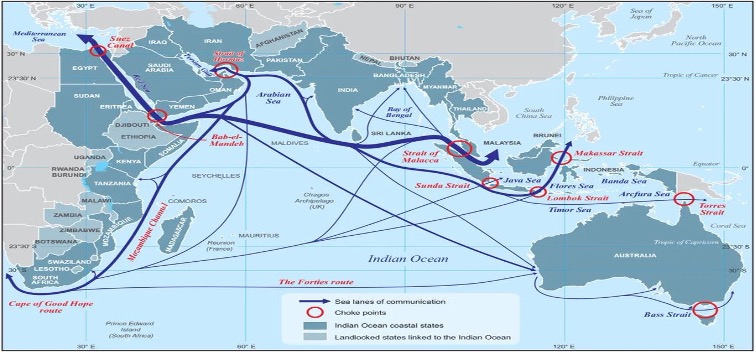
However, there are critical choke points in the Indian Ocean – the Strait of Hormuz, Bab-El-Mandab (Gate of Tears)[9] at the southern end of the Red Sea and the Straits of Malacca. About 90-95,000 vessels per year carrying 25-30% of world traded goods pass through Malacca. About 35% of the world’s oil, 20% of gas and fertilizer pass through Hormuz. About 20,000 vessels go through Bab-El-Mandab every year to the Suez Canal carrying 15% of global trade and 30% of global container traffic. The Iran war has shown how critical Hormuz is, and if the Houthi’s start attacking at Bab-El-Mandab things will get even worse. The open seas the world enjoyed since WWII is now over.
Trade Choke Points in the Indian Ocean
Source: Venter 2017[10]
China’s biggest concern and that of others in Asia is the Strait of Malacca. China has moved to secure land routes to circumvent that threat with a port in Gwadar (Pakistan), Hambantota (Sri Lanka) and is developing a deep seaport at Kyaukphyu in Burma and an East Coast Rail Link through Malaysia.
In the past, India had focused its defense budget on its main land threats from China and Pakistan but is now increasing its naval capabilities to project greater power in the Indian Ocean. [11] India currently ranked sixth or seventh in global naval power rankings, depending on how it is measured. It is now focusing more on modernizing and expanding naval power with two aircraft carriers and three nuclear powered submarines and has joined the US, Russia, China, and France in becoming a nuclear triad. It is also building a deepwater port at Galathea Bay in the strategically placed Andaman and Nicobar Islands, with facilities to monitor ship movements coming through the Malacca Straits.
India is ranked third in the Lowy Asia power index, after the US and China, but lags behind on two indicators – economic interdependence and defense networks. Its recent flurry of free trade agreements is designed to change the first lacuna, but it must do more on the second one – defense networks as well, where it ranks eleventh. Within this category it ranks 27th in regional alliance networks. This is, of course, part of its overall plan for “strategic autonomy,” but this can be carried too far. It should consider a closer relationship with Indonesian and Australian navies in the eastern part of the Indian Ocean. In West Asia it must build up on the I2U2 platform of India, Israel, UAE, and US.
Finally, India should open the possibility of an AUKUS type arrangement with the US and Indonesia centered on the Malacca Straits in the Indian Ocean. This could involve upgrading India’s capacity for naval defense production and maintenance and building mutual capacities to counter growing Chinese influence in the Indian Ocean. For the US with a base at Diego Garcia, a partnership with India with its long coastline of options for the maintenance of its fleet, undersea cable security and potential deep-sea mining and its growing capacity in the Andamans may prove mutually beneficial.
As the naval strategist Alfred Mahan said about the Indian Ocean “In the 21st century the destiny of the world will be decided on its waters “. India is the keystone on which the future safety and security of trade in and through the Indian Ocean lies. However powerful it becomes it may never be a formal US ally, but unlike China it will never be a threat to the United States. It will, however, want to be treated as a friend with benefits not as a subservient alliance partner.
[1] Is Distinguished Visiting Scholar, Institute for International Economy Policy, George Washington University, with a PhD from Stanford University and served as Assistant Secretary General at the UN and in senior positions at the World Bank.
2 Comprehensively laid out in Meena Ahamed’s book, “A Matter of Trust: India US Relations From Truman To Trump,” Harper-Collins India, 2021.
[2] Stated very bluntly by Deputy Secretary of State David Landau at the Raisina Dialogues in New Delhi in February 2026.
[3] India was a founding member of the non-aligned movement along with prominent countries like Indonesia, Egypt, Yugoslavia, and Ghana and twenty-nine countries in all at the Bandung Conference in 1955.
[4] Ed Luce, the FT’s editor in Washington and earlier FT correspondent in India made that prediction as early as 2005 when India was only around US $ 0.8 trillion in his book “In Spite of the Gods: The Strange Rise of Modern India” Little, Brown publishers London, 2006.
[5] See Sanjaya Baru | The Beginning of the End of the American Empire in the Asian Age.
[6] When India was considering a name change to Bharat, I argued why would you make a self-goal by giving up a name on which an entire Ocean is named after you.
[7] See a description of String of Pearls in China's Belt and Road Initiative and India's options: Competitive cooperation
[8] SAGAR is the Hindi word for OCEAN – the Indian Ocean is called the Hind Maha Sagar.
[9] Due to its history of perilous waters for shipping even before Houthi attacks.
[10] Venter, Denis. « India and Africa: Maritime Security and India’s Strategic Interests in the Western Indian Ocean ». Fluid Networks and Hegemonic Powers in the Western Indian Ocean, édité par Iain Walker et al., Centro de Estudos Internacionais, 2017, https://books.openedition.org/cei/469.
[11] Some say with trade land trade routes cut off by Pakistan to the west and Bangladesh and Myanmar to the east India is effectively a giant island state, with over 90% of its trade being maritime.
Ajay Chhibber is Distinguished Visiting Scholar, Institute for International Economic Policy, George Washington University with a Ph.D. from Stanford. He served as Assistant Secretary General at the UN and in senior positions at the World Bank. His co-authored book " Unshackling India " Harper-Collins India 2021 was the FT's Best New Book in Economics for 2022.

