







- Law & Policy
- Politics, Institutions, and Public Opinion
- Judiciary
- Civil Rights & Race
- Revitalizing American Institutions
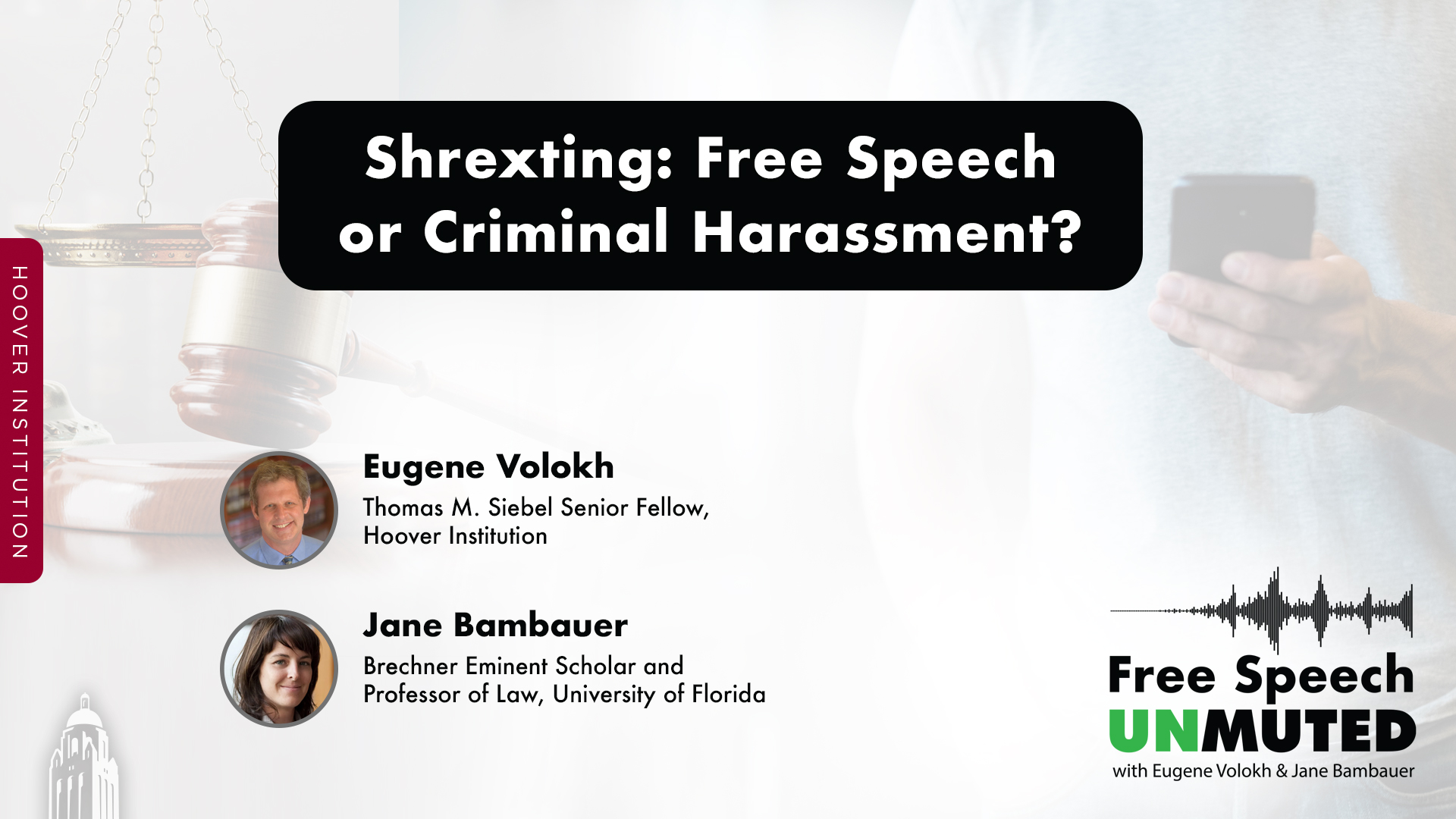
Eugene Volokh and Jane Bambauer tackle one of the strangest First Amendment controversies imaginable: whether sending a sexually explicit image of Shrek to a politician can constitute criminal harassment. Using an Ohio case involving a blogger and a state senator as their starting point, they explore the constitutional boundaries between protected offensive speech and criminally punishable harassment, the rights of unwilling listeners, the special status of public officials under the First Amendment, and how courts have struggled to adapt decades-old free speech principles to an era of texts, emails, and smartphones.
Recorded on June 16, 2026.
- Retting, isn't that someone in the Constitution? The freedom to Shrek t? No, no. Welcome to Free Speech Unmuted. I am one of your co-host Eugene Wallick, senior fellow at the Hoover Institution, and a, a professor of law emeritus at UCLA Law School. You and I'm Jane Bauer at University of Florida's College of Law. So, so welcome. Today we're talking about Shrek and Yeah, Sort of bits of Shrek. That's kind of a strange thing to talk about, but there it is. It's a strange world we live in. It's a nice way to, to delve into some first moment topics that we haven't touched yet. So, Exactly right. It's gonna illuminate broader questions about so-called criminal harassment or sometimes called telecommunications harassment. And when it, when the government can punish speech that's targeted to a particular person on the grounds that it is deliberately intended to offend them or harass them, ill-defined term. Okay, so let me lay out the facts. And then Eugene, I know you've worked on cases sort of similar to this one, so you can take us into the, the legal background. So, so in Ohio there's a blogger, a political news blogger named DJ Burns, who runs a site called, actually a sub, called the Rooster, which builds itself as all Ohio's depravity all the time. And he regularly criticizes Ohio State Senator Jerry Serino, who he also calls Young Mussolini. And this incident involves DJ burns, not, not, not just, you know, blogging about Senator Serino, but actually texting directly to j to Senator Serino on at least three occasions, some depictions of Shrek fully nude with an exposed and erect human-like penis according to and apparently Masturbating, at least According. Yes. And at least in one of them he was masturbating. Yes. And, and so a couple days and, and the texts also included some, you know, sort of insulting messages as well. A couple days later, the senator phoned up the chief of police and Burns was, was if not arrested, I dunno if he was arrested or simply if charged with, with criminal harassment. So is the sending directly to some target's, phone images of virtual ogre porn, is that sufficient to be considered unprotected or in any case, you know, punishable harassment in your view? So that is a good question. Turns out to be a complicated question. So it's well known that the First Amendment protects offensive speech general. So there's a famous case or somebody wearing a jacket that says the draft. This is 19. The, the case was heard by or decided by Supreme Court in 1971. The California prosecutor said that this is essentially a form of disturbing the peace through offensive conduct and public place. And the Supreme Court said, no vulgarity is protected by the First Amendment, even if people are offended by it. A few years later, in a case called e Nosnik versus City of Jacksonville, the Supreme Court struck down a city ordinance that banned the display of drive in of, of movies, on drive-in theater screens, remember, drive-in theaters. Yep. When they were visible from a public place and contained images of nudity, it was focused on nudity. And the Supreme Court struck that down. Now, to be fair, it wasn't limited there to highly sexually themed nudity, but still people can be offended even by non-sexual images of nudity. The court said, well, too bad for you, especially if you're in a public place, if you see something offensive, it's on you to turn away or to to, to not pay attention to it. So that's, that's one principle. It's a very important principle. But there's another principle also from the 1970s, a case called Roan v Post office department decided in 1970 that involved a federal statute that essentially allowed any pers any person who gets mailed to, to inform the post office that, that, that, that he or she finds a mailings from a particular particular sender to be, to be offensive, basically kind of sexually offensive, but sexually provocative or erotically arousing. But that's a judgment in the sole discretion of the addressee. So the could say that about anything. So essentially the address C can say, look, I find the mailings from this, from this source to be to be offensive. I need them to stop. And then the post office relays that to the address to, to the sender. And then if the sender keeps sending materials to that address, that is, that's at that point illegal and the supreme. So that would be illegal spam, basically. Well, spam, but doesn't have to be commercial advertising doesn't have to be kind of the, the, the ubiquitous unwanted advertising that, that we associate with spam, even if it's just an occasional mailing that can be, that can be blocked through the force of law. And the Supreme Court says that no one has a right to press even good ideas on an unwilling recipient that we are often captives outside the sanctuary of the home and subject to objectionable speech and other sound does not mean that we must be captives everywhere via asserted right of a mailer stops at the outer boundary of every person's domain. So, so there's a lot going on there, but let's unpack it. One of the things is that it, that the court is saying, the unwilling listeners do have rights to block the, to block unwanted material in particular when it goes into the home. Remember this is 1970, we was quite clear there was home address, there was work address, there's a home telephone line, there's a work telephone line. This is before the advent of email, which could be received really anywhere before the advent of cell phones, which people take with them. But there is a sense that the home or possibly a one's private domain more broadly is something that the government can protect against unwanted speech. A second thing though that, that the court stressed is the government doesn't have to decide in a case like that whether speech is offensive or not. Because even though the statute focuses on sexually provocative material, it's up to each recipient to say, is it or is it not sexually provocative? The government doesn't have to make judgements, doesn't have to have in the post office department some panel of people who say, well, I don't think this is really sexually provocative. Well, that is. So that's an important point that the law was in effect in some measure content neutral, although not entirely, because after all, probably most people who read the law figure they can only bring complaints based on sexually provocative material. A third thing though that I think is the most important thing is it set up a mechanism by which a recipient can say, stop sending stuff to me because I don't want it anymore without interfering to com with communication to willing listeners. So this wasn't somebody saying, look, you know, I don't want to see offensive words on a jacket in a public place, even though some other people may see it and say, yeah, that's, that's telling the truth in a forceful way that the law upheld in this Rowan case did not authorize the blocking of, of sending, of mailings to, to willing listeners. It only authorized the blocking of, of such millions to people who had already specifically said that they are unwilling. So those I think are, are, are important limitations of, of the Rowan principle, at least, at least in some measure. But again, remember there are the now two principles out there in First Amendment law about offensive speech. One is offensive speech is generally protected even though some listeners might be offended, but offensive speech to a particular person, just to that one person can be blocked in order to protect that unwilling listener from from, from such material. So the question is, how does this play out in the modern world where the line between home and not home is, is a, is a complicated line as a practical matter because again, we take our cell phones with us wherever we go. Very, some people may have a business cell phone and a personal cell phone. But my sense is that, that for various reasons, including money, it and the, the desire not to have to carry two different phones, that's pretty rare. And another question is just does the law really have to be totally neutral with as to content or can the government say, look, certain kinds of material we can just tell is offensive either because of its content or maybe because of its purpose. Because we think that in context, your purpose was to offend this person. Your purpose was sometimes the laws say to harass or abuse the recipient. So that's a question that courts have had to deal with quite a bit recently. And as a general matter laws that ban targeted harassment of people, which is to say, and again, harassment is not a well-defined term in many ways in the law. Some of the laws try to define it, although I don't think they do a great job. But for example, the Ohio law says that you, you can't make telecommunications, which includes emails, text, and such with purpose to harass, intimidate or abuse essentially the recipient to oversimplify. And these kinds of laws have generally not always have generally been been upheld if they're focused in this unwanted speech to a person, they've been sometimes struck down if they're Brought, directed to the per Exactly Right. If they're broader, Because there's plenty, there's plenty of case law, right, Right. There's plenty of case law that says that you can even ha you know, even if you have the intent to make, to insult somebody and make them feel bad, if you're doing it in the, in the process of a, of a public let, let's say like a, a political, a skew, you know, some sort of political cartoon that skewers a, a politician, right? Oh yes, Absolutely. So I'm sure you know, some, somebody in fact even this blogger when he blogs publicly, I'm sure one of his many goals would be to right offend the, the target, the subject of his writing, Right? So it's only when there's that purpose combined with a kind of a narrow casting, a directing of the message at the subject. Okay? Right. And so the line that courts sometimes, sometimes, excuse me, the way the courts sometimes articulate this line is distinguishing unwanted speech about a person from unwanted speech to a person, unwanted speech about a person. Again, could be a political cartoon in a newspaper on the web, or wherever else that generally speaking, constitutionally protected. Unless it's a falls within a First Amendment exception, such as it's a true threat or it's a defamation or something like that. But unwanted speech to a person can be restricted. That's the general big picture. But there's a little picture, but that's a very important little picture embedded within that as a possible exception. And that is what if this is unwanted speech to a government official or possibly to a political candidate. And there, Wait, actually before we go there though, yes. Can I ask one more clarifying question about Rowan? Of course. And what you've set up so far. I thought though that it was very important in Rowan that the reason this sorting out of un unwilling listeners is constitutional is that they have said in advance, right? And Therefore Provided notice that they don't want these messages. So a harassment law of the style that Ohio has, it sounds like it's enforceable even if the speaker does not get an advanced notice. Now, maybe that doesn't matter 'cause they know that the listener's unwilling, that's the whole, that they have the purpose of offending, right? On the other hand, don't we have a first Amendment interest in having some people sometimes hear things they don't wanna hear. I mean, don't, don't all of us do that sometimes when we are, you know, delivering bad news or telling somebody a, you know, a harsh truth that we think could ultimately Improve Their life or something, you know, is, is is there any tension in the case law so far that suggests that a speaker does have at least, you know, an opportunity to, to say something offensive until they are put on notice? Right? So, so I totally appreciate that this is something that the Rowan courts crest that that essentially the, the, the sender has to be told up front, oh, stop sending me this material. It's only after they've been given this veto that they, that they to can be punished for continuing to send to this particular recipient material that this person has already said no to. And one could distinguish some of these criminal harassment laws, most of which do not require, some of them do, do specifically, specifically limit themselves to repeated communications after being told to stop. But most of 'em do not require that. You can imagine. Okay, what's the doubt? Courts drawing that line. A few courts have have pointed to that. But a general matter, if the law does have a requirement of purpose to harass or abuse the recipient, whatever, those, Again, Pretty vague terms might mean the courts have said that's that's essentially enough to show it's pretty likely that the recipient doesn't want to hear it. That in some of the example, like for example, you giving Someone bad news, it's itself in a way. Pardon? Right. If you're giving someone bad news, you probably don't have the purpose to harass or abuse. But if your purpose is to harass abuse, that's right. Yeah. You, you ought to realize that the person doesn't want to get that again. Fair enough. You can, can imagine lying fair be drawn elsewhere. Fair enough. And the Supreme Court, since Rowan has not really confronted this issue much, at least in any direct way in the context of criminal harassment laws. So we're talking about lower court case law, as with case law in lower courts, it's not completely consistent, but the dominant view seems to be these, these statutes that, that ban unwanted speech to a person are constitutional, even if they don't, don't require specific notice from this specific recipient. Stop sending me stuff even. And if they use sort of the malign purpose as a subsidy. But what about unwanted speech to a government official? Maybe the petition clause does give you the right to say highly offensive things to government officials. And in fact, many courts have said that the very First Appellate argument in the First Amendment case that I had second, my second appellate argument in the first one in the first Amendment case was this point over 15 years ago in the Nebraska Supreme Court. And they, that involved a person who was, who sent a couple of, of offensive, not sexually themed, but but just insulting messages to actually as it happens, this former university professor who at the time was running for the Nebraska legislature, he was prosecuted for essentially disturbing the piece by sending these unwanted emails. And the Nebraska Supreme Court, sorry, I represented the defendant and the Nebraska Supreme Court unanimously held, this is constitutionally protected speech. There are other examples. One of the cases we relied on was a case from the DC circuit in 1999 called United States versus Popa. The defendant there left a racist voicemail on the voicemail of the US attorney, which is the head federal prosecutor for the District of the District of Columbia. As it happens, he was Eric Holder who would later become Attorney General. And he left messages, for example, saying he was a whore born by a negro whore, I'm quoting here really offensive stuff. He was prosecuted under the federal tele telephone harassment statute. And the court essentially said, you can't do that there. It said, when speeches on matters of public concern, but it has mostly been quoted in, in cases involving speech to a government official. The court essentially Said, You can't, you can't punish this kind of speech in this context of political communications to a, to a high level political official. And a bunch of other cases have, have held the same. It's not unanimous. Some, some courts have have allowed punishment for such such speech, even when it was said to government officials. But the general view seems to be that there's an exception. So there's a first Amendment exception, essentially for unwanted speech to a particular person when it's said with a purpose to harass or abuse. But there's an exception to that exception for for government officials. But you know what, this, here's this question. Oh, go ahead. Is this limited to speech said to the person at their office or on their office email or sent to their office email on their office voicemail and therefore not, excuse me, I'm sorry. Again, I need, I I need to, to, to instruct this. So, so here's one important twist. You might think is it an exception To an exception? To an exception, but perhaps the better affirmative way to to say it is, even though we probably do have the right to say offensive things to government officials, is it limited to saying it to them on their official or office communications facilities, a letter sent to their office, an email sent to their official address, a phone call to the office? Or does it also extend to, to things sent to them at home, let's say, or possibly on a, a text to their phone that people use often for personal business? Does it matter, for example, whether the, the official predominantly uses the phone for personal business? Is it enough if the official sometimes uses the phone for, for for office business? So those are the somewhat uncertain questions. It does look from the lower courts that you do have the right to say unwanted offensive speech to a government official, but maybe only on to their government email official communications channels, official communications channels. So, you know what this reminds me of though? I wonder if there's another reason to treat politicians differently, which is maybe it's analogous to the rules related to fighting words where courts have said that the standard for what even counts as a fighting word is different if the victim or the, you know, the person rece, you know, receiving these, these obnoxious speech is, is a police officer. The idea being that there are certain people where in their official capacity, they're expected to handle lots of harsh criticism. Lots of insults, why not ex you know, the, the, that logic seems to me to the, to apply to politicians as well. Is there anything like that in the caseload or not really? Well, there is, there is something like that. So I shouldn't stress not all courts, I'm sorry, let's step back. Fighting words exception is a separate first amendment exception. Yes. It's for not just any old offensive speech to a person, it's face-to-face personal insults that because they're face-to-face and personal and highly insulting, seem fairly likely to start a fight. So classic example might be somebody calling someone else some other, yeah, sometimes that's said affectionately anything could be said with affectionately yes, of course. If somebody comes up to, to, to me and says that on the street, I, I would never punch them 'cause I'm a peaceful man. But there's enough of a risk that might might lead to, to, to a fight that, that that would be, that, that, that would be a potentially fighting word. But some courts say that police officers need to be trained to, to deal with these kinds of things. And that saying such things to a police officer, basically they're categorically is not fighting words. Even though saying it to an, to an ordinary citizen might be fighting words or at the very least it cuts very much against the, the, the recipient being a police officer cuts very much against The Likelihood of this thing found to be fighting of Causing Not all courts take that view. But yes, and I do think that this helps explain why courts essentially say, look, you know, most people do have protection from unwanted, highly insulting phone calls, messages and such, probably even at their, at their business phone line. But government officials are different maybe because they ought to, they ought to expect these kinds of things. Or maybe it's just that it's just so important for people to speak their minds to government officials. But again, the question is, should that apply to any communication to a government official or only the go when the government official is in a sense on the job, but, and in in the sense that this is a communication on that person's official government channels like email, phone, and the, like, let's, let's say the office phone, like hmm. And should they, in their own private lives where they just have their cell phone, which they're usually using for ordinary communications with their friends, should they still enjoy the same protection against unwanted offensive speech that, that ordinary citizens do? That is one of the unresolved questions. So I should say by The, okay, well, So one thing that makes this I think particularly offensive to some people is this is an a an image that was sent was wasn't just offensive, it was, it was apparently image of masturbation. Now it is cartoon masturbation by a fictional, although humanoid creature, and it wasn't sent for tit for purposes of titillation. This was sent to precisely to offend people. But I do think there's a sense that, that we should have something more of a right to be free from unwanted highly sexualized imagery, even if it's not pornographic in the sense of being aimed at, at arousal. But if, but it's sufficiently highly sexualized, we just shouldn't have to be confronted, especially sent directly to us with images of, of, of masturbation. I think a lot of people would say, Yeah. So unwanted sexually vulgar kind, kind of like, I mean we've, we've had episodes about the special rules for indecent speech directed at children. So you could imagine some kind of, well if you know, whether, whether they're a child or an adult, if you know that imagery is unwanted and sexual in nature, then, then maybe you could imagine there being justification for a different rule, Right? Right. Or more protective rule. And some, and some states have special harassment statutes to prohibit lewd communications, lewd or indecent communications with the, the purpose of, of abusing or harassing. And some courts have upheld that, that now in a sense, the very fact that the laws distinguish between types of communication may make them content based and therefore more constitutionally suspect. But at least some courts have said no, That's Actually a good thing because it limits it to this kind of material, which is not really necessary for political communication. Interestingly, the Ohio law, as I understand it, the particular provision being used here is not so limited. Although there is a separate provision which isn't being applied here, but I think, I think is an illustration of, of this sexist different theory. It it that Ohio law says that you, that it's a separate crime to describe, suggest or request or propose that the recipient engage in sexual activity when the recipient has requested that the caller not make such communications to the recipient. So that does have a kind of, that's very content specific, but it also spec specifically with the request for sex. You'll see the reason for, we can tell the reason that there, that that, that this applies only when the person has said no. Sometimes people call up each other and suggest sex and the other person says yes by the time you did that or something like that. But if the person says no, the sense is that like it's one thing to suggest that you vote for some candidate or you change your views on some subject. But it's another thing to suggest that you have sex with me, especially after you've told me no before. So there is the sense in some of these laws that sex is different. Some court cases at least do suggest that sexual communications in various senses could be specially punished. But it doesn't seem like that is an element of the particular crime with which this defendant is being charged just because that's not the way that particular part of the Ohio law under which he is being charged as written. Right. And I I think we can agree though that as offensive as what a seeing Shrek masturbate may have been. It it is, it certainly has some slaps value and therefore is not obscenity Well, it's so interesting. So slap value is serious scientific, literary, artistic or political value. And That's an element of the obscenity test. So yes, if you were prosecuted for distributing obscene material Pretty clearly, yeah, not gonna work. This would not, this would not be punished. But, and there is actually a separate provision of the Ohio statute that that does apply to obscene communications. And I don't think that that would be, that, that would be applicable here. Because again, the ob obscenity is really hardcore pornography that lacks any serious political element to it. And for various reasons I think this would not qualify. But again, these, these, while sometimes these harassment laws are aimed at sexually them material, they're almost never re are limited solely to obscenity. And again, the theory is pornography pe many people say should be protected 'cause it's just between consenting adults, consenting adults wanna watch highly sexually themed material. Fine. And the law in some measure endorses that. But the question of course here is what if there's a non-consenting adult as the recipient of the communication? And that's where these criminal harassment laws come in. Yep. Very good. And then of course these are like, we're, you know, we're, we're sort of focusing on this particular weird Shrek example, but there are plenty of unsolicited pics that wind up, you know, follow, following these, following into these elements and, and so I think these harassment laws probably are designed for things like that. Well, Eugene, I just got a text message. I gotta go see what it says. Well be careful. You never know, Jane, great pleasure as always. All right, talk to you next time. This podcast is a production of the Hoover Institution, where we generate and promote ideas advancing freedom. For more information about our work, to hear more of our podcasts or view our video content, please visit hoover.org.
ABOUT THE SERIES
Hoover Institution Senior Fellow Eugene Volokh is the co-founder of The Volokh Conspiracy and one of the country’s foremost experts on the 1st Amendment and the legal issues surrounding free speech. Jane Bambauer is a distinguished professor of law and journalism at the University of Florida. On Free Speech Unmuted, Volokh and Bambauer unpack and analyze the current issues and controversies concerning the First Amendment, censorship, the press, social media, and the proverbial town square. They explain in plain English the often confusing legalese around these issues and explain how the courts and government agencies interpret the Constitution and new laws being written, passed, and decided will affect Americans' everyday lives.

