







- Economics
- Political Philosophy
- Education
- Answering Challenges to Advanced Economies
- Reforming Education
- Understanding the Effects of Technology on Economics and Governance
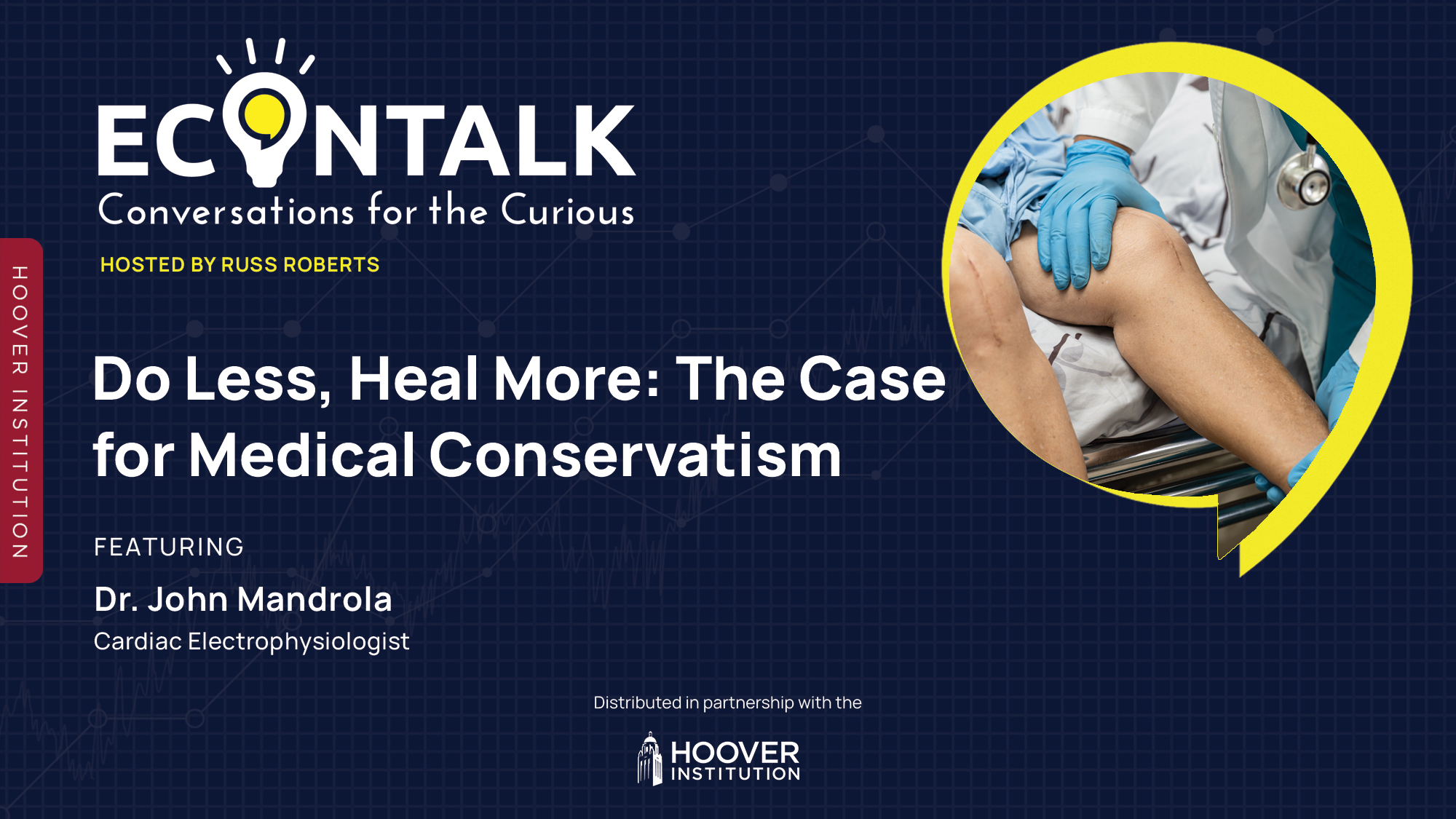
What if the surgery that fixed your knee did no better than fake surgery? EconTalk host Russ Roberts speaks with Dr. John Mandrola about a striking clinical trial in which patients who received sham knee surgery (a real incision, but no actual repair) did as well or better than those who had the actual procedure — one performed 700,000 times annually in the US. The conversation ranges from the power of placebo and nocebo effects (how expectation of harm can cause real suffering) to the broader philosophy of "medical conservatism" — the idea that humility, watchful waiting, and honest counsel often serve patients better than the knife. Mandrola argues that financial incentives, professional identity, and language itself ("bone-on-bone," "the widowmaker") conspire to push patients toward interventions that can do more harm than good.
Listen to the episode here.
- Today is May 20th, 2026. And before introducing today's guest, I wanna let listeners know we'll be doing an EconTalk book club around the Iliad by Homer. The first episode of that book club will be with Ido H of Shalom College here in Jerusalem, who's been teaching the ilead here for over a decade. And that will air if all goes, is planned on July 6th. That will, that will provide some useful context on the book to help you get started. And we'll have at least one, if not two or more. We'll see how many episodes in the weeks that follow. And we will be using the ALS translation, but there are many others to choose from. And now for today's guest, Dr. John Mandrola. John is a cardiac electrophysiologist, which is a specialization in heart rhythm disorders. Our conversation today is based on an article he wrote for the Substack Sensible Medicine, which he edits with past EconTalk guest Adam Sifu. John, welcome to EconTalk. Well, thanks for having me. It's a real honor to be on a podcast that hosted Milton Friedman and Thomas Soul, so I'm quite excited. Well, thank you. The title of your article was, bravery and Humility is needed to do Proper Medical Science. Let's start with some background. You're playing basketball or tennis or skiing, or you're just squatting to pick something up, or you're old and something's gets worn out and all of a sudden you have this terrible knee pain. You might have your knee lock up. So you go to the doctor and you find out you have a, a, you've damaged your meniscus, and Chad GPT will find you a nice image of, of a meniscus. It's a, it's a little shock absorber that, that protects your, the bones that make up your knee. So what do you, what are your choices when you, when you get that diagnosis? Well, when you go to the doctor, I mean, the doctor would probably assess you determine what it, what the exam is like, and then he or she will probably order an MRI or some sort of x-ray maybe after a period of time. And then if it shows an anatomic abnormality, say of the meniscus, or people get labral tears, other kinds of things the doctor could suggest arthroscopic surgery. And what, you know, what strikes me about these, these treatment plans is that a patient could get better because the illness just runs it course so-called natural history. It could get better because of the surgery or it could get better from a combination of things such as the placebo or placebo effect, which is an expectation that they should get. And so many things in medicine that we, that we treat, there's multiple reasons why patients get better. And what struck me so much about the, the study that we'll talk about is how they used really a proper placebo control, which we use in drug trials, but we don't often use in surgery trials. Yeah. I have a friend of mine who's an emergency room physician, and when I ask him about some situation, one of us had some health issue and it gets better. And I'll ask him if it was the treatment, the drug, forget, forget what doesn't matter. The drug, the treatment, the whatever, he'll shrug and say, or, you know, passage of time. So I, most doctors, a lot of doctors don't have that perspective that you're suggesting and that, that this friend of mine has. But let's go to the study and, and we should just say laparoscopic surgery is this is the idea of it's non-invasive, right. Or is as invasive as minimally as possible. Correct. Well, Russ, I think if someone's sticking a, a sticking a tube inside of a joint, anytime that we put things into the body, I would determine, I would call it invasive. And of course, the definition of small surgery is surgery on somebody else. So I, you know, it's not, it's not like open knee surgery, but it's not nothing either. Okay. So how, how big is this problem, by the way? How, how, do you have any idea for how common this kind of surgery is to repair a, a weekend athlete who has a problem? I, I read in the introduction to the paper that in, you know, many thousands, I think here's a 700,000 arthroscopic, partial menis, men menis gummies have men performed annually in the United States. So, you know, this is a big deal. I mean, 700,000 procedures Seems like a lot. And what was the, what was the, the study, what did they try to, what did they do? So importantly, whenever you look at studies, you always have to think about who's in the study. And these were patients with sort of chronic tears that were, these were not somebody who, not, not a, you know, complete, complete acute tear that's was, you know, there immediately from an acute injury, but sort of a chronic knee pain, chronic things. And, and what they did was they took 146 of these patients and they all had arthroscopy. And the, the explain surgeon arthroscopy a tube looking into the knee, right? So the surgeon looks into the knee and sees that there's a meniscal problem, and then there's randomization to repairing it, shaving it, making it look clean. My impression it is that it makes the knee joint look pretty and then, or or pretending that they did so-called sham operation where they push around and, and ask for instruments. And basically the patient doesn't know whether they're getting real meniscal surgery or sham surgery. And then, Hang on, how is that possible? Don't, don't I see you with, am I awake? Yeah, well, no, there you're under sedation. Light sedation. So there's, and there's a block like a, a a nerve block and there's sedation. And the way we do it in cardiology is patients wear headphones and they listen to music and they're, they're sedated. So there's, they don't really know. And then of course, later on, whenever there's sham controlled studies, the, there's a sham index where people are asked whether they can guess their treatment, you know, treatment assignment. And you know, usually if the blinding is pretty good, then they don't know. And so then the surgeon is off the case. All the follow-up is done by people who don't know whether the patient has had true surgery or a sham surgery. Wait a minute. Hang, gotta ask another question. So I'm, I'm groggy perhaps, or I'm listening to, you know, bolero or crossroads by cream. I'm not sure what, I'd love to know what people choose when they have headphones for knee surgery, but so I'm, I'm a little bit out of it or I don't hear certainly the, what the, what the staff is saying about my knee. But don't I have a scar? Don't I have, or do they make a scar? Do they scar me to, for the sham? No, the, the, the, correct. So what's so elegant about this surgery, this, this, this study is that, that all patients had the arthroscope, they, so they all had an incision in the knee, the, the, the tube placed into the knee. There'll be a scar afterwards, and it's just one group had the actual repair through the arthroscope and the other group had no repair, had a fake repair, and just left it basically. And, and so on the outside, the patient can't tell. And you mentioned in the article, in your essay, there's some ethical questions here, what right to, to do this to someone who maybe needs surgery. The, the goal of the study is found that if indeed the surgery is effective, but the idea of of doing this to someone and then really doing nothing is, is borderline unethical. It feels a little funny, but it's for the good of humankind, presumably to find out whether this thing works or not. So that's a tension, isn't it? Because we just talked about 700,000 of these procedures are done annually. And then the, what are the ethics of doing 700,000 procedures that really doesn't have any better effect than, than sham surgery or operating on 145 patients. And you know, we have many examples in cardiology where patients were getting far more invasive surgeries on their heart that were once studied under placebo was shown to be not beneficial. And so I I, I'm not an ethicist, but I can understand that there's, there's tension. But without doing this placebo controlled study, we don't know whether there, whether some of these things are effective. This feels funny to say 'cause I don't agree with it, but I'm gonna say it anyway. I think a lot of people would say, well, the 700,000 procedures that were done, and spoiler, we're gonna find out that the surgery is not particularly effective relative to the placebo because it, it, it may be worse, but, but people would say, but, but that's different because those were done to help people and the sham surgery was, was done just to gouge their knee with this fake arthroscope, this this useless, non helpful arthroscope. It's just funny how our ethical judgments are clouded by motivation or presume motivation. Of course, that ignores the fact that, you know, people do surgery for all kinds of reasons besides helping people. They, they, they do get paid. They, I mean, it's not a good analogy, but I think emotionally people would assume that the 700,000 surgeries were well intentioned, whereas this thing is just trying to find out what the truth is, which is important. Okay, sure. But for those 146 people, it's kind of tough. Well, I, I guess you could, I, I understand your point and I think it's, it's an important point, but I I would counter by saying that you could make an argument that the arthroscope is partially diagnostic, right? So the surgeons looking into the knee joint might find something else. And in the patients having that, having that diagnostic procedure in, in cardiology, we have a very famous study where this group in London did, did looked at patients with single vessel coronary disease, severe lesions of a coronary, it was causing angina. And one group got a stent, got the thing fixed, and one group got pressure wire and nothing was done. And in the end, in the end, Russ, they showed that there was no difference in exercise time from fixing these things. But the way they, the way they got along with that study called the orbita study was that they said, okay, you can have the stent procedure after a six week period, you won't know whether you had the stent or had the placebo stent. But if you just wait six weeks, then we can do the stent. That's Awesome. And, and patients in Britain have to wait more than weeks anyways for their procedure. So they, they were able to learn so much. But, so, so there, there's that, there's some, I think there's some creative ways around, around the ethics of this, but ultimately it's, it's just learning what works and what doesn't work. Yeah, I don't have any problem with it. I'm, I was just trying to play devil's advocate there. I think it's, I think it's, doesn't bother me. I just think emotionally it, it taps into something in our, I don't know, our cultural DNA or I don't know where it comes from. But before, before we talk about the, the actual results, do you have any idea of how often the actual surgery goes wrong? Not we're gonna be looking whether it reduces pain and improves I mobility and so on, that would be the normal thing to look at. But I assume sometimes there's infection from the surgery and just, it's a, it's a, it's not just ineffective, it's harmful. Is that, is that correct? That's, that's correct. For any surgery. And it's a really important point because what it would be for, you know, arthroscopic knee surgery is, is x I'm not sure I could quote that, but it's something, and it's the same with any, any cardiac procedure, any back surgery procedure, there's going to be a finite risk infection, anesthesia, complications, bleeding, and if the surgery is no more effective than placebo, that's really important to know. Okay, so what did they find? They found that, they found, interestingly that when you look at the, when you look at the response curves of the pain scores, these were subjective scores. They, they both, both groups improve exactly the same. There's no difference. So the placebo group improves and the actual surgery group improves. And so you, the, the actual surgery was no better than a sham surgery. Now you don't know without a no surgery group, you don't know what the true placebo effect is. You just know that the surgery done 700,000 times per year is no better than placebo surgery. And we'll come back to that. But that they didn't look at people who had no surgery. That, that's a strange thing. It seems to me that if you wanted to really test this, you'd you'd wanna do that. Why, why didn't they do that? And I may, that may not be clear to listeners, but we'll explain in a minute. But why didn't, you know why they didn't do that? Why they generally don't do that? It, it, it's generally not done. I I I, I can't explain exactly why I, I can say that logistically it, it would be difficult. It might be assumed that, that there would be, that there would be a difference, but it would be the only way to, I think truly quantify the, the placebo effect. So yeah, we'll, we'll come to that. So, so they found no impact relative to the sham surgery. And as you point out, kind of funny sham is what we call the people who only got the scope but not the knife. But if the knife doesn't work, it's kind of a sham. I, yes, there's a very famous group in, in London, Imperial College of London that did the orbit of study that really pushes back against using the term sham because it's really a placebo procedure. And if it, the surgery doesn't work, then the whole thing's a the whole thing's a sham. And the last thing I wanna say about the study, its impact, I'm reading it now from the, from the, the study results, more patients in the surgery arm, meaning the group that got the actual surgery progressed to high tibial osteotomy or total knee replacement, 12% versus 4%. So I, I I assume that's significant for that study size, but it didn't say so when I, in what I saw. But what that's saying, if it is significant, is that the procedure itself probably weakened the knee and made a replacement more likely. Yes. I mean it's 12% versus 4% are, I mean, are small numbers. But yeah, it's, it's, it's, it, it's not just the potential harm and cost and inconvenience of having surgery. It's potential downstream, downstream problems. I mean, the study that I wrote about in Sense Medicine was a 10 year follow up. And these are, these are, these are old studies, but I mean it's truly, it's it's truly remarkable that they're done. And, and I think Russ, the other thing that as a clinician, I'm a practicing clinician. The other thing that we learn, you know, we learn, we, we sort of have a research lens to these studies and we learn what procedures work and how placebo resistant they are. But as a clinician, we also learn from these studies in, in, in using the placebo effect and, and avoiding the no SIBO effect, the opposite of the placebo effect in clinic. And we, it, it helps us understand, I think the component of the caregiver's relationship in the, in, in the caring sort of program. What, what is the no SIBO explain. So, so, so the no SIBO effect is directly opposite the placebo effect. The placebo is effect is, is when a patient, a doctor expects there to be an improvement, a, a, a colored pill or a big capsule per, you know, makes a, makes a, a bigger placebo effect than a white small capsule. And surgery, certainly a bigger expectation signal than a, than a pill. But the no SIBO is when you expect harm and the expectation of harm makes you feel ill. And you know, there's a, the very common, very common medicine that we use for cholesterol called statin drugs. And, and, and statin drugs are a classic example of, of no SIBO effect, where that the drug, you know, there's four or five different statin drugs and they lower cholesterol, they, they reduce the chance of having a heart attack. And in blinded trials, when a patient doesn't know whether they're on the statin or a placebo, there's absolutely no difference in side effects. But then when we look at observational studies where patients know they're taking the statin drug, there's a tremendous amount of muscle pain and ill health and, and, and in in clinic we see it all the time that says, this statin makes me feel terrible, I'm a cyclist. And cyclists who take it just say that their legs aren't as good on the statin 'cause they know that could affect their muscles. And that's all mostly all no SIBO effect. And it was actually shown in one of the best, in one of the best trials ever. And, and, and if I could just tell you about it, because it has, it's called the Samson trial and it's such a great story. Again, the Imperial College London Group took a hundred patients who they said could not take statins. These were statin intolerant patients and very clever experiment. What they did is they randomized these patients on a month's basis. In one month the patient would take a statin. Another month they would take a statin, placebo, identical tablet. And in one month they would take notes Visually identical. Visually. Visually. They're not chemically identical. No, they're not chemically identical. They just, they just look the same. So one month of statin, one month a a statin placebo, and one month no tablets at all. And then they had an app and every day they, they said how they felt on the app. And what they found, Russ, is it's just so amazing, is they found that the best months were the no tablets. And they felt identically bad, whether they took a statin or a statin placebo. So and so, so there was, there was clear ill effects from the statin, but it didn't matter whether it was the statin chemical or a statin pill that looked like a statin. And so they just elegantly showed the the nocebo effect of, of statins. So I, I apologize to whoever was writing about this. I've forgotten the source. I have a lot of leg pain right now. Maybe we'll have a chance to talk about a doctor and, because I think about, was thinking about your essay while I was limping around with sciatica, but I was reading this essay, I can't remember in a book about a guy, it's probably very famous case. He, it's a construction site. He falls off the, a ladder or something and a 12 inch horribly long nail comes up through his foot and comes up through his boot or shoe and he's screaming in pain and they give him fentanyl and other things to try to, to make him comfortable. And they, they, I don't know if they can, it's just, it's a horrible, horrible experience. And they finally get his shoe off to, to see just how, how bad it is. And they discover that the nail has missed his foot. It has gone between the toes and he has nothing his, it didn't pierce his skin. And yet he's visually from si it's the, it's the ultimate no sibo. Right? And, and obviously the brain pain is a weird thing. Obviously it's a mental thing, which is not helpful to say that, but it's has to be said. And the brain has some extraordinary powers that this study and, and the, the things you're talking the noce o studies and, and the question is how do we tap into that? So I give you, well first we'll come back to that actually. Let, let, let me ask a more basic question. We talked about this issue on the program sometime in the past with, especially with respect to vertebroplasty, which is you've, you've got horrible back pain and back pain is, is like many pains and a lot like leaks in the roof. Where you see it or where it feels like it's coming from is not always the actual source. So you have, you have back pain. It's often the case of my mom, she had a cracked vertebrae, so I knew that vertebral vertebroplasty in trials against pretending to do vertebroplasty where you would op open the tube of the cement so that the patient could smell it, you would inject I think a saline solution instead of the actual stuff had no better effect. The, the actual search route did not work. My mom got it cured her pain instantly, instantly. The next day she walked outta the hospital. She couldn't move before this. She's was a 90 euro woman or so, and she walked outta the hospital. Fine. Somebody commented on that episode when we talked about it before that, you know, when you put that sim in and it stiffens the back a little bit. And so she had another episode not that long after and had it done again, and it worked again. Now, at some point maybe she would've become brittle and it it wouldn't have worked. But the problem with these studies, and I I'm eager to hear your reaction to this. What's the lesson for what we should actually do? We're not suggesting are we, that if you have, you play, not play tennis. 'cause these are, as you say, older people who've got basically deterioration and your knee starts to hurt and then all of a sudden you can't really walk well. And you go to the doctor and say you have a, you need surgery. And you say, well look, you know, I read this essay by, by John Mendrola, can you just pretend to did the surgery? Because that way we'll have less chance of the side effects. And my brain, in fact, actually I'll just pretend I've had it already. Now we can't, it doesn't work that way. So, so what's the, what's the takeaway for you on this? You, your takeaway is we shouldn't be doing these, but, but we have to do the fake one. It seems like the sham because otherwise I and since they didn't include people who didn't get any treatment, how do we, what do we do with it? What's the, what's the indication? Yeah, I think what we can learn from it is that we, it, what's so really beautiful about these studies is as a clinician is that we, we learn from it as a clinician and we can have counsel with the patient and we can say that, you know, we are sorry that they're having pain. We've, we understand that, but the pain will get better and the surgery's been shown not to be any more effective than, you know, a placebo surgery. And it will get better and we'll support you through it. And I think that, you know, I I, I once gave a lecture titled words can harm and words can heal. And I think that what we learn can learn from these procedures, these, these sham surgeries, is that patients will get better via the natural history. They'll get better from other measures, but they will get better. And I think that we kind of have to be partners with our patients and, and advisors. And I know that sounds kind of lofty, but it, it, it's, it's really true. It's, Well, it's, it's hard to charge for good advice. That's one of the problems is that where as you do the surgery, it's, it's got a nice code for the for for Medicare and Right. Any doctor will tell you Russ, a hundred percent that it's much harder to just do the darn surgery than it is to explain why we shouldn't do it. Why you don't get, but you don't get reimbursed for it, for good advice. You get reimbursed enough, I think, and you, and, and you get the pleasure of, of helping somebody by with your words, which is I think, more elegant than with a knife or a catheter, honestly. So the only problem, and maybe tell me if I'm wrong. So I come in with the bad knee and you say, look, it's the, the actual surgery with the knife is the sham. You, you shouldn't do it. You get better on your own. But I need the sham surgery, the, the either the knife or the pretend knife for my brain to do the get better part, don't I? No, that's where the doctor comes in. You just have, you can you, you, you can tell the patient, now I've had a surgeon tell me this. I had a surgeon, I had a labral tear of my hip and it was terrible. I couldn't run, couldn't even cycle. And he says, John, you've got a labral tear, it's gonna get better. It's gonna take some time. And I said, well what about labral surgery? He goes, I wouldn't do it. It's it, you're just gonna get better on your own. It, it doesn't really help. And that was enough for me and I really appreciated that advice. But that advice wouldn't have occurred if someone, if we didn't have brave investigators doing these kinds of studies. Well, as I pointed out recently, this is, we don't give medical advice on this program. You should take anything you hear here with a grain of salt. So you're not suggesting, I assume that all labral tears of the hip will get better. Thank you. Yes, of course. My labral tear got better on its own. I had the same thing. I tore a rotator cuff, I had two shoulder injuries I'm going to, and one was embarrassing. I did a seven minute workout. It was, you know, some ridiculous thing that I'd seen on the web. And I tore my rotator cuff on one side, the other side I had what's called frozen shoulder where the cap of the shoulder starts to have trouble either from scar tissue, I dunno what it is, but you lose mobility in the shoulder. So basically I was, I was doomed to a life of being unable to throw football to my grandchildren with either arm. And I might struggle to get my suitcase into the overhead rack. There's nothing more. It's really the only thing that matters in life is having enough shoulder flexibility to boost your carry on. And I was told to get surgery for I think maybe one, one. I got a, I got a shot, worked like a charm of course. Yep. I saw the needle. By the way, I don't, in, in the, in in the MRI or whatever it was like the scan, of course it could have had nothing in it. It could have been a, a placebo. But the, I did not get the, the frozen shoulder fixed. And I'm fine now. I might be lucky, I might have had a very mild case. You know, we have to recognize that a lot of people are different. Correct. Absolutely. And I don't want listeners to think that, I think that we should just tell patients they don't need surgery. There are clearly things, there are clearly things that, that get better. But for instance, for instance, Russ, I I, my example and I have colleagues who've had it, is we've developed atrial fibrillation, an irregular rhythm of the heart. Millions of people get it. And I got it. I couldn't believe it. I'm a heart rhythm doctor with atrial fibrillation. And the most frightful thing for me of having this ahy disorder was having a procedure scared the crap outta me, even though I do the procedure every day. Wow. So, so I just, I just said, I'm gonna see what happens. I just slow rolled it and, and it got better. And then I, when I give Lectures. So you couldn't do it. You did not do I, wow. No, I just, I just dealt with it and took some medicines for a while and it got better. I have this beautiful example of this cyclist who came to me and he was having all this atrial fibrillation and he has this monitor and he put all, he's an engineer, so he put all the AFib episodes in red boxes and he had this calendar full of red. And I said, that's terrible. And then he was also conservative and didn't wanna do anything. So then I I I say that in July, it, the AFib iss all better, all green squares. It's basically gone. And I say if I, he had had a procedure in February, we would've called that procedure successful. Absolutely. Even though, even though the condition gets better, labral tears are like this atrial fibrillations, like this many things are like this. I mean, so as a clinician, we just, I think it's elegant and, and beautiful and fun to harness all of the ways that patients can get better and, and, and rather than intervening early and often The worry I have is that I'm worried that, you know, I just mentioned I have pain in my leg. My son said you need to go to a doctor, dad. And I, of course, being a veteran EconTalk listener, I'm thinking about all the, the placebo effects and the studies that show things don't work and medical reversal where something that looks like it works doesn't work. It turns out when it's studied more carefully. So I feel very intellectually secure in waiting. And I also, but I have to confess, and this is the humility, I dunno if that's the humility in your title of your essay, but I'm also afraid I have an, I have an emotional aversion to procedures, shots, surgery. And so I worry that, and I don't want listeners to make the same mistake that I justify my inaction by an intellectual veneer when the real reason is I'm just, I'm just afraid and I just, I'm being myopic. I'm hoping it'll turn out well and sometimes it does, which makes me feel even better about my intellectual contrarianism. But, and, and probably noise my doctors. What do you think about that? Huh? You and I are 100% similar because I'm, I'm much more afraid of intervention than I am of any condition. But we, we should, we should set out that conditions differ. And there are some things that are very reasonable to watch under, you know, a careful surveillance of a, of an intelligent physician who's an expert, any partner she or she partners with. And, and it's very okay to watch certain things. There are other things that are, are, are, are more scary. And you need a wise, you know, counsel to say, to say, Russ, a lot of things, we can wait and we can slow roll, but this is something that we shouldn't and it's hazardous and, and we should intervene. But in the vast majority of, of these chronic conditions, leg pain, numbness and tingling in the foot or something, or in a hand e even atrial fibrillation, you can, you can, you can watch and, and be conservative really. Volter famously said, the best physician humors the patient until nature heals the patient. And so I I call it the volter approach and it's, it's, it's underused, but it's really effective and, and elegant. So let's talk a little bit about medical reversal. You know, we did an episode on it probably to more than one actually, now that I think about it. It's, the idea is that you do some observational study, meaning you look at a whole group of people, you know, control for anything. 'cause you don't have the data, it's just you have maybe self-reported things. You don't have everything you might need and you find the impact of some procedure or some drug. And when you do a clinical trial where you actually have a control group, it, the procedure turns out not to work. And it's really fun to discover these, we've, we've been enjoying the, these examples of placebo effects in our conversation. But of course there I hope many things that work in randomized control trials. So I I, you kind of wanna know what the numerator and the denominator are because, you know, I, being the contrarian I am and being afraid, my natural impulse to say, well, we'll get better. But, and that's 'cause I see, you know, you have a table in your essay with all the medical I just had, you said, Claude found a bunch of reversals for me. I think there's like 15 or so. And it's horrifying. It means that we spent money, risk lives had negative side effects from these things that actually did not do good. They did harm. But there's a big denominator or is there are any things that turn out to actually work Well, yes, I, I see where you're going with this question. There are a lot of reversals more than there should be, mainly because of, of our hubris and our ability to be bamboozled by observational non-random studies. There's a lot of those. There's too many in my opinion. And there's a way around that I think, which gets to the medical conservatism. But there are many, many more things that work in medicine. And it's never been a better time to be a doctor or a patient. We, we, we have many drugs we've transformed, for instance, congestive heart failure care, patients with congestive heart failure used to die of their condition in a year or two. And now it's not uncommon to take care of people with congestive heart failure. 20 years cancer has been transformed. Many cancers are chronic diseases. And so I would wanna be, I would not wanna be pessimistic or nihilistic about the, you know, medicine now. It's, it's wonderful. But what we learn from medical reversals, I think Russ is to, is to have the humility to understand that many things don't work. And before things get accepted, they should be evaluated in, in proper trials. So I've been a big advocate of, of rather than accepting some of these procedures that we should have proper trials initially to show that there's an effect. Now people would push back a little bit on that and they would say, John, you have to be careful with that because first generation devices, first generation surgeries are often not as effective and procedures iterate and you have to let the procedure iterate so that things get better. But again, I I really, really believe that, that we should be very careful about observational non-random things that we think make people better because we observe it. And we should be more of a, have more of a culture of randomization. For instance, I, I've been blessed to go to Denmark many times, and when you walk through a hospital in Denmark, they'll take you through and probably a third or more of patients in a Danish hospital is in a randomized trial of one sort or another. And so there's patients getting care, but they're randomized to one thing or another, maybe a different temperature in a, you know, cooling in the ICU or maybe a different saline solution or this or that. And they're just constantly studying things. And so they have a culture of, of randomization. And then we would be better off, I think as a, as a field if we did more of that. Even now, Russ, because we've done so many good things that we're sort of on the plateau phase of medicine where it's harder to make big improvements. And it's, I think it's even more important to, to study things before we accept them. So raise this question. I mean, your, your essay was called bravery and humility. I assume the bravery is to admit that sometimes something you're you've been doing isn't right. And that's also the humility, right? Yeah. Bravery is to randomize patients to sham surgery. I think it's brave. Yeah, that's true. Brave for both the surgeon and the, the patient. But here's the thing. So this, I don't know when this study came out this year, this, this is the a 10 year follow up from this original study. It's called the Fidelity study. For those listeners who wanna look it up, we'll try to put a link to it if, if we can, and in Fidelity's actually an a clever and a, a clever acronym, but you'd think after the study comes out, if you were right about its effectiveness is a study and showing that these meniscal repairs, meniscus repairs don't do anything. You think that would be the end of those kinda surgeries. But I just have a suspicion that it doesn't have that big an effect. I don't think all the orthopedic surgeons in the world looked at this and said, oh, well that's embarrassing. I we did 700,000 of these last year, we shouldn't have done any. And I guess I'll put my knife away and I'll hang up my knife. No, I, I I, that's a really good point. And I think that, I'm not an orthopedic surgeon, but I know that many of the issues with translation of these trials to the clinic is that pa I mean these, these were 146 patients or 148 patients. So these are very highly selected patients and that's a problem with clinical trials. So a clinical trial is a, they highly select their patients and that's okay because you wanna know for that group of patients, does the surgery work, does the medicine work? But then patients we see in clinic come in many different varieties. And you'll often see a thousand patients screened 140 enrolled. And what about those other, you know, 800 to 900 patients? So I think a surgeon would say for this highly select group, it's not beneficial. But there are many, many different kinds of, of meniscal injuries or knee injuries and that are different from this study. And, and I think that we have to be careful translating highly selective studies to a clinic where there's all different manner of patients. But of course, if you have a hammer, everything looks like a nail to use a bad image relative to my earlier example of the construction site. And I, I think that the challenge of, of using this kind of knowledge effectively is that the people who should be consuming this knowledge, the surgeons and the people in the clinic, it's costly. It, it's, they don't want to hear it. And so they find a reason, just like I find a reason not to do it. They find a reason to do it. Say, well, for this patient, and of course it often works. They often see their patients are happy, they see 'em a week later, they say, I'm feeling great. They don't talk to 'em 10 years later when they need the knee replacement. If they do, they say, well, we probably wouldn't need the knee replacement either way, it's probably genetic. So I, I think it's a fascinating question of how you keep from fooling yourself when it's your, it's your, and by the way you say it's kind to use your words to heal people, but it's also that takes a lot of bravery to say to somebody, you're gonna get better, but you, and then, but the patient's saying, doctor, I want the drug or doctor pick, put me under the knife, take care of me. And you're saying, no, no, no, just it'll get better on its own. I, there's so many forces working against that for the, for the, the practitioner. It seems It it is true. It is true. And I think an example in my world of cardiology, as we have known, we've known for probably 15 to 20 years that doing a stent or or fixing a coronary blockage doesn't reduce heart attacks, doesn't make one someone live longer. And, and yet it's, it's very difficult. It's very difficult to walk away from those things. It so it, and it's not just financial, it's also your career is in fixing things. Yeah. And You know, there's just a, there's really Vinai Prasad talks about this, it's like the double whammy. You get paid and you get good feelings about Fixing These things. But, but again, what what strikes me about proper placebo controlled trials is we learn, we, we, we learn humility. We, we learn that things get better and we learn that not everything that we do works as well as we think, as we think it does. And I, IJII just find it beautiful and fascinating. Yeah, I agree. And I've, I've mentioned on the program before when my mom asked my advice on whether she should get the cement put in her vertebrae. I said yes. And it worked. I had, I was very uncomfortable about it, partly because I knew the complexity of it and the data, but also because I knew that the particular surgeon that she had been going to wanted to put her under general anesthesia for the procedure, which many practitioners don't, but he did. And I know that adds an extra risk, you know, and if it didn't work, I've got that side effect and of the cost of, of anesthesia. But we so often err on the side of doing something, of being active rather than passive. And it's a, it's a human, it's a human thing. You know, so many people, we've talked about this many times on the program with respect to other treatments and surgeries. You know, it's, once you find out you've got something in your body that could kill you, even if it might take a long time, and even if it will not affect your quality of life, most people wanna take it out. Even if the taking I'm thinking of of, you know, prostate cancer and other cancers, they, the idea of it is just, it's too, the the, the advice take, you know, it, it, it's slow growing. It'll take a long time. It doesn't comfort. They want action. I, I couldn't agree more. And I've heard you talk to Vinai about screening, and one Of the Things that I, one of the things that I don't allow my doctor to do is A PSA because I don't even wanna know. Yep. 'cause if I, if I know the PSA, then I'm gonna worry about it, then I might lead to a, then it might lead to a biopsy, and then that might lead to whatever. And it's like if a mouse, if you give a mouse a cookie, and it's best to, for me not even start the cascade. And it's the same with colonoscopies. Since there's a study that shows it doesn't change your, your longevity. I just, I, I don't do it. And I don't have any, I don't have any regrets about it. And, and, and it is true when, when you, when you find out these things, so I'm okay with it. I'm okay with not, not looking. Yeah. I, I tell my doctor not to do the PPSA is a test that we've talked about it many, many times on the program. Eric Tobel for sure. I don't know who else we've talked to. You can probably Google it and find it, but, and I don't know where the, where the mainstream consensus is on this issue. Now. I haven't paid any attention to it for a while, but, but I probably have mentioned it where I tell my doctor I don't want it, and then I get my results back and it's, there it is. And I tell my doctor, I said, I told you I didn't want it. And he said, well, it's just, it's kinda, it's routine. It's part of the, you know, it's part of the workup and it's like, it's just, it's cruel actually. It's expensive. There's a cost involved, obviously for the whoever's paying for it. But more than that, it's just the cost on me. If it had been a bad score. And then, anyway, so it's a, it's a fascinating example. Another example since we're talking about orthopedics is I see tons of patients who, the surgeon has told 'em they have bone on bone. Bone on bone is one of the most harmful phrases in, in, in medicine. Because I, and I'll ask the patient, I'll say, well, how did, does your knee hurt? No, but the doc, why are you having knee surgery? I have bone on bone. And so the, the notion that there's bone on bone just gets into people's heads and they say, I said, you don't really need to worry about it. They're like, they're like, you're not an orthopedic surgeon. I'm like, well, if my knee didn't hurt, I wouldn't be having surgery. Yeah. My, my dad had a friend, if there was any, if his car was making noise, my dad would say, you know, what is that? He goes, oh, it's just two pieces of metal rubbing up against each other. One of 'em, wear the other one down and it'll go away. That's the bone on bone. Right. It's, but it, but it ha it's funny when, as soon as you said that phrase, I actually had a physical reaction with the hair on my arm. I could feel a 10, a fear response from that phrase, bone on bone. It's, it's a terrible thing. And what a what a what a clever marketing technique for surgeons. But I mean, we have the, we, we are just as guilty in cardiology. We have the widow maker, right? So if you have a widow maker, you're gonna wanna have a stent in it. Even though studies, studies show that doesn't make a difference. We have, when a patient comes in and they have a stress test that's positive, we say they failed the stress test. And so we have all of these, these words and syntax that sort of create a milieu where patients are more willing to have intervention. Yeah. I was at the dentist this week and he, he decided he wasn't gonna do it at first, but he decided that he needed to give me a, a shot to anesthetize to, what's the right word? I want Numb To numb my, my gum. And I'm 71. And when I hear the phrase, I'm gonna give you a shot, I get that response, the fear response, because when I was six and seven and eight years old in the fifties and early sixties, a shot really hurt because the needle was very blunt and thick. Shots today are really remarkably painless. But I have to really work at it to not have it be painful. 'cause I, I, I have this emotional connection to it. So he says, he starts to gimme the shot and he says this, this is gonna pinch, and, and, and it, and it'll hurt. And I'm thinking, all you have to say is the pinch part. I wanted to, I didn't have time to talk to him afterwards, but I wanted to explain to him that once he says it's gonna hurt, he's, he's, he's hurting me. He doesn't, and not because I'm emotionally reacting to it, my brain is gonna look for the pain. It's gonna be the, the nails through the shoe thing. There are, there are, there are. I could show you empirical studies that show the exact same thing. And, and I try not to do this when we give, when we give local anesthetic, we say, this isn't gonna hurt hardly at all. This is gonna be fine. And, and rather than, you know, I used to say when I was young, this is going to, this is gonna feel like a bee sting. Which, which is a terrible thing to say because, because bees hurt like hell. Yeah. It's a terrible thing to say. Plus you're, most of us have experience of that when we're very young. And it has, I mean, just again, just mentioning a bee sting. I, I can still feel it's weird. Yeah, yeah. Anyway, let, let's close and talk about sort of this general philosophy we're you're sharing back in 2019, you wrote an essay with, with Adam Sifu and iad, Andrew Foy, the case for being a medical conservative. We had Adam on the program to talk about it here on EconTalk. Now that was seven years ago. And you've espoused some of this view in our conversation. I'm curious about two things. One, I want you to share with the audience to really just say exactly what you mean by a medical conservative. You've, you've called yourself that. And I'm curious if in writing that essay and practicing, you've gotten criticism, I assume pushback, some praise. Have your views changed at all in the, in the years, and I'm sure you talked to your, your colleagues about this, this question, is this a lonely club that you're in with, with Adam and I and Andrew? Or is it a growing recognition of our limits as interveners? Tell me, talk about it. Well, number one, nothing has changed. And I think that as medicine has plateaued and as the push to do more and more, it's made me even more medically conservative. Number one. Number two, you know, Russ, I have a, a kind of a small podcast in cardiology called this Week in Cardiology podcast. Comes out every Friday. And I hear from young people all over the world, when I go to a meeting and young people come up to me and they say, I can't say anything about this to my professors, but I just want you to know that you've influenced me and Andrew and, and Adam and Vinai and I will get notes from young people who say that influences. So I think it's kind of a quiet below the surface effect on, on young people. And it gives me great pleasure to hear that. And, and I guess explaining the, the, the medically conservative approach, I, I liken it a lot to Thomas Hall's constrained and unconstrained views is that as medical conservatives, we sort of have a constrained view of what medicine can do. I think an an an unconstrained doctors, these enthusiasts, so to speak, they just think if they do enough that they can make everything better. And, and a medical conservative appreciates medicine appreciates the progress that we made, but we also recognize that a lot of things we do don't have substantial benefit and could be treated more conservatively. And we also believe that while there's a profit motive and, and when there's a confluence of interest between industry and, and, and, and medical progress, that, that there are many things that industry helps us with, but their interests are different than our interest in some cases. And that we just believe that things should be shown to be effective in proper trials before they're widely accepted. And, and, and I, I think that's the, the essence of it. So no, I haven't changed. I've become more that way. And I think our, our, our following is, is strong in the young people. And it, and it's growing. And I think that's great. The Thomas Soul references his book, which, which I recommend a vision of the anointed. I'm sure he talks about it elsewhere. But in in that book, he talks about those people who think human beings can be perfected. Those are the anointed ones who are, you know, very similar to Adam Smith's man of system who thinks you can move the people around or their bodies around as if they were pieces on a chessboard without a movement of their own versus the conservative. And this is not, it does often align with political conservatism also, but the, the idea that human beings are flawed and our ability, and they have their own interests and our ability to manipulate them is limited. So in medicine, I guess the analogy is, you know, the, the human body is, is just, just, you can just, everything's fixable. And we just keep pushing out the frontiers of progress until we can fix more and more things. And it's not a bad perspective. It, it is approximately true. It's just that on a Wednesday in Jerusalem in May of 2026, it may not be true about this particular thing we're talking about. And I, I think that's a, that humility that you're talking about, which is a very strong part of soul's view about intervention. It also comes back to soul's point of, you know, there aren't, which, which I always get wrong, but I think he got it from Arthur Smithy. Now I think I got that right. But there are no solutions, only trade-offs. You know, things that you want to fix in the body don't come free. They come with other costs, whether it's pain or mis, you know, diagnoses, type one or type two errors that, that offset the, the well-intentioned intervention, the unintended consequences. So it's, it's a very interesting example. And I, I wanna just give you one more piece to this, which I think is, you know, as you get older, you have to confront it. The same friend I was talking about who's an emergency room doctor, says, you know, families will come in with a loved one who's got something terribly wrong with them, and they'll intervene in some way, and it might work for a while, but it doesn't completely solve the problem. And then the patient's condition gets worse. And then the family says, well, so what do we do now? And the doctor says, well, there's really nothing to do. It's your loved one is probably gonna die. And no one wants to hear that. They wanna be, they say, well, but where's the switch we can turn from off to on to, to, to cure it. Where's the drug? What, what drug now do we try, if those other ones didn't work, what surgery now do we try that didn't work before? And we, we so want that to be true. I think both as, as you know, loved ones of, you know, friends and and family members, we, we want them to, to live forever. And part of the humility I think you're talking about is the understanding that there comes a point where we rely on the body's natural ability to heal itself. But sometimes that comes to an end and you have to confront that there's nothing left to do. And we, it's just, it's in 2026, that's unacceptable. It's such a difficult problem. And of course in cardiology, it, it, all of our patients, all many of our patients end up dying of heart disease or they die with their cardiac devices. And we have to face this. My my wife Stacy is a retired hospice and palliative care physician. So I have a unique perspective on this. And the one phrase that you used there in that statement, you said, there's nothing else we can do. And I, I guess I would push back on that concept of, of of, there's always something we can do. It might be different than a life prolonging therapy, but we can change our goals of therapy to, to more of a, a comfort care. And so I, I like to say that there's always something we can do, and caring is involved. It might be different than turning that switch and curing that cancer or curing that heart disease. But we can change our goal of care. And the goal of care instead of life prolonging might be improving comfort, being at home with family, maximizing the time that, that, that people have. And so, but it is, this is one of the, then this is one of the most difficult, the most difficult things because you just think, you just think you might be able to do one more thing to help this patient. One more surgery, one more pacemaker lead, one more stent. And saying counseling patients and finding the time to say it's time to change. Our goal of care is one of the most difficult things. My guest today is with John Manolo. John, thanks for being part of EconTalk. Thank you.
ABOUT THE SPEAKER
Dr John Mandrola is a cardiac electrophysiologist based at Baptist Health in Louisville, Kentucky. In addition to his clinical work, he is widely recognised as a leading voice in contemporary cardiology through his writing, podcasting and public engagement. Dr Mandrola is known for his clear, patient-focused commentary on cardiovascular care, evidence-based medicine and the responsible use of medical technology.
RELATED SOURCES
- Dr. John Mandrola's Website
- Stop and Think Substack
- Sensible Medicine Substack
- "Bravery (and Humility) is Needed to do Proper Medical Science" by John Mandrola in Sensible Medicine. May 2026
- "Arthroscopic Partial Meniscectomy versus Sham Surgery for a Degenerative Meniscal Tear" by Raine Sihvonen, M.D., Mika Paavola, M.D., Ph.D., Antti Malmivaara, M.D., Ph.D., Ari Itälä, M.D., Ph.D., Antti Joukainen, M.D., Ph.D., Heikki Nurmi, M.D., Juha Kalske, M.D., and Teppo L.N. Järvinen, M.D., Ph.D., for the Finnish Degenerative Meniscal Lesion Study (FIDELITY) Group, in The New England Journal of Medicine. 2013
- "A Placebo-Controlled Trial of Percutaneous Coronary Intervention for Stable Angina" by Christopher A.Rajkumar et al. in The New England Journal of Medicine. November 2023
- Nocebo Trial "N-of-1 Trial of a Statin, Placebo, or No Treatment to Assess Side Effects" by Frances A.Wood et al. in The New England Journal of Medicine. 2020
- Cement in Vertebrae Study "Vertebroplasty and the Placebo Response" by Franklin G Miller, David F Kallmes, and Rachelle Buchbinder in Radiology. June 2011
- Adam Cifu on Ending Medical Reversal on EconTalk
- Adam Cifu on the Case for Being a Medical Conservative on EconTalk
- "Finnish Degenerative Meniscal Lesion Study (FIDELITY): a protocol for a randomised, placebo surgery controlled trial on the efficacy of arthroscopic partial meniscectomy for patients with degenerative meniscus injury with a novel 'RCT within-a-cohort' study design" by Raine Sihvonen, Mika Paavola, Antti Malmivaara, Teppo L N Järvinen in BMJ Open. March 2013
- Vinay Prasad on Cancer Screening on EconTalk
- Eric Topol's EconTalk Archives
- "The Case for Being a Medical Conservative" by John Mandrola, MD; Adam Cifu, MDb; Vinay Prasad, MD, MPHc; Andrew Foy, MD in The American Journal of Medicine. August 2019
- This Week in Cardiology Podcast
- The Vision of the Anointed: Self-Congratulation as a Basis for Social Policy by Thomas Sowell on Amazon.com

