
















- Politics, Institutions, and Public Opinion
- Europe
- Campaigns & Elections
- Answering Challenges to Advanced Economies
On June 18, three parliamentary by-elections were held in the United Kingdom. Although by-elections typically receive considerable media and pundit attention, these were particularly notable.
First, the contest in Makerfield (Manchester) was a crucial move in the political chess match designed to depose Prime Minister Keir Starmer, who on June 22 did yield to pressure and announce his resignation. The only reason the seat was open was to give Andy Burnham, the mayor of Greater Manchester, a route into the House of Commons so he could challenge the unpopular Starmer for the Labour Party leadership. Burnham’s strong and convincing by-election victory will undoubtedly lead to his “coronation” as the nation’s seventh leader in ten years.
What this means for Britain is, amazingly, unclear. Burnham has a reputation in some quarters as a shape shifter and people pleaser, and nobody (including Burnham) has stated how a new government would deal with the nation’s many problems. This is, apparently, his summer homework. At the moment, he has little to offer beyond vibes (“King of the North”), slogans (“Manchesterism”), relatively high approval ratings (for now), and economic ideas that may scare the bond markets.
The main political beneficiary is likely the left wing of the Labour Party, which has regularly forced Starmer into expensive policy reversals and then blamed him (amplified by a sensationalistic media) for “turns “and “indecisiveness.”
Second, the elections call into question whether the Reform Party, led by Nigel Farage, is on an unstoppable path to power. For several years, this Democracy in Britain series has been a rare voice raising doubts about this simplistic narrative. These three by-election defeats of Reform are so visible that even the media and pundit class are starting to question Reform’s future. Could the era of massive and often fawning coverage of Reform and Farage be coming to an end?
Third, the Conservative Party is showing signs of electoral life. While commentators are understandably focused on Makerfield, the Tories won the second significant by-election, Aberdeen South (Scotland), and placed second (behind the Scottish National Party and ahead of Reform) in the third, Arbroath and Broughty Ferry (also Scotland). These outcomes are receiving scant attention from the national media, which cares little about Scotland, but they clash with claims that the Tories would be replaced by Reform as the main party of the right.
The Downing Street chess match
The Makerfield by-election was triggered by the resignation of the incumbent Labour member of parliament (MP). While such departures are typically the result of scandal, this was a move in a game designed to see Andy Burnham replace Starmer. Only an MP can challenge the party leader, and while Burnham has long wanted the top job, he has been mayor of Greater Manchester since 2017.
The first move was when Burnham asked to stand as the Labour Party candidate in the Gorton and Denton by-election in February but was blocked by the party, possibly at the behest of Starmer. Makerfield MP Josh Simons then resigned “so that Andy Burnham can return to his home, fight to re-enter Parliament, and if elected, drive the change our country is crying out for.”
Burnham was not blocked this time, likely because of Labour concerns about losing two by-elections in a row, and he went on to win Makerfield by a comfortable margin. As an MP, he can challenge Starmer if he receives the support of 20 percent of Labour parliamentarians (81 individuals). Had Starmer refused to resign as party leader, or if other candidates reach the 20 percent margin, the next step would be a vote to be held among the members and affiliate members of the Labour Party. The conventional wisdom is that Burnham will be unopposed and assume office by mid-July.
From the American perspective, this is like holding a primary to replace a president less than two years after a general election because he is low in the polls and a faction of the party wants more radical policies.
The Makerfield contest
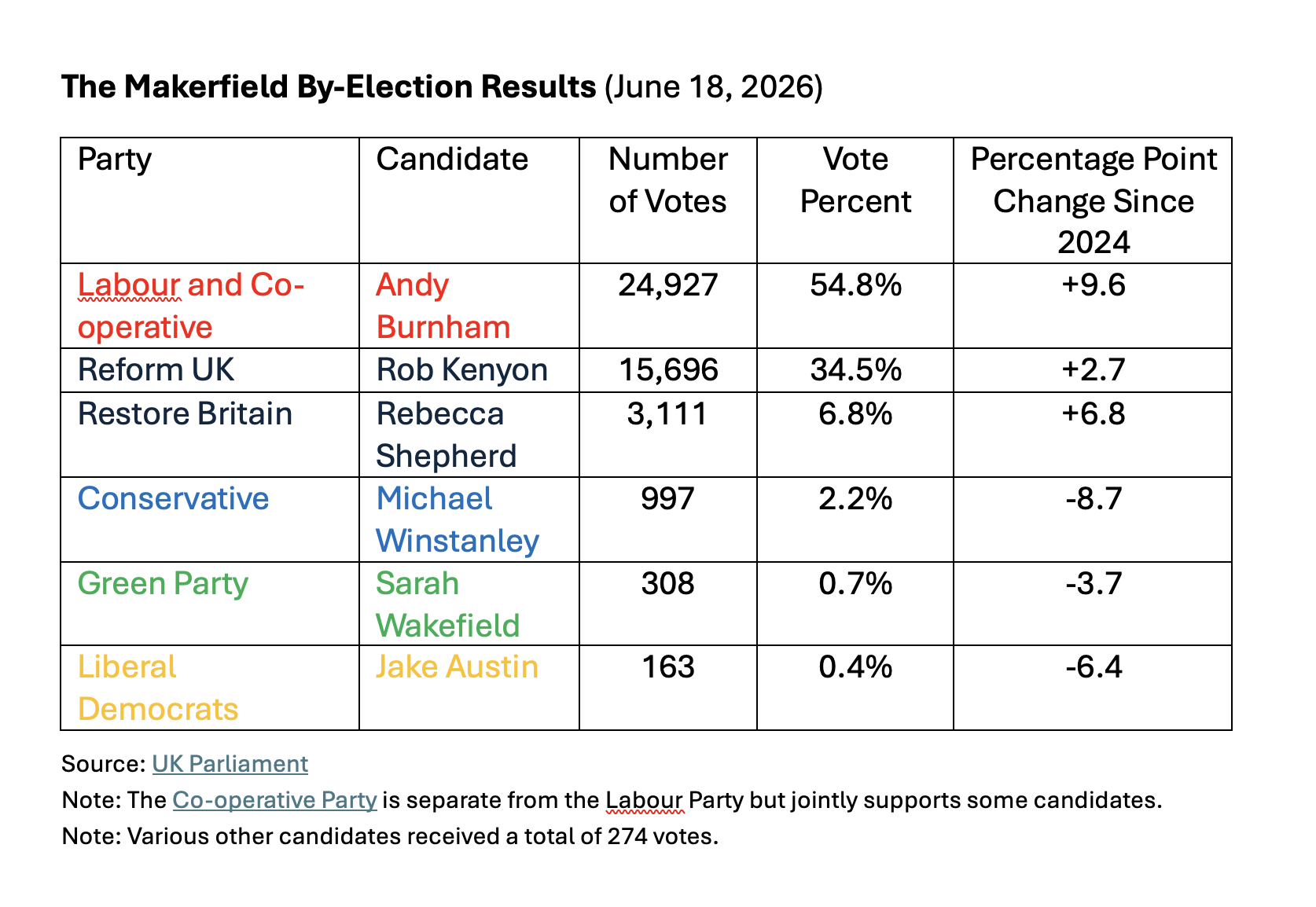
Although multiple parties contested the election, the race was between Labour and Reform, although the new Restore Britain party was a potential spoiler.
The Makerfield By-Election Results (June 18, 2026)
The Labour (or Burnham?) victory
Andy Burnham was previously a Labour MP from 2001 to 2017, representing Leigh, a constituency in the Greater Manchester Area. He unsuccessfully attempted to become party leader in 2010 and 2015. He subsequently became mayor of Greater Manchester, an unusual and even bold career move in a non-federal UK political system that only recently devolved some power to local regions and nations.
His by-election campaign was based on his popularity in this key city in the north, a region where Labour has hemorrhaged voters in recent years. The constituency is 97 percent white, largely upper working class, and voted for Brexit by almost a 2-to-1 ratio, so a Labour victory would suggest that the party has a path to victory in constituencies that had been moving away from Labour. Burnham also developed an image as a political outsider and a reputation for revitalizing the city through “Manchesterism.”
Observers have raised questions about these narratives. One view is that “his charismatic persona has managed to overshadow any contradictions in his public image, like his insistence he is an outsider to Westminster, despite becoming a parliamentary researcher at 24, a special adviser at 28, and a member of Parliament for the first time at just 31.”
He has also been described as “a master of reinvention" who “pulled off an impressive number of costume changes through his 25-year career: He has evolved from a Blairite rising star to a conscientious Brownite to the harbinger of New Labour 2.0 ‘aspirational socialism’ in the 2010 leadership contest, to the rebel outsider King of the North.” An alternative perspective is that his journey over the past decade represents a “story of rising certainty and self-confidence.”
Others question the meaning of Manchesterism, ask whether the city’s revival even began under Burnham, and ponder if any of its claimed lessons can scale up to the national level.
It has been described sympathetically as a “mix of collectivism and entrepreneurialism” and “the return of sovereign economic control of the economy’s foundations”—or in Burnham’s words, “business-friendly socialism.” But some argue it is “built on borrowed money” and is “dead in the water” if Burnham actually follows Chancellor (for now) Rachel Reeves’ fiscal rules.
Burnham’s most specific Manchester achievement is said to be the Bee Network of buses, although one commentator argued that while he deserved credit for it, “The rest of Burnham’s Manchester story is fluff.”
Regardless, Burnham not only won but outperformed the pre-election surveys. Rather than a close election, as some pundits predicted, he won by twenty percentage points and improved upon Labour’s 2024 vote by almost ten percentage points. Whether Labour would have won with another candidate on the ballot is difficult to know, although some polling suggests a strong “Burnham effect.” This is the Manchesterism that Labour wants, but whether it can survive the hard realities of Britain’s domestic and foreign policy challenges is doubtful.
Another Reform loss
The Reform Party’s candidate, Robert Kenyon, was a local plumber and army reservist. It may be no coincidence that a plumber representing the Green Party won the Gorton and Denton by-election earlier in the year, despite much pre-election hype about the Reform Party’s chances.
Kenyon’s campaign unsurprisingly emphasized immigration, and in a candidate debate also said he wanted to “scrap VAT on energy bills, scrap Net Zero, and start drilling in the North Sea.” However, he was dogged by his past controversial social media posts.
The outcome was “a thumpingly bad result for Reform, after winning every council ward in the constituency in the local elections just 42 days ago.” The party underperformed the pre-election surveys and ultimately gained less than three percentage points in comparison to its performance in 2024. Taken together, these results are consistent with my argument that protest voting in unimportant elections is very different from winning consequential parliamentary contests.
Farage blamed this defeat on Starmer. His logic was that potential Reform supporters might have voted for Burnham in order to dislodge Starmer. However, the fact is that Reform has not only lost the past two parliamentary by-elections in the north of England, which were both potentially winnable, but also underperformed pre-election polls in both. The party also nominated candidates who attracted a great deal of criticism, which raises questions about its candidate pool and its vetting and decision-making processes.
Restore Britain
Reform also faced a challenge from Restore Britain, a new party, in the populist-right space. Just as the Conservatives are forced to worry about their right flank because of Reform, the latter must now worry about Restore. It claims that Reform is “not right-wing enough on key issues and point(s) to the Reform leader welcoming swathes of former Tories as evidence that he is not serious about taking on the status quo.”
Led by MP and former Reform member Rupert Lowe, and with support from Elon Musk, the party advocates mass deportation, a referendum to restore the death penalty, banning the burqa, defunding the BBC, banning halal and kosher food production, and anti-wokery.
Whether this “pushes the Overton window even farther rightward” and serves as an example of politicians “racing to the hard right”—or makes Reform seem more reasonable to voters—is to be determined.
In Makerfield, voters to the right of center therefore had three choices: Conservative, Reform, or Restore. In the past, it was the left that found itself divided while facing a single Conservative Party; now the right is offering many choices that divide its vote.
Some asked whether Restore would prove “a threat to Farage” and was “set to outflank Reform on the Right,” but in the end, the party received 6.8 percent of the vote. It also did not play the spoiler. If the Reform and Restore vote were combined behind one candidate, this person would still have lost by more than 10 percentage points.
Next: Where were the Conservatives, the Greens, and the Lib Dems?

