




- Political Philosophy
- International Affairs
- Politics, Institutions, and Public Opinion
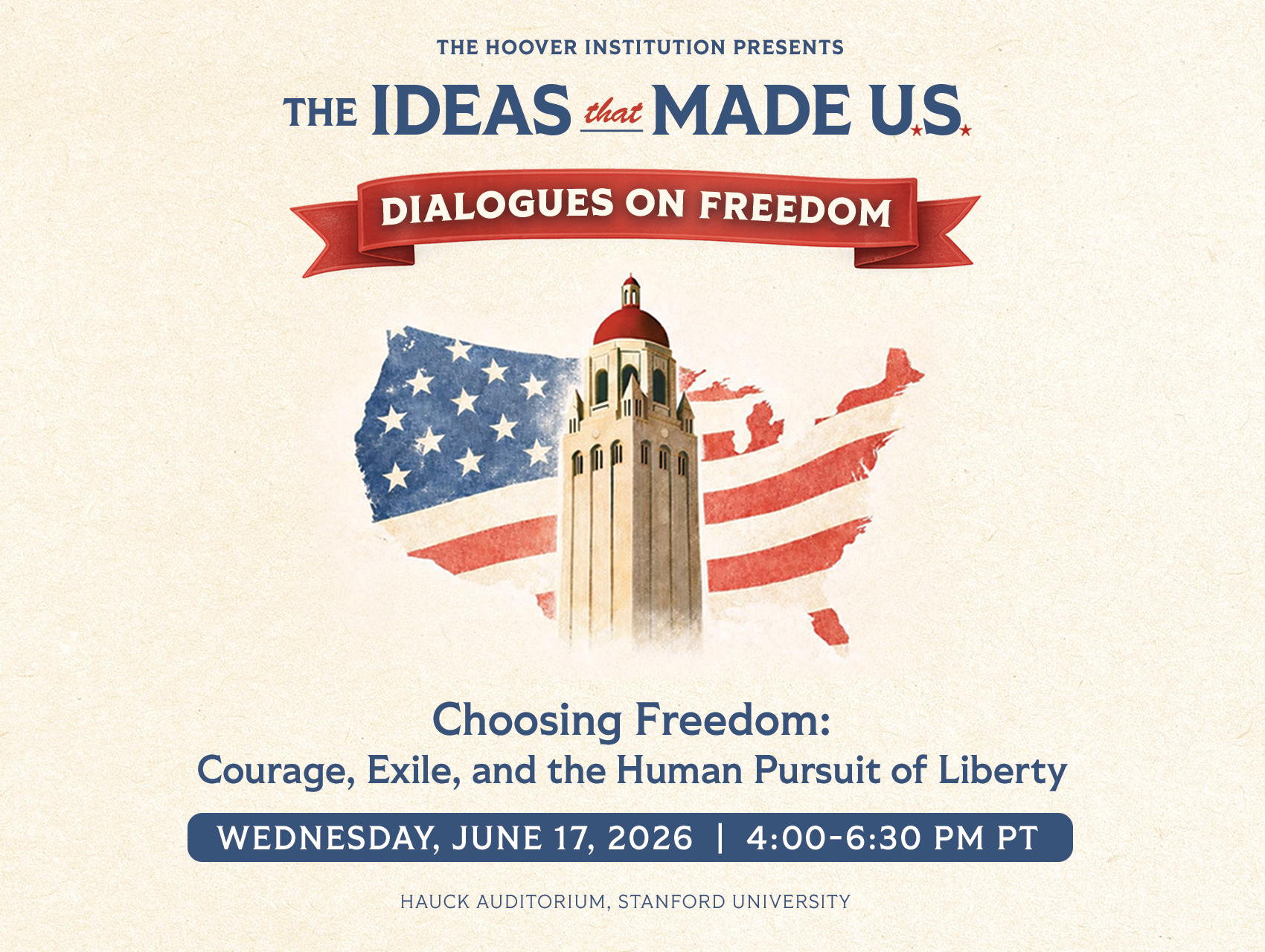
Choosing Freedom draws from powerful testimonies, personal belongings, and striking archival materials to tell the stories of individuals who fled authoritarian regimes in search of liberty. Through intimate artifacts and firsthand accounts, the exhibition illuminates the enduring human desire for freedom and the extraordinary courage required to pursue it.
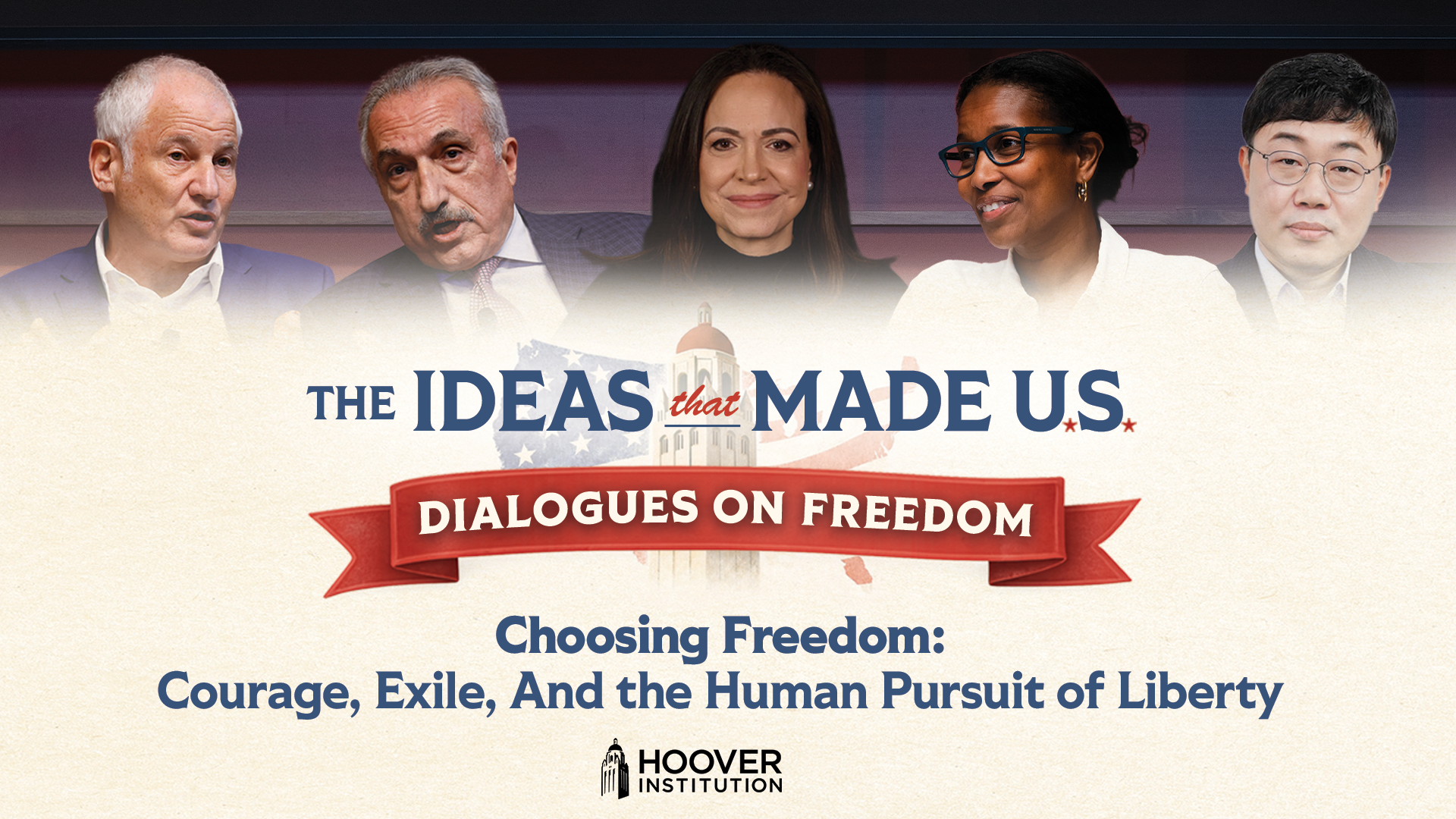
To mark the opening, Hoover hosted a special evening chaired by renowned historian and Hoover Senior Fellow Stephen Kotkin. The program featured María Corina Machado, leader of Venezuela’s democratic movement and 2025 Nobel Peace Prize Laureate, who delivered featured remarks and joined Kotkin for a conversation on democratic resistance, political courage, and the enduring pursuit of liberty in the face of authoritarian rule.
The evening also featured human rights activist and Hoover Research Fellow Ayaan Hirsi Ali, Hoover Fellow Abbas Milani, and journalist Joo Sung Ha. Drawing on experiences shaped by Venezuela, Iran, North Korea, and other societies where freedom has been denied, participants explored the meaning of liberty, the costs of tyranny, and the extraordinary courage required to choose freedom.
This special evening examined one of the defining questions of the American experiment: Why does freedom remain worth choosing and defending?
- Freedom is not an accident of history. It is the result of ideas tested over time, shaped by debate and sustained by institutions and citizens willing to defend them. The United States was founded on an audacious premise that a free people could govern themselves, that liberty could endure, not through force, but through law, not through unanimity, but through argument. I have a dream that one day this nation will rise up, live out the true meaning of its creed, And not through tradition alone, but continued renewal across generations. Americans have wrestled with enduring questions. What does citizenship require? What responsibilities accompany freedom? How should power be restrained? And how should a free society respond to moments of danger, disruption, and change? Today, those questions are once again, urgent. Democratic societies face pressure at home and abroad. New technologies are reshaping economies and institutions. Authoritarian systems challenge the principles of open societies, and Americans are called to reconsider how freedom can be preserved in a rapidly changing world. The ideas that made us dialogues on freedom is dedicated to examining these challenges through serious inquiry and open debate. Across the year, the Hoover Institution will bring leading voices to explore the foundations of American freedom from citizenship and education to innovation, governance, national security, and global competition. Each dialogue connects enduring principles to contemporary choices, asking not only where we have been, but where we're going. These conversations are not about prescribed dogma or doctrine. They're grounded in open, serious, and constructive dialogue. They, they're about a deeper understanding and about responsibility and about the ideas that have made the United States and will shape its future. In late 19th century Japan, the major government suppressed the freedoms that new mediums of communication could provide. But in any publication that criticized those in power, activists from the Freedom and people's rights movement looked across the Pacific and found in America what Japan denied them. A constitutional protection of free speech from the San Francisco Bay Area. They launched newspapers like Ong Koku, and Liberty smuggling copies back to Japan in a cycle of resistance. The censored publications included in this exhibition were not just acts of defiance, they were voices that refused to be silenced. This prove that when speaking becomes dangerous, it becomes essential. After the failed Bay of Pigs invasion over a thousand prisoners, languished in Cuban prisons facing malnutrition, disease and torture. Until a lawyer, James Britt Donovan masterminded their freedom and secured a safe passage from many to the United States. After 15 visits to Cuba and countless hours of diplomacy, Donovan built an unlikely trust with Fidel Castro. Donovan even brought his own teenage son to fish at the Bay of Pigs. During one of his trips, a chance hospital visit revealed his bargaining chip Cuba's desperate need for medicine. The documents in the Lou Henry Hoover Gallery demonstrate how patience cleverness and $53 million in food and medicine brought 1,113 prisoners home on Christmas Eve, 1962, and eventually freed nearly 10,000 more. Lenin wished to transform imperialist war into civil war. And the violence communism unleashed on Russia and Eastern Europe fulfilled that dark vision beyond measure. From the very first days of Bolshevik power to the last hours of communist regimes, stories of Escape United, all classes in our common desperation for freedom, members of a ruling family who lost an empire and a Cold War era tank that became a symbol of defiant escape stand as monuments to that indomitable will. The objects now on display at Hoover, including personal letters, crude escape plans, cherished possessions prove that walls, no matter how well fortified, cannot imprison the human spirit that refuses to be broken. When Mao's cultural revolution branded 16 million educated young people as two free thinking, they were forcefully sent to the countryside for reeducation as farmers and laborers to escape these labor camps. Thousands of Chinese intellectuals fled to Hong Kong and Macau in the dead of night risking capture gunfire and drawn into cross borders and bays. Historian Tan jalo preserve their voices in oral histories and artifacts now housed at Hoover, consisting of banned manuscripts, smuggled journals, and memories of difficult journeys. These archival materials prove that ideas scattered like seeds, and in this case were carried by refugees to free soil in Taiwan and America waiting to take root. We hold these truths to be self-evident that all men are created equal, and that they are endowed by their creator with certain unalienable rights, that among these are life, liberty, and the pursuit of happiness. Thank you for joining us today as we engage the ideas that made us and take part in a dialogue on freedom. Welcome to the Hoover Institution. I'm Eric Wakeen. I'm the Deputy Director of the Institution and the Everett and Jane Houck, director of our amazing library and archives. We are delighted to have a full audience for today's talk entitled, choosing Freedom, courage, exile, and the Human Pursuit of Liberty, which is part of the ideas that made us dialogues and freedom our year long series. As you heard on America's 250th anniversary, as you saw in our introductory video, this series explores the ideas that have shaped the American experiment, those that guide its renewal in the years ahead. Tonight, our conversation takes inspiration from the new exhibit, choosing Freedom Lives, the Defied Tyranny. The exhibit, which you heard about from our curators, draws on the testimonials and belongings and memories and material in the Hoover Library and archives to tell the story of individuals who both fought against authoritarian regimes and left them for freedom. In the audience, we have a number of people who've made that journey, some of whom actually are represented in the exhibit, and I do wanna recognize some of our friends from China who risked their lives to swim to Hong Kong for freedom. So let's recognize them. Thank you, Gwen. Hong Kong and Macau were freer places. I know there are others in the audience, and you're gonna hear from some on the stage. I ask you to consider the Hoover Institution writ large, and the Library and archives as places and embodiments of an idea that venerates and supports the value of freedom the archives by providing a home for endangered collections from around the world. So the voices you'll see in the exhibit if you visit it, and on this stage will never be lost to history. And of course, the Hoover Institution, whose mission is to improve the human condition by advancing ideas that promote economic opportunity, prosperity, and secure and safeguard peace and freedom, which are fundamental to the American way of life. So with that, let me introduce our first two speakers. I'd like to bring up my colleague Steve Kotkin, who's the Klein Heights family senior fellow at the Hoover Institution. His publications include the Magisterial first two volumes of his biography of Stalin, Stalin, waiting for Hitler and Stalin, paradox of power and the superb magnetic Mountain Stalinism as civilization. Steve also directs the Hoover History Lab, which functions as a hub for research, teaching, and convening, and uses history to inform public policy. His broader research focuses on authoritarianism, geopolitics, global political, political economy, and empire. Steve, please, joining him today is Maria Corina Machado, leader of Venezuela's Democratic movement and a 2025 Nobel Peace Prize laureate Maria Corina Machado won the 2023 opposition primaries in Venezuela with 92% of the vote barred by Nicholas Maduro's regime from running in 2024. She led the campaign of Edmundo Gonzalez Oria, who won nearly 70% of the vote following the election. Persecution by the regime forced her into hiding until she was able to leave Venezuela to receive the Nobel Priest Prize in December, 2025. Today, she continues to lead Venezuela's Democratic cause and advocate for the nation's transition to freedom and democracy. We are so honored, so very honored to have her joining us today for this conversation remotely. Please welcome Maria Carina Machado. Well, dear Eric Waken and Stephen Kaing, dear friends, it is profoundly me meaningful to speak again at San Force New institution, a place built and the conviction that freedom, private enterprise, and limited government are the foundational pillars of human dignity and prosperity. The title of this event, choosing Freedom, is No mere obstruction for Venezuela's Democratic movement. It is a daily act of courage by millions of people who refuse to surrender their humanity. To Tyra, it's certainly a distinct honor to join you all as you celebrate the 250th anniversary of the Declaration of Independence and inaugurate an exhibition dedicated precisely for those who choose freedom in the face of oppression, and especially those present in this event today. The word freedom is so deeply woven into our political lexicon that we sometimes forget what it truly means in the lives of ordinary people. Over the years, I have met mothers who waited months, months for a single thread of news about a son in prison for defending the truth. I have spoken with families fractured by exile, uncertain when they would ever embrace one another. Again, I have listened to citizens who knew they risked torture just for speaking openly that did so anyway, because remaining silent would have meant surrendering a piece of their very soul. For them, freedom has never been an abstract concept. It is the tangible possibility of living without fear. It is the absolute certainty that every person possesses an ing dignity, that no government can grant and no government can strip away. It is a right to participate in the destiny of one's nation and to trust that the law protects the citizen rather than the powerful. 250 years ago, the authors of the Declaration of Independence transformed those deep convictions into a historic political project. They affirmed that legitimate authority derives solely from the consent of the governed, and that every human being is born with rights that precede the state itself. Those principles shaped United States, but the influence travel far beyond its borders. Across Latin America, they found fertile ground among societies, sharing many of the same cultural and intellectual roots. We inherited tradition shape by Greek philosophy, Roman law, and the ju Christian Christian understanding of the sacred dignity of every human person. Our histories follow different path, and each nation forge its own institutions and identity. But beneath those differences lies a foundational conviction that freedom is inseparable from human dignity, that power must be subject to the law, and that legitimate government derives only from the of the government. These shared inheritance helps explain why democratic aspirations have endured throughout the Americas, even through darkest periods of authoritarianism and profound adversity. From the Declaration of Independence 250 years ago to the post World War II international Order, the United States has understood that the cause of freedom is indivisible. That what happens to liberty in one nation reverberates across the entire world. That's why Venezuelan struggled. Today is a vital part of the same great arc of history. United States has stood at critical junctures before supporting democratic transitions in eastern Europe, Latin America, and beyond. Out of the recognitions that free societies make the world more stable, more prosperous, and more just democratic peace theory stands, firm, democratic nations build a more peaceful world asking America to stand with. Venezuelan's. Democracy today is simply asking her to remain consistent with everything. This nation has always believed about the universality of human freedom. The fundamental principles in trying in the US constitutions the right to choose one's leaders, freedom of expression, the rule of law, and the dignity of individual continue to inspire people around the globe. Today, they form the beating heart of the Venezuelan struggle for democracy. My country Venezuela has shared in that aspiration. Since its founding throughout our history, generations of WANs have made extraordinary sacrifices to defend it. Today we found, we find ourselves again writing another chapter in that very long struggle. For the past decades, Venezuela has suffered, as you know, the assault of a criminal authoritarian system sustained by corruption, ruthless, ruthless repression, and the support of external actors viewed to build our nation as a geopolitical geopolitical platform for their own ambitions. The consequences have been the vast day, millions. Actually, a third of WANs were forced to flee their homes. Families were torn apart, and institutions were hauled out. Fear became the regime's primary tool of governance. And yet something remarkable happened At the very moment when many believed the venison people had been decisively defeated citizens across the country began re began rebuilding hope from the ground up, the organizing neighborhoods, churches, universities, homes, and tight knit communities. They did so quietly, patiently, and often at enormous personal risk. What emerged was a profound civic awakening. Millions ofs refuse to surrender the belief that truth matters, and that in a democracy, the ultimate peaceful expression of that truth is the vote They held fast to the conviction. Conviction that freedom will always be worth defending no matter the cost. Many told us it was impossible, and yet we did it against overwhelming odds. They demonstrated that a society united around democratic values is stronger than any apparatus of intimidation. Now, the work had be left free and democratic Venezuela remains immense. We must rebuild new institutions, restore justice, strengthen the rule of law, and recreate the conditions for economic prosperity. After years of deliberate destruction, I face this monumental challenge with profound confidence, rooted deeply in the proven character of the Venezuelan people. I have seen citizens step into care for one another when formal institutions utterly failed them. I have watched communities organize to shoulder burdens that no functioning democracy should ever ask ordinary people to be appear alone from child nutrition and education to shelter and basic security. Through these trials, I have come to understand the extraordinary reserves of strength, creativity, generosity, and civic responsibility that truly define Venezuelan society. Throughout history, authoritarian systems have relied on fear, coer, coercion, and deception to preserve themselves, they can inflict enormous damage on a society and leap deep wounds that endure for generations. Debt, time and again. People recover their voice, rebuild, trust, and reclaim their right to shape their own future. They do so because the aspiration to live in dignity and freedom runs deeper than any system built on fear. Venezuela possesses everything. A successful democratic transition requires a deeply ingrained democratic culture, a cohesive society, free of religious, racial, or social divisions, a broad, organized and determining movement. Built on a nationwide network of civil society organizations and community leaders, a legitimized leadership and unified political coalition. We also count on the vital support of the peoples and democratic governments of a region who fully understand the profound impact of free Venezuela will have under own nations. In this effort, the role of United States remain decisive. No other global actor possesses the unique combination of moral authority, economic leverage, and geopolitical weight necessary to help catalyze a genuine democratic breakthrough. In Venezuela, the support of the US government, the US Congress and Civil society institutions like the Hoover Institutions, is absolutely strategic at this defining hour, a Venezuela will be a long term reliable partner for the United States in the heart of the Americas, on matters ranging from energy, security, security to economic operation and regional stability. It will also mean the return and reinvestment of a vibrant diaspora with tip ties to American institutions, universities, and businesses. Ultimately, it will dismantle the most destabilizing authoritarian node in the western hemisphere of this last century. The aspiration that inspired those who signed the Declaration of Independence 250 years ago is the exact same aspiration that unites and mobilize the Venezuelan people today. Libertad freedom. As we commemorate this historic anniversary, we honor an enduring truth that a free people acting with courage and unwavering severance possesses the ultimate power to shape their own destiny and alter the curse of history. Listen to me clearly Venezuela will be free. Thank you very much, Nina. Maria Karina. This is Steven Kotkin from the Hoover Institution. I'm a scholar of totalitarianism. Thank you so much for that eloquent speech and your inspiring example. The auditorium is full. It's full of people who've come to hear about Libertad, but also many who themselves dedicated their lives to similar struggles elsewhere. It's a part of a dialogues on freedom for the whole year leading up to our anniversary. It's also part of an exhibition because the Hoover Library and Archives has a profound collection of the life stories of many people like yourself. I wanna ask you a little bit about how this happened, how it was that you embarked on this path. Where did you find the courage? What galvanized you to take on this fight with your colleagues with society in Venezuela, many of us will struggle for freedom under conditions that are are already mostly free. It's a rare person who takes up the struggle under the conditions that you took it up. Tell us a little bit about how you got started and what inspired you and where this courage came from. Well, thank you very much. I I have to say that, that what has happened in Venezuela is, is a, is a movement that, that is profoundly rooted in, in, in, in the values that we share, that we were taught in our families. I, I have to say that I never, it never thought I would get involved into politics. Perhaps that was the last activity I, I would imagine for myself. Actually. My generation grew with profound projection to politics and politicians rage, mistake. And we learned it the hard way. So when cha came into power, we, we did not realize at the beginning the the magnitude of devastation that that was coming. But, but soon we understood that the, this idea of dividing society among, you know, in every single aspect or condition, you know, it either by religion, by race, by, by, by region, by, by political ideas, was so dangerous and was creating such violent tensions that, that I realized with friends in civil society that what we need to move ahead into, into, and activate into exercising citizenship. And the first steps were from civil society organizing a movement called Sum or Join Us, which was channeling this tension peacefully through the vote. When, when Cha realized, and this the regime that they were contested by the, the civil society, by the citizens, they grew even more and more authoritarian. And then I had to make a very hard decision, a life decision, and was taking the step and, and, and getting involved into politics. Frankly, I never expected that the, the degree of persecution and risk would be so large, especially for my family. And I have to say that the hardest decision I had to take at that time was sending my kids away the day that I realized I could not be a good mother and protect them and at the, and at the same time, serve as a citizen. I, I believe I should and stay, stay fighting. But I did it for them and I did it for love, love of freedom, love of my land, and certainly love of my children. I like having, You know, we see that the regime can frighten people. We see that they can intimidate people. We see that they can hurt people. We see that they have quite a lot of repressive power, but we also see that the regime is afraid. It's afraid of its own people. It fears its own people, at least as much, maybe more than the people fear the regime, this power of the people and the fear that the people strike without guns, just by their thoughts, their organization, their willingness, their courage, their willingness to stand up. How could it be that the opposition could win the election and prove, and prove to the whole world that it won? How could it be that such a a, a society that's oppressed, that doesn't have the official institutions like the regime? How could you have won and proven that you have one? Well, well, look, we had tried everything. Hmm. If you look back to these 27 years, Venezuelan society never surrendered. Hmm. We had more than 30 shams. We went, we went hundreds of times to the streets, and we were shot at persecuted in prison, tortured, we had 17 experiences of so-called negotiations and dialogue. We were, you know, masquerades because the regime wanted to stay in power and gain time and legitimacy. We had tried everything. And then January, 2023, Venezuela new conflict looked all hopeless. People would, you know, internationally, France would say, you know, you, you have to give up. There's nothing you can do. But IIII, I known my country, you know, I had been forbidden from leaving Venezuela for over 12 years, and I had to even take a local flight. The airlines commercial line airlines were, were warned they would lose their licenses if they get me in a plane, if I buy a ticket. So I had to travel around Venezuela driving my own car. So I knew what we vene salons were filling. So at that time, I say, no, we, the people want to have a voice. People need to have the, the, the power. So seeing that we have an election, a presidential election, the next year, the way we could reach out and organize was coming up with a primary process in which the power would be given to the people. And that people would say, realize they have a word. And they had the decision in their own hands. And that wasn't just a process of coordinating coordination of political forces in the opposition. It was a process that we used to reach out and to bring a country back together to tear down those barriers that regime had brought to divide us. And at the end, the most powerful idea and I, and, and, and, and long that brought a country together resume in a simple phrase, I want to have my kids back home. I want my family reunited. Because we all knew what it meant. It meant we have, we needed a country in which our children live with dignity, with opportunities, with freedom. That brought a country back together. And when we had that primaries in, in October, 2023, the regime underestimated it. They did not realize what was building from within the nation. It turned into a cultural and social movement, not a political one. If you see this from an electoral perspective, you are missing the point. You are standing the surface. It turned into an existential fight. And that's why when they expected a few hundred thousand people to go and vote in the primary, which meant you were identifying yourself with the opposition at high risk, they never expected the dose turned into millions. Over 3 million people showed up that day with defeated the regime spiritually. And then the next step was creating the most affordable, formidable citizen platform to do what? To do what you just mentioned. We needed to have not people all around in every voting station, more than 30,000 voting stations, train coordinated, prepared with a specific task without the regime identifying what was coming over 1 million volunteers. And we used technology, technology for freedom. I think that's a great contribution. The Venezuelan people and our movement has offered, not only Venezuelan, but the other countries as well. Yes, it's been very inspiring to see the Venezuelan example, the self-organized society, the regime's, arrogance and ignorance about its own society, the ability to show who voted and what the vote actually was as opposed to the lying, the lies of the regime help us understand the next steps and what role we can play. You mentioned this in your opening remarks. We understand that there needs to be an election and that if there is an election, the society will get its choice, it will be able to choose freedom. There will be the consent of the governed. How do we get to the election phase that you guys won already in 2024? How do we get back to that process? Well, many people wonder why after winning an election, we decided to, to, to promote the participation in a new electoral process. And the fact is that January 3rd was a huge step. And as I said, we are very grateful to this country, which is the only country that has missed the lives of its military men and women for freedom of Venezuela. And that was a huge step that was based on the moral and legal ground that our victory on July 24th offered. So in order to to, to demonstrate we truly want to support this three phase process that Secretaries Rubio has described, we said, okay, we're willing to participate. And to once again, rele legitimize the, the decision and the popular sovereignty of our people. We are, because we trust our people. No one should fear the people. I know many people are concerned about stability in Venezuela. And you get stability when you have legitimacy. Yes, when you have the power of the people support in a process, we perfectly understand that Venezuelans in rooms our institutions, this economy destroyed. We understand that it will take a lot of effort to build it back. But even though Venezuelans are now suffering from dire conditions that it worse every day. Venezuelan people are content because we know there will be a peaceful mechanism through which we will have changed democracy, freedom, and our children back home. So this is a moment in which we need to channel all this energy. There is anguish, there is, there is urgency because of the horrible situation our people are. Remember, this is a nation in which more than 85% of the population living poverty in which children go only twice a week to schools because teachers earn $1 a day in which children go to sleep without food education and their mothers, because they had to flee in order to send them back home to eat back home, money for them to eat. So even though there's this energy, what has started happening after January 3rd is that it, it was a huge dam in which a crack happened and it started flowing. And you're starting to see people speaking out, demonstrate the media for the first time, starting to say the truth and believe, Ms. Steve, this is unstoppable, unstoppable, Maria Karina, we're so inspired by you. Very few people have achieved what you've achieved. The courage, the persecution. You're under the threat to your life and to the lives of your loved ones, your escape from the country under perilous circumstances in order to get to Norway, your eventual return. We understand to the country to re help reclaim the country. As you say, we couldn't have had a better opening to our evening today. And I have to say that this is very memorable to have you here on screen. And one day we hope to have you back in person from a free Venezuela. Maria Corina Machado, thank you. Thank you Very much. Thank you. My pleasure, honor. Thank you Steven. Thank you so much. Now we have a special panel discussion with perspectives from parts of the world where freedom has been denied to many. I'd like to invite Hoover fellow Abbas, Malani and journalists, Mr. Jung, to the stage. Abba Milani is the Hamid and Christina Moga Dam, director of Iranian studies at Stanford University, a fellow at the Hoover Institution and the co-director of the Iran Democracy Project. The current regime is branded him as one of the most dangerous people against Iran in America. He has written broadly and deeply across so many fields. His books and articles have addressed a biography of the Shah, the Iranian Revolution, Dylan Thomas modernity, poetry and history. And it's wonderful to have him here. Joining us, Mr. Jha is an award-winning journalist at the Donga Elbow, a leading newspaper in EO South Korea, where he writes about North Korea and the cost of authoritarianism. Born in North Korea in 1975, Jew studied at North Korea's foremost elite institution. Kim Sung University, witnessing the contradictions of socialism. Jew founded a dissident organization and after reading a forbidden text, Adam Smith's Wealth of Nations, which is also celebrating his 250th anniversary this year. I'll have you know, Jew escaped from North Korea in 2001. Also with us is R Roy, the Klein Heinz fellow at the Hoover Institution, and a specialist in the history of modern Korea in East Asia, who will be joining our panelists today to provide English translations for Mr. Jha. Please welcome this esteemed group to stage. Thank you. Hard to follow the Nobel Laureate, but if anybody can do it, it's these two Gentlemen, I'd like to start off Mr. Sangha, to ask you about your experience in deciding to flee North Korea. The dangers that you anticipated, the fear that you might have had, the the worries for family members as well as yourself. How could someone make a decision like that to risk everything one's own life and the life of one's family and friends to flee the North Korean regime? Let's talk a little bit about what's happened since you left North Korea decided that you were gonna risk your life in a perilous journey to get out and you made it to South Korea. So now you are a principal source of information and analysis about North Korea for South Korean society. You work as a journalist, you have a very substantial following. I should point out that his work explaining North Korea to South Korea has in the past decade had 69 million hits, 69 million unique views. So that's the role he now plays in that society. There are very few people who have deeper knowledge, but also deeper reach to communicate that knowledge about North Korea. So not fantasies about North Korea, not hopes about North Korea, but the truth about North Korea. Tell us how you got into journalism, how you decided to play this role of analyzing, informing people about North Korean society and the work that you're doing. We'll come back to you. Thank you for those eloquent answers. We'll now turn to our colleague Abbas Melania. We all know Abbas as one of the great living experts on Iranian history, Iranian politics, the current Iranian regime. Abbas appears frequently here on Stanford campus and in various other venues. But today we wanna start with your personal story. We want to talk about how it was that you ended up outside of Iran and in the struggle in the diaspora, in the exile against the Iranian regime. What went through your mind? When did you decide or when were you forced to, to go into opposition to the regime? Tell us your story. We all know the revolution took place. 1979, the Shah fell. I have to tell you, if you want to read a transcendent biography, there is one, it's called the Shah, and it's written by Professor Milani. Tell us your story. Well, thank you very much. My first hope is that some of his writings were translated into Farsi and Iran's supreme leader could have read them because for him, North Korea is the ideal model of government that's really on record. How many had had visited North Korea. And on the plane back, he said that's the way to run a government. And if he had read his papers, maybe he would've been led straight. In terms of exile, I think those of you who haven't experienced it, let me tell you, it is not a decision you make by your mind. You have to make it by your heart. As a, a famous Polish writer whose work I translated into Farsi Cap, a captive mind, Milo de Nobel Prize, he immigrated, he fled the Stalinist Poland and he said, A decision to migrate is made when your body tells you you can't live in this country anymore. That's literally what happened to me. I was teaching at Teran University. They won't let me teach, but they won't fire me either. They would pay me the make a salary and said, you can only teach graduate PhD students. And there were only one PhD student. So I was essentially outta work. And within a year, within a year, I was diagnosed with falsely with lymphoma cancer of the lymph node and heart disease that requires open heart surgery. Luckily I had family at UCLA. I came and went to a cardiologist. It says, there's nothing wrong with you. You have Homini syndrome. And I said, what is Homini syndrome? He says, your body is telling you don't live there. My body was wise, I wasn't wise. I went back once more and next time I decided I have to leave. That was when the war was at the height of the Iraq, The Iraq Iran War of 1980s. Right. And, and I had a, I still have, but at that time I had a 6-year-old son and nightly attacks were beginning to disrupt his sleep and disrupt change his paintings. I decided, this is no country for me. And I left and I came back to the only country I knew and the country I knew I could live and survive. The only country that I could come at the age that I came and end up at Stanford and at Hoover. I, I don't think this is possible in any other country in the world. You left out the part that they put you in prison. I did It. It was, it's funny, but not really funny if anyone's ever been in a political prison, not having committed a crime just because of what you think or what you've said. It's a harrowing experience. You were in an infamous in prison. How did you end up in prison and how did you get out of prison? I ended up in prison, ironically, strangely, as a maoist of all things. Not just a Marxist, not just a Stalinist, but a Maoist. And I spent a year in prison. So the the regime put you in prison because you were a political threat from the Marxist left. From the Maoist left. Well, the, the regime that first put me in prison was the Shahs regime. That's what I mean. Yes. And they thought we were the great danger. Now, to give you a sense of how wrong some regimes can be, our whole group was about 30 pseudo intellectuals. The mullahs, the Shah thought were their allies. They were free to roam the country Yes. And set up institutions and collect funds and virtually prepare the ground for the revolution. So yes, they did put me in prison. But six months of that prison, the I spent with what became the future leaders of the Islamic Republic of Iran. In other words, almost every Mullah who became somebody in post 1979, I spent six months in prison with them. I played volleyball with them. At one time, I hit a spike over the head of R Tanja because he was short, great prides of my life. I, I taught English to Mr. Monte a little bit who became a potential successor to Khomeini. And I realized how dogmatic, how undemocratic, how profoundly misguided these people are. Yes. At that time, nobody thought they would become the rulers, but I had a taste of what this region was. That's why it was easy for me to leave in 7 87. Yes. I think they misjudged you because I think your power and eloquence today, if they had only known what a voice you have against their tyranny now, how did it evolve that you were able to make the transition? You mentioned that you came to the United States, you had relatives in Los Angeles, which is of course the capital of the diaspora in so many ways, so much talent from Iran here in California. And how did it happen that you, Iranian studies became your calling and your ability to translate that culture and that society and politics for us here in America, I began actually teaching at a small liberal arts college. Not from, from here, Notre Dame Deur University College of Notre Dame. In Belmont. In Belmont, yes. Sisters of Notre Dame, who are profoundly nice people. They essentially took pity on me. Here I was 35, I had been out of the academic world. I hadn't published anything in English, but I had published stuff in Fari and they took a chance and I began teaching there and I began writing, my first book became a bestseller in Iran. Yes. This was before the Shah. I wrote a book on the prime minister called the Persians, things that became very much a bestseller and, and then I worked on the Shah. And after that, Stanford and Hoover, first Hoover decided to start a Iran democracy project. Larry Diamond, Mike McFall. And I began that. And I'm very proud to say that I, I don't think there is any program in the world that has been as attacked directly by the Iranian regime as our program. They still called it sometimes Hoover rather than Hoover. I think the first person who wrote an article against us didn't speak English well enough and they read Hoover and Hofer. So we have become the Hofer institution. But they literally talk as, as you kindly suggested, as the center of the, the activity against the regime. Yes. So we have two representatives who have fled tyranny, managed to get out alive. Many people don't get out alive. Many people want to flee and make up their mind to take the risk and they don't make it. And so we have to remember just how perilous and difficult this passage is from living under a tyranny. And then when you get out, you are not necessarily safe, especially if you have the kind of eloquence that you heard from Maria Corina or that you hear from these two panelists right here. They're under threat. If they have relatives somewhere else, they're potentially under threat. So it takes a level of courage that may be, is unusual for us here in a free society. Let me ask a little bit about current situation in North Korea. Are there any people escaping now? Is it possible to leave North Korea and make it safely into exile? Is the regime stable? Or does the regime have vulnerabilities that we should better understand? What, how can we understand the current situation in North Korea, both in terms of the people who are potentially wanting to leave and the stability of the tyranny? Thank you Abbas. Let's talk a little bit about the mistakes that we make vis-a-vis understanding Iran, your firebrand youth, your passion and your commitment to political activism and transformation as a youth, your maoism, you still retain that passion and that dedication, that power, that civic activism. However your politics have understood better. It's, it's it, I just want to point out that one doesn't need to graduate from an American university to be a Maoist in their youth. It's also possible elsewhere, including Iran. But we know you now as a eloquent advocate for freedom and for understanding this tyranny in Iran. You are all over YouTube, you're nuanced and detailed views. But summarize for us the mistake that we make in understanding or misunderstanding this Iranian regime. What do Americans, what are Americans unable to understand, to grasp? First of all, I have to sadly say that I did become a Maoist in American University. It was actually across the Bay, Berkeley. But that not, there were people other places. There were people in Sorbonne. Jean Paul start was using selling newspapers. I was trying to cut Berkeley, a little bit of slack. We went to Berkeley at different times. I was also a PhD student at at Berkeley. Yes. But I didn't have the pleasure Yeah. Of being out in the malice. So I had fewer friends. I I, I think what the west generally hasn't gotten right about Iran, Yes, Particularly in the last few decades, is that Iran is truly one of the most remarkable cultural civilizations in the world. It's I think one of the five, six most consequential civilizations in the world. The Abraham Abrahamic religions would not be imagined, could not be imagined without the influence of Persian ideas, religious ideas, Raan, mim, aism. Iran is not the Islamic Republic of Iran. That is, I think, what needs to be understood. The Islamic Republic of Iran is not a forced foreign intervention as some people would like to imagine within Iran. But it is the shadow, as Yung would say, is the dark side of Iran. Iranian Jews have lived peacefully in Iran for 2,500 years, more peacefully than in Europe for 2,500 years. But there was also a dark force in Iran that wanted to destroy Jews 2,500 years ago. That complexity is I think, what is missed in appreciating the role of Iran today. I think the West, the United States misunderstands how powerful the urge for democracy is in Iran. How people have valiantly fought within a study in Iranian studies program from 2009 to 2024, every third day in the city of Tehran, there has been a demonstration, and this is a brutal bastard of the regime that kills the last time people took out to the streets in hundreds of thousands. This regime in its own account killed 3,188. The number is several times that in spite of that brutality, people come out. People want a different Iran. The west can't deliver that for Iran, but the West can help Iranians achieve it. Today, for example, maybe giving this regime $300 billion, not the US money, Saudi money, Kuwaiti money. Qatari money is not gonna help the Iranian democratic movement. It might not be able to stop it, but it certainly won't help it understand the urge, that remarkable heroic urge of the people to fight for democracy and for their favorable dis position to the west. There is, other than Israel, no other country in the Middle East where the US has a more favorable standing. There is no Muslim country anywhere where the Americans have been more involved in it. Read 1700, 1700 papers, colonialist papers. Iran is the most enamored country. Iran in colonialist papers is seen different than Islamic countries. It is seen for what it is. See Iran for what it is, help the people get what they want and you will have a peaceful Middle East without democracy in Iran, there will not be democracy in the Middle East. And people want it. People have been fighting for it. And they don't want the Americans to come and bomb Iran into a democracy, but they want a more equitable playing field. Iran gets help from North Korea, from China, from Russia, occasionally from India to sustain this oppressive apparatus, help the people get themselves a more democratic society. And you'll have peace much more, but you'll have also a lot less technocrats here. Iran has had the biggest, you asked about immigration. Yes. The biggest immigration in Iran's 3000 year history is the current immigration. Almost a 10th percent of the Iranian population now live in exile never before. Never before has there been so many people in exile. And these are some of the best and the brightest. Iran was the number one country till a year ago. I dunno the numbers the last two years, two years ago in a brain drain. But these people will help build a democratic Iran. That I think is what, okay, These regimes, these regimes support each other. These regimes help each other every way they can. Sometimes they do it covertly or they deny it, but they don't want to see them fall because if one falls, there's a fear of a domino effect. If the weakest one falls, maybe the next one and the next one. And maybe if you see a regime fall, you think another one can go. We saw this happen in the case of Eastern Europe in 19 89, 19 90, having the knock on effects in the Soviet republics. If Poland can get out, Lithuania can get out. And so if something changes in Venezuela or Iran or even North Korea, it potentially has knock on effects for the other places. I think that's important. Let's have Mr. Joe, last word. Tell us a little bit about what North Korea could be if it got out of the tyranny. What kind of society could it be? What could take place in North Korea if the regime were not preventing North Korea from being free? Ladies and gentlemen, JHA, Joesha and Abbas. Milani. Thank you Steve. Thank you so much. Thank you Juhan. Thank you Elba so much. We just have a few more minutes before we wrap up for reception. We're gonna show you another video. Few people embody courage, exile and the pursuit of liberty more powerfully than Ayan Hirsi Ali, born in Somalia, raised in exile. She escaped a forced marriage, found refuge in the west, and transformed her personal journey into a lifelong defense of freedom and human dignity. As an author, as a parliamentarian, as a Hoover fellow and an advocate for women's rights, she's challenged oppression wherever she's founded around the world, often to create personal risk. Her story reminds us that freedom is never only an abstraction, but is instead something which individuals are willing to fight for, fight against, and to sacrifice for if you know the death threat she's been under, you'll understand that unfortunately Ayan could not be here with us today. But I spent some time speaking with her this morning, asking her to reflect on her journey, her understanding of freedom and the experiences that shaped her life. We're pleased to share that conversation with you now. Thank you, Aion. Thank you so much for being here. I'm a huge fan of you. Your work, your scholarship, your films. Could you tell us a little bit about yourself or the audience so they understand you and your journey? I was born in Mogadishu, Somalia in 1969. I grew up all over the place. My family fled Somalia. We lived in Saudi Arabia when I was about eight years old. Lived there for a year, moved to Ethiopia, lived there for 18 months, and then Nova, we went from Somali to Saudi Arabia, to Ethiopia, to Kenya. All of these, by the way, all of these societies were despotic in in different ways. I grew up a Muslim. I discovered that Islam as it was practiced in Somali in the 1970s was very different from the way it was practiced in Saudi Arabia. That is a pure theocracy. And then went to Ethiopia. And I think for the first time I met non-Muslims and I, I was about nine years old, and then I went to live in Kenya. And it's in Kenya where I learned to speak English. We lived there for about 10 years, and then I was 22 when I was married off and I fled and went to the Netherlands and asked for asylum and never looked back since Ayan, your, your life has taken you across continents, cultures, and political systems. When you look back at this moment, was there a single moment you felt you were consciously choosing freedom? Yes, and that moment was on the 24th of July, 1992 when I decided to take a train from born in Germany to Amsterdam in the Netherlands. And I was taking a step towards freedom away from a forced marriage. And at that point I plunged into the unknown and never looked back. And I'm glad I made that choice. And for me it was freedom. From what I knew, it was the life of my mother, my grandmother. It was the life of almost all the women around me who were bonded or in bondage to the tradition and the faith of their fathers and forefathers and on and on. And my experience, my observation of that time observing those women's lives was I thought they were slaves of circumstance. And by taking that moment to go, just go, I thought, here is me 22 years old, leaving what I know and the certainty of that world and taking responsibility for my own life and for in, instead of being, as my grandmother used to say, faith is our master. I thought this is different. I know, you know, fate is a force, but for a moment I indulged in the fantasy of becoming the master or mistress of my own life. What, what an extraordinary choice you made too. And what an extraordinary journey. So I I, I know from your history and reading your books throughout your life, there have been moments when speaking openly carried extraordinary personal risks. And you, you spoke openly many times. How do you think about courage? Is it something people possess or do they discover it when the circumstances demand it? I think it's both. I think you don't know that you possess it until the circumstances demand and you find yourself speaking out or acting or doing something you thought you'd never, ever do. So for me, the moments right after nine 11, when I started speaking out against what I thought was, I mean, I, I was speaking to an audience whom I thought, oh, they don't understand the meaning of what happened on nine 11 2001. Let me explain it to them. So I didn't really think I was being courageous. I think the only, at that moment, the only inhibition I had to overcome was that of just being shy and speaking in a group and that sort of thing. But I didn't think it was a life or death matter until a few days later. And then once the threats started to come in, that's when I had to make the choice between staying silent or going into hiding versus continuing to speak out. And I chose to speak out consciously knowing that, you know, it, it, it was, it was probably going to cost me my life. And then there were other moments I was, after Theo Fungo was killed in 2004, the Dutch government offered me what they call a witness protection program where you could go into hide and completely disappear. And I thought very hard about it and chose not to do that. Your, yeah. Your film that you wrote and that, that he directed was a pivotal moment in, in, in seeing the backlash against free speech and free artistic expression in the Netherlands. And frankly, the response from around the world, both positive and negative. You, you know, that movie's about freedom and free speech in some ways and the way you wrote it, but can you talk more about free speech and why it's a really foundational value and right for people? So I tie free speech to free freedom of conscience. And I think if you don't have freedom of conscience, you don't have integrity, you have a society that lives only in fear and people will confess profess to say things they don't really mean. And so it's, it's really living a lie and deceiving one another continuously. Well then I, and I lived that way for a while. There was a time I think when I wasn't practicing Muslim, but I sort of pretended I was, because I was afraid of the consequences. And so it, it became very clear to me having lived for a decade in the Netherlands. So this 2001, 2000, I came in 92 and 10 years on, it was very clear to me what the differences were between the society I had come to, which was the Netherlands, where they had freedom of speech and conscience and all, all of this was institutionally protected versus the societies that I had left behind where we lived in terror of one another and in terror of God. And so I understood that if we all gave into the threats, my Dutch friends and colleagues were saying, it's not giving in. It was a form of appeasement. It was a form of we're not quite giving in, but you know, for the moment we're going to wait until they come to our way of thinking. And I understood that the force of Islam as it was manifesting itself in the Netherlands and in the rest of the West, was not a force that was going to weaken. It was only going to become stronger, especially if you appease it and accommodated it. And so I had to keep speaking out because not speaking out for me just meant my goodness, we're going to go, this society is going to become like that society. The title of the event is Choosing Freedom. Do you believe freedom is something that a generation has to choose? Has to, in, in every generation, ANU has to choose. It is absolutely something that you have to choose. And it, it starts with understanding freedom and what it is. And it, it's very different from license, which again, in my younger years, I, I thought freedom meant you can do whatever you want. It's actually the opposite of that. You cannot do whatever you want. And there are constraints, but it, it's not only when I say choose by choice, I don't mean just that you consume freedom. It's very easy for me to come into a country like America and choose to be free, meaning I'm consuming the legacy of the institutions that safeguard my freedom. But to choose freedom also means to protect those institutions from tyranny, from anarchy, from corruption and, and all the rest of it. So I think that actually now we are in the west, we are going through this period of trying to protect these in understand these institutions of freedom and protect these institutions of freedom. Tonight's part of a year long Hoover celebration of America at two 50 about the ideas, the institutions, the civic traditions that sustained American freedom. It's also about a library and archives exhibit called Choosing Freedom about people who have chosen to leave unfree or less free places for more free places. So when I think of America in the 250th anniversary, I think of the Declaration of Independence. And what do you think the ideas of the Declaration of Independence mean to those such as yourself who chose freedom? I mean, those ideas really mean salvation. It is. America is a place where an individual like me can come and be accepted and find my way around. And my obligation then is to understand what the contents of the declaration and the constitution and American history and not just understand, but also abide, I think by the laws and institutions that those documents inspired. And then finally, as a citizen, I chose to be a citizen of the United States, and I took an oath and that it part, that oath was to defend freedoms and institutions that those documents inspired. And so I I, I have once in a while I'm asked by people, what is it? Why is it that you know, someone like Ilhan Omar, who's also from Somalia, also escaped, you know, all forms of tyranny. She's in the United States. Why doesn't she seem to have, you know, trouble being completely loyal? And of course I don't know her, I have never met her, but just like everyone else judging her from a distance, I think what I have done differently is understand that I can't have it both ways. I can't be loyal to the clan and to align Mohammed and a whole host of other doctrines that are hostile to the foundational doctrine of, of America, and at the same time call myself a proud American. I, I just couldn't do that cognitively speaking. I would be in a total cognitive dissonance all the time. So I understood that I had to make a choice. And so I freely chose to become an American and adhere to the laws and the constraints of these documents while enjoying the freedoms that they impart. Our audience is here today because they understand and appreciate the value of liberty, but many of us wonder how we can help to protect free societies and free institutions. What's your message to the audience today? How can they individually work to advance liberty? I think in a way too broad a question in the sense that, you know, different people have different abilities. I operate within the world of academia. And so for, for people in that world, we are now going, I mean, experiencing institutions that have been infiltrated or subverted from within, where these terrible ideas proliferate and we churn out graduates who a do not understand the history of America and the history of the West and the snippets of that history that they have been given is one that is awful. It's just all the, all the bad things that we did as Americans that are exaggerated and none of the good things. I mean, we abolished slavery in America. We had a civil war over that. And not only that, we ended segregation. And not only that, but we also actively sought to end empire wherever it's, it manifested itself. So anyway, I would say what, what would I say that people in academia do? That is where you need real courage to map and identify the people who are subverting academia and the ideas that they're spreading and fight that protect the students right to learn how to think and not what to think. What gives you hope about America? Where do you see evidence that the ideals of freedom remain strong or, or people are defending them? I just love the idea that, and it gives me a lot of hope that when we see problems in America we think not only about, oh my goodness, we have problems, but come together and figure out, okay, so what's the solution? And so this mentality, this pragmatism if you want to call it, but this mentality of no problem is too big. And if we are determined enough, we can get, we can figure out how to do this. I think that that gives me hope. It also, what also gives me hope is that some of our institutions, even though they're challenged to a certain extent, they're still intact. And so we can't fight within these institutions without collapsing into revolution. So America is the greatest nation on earth, and I'm proud and humble to be an American citizen. But we can't take these freedoms for granted. We've got to continue to defend them for the next 250 and the next 1000 years. And the, what I see, the threats I see today to our American future, it, it's three of them. And one of them is that we are drifting away from the credle, the biblical foundations of America. And because of that, we find ourselves in a time when there is a proliferation of very bad ideas. And we're also going through a leadership crisis. And by that I don't mean just politics, I mean institutional, you know, broadly speaking, all institutions are going through some form of leadership crisis. And so these are three big challenges and they're all unfolding at the same time. And so my message is in, in an institution like Hoover, our job is to make sure that we address these crisis, that we understand them and that we respond to them in the right way to continue to protect and preserve those freedoms that we've all enjoyed. Ayan, thank you so much for taking the time to talk about freedom, liberty, and your own personal journey. Wonderful. Tonight's event, choosing freedom, courage, exile, and the human pursuit of liberty is gonna bring together many different people who've fled to more free places from less free places. And it's wonderful to have your perspective on that. I'm sorry you couldn't be here in person, but I'm so grateful you were able to attend virtually and make this recording. Thank you Eric. Thank you very much for having me. And it's a wonderful company to be among and I regret not being with you in person, but I am with you in my heart. Okay, we have one, one very short reflection, then we're gonna release you for the reception. And if you wanna see the exhibit, it's in the tower, the exhibit. And this night is built around people who risked their lives for freedom, made choices to come to Morphy places. One figure who embodies that cover, that courage extremely powerfully is Jimmy Lai, the Hong Kong publisher, entrepreneur and democracy advocate and longtime friend of Hoover. For decades, he championed liberty in the face of mounting repression with his newspaper. And personally today, he remains imprisoned in China for those convictions. His story reminds us that the struggle for liberty is not confined to history. It continues in our own times. Let's just hear a very brief excerpt from something he said. Thank you. Is President Xi a genuine and committed communist or a Chinese nationalist? I think the guy is a fetal, a fetal communist. You know, the guy canceled the tournament, a limit and you know, make himself a president for life, which is a emperor. You know, he just want to get China back to the mo. Most time. I think this is crazy. China is determined to take away our freedom, our rule of law, and we just have to fight. We cannot allow that. If we lose freedom, we will lose everything. A lot of people wonder why China cannot follow rules, because they never look at com. Commercial competition as competition, they look at it as warfare. It's never competition for them, it's always warfare for them, whatever they do is warfare. Because as a dictator, the outside world is always the potential enemy. A China that does not respect the right of its people will not respect the right of his neighbors. Under what circumstances did Jim, does Jimmy La get out of Hong Kong? I would not get out of Hong Kong because I'm one of the troublemakers. I can't make the trouble and then go, I cannot do that. Well, mutants, fitment wants, there's no free lunches. If I take the stand, I stand, you know, the way that they treat me, wherever they harass me and all that, that's just lunches. You know, I cannot more, you know, to pay for it. I have long determine not to be frightened by fear. If I always think, if I say this, what is the consequences? If I do this? What's the consequences? I can do nothing. My life is finished. So I long, you know, be very long ago I just decided, no, I'm not gonna think about this. I just do what's right and go on my life. Thank you To, to close the evening. I want to share a brief exchange that captured between Jimmy Lai and Ayan Hersi. Ali Ayan was in the audience when Jimmy was here at Hoover, and their lives are shaped by different circumstances, but they both have a incredible commitment to freedom and courage. And we captured an audio. After you hear that, I'll invite Steve kin up to close us out. So let's listen to the audio and then we'll close out. Thank you. Thank you. So thank you. Yeah, thank you so very much, Peter. This was really excellent, inspiring and moving. I was moved by the images you shared of people in Hong Kong waving the American flag and what you said, which was, we don't want your money, we don't want any of your material stuff, we just want you to stand with us on a model, on a value level, right? Unfortunately, here we are in the United States of America, in Great Britain, other Western capitals, and we are divided. We are in decline. We are, I dunno, at times, I think we are decaying. This is a very, very difficult question for you. If we let you down, do you think you can lift us up? Well, I think the government, the politics are divided. I don't think the American people are divided in their perception, in their love and moral authority. When I went to Armandy, I saw all this white graves. I was so touched. You said, your young people to favor for other people's liberty. That's your moral authority. That's America. That's why we hold your friends. That's the America. We believe that's the true America. It's the people. Ladies and gentlemen, we're the Hoover Institution ideas advancing freedom. We mean that. We're not saying that just to say it. We're not embarrassed to say it, we mean it. Does that mean we're perfect? No, quite the opposite. We're imperfect. We have a lot of work still to do. Freedom is an idea. It's a state of mind, especially when you are living in unfree conditions. It's a set of institutions and God bless the institutions we inherited. And it's a process. It's a process that challenges all of us. If the people you saw tonight in those conditions can stand up for freedom, what about us? Can't we do that too? Yes, we can. Freedom. Ladies and gentlemen, thank you for your attention.

