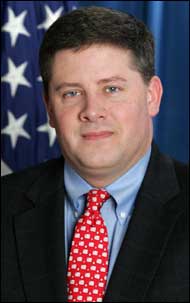
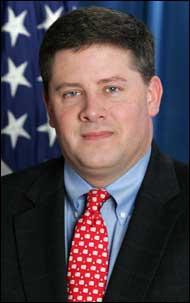
Keith Hennessey

Biography: 

Keith Hennessey was a research fellow at the Hoover Institution. His appointment ended on August 31, 2012. He is a lecturer at the Stanford Graduate School of Business. He served as director of the National Economic Council and assistant to the president for economic policy for President George W. Bush from November 2007 to January 2009. As such, he was involved in analyzing economic issues and coordinating the design of the president's economic policies, including advising President Bush on his administration’s response to the financial crisis of 2008. Before being named director of the National Economic Council, he was deputy assistant to the president and deputy director of the National Economic Council under three directors. Hennessey spent seven years as staff for two senators, most of that time as economic policy adviser to Senate majority leader Trent Lott. He recently served as a member of the Financial Crisis Inquiry Commission. He earned a BAS in mathematics and political science from Stanford and a MPP from Harvard's Kennedy School.

Filter By:

Topic

Type

Recent Commentary

Analysis and Commentary

The Congressional Budget Office vs. the President

by Keith Hennesseyvia KeithHennessey.com
Saturday, March 19, 2011

Yesterday the Congressional Budget Office released its preliminary analysis of the President’s budget proposal for FY12...

The Congressional Budget Office vs. the President

by Keith Hennesseyvia Advancing a Free Society
Saturday, March 19, 2011

Yesterday the Congressional Budget Office released its preliminary analysis of the President’s budget proposal for FY12.  Let’s compare what the President says about his budget with what CBO says.  All Presidential quotes are from his

The Schumer Maneuver

by Keith Hennesseyvia Advancing a Free Society
Thursday, March 17, 2011

Last week Senator Charles Schumer (D-NY) made news by proposing a “reset” of FY11 appropriations negotiations.  He suggested substituting savings from Medicare and Medicaid and tax increases for the cuts being negotiated in discretionary spending.

Analysis and Commentary

The Schumer maneuver

by Keith Hennesseyvia KeithHennessey.com
Wednesday, March 16, 2011

Last week Senator Charles Schumer (D-NY) made news by proposing a “reset” of FY11 appropriations negotiations...

Analysis and Commentary

A different strategy for impatient fiscal conservatives

by Keith Hennesseyvia KeithHennessey.com
Tuesday, March 15, 2011

Several conservative House and Senate Members, dissatisfied both with the spending cuts enacted so far and with repeated short-term appropriations negotiations, are threatening to oppose another Continuing Resolution. I think that’s a mistake...

A different strategy for impatient fiscal conservatives

by Keith Hennesseyvia Advancing a Free Society
Tuesday, March 15, 2011

Several conservative House and Senate Members, dissatisfied both with the spending cuts enacted so far and with repeated short-term appropriations negotiations, are threatening to oppose another Continuing Resolution.  I think that’s a mistake.

Bad cop, worse cop

by Keith Hennesseyvia Advancing a Free Society
Thursday, March 10, 2011

Speaker Boehner and Leader McConnell are effectively maximizing their leverage in the ongoing appropriations negotiation.

Looking at the Senate spending votes

by Keith Hennesseyvia Advancing a Free Society
Thursday, March 10, 2011

Yesterday the Senate voted on competing proposals for discretionary spending for the remaining seven months of Fiscal Year 2011.

Analysis and Commentary

Bad cop, worse cop

by Keith Hennesseyvia KeithHennessey.com
Thursday, March 10, 2011

Speaker Boehner and Leader McConnell do not have infinite leverage, and they will be attacked from their wing no matter the final outcome. So far they deserve praise for their tactical acumen in this negotiation...

Analysis and Commentary

Looking at the Senate spending votes

by Keith Hennesseyvia KeithHennessey.com
Thursday, March 10, 2011

Republicans offered the House-passed bill, H.R. 1. Democratic leaders supported an alternative offered by Appropriations Committee Chairman Daniel Inouye. Each proposal needed 60 votes to succeed. Both failed to get even a majority...

Pages