







Published Works by Fellows
Research from the Hoover Institution fellowship on the most pressing issues in public policy providing key insights and analysis across a broad range of issues and topics.
Featured Works
Articles
China Refocuses Its Science And Technology Ecosystem On Innovation And Security
The government of China is overhauling its science and technology (S&T) ecosystem in ways that are sharpening geostrategic rivalry and impacting the risk portfolios managed by research security professionals.
Articles
Iran’s S&T Ecosystem: A Primer For Research Security Professionals
The science and technology (S&T) ecosystem of the Islamic Republic of Iran (IRI) prioritizes research with defense applications, state control of research institutions, and circumvention of export controls and sanctions. Drawing on government documents and bibliometric datasets, this advisory provides a high-level overview of key features of that ecosystem, enhancing situational awareness of potential research security risks for the US research community.
Articles
PRC Foreign Talent Recruitment Programs Test US Research Security
In the People’s Republic of China’s (PRC), foreign talent recruitment programs are core components of a comprehensive, highly integrated toolkit for achieving state strategic goals that include global preeminence in science and technology, industrial and economic self-reliance, vibrant innovation chains, and military strength. This advisory analyzes the sophisticated foreign talent recruitment strategies the PRC pursues, the limitations of current US compliance frameworks, and the challenges evolving PRC practice poses to the US research community.
Essays
Medicare Drug Price Regulation: Small Savings, Large Innovation Losses
This essay examines the impact of the Inflation Reduction Act’s Medicare prescription drug price negotiation program. The new price controls will lead to higher launch prices, offsetting expected savings for Medicare and its enrollees. The societal costs of reduced innovation outweigh the small financial benefits to the government and Medicare recipients.
Books
Jews vs. Rome: Two Centuries of Rebellion Against the World's Mightiest Empire
A new history of two centuries of Jewish revolts against the Roman Empire, drawing on recent archeological discoveries and new scholarship by leading historian Barry Strauss.
Essays
Sanctions As A Tool Of Economic Statecraft: Designing, Integrating, And Implementing To Advance Vital Interests
When designed and implemented properly, sanctions can serve as a useful tool of economic power for achieving US foreign policy objectives.
FEATURED RESEARCH


American Federalism Today
Expert scholars and practitioners examine the relationship between the US federal and state and…

Hoover Press


A Neighborhood Between Civilizations
This work evaluates the potential of various cooperative activities to serve US interests in securing the former Soviet states of Georgia, Moldova, Armenia, Azerbaijan, and the Central Asian countries.
Learn more
China Refocuses Its Science And Technology Ecosystem On Innovation And Security
The government of China is overhauling its science and technology (S&T) ecosystem in ways that are sharpening geostrategic rivalry and impacting the risk portfolios managed by research security professionals.
Learn more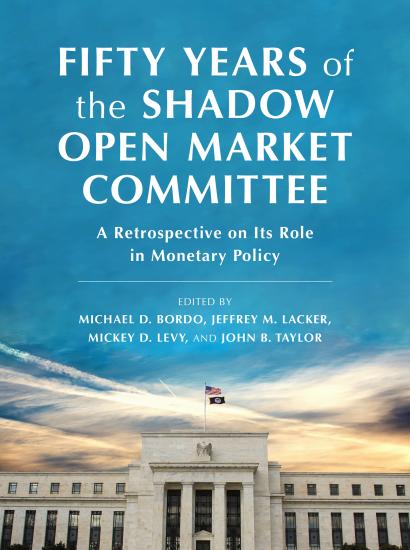
Fifty Years of the Shadow Open Market Committee: A Retrospective on Its Role in Monetary Policy
Authors examine the history and role of the Shadow Open Market Committee as a watchdog of Federal Reserve policy, focusing on the importance of transparency and rules-based monetary policy.
Learn more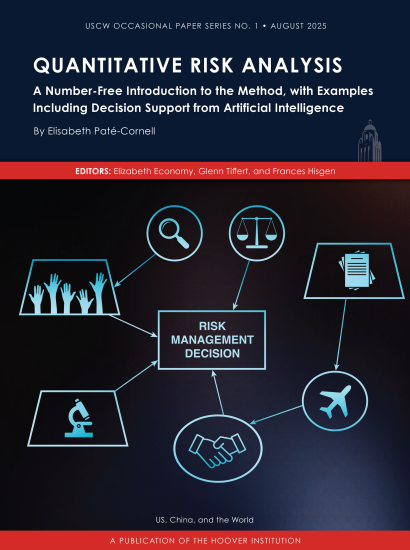
Quantitative Risk Analysis: A Number-Free Introduction to the Method, with Examples Including Decision Support from Artificial Intelligence
Sound policy decision making—especially in the US-China relationship—involves understanding risk: uncertainties and their consequences. Quantitative methods of risk analysis determine failure probabilities, forming input for rational risk management. Quantitative probabilistic analysis requires factual analysis independent of personal biases, based on known scenarios and outcomes.
Learn more
Sanctions As A Tool Of Economic Statecraft: Designing, Integrating, And Implementing To Advance Vital Interests
When designed and implemented properly, sanctions can serve as a useful tool of economic power for achieving US foreign policy objectives.
Learn more
Medicare Drug Price Regulation: Small Savings, Large Innovation Losses
This essay examines the impact of the Inflation Reduction Act’s Medicare prescription drug price negotiation program. The new price controls will lead to higher launch prices, offsetting expected savings for Medicare and its enrollees. The societal costs of reduced innovation outweigh the small financial benefits to the government and Medicare recipients.
Learn moreExplore
Edit Filters
Refine Results
Subscribe to the Books by Hoover Fellows Feed
The depth of Hoover’s scholarship is reflected in the numerous books published by our fellows on a broad variety of topics and issues. This timely and prodigious output offers insight on the most pressing issues in public policy.
